
If a terpene supplier sends you a passing lab report, what tells you that the material arriving at your loading dock is the material the lab tested?
That's the gap a certificate of analysis, or COA, needs to close. For manufacturers buying botanically derived terpenes, the report is a supplier input document. It should connect the purchased lot to a tested sample, a defined specification, and a clear approval decision.
Good cannabis lab testing starts before a sample reaches an instrument. It starts with knowing what you're buying, which tests your market requires, and how that input will move through mixing, filling, and finished-batch release.
Core Tests in Cannabis Lab Testing
A lab panel works like a home inspection checklist. An electrical inspection doesn't tell you whether the roof leaks, and a terpene profile doesn't tell you whether a blend carries pesticide residues. Each line on the report answers one question, so a pass on one line says nothing about the others.
The checklist also changes with location. U.S. states regulate a wide range of cannabis contaminants, with pesticides and solvents among the most commonly covered. There is no single national panel, so the destination market and product type decide which rows belong on yours. A blend cleared for one jurisdiction can still fall short of another's requirements.
Core analytes and what each one checks
| Test | What It Checks | Why It Matters for Terpene Buyers |
|---|---|---|
| Cannabinoid potency | Cannabinoid content by weight | Confirms the base material matches the batch record |
| Terpene profile | Identity and amount of each terpene | Confirms the blend matches its spec sheet |
| Residual solvents | Leftover extraction solvents | Flags process carryover in distillate and blends |
| Pesticides | Active pesticide ingredients | Required in several markets, including Canada |
| Heavy metals | Lead, cadmium, arsenic and mercury | Checks for contamination from inputs and processing |
| Microbial impurities | Specified bacteria, mold and yeast counts or presence | Matters for finished products, not only raw material |
| Mycotoxins | Toxins produced by mold | Checks contamination associated with mold, including storage concerns |
| Moisture and water activity | Water content and how available that water is | Affects stability and interpretation of moisture-corrected results |
| Foreign material | Physical debris in the sample | Checked by visual and microscopic inspection |
Identity tests and contaminant tests answer different questions. Potency and terpene results describe what is in the sample and how much. Contaminant panels check for substances that should stay below the applicable limits. Read the COA as a supplier input document: each passing line covers only its own analyte, only for the lot the lab received.
For flavor matching, look beyond total terpene content. Two blends can post similar totals with very different amounts of individual compounds, so compare the reported profile against your approved specification, lot by lot, before blending.
Match the panel to the manufacturing risk
Residual-solvent testing addresses process carryover. Metal and pesticide testing assess contamination tied to ingredients or production. Microbial and mycotoxin panels address different targets, so neither stands in for the other.
Moisture and water activity aren't interchangeable either. Moisture measures how much water the sample holds; water activity describes how available that water is. Ask the lab which measurement suits your sample type before booking the panel.
Use our pesticide residue testing guide when building ingredient requirements. For Canadian channels, Health Canada's pesticide-testing requirements call for representative lot or batch samples tested by an independent laboratory holding an analytical-testing licence.
Before ordering inputs or booking finished-batch analysis, write down the required analytes, methods, reporting limits, and product category. A purchase order that says only "lab tested" leaves too much unanswered.
How a Sample Moves From Batch to Lab Report
The lab can measure the material it receives. It can't repair a missing lot record or make an unrepresentative sample represent an entire production run.
Use this flow to keep the physical sample connected to its paperwork.
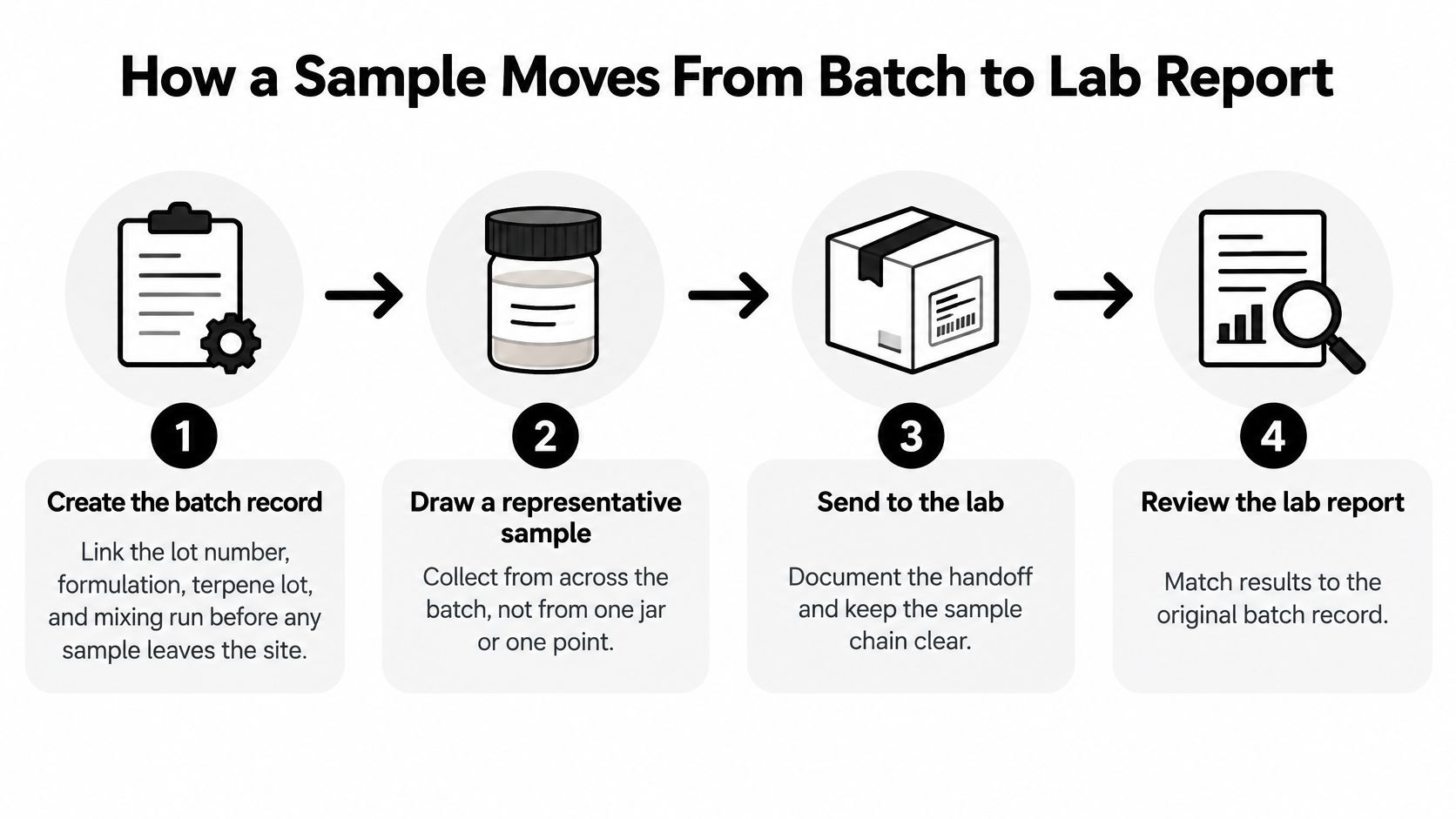
Keep the sample identifiable at every handoff
Create the batch record. Connect the formulation, incoming terpene lot, base-material lot, mixing run, and packaging lot before sampling. A copied or incomplete record can attach valid results to the wrong production batch.
Draw a representative sample. Follow the approved sampling procedure across the batch rather than selecting one convenient jar or the top layer. Poor mixing or selective collection can hide differences within the lot.
Document chain of custody. Give the sample an identifier, record collection details, seal it, and document each handoff. An unexplained transfer makes it harder to establish that the tested material is the material collected.
Prepare the sample. The laboratory homogenizes, weighs, and prepares portions for the required methods. Inadequate homogenization or insufficient material can compromise analysis or prevent completion of the panel.
Run the analysis. Laboratories use chromatography for composition and solvent testing, often paired with mass spectrometry for contaminant analysis, plus suitable metal-analysis methods. The wrong method for the sample matrix can produce unreliable recovery or interference.
Review quality control. The lab checks calibration, blanks, and spike recoveries before releasing results. Failed controls need investigation, not a report issued without explanation.
Issue the COA. Results should identify methods, units, and the applicable pass-or-fail decisions. Missing units or an incorrect sample description can make an otherwise sound result unusable for approval.
Reserve enough material before production ends
Under California's testing regulations, minimum analyzed portions include 0.5 grams for residual pesticides, 1.0 gram for microbial impurities, and 0.5 grams for mycotoxins. These aren't a total submission allowance for an entire panel.
Ask the laboratory how much material it needs for preparation, required tests, and permitted repeat work. Reserve representative retains separately, and use inventory management practices that preserve their lot identity.
Practical rule: When a result looks wrong, trace the sample backward before assuming the instrument was wrong.
Question the relevant step: collection for inconsistent composition, custody for identity concerns, preparation for unusual recovery, or report review for a unit mismatch.
Reading a Certificate of Analysis Line by Line
Start at the header, not the large pass label. Match the lot number to the receiving record, container label, and invoice before interpreting any chemistry.
Then inspect the sample ID, collection or intake details, laboratory identity, and methods. A report can be genuine yet irrelevant to the lot you're buying.
COA fields to check before approval
| COA Field | What to Confirm | Red Flag |
|---|---|---|
| Lot or batch number | Matches your receiving record and label | Lot number missing or different from the invoice |
| Sample ID and date | Sample logged, sealed and dated at intake | No intake date or sample ID |
| Lab license | Lab is licensed for the jurisdiction and test type | License not stated or cannot be verified |
| Test methods | Method named for each analyte | Methods not listed |
| Results and units | Value per analyte with units such as µg/g or µg/kg | Units missing or inconsistent without explanation |
| Detection and reporting limits | Lowest detectable and reliably reportable levels are shown | Absent results with no limit stated |
| Pass or fail status | Each required test has a result | Required test missing or marked not tested |
| Terpene section | Terpene names and amounts listed | Terpene data that doesn't match the lot |
| Signature and date | Lab signs and dates the report | Unsigned or undated report |
Read the small print beside the result
Units belong to the result. Micrograms per gram and micrograms per kilogram aren't interchangeable. Check whether composition is reported by weight and whether a moisture correction was applied before comparing reports.
Next, inspect the analyte list itself. A ProPublica investigation reported in 2026 that 49 Colorado vape products were recalled after methylene chloride contamination was identified. The state's planned rule covering that solvent hadn't yet been implemented, illustrating why panel scope matters.
For each required panel, confirm an explicit result rather than assuming an overall pass includes every test you need. Review amendments and report dates, and request the complete laboratory-issued document if you receive only a cropped summary.
Our chromatography testing guide explains the measurement approach behind composition reports. Terpene information for our products is provided by SC Labs. Match that information to the purchased lot and preserve the connection to the originating report.
A COA is useful for receiving approval only when you can establish which material it describes. A product name alone isn't enough.
Does a Passing COA Prove Safety and When to Retest
A pass is often read as a broad promise of safety. It's narrower than that: the tested sample met the applicable acceptance criteria for the listed panel. It doesn't establish that every possible contaminant was measured or that every portion of the batch has the same composition.
That distinction matters when approving botanically derived terpenes. A supplier may provide excellent identity data while leaving unanswered questions about contaminants, sample collection, or the condition of material after storage.
Understand what wasn't measured
Mandatory analytes are those your jurisdiction requires for the relevant product. Optional analytes are additional targets you choose because of the ingredient, process, supplier history, or intended application. Optional doesn't mean unimportant; it means you need to define the requirement rather than assume the standard panel includes it.
Read laboratory abbreviations carefully. Not detected means the analyte wasn't detected above the method's detection limit, not that its concentration is mathematically zero. A result below the quantitation limit means the lab can't reliably assign a precise amount at that level.
The reporting capability must suit the decision you're making. If a laboratory can't measure low enough to assess your required limit, an apparently clean result doesn't resolve compliance.
Likewise, THC-free doesn't mean contaminant-free. A botanically derived terpene blend still needs appropriate pesticide, metal, and solvent evidence. Absence of a cannabinoid isn't evidence about unrelated chemicals.
A passing result answers the questions the laboratory was asked. It doesn't answer questions that weren't included in the test order.
Examine sampling and laboratory differences
The Missouri Independent reported that one laboratory performed about 82% of Missouri's cannabis testing while reporting an Aspergillus failure rate below 0.5%, compared with 3.3% at other Missouri laboratories and a reported 3.8% national average.
Those differences warrant questions, not an automatic conclusion about any individual lot. Different sample populations, sampling practices, methods, and laboratory performance can affect observed failure rates. A low failure rate alone doesn't prove superior quality or inadequate testing.
Before relying on a supplier report, ask:
- Does the sample represent the whole lot? Review who collected it, where it came from, and whether the batch was homogeneous.
- Is the laboratory qualified for this work? Verify licensing and relevant accreditation scope, then ask how the laboratory handles quality-control failures.
- Does the report cover the exact lot you'll use? Confirm identity through receiving, storage, and transfer to production.
For a disputed result, arrange a documented split-sample comparison with qualified laboratories. Agree on methods, units, moisture basis, and acceptance criteria before comparing the reports. Otherwise, you may mistake differences in reporting conventions for differences in material.
Retest to answer a defined question
Retesting should investigate a concern, not search for a passing certificate. Hold suspect material while the responsible quality team determines the permitted investigation and disposition process.
Say an incoming blend passes its supplier specification, but the mixed distillate has an unexpected terpene profile. Check ingredient identity, weighing records, mixing uniformity, and sample preparation before deciding the supplier blend is at fault. Test the relevant material at each stage needed to isolate the problem.
Finished-form testing is especially important after combining inputs. Health Canada's good production practices guidance requires applicable microbial and chemical-contaminant testing on the final form of the cannabis, before or after packaging and labeling. An input report can support qualification without describing everything introduced during blending, filling, or packaging.
For aged stock, ask whether the proposed test addresses the suspected change. A routine terpene profile may show composition shifts, but it shouldn't be assumed to cover every oxidation product or formulation interaction.
Results that call for retesting
| Result or Situation | What It Suggests | Next Step |
|---|---|---|
| Only a supplier COA, no lot-specific report | Sample may not reflect your lot | Request a COA for your exact lot |
| Lab not named or accreditation unknown | Method and quality control unverified | Ask for license and accreditation proof, then arrange a documented split sample |
| Mold or mycotoxin flag on any lot | Possible storage or process problem | Hold the lot and request mycotoxin and microbial retesting under the applicable investigation rules |
| Terpene profile differs from spec sheet | Blend or dilution may have changed | Test the blended lot against spec before filling |
| New supplier or new blend | No history to compare against | As an internal qualification policy, run a full applicable panel on the first two lots |
| Aged or oxidized terpene stock | Composition may have shifted over time | Request a fresh terpene test before use and assess whether additional targeted testing is needed |
Keep the original result, investigation notes, and repeat results together. Approval should reflect the full record, not just the most favorable page.
Treating Terpene Blends as Controlled Inputs
A botanically derived terpene blend belongs in your controlled-material system, not on a shelf marked generic flavor. Its lot identity, approved specification, and release status should remain visible from receiving through production.
Keep the documents beside the material record, as you would for any other formulation input.
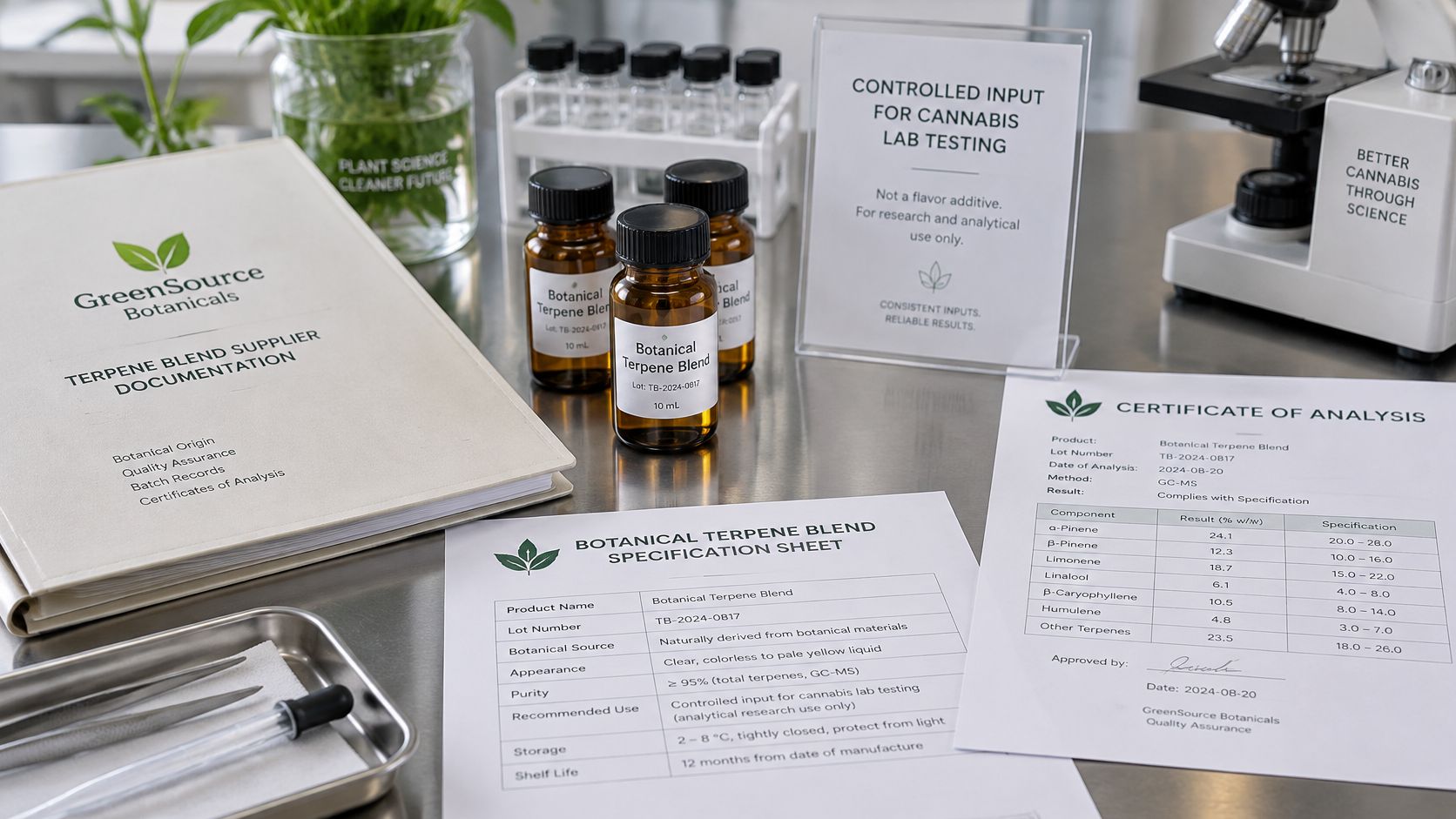
California's Department of Cannabis Control requires every batch of cannabis goods to pass laboratory testing before sale. A supplier's input COA doesn't replace required finished-batch testing.
Define the ratio before weighing
For a hypothetical bench trial, adding 0.25 g of terpene blend to 5 g of distillate is a 5% addition relative to the starting distillate weight. It is not 5% of the final blend, because the added material increases the total mass.
Write the denominator into the formula: terpene mass divided by starting-base mass for an addition rate, or terpene mass divided by total finished mass for a final concentration. Don't use an unlabeled percentage in a mixing instruction.
We offer a Mixing Calculator as a resource. Use it to check gram-to-percent conversions, then record actual weights, the calculation basis, terpene lot, mixing conditions, and operator approval. The example is a recordkeeping exercise, not a universal formulation recommendation.
Use the video alongside your written mixing procedure, not instead of an approved batch record.
Link supplier controls to production records
At Gold Coast Terpenes, all ingredients are lab tested. We trace and track the origins of our products and test them for purity and freedom from pesticides, heavy metals, and solvents. For purchasing approval, verify those controls through the lot-specific laboratory documentation rather than treating a general testing statement as a substitute.
Keep these records connected:
- Incoming material: Supplier identity, purchase record, container lot, specification, and COA.
- Production use: Formula version, actual weights, mixing run, and equipment record.
- Finished batch: Fill or packaging lot, sampling record, final COA, and release decision.
- Retained material: Storage location, quantity, condition, and the lots it represents.
Ask for the laboratory name, methods, and scope for the lot being approved. Retain enough representative material for the planned panels and investigation work, with the amount agreed with the laboratory.
Traceability check: A failed finished-batch result should lead you to specific inputs and process records, not a search through unrelated supplier emails.
Next Steps to Verify a Terpene Supplier and Order
A supplier can send a polished catalog and still leave your quality team without a defensible release decision. Buyers who define the required evidence before ordering avoid that gap. Price and flavor fit still matter, but neither resolves a missing analyte or an unidentified sample.
A staged routine keeps a promising material out of production until quality review is complete.
A practical purchasing routine
Request the exact-lot evidence. Obtain the complete COA naming the laboratory, methods, results, and the lot offered for purchase. Compare the material description with the supplier specification and your intended application.
Verify the laboratory and scope. Check the relevant licence and testing authorization, then compare the report against your market's required panel. Resolve missing methods, unsuitable reporting limits, and unclear units before accepting the material.
Test the lot before scaling. Run the offered material through your own controlled formulation at small scale. Record the addition basis, actual weights, mixing procedure, and finished-batch sample identity, then compare the measured profile with your target specification.
Approve or hold the lot. Release the material only after required finished-batch results and your internal acceptance criteria are satisfied. If the profile differs from specification, hold the lot while you investigate rather than adjusting the formula without documentation.
Make the order easy to trace
When you buy terpenes for manufacturing, include the approved specification and documentation requirements in the purchasing record. Keep commercial approval separate from quality release so receiving staff know whether the material may enter production.
Bulk orders deserve the same preparation. Bring the intended application, target flavor profile, formulation basis, destination market, and required test scope to the discussion, because clear requirements help both teams identify gaps before material ships. For wholesale purchasing, Gold Coast Terpenes offers pricing on strain orders totaling over 64oz.
A supplier who can connect the offered lot to its laboratory evidence is easier to qualify than one who sends a single generic certificate. Judge the documentation by one standard: can your quality team make a defensible release decision from it?
Gold Coast Terpenes offers strain-specific terpene profiles and isolates that are SC Lab-tested, THC-free, and legal worldwide, alongside wholesale and bulk programs for manufacturers and brands. If you want to compare profiles before committing to a larger order, the 3ml Strain Picker Pack lets you select any three different terpene profiles in 1.5ml or 3ml sizes. Visit Gold Coast Terpenes to shop the catalog, or call 929-356-6086 to discuss your formulation and documentation needs.