
Does a 90% CBG result on a certificate of analysis mean you have a cartridge base you can scale? Not on its own. Two lots can both arrive labeled CBG distillate and behave like different raw materials, one pouring thin and pale, the other sitting dark and thick, and the headline potency number won't tell you which one you're holding.
A CBG distillate is a base, not a finished product. What you do to it next (the terpene blend, the diluent, the fill temperature, the storage) decides whether the cartridge holds its flavor and its label claim. This guide walks the whole chain in order, from the federal definition to the pilot batch you run before you buy a kilo.
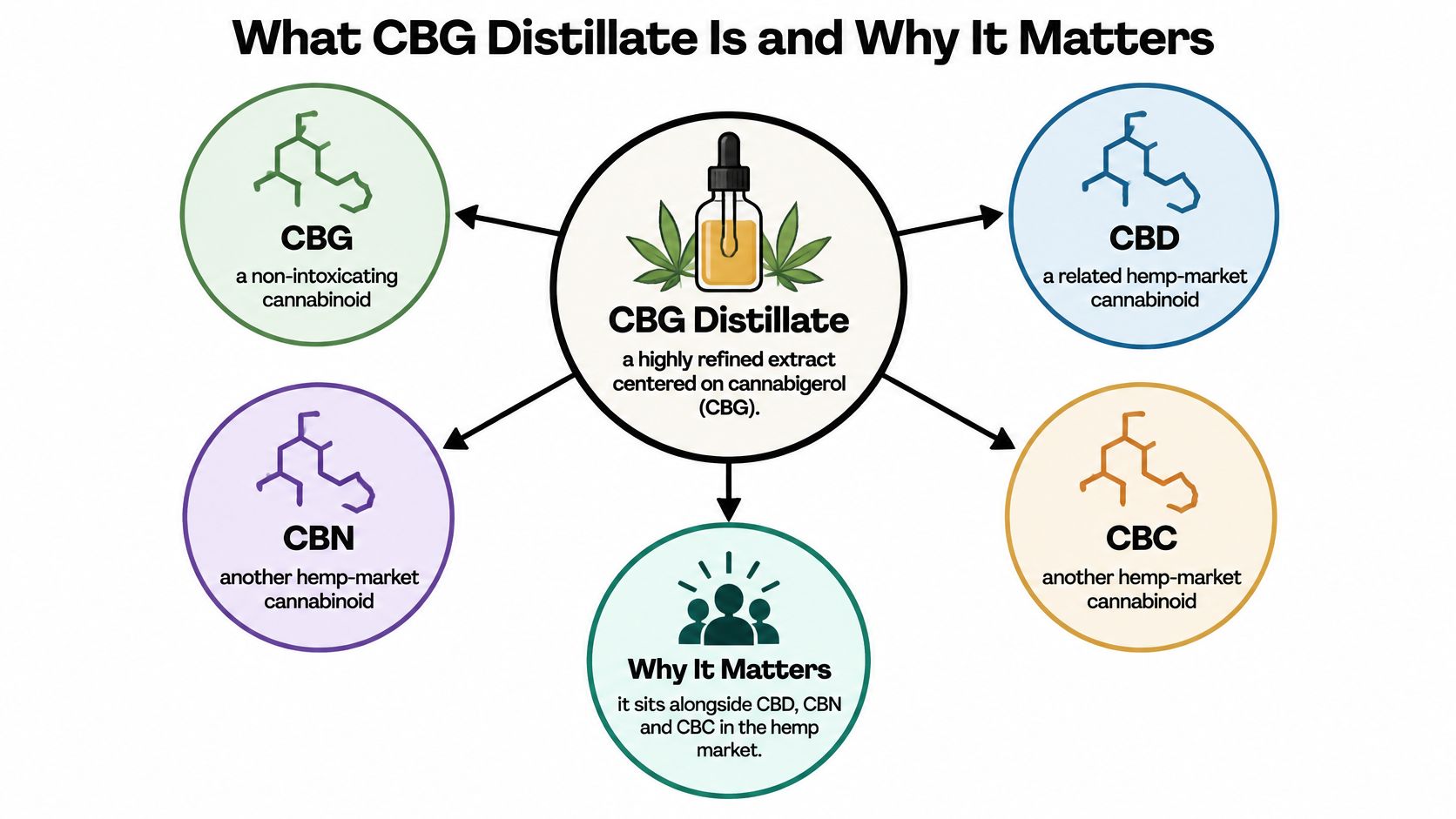
What CBG Distillate Is and Why It Matters
CBG distillate is a highly refined cannabinoid extract built around cannabigerol, a non-intoxicating cannabinoid that is gaining attention alongside CBD, CBN and CBC. The FDA's hemp overview records that framing and the federal rules sitting behind it.
Distillation is the step that concentrates and standardizes cannabinoid-rich material after extraction. That's the practical value to a buyer: you get a base you can dose against a number, instead of a raw extract whose cannabinoid ratio drifts from lot to lot.
The commercial frame started with the Agriculture Improvement Act of 2018, the law commonly called the 2018 Farm Bill. Signed on December 20, 2018, it removed hemp and qualifying hemp derivatives from the federal Controlled Substances Act, as long as the material holds no more than 0.3% delta-9 THC by dry weight. The statutory definition is deliberately broad, covering plants, derivatives, extracts, cannabinoids, isomers, acids, salts and salts of isomers.
The federal line: hemp-derived CBG counts as hemp only while delta-9 THC stays at or below 0.3% by dry weight. Above that, the material drops out of the hemp category entirely.
One caveat matters to anyone building a product line. The law did not clear CBG products for any use. The FDA kept its authority under the Federal Food, Drug, and Cosmetic Act and the Public Health Service Act, so safety, manufacturing, labeling, marketing and intended use all remain regulated.
So treat the distillate as a base. Before it becomes a product it usually needs botanically derived terpenes for flavor, a diluent to reach a workable viscosity, and documented testing on the lot you bought. Three terms carry the rest of this guide: the distillate (your cannabinoid base), the terpene blend (the flavor and aroma component), and the certificate of analysis (the lab report tied to one batch). If you want the longer definition of the base itself, our explainer on what a distillate is covers where it sits among extract types.
How CBG Distillate Is Made and Purified
CBG distillate begins as crude hemp extract, and every stage after that removes something your cartridge doesn't want. The order is fixed because each step depends on the one before it.
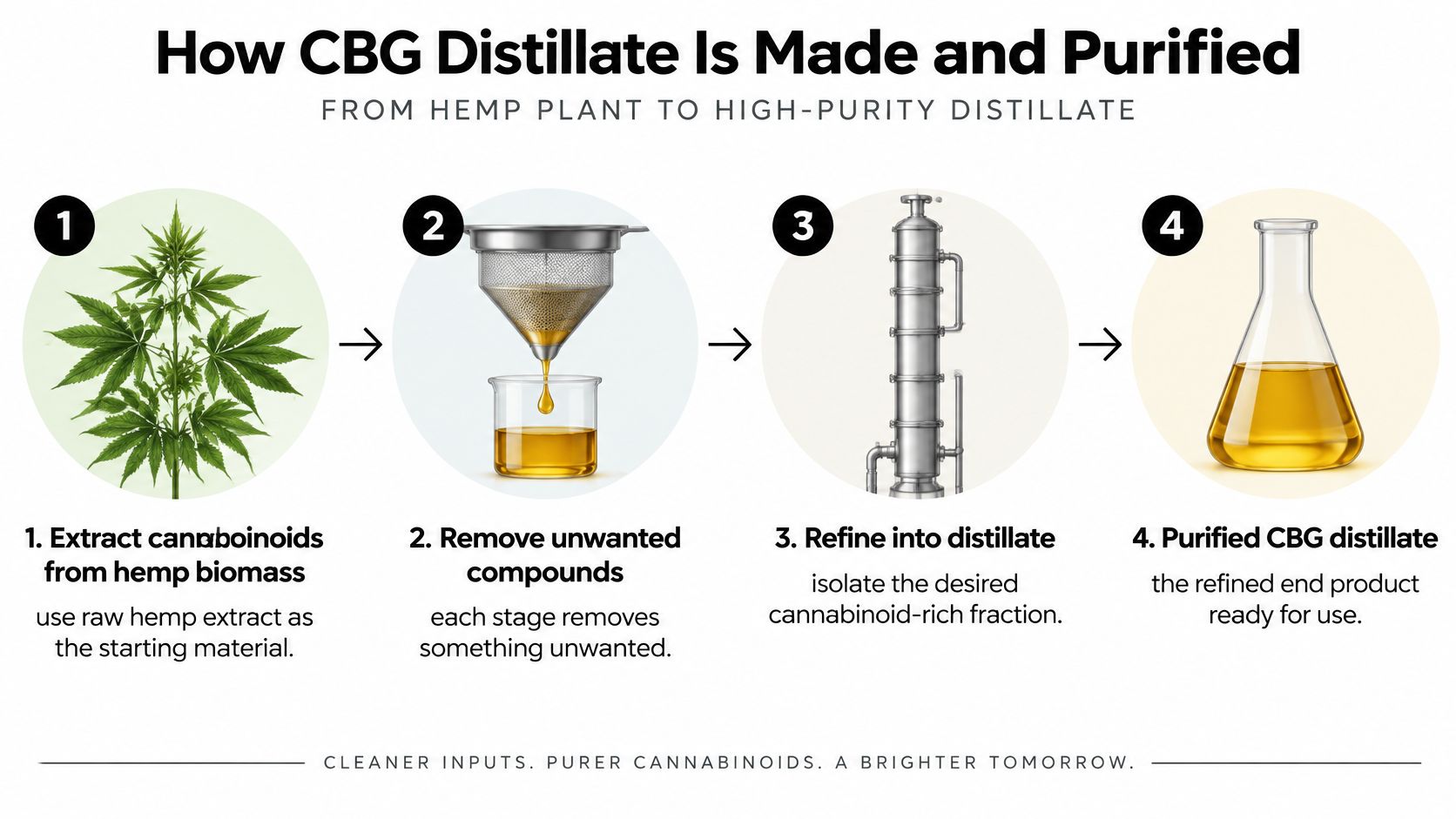
- Extract cannabinoids from hemp biomass. Ethanol or CO2 pulls cannabinoids out of the plant, and the method decides which compounds ride along into the crude extract. Get it in writing, because no downstream step fully fixes a crude profile you didn't specify.
- Winterize the crude extract. Chilling the extract in ethanol and filtering out waxes and plant fats keeps the finished oil from clouding or separating in a cart.
- Distill under vacuum. Heat under reduced pressure separates cannabinoids by boiling range. Lower pressure lets you run the separation at a temperature that limits thermal damage to the material.
- Run chromatographic purification when CBG has to sit high. Matrix removal and peak recycling push CBG past what plain distillation reaches, at a cost in throughput and yield.
- Test each lot before release. A validated HPLC method that quantifies CBG, CBGA, CBD, THC and the relevant minor cannabinoids, alongside residual solvents and heavy metals, is the release gate. Skip it and every downstream ratio you calculate is guesswork.
Why purity figures spread so wide
A preparative purification study from Knauer shows the range in plain numbers. An initial CBG-rich extract measured approximately 81% CBG. An ethanol-based, two-stage process combining matrix removal and peak recycling produced a purified fraction reported at 100% CBG under the stated analytical conditions. A simulated-moving-bed method raised CBG purity by 38 percentage points to approximately 80% while eliminating reported CBD and THC, and a later purification reached a 97% CBG fraction. Same molecule at the start, three different endpoints, and the gap comes down to equipment and how many passes you pay for.
Column chromatography is easier to picture once you've watched a system run. This walkthrough shows the hardware in motion:
True distillate or enriched fraction
Those two routes don't hand you the same material. A true distillate and a chromatographically enriched fraction can differ in viscosity, color and cannabinoid ratio, which changes how the base wicks, how much diluent it needs, and how the terpenes read in the finished cart. Ask which route produced the lot before you write a fill specification around it, and have the certificate state the assay basis, the detection limits, and whether percentages are reported by mass or by area normalization.
CBG Distillate Compared With Other Cannabinoid Distillates
Three quotes land on your desk: one CBG, one CBD, one CBN, all priced per kilo. The price gap is obvious. The spec gap is not, and that gap is where the decision sits. Use the table below as a lookup while you weigh those quotes. The purity column describes typical market patterns, not a guarantee on any single lot, because only the lot's own certificate carries that weight.
| Distillate | Main cannabinoid | Purity evidence in research | Key test to request | Stability concern |
|---|---|---|---|---|
| CBG distillate | CBG | Purified fractions reported at 97% to 100% CBG | HPLC for CBG, CBGA, CBD and THC | Peroxide-driven breakdown of CBG |
| CBD distillate | CBD | High-purity lots are the commercial norm, so supplier differences show up in minor cannabinoids and residuals | HPLC for CBD and THC, plus residual solvents | Light, heat and oxygen exposure, the standard handling risks |
| CBN distillate | CBN | Smaller-volume lots with less published purity benchmarking than CBD | HPLC for CBN and THC, plus residual solvents | Same baseline handling risks, so ask for stability data on the lot |
CBG starts from a different position than the other two. It is a minor cannabinoid, showing up at lower concentrations in ordinary cannabis varieties than THC or CBD, as the FDA testimony on hemp production and the 2018 Farm Bill lays out. Scarcer starting material means every point of final purity has to be earned during processing, so the spread between a mediocre CBG lot and a clean one tends to run wider than the spread between two CBD lots.
The paperwork gap is just as real. A 2025 Scientific Reports analysis of cannabis flower and concentrate products found that 84% did not report label values for minor cannabinoids including CBG. A CBG name on a jar or a spec sheet is a starting claim; the certificate is where that claim gets checked.
What the CBG label doesn't tell you
A headline potency number never shows how clean the separation was. You also need CBGA, because leftover acid means the material was not fully converted, plus CBD and THC, the cannabinoids most likely to ride along and the ones regulators check first. Two lots can both read high on CBG and still carry very different minor-cannabinoid profiles, and that difference decides how the oil pours, wicks and tastes in a finished cart.
When you line the quotes up, run the same four questions against each one:
- Target cannabinoid: which compound the product stars.
- Purity needed: whether the base is the whole formulation or a minor addition.
- Testing package: the panels you require on every lot, not once.
- How the base gets used: cart, edible, topical or bulk resale, since each carries its own spec.
Answer those four, and the comparison stops being about price per kilo. A lot that passes on paper earns a pilot batch; a lot with thin paperwork gets sent back for the missing panels before it earns anything.
How to Add Terpenes to CBG Distillate
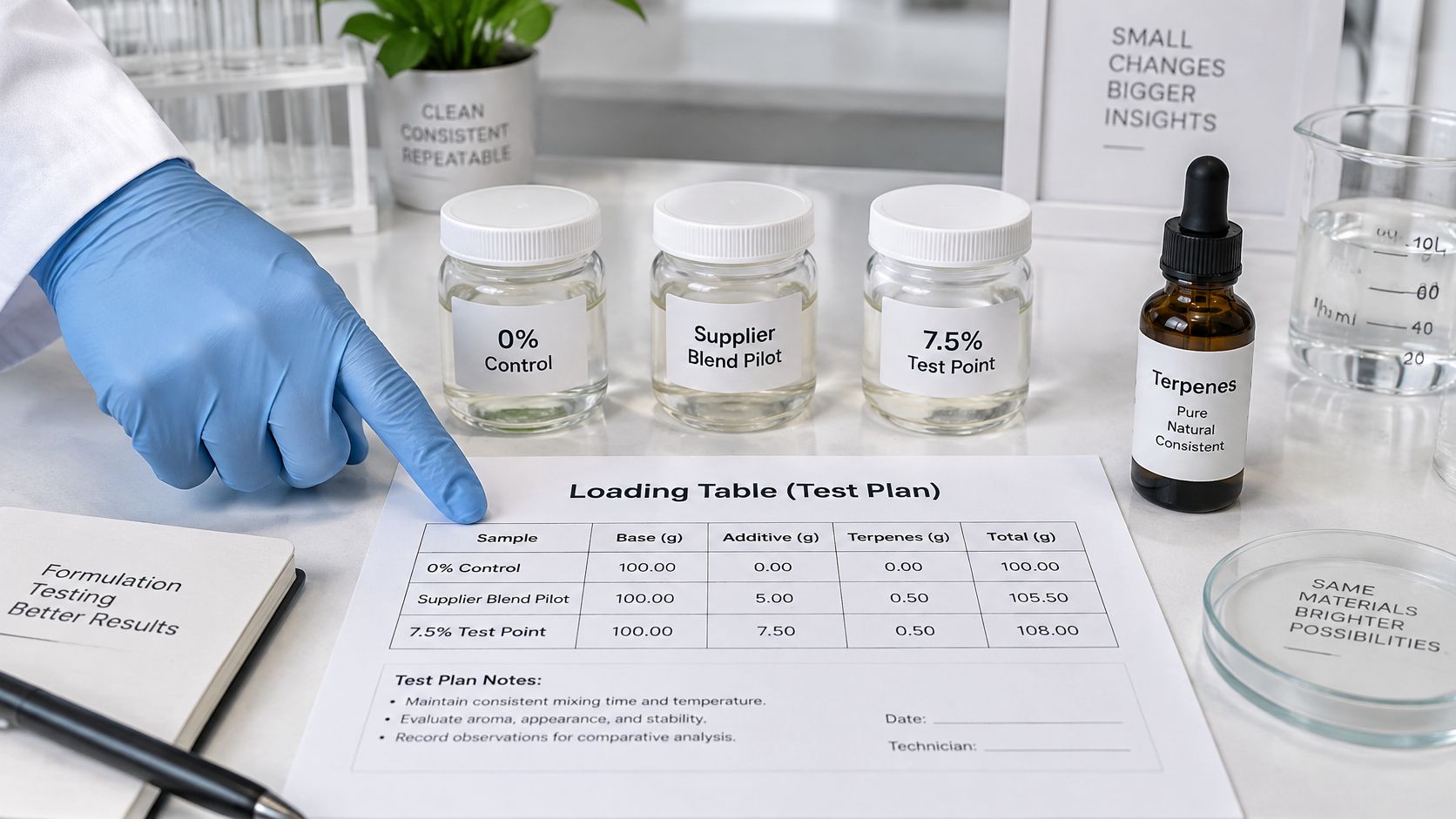
Set the test plan before you open a bottle of blend. The load table below gives you four points to run in order, and the top one exists to find the failure point, not to become your production ratio.
| Batch type | Terpene load by weight | What to record | Purpose |
|---|---|---|---|
| Unflavored control | 0% | Viscosity, color and potency baseline | Shows the distillate's own character |
| Native terpene level | 0% added, measure what survives distillation | Residual aroma, flavor and homogeneity | Reference for what the distillate keeps on its own |
| Lower pilot batch | 1% to 3% | Flavor match, mixing time and cart draw | Starting point for flavor matching |
| Upper test point | 7.5% | Flavor intensity, homogeneity and cart performance | Stress test used in a University of California study |
That upper point comes from real testing. A University of California study supported by the California Department of Cannabis Control added terpenes to distillate at 7.5% by weight against a 0% control to examine how terpene formulation changes aerosol emissions, per the California Department of Cannabis Control report. The study used a defined commercial terpene mixture rather than treating "terpenes" as one ingredient, which is exactly why each botanically derived blend deserves its own trial.
The pilot sequence
- Read the certificate before you weigh anything. Confirm the CBG percentage and the THC result for the exact lot in front of you. Using last month's certificate is the most common shortcut, and it throws off every ratio that follows.
- Pick one blend by flavor target. Citrus, fuel or dessert notes each pull a formulation in a different direction. Our blends are extracted from fresh plants and are free of mixtures, chemicals and additives, and the Mixing Calculator on our site handles the arithmetic once you know your batch weight. Run one blend per trial so you know what caused the result.
- Weigh terpenes against total batch weight, not the distillate alone. If you add a diluent, it counts. Forgetting it overdoses the terpenes and makes the batch harsher than the trial predicted.
- Mix gently until uniform. Low shear, short duration, no heat that drives off the volatiles you just paid for. High-speed mixing whips air into the oil and oxidizes the aroma.
- Check homogeneity and color. Pull a small sample from the top and the bottom. If they differ, you have a mixing problem, not a flavor problem.
- Test cart draw and flavor before you scale. Fill two or three units, let them sit, then judge. Scaling on flavor alone is how a good bench sample becomes a clogging production run.
Log every trial on one worksheet: mass of CBG distillate, the laboratory CBG percentage, final batch size, blend identity and addition rate. That single sheet gives you traceability, label review and a repeatable starting point for the next lot. Start low, record everything, and climb only when flavor and cart performance both demand it. For the ratio math and mixing order in more detail, our guide on how to mix distillate with terpenes walks through the sequence step by step.
Storage, Stability and COA Checks for Cartridge Oils
CBG behaves differently from its neighbors once oxygen is in the room. Forced-degradation research found pronounced CBG instability under peroxide-mediated stress, unlike CBD and CBN, and the authors linked it to accessible double bonds in CBG's side chain that act as reactive oxidation sites, as reported in this study on CBG degradation.
That finding lands directly on cartridge oils. Oxygen exposure, peroxide-containing contaminants, high temperature and light can pull potency down and reshape the chemical profile even when the batch passed assay on release day.
Practical rule: if a cart will sit on a shelf for months, the air in the headspace is part of the formulation, not a packaging afterthought.
Keep headspace small, choose packaging that limits oxygen and light, and screen carrier materials for contamination or existing oxidation before they go near the batch. Then build a stability schedule instead of hoping: assay CBG potency and degradation products at release, 1, 3, 6 and 12 months, under both ambient and higher-temperature storage. Treat any terpene-added batch as a complete formulation, because terpene oxidation products and dissolved oxygen change the degradation environment rather than sitting inert inside it. Our guide on how to prevent oxidation covers the handling side in more detail.
The certificate checklist
- Assay basis and detection limits, so you know what the percentage measures.
- Reporting method: mass basis or area normalization, stated plainly.
- CBGA, CBD and THC results on the same lot.
- Residual solvents and heavy metals at or below your spec.
- Microbes and pesticides, not assumed from a potency panel.
- Homogeneity, appearance and viscosity, the physical facts a potency number can't carry.
Terpene information for our products comes from SC Labs, which is the document to file next to the distillate certificate rather than somewhere in a folder nobody opens. A high CBG result on its own still doesn't prove clean processing, uniform material or suitability for inhalation, and that gap is where recalls get born.
Compliance Checks by Market Before You Buy
The federal 0.3% delta-9 THC limit is the floor, not the whole rulebook. Each state adds its own requirements for labeling, testing, licensing and product limits, and your purchasing spec has to reflect every market you ship into.
| Market | Rule or limit | What buyers should check |
|---|---|---|
| Federal (U.S.) | Delta-9 THC at or below 0.3% by dry weight | Certificate showing THC result and lot number |
| Minnesota (edible example) | Up to 100 mg CBG in a lower-potency hemp edible; 400 mg combined ceiling with CBD, CBN and CBC | CBG per finished serving; use as a calculation example since the rule covers edibles |
| New Mexico | Harvest certificate or equivalent showing 0.30% THC or less, dry weight | Source documents on file before blending |
| New York | Distillate, isolate and full spectrum labels must meet defined rules; hemp extract THC at or below 0.3%; in-state manufacturing must be licensed | Whether the material is an intermediate extract or a finished product |
| Maryland | Pesticides, residual solvents, microbes and heavy metals tested at multiple storage intervals | Contaminant reports at each interval |
Minnesota's numbers come from the state's hemp business guide, and the edible framing is the point: the buyer has to calculate CBG per serving, not per gram of bulk material. New Mexico's hemp facility rules put the harvest documentation burden on you before anything reaches a mixing vessel, and they restrict semi-synthetic or synthetic cannabinoids unless a stated exception applies.
New York goes further on naming. Its cannabinoid-hemp guidance for licensees requires products described as distillate, isolate, full spectrum or broad spectrum to meet the applicable regulatory definitions and Part 114, caps hemp extract at 0.3% total delta-9 THC, requires licensing for extraction or manufacturing in the state, and states that hemp extract must be made into a cannabinoid-hemp product before retail sale rather than sold directly to consumers. Your product name is a compliance decision, not marketing copy.
Maryland's technical authority framework lists pesticides, residual solvents, microbiological impurities and heavy metals as core contaminant categories and requires samples across multiple storage intervals, which is the same logic as a stability program. Our regulatory compliance checklist is the companion piece for keeping that paperwork in order market by market.
One state's ceiling is a planning input, not a national rule.
Keep one file per lot: certificate, source documents, lot number, terpene blend identity and addition rate. That file is what lets a reviewer place your finished cart in the right category for each market, and it's what you'll reach for when a distributor asks a question two months after the fill.
Confirm Your Compliance and Order a Sample
Run the sequence in this order and the testing budget gets spent once instead of twice.
- Map every market you plan to sell into using the table above, and note which rules apply to edibles versus inhalables versus bulk intermediates.
- Request the paperwork for the exact lot from each supplier, checked against the certificate items covered in the stability section.
- Order a small pilot of one botanically derived blend and run the load points from the terpene section, recording viscosity, flavor and cart draw for each batch.
- Scale only after the pilot clears both stability and compliance review.
For supplier selection, favor partners who document every lot without being chased and say plainly whether their CBG material is an intermediate extract or a finished product. We run programs for distro, shops and independent reps, affiliates, and manufacturers and brands, so there is a route whether you are filling carts or supplying the people who do. Orders above $100 ship free, and the Mixing Calculator on the site helps you set an addition rate before the first pilot run.
Keep the terpenes in their lane. They add flavor and aroma to the base. The finished cartridge still carries its own compliance review in every market you ship into.
Gold Coast Terpenes supplies botanically derived terpene blends and isolates for CBG distillate work, with SC Lab-tested documentation so the flavor decision and the paper trail move together. Start with a small pilot order, run the load points in your own base, and compare the unflavored control against the flavored batch before you commit to a fill. Visit Gold Coast Terpenes to shop blends and isolates, call 929-356-6086 with a formulation question, or ask about the wholesale, bulk and affiliate programs.