
A strain name on a work order is not a formula. In a 2017 peer-reviewed analysis of 233 cannabis samples from 30 cultivars at one California medical dispensary, seven samples labeled Trainwreck showed terpinolene as the lead terpene at an average of 9.6 mg/g, with myrcene next at 3.7 mg/g, as summarized in the Entour account of that analysis. Terpinolene sat about 2.6 times above myrcene. That gap is a useful starting map for a Trainwreck terpene profile, and it is still only a snapshot of one market.
Treat the name as a family of related cuts. Your job is a target range, a lot check, and a small fruit-accent test when a batch smells sweeter than the pine you expected.
Trainwreck Terpene Profile Numbers at a Glance
The lab did not guess from smell. Concentrations were measured by gas chromatography with flame-ionization detection, and the peaks were confirmed by gas chromatography mass spectrometry.
The same seven-sample set also reported limonene at 3.4 mg/g, trans-ocimene at 2.6 mg/g, beta-pinene and caryophyllene at 1.5 mg/g each, and alpha-pinene at 0.9 mg/g. Read the ranking as roles in a blend, not as a perfume story.
| Terpene | Average (mg/g) | Aroma direction | Role in a blend |
|---|---|---|---|
| Terpinolene | 9.6 | Bright pine, floral, herbal | Lead identity marker |
| Myrcene | 3.7 | Earthy, warm, herbal | Body and warmth |
| Limonene | 3.4 | Citrus, bright | Top-note lift |
| Trans-ocimene | 2.6 | Sweet, floral | Floral lift |
| Beta-pinene | 1.5 | Pine, woody | Pine backbone |
| Beta-caryophyllene | 1.5 | Spicy, woody | Spice depth |
| Alpha-pinene | 0.9 | Sharp pine | Pine edge |
Seven plants from one dispensary and one market are a cultivar snapshot, not a universal specification. Genetics, grow conditions, harvest timing, storage, and the lab method can all move these levels.
How a product team should use the ranking
Use terpinolene as the identity marker, then balance it with myrcene, limonene, ocimene, the pinenes, and caryophyllene so the blend still reads as Trainwreck-style. Lock that order into your spec as a starting target. On the next lot, compare your certificate to this table before you scale a cartridge fill. If the lead flips, you are holding a different expression, and the strain name alone will not catch it.
Lead Terpene Chemistry Versus What You Smell
Think of a band. You notice the singer first, then the players behind the singer fill the sound. In this profile, terpinolene is the singer that sets the identity. Myrcene, limonene, ocimene, the pinenes, and caryophyllene are the backing parts. They add warmth, citrus, floral lift, pine, and spice.
A terpene level is a chemical measurement. Aroma is what a person perceives. The two track each other, and they are not the same thing. The same milligrams can read brighter or duller based on what sits next to them. A list of numbers cannot predict the finished smell by itself. Our guide to what terpenes smell like is a useful companion when you translate a certificate into a sensory note.
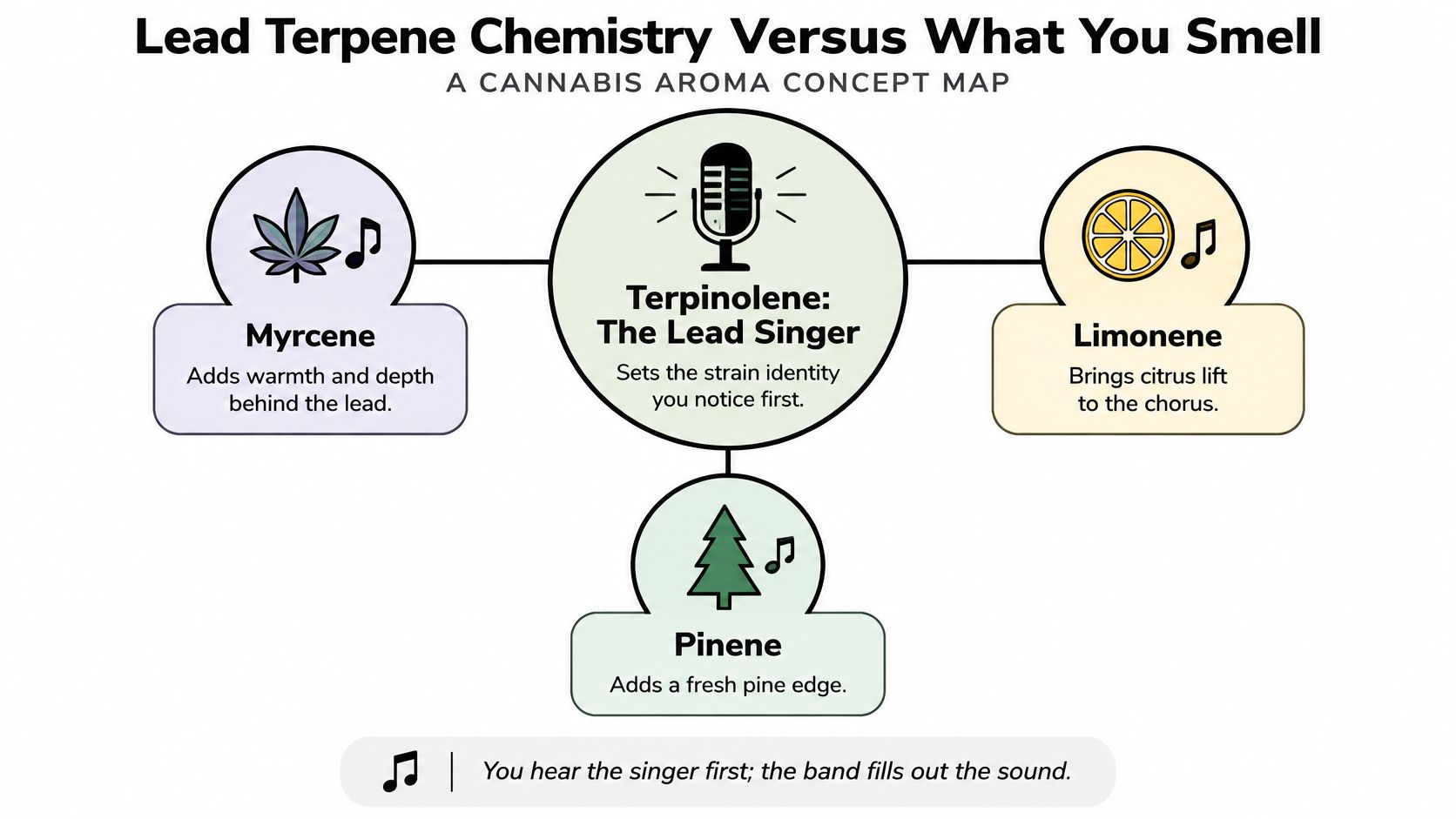
A three-step read for any lot
Trainwreck names a family of cuts, so the same label can hide different balances. This read works on any certificate, not only on that seven-sample set.
- Find the lead. Confirm the largest value on the certificate is the terpene you specified.
- Check two or three supporters. See whether their ratio to the lead sits inside your written range.
- Match smell to the sheet. If the note says pine and the panel smells fruit or earth, flag the lot for a sensory check before you blend.
Practical rule: If the lead on the certificate is not the lead in your spec, stop the fill and retest. Do not "fix" it by adding more of the missing note on the line.
Why Trainwreck Batches Do Not Match Each Other
A Trainwreck terpene profile is not one fixed formula. Peer-reviewed chemotaxonomic work places Trainwreck in a terpinolene-associated group and separates it from Jack Herer by myrcene and limonene levels, as described in this chemotaxonomy paper. Profiles shift with genetics, cultivation, extraction, formulation, and storage, and lab methods themselves can disagree across products.
Published strain pages often print a neat ranking and skip the cut, the harvest, the matrix, and the method. That ranking is only as solid as its source. Order by the strain name alone and the drum can come back as either chemotype below.
| Scenario | Lead terpene | Supporting terpenes | Sensory direction | Formulation note |
|---|---|---|---|---|
| Terpinolene-forward | Terpinolene | Myrcene, limonene, ocimene, pinenes | Bright pine, floral, citrus | Hold the lead terpene steady and match pine lift first |
| Myrcene-forward | Myrcene | Terpinolene, caryophyllene, limonene | Earthy, warmer, herbal | Raise myrcene and caryophyllene and keep citrus as a lift |
| Unverified cut | Not named on the sheet | Not listed | Unknown until a panel smells it | Test the lot before using the strain name |
What actually moves the numbers
Work backward from the certificate. Phenotype and grow conditions change the plant itself. Harvest timing, drying, and storage decide which volatiles survive into the oil. Extraction and the test method then decide what the certificate reports. How environmental factors change flavor is the production variable your spec has to absorb.
So write the target before you buy. Name the lead terpene, set supporter ranges, and pick the sensory result you will accept. Then check every batch against that sheet.
Pine lift or earthy warmth is the decision that sets the lead. Pick one before the purchase order goes out. A customizable blend built from fresh-plant terpene extracts, free of additives, can hold that choice steady when the crop does not.
Why Some Trainwreck Blends Smell Fruity
A certificate of analysis works like a nutrition label. It lists the ingredients above a reporting threshold and leaves out the trace compounds that a human nose can still catch. That gap explains why some Trainwreck samples smell mildly fruity or cherry-like while the headline terpenes read as piney and herbal.
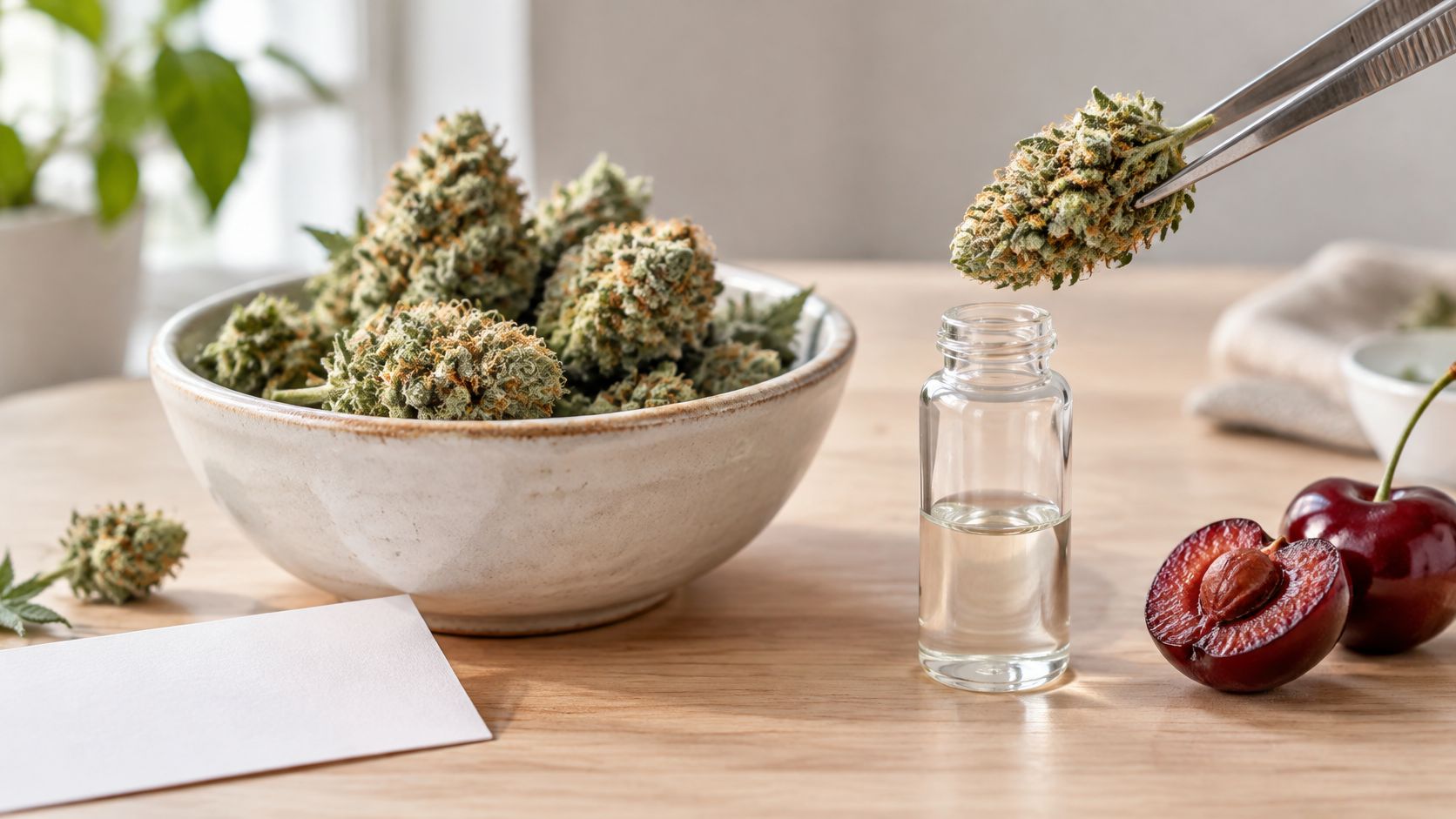
A peer-reviewed aroma study found that a minor non-terpenoid compound, cherry propanol, measured 0.739 micrograms per milligram in Trainwreck versus an average of 0.016 micrograms per milligram in other samples, about 46 times higher. Researchers suggested that this compound, together with the terpene set, may add to perceived sweetness or fruitiness. One trace molecule at a low concentration can carry real weight in a blend, the same way a pinch of salt changes a whole pot of soup.
Oxidation, extraction conditions, and storage also shift what a panel smells even when the big terpenes look similar on paper. More terpinolene will not erase a fruity note, and it will not create one either.
A small fruit-accent test
Run two bench samples before committing a full tank.
- Backbone only: Blend the lead terpene and supporters with no fruit accent. This is the control every accent gets judged against.
- Backbone plus a small fruit accent: Add a controlled cherry or fruit note on top of the same backbone, keeping the backbone ratio identical so the only variable is the accent.
- Panel both against the target aroma. Keep the accent only if the panel prefers that sweetness, and record the accent level so the next batch can repeat it.
A fruit accent is a flavor choice layered on a sound backbone, not a patch for a weak terpene base. The study reports on aroma, not on any effect of the profile on the body, so keep the panel discussion on smell and taste.
How to Build a Trainwreck-Style Blend
Screen terpene load by mass. A reported 2025 ACS study, covered in our note on terpenes for vape formulations, tested additions of 0%, 7.5%, and 15% by mass in cannabinoid distillates. The oil in that test was rich in limonene, beta-caryophyllene, and beta-myrcene. It was not a Trainwreck-specific blend. Use those three loads as a method, not as your target recipe.
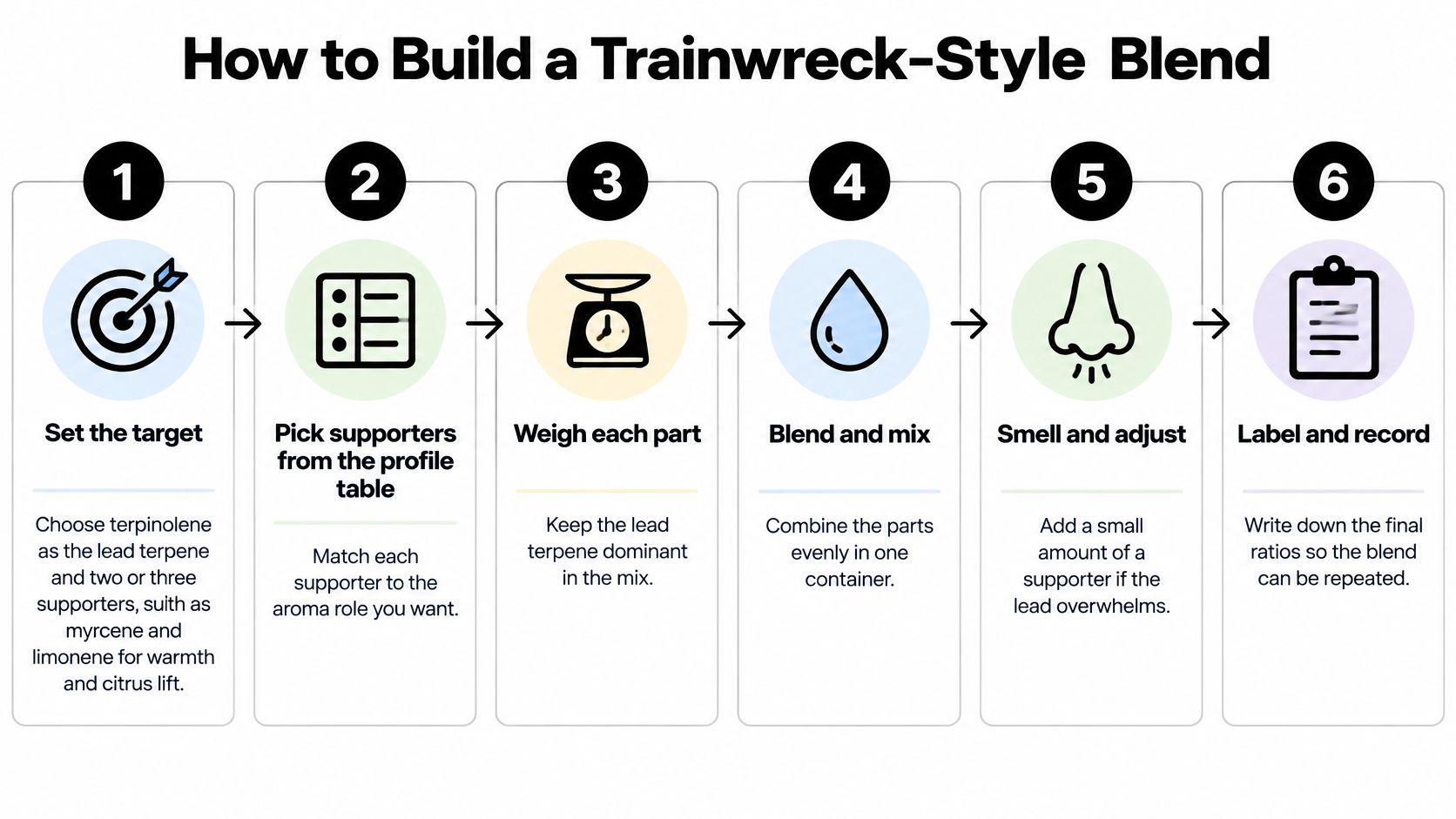
Six steps on the bench
- Set the target. Choose terpinolene as the lead and two or three supporters, such as myrcene for warmth and limonene for citrus. Write the ratio before you open a bottle.
- Choose the load. Make three jars of base distillate at 0%, 7.5%, and 15% terpene by mass. The zero jar shows the base. The middle jar is the likely production candidate. The high jar shows what "more" does.
- Convert percent to grams. At 7.5%, a 1 kg batch needs 75 g of terpene. Weigh it. Do not dose by eye. Our Mixing Calculator and Terpenes 101 pages are there for that math.
- Blend supporters first, then the lead. Mix myrcene, limonene, and any ocimene or pinene until the pre-blend is even. Add terpinolene last so the identity marker is not stuck on the wall of the beaker. The sequence in mixing terpene strains matches this order.
- Dose into winterized distillate. Add the pre-blend and mix until the oil is uniform, with no streaks and no hot spots of neat terpene.
- Check aroma, viscosity, and heated emissions at each load. Approve the lowest load that hits the sensory target.
At the 15% load, carbonyl emissions in that study rose by as much as ninefold. More terpene is not automatically better. Log every run with loads, lot numbers, viscosity, smell notes, and emission results so the next batch can be matched instead of reinvented.
Confirm the Profile Before You Buy or Blend
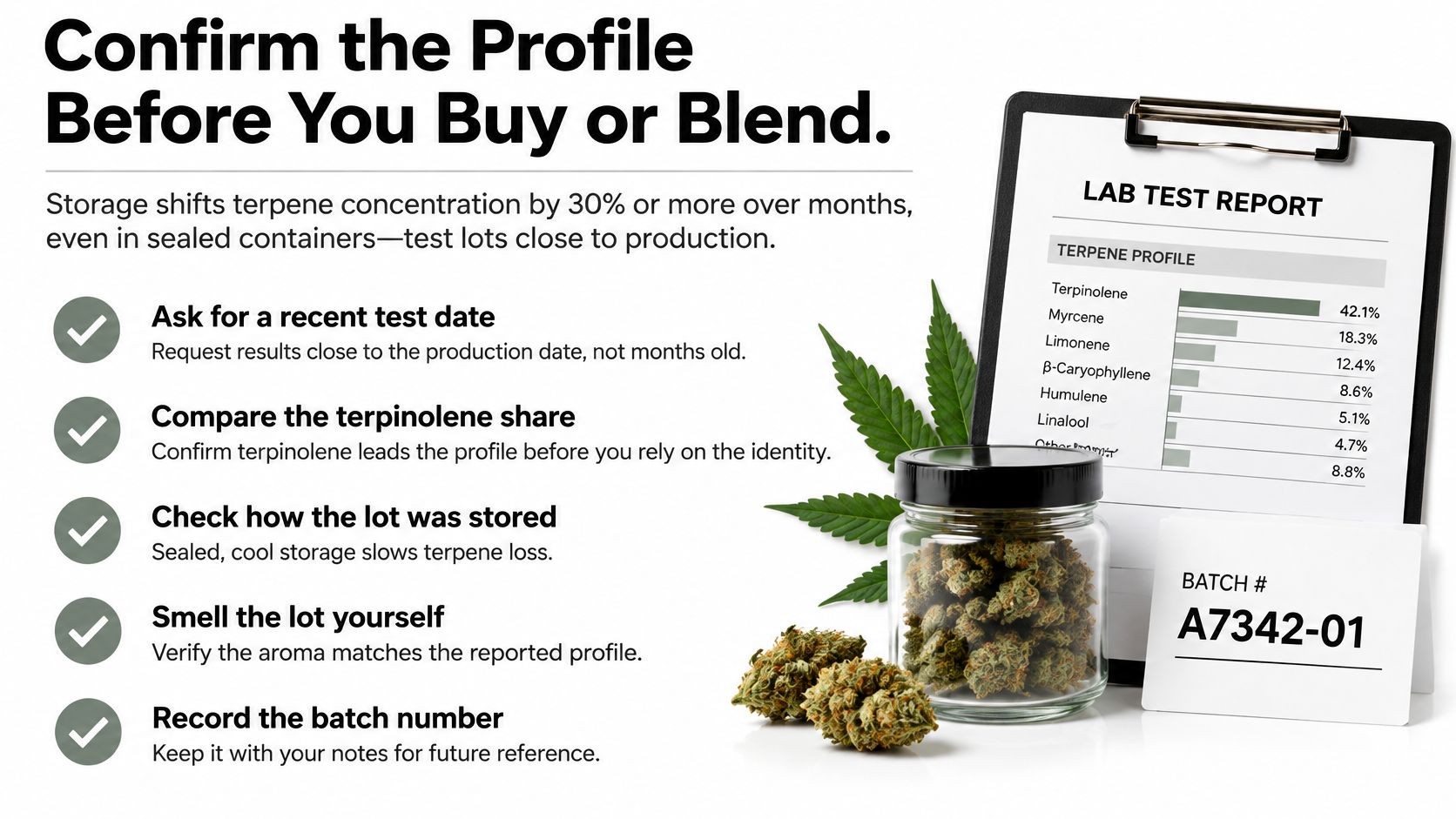
A blend that leaves the mixer on target can still drift before it reaches a filling line. Terpene concentrations shift over months of storage, even in sealed containers, and Trainwreck makes this harder to manage because reported lots already split between terpinolene-forward and myrcene-forward patterns. Phenotype, harvest timing, drying, and storage each move the result. Test close to the production date, keep stock cool and sealed, and treat any old certificate as a starting point rather than proof.
Supplier paperwork matters as much as the ratio on your whiteboard. Gold Coast Terpenes supplies terpene profiles and isolates with terpene information provided by SC Labs, its cartridge terpenes are SC Lab-tested, and the site maintains a Terpene Safety and Documents page. Whatever the source, ask for written numbers before you commit a lot to a fill.
What to request on every order
- A current certificate of analysis for that lot, not a generic strain sheet.
- Accepted lot-to-lot ranges for the lead terpene and each supporter.
- A written terpene specification that names the chemotype you want, not only the strain name.
Read each certificate the same way every time: the measured value for every terpene, the test date, and whether the lot falls inside your ranges. If you need a method for that read, start with how to test for terpenes. Smell the lot itself too. Minor volatiles can push a batch toward fruit even when the lead terpene numbers match. A lot that misses the lead or drops a supporter below its floor gets rejected or reworked, because a strain name on an invoice is no guarantee of what is in the drum.
Once your targets are on paper, the buying step is straightforward. Set your lead and supporter ranges, then visit Gold Coast Terpenes to shop terpene profiles and isolates or ask about bulk orders for production runs. Scale only after the incoming lot passes your aroma, viscosity, and emissions checks.