
Only 62.5% of Tangie-labeled samples in a dataset covering 89,923 commercial flower samples from six U.S. states fell into the same broad terpene group, according to a comparison of strain chemistry built on that dataset. For a buyer, that means close to four in ten products sold under one of the most recognizable citrus names in the catalog carried a chemistry that didn't match the rest of the family.
That gap is the sourcing problem. Writing "Tangie" on a batch sheet describes an aroma, not a formula. What gets weighed into a distillate run is a set of percentages: limonene for the tangerine note, myrcene for body, a little pinene for lift, caryophyllene for weight.
A working Tangie spec has three parts. A target ratio taken from a real certificate of analysis. A sensory match against a retained reference, judged at the concentration your customer will taste. A recorded load, so the next lot is dosed to a number instead of a word.
One boundary up front, because it shapes every decision that follows. Terpene data describes aroma and flavor. It doesn't predict a clinical or psychoactive outcome, and no percentage here should be read as a health claim.
Tangie Terpene Profile Core Terpenes
Seven compounds do nearly all the work in a Tangie blend. The table below sets out what each one contributes and how reliably it shows up in measured samples.
| Terpene | Aroma Note | Role in a Tangie Blend | How Consistently It Appears |
|---|---|---|---|
| Limonene | Bright citrus, orange peel | Leads the citrus top note | Present in nearly all samples |
| Myrcene | Musky, earthy, fruity | Adds earthy body | Present, share varies by batch |
| Alpha-pinene | Sharp pine resin | Adds lift and freshness | Strong in some samples |
| Beta-pinene | Fresh pine, green herbal | Adds a green edge | Minor, seen in some samples |
| Beta-caryophyllene | Warm, peppery, woody | Adds depth and stops a thin profile | Present in most samples |
| Terpinolene | Floral, herbal, fresh | Optional lift in some chemotypes | Occasional secondary |
| Alpha-bisabolol | Soft, floral | Minor floral sweetness | Trace, seen in some samples |
Working profile: a limonene-led citrus top note with earthy and spicy support, confirmed by batch data rather than by the name on the label.
Tangie traces to the citrus-focused breeding work of Crockett Family Farms, which built the line from California Orange (Cali-O) and Skunk-related genetics and later partnered with DNA Genetics. The cultivar won its first Cannabis Cup in 2011, the milestone that moved it from a regional California cut into international seed catalogs, as a history of the Tangie family tree records.
Reading the table as a formulator
Limonene is the anchor, the one compound you can plan around. It carries the bright citrus note, orange peel rather than lemonade, and it sits at or near the top of nearly every certificate. Build around it and you have something a customer will name as Tangie.
The second tier decides whether that citrus reads as fresh fruit or as cleaning product. Myrcene brings the musky, earthy weight that keeps limonene from turning sharp. Beta-caryophyllene supplies the warm peppery floor. Get those two wrong and no amount of extra limonene fixes it.
The rest are variables, and you treat them as such:
- Plan around limonene and caryophyllene, because both appear in most samples and both shape the structure of the blend.
- Treat the pinenes as batch decisions. Alpha-pinene and beta-pinene add resin and a green edge, and they swing hard from lot to lot.
- Use terpinolene and alpha-bisabolol as trim, for lift and a soft floral finish when a certificate calls for them.
That's why the name signals a target rather than a recipe. Set the blend only after you've read a certificate of analysis for the specific lot in front of you.
Why Tangie Batches Vary So Much
Two Tangie certificates issued about a year apart both put limonene at 0.39%. Almost everything behind it moved.
| Sample | Total Terpenes | Limonene | Myrcene | Pinene | Beta-caryophyllene |
|---|---|---|---|---|---|
| Certificate dated March 28, 2021 | 1.32% | 0.39% | 0.25% | Not reported | 0.12% |
| Certificate dated March 19, 2022 | 1.65% | 0.39% | 0.28% | 0.19% beta-pinene | 0.10% |
| Commercial Tangie certificate | Not reported | 0.363% | Not reported | 1.166% alpha-pinene | 0.201% |
The first two rows share a label and little else. Total measured terpenes rose from 1.32% to 1.65%, a gain of 0.33 percentage points, or roughly 25%. The supporting compounds moved with it: myrcene climbed from 0.25% to 0.28%, beta-caryophyllene slipped from 0.12% to 0.10%, and beta-pinene showed at 0.19%, a compound the earlier sheet didn't report at all. A Tangie cartridge certificate of analysis records those figures side by side.
The last row breaks the pattern entirely. A commercial Tangie certificate reports alpha-pinene at 1.166%, ahead of (R)-(+)-limonene at 0.363%, with trans-caryophyllene at 0.201%. Same name on the label, different lead compound in the bottle. That sample is pine-forward with citrus in a supporting role, and nobody smelling it blind would rank limonene first.
Published figures spread wider still. Weedth's Tangie cultivar guide reports total terpene content of 2.6% to 3.5% by dry weight. That figure is measured on dry flower, a different scale from a finished-product total, so lining it up beside the certificate percentages makes a supplier's data look better or worse than it is.
What actually moves the chemistry
The causes are ordinary and mostly outside a buyer's control. Which mother plant a cultivator selected. How the crop was lit and fed. The day-to-night temperature swing during ripening. How late the harvest ran relative to trichome maturity. How long the material dried and cured, and how it sat before extraction.
Each step reshapes the volatile fraction, and the light monoterpenes at the front of the profile move faster than the heavier sesquiterpenes behind them. Limonene holding at 0.39% across two lots while myrcene, caryophyllene and pinene all shift is exactly what that looks like on paper. The anchor stayed. The floor under it was rebuilt.
The name is fixed. The chemistry is lot-specific. Only the certificate tells you which Tangie you bought.
That spread is why repeatability is a specification exercise. A certificate of analysis pins the lot's chemistry, and a retained sample from the last accepted batch gives you something to smell the new lot against, catching the drift a percentage table can miss. Read how chromatography testing turns a certificate into a dosing decision, then hold every incoming lot to both checks: the sheet and the reference.
Building a Citrus-Forward Tangie Blend
Limonene alone doesn't make a Tangie. Push it to 60 or 70% of the blend and you get a citrus note with no floor under it, thin at the top and harsh on the finish. The published descriptors give you the sensory map to build against: limonene reads as lemon and orange, myrcene as musky, earthy and fruity, and beta-caryophyllene as warm, peppery and woody.
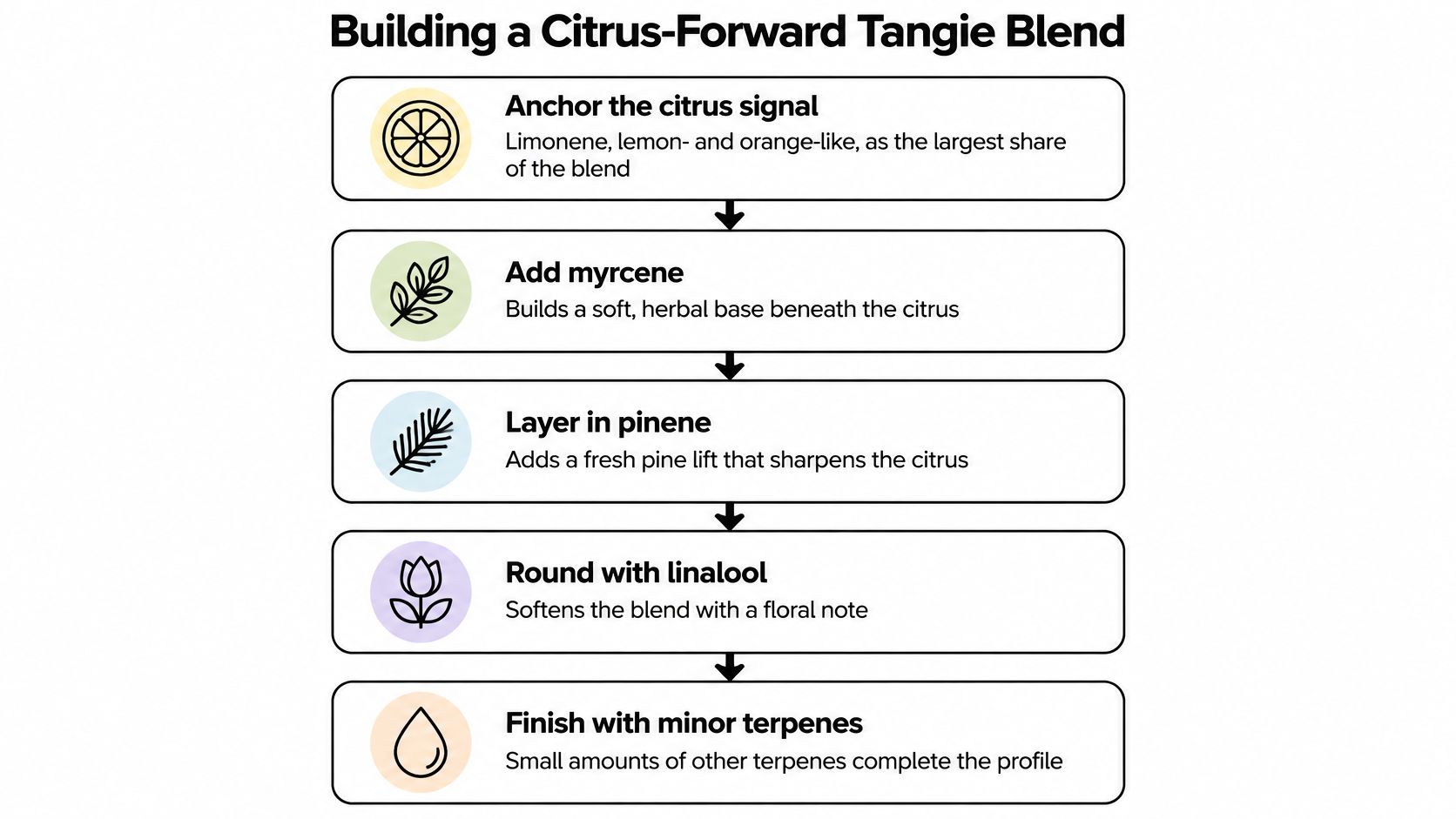
The build order matters more than the recipe. Each layer has a job, and the order below keeps the citrus dominant while the supporting compounds fill in around it.
Build in five layers
- Anchor the citrus. Limonene takes the largest single share. It's the note a customer names when they say Tangie, so it goes in first and sets the ceiling on everything else.
- Add myrcene for body. Musky and faintly fruity, it gives the citrus something to sit on. The March 2022 certificate ran limonene at 0.39%, myrcene 0.28%, beta-pinene 0.19% and beta-caryophyllene 0.10%, which works out to a starting ratio of roughly 4 : 3 : 2 : 1. That's one sample's ratio, not a fixed recipe.
- Round it with caryophyllene. Warm and peppery, it keeps the blend from going thin. Underdose it and the citrus reads like candy. Overdo it and you get a woody, drying finish.
- Test pinene as a variable, not a default. Alpha-pinene adds a pine-resin edge some buyers want and others reject on the first smell. The commercial certificate at 1.166% alpha-pinene is a pine-led product, so if you're matching that direction, start at a fraction of that share and build up gradually.
- Try terpinolene last, in small amounts. Treat it as a top-note lift rather than a structural compound. Weigh it in small increments and stop when the blend reads brighter, because a little more past that point pushes the aroma toward the sharper end of citrus.
A 100 g test batch
A 4 : 3 : 2 : 1 split is 10 parts. In a 100 g test blend that means 40 g limonene, 30 g myrcene, 20 g pinene and 10 g caryophyllene. Weigh into a sealed vessel and record the actual weighment rather than the target, because monoterpenes evaporate as you work and the sheet should match the jar.
Judge the blend diluted at the concentration it will be used at, never as a neat concentrate. Dilution changes odor intensity, and it changes which compound dominates. A blend that reads balanced on the bench can go flat or sharp once it's mixed into oil.
Keep the ratio sheet and a small retained sample with the batch, and match every later lot to that reference at working dilution. Building the base from a documented terpene-blend base keeps your reference stable enough that a single compound can be corrected without rebuilding the profile from scratch.
Dosing Tangie Blends in Distillate and Cartridges
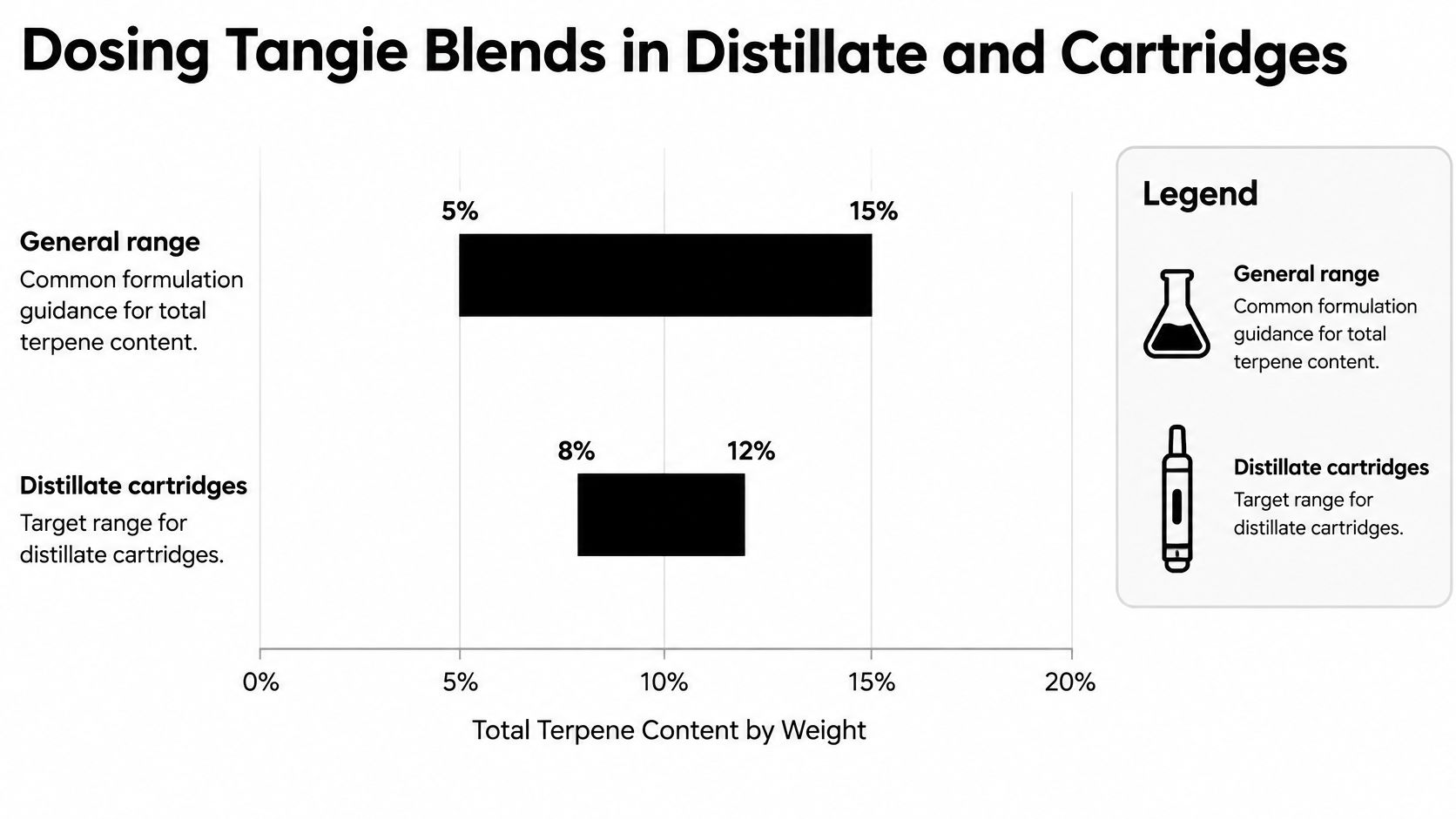
Load percentage is the number that turns a Tangie spec into a repeatable product. A practical working window is 5% to 15% terpene by weight of the finished oil. Distillate cartridge fills usually sit between 5% and 10%, climbing toward 8% to 12% only where the hardware and viscosity allow. Treat these figures as starting points that a pilot batch and the cartridge's viscosity limits either confirm or correct.
Three dosing situations cover most Tangie work:
| Use Case | Total Terpene Load by Weight | Check Before Committing |
|---|---|---|
| General working range | 5% to 15% | Pilot batch confirms the sensory match against your retained reference |
| Distillate cartridge, common target | 5% to 10% | Viscosity and fill performance at the lower end |
| Distillate cartridge, higher target | 8% to 12% | Hardware tolerance and viscosity at the higher end |
Run the pilot in six steps
- Set the target load inside the range and write the number on the batch sheet before you open a bottle.
- Blend the limonene-led base first. Get the citrus signal right before any secondary compound goes in.
- Add the secondaries in small increments, weighing between additions so you can stop at the point where the profile turns.
- Mix into winterized distillate and check viscosity. Thick distillate and tight hardware call for a lower load. Thinner oil tolerates more.
- Pull a sample of the finished oil and taste it once it cools. Warm oil doesn't taste like a finished cartridge.
- Record the batch percentages so the next lot is matched by number instead of by nose alone.
A worked 1 kg batch
At an 8% target load, a 1 kg batch takes 80 g of the Tangie blend and 920 g of distillate. At 5% it's 50 g of blend, and at 10% it's 100 g. Run the first test at 100 g of finished oil before you commit the full run, and keep a sealed sample as the reference the next lot is matched against.
Batch sheet rule: load, certificate number, viscosity reading and sensory result on one line. A lot you can't describe is a lot you can't repeat.
If the fill still runs thin, or the flavor fades after a week, work through how much terpenes to add to distillate before you change the blend itself. The ratio and the load are separate variables, and changing both at once teaches you nothing.
Heating and Compliance Checks Before Scale-Up
Heat changes the molecule you paid for. Terpenes such as myrcene, limonene and linalool can break down under dabbing temperatures into compounds that are not flavor notes, so a clean certificate describes the material before heating, not after.
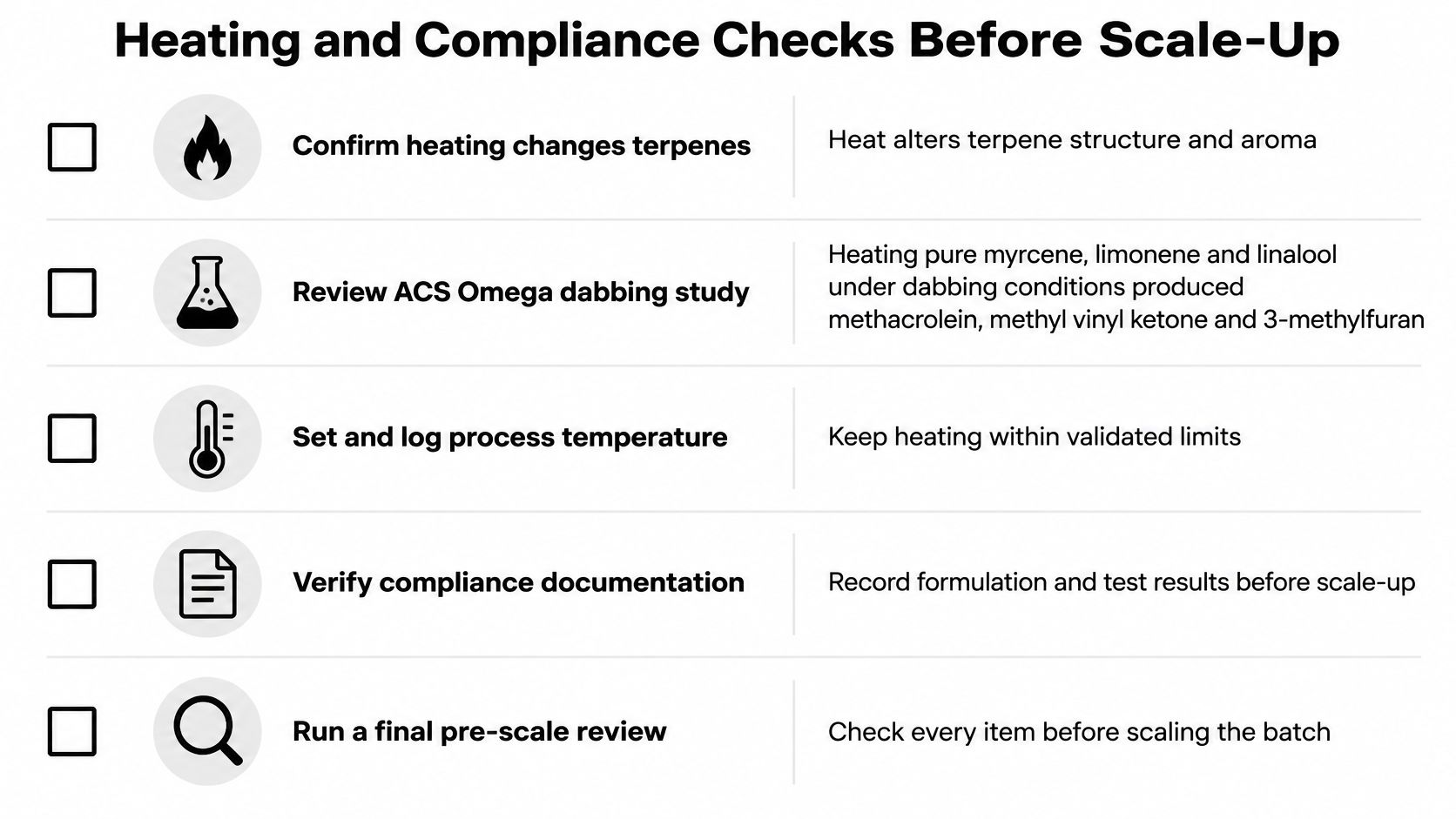
Check the scale of that effect before you set a loading. A study in Frontiers in Toxicology reported that adding a terpene mixture to cannabinoid distillates increased carbonyl emissions by as much as ninefold, with most carbonyl products originating from terpene oxidation.
Results depend on hardware, temperature, voltage, oxygen exposure, concentration and the formulation itself, so that figure doesn't predict what any single Tangie cartridge will emit. It does rule out the assumption that a natural, strain-named blend is automatically low-risk when inhaled. Flavor performance and inhalation safety are two different tests, and passing one says nothing about the other.
This walkthrough covers what temperature does to a terpene profile in practical terms.
The pre-scale checklist
- Validate hardware temperature and final terpene loading before a full run, at the voltage your production hardware will deliver.
- Ask for inhalation-relevant documentation, rather than relying on a food-flavor statement. FEMA GRAS status covers ingestion and doesn't automatically establish safety for inhaled aerosols at higher flavoring concentrations.
- Keep a certificate of analysis on file per lot, with batch-level terpene percentages from an independent lab. Terpene information for our products is provided by SC Labs.
- Run GC-MS composition and flavor checks after repeated heating and at storage temperature, because monoterpenes can shift the perceived balance faster than the heavier compounds.
- Hold a retained Tangie reference so every future lot is measured against something concrete after heat and storage have worked on it.
Paperwork runs parallel to sensory work. Our regulatory compliance checklist covers what to hold on file, and our Terpene Safety & Documents page carries the safety sheets. Terpene statements on our product pages have not been evaluated by the Food and Drug Administration.
A blend describes a sensory identity. Nothing in a certificate of analysis supports a therapeutic claim, so keep disease and treatment language off the label and out of the product listing.
Order a Tangie Blend and Confirm the Specs
A Tangie purchase either survives production or it doesn't, and four things decide which.
- A target ratio, not a strain name. Ask for the blend specified as a percentage breakdown against a named reference lot. A supplier who can only say citrus and orange is selling you a direction, not a spec.
- A certificate of analysis for every lot, dated to match the material you're receiving.
- A sensory match against a retained reference, judged at your production dilution rather than neat out of the bottle.
- Documentation for the use that applies. Inhalation documentation for cartridges, food-grade documentation for ingestibles, and no assumption that one covers the other.
Then comes the pilot. Run a 100 g finished-oil test at your target load, hold a sample back, and compare it to your reference after a week at your storage temperature. If the citrus holds and the body doesn't thin out, you have a load worth scaling.
Our Tangie blend is described as citrus, orange and sweet, and it ships in the Tropic Pack alongside Pineapple Express and Sour Mango when you want to compare citrus directions side by side.
Gold Coast Terpenes supplies a botanically derived Tangie blend and 50+ other strain profiles, all THC-free and SC Lab-tested, so you can lock a citrus spec and repeat it lot after lot. Wholesale, affiliate and bulk programs cover larger production volumes, with discounts on orders exceeding 64 oz. Visit Gold Coast Terpenes to shop the Tangie blend and the Tropic Pack.