
Wedding Pie is sold as a dessert strain, yet the compound carrying much of its aroma reads as cracked pepper on the lab sheet. In the compiled COA data behind this profile, beta-caryophyllene sits beside cedrene at the top of the curve, ahead of the grape and citrus cues the name advertises. Gold Coast Terpenes, a supplier of 100% natural botanically derived terpene blends, treats Wedding Pie as a measured target to match against batch COAs and sensory checks, not a fixed formula attached to the label.
A strain name buys a category. A certificate of analysis buys a specification, and the gap between them is where a botanical blend succeeds or fails.
The formulation rule: match the ratio on your target lot, not the decimals on someone else's strain page.
Build a cartridge from limonene alone and the result is citrus cleaner wearing a dessert name. Build it from the Wedding Pie ratio and a buyer recognizes the profile before reading the packaging.
What Terpene Profile Does Wedding Pie Have and How Do Its Roles Shape the Flavor?
The numbers below are means compiled from verified certificates of analysis, not a reading from one flower sample. That dataset ranks cedrene at 1.00%, beta-caryophyllene at 0.97%, limonene at 0.64%, linalool at 0.49%, beta-myrcene at 0.47%, farnesene at 0.31%, humulene at 0.29%, guaiol at 0.22%, nerolidol at 0.16%, ocimene at 0.12% and alpha-bisabolol at 0.12%, per CannMenus compiled strain data. The same source notes those figures move with harvest and cultivation practice, which is why a botanically derived blend built to this profile gets tuned per batch rather than copied once.
| Note role | Terpene | Reported mean | Sensory direction |
|---|---|---|---|
| Base | Cedrene | 1.00% | woody, warm |
| Base | Beta-caryophyllene | 0.97% | peppery, spiced |
| Base | Guaiol | 0.22% | woody, floral |
| Mid | Linalool | 0.49% | floral, soft |
| Mid | Beta-myrcene | 0.47% | herbal, musky |
| Mid | Farnesene | 0.31% | green apple, woody |
| Mid | Humulene | 0.29% | earthy, hoppy |
| Mid | Nerolidol | 0.16% | floral, woody |
| Mid | Alpha-bisabolol | 0.12% | soft, floral |
| Top | Limonene | 0.64% | citrus, bright |
| Top | Ocimene | 0.12% | sweet, herbal |
Read the Table as Three Layers, Not Eleven Ingredients
Formulators who scan a terpene list, pick the biggest number and order that isolate end up with something that smells like one molecule with a strain name stapled to it. Group the rows by note role and the architecture appears: cedrene, caryophyllene and guaiol form the base, linalool, myrcene, farnesene, humulene, nerolidol and bisabolol sit in the mid, and limonene and ocimene are the top.
The profile works like a pie. The crust holds the shape, the filling gives it body, and the glaze is what you notice first. Cedrene and caryophyllene are the crust here, woody and warm and load-bearing. The mid notes soften the edges and add the creamy, floral, faintly green-apple character that reads as pastry rather than spice. Limonene and ocimene are the glaze, immediate and bright and the first thing to fade.
Order of operations: base notes decide whether the blend is recognizable, top notes decide whether it's pleasant. Get the base wrong and no amount of limonene recovers it.
Why Caryophyllene Sets the Structure Even When Cedrene Scores Higher
The mean puts cedrene barely ahead, and single-lot data explains why the two get handled differently in practice. One reported laboratory sample at 21.9% THC measured beta-caryophyllene at 1.18 mg/g, against beta-myrcene at 0.39 mg/g and limonene at 0.37 mg/g, roughly a three-to-one gap between the principal note and its supporting players (Hytiva strain data). That sample's reported values total 1.94 mg/g, which is one lot's evidence rather than a universal specification.
A separate commercial lot tells the same story in a different unit. There, beta-caryophyllene at 1.26% represented roughly 45% of a 2.78% total terpene figure, with beta-myrcene at 0.39%, limonene at 0.30%, linalool at 0.29% and humulene at 0.28% (MHW product COA listing). The pattern that matters is the split: one compound holds close to half the terpene mass while the remaining four divide the rest in near-equal shares. Cedrene's higher mean reflects lots where it ran hot, while caryophyllene holds the top spot more consistently.
What Goes Wrong When You Chase the Headline Note
Adding limonene outside the ratio is the most common error, and an easy one, because limonene is the note a marketing deck can describe in one word. Push it up and the profile slides from pastry and pepper toward sharp citrus peel, which reads as a different cultivar to anyone who knows the flower. The same logic applies in reverse: cutting myrcene or humulene to make room for a brighter top strips out the herbal, earthy weight that keeps the mid layer from tasting thin.
Treat the table as a hypothesis. Pull the COA of the batch you're matching, compare its top three terpenes against these rows, and correct the single note that's off. A wedding pie strain profile built this way stays repeatable across lots.
Where Does the Wedding Pie Lineage Come From?
Wedding Pie is generally described as an indica-leaning hybrid created by crossing Wedding Cake with Grape Pie, and how far any given plant leans drifts by phenotype and producer. The breeding record is the firm part of the story.
Potency is the soft part. Common strain references place a wedding pie strain around 20-30% THC, one account narrows that to 21-25%, and JAR Cannabis Co. listed 24-27% in its product profile (JAR Cannabis Co.). Wider context for those ranges comes from strain reference data. Each figure describes a population of harvests, not a single product you can order.
Both parents belong to the dessert-and-fruit wave of modern breeding, which explains why buyers expect sweet, fruity, lemony and gassy descriptors before they ever open a jar. Expectation is useful for naming a SKU and useless for setting a formula, because a cross predicts aroma direction loosely while cultivation and extraction decide what lands in the oil.
Naming is the variable that trips up product teams. Commercial strain names aren't standardized, so the same label can point to materially different plant material, and independent references consistently list beta-caryophyllene, limonene and linalool as recurring major constituents while warning that expression shifts with phenotype, cultivation, harvest, curing, storage and extraction (Leafly strain profile).
What the lineage gives a formulator is a cultivar identity and a starting aroma hypothesis: peppery spice up front, citrus lift, floral and creamy body underneath. A hypothesis like that earns its keep only when a batch COA confirms it. For the dessert-side reference point behind the cross, the Wedding Cake strain breakdown shows where the vanilla and cake character originates.
What you can rely on: the parentage. What you can't: that any two Wedding Pie products share a chemistry.
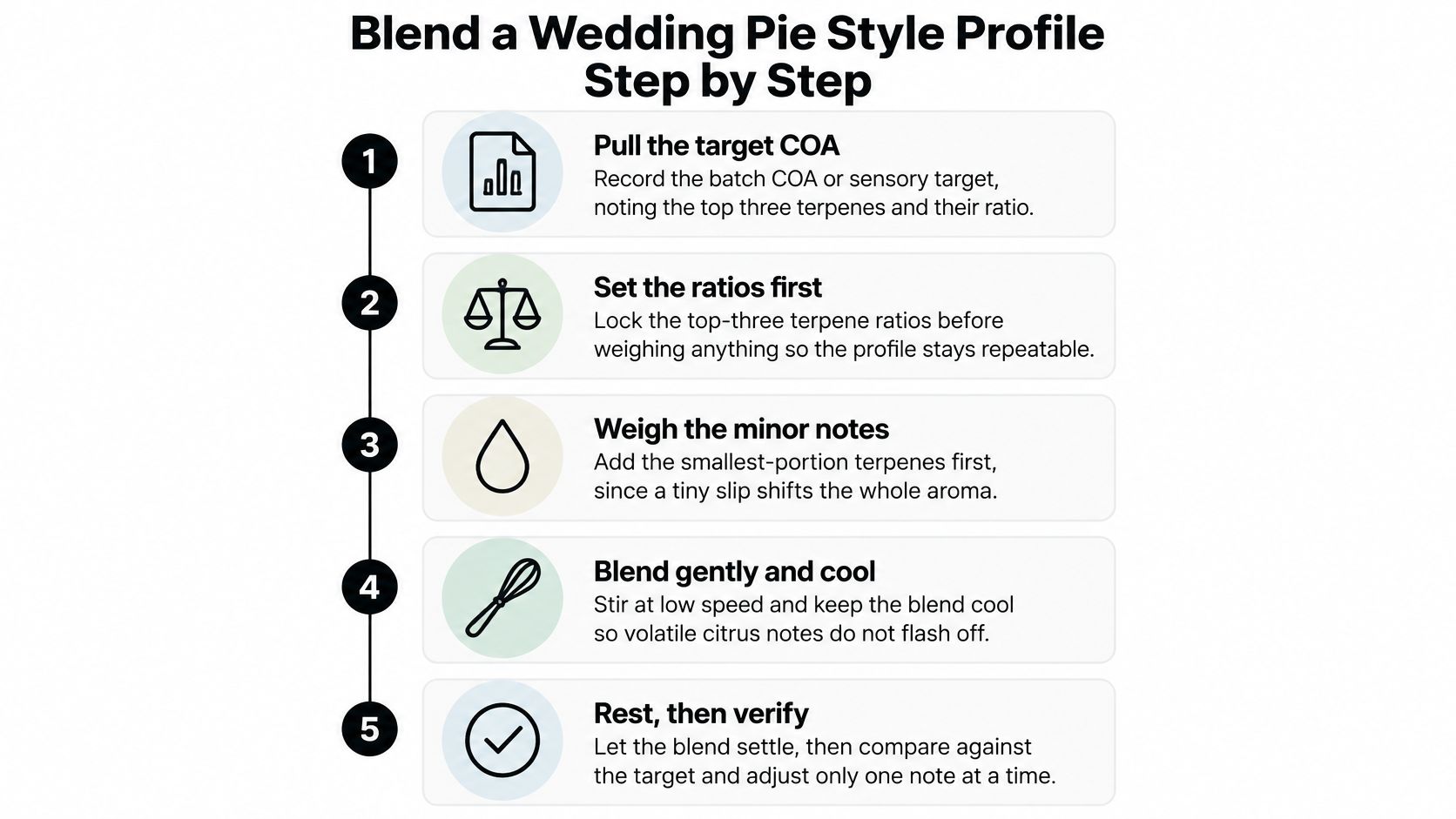
How Do You Blend a Wedding Pie Style Profile Step by Step?
Build the blend from the ratio on a real target, then verify it against that target before you scale. The sequence below protects the base notes and keeps the volatile top notes from running the whole batch.
- Pull the target COA first and record the top three terpenes with their ratio. The ratio is the actual spec. The common slip is starting from a strain description or a competitor's marketing copy instead of a document.
- Weigh the base notes before anything else. Caryophyllene and cedrene set identity and are hard to walk back once overdosed, so they go on the scale first. Slip: building base notes last, after the blend already smells like something else.
- Add the mid notes by weight, never by volume. Linalool, myrcene, humulene and farnesene carry the creamy body, and volume dosing drifts with temperature and viscosity. Slip: counting drops.
- Dose limonene and ocimene last and lightest. These evaporate fastest and dominate perception within seconds of opening the vessel. Slip: adding an extra drop to "brighten it up", which is the fastest way to lose the pastry note.
- Mix in a clean glass vessel at low speed, then cap it. Agitation and heat drive off the top notes you just weighed. Slip: blending in an open container on a warm bench.
- Dilute to target strength by final weight and record dose per gram of oil. Calculating from finished mass instead of starting mass is what makes batch two match batch one. Slip: dosing as a percentage of the concentrate rather than of the finished cart.
- Panel the lot against the target and label it with date and ratio. A blend approved only from the bench sample hasn't been tested. Slip: skipping the panel because the numbers matched.
For carriers, dilution order and mixing ratios, the guide to mixing terpene strains covers the mechanics that sit around this procedure.
What a Matched Blend Should Smell Like
Caryophyllene spice arrives first, warm and peppery, then the citrus lift comes through a beat later, and the floral mid notes round the finish. No single note stands alone or shouts over the others. If the first thing you notice is lemon, the top notes are hot. If the first thing you notice is nothing, the base is thin.
Why Does a Batch COA Matter More Than the Strain Name?
A batch COA is stronger evidence than the strain name because the same name can produce different chemistry, and that gap is measurable. A dataset of 2,662 Nevada medical-flower samples sold under 396 reported strain names found their terpene profiles clustered into only three broad chemical groups, which means composition sorted those samples far more cleanly than their names did (chemotype explainer).
Terpene expression moves with genetics, cultivation, harvest timing, curing and storage. Two growers running the same cut under different conditions can land in different clusters entirely, which is why a label is a search term and a COA is the answer.
Storage belongs on that list of variables, not in a footnote. In a peer-reviewed chemical and enantiomeric study, elapsed time significantly affected terpene concentration, with levels falling for every measured terpene except p-cymene (terpene stability study). That single exception is worth knowing: p-cymene holds steady while everything else drops, so a lot that smells thin and still shows p-cymene has probably aged rather than been misformulated.
A Quality Routine That Separates Two Different Problems
Without a routine, oxidation and a wrong recipe look identical on the panel sheet. Four habits fix that:
- Retain a sample from every production lot. Store it sealed, in the dark, at a recorded temperature, so you have a reference point when a complaint arrives.
- Log storage conditions on the batch record. Temperature and time are the two variables that predict volatile loss.
- Test at defined checkpoints after mixing and after filling. A blend approved only at the bench hasn't met the process yet.
- Compare chromatograms or panels across time, not against memory. Trend data shows whether a note faded or was never there.
The COA guide explains how to read the document itself. The point of the routine is diagnostic: it tells you whether the blend changed or the recipe was wrong, and those two outcomes call for opposite fixes.
How Do You Formulate Wedding Pie for Vape Cartridges and Distillate?
Formulate for the hardware, not just the recipe, because the top notes are the ones most at risk once heat enters the picture. Volatile citrus and ocimene fall away first, so a blend that tastes correct at room temperature can read flat and woody in a cartridge.
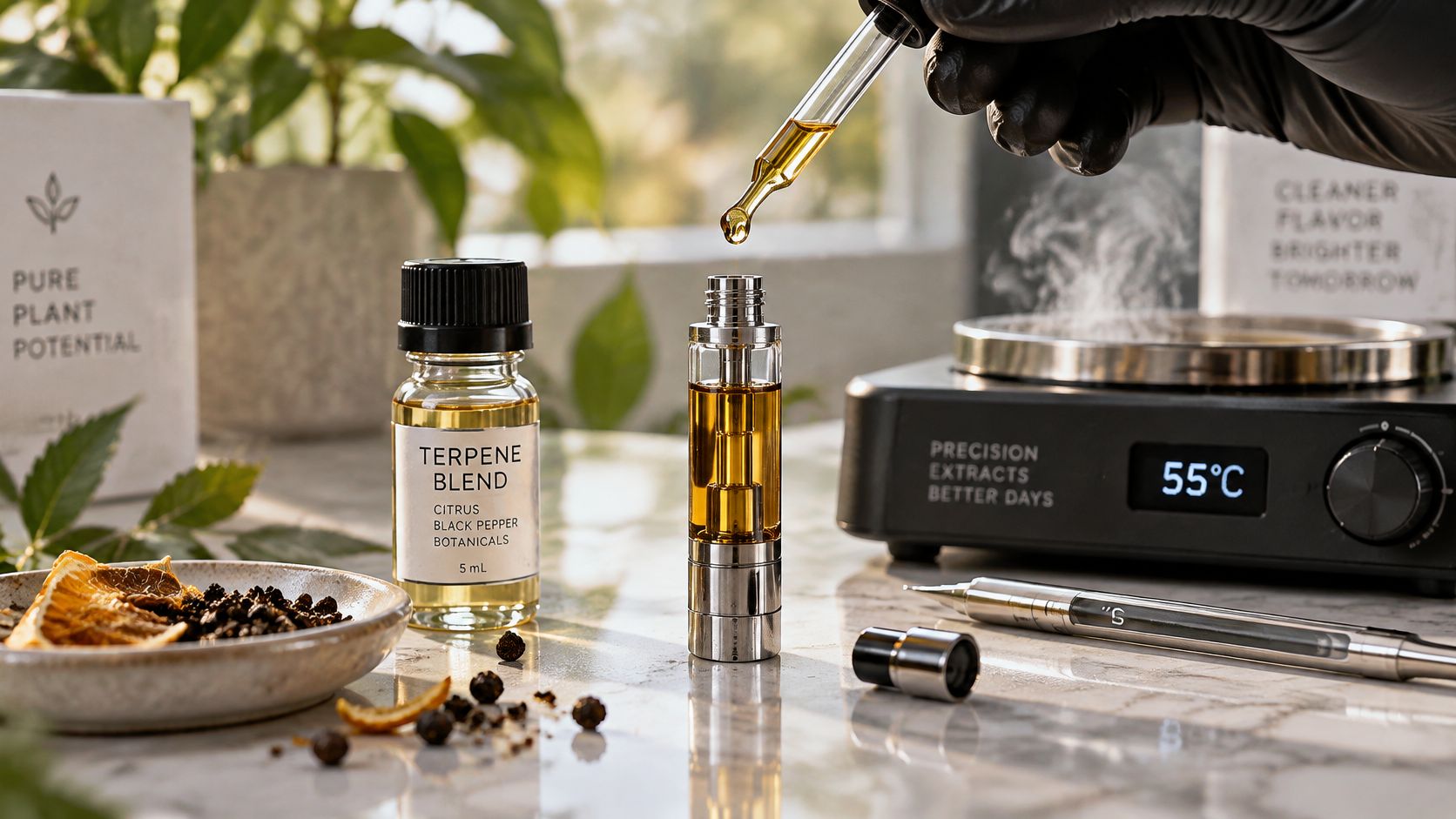
Distillate raises the stakes. A stripped matrix carries almost no native terpene, which means your added blend is the entire flavor, and the base notes have to hold identity after the top has burned off. Flower rosin keeps more of the fruit and cream character on its own; distillate has to be given it.
The Working Checklist for Cartridge and Distillate Lots
- Test the blend after heating, not only at mixing. The room-temperature sample hides the exact top-note loss your customer will taste.
- Keep the base-to-top ratio fixed when you scale. Proportions drift as batch size changes, and the drift always favors whichever component is easiest to pour.
- Choose a carrier that doesn't mask the top notes. Carrier character reads as flavor in a low-terpene matrix.
- Label dose per gram of final oil. That single figure is what lets the next batch be reproduced rather than guessed at.
Store and retest those lots on the schedule described above rather than building a second system for cartridges.
For a visual walkthrough of the filling and dilution side of the process, this session covers the practical sequence:
What Labeling and Compliance Rules Apply to a Botanical Wedding Pie Blend?
Label the origin of every terpene on the product, because botanical and nature-identical claims are not interchangeable and the flavor claim you can legally make depends on which one you are using. Gold Coast Terpenes sells 100% natural, lab-verified terpene blends that are SC Lab-tested, which gives a formulator supplier documentation solid enough to build a label on.
Three checks should pass before anything goes to print:
- The origin statement. State botanical or nature-identical explicitly. A vague "natural terpenes" line invites a challenge the batch file cannot answer.
- The ingredient list and lot number. Every component on the label has to trace to the material in the bottle, and the lot number is what ties the printed claim to a specific batch rather than to the product line in general.
- The jurisdiction rule for your market. Cannabis and hemp product rules are set by the regulator in each market, not by the strain name or the supplier's marketing sheet, so confirm the requirement where the product will be sold.
The claim rule is the one brands most often break. Describe flavor, such as caryophyllene spice and citrus lift, and do not attach a terpene to a physical or therapeutic outcome. Aroma language is defensible. Effect language is not.
Documentation standard: request lot-specific test documentation from any supplier before scaling, so the origin on the label and the profile on the test report describe the same material.
If a supplier cannot state the origin of each component on every product, do not scale the blend with that supplier. The label becomes unsupported the moment a buyer or a regulator asks for the supporting file, and reprinting packaging costs far more than switching vendors early. The regulatory compliance checklist lists the documents to gather before a launch.
How Do You Confirm the Blend and Source Terpenes Before You Scale?
Confirm the blend on a small sample first, and scale only if that sample matches your target on top, mid and base ratio after heating. Everything before that point is a hypothesis with a nice label. What arrives in the bottle is a measured ratio, and only the material in hand can confirm it.
Gold Coast Terpenes sells a Strain Picker Pack in 1.5ml or 3ml sizes that lets a buyer select any three different terpene profiles from the catalog, with terpene testing, custom vape or tincture formulation, and profile comparison listed as its use cases. That is the right scale for a Wedding Pie trial: one pick builds your target ratio, two picks build neighboring candidates, and all three fit a sensory panel without committing to production volume. Wholesale pricing applies to strain orders totaling over 64oz, so the sample you approve and the bulk order behind it can come from the same catalog and the same profile.
| Criterion | What to require | Why it matters |
|---|---|---|
| Batch documentation | COA matched to the lot number on the bottle | Reported profiles vary by batch and producer |
| Terpene origin | Stated source on every component | Determines what the label can claim |
| Test sample | 1.5ml or 3ml profiles via the Strain Picker Pack | Confirms the blend before bulk |
| Bulk terms | Wholesale pricing on strain orders over 64oz | Keeps the approved profile and production volume in one catalog |
| Minimum order | Strain listings from $15.00 | Sets the floor for a trial commitment |
Run the confirmation warm, at the temperature your finished oil will see. Light top notes flash off faster than the heavier base, and a ratio that smells balanced in a cold bottle can read thin once it is heated.
Ordering the test sample and the production run from the same catalog matters more than it sounds. A profile approved from one source and supplied by another is two unrelated materials sharing a file name.
If the sample matches your target COA or sensory benchmark, move to bulk and reorder against the same strain-specific listing so the profile stays fixed. If it misses, adjust the ratio and run another Picker Pack trial. Scaling a blend you have not confirmed multiplies the error, and bulk terms make that error expensive.
What Do Formulators Ask About Wedding Pie Terpenes?
Is there one standard Wedding Pie terpene blend? No. Reported ranges shift by batch and producer, so match a current COA or a defined sensory target instead of a fixed recipe copied from a strain page.
Can limonene alone recreate Wedding Pie? It can't. Limonene supplies the top note, while the caryophyllene and cedrene base carries the identity, which is why Gold Coast Terpenes matches the whole ratio rather than a single compound.
Are botanically derived terpenes better than cannabis-derived ones for vape brands? For most vape brands the deciding factor is the origin statement, and botanically derived blends keep that statement simple and clear on the label. Gold Coast Terpenes makes botanically derived blends, so confirm the origin on each lot before scaling.
Does Gold Coast Terpenes carry a Wedding Pie style profile? Check the current strain-specific profiles in the catalog, then confirm the closest match against your own target COA before committing to volume.
How often should a blend be retested? Concentrations fall with elapsed time, so retest at defined checkpoints after mixing and after filling, and keep retained samples with storage records so you can tell aging from a formulation error.
What's the most common formulation mistake with this profile? Overdosing limonene. It turns a pastry-and-pepper profile into citrus peel within a few drops, and the correction means rebuilding rather than adjusting.
A Wedding Pie style profile is only as good as the target behind it, and Gold Coast Terpenes supplies botanically derived blends plus the lot-specific documentation that lets you match a ratio, label the origin, and reproduce the result on the next production run. Start with a 1.5ml or 3ml Strain Picker Pack to test three candidate profiles against your own COA, then scale once one clears the panel. Visit Gold Coast Terpenes to review the current strain catalog and confirm the closest match for your formulation.