
Copying a terpene list from a strain page isn't a reliable way to recreate Cookies and Cream for a cartridge. Gold Coast Terpenes describes its blends as 100% natural, so request the origin declaration for the lot you plan to order. Ingredient origin alone doesn't establish whether a formula matches the intended flower or performs when heated. For Cookies and Cream strain-inspired terpene blend formulation, start with a defined sensory target, batch-specific chemistry, and the hardware you'll sell.
The expensive mistake is approving a blend because it smells convincingly sweet in a sample vial. A production-ready profile needs to survive dilution, mixing, storage, and heated evaluation without losing its identity or introducing unacceptable emissions.
Cookies and Cream Terpene Profile Reference
Treat the cultivar name as a sensory reference. The chemistry underneath it moves from batch to batch, so use the compiled profile as a starting point and confirm every production lot against its own certificate of analysis.
Cookies and Cream reference terpene profile
| Terpene | Reported average | Formulation role | Note |
|---|---|---|---|
| Beta-caryophyllene | About 0.8% | Base note, spicy backbone | Strongest quantified marker in the compiled reference |
| Humulene | About 0.4% | Mid note, earthy | Supports the dough-like character |
| Terpinolene | About 0.4% | Top note, fresh | Listed first on one strain page, so batch results may differ |
| Limonene | About 0.3% | Top note, citrus lift | Sits behind caryophyllene in the reference |
Cannigma's Cookies and Cream compilation reports approximately 0.8% beta-caryophyllene, 0.4% humulene, 0.4% terpinolene and 0.3% limonene across products sold under the cultivar name. Those are aggregate measurements of finished products, not addition rates for a concentrate.
Myrcene is the gap worth watching. Some strain pages list it as the leading terpene for this cultivar even though the compiled reference leaves it unquantified, and the difference is functional rather than cosmetic: a batch above roughly 0.5% myrcene produces a more sedative high, while a batch under that line has an energizing effect. Establish where each lot sits before you lock the sensory target, because two jars with the same label can legitimately land on opposite sides of it.
That gap is also why a percentage measured in flower or an extract cannot be copied into a purchased terpene concentrate or assumed to be a suitable loading in a finished cartridge.
Normalize before comparing
Convert each measured terpene into its share of the sample's total terpene content:
Normalized share = individual terpene concentration ÷ total terpene concentration
Express the result as a percentage on one reporting basis and use the laboratory's complete terpene total, not only the compounds in the reference table. A sample can be caryophyllene-led by normalized share even when its absolute terpene content is low, and the reverse is also true.
Normalization answers a compositional question: how much of the measured terpene fraction is caryophyllene, humulene or another compound. The separate question of how much concentrate belongs in the finished oil stays open until you run heated evaluation.
Keep those decisions in separate worksheet columns:
- Composition target: Each compound's share of the terpene blend.
- Finished-product loading: The amount of that blend added to the base oil.
- Acceptance criteria: Analytical and sensory limits used to release the finished product.
The Formulation role column is a working hierarchy for organizing trials, not a literal recipe in which one compound supplies cookie and another supplies cream.
Release the blend against the batch COA and the acceptance criteria. The name on the label describes the target; it does not release the product.
How Top, Mid and Base Notes Build the Cookies and Cream Aroma
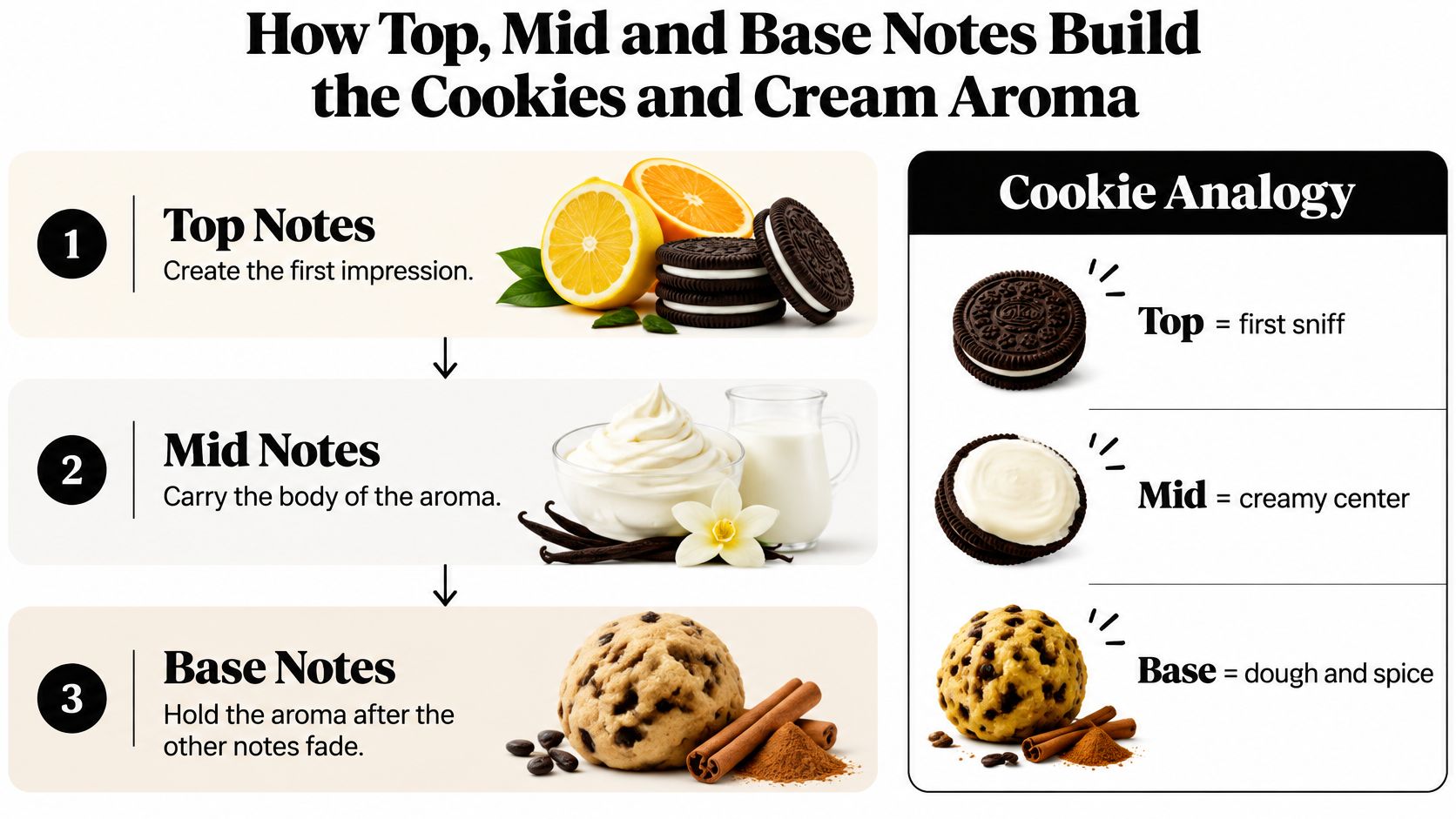
Top notes create the first impression, mid notes carry the body, and base notes provide the lingering foundation. For a caryophyllene-led reference, the challenge is preserving that foundation without making the finished profile excessively spicy.
Think of a cookie once: the base is dough and spice, the middle is the creamy, earthy center, and the top is a light citrus glaze. The analogy helps organize adjustments, but it doesn't mean a single terpene supplies every impression associated with cream, dough, or sweetness.
The hierarchy is useful when deciding which part of a trial needs correction.
Separate first-sniff impact from persistence
Limonene and terpinolene serve as relatively volatile top-note components in this formulation framework. Their prominence can change during handling and heating, so a balanced jar aroma doesn't guarantee a balanced cartridge result.
Don't compensate for a weak heated aroma by immediately adding more top notes. First establish whether the loss comes from the composition, mixing procedure, sample storage, or device behavior.
For a reference with a caryophyllene-led backbone, keep beta-caryophyllene as the largest target component during initial development. Treat that as a starting hypothesis, not an instruction to override a retained sample that clearly has a different chemical and sensory balance.
A strong first sniff isn't the same as a faithful finished-product flavor.
Evaluate the trial at its intended dilution in the actual base matrix. Compare it with the retained reference using consistent containers, sample conditioning, and evaluation timing, then send the candidate through a controlled heated evaluation.
Diagnose the missing layer
A sharp opening with little persistence suggests a different adjustment from a heavy, earthy profile that lacks freshness. Record those observations separately instead of reducing every result to “too weak” or “too strong.”
Use this role-balance checklist:
- Base anchor: The spicy foundation remains recognizable without dominating the entire profile.
- Mid-note body: Earthy and supporting nuances connect the opening to the finish.
- Top-note lift: Freshness improves definition without turning the target into a citrus-led blend.
Don't treat harshness as a sensory problem that can always be blended away. Stop the trial and investigate formulation, contamination, hardware, and emissions before making another flavor adjustment.
Why Two Cookies and Cream Batches Can Smell Different
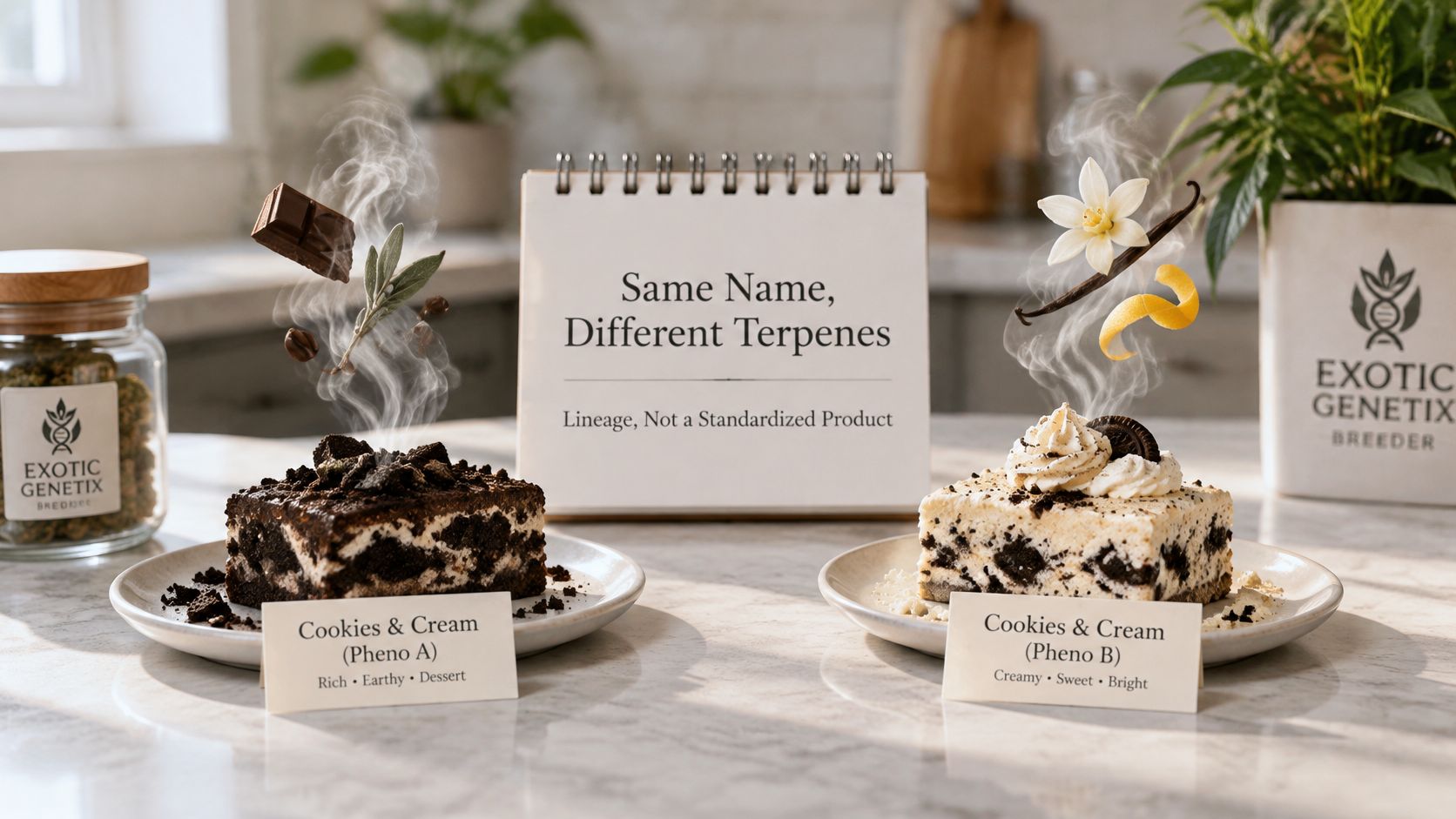
Conflicting strain-page descriptions reflect the central problem: Cookies and Cream identifies a lineage, not a standardized chemical product. One description emphasizes caryophyllene, limonene, and myrcene, while another puts terpinolene first.
Phenotype differences can help explain why similarly named material doesn't present the same aroma.
The Prime Cuts Nursery Cookies and Cream page supports the caryophyllene, limonene, and myrcene reading. Compared with the terpinolene-first description, it demonstrates why a web summary shouldn't become a purchasing specification.
Two strain pages, two different leading-terpene readings
| Source | Leading terpenes | Profile described |
|---|---|---|
| Strain page A | Caryophyllene, limonene, myrcene | Spicy, citrus, and earthy emphasis |
| Strain page B | Terpinolene first | Mixed, moderate profile |
Leafly's cultivar record identifies Exotic Genetix as the breeder and connects Starfighter with an undisclosed Girl Scout Cookies phenotype. The undisclosed parent limits traceability: the broad parental pairing is more defensible than an assumed, completely documented parental clone.
Compare lots, not names
Phenotype selection, cultivation conditions, harvest timing, curing, extraction, storage, and laboratory methods can all influence the result. The practical discussion of environmental factors and terpene transformation helps frame why cultivation history belongs in a supplier conversation.
Place the batch certificates side by side and check:
- Reporting basis: Confirm that both laboratories report comparable units and sample types.
- Analytical coverage: Identify compounds tested by one laboratory but omitted by the other.
- Detection limits: Don't treat an unreported or below-quantification result as a confirmed absence.
- Meaningful differences: Flag deviations outside your approved analytical tolerance, accounting for laboratory uncertainty.
A universal “small margin” isn't useful. Set the acceptance range around the intended reference and the repeatability of the method you're using.
For additional cultivar context, the accompanying video can support the discussion, but it doesn't replace lot documentation.
When the chemistry differs, choose the sensory markers your product must retain: creamy sweetness, cookie-like spice, citrus lift, or a gas-like accent. Don't force all of them into equal prominence merely because they appear in different descriptions.
Treat the strain name as a sensory reference, and require each batch to supply its own evidence.
How to Build and Validate a Strain-Inspired Terpene Blend
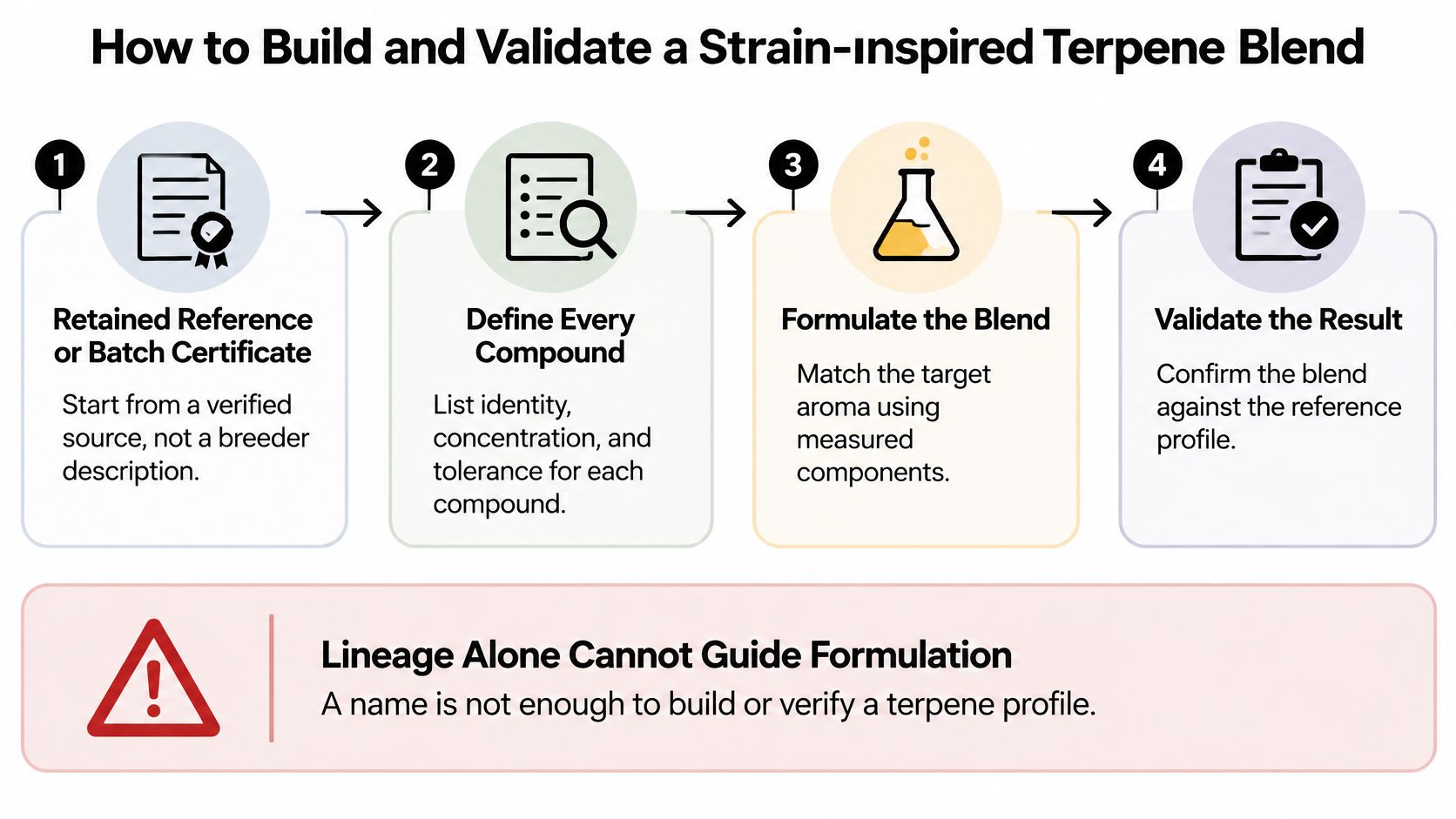
Build from a retained reference and a batch certificate, then specify every component by identity, concentration, and tolerance. Breeder descriptions help select a direction; they don't provide a complete formulation.
The Prime Cuts Nursery strain catalog describes the undisclosed Cookies parent and Starfighter F2 contribution. That background supports looking beyond a generic Cookies blend when the target includes creamy, nutty, or floral nuances.
Use a documented workflow rather than repeated informal adjustments.
Establish the reference and build the trial
Obtain the actual target material. Request a retained flower or oil sample and its matching batch certificate for each lot you're replicating. Record whether the target is fresh flower, cured flower, resin, or finished oil, because those aren't interchangeable references.
Evaluate a properly diluted trial. Compare the reference with the candidate in a defined evaluation matrix rather than smelling neat concentrate alone. Use coded samples so a familiar product name doesn't influence the assessment.
Set the base composition. Use the normalized analytical profile to establish the initial caryophyllene anchor. Weigh additions with a calibrated balance and record component lot numbers so another technician can reproduce the trial.
Develop the middle deliberately. Add humulene and other justified supporting components in measured increments. Change one variable at a time when diagnosing earthy body, dough-like impressions, or missing floral detail.
Adjust the opening last. Introduce limonene or terpinolene against the reference instead of chasing maximum freshness. Record the exact concentration after every revision, including any correction made to the total batch mass.
Validate before locking the formula
Check the analytical match. Have the trial evaluated chromatographically and compare individual compounds, total terpene content, and unexplained peaks with the intended specification. A sensory match with an unexplained analytical discrepancy needs investigation, not automatic approval.
Test the finished application. Evaluate the candidate in the target distillate and cartridge, including controlled heated testing and appropriate emissions assessment. Lock the formula only after the analytical, sensory, stability, and hardware acceptance criteria are satisfied.
Gold Coast Terpenes offers isolates and strain profiles for comparative development. Its Elevated Strains are made by the Master Terpologists, who refine selected rare and exotic terpenes to bring out fruity and flavorful nuances; use those as comparison candidates, not automatic substitutes for a measured reference.
The 3ml Strain Picker Pack lets customers select any three different profiles from the catalog in 1.5ml or 3ml sizes. All strains are highly concentrated and need proper dilution before use.
Development rule: Freeze the reference, evaluation method, and acceptance criteria before deciding which trial wins.
The guide to mixing terpene strains provides useful mixing context. Your production record should still carry the actual formula, mixing sequence, component identities, lot numbers, and release limits.
Thermal Safety and Hardware Limits for Cartridge Blends
Heating changes the exposure question, so a convincing aroma isn't sufficient evidence for cartridge suitability. Validate the complete formulation in the intended hardware rather than declaring a terpene blend safe because its ingredients are natural.
The Frontiers in Toxicology discussion of terpene-containing vape emissions identifies temperature, device characteristics, formulation, and ingredient proportions as relevant variables, while noting gaps in complete emissions profiles and chronic toxicity information. The practical conclusion is limited but important: neither ingredient familiarity nor a favorable room-temperature assessment establishes inhalation safety.
Likewise, flavor-origin terms don't resolve the toxicology question. Natural, botanical, and synthetic labeling shouldn't substitute for evidence about the material and its use conditions.
Define the operating envelope
A cartridge specification needs more than a nominal power setting. Include the oil, device, filling procedure, conditioning requirements, and test conditions so the laboratory assesses a reproducible system.
Use these controls:
- Lot-specific testing: Confirm incoming material identity and composition before release into manufacturing.
- Conservative loading: Use the lowest addition that meets the documented sensory target and application requirements.
- Validated hardware: Assess the intended cartridge under representative operating conditions, including relevant stress conditions.
- Retained samples: Keep traceable material from each production run for investigation and stability checks.
- Controlled claims: Don't promise reliable medical or psychoactive effects from the terpene profile.
The guide to common terpene burning points offers background terminology, but a burning-point discussion cannot establish a safe cartridge operating temperature. Real devices expose mixtures under conditions that aren't captured by a single compound property.
Don't confuse flavor changes with THC delivery
Evidence that terpene profiles substantially change THC delivery remains limited. Possible differences in subjective experience don't justify a dependable effect claim or remove the need to characterize the aerosol.
Keep the release decision focused on what you can substantiate. Sensory fidelity, concentration, hardware compatibility, and thermal exposure must be assessed together, because improving one can compromise another.
Botanical vs. Cannabis-Derived Terpenes for Vape Cartridges
Botanical terpenes come from non-cannabis plant sources; cannabis-derived terpenes come from cannabis material. Gold Coast Terpenes identifies its blends as botanically derived, which is an origin distinction rather than an exemption from application testing.
Botanical vs cannabis-derived terpenes for cartridges
| Factor | Botanical terpenes | Cannabis-derived terpenes |
|---|---|---|
| Origin | Derived from non-cannabis plants | Derived from cannabis material |
| Label term | Botanical and natural terminology doesn't establish inhalation safety | Cannabis-derived origin also requires documentation |
| Heated emissions | Depend on temperature, hardware, formulation, and proportions | Same dependence; heated testing remains necessary |
| Batch certificate | Required for every lot under the purchasing specification | Required for every lot under the purchasing specification |
| Match to a strain | Specify by identity and concentration, then validate | May carry native volatiles; characterize and validate the complete profile |
Choose the control strategy, not the story
A botanical blend can be assembled around defined components and adjusted toward a selected sensory target. That gives the formulator control, but it doesn't guarantee that the selected components capture the full aroma of the reference.
Cannabis-derived material may retain native volatiles that are useful to the target. It can also contain features that complicate an exact match, particularly when the incoming material differs from the lot used during development.
Neither route eliminates specification work. The comparison of synthetic, botanical, and cannabis-related terpene categories is useful for separating origin terminology before drafting purchasing documents.
Document origin and chemistry separately
A certificate of analysis describes what a laboratory tested and found. It doesn't necessarily establish the agricultural origin of chemically identical compounds.
Request an origin declaration and appropriate traceability records alongside the analytical certificate. If nature-identical terminology appears in supplier paperwork, clarify whether it describes chemical identity, manufacturing route, or a marketing category before using it on finished-product labeling.
Choose the source whose identity, origin, composition, and intended use you can document consistently.
For cannabis, hemp, and CBD brands, the useful decision isn't which source sounds more authentic. It's which material meets the compliance, labeling, sensory, and manufacturing requirements of the actual product.
How to Choose a Terpene Supplier for a Vape Brand
Select a supplier by documentation quality and trial performance before comparing purchase price. Confirm origin, lot certificates, independent laboratory verification, carrier composition, and minimum order terms before committing to production material.
Gold Coast Terpenes's botanical sourcing distinction is relevant to the first check. It doesn't replace your incoming-material qualification process or establish that every formulation is appropriate for every market.
Qualify the paperwork
Get origin in writing. Separate botanical material from cannabis-derived material in the purchasing specification. Make sure the declaration applies to the material you're ordering, not merely the supplier's general catalog.
Review a representative certificate. Look for individual terpene results, total terpene content, test methods, laboratory identification, and a lot identifier. Ask how the supplier handles an out-of-specification result.
Confirm independent verification and carrier status. Obtain the applicable third-party report and a complete composition declaration. Where your specification excludes VG, PG, PEG, or MCT, make that exclusion explicit rather than assuming “terpenes” means no other ingredients.
Request actual order terms. Ask for the minimum order quantity for each candidate blend and trial format, along with available pack sizes and substitution policies. A sample option doesn't establish the commercial MOQ.
Make the sample trial the production gate
Confirm target coverage. Select candidates that address the reference's actual sensory gaps, not merely a similar strain name. For replicating the flavor of Cookies and Cream, that may mean comparing supporting earthy or floral characteristics rather than selecting the sweetest option.
Approve the application, not the vial. Complete the heated-test protocol, analytical review, and stability assessment before placing the production order. Keep the approved sample and specification under revision control.
The best terpene supplier for a vape brand is the one whose material and documentation fit the product's requirements consistently. A lower concentrate price won't compensate for repeated reformulation, unclear labeling, or a failed hardware qualification.
Frequently Asked Questions About Cookies and Cream Terpenes
Does Cookies and Cream have one fixed terpene profile?
No. The name identifies a cultivar lineage rather than a standardized chemical specification, so compiled averages need verification against the selected batch’s certificate and retained sample. Define which expression you’re reproducing before approving a formula.
Which terpenes should a formulator start with?
For the compiled reference, start with beta-caryophyllene as the anchor, then evaluate humulene for supporting body and limonene or terpinolene for the opening. Keep those roles subordinate to the actual reference, because a terpinolene-forward target shouldn’t be forced into a different profile merely to match an average.
Are botanical terpenes safer for vape cartridges than cannabis-derived ones?
Origin alone doesn’t establish comparative inhalation safety. Gold Coast Terpenes’s botanical sourcing still requires application-specific evaluation, because the complete formulation, hardware, and heating conditions determine the exposure being assessed.
How should a vape brand choose a terpene supplier?
Request written origin, lot-specific certificates, third-party laboratory verification, carrier declarations, and minimum order terms from Gold Coast Terpenes or any other candidate. Approve the supplier only after a representative sample passes your documented formulation and hardware qualification process.
Gold Coast Terpenes offers botanical strain profiles and isolated compounds for developing a Cookies and Cream-inspired formulation around a defined reference. Visit Gold Coast Terpenes to select trial materials, then request the applicable lot documentation and order terms before beginning your diluted, hardware-specific evaluation.