
Copying a strain page into a production formula is the fastest way to miss your target. Gold Coast Terpenes, a Redondo Beach, CA supplier, makes 100% botanically derived terpene blends, not cannabis-derived blends, and that distinction matters because a botanical strain-inspired terpene blend has to be built from a verified ratio, not a cultivar story. Treat Banana Runtz Terpenes as a sensory brief, then prove the ratio against a reference lot before you scale it for distillate or for vape cartridges.
Target Terpene Ratios and Note Roles for Banana Runtz Blends
Banana Runtz doesn't have a fixed commercial recipe you can copy with confidence. I would use the published ranges as a reference band for a terpene profile for Banana Runtz, lock the relative order first, and tune minor compounds only after blind sensory and lab checks.
Gold Coast Terpenes places its Banana Runtz profile in its flavor-hybrid range of botanical blends. That positioning is useful for formulators because it signals a fruit and dessert direction, but it doesn't replace a specification sheet with targets, tolerances, and a lot certificate.
Start With the Reference Band Not a Single Number
The core is consistently built around limonene, beta-caryophyllene, and myrcene, with linalool as a smaller accent. The Strainpedia Banana Runtz profile lists typical ranges of 0.5 to 0.9% limonene, 0.4 to 0.8% beta-caryophyllene, 0.3 to 0.6% myrcene, and 0.1 to 0.3% linalool, while noting that phenotype, cultivation conditions, and cure duration can shift measured values.
Don't paste those flower or compiled percentages straight into a distillate formula. They're a starting map for proportions, not a finished-oil specification, and your reference product may sit well below that band. A Hashery Banana Runtz disposable listing from 2026 reported 0.63% total terpenes, including 0.27% limonene, 0.22% beta-caryophyllene, and 0.14% beta-myrcene, so limonene was highest in that specific product.
That example shows why total load and ratio are separate decisions. A low total can still preserve a clear citrus, spice, and herbal order, while a high total with the wrong order won't read as Banana Runtz.
Reported Banana Runtz terpene ranges and note roles
| Compound | Note position | Reported range | Sensory role |
|---|---|---|---|
| Limonene | Top | 0.5-0.9% | Bright citrus lift |
| Beta-caryophyllene | Mid to base | 0.4-0.8% | Spicy, peppery body |
| Myrcene | Base | 0.3-0.6% | Herbal, musky depth |
| Linalool | Accent | 0.1-0.3% | Floral lift, tuned last |
Assign Each Compound a Job
Note position gives you a practical mixing order. The ILGM Banana Runtz strain guide associates caryophyllene with spicy, peppery, earthy character, limonene with citrus freshness, and myrcene with herbal, earthy, musky depth, which supports using limonene as the top note, caryophyllene as persistent mid to base body, and myrcene as the rounded base.
Build in that sequence. Set limonene first because the first impression has to carry banana candy and citrus lift before the heavier notes arrive. Add caryophyllene second to give the middle weight and a light pepper edge, then add myrcene to fill the base without flattening the opening.
Practical rule: If you raise myrcene before you've fixed limonene, you'll chase brightness for the rest of the trial. Myrcene adds fullness, but excess myrcene mutes limonene fast.
Linalool goes last. It's your floral accent and smoothing tool, not a structural lever, so small moves are enough. If you lead with linalool, the blend can turn perfumed before the fruit and spice framework is stable.
Use a Worked Split to Make Trials Comparable
For bench work, translate the order into a 100-part illustrative split so every panelist tastes the same logic. A clean starting point for replicating flavor of Banana Runtz is limonene 40 parts, caryophyllene 30 parts, myrcene 25 parts, and linalool 5 parts within the terpene blend itself. That's a formulation exercise, not a claim about any flower lot, and it keeps the top note in front.
Use a calculator to convert parts into grams for your batch size, then record the exact weights. The terpene mixing calculator guide is useful at this stage because rounding errors at bench scale become real drift at production scale.
Change one note per trial and log the result in plain language. Write down whether the change moved the opening, the body, the finish, or all three, because memory blurs after the second sample.
- If it tastes flat: Raise limonene before you touch caryophyllene, because the problem is usually weak lift, not weak spice.
- If it tastes thin: Add 2 to 3 parts myrcene in your trial split and retest, then stop if the citrus opening dulls.
- If it tastes sharp: Hold limonene and check whether caryophyllene is dominating the finish before you add more base weight.
- If it tastes floral: Cut linalool first, since it's the accent and shouldn't define the profile.
Protect the Banana Read Without Chasing a Single Compound
Banana character in this profile comes from balance, not from spiking one terpene. The fruit impression needs limonene lift on top, enough caryophyllene body to keep it from reading as generic citrus, and myrcene depth to make the finish feel ripe rather than clean and soapy.
Formulators often push total terpenes when the banana note feels weak. That's usually the wrong fix, because a stronger wrong ratio just becomes louder. Correct the order first, then decide whether the finished oil needs more or less total load for your hardware.
Keep a retained reference sample from the lot you're matching and taste against it blind. Label cups with codes, randomize order, and score top, mid, and base separately so a strong opening doesn't hide a thin finish. Your target is repeatable agreement on order and character, not unanimous praise for intensity.
Why a Strain Label Cannot Set Your Recipe
A strain label is a hypothesis about aroma direction; only a lot certificate gives you composition. You still need that certificate before you write percentages into a specification for cannabis product formulation.
Banana Runtz isn't a chemically standardized cultivar name, so breeder, clone, harvest, and laboratory can all shift the result. The Graswiese Banana Runtz strain page notes that descriptions commonly associate the name with Solfire Gardens and Banana OG × Runtz, and that seed packs and grow reports were documented by approximately summer 2020. The same source shows the core problem: some descriptions identify caryophyllene as dominant while other profiles emphasize myrcene and limonene.
Two sources that disagree on the lead compound produce two different products under one name. Build to the caryophyllene reading and the blend leads with spice. Build to the myrcene-led profile and the finish carries more weight than the top. Both can be accurate descriptions of something sold as Banana Runtz, and neither is safe to copy as a recipe.
Evidence types and what each one proves
| Evidence type | What it establishes | What it does not establish |
|---|---|---|
| Strain description or seller profile | Likely dominant terpenes and aroma direction | Batch composition or percentages |
| Single published lab scan | One product-specific data point, like the limonene-dominant Hashery scan covered above | A representative range across lots |
| Source-frequency terpene ranking | Which terpenes recur most often in source records | Measured concentrations |
| Certificate of analysis for your reference lot | Measured composition for that lot | Behavior of future harvests or other batches |
Use the strain name to set the sensory brief: creamy fruit, candy citrus, light spice. Use the certificate to set the numbers, tolerances, and release criteria. When the two disagree, the certificate wins for that batch. That certificate is also your baseline for what comes after blending, because loading rate and cartridge heat will shift the measured profile again before the customer ever tastes it.
How to Validate a Blend Before Production
Validate in five steps, from the reference certificate to the finished cartridge, and hold scale approval until sensory, analytical, and hardware results agree. A blend that smells right in a beaker can still fail in oil, and a blend that hits lab targets can still miss the flavor brief.
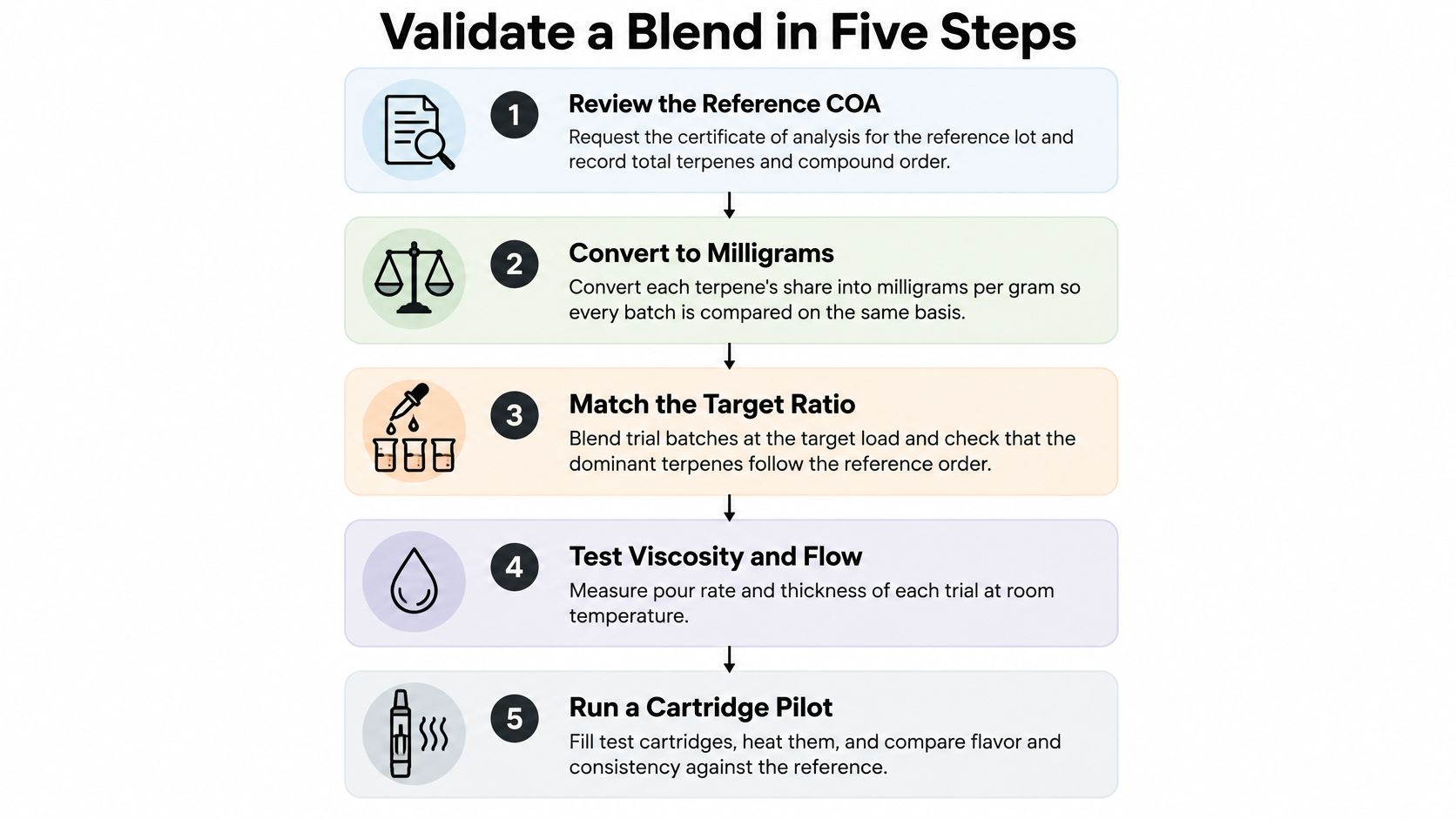
- Review the reference COA: Request the certificate of analysis for the exact reference lot and record total terpenes and compound order before you mix anything.
- Convert ranges to working bands: Turn single targets into acceptable bands around each compound, so normal weighing and lab variation don't trigger false failures.
- Run blind sensory: Use at least three panelists, code the samples, and score top, mid, and base notes separately against the retained reference.
- Send the blend for GC-MS: Check each target against its band, log deviations by compound, and correct the recipe rather than explaining away a miss.
- Pilot in real hardware: Fill the actual cartridge, run draw and leak checks, and taste after heating before you approve the SKU.
One decision rule covers conflicting results. If a blend passes GC-MS but fails blind sensory, adjust minor compounds and retest, because the main ratio is probably close. If it passes sensory but fails GC-MS, correct the recipe before the next run, because you can't release on taste alone.
The walkthrough below shows what the chromatography check behind step 4 looks like in practice.
Put the Numbers in Market Context
Commercial flower data helps you sanity-check a certificate without overgeneralizing it. A large PLOS ONE study of commercial cannabis found total terpene content averaged about 2% by weight, most individual terpenes were below 0.2% in the majority of samples and rarely above 0.5% individually, and total terpene and total cannabinoid content correlated at approximately r = 0.37, with P < 0.0001.
That context makes a 0.63% product result plausible for that item, though it doesn't make it a universal Banana Runtz specification. Balance among compounds sets the banana, candy, fruit, and spice read, so total terpene percentage alone is a weak release criterion. For method background, the chromatography testing resource helps your team align on what the lab report can and cannot prove.
Request a trial quantity from Gold Coast Terpenes for steps 2 and 3 before you commit to bulk volume. Three coded bench trials teach you more than a large first order built on an unverified ratio.
How Loading and Heat Shift the Cartridge Profile
Terpene load sets viscosity and aerosol behavior as well as flavor. Set it in the finished device, because the oil you approve at room temperature behaves differently once the coil heats it and the customer draws.
Work from a concrete starting band rather than a vague preference for stronger flavor. The image below shows the bench stage where small weighing choices decide both flow and intensity.
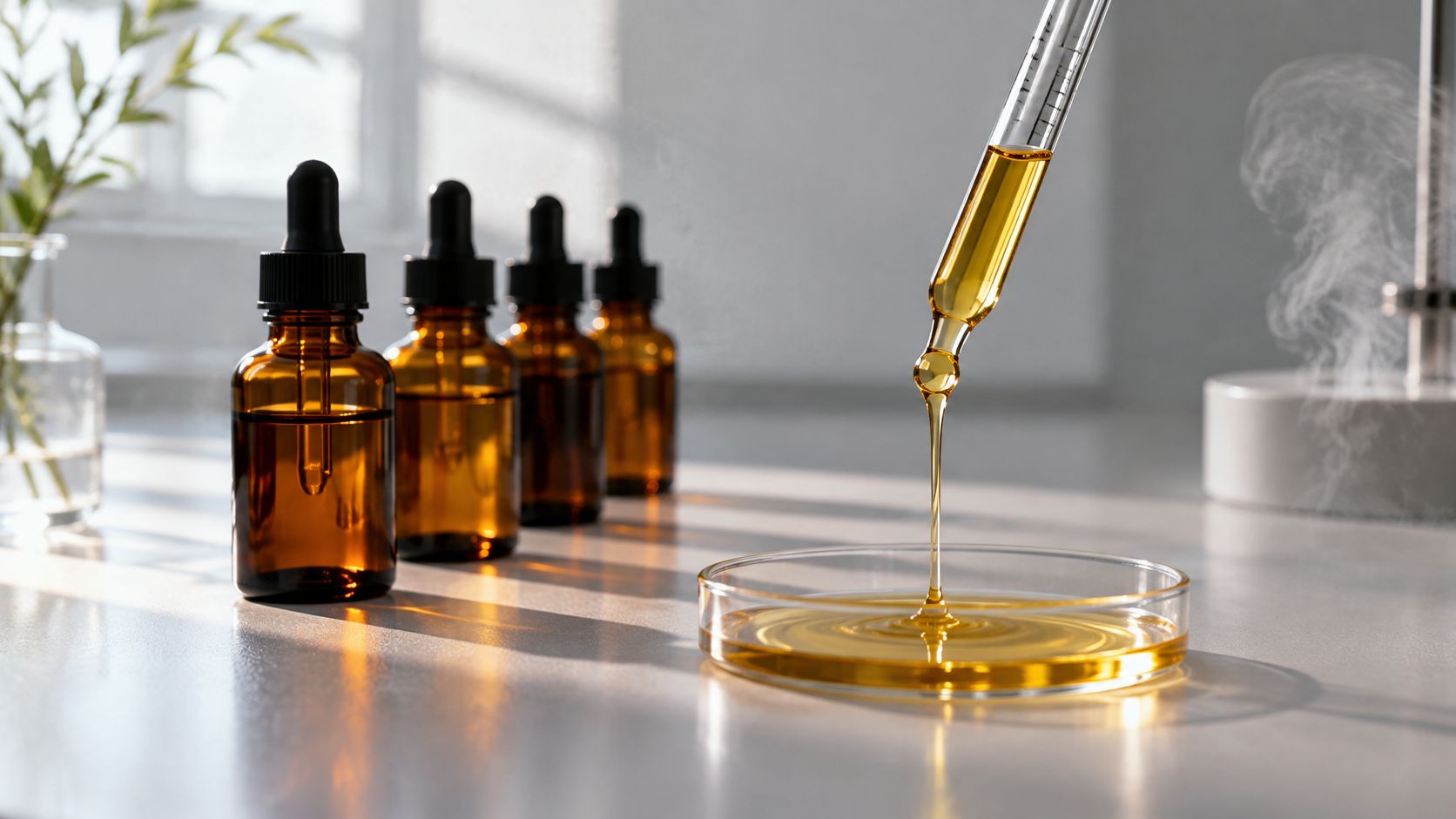
A cannabis concentrate vaping study in PMC ran a 9:1 THC-to-terpene ratio, approximately 10% terpene content in that model, and kept the material fluid enough to wick without leaking from the pen. Anchor your first bench trials near that band for a terpene profile for cartridges, then let your own fill and draw data move it.
Terpenes moderate cannabinoid viscosity, so load changes fill behavior as much as taste. Low loading leaves oil thick and aroma faint on the draw. High loading thins the oil and raises leak risk. Coil resistance, intake hole size, distillate viscosity, and fill temperature each move the practical ceiling, which means the same blend can pass in one cartridge and fail in another.
Terpene loading bands and what to check in hardware
| Terpene share | Oil behavior | Check in cartridge hardware |
|---|---|---|
| Below 10% | Viscosity rises and aroma may read faint | Draw strength and flavor after heating |
| About 10% (9:1 research model) | Balanced flow and viscosity in the study | Starting band; confirm fill and draw |
| Above 10% | Fluidity rises and leak risk increases | Leak test and wicking check |
Heat Rewrites the Profile You Mixed
Heating changes which compounds dominate the emitted vapor. A Frontiers in Chemistry study of cannabis vape oils heated oils to 200°C and found substantially more terpenes in vapor than in unheated oil, with caryophyllene, D-limonene, alpha-humulene, linalool, terpinolene, and 2-pinene among the most abundant detected compounds.
Your liquid ratio still matters, because it is the input the coil starts from. What you cannot assume is that the caryophyllene, limonene, and myrcene balance on the lot certificate reaches the customer unchanged. The boiling point of terpenes guide gives your team a concrete volatility frame for that discussion before anyone blames the blend for a device problem.
Don't approve Banana Runtz Terpenes from a scent strip. Approve them from filled hardware after heating, resting, and a second draw test.
Check fill accuracy, leakage, wicking, and draw on the exact cartridge you will sell. Then confirm the spec sheet states diluent-free status and THC-free composition for the blend, so production, compliance, and purchasing are reading the same document.
Botanical vs. Cannabis-Derived Terpenes and Supplier Selection
The label on the terpene drum commits you to a sourcing and compliance position, so settle it before flavor matching goes too far. Gold Coast Terpenes labels its blends 100% botanically derived, not cannabis-derived, and your spec sheet should carry that exact distinction into finished-product files.
Botanical terpenes come from non-cannabis plant material and should be documented as THC-free by lot. Cannabis-derived terpenes come from cannabis input, so they carry the regulatory weight of that input in storage, transfer, and sale. Nature-identical compounds are synthesized to match a natural molecule, and they must be labeled that way, never as botanical.
Botanical, cannabis-derived and nature-identical labels
| Label | Source | Compliance note |
|---|---|---|
| Botanically derived | Non-cannabis plant material | Confirm THC-free status and lot COA |
| Cannabis-derived | Cannabis flower or extract | Treat as cannabis input; check state sale rules |
| Nature-identical | Synthesized to match a natural molecule | Label as nature-identical, never botanical |
That distinction also affects reproducibility, which is central to the botanical vs. cannabis-derived terpenes decision. The CDT vs. BDT comparison gives buyers a direct frame for that choice, especially when a brand needs the same Banana Runtz profile across multiple production runs.
Ask Every Supplier the Same Five Questions
I would compare at least three suppliers on identical criteria before choosing a strain-inspired terpene blend partner. Price per milliliter tells you very little if the certificate package is weak.
- Lot COA: Can the supplier provide a certificate of analysis for this lot from a named accredited laboratory, not a generic template?
- Safety fields: Does each certificate show residual solvent results and THC-free status in a form your compliance team can file?
- MOQ and trial size: What's the MOQ by SKU, and can you buy a trial quantity for sensory and GC-MS validation first?
- Additive statement: Will the supplier confirm in writing that the blend contains no VG, PG, PEG, or MCT?
- Label fit: Does the supplier's botanical or nature-identical language match your state's labeling rules for the finished product?
Score the answers in writing. If a supplier can't answer the COA or additive questions clearly, don't let a strong bench sample carry the decision. Flavor matching only matters if you can document and reorder the same material.
Confirm the Profile Before You Order or Launch
Approve the SKU only when blind sensory, GC-MS against your bands, and cartridge hardware testing all pass. Launch requires all three checks; two of three means retest. When a check fails, apply the single-variable fix path from the validation section and retest that element alone rather than rewriting a recipe that already passed on the bench.
Work through Gold Coast Terpenes in a controlled order. First, request the current certificate for the Banana Runtz reference lot and confirm SC Lab testing and THC-free status before any purchase order goes out. Second, model loading in the Mixing Calculator and record your exact trial weights so the winning bench run can be repeated by someone who wasn't in the room. Third, review the Terpenes 101 guide with everyone scoring samples, so top, mid, and base language means the same thing across the panel.
Fourth, compare the certificate against the Banana Runtz product page as a sensory target rather than a guaranteed composition. The related flavor-hybrid strain page shows how that range presents individual profiles for buyers comparing options. Fifth, order a trial quantity and run it in your distillate and hardware before any bulk commitment.
Gold Coast Terpenes offers wholesale and bulk programs, but scale only after the trial passes. Get pack size, reorder terms, and the MOQ for your SKU in writing, so purchasing holds volume until formulation signs off.
Banana Runtz Terpenes Questions Formulators Ask
Does Banana Runtz Have a Standardized Terpene Profile
Anchor the spec to a lot-level certificate of analysis and write every line as a target plus a tolerance. A release spec for this profile needs at least these fields:
| Spec line | What to record |
|---|---|
| Reference lot | Lot number and COA date that define the match |
| Core compounds | Weighed targets for caryophyllene, limonene, and myrcene |
| Floral accent | Linalool held to a small, capped range |
| Tolerance | Pass/fail band around each target, tightest on the dominant compound |
| Method | GC-MS on incoming material and finished oil |
| Requalification | Triggered by every new lot, distillate batch, or hardware change |
The last row matters most at reorder: a new lot enters as an unqualified input until it clears the same table.
Which Terpenes Define the Profile in Formulation
Read the COA's ranking before its numbers. Caryophyllene, limonene, and myrcene should hold their order with linalool trailing as the floral accent; a lot where myrcene outranks limonene is a different expression of Banana Runtz. Accept or reject on ratio order before you spend time tuning absolute values.
What Load Should I Start With for Distillate Carts
Hold the blend constant while you vary load, so dilution rather than a recipe change explains any flavor shift. Judge each level on fill behavior, wicking, leakage, and heated flavor in your own hardware. Log trial weights alongside coil model and rest time so the winning run reproduces at scale.
Does Heat Change the Emitted Profile
Score the device at first pull, mid-tank, and near-empty, since coil heat history shifts what reaches the user across the cart's life. Listen for the top-note lift thinning and for harshness building late in the tank. Comparing heated scores against the same lot's liquid panel tells a formulation gap apart from a device problem before you choose which to fix.
Where Does Gold Coast Terpenes Fit in Sourcing
Gold Coast Terpenes supplies 50+ 100% natural, THC-free profiles, including Banana Runtz, with SC Lab-tested documentation and safety documents available on request. The botanical designation keeps the blend distinct from cannabis-derived and nature-identical inputs in your compliance file. When a trial lot needs a nudge, matching isolates such as limonene, myrcene, or beta-caryophyllene let you correct one compound without rewriting the profile. Start with a trial order and scale once sensory, GC-MS, and hardware checks pass.
Gold Coast Terpenes offers botanically derived, THC-free Banana Runtz terpenes and matching isolates for distillate and cartridge work. Send your spec sheet and reference lot number with the order so incoming documentation lands against your release table. Visit Gold Coast Terpenes to start with a trial quantity and build your specification from measured results.