
A winterized distillate can look clean and consistent while carrying little of the aroma that made its source material distinctive. Gold Coast Terpenes, a Redondo Beach, CA supplier of 100% botanically derived terpene blends rather than cannabis-derived material, offers isolates that formulators can evaluate when rebuilding a flavor profile calls for a specific note, not another generic citrus or pine addition.
For cartridge and distillate developers, alpha-bisabolol is a targeted refinement ingredient. Its soft woody-floral character can help round a strain-inspired terpene blend when sharper isolates push the aroma too far. The practical job is to identify the material precisely, place it in the note structure, test it in the actual oil, and document the decision. That means treating aroma, formulation behavior, and exposure documentation as separate questions, not turning biological research into a product claim.
Why Does Alpha Bisabolol Terpene Matter in a Blend
Alpha-bisabolol matters when a rebuilt distillate needs a soft floral, woody finish without adding more sharp citrus or pine character. For developers designing a strain-inspired terpene blend for vape cartridges, it can serve as a small but distinctive part of the flavor match rather than the dominant structure.
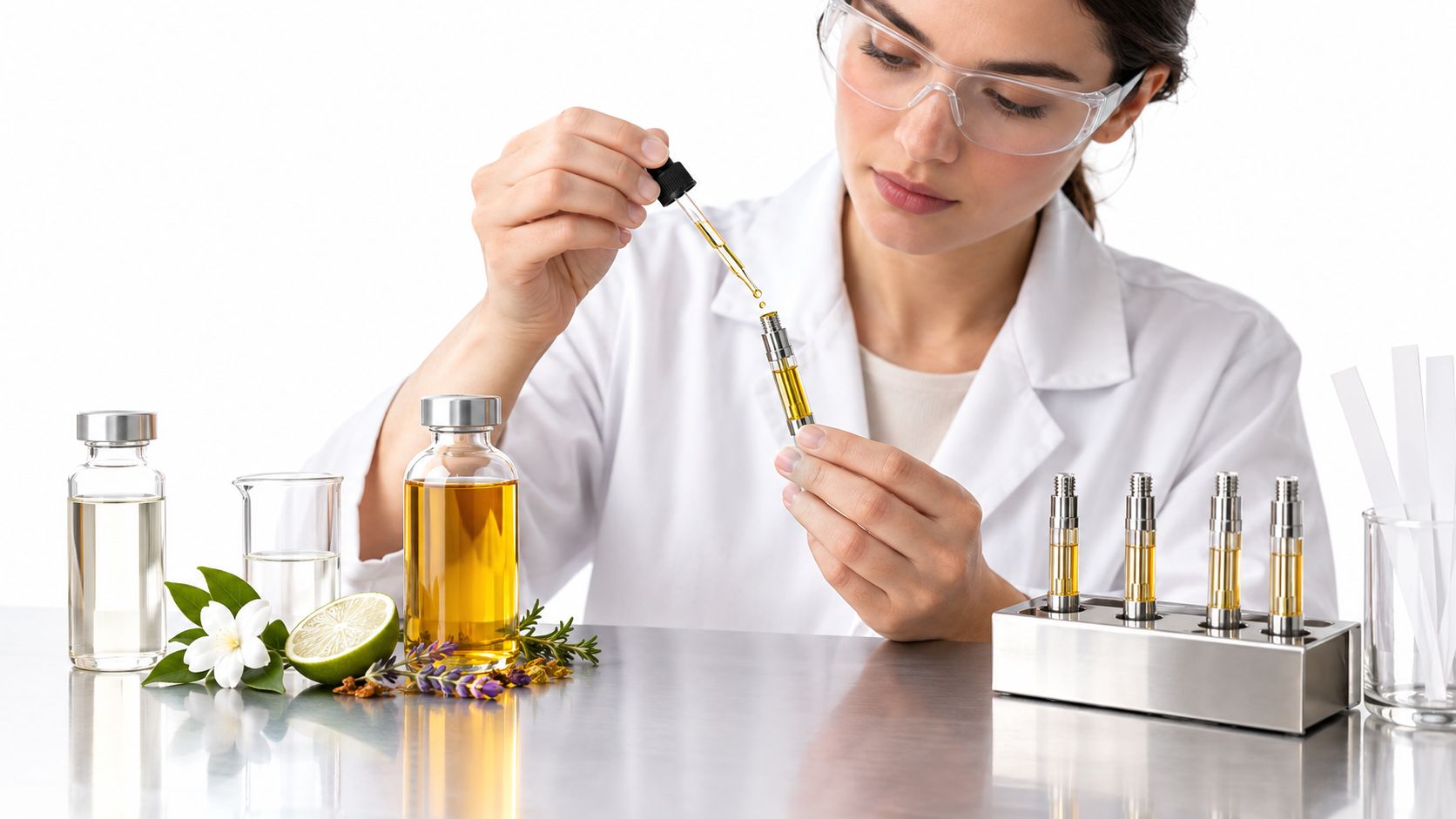
Rebuild the missing part, not the whole profile
A common formulation problem starts after volatile components have been removed or reduced during processing: the distillate base is usable, but the finished oil no longer carries the source material's aromatic shape. Adding a broad, bright terpene blend may create aroma, yet it can also make the result smell more citrus-forward or pine-like than the reference.
Alpha-bisabolol has a different sensory role. It's associated with a mild woody-floral or sweet-floral odor, making it a candidate when the target has a softer, chamomile-leaning tail. That doesn't mean it can reproduce a cultivar profile on its own. The reference's dominant notes still need to come from measured data and sensory comparison.
Match the target, then choose the isolate
A useful brief describes the gap in the finished oil: a floral dry-down is missing, or the aromatic balance is too sharp. The formulator can then assess whether alpha-bisabolol belongs in a custom terpene profile for distillate, rather than adding it just because it appears in a compound list.
Formulation principle: Buy and test an isolate to solve a defined sensory problem. Don't use a botanical association as a substitute for a flavor target.
Gold Coast Terpenes' botanical blends and isolates are one possible sourcing route for a brand comparing custom additions with ready profiles. The commercial question isn't whether the ingredient sounds familiar. It's whether it helps the finished oil approach the reference without compromising the intended balance.
The working takeaway is straightforward: alpha-bisabolol is a refinement ingredient for flavor accuracy. Its place in a blend depends on the target aroma, the oil matrix, and the evidence the product team can document.
What Defines Alpha Bisabolol Chemically
A formulation record needs to identify the isolate precisely, especially when strain replication depends on a consistent, heavier base-note material. Alpha-bisabolol is a sesquiterpene alcohol with the formula C15H26O and a molar mass of approximately 222.4 g/mol. The naturally occurring levorotatory enantiomer is also called levomenol. The listed identifier is CAS 515-69-5, but the linked compound identifiers document carries a different CAS number. Do not use it to verify CAS 515-69-5; confirm the identifier against the supplier's lot-specific documentation.
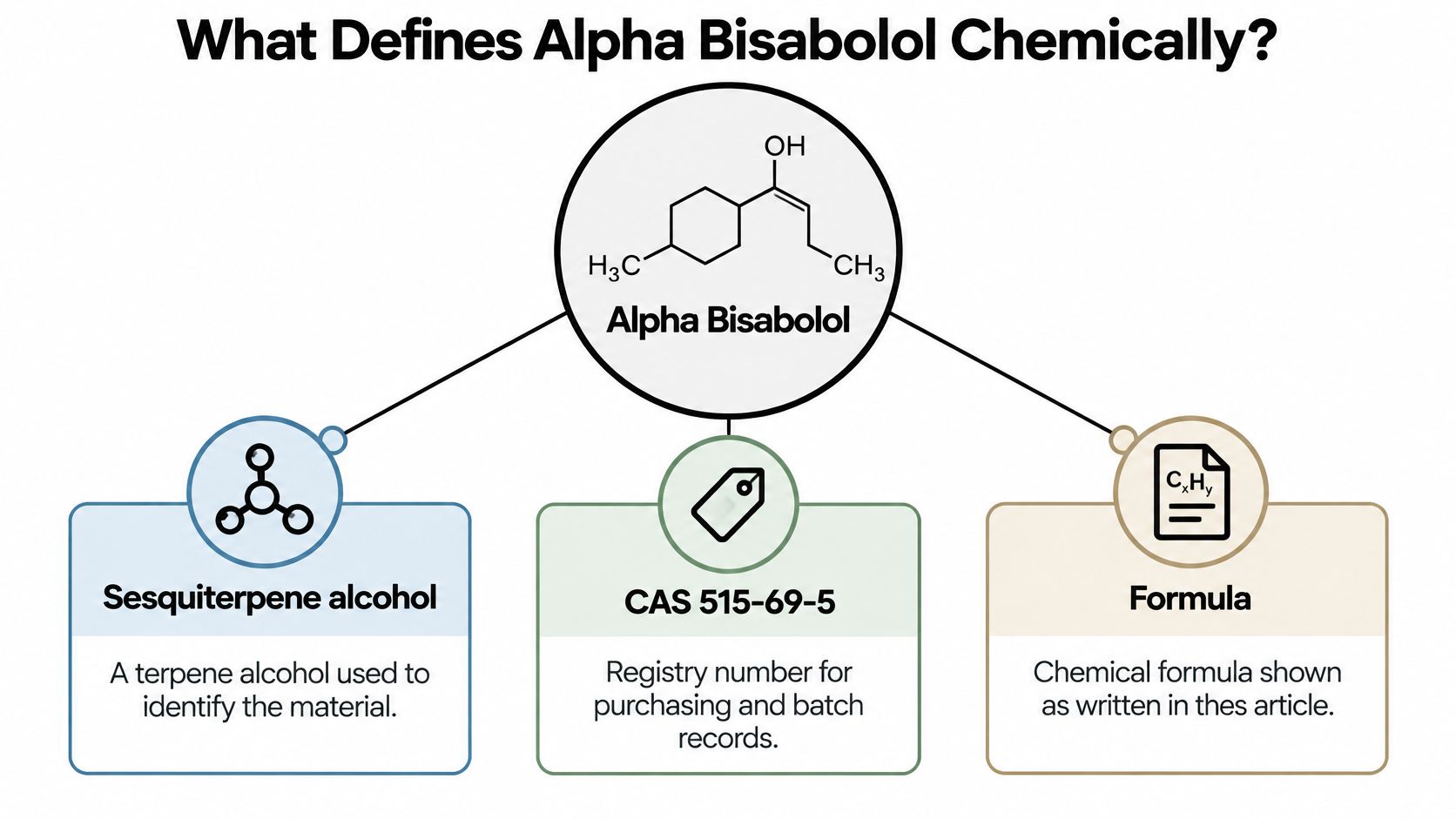
Specify the isolate, not just the family name
Alpha-bisabolol is assembled biosynthetically from three isoprene units, distinguishing it from lighter monoterpenes such as limonene and myrcene. That chemical distinction supports its use as a heavier base-note isolate, but it does not establish how it will behave in a particular distillate.
Do not confuse it with bisabolene. They are different compounds, so “bisabolol” alone is too vague for a purchasing specification. Require the chemical name and confirmed CAS number on the certificate of analysis and formulation record.
Keep stereochemistry and source in view
Alpha-bisabolol has been identified in German chamomile, candeia, several Salvia species, and Vanillosmopsis species. Botanical origin helps describe sourcing, but it does not verify identity, purity, or suitability for inhalation. Missing inhalation-specific evidence is a compliance gap, not a reason to infer product safety from a plant association.
Natural levomenol is levorotatory. A chemical and physical profile reports an optical rotation near [α]D −55.7 (chemical and physical profile). If enantiomer identity matters to the target or specification, document it and request supporting batch records rather than relying on the general ingredient name.
A practical record can specify: Alpha-bisabolol (levomenol when the natural levorotatory enantiomer is specified), CAS 515-69-5, C15H26O, approximately 222.4 g/mol. Attach the supplier's lot-specific identity and purity documentation before the material enters a blend.
Where Does Alpha Bisabolol Sit in a Terpene Profile
If a strain-inspired blend opens with a sharp citrus impression but loses its softer character on the dry-down, alpha-bisabolol may help fill that gap. It functions as a soft, heavier base note, contributing a mild woody-floral or sweet-floral character rather than driving the blend's citrus or pine. Its reported density is about 0.93 g/mL. It is described as a colorless, lipophilic, volatile liquid, and its density and reduced-pressure boiling point are useful physical references for formulation records (physical and sensory characteristics).
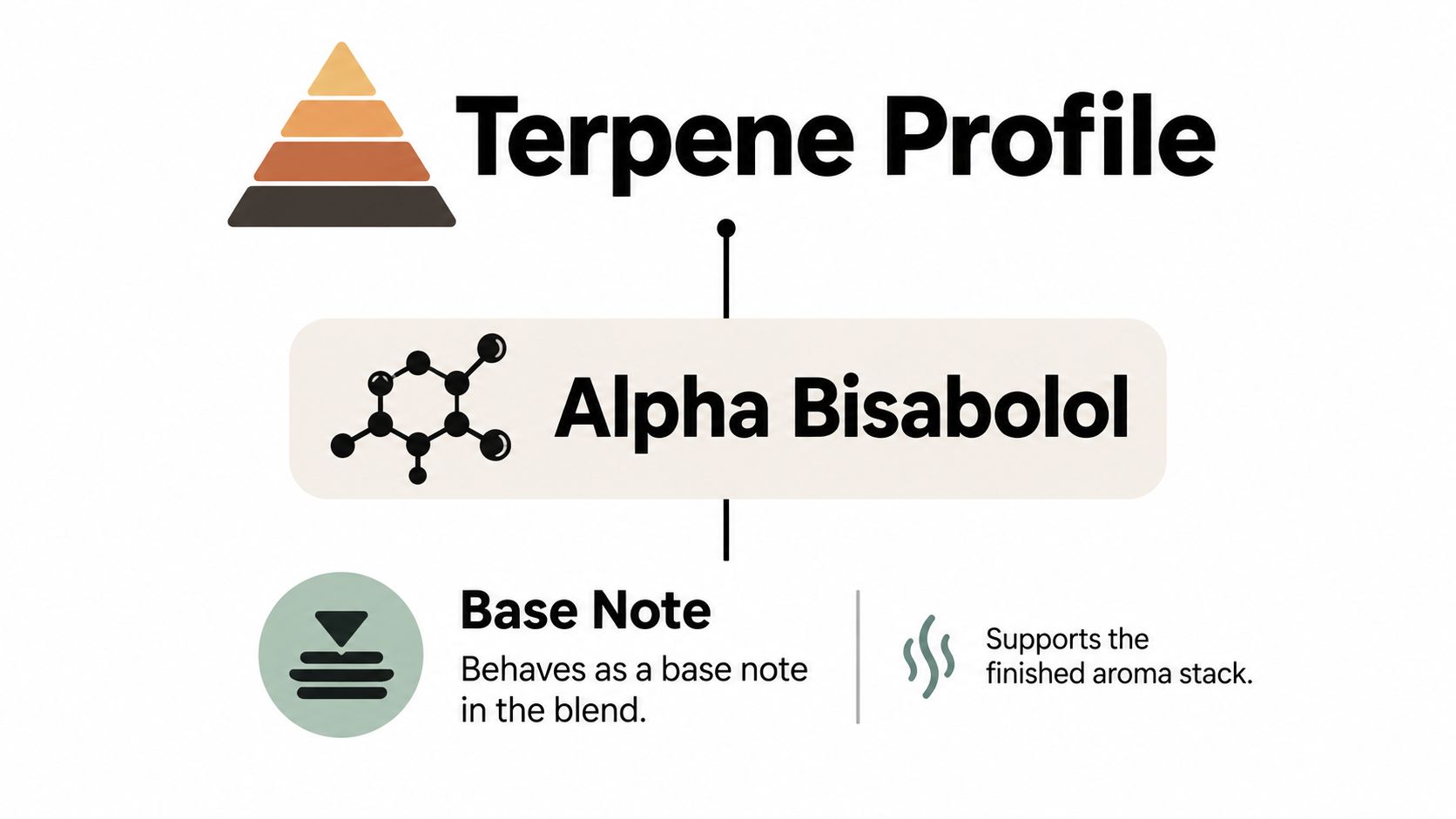
Build the note stack in layers
Map the blend by the role each group of compounds plays in the aroma:
- Top notes: Brighter compounds such as limonene set the first impression. If they dominate, the profile can read sharply citrus-forward.
- Mid notes: These give the aroma body and connect the opening to its more persistent character.
- Base notes: Alpha-bisabolol can support a softer, chamomile-like dry-down, adding floral-woody depth without becoming the blend's main aromatic structure.
Chamomile offers a sensory comparison, not a formula. A pharmacological review reports that (-)-alpha-bisabolol can make up as much as 50% of chamomile essential oil, with the proportion varying by species, genetics, geography, growing conditions, harvest, and extraction (review of alpha-bisabolol research). That variability helps explain the floral association. It does not make chamomile oil a cartridge recipe or mean that every chamomile-like target needs the same ingredients.
Use the dry-down to diagnose imbalance
When a blend reads too sharp, check whether the top-note structure overwhelms the softer tail. Retain a reference batch, run a side-by-side panel, and adjust only the supporting notes. This keeps changes tied to the target profile instead of aroma vocabulary alone.
The reported boiling point is about 153 °C at 12 Torr. That is a reduced-pressure measurement, not an operating instruction for a cartridge or distillation process. Use it as a property to document, then assess aroma under the actual processing and storage conditions for the blend.
For strain replication, place alpha-bisabolol where the retained reference calls for a softer, more persistent base. Keep brighter ingredients responsible for the opening and the mid-range responsible for body. Confirm the sensory match in the oil, not on paper.
How Should Formulators Add Alpha Bisabolol to Distillate
Add alpha-bisabolol as a minor identity compound in the terpene fraction, then validate viscosity, phase stability, sensory impact, and aerosol behavior in the actual distillate or cartridge matrix. There's no universal percentage that works across every oil.
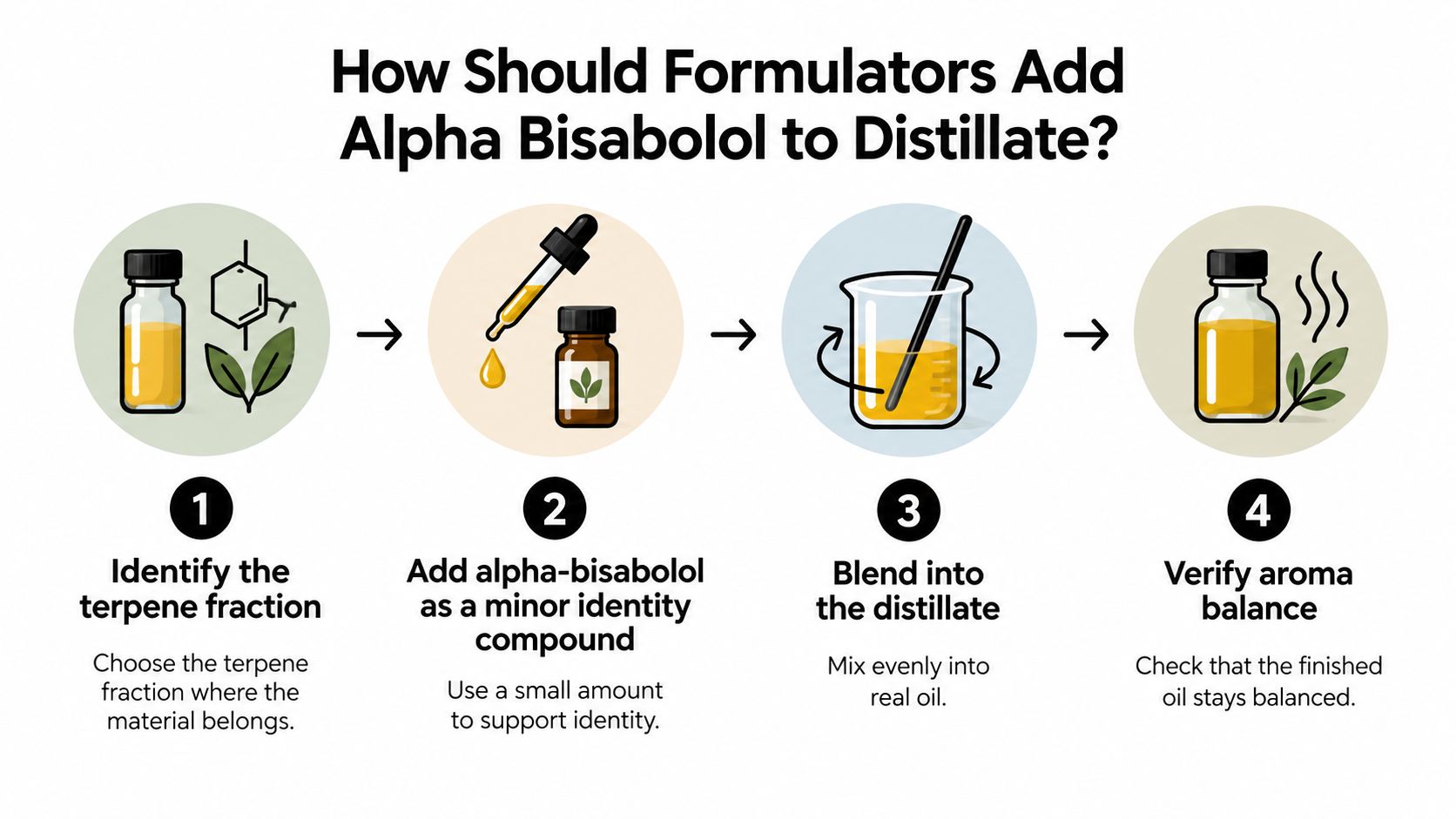
Use a repeatable matrix-first process
A conservative development sequence keeps ingredient identity and finished-product performance connected:
- Confirm what arrived. Check the incoming isolate's chemical name, CAS, and purity documentation against the purchase specification.
- Define the target. Decide whether the job is to reinforce a strain-inspired terpene blend or make a single-note adjustment to an existing profile.
- Blend into the actual base. Disperse the isolate in the terpene fraction and evaluate it in the winterized distillate or concentrate that the brand intends to use.
- Rest and compare. Allow the blend to settle according to the team's established process, then compare it with a retained reference rather than relying on a strain name alone.
- Verify the finished matrix. Check aroma, viscosity, phase behavior, and aerosol performance using the finished oil and relevant product testing.
Treat delivery claims as a separate question
Lipophilicity doesn't demonstrate better uptake, potency, or bioavailability in a vape oil. In a 2024 buccal-delivery study, alpha-bisabolol at 0.9% and 1.8% didn't improve prilocaine or lidocaine hydrochloride permeation or retention across porcine esophageal epithelium, despite prior reports in other models (buccal-delivery study). That finding doesn't dictate cartridge performance. It does show why results from one formulation and tissue model can't be carried over to another.
Gold Coast Terpenes describes its terpenes as THC-free and lab-verified, formulated without VG, PG, PEG, and MCT. A brand can assess those materials while retaining control over its own oil and carrier choices. For practical formulation support, consult the terpene mixing guide, then use Gold Coast Terpenes' Mixing Calculator and Terpenes 101 resources through its website.
Practical rule: Treat every trial as a matrix-specific test. A result in a different oil, tissue model, or delivery route doesn't establish performance in your cartridge.
The output of this process is a documented test plan: the target, the batch identity, the actual matrix, the sensory comparison, and the finished-oil observations. It's not a universal inclusion rate or a pharmacological promise.
How Does Alpha Bisabolol Support Strain-Inspired Blends
A strain-inspired blend can match a fruit-forward opening and still miss the reference on the finish. Alpha-bisabolol is a candidate for that quieter floral, woody base note, not a substitute for the compounds that define the profile. A survey of 240 Cannabis sativa cultivars identified it among the 20 most abundant detected terpenes, while myrcene, beta-caryophyllene, and d-limonene were generally more abundant (cultivar terpene survey).
Let the dominant compounds set the architecture
For formulation, that relative abundance points to a refinement role. Start with the main aromatic structure indicated by the chromatogram and target sensory profile. Consider alpha-bisabolol when the reference's dry-down calls for a soft floral-woody contribution, then assess whether the finished blend retains the intended identity.
A flavor-matching session might begin with three distinct targets:
- Fruit or dessert reference: Keep the dominant fruit character in focus; test a restrained floral tail only if the finish supports it.
- Chamomile-adjacent hemp or CBD oil: Aim for a gentle floral shape, without letting sharp pine notes dominate.
- Rebuilt distillate: Use analytical results and sensory comparison to reconstruct a profile after native terpenes have been reduced or removed.
Gold Coast Terpenes' strain terpene profiles provide catalog comparisons, including named profiles such as Blue Dream, OG Kush, Forbidden Fruit, and Green Crack. The Apple Fritter profile in its strain product range is another catalog example, described as a flavor profile without specifying alpha-bisabolol content (Apple Fritter profile). These examples can help frame sensory comparisons, but a strain name or catalog description does not establish isolate content.
| Blend job | What alpha-bisabolol contributes | What not to assume |
|---|---|---|
| Fruit or dessert refinement | A soft floral-woody tail when the target calls for it | That a floral finish proves alpha-bisabolol is present in the reference |
| Chamomile-adjacent profile | A gentle floral direction for sensory evaluation | That chamomile oil itself is suitable for a cartridge formula |
| Distillate reconstruction | A candidate refinement ingredient when target data supports it | That a strain name alone defines terpene composition |
Brief the session around the dominant measured structure first. Add alpha-bisabolol only when the reference chromatogram or dry-down supports that choice, then compare the finished blend with the same sensory target. Treat isolate identity and the finished profile as separate documentation points. A label-level mention is not compositional evidence.
Why Is Botanical Origin Not Enough for Cartridge Safety
A botanical isolate may have a familiar aroma and a long cosmetic research history, yet cartridge use calls for separate evidence. Alpha-bisabolol's heavier base-note role can support strain replication and flavor accuracy; it does not establish inhalation safety. For developers, missing inhalation data is a documentation and compliance issue that needs to be addressed in the product review.
Separate handling guidance from route-specific evidence
Fisher Scientific classifies bisabolol as hazardous under OSHA's Hazard Communication Standard, warns against breathing vapors, mist, or spray, and notes possible allergic skin reactions. BASF's 2025 safety sheet says vapor may form an explosive mixture with air and recommends respiratory protection when aerosols are released (supplier safety documentation). These documents inform handling and risk assessment. They do not establish the ingredient's effects when inhaled from a cartridge.
Research findings also need to be kept within their tested context. Reviews describe anti-inflammatory, antioxidant, antimicrobial, and other mechanisms, while historical animal research examined skin responses and topical burn healing. Such results are not human vape outcomes or evidence of a cartridge benefit.
Build documentation around the finished product
A 2025 mouse study found reduced scratching in a histamine-induced itch model, but not in a chloroquine-induced non-histaminergic model; the vehicle also affected observed activity (mouse itch study). This is biological research, not a product claim. It does not establish vape effects, human dosing, or a generalized relaxation benefit.
For cartridge development, the review packet should address the actual formulation and intended product:
- Identity and purity: Chemical name, CAS, supplier lot, and supporting identity and purity documents.
- Impurity and allergen information: Residual-solvent data and ingredient-relevant allergen declarations.
- Physical hazard information: Flash-point and flammability details, plus storage guidance.
- Finished-product evidence: Testing and observations for the brand's formulation and intended use.
Gold Coast Terpenes identifies its isolates as SC Lab-tested and THC-free and provides safety documents for review. Brands should request relevant records and assess them within their own product and compliance process. The guide to terpene safety for vaping can inform that review, but product-specific assessment remains necessary.
How Should Brands Source Alpha Bisabolol and Validate a Blend
A strain reference may call for a rounded floral base note, while the working distillate needs only a measured adjustment. Source an alpha-bisabolol isolate when the target requires that specific note and control over the blend. Choose a complete strain-inspired profile when the goal is to compare or reproduce the broader aroma structure.
Compare the sourcing routes
A single isolate gives formulators control when building a custom terpene profile for distillate. A ready-made strain-inspired blend provides a direct starting point for matching a complete flavor reference. Combining a profile with an isolate can suit a house blend that needs a softer floral note, provided the final oil is assessed in its intended matrix.
Gold Coast Terpenes lists more than 50 classic and contemporary profiles and offers isolates including limonene, myrcene, and beta-caryophyllene. Its guide to choosing a terpene supplier offers a starting point for comparing suppliers. Confirm wholesale availability and purchasing terms directly, since terms may vary by product.
Before production, compare the proposed material with the internal specification and a retained aroma reference. Then check stability in the intended cartridge or distillate. A Mixing Calculator can support trial calculations, but it cannot validate a formulation or replace testing in the brand's own oil.
Questions brands should settle before ordering
How do we distinguish botanical, cannabis-derived, and nature-identical materials on a purchase order? State the claimed source and material type explicitly. Ask the supplier to document the origin and the basis for any nature-identical designation rather than relying on a broad term such as “natural.”
What belongs on an internal label besides “bisabolol”? Use the identity details established in the earlier chemistry section, then record the supplier, lot, and linked COA or specification. If the product is sold as a particular enantiomer, make that distinction clear in the purchasing and batch records.
How should a vape brand start a bulk and MOQ discussion? Share the intended application, target profile, evaluation needs, and purchasing requirements. Ask the supplier to confirm its MOQ and bulk terms for the specific isolate or blend under consideration.
When is a finished strain profile a better buy than the isolate? Choose a finished profile when the target is a complete aroma structure and the team needs a ready comparison point. Choose the isolate when sensory evaluation or reference data calls for a particular adjustment within a custom blend.
For a first trial, select the isolate or candidate profile, calculate the test quantity against the brand's oil weight, and document the material and results with the batch record. Gold Coast Terpenes provides a Mixing Calculator and safety documents for product development; review the documents relevant to the selected material and formulation.
Gold Coast Terpenes offers botanical terpene blends, strain-specific profiles, and isolated compounds for cartridge and distillate formulation. Compare an alpha-bisabolol isolate with a candidate profile at Gold Coast Terpenes, then validate the selected material in your own oil before production.