
Gold Coast Terpenes supplies natural, lab-verified, THC-free terpene blends made without VG, PG, PEG, or MCT, but buying a named blend isn't the same as buying an authenticated flower chemistry. The most common formulation mistake is treating the Strawberry Cough strain name as a fixed recipe instead of defining the aroma, testing the batch, and qualifying the finished cartridge.
What Should Formulators Know About the Strawberry Cough Strain
For Strawberry Cough formulation for vape cartridges, the useful specification is a bright berry impression with pine and pepper structure, not a promised cannabinoid percentage or effect. A cultivar name can guide sensory development, but it can't replace analytical acceptance criteria.
That distinction matters when a brand develops related vape, CBD, and cannabis products. Developers may want recognizable flavor across those products while using different cannabinoid inputs. The aroma target can remain consistent even when the oil matrix, potency specification, and finished-product requirements differ.
Published descriptions commonly present Strawberry Cough as a THC-dominant, low-CBD cultivar, but they also acknowledge substantial variation between phenotypes and cultivation batches. The practical conclusion is to verify incoming materials rather than translate a strain description directly into a production formula, as explained in this Strawberry Cough composition review.
Separate the purchasing decisions
A production-ready brief should distinguish what the terpene supplier controls from what the cartridge manufacturer must validate.
- Flavor accuracy: Define berry character, pine brightness, herbal depth, and pepper intensity against a retained reference.
- Oil performance: Evaluate the blend in the actual distillate or other intended matrix, not only in its concentrated form.
- Documentation: Request batch identity, analytical results, ingredient information, and applicable safety documents.
- Product claims: Keep flavor descriptions separate from cannabinoid potency, intoxication, and therapeutic language.
Purchasing rule: Buy a documented sensory profile. Don't buy a cultivar name as a substitute for a specification.
For botanical reconstruction, the purchasing target is straightforward: a documented blend that delivers the intended berry, pine, and pepper balance without relying on cannabis-derived cannabinoids. The cannabinoid input belongs on its own specification and test record.
Supplier education, strain-specific guidance, and mixing tools can support that work, but they serve different purposes. A guide helps define terminology, a calculator helps document additions, and a batch certificate identifies the tested material. None independently establishes that a finished cartridge is suitable for release.
Where Did the Strawberry Cough Strain Lineage Start
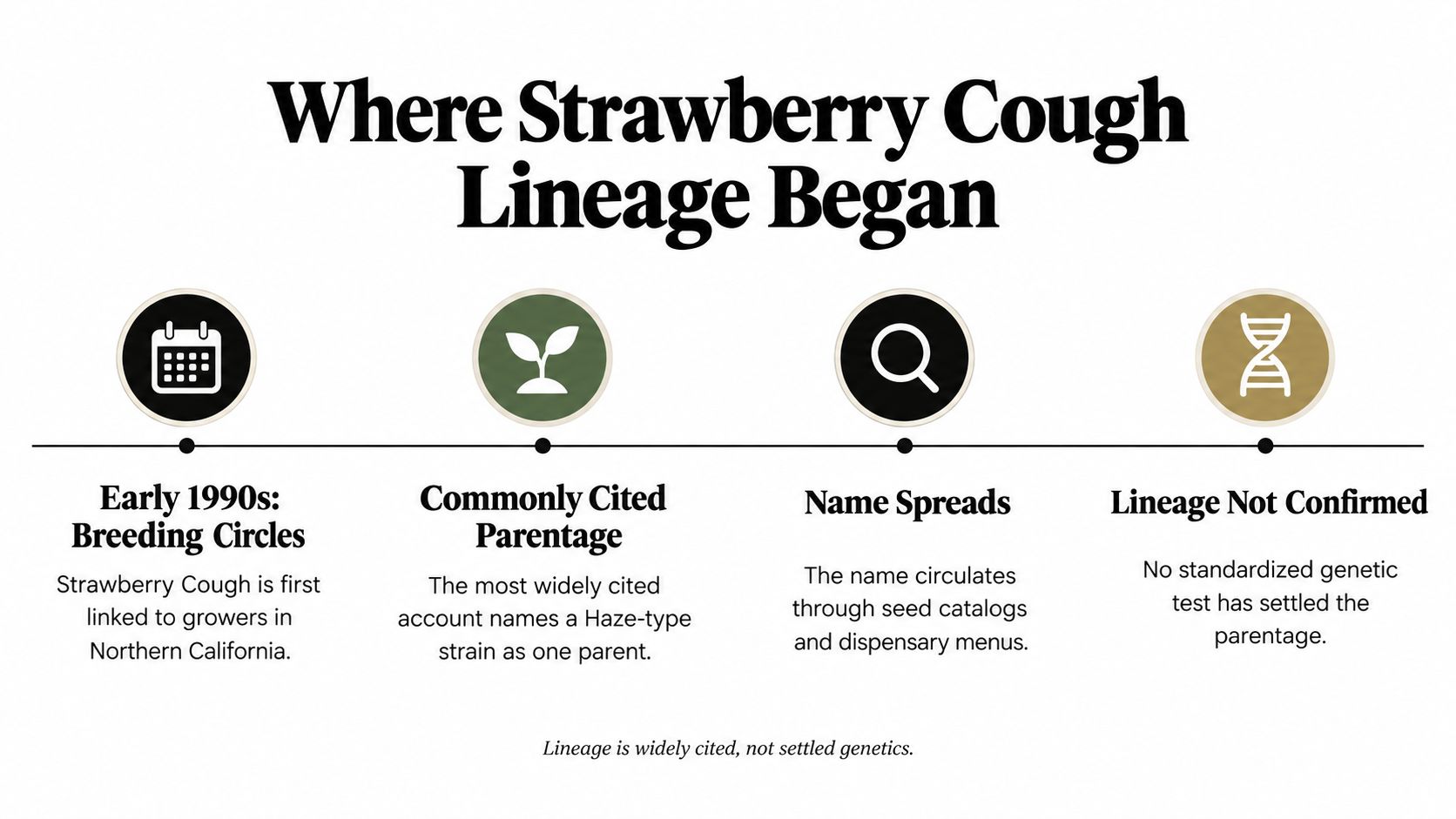
The most widely cited account places Strawberry Cough's documented clone history in Bridgeport, Connecticut, rather than in a verified genetic registry. Its association with Kyle Kushman is useful historical context, but it doesn't authenticate the chemistry of a current commercial batch.
According to the widely cited Strawberry Cough historical account, Kushman reportedly received a clone while helping a cultivation operation in 1999. The same account identifies Strawberry Fields crossed with Haze as the commonly cited lineage and describes his 2004 move from New York to California, during which he distributed clones to contacts across multiple states.
That informal distribution helps explain how a regional plant became a nationally recognized name before regulated cannabis markets existed. It also explains why modern buyers shouldn't expect every product bearing the name to trace back through a controlled chain of authenticated plant material.
Heritage language needs qualification
The historical reference describes the familiar 80% sativa and 20% indica classification as a breeder and marketing convention, not a standardized genetic measurement. Its description of a pronounced strawberry-associated aroma and an uplifting reputation belongs to the cultivar's heritage, not to a guaranteed finished-product outcome.
For brand education, distinguish carefully between these statements:
- Reasonable historical wording: The cultivar is commonly associated with Kushman and widely described as Strawberry Fields crossed with Haze.
- Unsupported authentication: A modern botanical reconstruction contains the original clone's exact chemistry.
- Inappropriate performance promise: A sativa designation guarantees focus, energy, or a particular psychoactive response.
The Strawberry Cough indica-or-sativa discussion can provide additional classification context, but classification still shouldn't function as a purchasing specification.
The lineage visual below should be read as an illustration of historical uncertainty, not as independent verification of an earlier origin or settled parentage.
A botanical reconstruction doesn't need to resolve that history to be commercially useful. It does need honest positioning: strain-inspired flavor, defined ingredients, and current batch documentation rather than an implied genetic pedigree.
Which Terpenes Shape a Strawberry Cough Strain Blend
A practical terpene profile for Strawberry Cough combines pine-led brightness, a fruity or herbal middle, and a warmer peppery foundation. Treat these as sensory roles, not proof that every authentic plant must share the same dominant compound.
General descriptions frequently identify myrcene, pinene, and beta-caryophyllene, with additional compounds varying by phenotype. The Leafwell Strawberry Cough terpene description also explains why genetics, harvest timing, drying, storage, and extraction can change the fingerprint.
Read the panel as architecture
One published concentrate provides a useful counterweight to a fixed, myrcene-first narrative. Its Strawberry Cough concentrate certificate reports 75.4% total terpenes, with the individual results shown below; these are shares reported for that tested material, not recommended additions to cartridge oil.
Strawberry Cough Strain Note Roles from One Concentrate COA
| Note role | Reported compound | Share in that panel | Formulation job |
|---|---|---|---|
| Top | Alpha-pinene | 23.3% | Pine brightness and a defined aromatic opening |
| Mid | Beta-myrcene | 18.9% | Herbal depth beneath the berry impression |
| Top | Beta-pinene | 10.5% | Additional fresh, pine-associated structure |
| Base | Beta-caryophyllene | 9.45% | Warm pepper character and contrast |
| Top and mid | Limonene | 7.48% | Citrus lift supporting the fruity impression |
| Minor modifier | Alpha-humulene | 2.52% | Supporting earthy structure |
| Minor modifier | Linalool | 2.36% | Floral nuance within the broader profile |
Think of the note structure like a fragrance brief. The opening must be recognizable without overwhelming the body, while the base should add definition without making the result predominantly spicy.
The practical trade-off is brightness versus fidelity. Increasing pine or citrus may make a sample more immediately aromatic, yet move it away from the desired berry-centered balance. Removing too much herbal or peppery structure can produce a simpler sweet profile that no longer resembles the intended target.
A more intense aroma isn't necessarily a closer match. Protect the relationship between notes before increasing total intensity.
Brief the blender in sensory terms
Ask the blender to preserve the berry impression through dilution, control pine sharpness, and retain enough peppery contrast to avoid a flat finish. Don't assume myrcene alone supplies a complete strawberry flavor, or that minor modifiers should be increased only because they appear on a certificate.
The accompanying video is supplementary context, not a replacement for a batch-specific analytical reference.
A concentrate panel, flower panel, and finished cartridge panel describe different materials. Copying a concentrate's reported percentages directly into a vape formulation confuses a reference fingerprint with a finished-product recipe.
Why a Strawberry Cough Strain Name Is Not a Formula
Commercial Strawberry Cough products aren't one chemically uniform material. Their shared name doesn't establish equivalent cannabinoids, terpene content, extraction history, or intended use.
The available commercial paperwork includes 0.270% total CBD on one cartridge certificate, 0.142% CBD on another product certificate, and a separate 70.5% THC-related result for a highly modified cannabinoid cartridge, as summarized in the Strawberry Cough cartridge documentation. These figures concern different products and laboratories, so they must not be presented as a controlled comparison of flower genetics.
The interpretation matters more than the apparent precision. Before comparing results, identify the matrix, analyte, reporting basis, and method. A result associated with a modified cannabinoid cartridge isn't interchangeable with total THC measured in conventional flower.
Replace name-based approval with an intake checklist
A useful incoming-material review should include:
- Dominant compounds: Compare the actual terpene distribution with the approved reference.
- Minor constituents: Check whether supporting compounds are present, missing, or materially different.
- Cannabinoid identity: Distinguish conventional delta-9 THC from other cannabinoid formulations.
- Analytical context: Record the laboratory, method, reporting units, and tested matrix.
- Traceability: Match the certificate to the delivered lot and supplier documentation.
- Sensory descriptors: Record berry, pine, herbal, pepper, and citrus character separately from effect language.
This also changes how developers compare flavor systems. A strain-specific reconstruction, a terpene-enhanced flavor, and conventional e-liquid flavoring shouldn't be approved as interchangeable inputs; the comparison of terpene profiles and flavoring categories helps frame that distinction.
Sativa isn't an analytical result
A broader 2025 analysis of 140 medicinal cannabis flowers in Germany found no statistically meaningful relationship between sativa, indica, or hybrid classifications and terpene composition, a finding discussed in the Royal Queen Seeds Strawberry Cough profile. That supports a limited conclusion: classification labels aren't reliable substitutes for compositional testing.
For commercial positioning, berry-forward, sweet, and sativa-associated describes a sensory and historical target. Guaranteed energy, focus, or predictable psychoactivity claims go beyond what the name and terpene panel establish.
How Do You Replicate Strawberry Cough Strain in Vape Cartridges
Replicate the profile by matching a documented reference, then evaluating the diluted blend in the intended oil and hardware. Select the lowest terpene concentration that achieves the approved sensory target and passes finished-product qualification.
Begin with a retained reference and a written description of the desired opening, body, and finish. Compare candidate materials using GC-MS terpene fingerprints, then assess aroma after dilution rather than approving the concentrated blend alone.
The relevant testing environment is the actual oil system, not an isolated aroma sample.

Treat published loads as context, not instructions
A review of cannabis vaping research reports approximately 10–20% terpenes by weight in common cannabis electronic cartridges and estimated aerosol concentrations of 2,500–5,000 ppm total terpenes. The same review discusses sensory irritation, airflow limitation, and inflammatory responses in animal studies at substantially lower ambient exposures, and identifies linalool, dipentene or racemic limonene, and citral as particularly radical-generating flavorants in an in-vitro analysis.
Those findings don't establish a universal safe loading limit. They do rule out treating stronger aroma as sufficient evidence of a better formulation.
Research has also modeled a 9:1 THC-to-terpene mixture to balance viscosity and vaporization without added solvents, as described in this cannabis concentrate vaping research. That experimental mixture isn't a house recipe or blanket recommendation for other oils and devices.
Qualify the oil and device together
Use controlled bench trials in the intended winterized distillate or other validated matrix. Keep the cannabinoid input and hardware consistent while evaluating candidate terpene loads.
- Sensory fidelity: Compare diluted samples against the retained target without identifying the candidate to evaluators.
- Physical behavior: Assess viscosity, consistency, and performance in the selected cartridge.
- Thermal performance: Evaluate coil behavior and device temperature under the chosen test conditions.
- Stability and emissions: Examine oxidation, storage changes, harshness, and finished-product emissions through appropriate laboratory testing.
The practical guide to using terpenes can support handling and mixing preparation, but supplier instructions don't replace device-specific qualification.
Terpenes shape aroma and flavor; they don't independently create cannabis intoxication. Keep that separation visible in development records, packaging review, and sales training.
How Should Brands Choose a Strawberry Cough Strain Terpene Supplier
Choose a supplier by documentation, source transparency, sensory repeatability, and support for your intended application. The right purchase depends on whether you need individual-component control, a particular cannabis extract, or a botanical strain-inspired reconstruction.
Reconstructing from isolates gives developers direct control over compounds such as limonene, myrcene, and beta-caryophyllene. The trade-off is development responsibility: matching major compounds alone may leave the profile lacking the minor constituents needed for a convincing sensory result.
Buying cannabis-derived material can anchor development to a particular extracted batch. Require its actual cannabinoid results and compositional documents rather than assuming that cannabis origin guarantees either authenticity or freedom from cannabinoids.
Buying a botanical strain-inspired blend separates the sensory purchase from the cannabinoid input. Ask the supplier to distinguish botanical origin from nature-identical chemistry, and require ingredient descriptions that support the intended labeling.
Compare documents before comparing quotes
Gold Coast Terpenes supplies natural terpene blends, strain-specific profiles, and isolates for cartridges, concentrates, and formulation. Its stated specifications include THC-free materials, SC Lab testing, and exclusion of VG, PG, PEG, and MCT; request current documents for the material under consideration.
The catalog includes an Elevated Strains product page, but that page shouldn't be treated as evidence of a dedicated Strawberry Cough SKU. Confirm the available profile directly rather than substituting an unrelated flavor.
Use the terpene purchasing guide to frame supplier questions, then request:
- Commercial terms: Current MOQ, sample quantities, wholesale eligibility, bulk pricing, and lead times.
- Quality records: Lot-specific certificates, safety documents, ingredient origin, and change-control practices.
- Technical resources: Access to Terpenes 101, the Mixing Calculator, and application guidance.
- Compliance support: Documentation appropriate to the destination market and finished-product category.
Don't select by vapor volume
A California Department of Cannabis Control-linked study tested oils containing 0%, 7.5%, and 15.0% added terpenes and found no significant effect on aerosol mass under those conditions. That result doesn't establish equivalent emissions or performance across all formulations and hardware.
Judge flavor fidelity, harshness, viscosity, emissions, and documentation separately. A supplier certificate supports ingredient qualification; it doesn't establish finished-cartridge safety or worldwide regulatory permission.
What Should You Do Next with a Strawberry Cough Strain Blend
Turn the sensory target into a written purchase specification and a bench-trial plan before committing to production material. Request the blend documents, use the Mixing Calculator to record additions, and compare candidate loads in the actual oil and hardware before approving the SKU.
Keep the release decision practical: an approved aroma reference, traceable incoming ingredients, separate cannabinoid records, and documented finished-product results. Gold Coast Terpenes' stated natural, THC-free, carrier-free blend specifications can support ingredient selection, but your team must still qualify the application.
Questions buyers should settle before ordering
How should labeling distinguish botanical reconstruction from authenticated flower?
Use the flavor name to identify the sensory target, while the ingredient declaration and supporting records identify the terpene source and cannabinoid input. Don’t imply that a botanical reconstruction was extracted from authenticated Strawberry Cough flower, and have the final wording reviewed for the destination market.
Which wholesale and bulk details should purchasing confirm?
Gold Coast Terpenes offers wholesale, affiliate, and bulk programs, but purchasing should obtain current written terms before budgeting an order. Confirm MOQ, shipping eligibility, discount thresholds, sample terms, and lead time directly rather than treating an educational page as a standing commercial quotation.
Can a THC-free blend be evaluated in both CBD and cannabis distillate cartridges?
Yes, the same aroma blend can be evaluated in either matrix, but approval in one doesn’t establish performance in the other. Compliance and release decisions depend on the cannabinoid ingredients, finished-product testing, hardware, and applicable market requirements.
When should developers stop chasing a closer strawberry note?
Stop increasing limonene or total terpene load when additional material fails to improve blind aroma matching or introduces harshness, stability concerns, or unfavorable emissions results. Revise the balance or reconsider the reference instead of making concentration the only adjustment.
Gold Coast Terpenes offers natural terpene blends, strain-specific profiles, and isolates for developers building documented sensory targets. Visit Gold Coast Terpenes to request current blend documents and purchasing terms, then qualify a Strawberry Cough-inspired profile in your intended distillate and cartridge system before committing to production.