
The most popular advice about the Blueberry Nerds strain is also the least useful for commercial formulation: start with a strong blueberry flavor and adjust until it tastes sweet. That approach often produces a flat candy note, weak backend structure, and a cartridge that performs differently from the flower or distillate it's meant to represent.
For formulators, Blue Nerds, also written Blue Nerdz or Blueberry Nerds, is a profile-identification problem before it's a flavor problem. The name can refer to materially different genetic lines, and the available chemistry shows why a convincing recreation needs more than a single berry accord. The practical question is not whether the product smells like blueberry. It's whether the source material, terpene architecture, loading level, and hardware all support the same sensory expectation.
Why Blueberry Nerds Strain Name Confusion Matters for Formulators
The Blueberry Nerds strain name is a formulation variable, not a reliable specification. Two oils sold as Blue Nerds can differ sharply, with one showing bright citrus and terpinolene character while another presents darker berry and spice. A single strain-inspired terpene blend will not reproduce both profiles accurately.
The root problem is disputed lineage. Listings variously describe Blue Nerds as Forbidden Fruit crossed with Watermelon Z, Blue Nerdz as Blue Sherb crossed with Zkittlez, or the name as connected to Blueberry and Grape Ape. Neutral strain listings document these conflicting genetic claims. For a formulator, those claims set different expectations for fruit structure, minor compounds, and the identity the finished cartridge is supposed to communicate.
Blue Nerds belongs to the flavor-focused cannabis market that expanded through U.S. legal markets in the late 2010s and early 2020s. It is commonly described as a balanced hybrid rather than a pure indica or sativa. Published guides and dispensary databases place typical THC content in the 20% to 26% range by weight, with some batches reported near 28%, while CBD is generally below 1%. The reported potency range and market context are summarized in this Blue Nerds strain guide. Those figures describe a high-THC dessert and candy category, not a verified cut or fixed terpene expression.
Commercial rule: Treat the strain name as a starting label, not as a complete specification.
The commercial risk appears in the cartridge. A product positioned as blueberry candy may deliver sharp citrus, green pine, or spice with little fruit body. That result can indicate misidentified source material before it indicates a bad blend. Record the supplier's stated lineage, retain the batch COA, and define the sensory target in chemical terms before approving a production run.
Gold Coast Terpenes' strain terpene profile guide provides a useful way to organize strain-inspired targets. Use it as a reference framework, while keeping each incoming batch chemically and sensorially qualified rather than treating shared naming as proof of interchangeability.
Resolving the Lineage and Genetics Debate
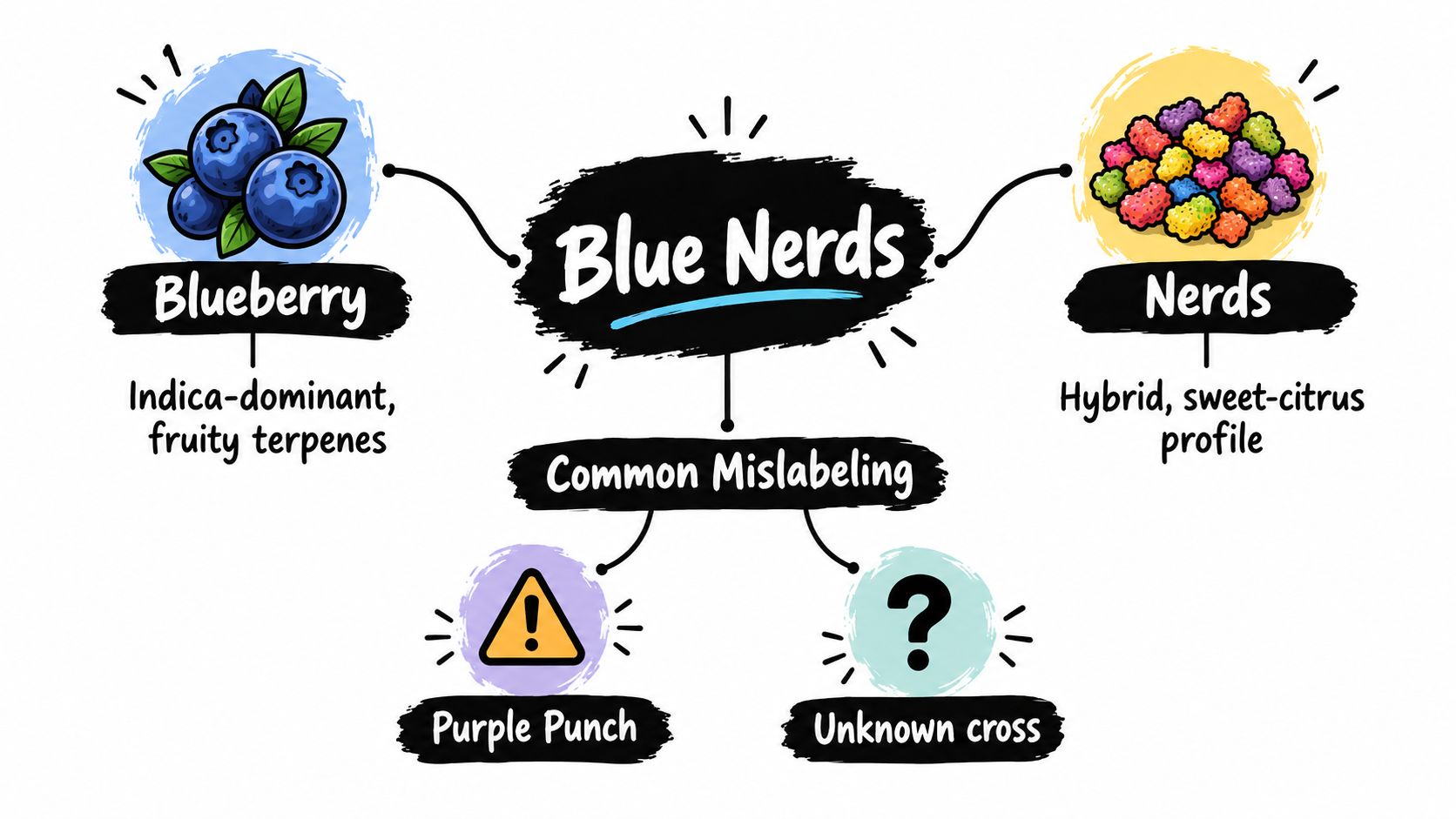
Blue Nerds is not a single, reliably standardized genetic identity. For formulation work, separate the name, claimed lineage, and measured chemistry. These fields can support one another, but none should substitute for batch qualification.
Reported parentage includes Forbidden Fruit x Watermelon Z, Blue Sherb x Zkittlez, and Blueberry x Grape Ape. The names Blue Nerds, Blue Nerdz, and Blueberry Nerds also appear across different references, without proof that every listing describes the same cultivar. An infographic explaining the Blue Nerds strain, detailing its genetic components and common issues with mislabeling. Treat those parentage claims as working hypotheses. The supplier's certificate, retained sample, and lot history carry more weight than the product name.
Use chemistry to qualify the cut
Lineage can establish an initial sensory hypothesis. It cannot verify the incoming material on its own. Compare the stated direction with the terpene pattern on the COA, then confirm whether the retained sample supports the same impression before building a cartridge formula around it.
Use this decision framework:
- Bright fruit target: Select material whose COA and sensory review support citrus, sweet fruit, and aromatic lift.
- Berry-spice target: Prioritize material with enough structural character to carry pepper, wood, and darker fruit notes.
- Unclear target: Hold the lot, document its aroma, and request clarification before making aggressive blend adjustments or scaling.
A COA does not prove genetics with absolute certainty. It can still identify a mismatch between the claimed cut and the material in hand. If a supplier describes a berry-forward Blue Nerds lot but its analytical pattern points toward a markedly different aromatic direction, record the lot as a qualification failure. Adding flavor to conceal that mismatch creates a formula tied to unidentified input material.
Adjacent flavor references can support sensory benchmarking, including Elevated Strains. Use the reference to define an aromatic direction, not to replace batch documentation or a written target profile.
Document the identity before scaling
Record the exact name spelling, claimed parents, source lot, harvest or production reference, COA date, and internal sensory notes. Attach those records to the formulation version so a changed lineage claim or terpene balance triggers a new development review.
This discipline prevents a costly correction loop. A team may adjust the blend to compensate for an unidentified source, then carry those compensations into later batches. The result can perform acceptably with one mislabeled input and fail as soon as the source changes. Verify identity and chemistry first, then set formulation targets.
Terpene Profile and COA Data for Blue Nerds
Generic blueberry descriptions miss the formulation problem. Blue Nerds material can combine berry-associated body with spice, citrus, and pine-like lift, while the name itself does not guarantee a consistent chemical profile. A representative Blue Nerds flower COA measured 29.097% THCA, 30.720% total cannabinoids, and 1.046% total terpenes. The same report measured β-caryophyllene at 3.21 mg, limonene at 2.53 mg, terpinolene at 2.10 mg, β-myrcene at 1.55 mg, and α-humulene at 1.07 mg. The representative Blue Nerds COA data is available in this analytical listing.
The practical lesson is not just potency. A modest total-terpene result can still create a recognizable profile when compounds contribute different sensory functions. Caryophyllene and humulene establish a dry, spicy foundation. Limonene and terpinolene add brightness and fruit lift, while myrcene rounds the transition into a fuller body.
A fruit-only reconstruction usually fails in a cartridge. One dominant berry note may smell convincing on a blotter, then turn narrow or artificial after dilution into oil, heating through hardware, and exposure to the user's draw pattern.
Read the COA as a sensory map
Use the COA to set the formulation architecture, not to copy every value as a literal replacement target.
| Functional layer | Relevant compounds | Formulation role |
|---|---|---|
| Bright upper layer | Limonene, terpinolene | Citrus, sweet fruit, aromatic lift |
| Structural middle | β-caryophyllene, α-humulene | Pepper, spice, depth, persistence |
| Softer lower layer | β-myrcene | Rounded body and berry-associated fullness |
A separate detailed blueberry sample profile measured β-myrcene at 19.87%, α-pinene at 34.1%, (R)-limonene at 9.14%, β-pinene at 13.32%, linalool at 7.46%, α-humulene at 4.26%, α-bisabolol at 3.09%, nerolidol at 1.5%, and β-caryophyllene at 1.83%. Those analytical proportions appear in the blueberry terpene sample document.
The important formulation tension is berry body alongside pine-forward lift. Both may belong in a strain-inspired direction. Remove the pine and upper aromatics, and the blend can become muddy. Push them too far, and the result reads coniferous rather than blueberry candy.
Account for batch variation
These values are anchors, not universal specifications for every Blue Nerds batch. Because the name can refer to different material, do not copy one supplier's COA directly into another supplier's formula. Set the initial target from the actual input, then use sensory evaluation to decide whether the product should reproduce that lot or express a controlled brand interpretation.
For release work, a COA review guide helps keep analytical review separate from flavor preference. The distinction protects the batch record. A blend may smell accurate yet fail a quality requirement, while a clean COA may describe material that does not match the intended SKU.
Building the Blueberry Formulation Using a Layered Terpene System
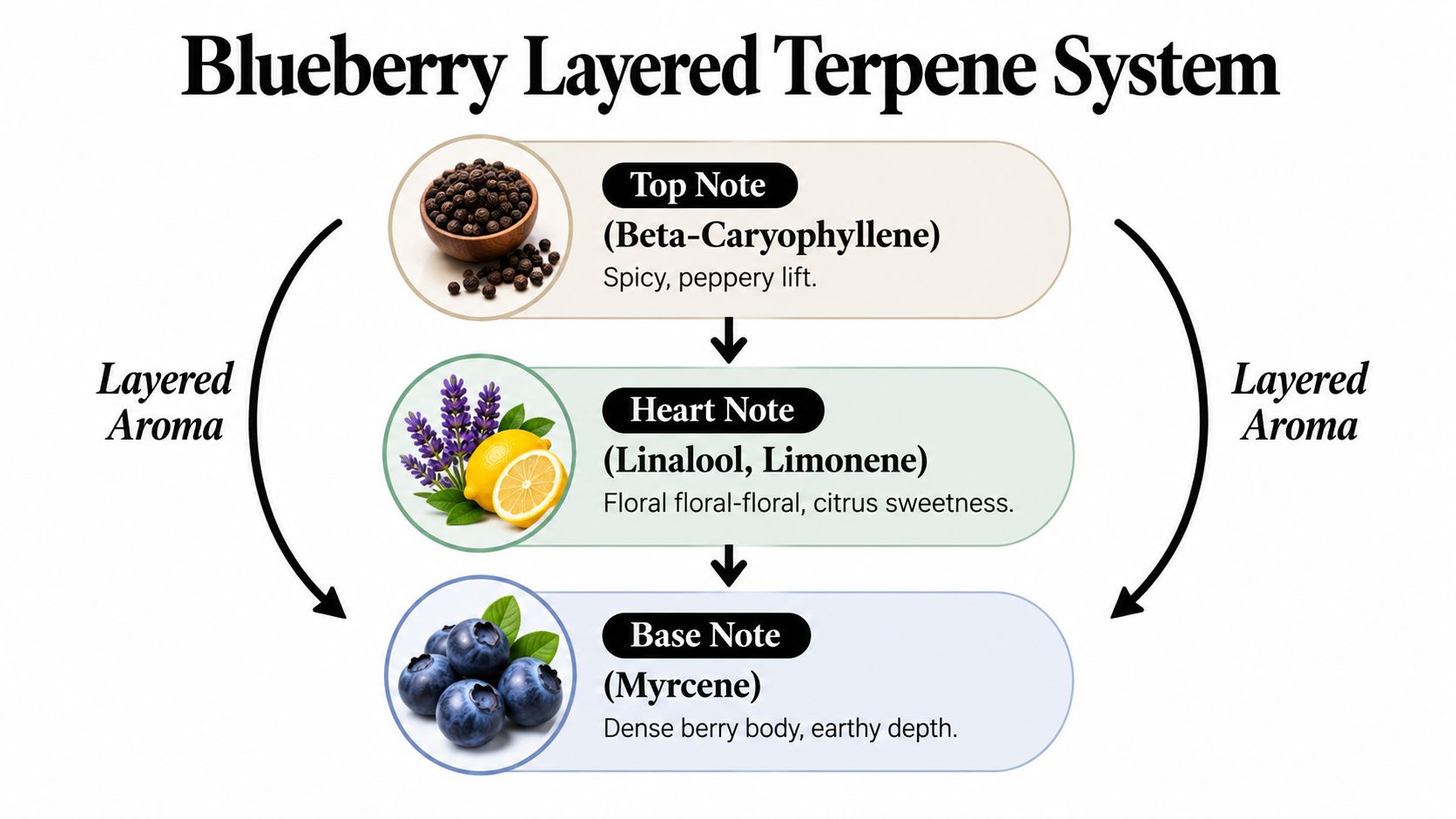
A bottle labeled blueberry is not a formulation plan. A reliable Blueberry Nerds profile depends on separate aromatic layers that survive dilution, heating, and cartridge delivery. Myrcene builds dense berry body. β-caryophyllene adds middle-note structure and keeps sweetness from becoming flat. α-pinene supplies top-note lift, which helps prevent a heavy berry base from tasting dull in vapor.
Use these roles diagnostically rather than as a fixed recipe. A bright first puff followed by a weak finish points to insufficient body or structure. Rich aroma in the bulk oil followed by a dull cartridge draw usually indicates that the upper lift is not carrying through the hardware.
Build the base first
Add the dense portion first, then the middle structure, and finish with brighter aromatics. This sequence makes it easier to separate berry character already present in the oil from aroma supplied by the terpene blend. For layering methodology, see this guide to crafting a blend from 50 strains.
A practical architecture is:
- Base: Myrcene establishes fullness and soft fruit depth.
- Middle: β-caryophyllene supports sweetness with peppery structure.
- Top: α-pinene, with brighter citrus or floral materials, keeps the vapor open.
β-pinene, camphene, geranyl acetate, linalool, natural flavors, and other terpenes can support the blueberry impression. This commercial blueberry ingredient map shows why a credible profile is composite, with pine, spice, floral, and ester-like elements around the fruit center.
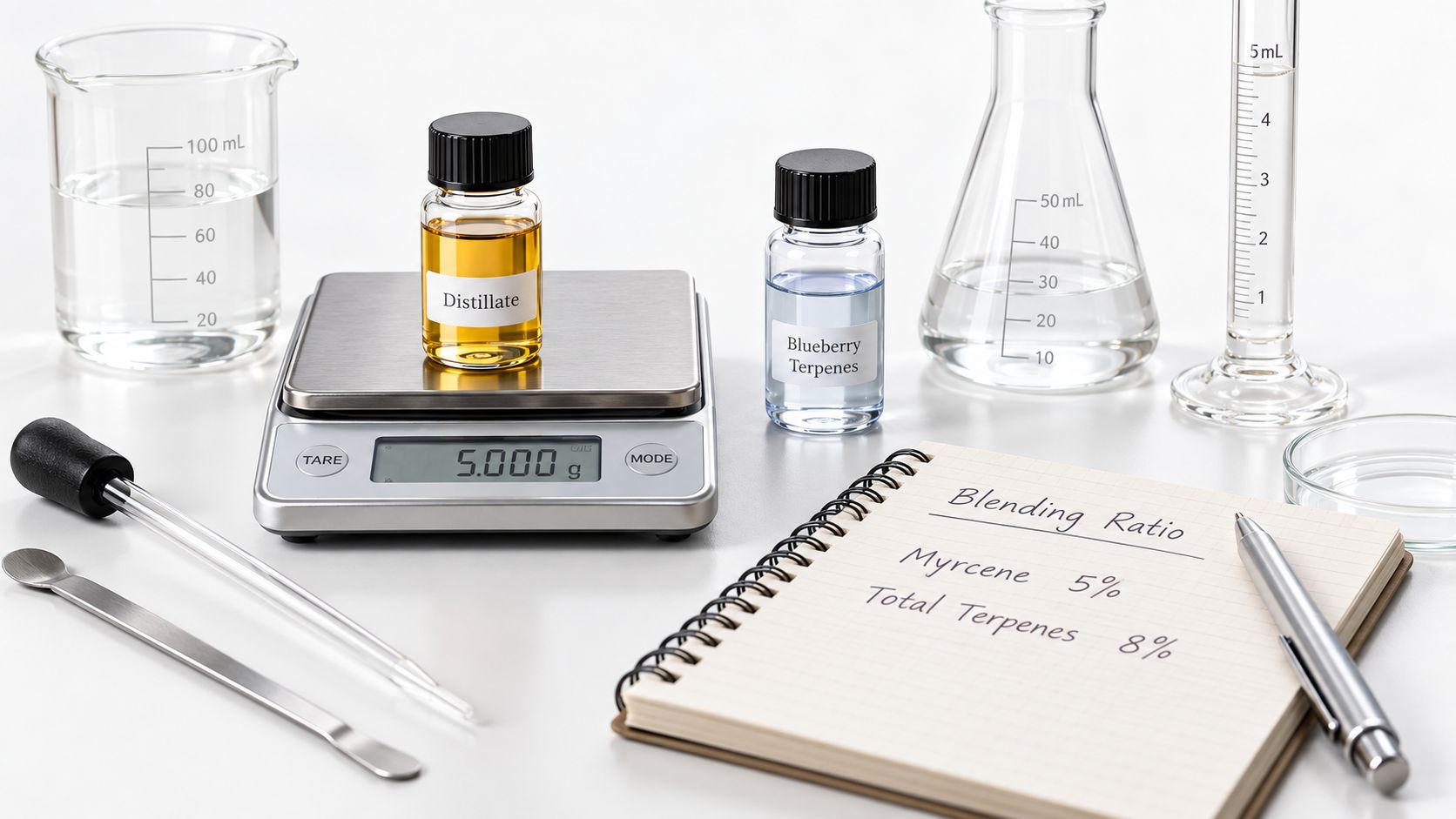
The strain-inspired add-back window is 0.5% to 3% by weight, with an 8% total-terpene maximum, according to this blueberry terpene formulation guidance. Start conservatively. Increase only when sensory results and cartridge behavior support the change.
Formulation insight: Berry accuracy comes from contrast. Sweetness needs lift, while lift needs a structured finish.
A dominant fruit note may smell convincing on an aroma strip yet collapse in a cartridge. Heat and volatility can make the top note lead the first draw, while the base and middle determine whether the aftertaste feels rounded or synthetic. Evaluate the blend in the intended hardware, not only in the mixing vessel.
For a visual explanation of the layering model, the following video provides an additional reference:
Practical Blending Ratios for Cartridges and Distillate
Cartridge formulation has two separate targets: flavor accuracy and mechanical behavior. A blend that smells correct may still wick poorly, flood the chamber, or produce a harsh first draw. The oil base, cartridge geometry, and desired sensory intensity all influence the usable loading level.
Industry-facing guidance places cartridge formulas in a working range of 5% to 15% terpenes by weight in one formulation guide, while another describes common cartridge loading as 4% to 10% by volume. The vape application guidance explains that viscosity, hardware geometry, and sensory intensity determine the final percentage. These ranges are not permission to select a number blindly. They're boundaries for controlled screening.
Separate the development questions
For a distillate formulation, first determine whether the oil needs flavor restoration, viscosity adjustment, or both. If the distillate already has a strong aromatic character, adding a full strain-inspired profile can overshoot the target and obscure the native material.
For a cartridge formulation, screen the blend in the actual hardware. A 510-thread cartridge, a proprietary pod, and a concentrate-oriented device may expose different problems even when they contain the same oil. Watch for delayed wicking, air return, leakage, darkening, and flavor loss after repeated heating.
A practical development sequence looks like this:
- Screen the low end first: Establish whether the profile is recognizable before increasing terpene loading.
- Check viscosity in the intended hardware: Don't approve a blend based only on a beaker test.
- Evaluate first draw and later draws: A blueberry profile that starts bright but becomes flat or harsh needs a structural adjustment, not automatically more flavor.
- Change one variable at a time: Alter the loading level, upper-note balance, or base structure separately so the result remains interpretable.
Match ratios to performance
Alpha-pinene and limonene can increase perceived brightness and alter the flow behavior of a blend, but the effect depends on the oil matrix and hardware. Myrcene-heavy systems can preserve body while contributing to a denser aromatic impression. Caryophyllene can help the finish feel structured, yet too much spice can move the profile away from candy and toward dry botanical notes.
The right ratio is therefore a controlled starting point, not a universal answer. Record the basis, weight or volume, oil lot, hardware model, fill conditions, and sensory result for every trial. That record is what lets a brand reproduce a successful batch instead of relying on memory.
Lab Verification and Safety Considerations for Commercial Formulation
Commercial formulation needs two separate approvals: documented input identity and finished-product performance. Confirm the terpene source, oil lot, intended use, and hardware before judging flavor. The finished formula must still match its declared identity after the oil, aroma materials, and cartridge interact.
A blueberry profile can contain α-pinene, β-caryophyllene, β-pinene, camphene, geranyl acetate, linalool, natural flavors, and other terpenes. That broader aroma-building set is a reason to review each constituent rather than treat “blueberry” as one isolated compound. The strain name alone cannot establish composition.
Use a release checklist
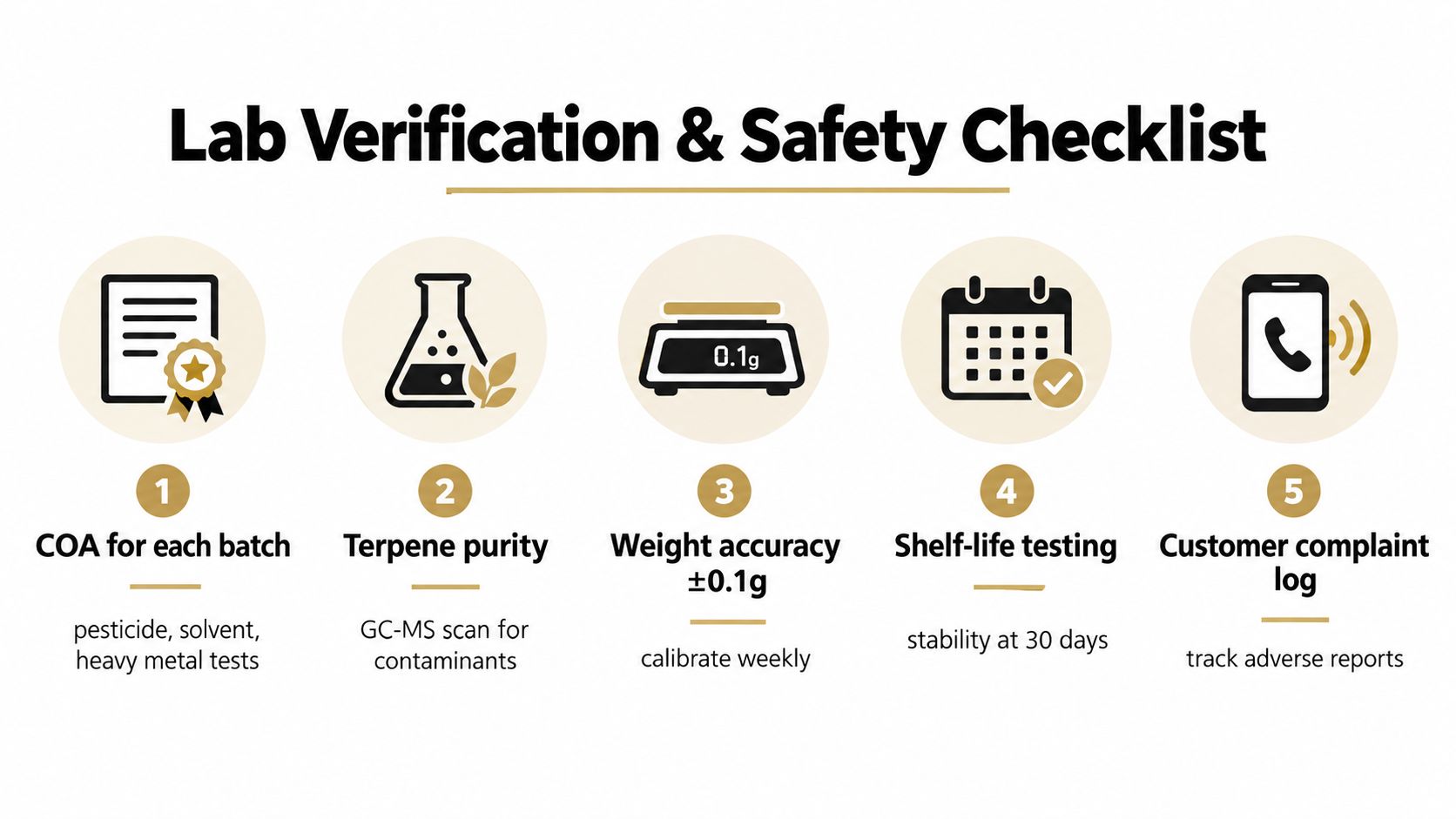
Before a commercial run, verify:
- COA coverage: Match every terpene and oil lot to the documentation retained in the batch record.
- Contaminant review: Confirm that testing addresses residual solvents, pesticides, heavy metals, and other requirements for the applicable jurisdiction and product type.
- Composition review: Check whether natural flavors or other additions introduce compounds requiring disclosure or separate assessment.
- Carrier exclusion: Confirm whether the material contains VG, PG, PEG, MCT, or another carrier excluded by the specification.
- Traceability: Record the blend version, operator, scale record, mixing date, source lots, and finished-product sample.
Gold Coast Terpenes describes its products as lab-verified, THC-free, SC Lab-tested, and free of VG, PG, PEG, and MCT carriers. Those statements identify specifications to compare with a project's requirements. They do not replace testing of the actual finished blend.
Keep sensory and analytical approval separate
A blend can pass a taste panel and still fail a compliance review. A clean analytical result can also produce the wrong Blue Nerds character for the product brief. These approvals answer different questions.
First verify material identity and safety. Then assess the sensory match. After that, test the finished product in its intended hardware, checking that the production record reproduces the approved result.
Quality-control principle: If the aroma cannot be traced to a verified input and controlled blend record, the formulation is not repeatable.
Putting It All Together for Consistent Blue Nerds Formulation
Consistency begins by retiring the idea that Blue Nerds is one fixed chemical formula. The name may describe a recognizable commercial direction, but the underlying material can vary by producer, phenotype, and claimed lineage. A repeatable program therefore needs an identity gate before it needs a flavor adjustment.
Use this sequence:
- Qualify the source. Record the exact name, claimed genetics, retained sample, and supplier documentation.
- Read the COA. Compare cannabinoid and terpene data with the intended sensory direction. Don't treat a strain name as proof of composition.
- Define the target. Decide whether the SKU should emphasize blueberry candy, citrus fruit, pine lift, spice, or a balanced combination.
- Build the layers. Establish berry body, add structural middle notes, then tune the bright upper layer.
- Screen conservatively. Work inside the documented add-back and cartridge-loading ranges, then adjust based on actual oil and hardware behavior.
- Validate the finished unit. Evaluate first draw, repeat draws, wicking, leakage, darkening, and flavor persistence in the final device.
The detailed blueberry sample profile shows why a strain-inspired blend may need both berry-forward and pine-forward components. The Blue Nerds COA shows why caryophyllene, limonene, terpinolene, myrcene, and humulene should be considered as different functional contributors rather than collapsed into a single “fruit” note. The blueberry terpene profile reference can serve as a working document when converting those observations into a blend specification.
Keep the protocol tighter than the name
The biggest avoidable mistake is changing several variables at once. If a batch tastes too sharp, don't immediately increase berry flavor, lower total terpenes, and change cartridges in the same trial. Isolate the cause, make one controlled adjustment, and document the result.
The second mistake is approving a formula outside the hardware context. Cartridge geometry and starting viscosity can change wicking and perceived intensity, so the final decision belongs in the device that customers will use.
A reliable Blue Nerds program is therefore less about finding a magic ratio and more about controlling identity, chemistry, layering, loading, and verification. That system protects the flavor promise and gives your team a defensible path from incoming material to finished SKU.
Gold Coast Terpenes offers natural, strain-specific terpene blends and isolated compounds for cartridges, concentrates, and distillate formulation, with lab-verified, THC-free options made without VG, PG, PEG, or MCT carriers. For a documented blueberry-style development process, visit Gold Coast Terpenes to review terpene profiles, safety documents, and formulation tools.