
A Tuesday bench pull tells you more than a strain name ever will. The 510 cart looks right, the oil pours cleanly, and the first draw should suggest sweet berry with a controlled pine lift. Instead, the vapor tastes like a Christmas tree. The myrcene is muddy, the pinene is too sharp, and the finished product no longer reads as Blue Dream.
That failure is common because Blue Dream terpenes aren't a fixed recipe. Phenotype, harvest, curing, extraction, hardware, and the choice between botanical and cannabis-derived inputs can all move the profile. For a formulator, the job isn't to chase a label. It's to preserve the sensory anchors that make a strain-inspired terpene blend for vape cartridges recognizable while controlling the variation that makes one batch taste berry-forward and another taste pine-heavy.
Why Blue Dream Terpenes Matter in Product Formulation
A workable Blue Dream formulation starts with a sensory definition, not a shopping list. The profile is usually myrcene-led, with alpha-pinene and beta-caryophyllene providing the sharper secondary structure. Myrcene supplies the musky, earthy, fruity body. Pinene adds clean pine and herbal lift. Caryophyllene contributes pepper and warmth. Smaller amounts of citrus or floral compounds can make the blend feel brighter, but they shouldn't erase the underlying berry-earth identity.
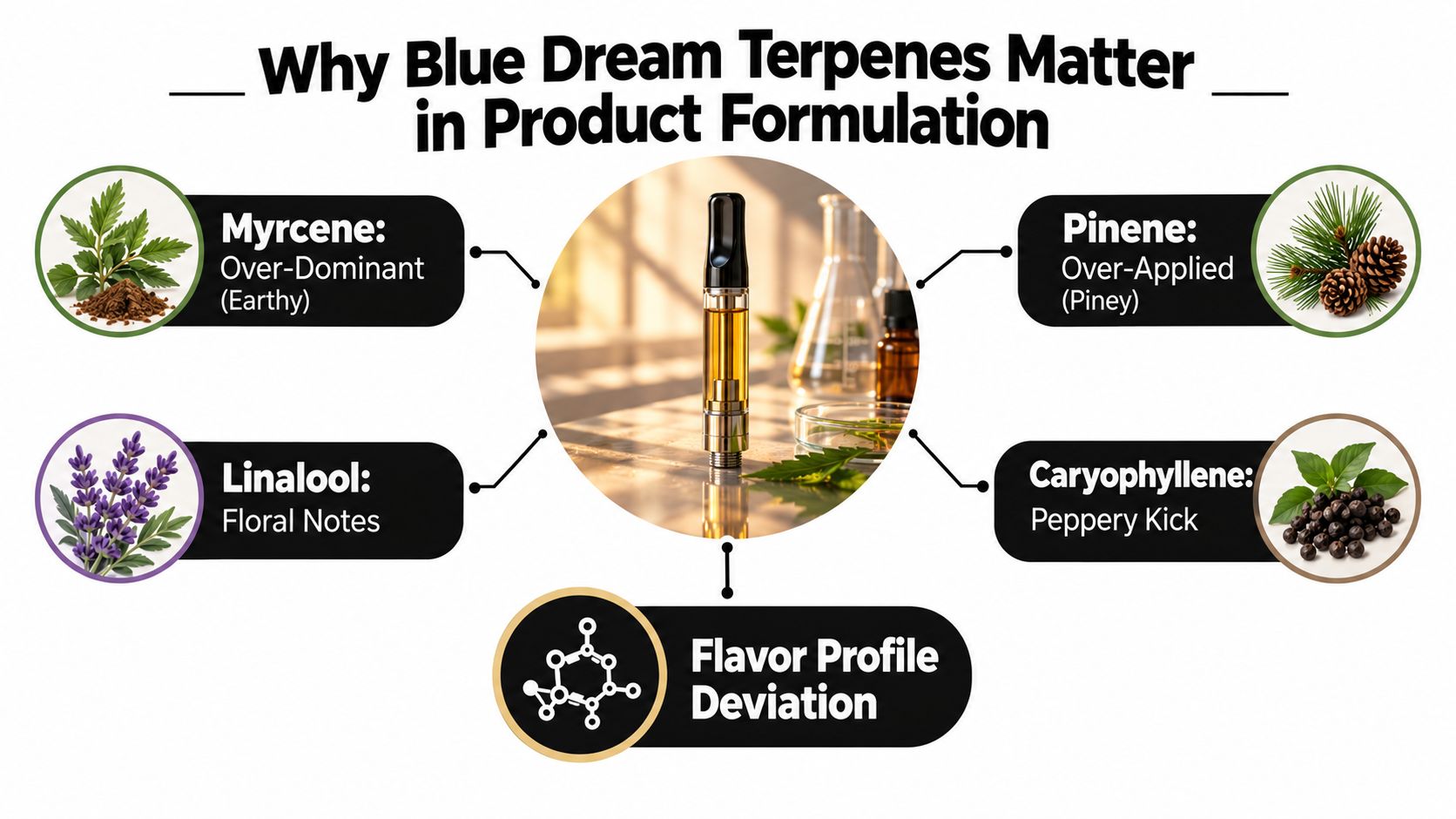
The chemistry matters commercially because Blue Dream is easy to recognize when the balance is right and easy to mislabel when it isn't. A blend that's dominated by pine may still smell attractive, but it won't pass a blind sensory check against a berry-led reference. A blend that's overloaded with myrcene can lose definition in distillate, leaving a dull, heavy palate that tastes more generic than strain-specific.
A strain-inspired blend is a target, not a claim
A strain-inspired terpene blend recreates a sensory direction. It doesn't prove that a cartridge contains flower from a particular genetic line. That distinction is important for product development, documentation, and label language. Botanical terpenes and cannabis-derived terpenes can both support formulation work, but they may differ in aroma texture, concentration, batch behavior, and interaction with the base oil.
The practical question is simple: can the input reproduce the expected opening note, mid-palate, and finish after it enters the actual oil and hardware? A room-temperature sniff isn't enough. A terpene profile that smells balanced in a vial may become sharper in a hot ceramic cart or flatter after mixing into distillate.
For a deeper foundation on compound functions, use this terpene function guide as a reference, then validate the blend in the finished device. The profile should be judged where the customer experiences it, not only where the formulator measures it.
The Dominant Terpene Stack in Blue Dream
The most useful way to read Blue Dream terpene data is as a hierarchy. Myrcene is the statistical leader, while pinene and caryophyllene define the contrast around it. Independent strain data reports beta-myrcene from 0% to 2.7%, averaging 0.81%, alpha-pinene from 0% to 1.2%, averaging 0.41%, and beta-caryophyllene from 0.1% to 1.03%, averaging 0.27%. The same dataset reports beta-pinene averaging 0.18%, linalool 0.05%, and alpha-humulene 0.11% (Blue Dream terpene profile data).
Those figures describe flower samples, not a universal concentrate recipe. A separate guide places well-grown Blue Dream at 1.2% to 2.2% total terpenes by dry weight, with myrcene around 0.5% to 1.0%, alpha-pinene around 0.2% to 0.5%, beta-caryophyllene around 0.2% to 0.4%, and ocimene at 0.1% to 0.3% in some phenotypes (phenotype range reference).
Reference table for incoming COAs
The table below is a practical fingerprint, not a fixed manufacturing formula. It uses the ranges and averages reported in the independent sources above. Compounds without a supported numeric range are marked qualitatively rather than assigned an invented figure.
| Terpene | Typical Range (%) | Aroma Descriptor | Formulation Role |
|---|---|---|---|
| Beta-myrcene | 0 to 2.7%, average 0.81% | Musky, earthy, fruity | Base body and berry depth |
| Alpha-pinene | 0 to 1.2%, average 0.41% | Pine, fresh, herbal | Clean lift and structural contrast |
| Beta-caryophyllene | 0.1% to 1.03%, average 0.27% | Peppery, warm, woody | Finish and mid-palate definition |
| Beta-pinene | Average 0.18% | Dry pine, herbal | Secondary pine detail |
| Linalool | Average 0.05% | Soft floral | Edge rounding |
| Alpha-humulene | Average 0.11% | Earthy, woody | Dryness and depth |
| Ocimene | 0.1% to 0.3% in some phenotypes | Sweet, green, floral | Top-note lift when present |
| Limonene | Reported as a supporting compound | Citrus | Brightness and opening aroma |
The central formulation lesson is that Blue Dream isn't a single-terpene profile. If myrcene is present without enough pinene and caryophyllene, the blend may read as soft but indistinct. If pinene is pushed too far, the profile loses its berry center. If caryophyllene rises excessively, pepper can dominate the exhale.
For compound-specific background, the myrcene terpene guide is useful during raw-material review. A formulator working across adjacent flavor families may also compare the profile against Elevated Strains as a separate reference point, but it shouldn't be treated as a Blue Dream substitute.
How the Profile Translates to Aroma and Flavor
The most reliable Blue Dream profile moves in stages. The first impression should be sweet berry with a light citrus or green lift. The middle should become earthy and musky rather than sugary. The finish should carry controlled pepper, pine, and a faint herbal dryness. That progression gives the formulation dimension. A blend that only smells like berry at room temperature often collapses once it reaches the coil.
Five sensory checkpoints
Vial opening: Check whether the initial aroma is fruity and soft or immediately sharp and pine-heavy. A harsh first nose usually signals that the volatile top notes are overrepresented.
Cold oil evaluation: Smell the diluted oil before heating. Myrcene should provide body without making the oil smell muddy. Limonene, ocimene, or other brighter notes may be more apparent here than they are in vapor.
First draw: The opening vapor should retain the recognizable sweet-fruity direction. If the first crack is all pine, reduce the sharp top-note contribution before changing the whole blend.
Mid-pull body: Myrcene and caryophyllene should create weight here. A thin mid-hit often means the blend is underbuilt in its middle and base notes, not necessarily that total terpene load is too low.
Aftertaste and reclaim: The finish should be peppery and earthy without turning burnt, bitter, or resinous. Reclaim color and odor can reveal overheating, oxidation, or a hardware mismatch that a vial sniff won't show.
A useful terpene aroma and flavor sensing guide can help standardize panel vocabulary. Keep the panel conditions consistent, because temperature changes which compounds dominate perception. A cold pull emphasizes volatile brightness. A warmer draw gives the heavier body more room to appear. High heat can exaggerate earthy, spicy, or floral remnants while suppressing the delicate berry impression.
Panel rule: Don't approve a Blue Dream blend from the vial alone. Approve the sequence from first draw through finish.
For dabs, compare the blend at the intended temperature rather than treating a single hot hit as representative. For carts, evaluate a rested cartridge and a device that has completed normal priming. The same oil can pass a bench sniff and fail after the wick or porous core changes the delivery curve.
Dosing Blue Dream Terpenes in Carts and Distillate
Start with the base oil, not the strain name. Distillate typically needs a more deliberate aromatic build because refining can leave it clean but relatively neutral. Live resin or another terpene-rich extract already carries native aroma, so adding a full-strength strain blend can bury the material's own identity.
Use these as starting windows, then tune against viscosity, hardware, and sensory output:
- Ceramic-cell carts: Begin around 5% to 8% added terpenes when the base is relatively neutral, using the cartridge's flow behavior and first-draw flavor as the deciding checks.
- High-terpene distillate: A working range of 6% to 10% may be appropriate when the base needs substantial aromatic structure, but the upper end can become sharp or overwhelming in a hot device.
- Live resin bases: Start around 1% to 3% when native terpenes already define the extract. The goal is correction, not replacement.
These ranges are formulation starting points, not universal specifications. The distillate terpene addition guide should sit beside your batch worksheet, but your own COA and hardware validation remain decisive.
Load ranges by base and hardware
| Base Oil | Hardware Type | Load % Range | Key Checkpoint |
|---|---|---|---|
| Neutral distillate | Ceramic-cell cart | 5% to 8% | First draw and pour viscosity |
| High-terpene distillate | Ceramic or pod format | 6% to 10% | Mid-pull body and harshness |
| Live resin | Ceramic or quartz-compatible system | 1% to 3% | Preserve native aroma |
| CO2 oil | Hardware selected for its viscosity | Start conservatively and titrate | Wicking and leak behavior |
| HTFSE | Hardware selected for high native terpene content | Start conservatively and titrate | Separation and flavor intensity |
Mix in the order the oil needs
Warm the base only enough to make it workable, and avoid using heat as a substitute for proper blending. Add the terpene phase gradually, mix until uniform, then let the oil rest before judging it. A fast sniff immediately after mixing can overstate volatile brightness and understate the settled mid-palate.
Porous-core hardware may wick differently from ceramic systems. A blend that pours well can still flood, leak, or starve depending on the core, aperture, and coil behavior. Check pour viscosity, cold-start flavor, mid-pull body, and reclaim color before releasing the batch. If the profile is right but the cart leaks, the formula still failed commercially.
Blue Dream Compared to Gold Coast Blends and Isolates
Blue Dream sits between sweet berry and earth-pine. That position separates it from profiles that lean strongly tropical, dessert-forward, or Kush-like. The comparison should be sensory first, because verified Blue Dream data doesn't provide a matched compound table for Tropical Kush, Maui Wowie, Sunset Sherbet, and Gelato-style blends.
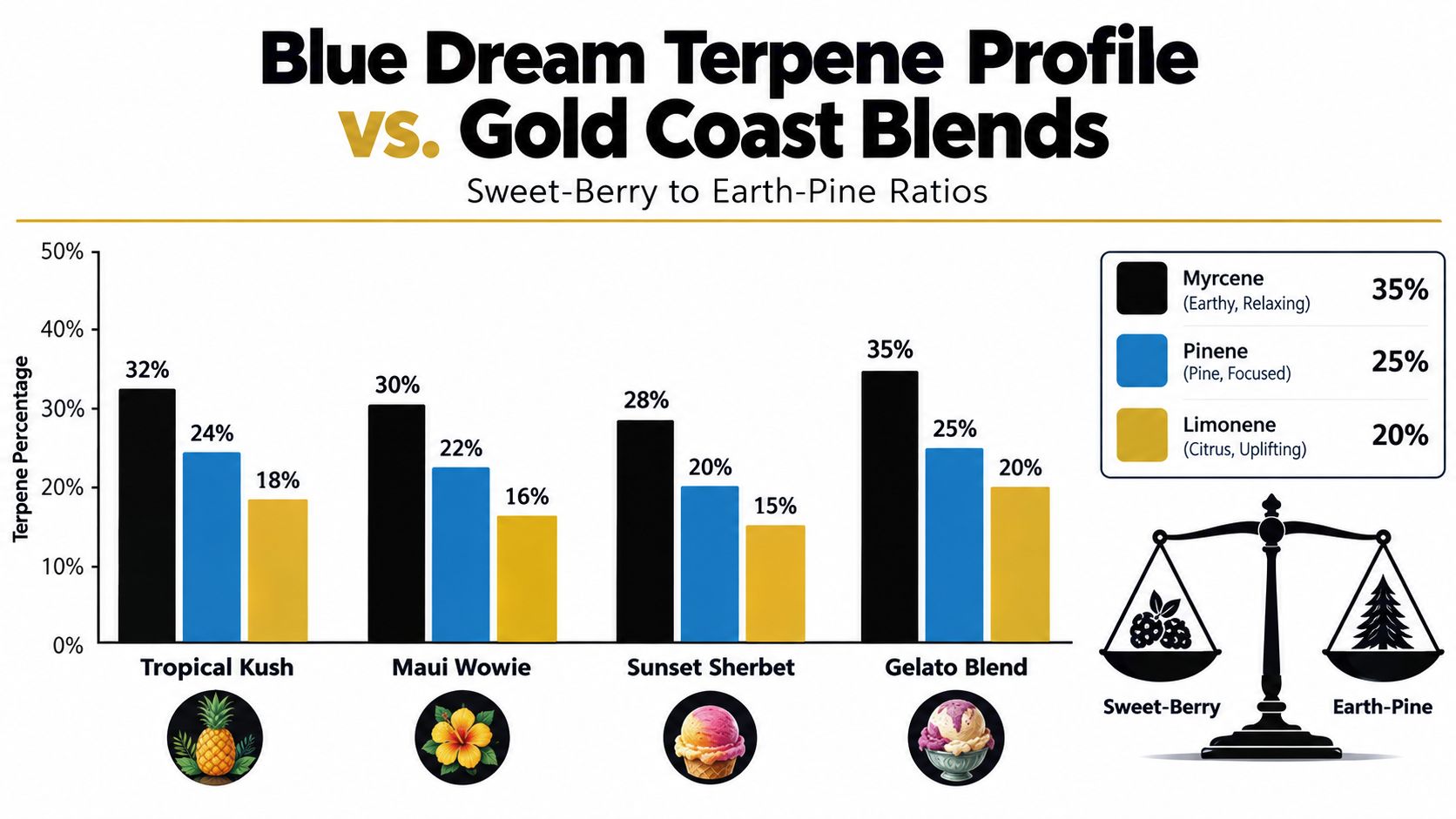
A Tropical Kush direction generally makes the fruit feel warmer and more exotic, while Blue Dream needs its pine and pepper structure to remain audible. Maui Wowie can push the formulation toward brighter tropical lift, which may be useful for a top-note extension but can make Blue Dream lose its earthy center. Sunset Sherbet and a basic Gelato-style blend often occupy sweeter, creamier, or dessert-leaning territory. They can support a berry concept, but they shouldn't replace the myrcene-pinene-caryophyllene relationship that gives Blue Dream its recognizable tension.
Isolate substitutions and trade-offs
| Available Material | What It Can Carry | What It Can't Reproduce |
|---|---|---|
| Beta-myrcene | Musky fruit and earthy body | Pine lift, citrus sparkle, pepper finish |
| Alpha-pinene | Fresh pine and clean herbal lift | Berry depth and rounded mid-palate |
| Beta-caryophyllene | Warm pepper and woody finish | Sweet fruit opening and bright lift |
| Myrcene plus alpha-pinene | Basic berry-pine direction | Full pepper, floral, and citrus nuance |
| Myrcene plus beta-caryophyllene | Berry-earth-spice direction | Clean pine definition |
| Alpha-pinene plus beta-caryophyllene | Pine-pepper structure | Blue Dream's fruity base |
A single isolate can rescue a drifted batch, but it can't reproduce the full blend. Myrcene is the best anchor for body, alpha-pinene is the practical correction for a flat or overly soft profile, and beta-caryophyllene is useful when the finish lacks warmth. Each substitution creates a sensory compromise, so label the batch internally as an analog rather than assuming it is chemically equivalent to flower.
Managing Phenotype Variability and Batch Consistency
Treating Blue Dream as one fixed chemical identity is the fastest route to inconsistent carts. Reported samples range from about 1.2% to 2.5% total terpene content, with myrcene reported around 0.39% to 1.0%, pinene around 0.2% to 0.8%, and caryophyllene around 0.1% to 0.6% across different laboratory profiles (Blue Dream variability reference). Those ranges are large enough to change the finished aroma even before extraction or hardware enters the process.
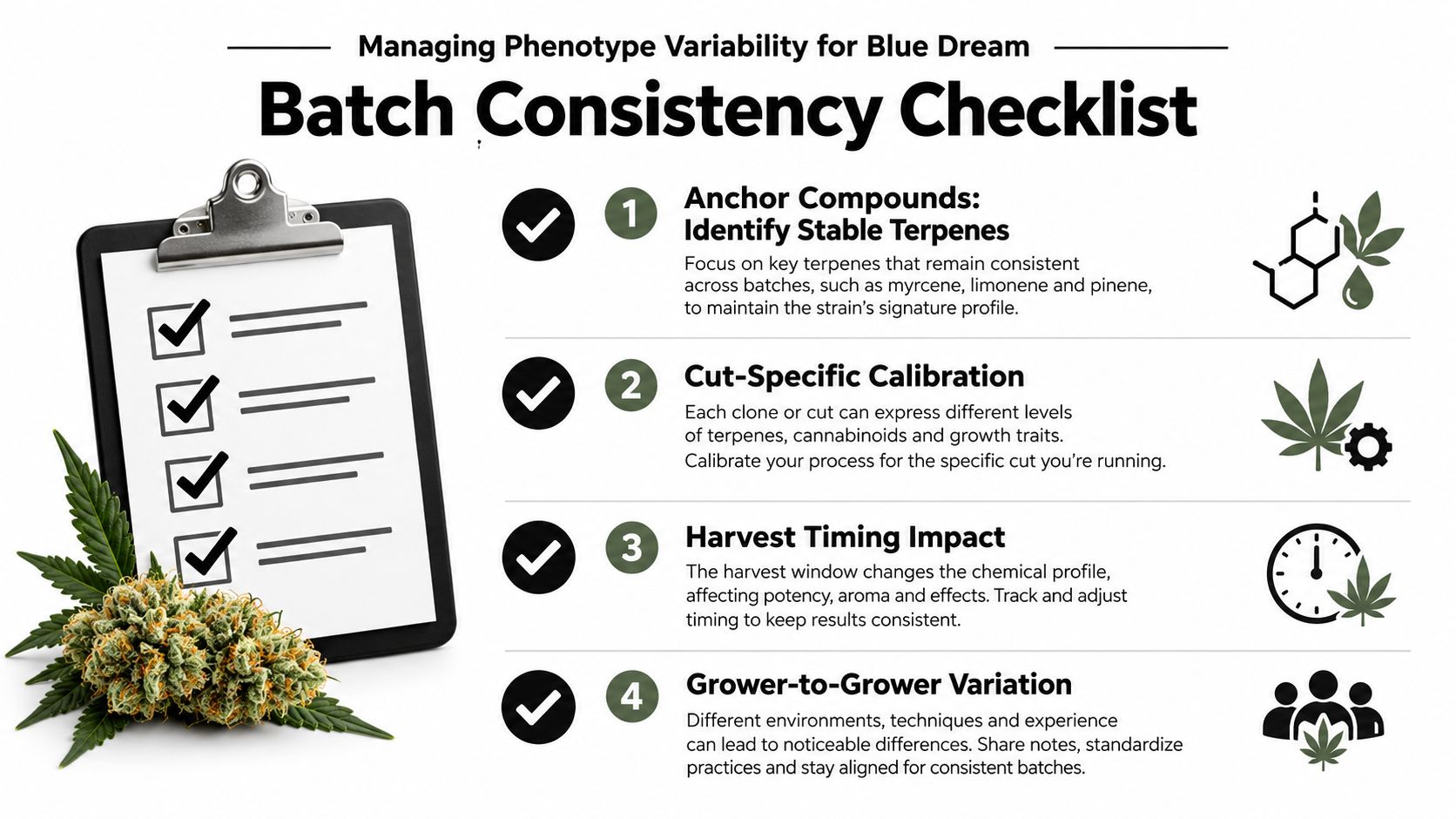
Lock the anchors, flex the nuance
A house standard should protect the compounds that define the profile while allowing secondary chemistry to move within an approved sensory band.
- Anchor beta-myrcene dominance: Keep the earthy-fruity body present across every accepted batch.
- Protect the alpha-pinene floor: Don't allow the blend to become soft, dull, or jammy.
- Set a beta-caryophyllene ceiling: Pepper should shape the finish, not take it over.
- Leave minor compounds flexible: Ocimene, linalool, humulene, and other trace notes can vary without forcing a complete reformulation if the sensory sequence remains intact.
Cure length, drying conditions, trim timing, and grower practices can shift the balance toward brighter pine or toward heavier earth and fruit. The right response isn't to reject every deviation. It's to classify the deviation and decide whether a small correction restores the house profile.
A practical batch-locking workflow looks like this:
- Review the incoming COA against your target ratio band and record the actual lot.
- Run a controlled sensory panel using the five checkpoints above.
- Apply a small correction only when the sensory fault matches the chemical drift.
- Release minor variations under the same profile standard, and escalate major deviations for reformulation or separate lot treatment.
Consistency is a sensory specification backed by chemistry. The COA tells you what moved. The panel tells you whether customers will notice.
Troubleshooting Common Blue Dream Blend Issues
Most failed Blue Dream batches fit a small set of patterns. Diagnose the failure in the finished oil and device before changing the aromatic formula.
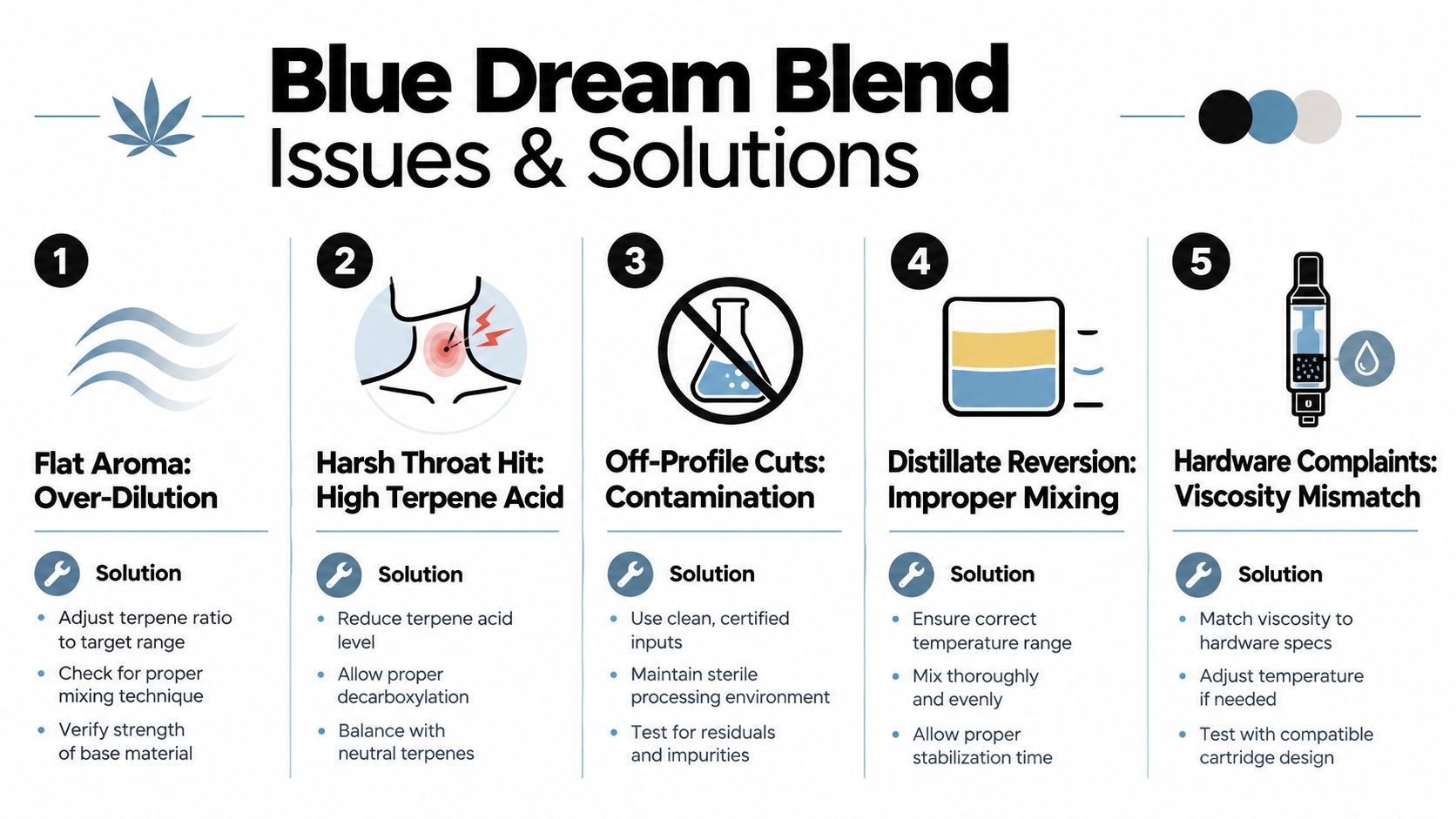
- Flat aroma from over-dilution: The oil smells weak in the vial and disappears on the first draw. Re-titrate in controlled 1% to 3% increments, then recheck the opening and mid-pull rather than judging intensity alone.
- Harsh throat from a sharp top-note spike: Excessive ocimene or terpinolene character can make the vapor feel aggressive. Reduce the bright fraction before adding more myrcene, because extra base won't correct a volatile top-note problem.
- Muddled berry from myrcene dominance: The oil has body but no separation between fruit, earth, and pine. Pull back the myrcene fraction and restore definition with the smallest practical pinene or caryophyllene adjustment.
- Oxidized pine from heat and oxygen: A fresh pine note turns stale, sharp, or resinous after processing. Keep mixing temperatures under 40 C where the process allows, limit headspace exposure, and use nitrogen-flushed storage when appropriate. The temperature guidance is a formulation-control practice, not a guarantee of preservation.
- Leaking or poor delivery from viscosity mismatch: A correct aroma can still fail in the cartridge. Compare the oil's flow against the selected ceramic, porous-core, or quartz-compatible hardware, then change the device or base balance rather than forcing the cart to handle an unsuitable viscosity.
Run a GC test on each Blue Dream input instead of relying on a vendor label or memory from a previous lot. Archive the COA, ratio sheet, hardware specification, sensory notes, and any correction made. That record turns the next troubleshooting session into a comparison against real batch data instead of guesswork.
Gold Coast Terpenes supplies natural strain-specific blends and isolated compounds for cartridges, concentrates, and formulation work, including Blue Dream-style profiles, Myrcene, and Beta-Caryophyllene options. Review the available components and formulation resources at Gold Coast Terpenes, then request the COA and build a small hardware-matched pilot before committing a full production batch.