
You've got a distillate that tests clean, the hardware is selected, and the first pull delivers plenty of citrus. But the profile feels thin. The limonene arrives sharply, the floral character disappears, and the cartridge loses definition after storage. That's where understanding what is linalool becomes a formulation question rather than a terpene trivia exercise.
Linalool can add a floral, woody-lavender dimension, connect bright top notes with fuller mid-notes, and influence how a cannabis-inspired profile reads from the first inhale through the end of a session. It also brings decisions around chirality, oxidation, heat, sourcing, analytical testing, and regulatory handling. For formulators building a strain-inspired terpene blend for distillate, those decisions matter more than a strain name on a label.
Why Linalool Matters in Vape and Concentrate Formulation
A distiller may see a thin botanical profile and reach first for more citrus or sweetness. The opening aroma becomes louder, yet the oil can still feel flat. Linalool's floral, woody-lavender character gives you another formulation lever. It can connect bright citrus with deeper aromatic materials, much like a middle layer that keeps the profile from breaking into separate notes.
In fragrance work, linalool behaves as a top-heart note. It brings freshness and transparency while easing the move into mid-note terpenes. That makes it useful when a limonene-heavy distillate feels sharp, a pinene-forward profile needs more roundness, or a floral target lacks lift. The result depends on the whole blend, not on the isolate alone.
Bench perspective: Treat linalool as a structural ingredient. You are deciding how the formula opens, connects, and fades, not simply adding a floral accent.
Start with the profile, not the isolate
Begin by diagnosing the oil. Does it lack a clear top note, or does it already carry too much sharpness? Is the target botanical-forward, or are you rebuilding the balance of a particular extract? The same linalool adjustment can help one problem and exaggerate another.
For a flavor-forward profile, keep the change restrained and assess it within the complete terpene system. A botanical-forward SKU may support a clearer floral presence, but the blend still has to fit the distillate's native aroma and the cartridge's heating behavior. Set the inclusion window through sensory trials and product constraints. More linalool does not automatically create a better profile.
Volatility belongs in the production plan as well. Linalool's normal boiling point is near 198 to 199 °C, according to the OECD chemical dossier and authoritative toxicology references. A cartridge does not heat every part of its contents uniformly, and boiling point alone cannot predict sensory release. It does signal that heated mixing, filling, and storage deserve controlled handling.
Oxidation risk also changes the decision. Oxygen, unnecessary heat, and long storage can shift the profile, so the formula must be evaluated alongside container choice, fill process, hardware, wicking, viscosity, and shelf-life targets. In a distillate or cartridge, linalool can turn a one-note oil into a more layered experience when the team controls both its blend position and its exposure during production.
Linalool's Chemical Identity and Natural Sources
Suppose a supplier offers two materials both labeled “natural linalool.” One comes from a botanical fraction, while the other matches only the name on the label. Their aroma, composition, and suitability for a distillate or cartridge may differ. The chemical identity is the starting point for making that decision.
Linalool is a naturally occurring monoterpenoid tertiary alcohol with the formula C10H18O. It occurs in herbs, spices, trees, citrus fruits, and other aromatic plants. That broad distribution explains its use as a reference material in fragrance chemistry and botanical terpene analysis. It also means the word “natural” does not identify one uniform raw material.
Linalool is chiral, so it can exist as mirror-image enantiomers, commonly described as the R and S forms. These forms may produce different olfactory impressions. For formulation work, a botanical claim should therefore be supported by an analytical package that addresses both origin and enantiomeric composition, rather than by a plant name alone.
Commercial linalool reaches the market through natural extraction and chemosynthetic production. OECD data recorded worldwide production at about 12,000 tonnes per year in 2000, with roughly 6,600 tonnes from chemosynthetic routes and 5,400 tonnes from natural sources. This supply structure matters in cannabis formulation because linalool is not limited to cannabis extraction. It is also produced for flavor, fragrance, and related markets.
Natural and synthetic material serve different formulation goals
Botanical material can retain secondary alcohols, esters, and other trace constituents. Those components may give a blend more depth, similar to the way a whole spice can taste more layered than a single purified aroma molecule. Chemosynthetic grade generally offers a cleaner, more repeatable composition and steadier supply. A highly purified isolate may, however, sound flatter than a complete essential-oil fraction.
The right choice depends on the product objective. A team reconstructing a tested extract may value botanical complexity. A repeatable cartridge program may favor a defined isolate with tighter specifications. Both materials require testing against the intended distillate, hardware, and sensory target.
| Attribute | Natural Botanical | Chemosynthetic |
|---|---|---|
| Source | Essential oils and botanical fractions from plants such as lavender, basil, coriander, ho wood, or cannabis | Industrial synthesis from terpene and terpenoid precursors |
| Aroma character | May include trace constituents that add complexity | More consistent and focused, with fewer secondary materials |
| Composition | Can vary with plant source, harvest, processing, and storage | Usually designed for repeatable purity and specification |
| Chirality | Enantiomeric ratio may reflect the botanical source | May differ from a natural enantiomeric profile |
| COA priorities | Origin, GC profile, chiral data, contaminants, oxidation indicators | Purity, identity, residuals, oxidation indicators, manufacturing traceability |
| Best fit | Native-profile reconstruction and nuanced botanical blends | Repeatable production and controlled isolate work |
Cannabis-derived linalool can be difficult to source consistently because cannabis flower usually contains it within a broader volatile profile, rather than as an abundant standalone stream. Many formulators therefore use botanical isolates, essential-oil fractions, or terpene-blend suppliers. That choice determines the COA scope and affects how the finished product should be described and labeled. A strain-inspired profile is a formulation claim, not proof that every ingredient came from cannabis.
Aroma Profile and Physical Properties for the Bench
Linalool's sensory identity is usually described as floral, woody, lavender-like, fresh, and slightly transparent. In a blend, it can connect citrus and floral anchors without making the formula feel as dense as a heavy base note. The exact impression depends on the enantiomeric ratio, purity, neighboring terpenes, concentration, and the distillate itself.
Its physical properties explain why it behaves differently from lighter monoterpenes. Reference data place its boiling point around 198 to 199 °C, while the National Toxicology Program cites values around 194 to 197 °C at 760 mm Hg and NIST lists 471.75 K (NTP toxicology background document). Its flash point is 76 °C, and it's insoluble in water while being miscible with ethanol and ether (formulation reference).
Those numbers don't replace process validation. They help you choose a safer process.
Translate the data into bench decisions
The boiling point is higher than that of many lighter volatile terpenes, but linalool still contributes early aroma during a cartridge pull. A vape system doesn't heat the whole liquid to a uniform boiling point. Coil temperature, residence time, airflow, wick or ceramic behavior, and oil composition all affect what reaches the user.
The 76 °C flash point is especially relevant to heated mixing and filling. Keep open handling away from ignition sources, and don't treat a warm bath as interchangeable with high-temperature processing. A controlled warm bath can reduce viscosity and improve incorporation, while aggressive heat can increase evaporative loss and accelerate oxidation.
Linalool's polarity also matters in high-cannabinoid distillate. It blends readily with ethanol and ether, but water isn't a useful carrier. In a cannabis oil system, evaluate miscibility in the actual distillate, not only in a reference solvent. A small pre-blend can expose haze, separation, or aroma imbalance before you commit the full batch.
For sensory benchmarks and additional flavor notes, use the linalool terpene taste reference once during development, then verify the result in your own oil and hardware. Store bulk material in a tightly closed, light-protected container with minimal oxygen exposure. The physical data tell you how to handle the ingredient. The finished cartridge test tells you whether the formula works.
Blending Linalool Into Distillate and Cartridges
Linalool works best when you add it with a purpose. Before weighing anything, define whether you're correcting a sharp citrus top, adding floral lift, or building a clearly lavender-forward profile. The target determines both the amount and the companion terpenes.
For many formulation trials, teams evaluate linalool around 0.5% to 2% of the total terpene blend, with botanical-forward concepts potentially moving higher after sensory and stability review. Those ranges should be treated as development starting points, not universal specifications. Always calculate against the actual total formulation and confirm the result in the intended cartridge.
A controlled addition sequence
Prepare a small pre-blend. Combine linalool with a small charge of the same distillate or compatible carrier used in the production batch. This reduces the chance of a concentrated pocket entering the main vessel.
Use gentle heat. A controlled range around 30 to 40 °C can help lower viscosity and improve incorporation. Keep the vessel closed where practical, and avoid unnecessary agitation that pulls air into the oil.
Add in stages. Introduce the pre-blend incrementally, mix thoroughly, and evaluate the aroma after the oil returns to a consistent temperature. A strong hot-vessel aroma can mislead you because volatile release is higher during processing than at room temperature.
Check the filled cartridge. Evaluate the first pull, middle-of-use behavior, and late-session character. A blend that smells balanced in a beaker can wick or aerosolize differently in ceramic and cotton hardware.
Linalool can bridge limonene and geraniol at the bright floral end of a profile and connect that opening with deeper materials such as β-caryophyllene. Its role remains top-heart rather than true base. It can round an accord, but it won't supply the lasting body that a heavier sesquiterpene contributes.
| Use Case | Linalool % | Position | Blending Notes |
|---|---|---|---|
| Flavor trim | 0.5% to 1% | Light top-heart correction | Use when citrus or herbal notes feel pointed and the profile needs softening |
| Floral lift | 1% to 2% | Clear top-heart presence | Pair with citrus or geraniol materials and assess sweetness perception |
| Lavender-forward | Above 2%, only after trials | Dominant floral direction | Confirm that the aroma remains acceptable after heating and storage |
| Botanical reconstruction | Profile-dependent | Native-style bridge | Match against the full COA and preserve the intended secondary-note relationship |
For a broader discussion of addition calculations, review the terpenes for distillate formulation guide. Hardware testing should include fill viscosity, wicking speed, leakage, and repeated-pull sensory checks. Ceramic and cotton systems may expose different release patterns, while crystalline or CBN-containing systems can require separate miscibility and stability work. Don't assume a successful distillate blend will behave identically in every cart.
Entourage Effects and Functional Positioning
Linalool often appears in product language as calming, relaxing, or evening-oriented. Those descriptors can be useful for sensory positioning, but they shouldn't be presented as established medical outcomes. The evidence base includes in vitro and animal work, along with limited clinical research, and the relationship between an isolated terpene, a cannabis extract, and a finished inhaled product remains difficult to reduce to one effect statement.
A major review reports sedative, anxiolytic, analgesic, anticonvulsant, anti-inflammatory, and local anesthetic activity across different research models, while also emphasizing the influence of stereochemistry (review in Flavour and Fragrance Journal). That breadth creates formulation interest, but it doesn't authorize a formulator to treat linalool as a clinically validated active.
Separate aroma positioning from pharmacology
A better framework uses three layers:
- Sensory layer: Floral, lavender-like, woody, fresh, or rounded.
- Chemotype layer: Linalool appears alongside cannabinoids and other terpenes in a defined tested profile.
- Evidence layer: Biological findings are described cautiously and only when the source supports the specific claim.
The entourage hypothesis proposes that terpenes and cannabinoids may influence one another, but human cannabis-specific evidence remains limited. Linalool is often evaluated alongside myrcene, β-caryophyllene, and limonene, because those combinations occur in cannabis-inspired profiles and can create a more complete sensory narrative. That's a reason to test the blend as a system, not proof that the combination produces a predictable pharmacological outcome.
The entourage effect terpene guide can help organize the formulation conversation, but packaging language still needs its own substantiation review. The 2026 cancer-focused review identified in the supplied literature describes the anticancer evidence as exclusively preclinical and does not support clinical anticancer use (PubMed review). That distinction should remain clear in brand briefs, product pages, and sales materials.
Positioning rule: Describe what the formula smells like and how it fits the tested chemotype. Don't turn a terpene ratio into a guaranteed therapeutic promise.
Cannabinoid ratios, hardware, inhalation behavior, and user variability all affect the finished experience. A responsible formulator can build an evening floral narrative without claiming that linalool itself delivers a confirmed medical or psychological effect.
Safety, Toxicology, and Regulatory Handling
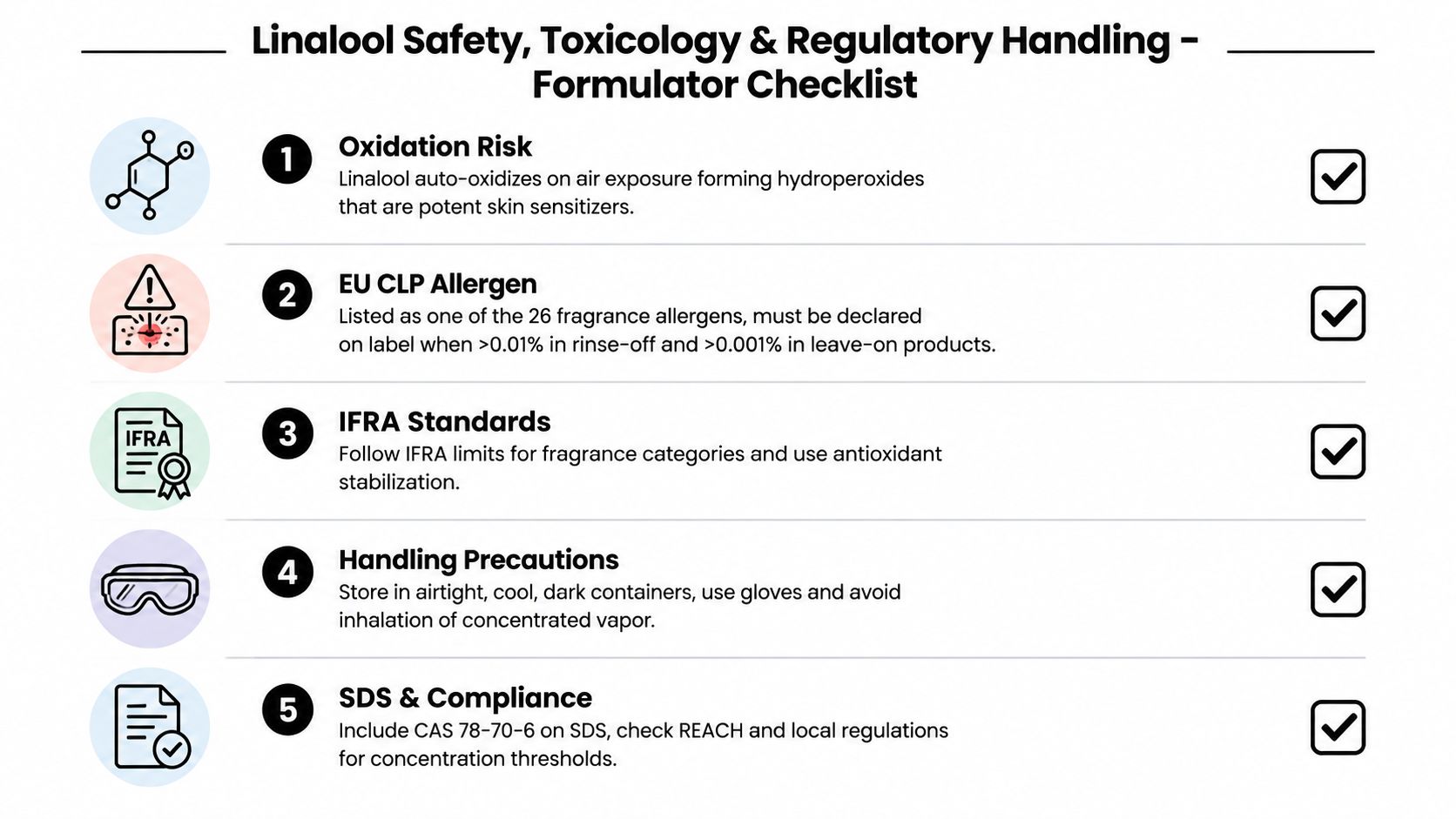
Linalool has a relatively favorable safety profile in several regulatory assessments, but it isn't risk-free. A toxicology assessment reported low acute toxicity and NOAEL values of 50 mg/kg/day for linalool and related esters, while human dermatology studies found no irritation, phototoxicity, or sensitization under declared use levels (Fragrance Material Safety Resource assessment). Other authoritative summaries still identify possible skin and eye irritation and liver injury, so route, concentration, product type, and oxidation state all matter.
The main practical concern for handling is oxidation. Fresh linalool can react with air over time, forming hydroperoxides that are more likely to trigger contact allergy. The cutaneous allergy guidance on linalool explains why age and storage can change the risk profile, especially for people with eczema or existing fragrance sensitivity.
Build handling controls into the process
Use airtight, light-resistant containers and limit repeated headspace exchange. Nitrogen-purged vessels, cool storage, FIFO rotation, and periodic peroxide-value checks can help identify deteriorating material before it reaches production. Concentrated vapor also requires ventilation and appropriate personal protective equipment.
Regulatory treatment depends on the product and jurisdiction. Linalool is one of the 26 fragrance allergens requiring declaration in EU cosmetics above 0.001% in leave-on products and 0.01% in rinse-off products (regulatory handling summary). IFRA limits can also apply to specific fragrance categories, including a cited 0.8% limit for some leave-on body-product categories. Those cosmetic thresholds aren't automatically cannabis vape specifications, but they demonstrate why the finished product category must be identified before a label or safety conclusion is approved.
Watch the supplied safety documents, current jurisdictional rules, and inhalation-specific risk review. For a practical overview of terpene handling in vapor products, consult the terpenes safety guide for vaping.
Lab Testing and Sourcing Best Practices
A supplier qualification process should begin with identity and composition, not aroma alone. Request a current COA that identifies linalool by GC-FID or GC-MS, shows the chromatogram where available, and states the tested purity. If a supplier claims natural-derived material, ask for chiral chromatography or other data supporting the R and S enantiomeric ratio.
Your testing request should match the risks in the material:
- Identity and purity: Confirm the reported linalool peak and assess whether related terpenes or esters explain the aroma.
- Chiral composition: Compare the R and S profile when natural origin or sensory replication matters.
- Contaminants: Screen botanical material for residual solvents, heavy metals, and pesticide residues.
- Oxidation: Request a peroxide value or an equivalent oxidation indicator before approving aged inventory.
- Traceability: Review lot numbers, manufacturing records, chain-of-custody documentation, and retest history.
A COA without a chromatogram isn't automatically invalid, but it gives you less visibility into co-eluting compounds, adulteration, and unexplained secondary peaks. Vague origin language, missing lot traceability, and pricing that sits well below comparable material deserve follow-up rather than automatic rejection.
Natural and chemosynthetic material can both be legitimate. The issue is whether the supplier's description matches the analytical evidence and your finished-product claim. If your goal is to replicate a cannabis extract, compare the isolate's chiral and secondary-compound profile with the reference extract instead of assuming that a single linalool peak will recreate the same aroma.
Store accepted material in amber, tightly closed containers with minimal oxygen exposure. Refrigerated inventory, controlled opening procedures, and documented retest intervals help catch drift before the ingredient reaches the mixing bench. Your internal release specification should state what happens when the material falls outside its aroma, purity, or oxidation limits.
Formulator's Recap and Quick FAQs
Linalool belongs in a formula when you need floral lift, citrus-to-floral continuity, or a softer top-heart transition. Start with a tested target, evaluate a restrained inclusion level, and judge the blend in the final distillate and cartridge rather than in a neat isolate sample. Protect the material from oxygen and heat, qualify the supplier's COA, and keep pharmacological language below the evidence ceiling.
A practical next-run checklist looks like this:
- Review the source material. Confirm identity, purity, origin claims, chiral information, and oxidation indicators.
- Make a small pre-blend. Use the production distillate or another validated compatible phase.
- Add under gentle heat. Mix incrementally, then evaluate after the oil equilibrates.
- Test the hardware. Compare ceramic and cotton systems for wicking, release, leakage, and late-session aroma.
- Document the sensory result. Record the linalool level, companion terpenes, batch, hardware, and storage condition.
Does winterization remove linalool?
Winterization can change the volatile balance, but the outcome depends on the solvent system, temperature, filtration, time, and how the process is closed. Don't assume that a linalool-rich extract will retain its original profile after winterization. Test the pre-process and post-process material with the same analytical method, then perform a sensory comparison in the finished oil.
Does linalool decarboxylate?
Linalool isn't a cannabinoid acid, so decarboxylation isn't the relevant transformation pathway. Sustained heat can still drive evaporation, oxidation, and other chemical changes. Validate any heated process with controlled time and temperature studies rather than treating linalool like a thermally neutral ingredient.
How does it behave in ceramic and wick atomizers?
Ceramic and wick systems can differ in liquid distribution, residence time, and local heating. A blend may present a clean floral opening in ceramic hardware but feel sharper or fade sooner in a cotton system. Compare filled cartridges under matched pull conditions, and inspect the oil after storage for separation, darkening, or aroma drift.
How can you rebuild a linalool-rich profile after shelf-life loss?
First, confirm that the loss is real through retained-sample testing and a current COA. Then compare the remaining terpene ratio, oxidation indicators, and sensory profile before adding anything back. A fresh linalool adjustment may restore the missing floral note, but it won't recreate secondary compounds that were lost from the original botanical fraction, so document the revised profile rather than presenting it as an unchanged batch.
Gold Coast Terpenes offers isolated linalool and terpene blends intended for cartridges, concentrates, and product formulation, alongside formulation resources such as a mixing calculator and safety documentation. Visit Gold Coast Terpenes to review linalool options and build a more controlled terpene profile for your next distillate or cartridge trial.