
A fresh 1 g limonene-forward distillate cart can smell like bright orange on day one, then turn flat and slightly piney after two weeks on a 28°C retail shelf. That failure isn't unusual. It comes from treating limonene terpene as a simple flavor addition instead of a volatile, oxidation-sensitive formulation material.
For cannabis product developers, limonene affects more than the first impression. It changes dose selection, blend architecture, cartridge behavior, storage, stability testing, and even whether a citrus SKU remains recognizable after release. The practical question isn't whether limonene belongs in a formula. It's how much to use, what to pair with it, and how to protect it from oxygen, heat, and time.
Why Limonene Drives Your Top-Note Decisions
At the bench, the first question is often sensory: does the cart smell like the target cultivar? A limonene-forward profile can answer that immediately, because the molecule arrives with a strong citrus signal. The same intensity creates the first formulation trap. Limonene is volatile enough to dominate the opening aroma, then leave the blend faster than heavier supporting terpenes.
That means a fresh cartridge can mislead you. The first inspection may show a convincing orange or lemon-peel note, but the aroma curve can change during storage and use. Oxidation produces compounds such as carvone, carveol, and hydroperoxides, shifting the profile away from clean citrus and toward resinous, pine-like, or turpentine-like impressions. The cart hasn't merely become weaker. Its balance has changed.
Bench rule: Judge a limonene blend at release and after stability exposure. A citrus profile that works only when fresh isn't a finished profile.
Limonene's volatility also front-loads the sensory experience. In a cart, the first 200 puffs can present a brighter top note than later draws because the most volatile fraction is consumed or lost first. A bridge terpene can soften that transition, but it can't restore limonene that has evaporated or oxidized.
This is why storage belongs in the flavor brief. A warm shelf, a poorly sealed tank, excess headspace, or repeated opening can alter the result before the customer uses the product. The practical guidance on limonene uses in formulation is useful as a starting point, but cartridge developers still need their own stability pulls.
Dose decisions follow the same logic. Too little limonene produces a vague citrus suggestion that disappears into a dark distillate base. Too much can make the opening sharp, thin, or solvent-like, while also increasing the amount of oxidation-sensitive material in the formula. The rest of this guide treats limonene as both the source of the citrus identity and the reason that identity needs protection.
What Limonene Actually Is and Why Citrus Plants Produce So Much of It
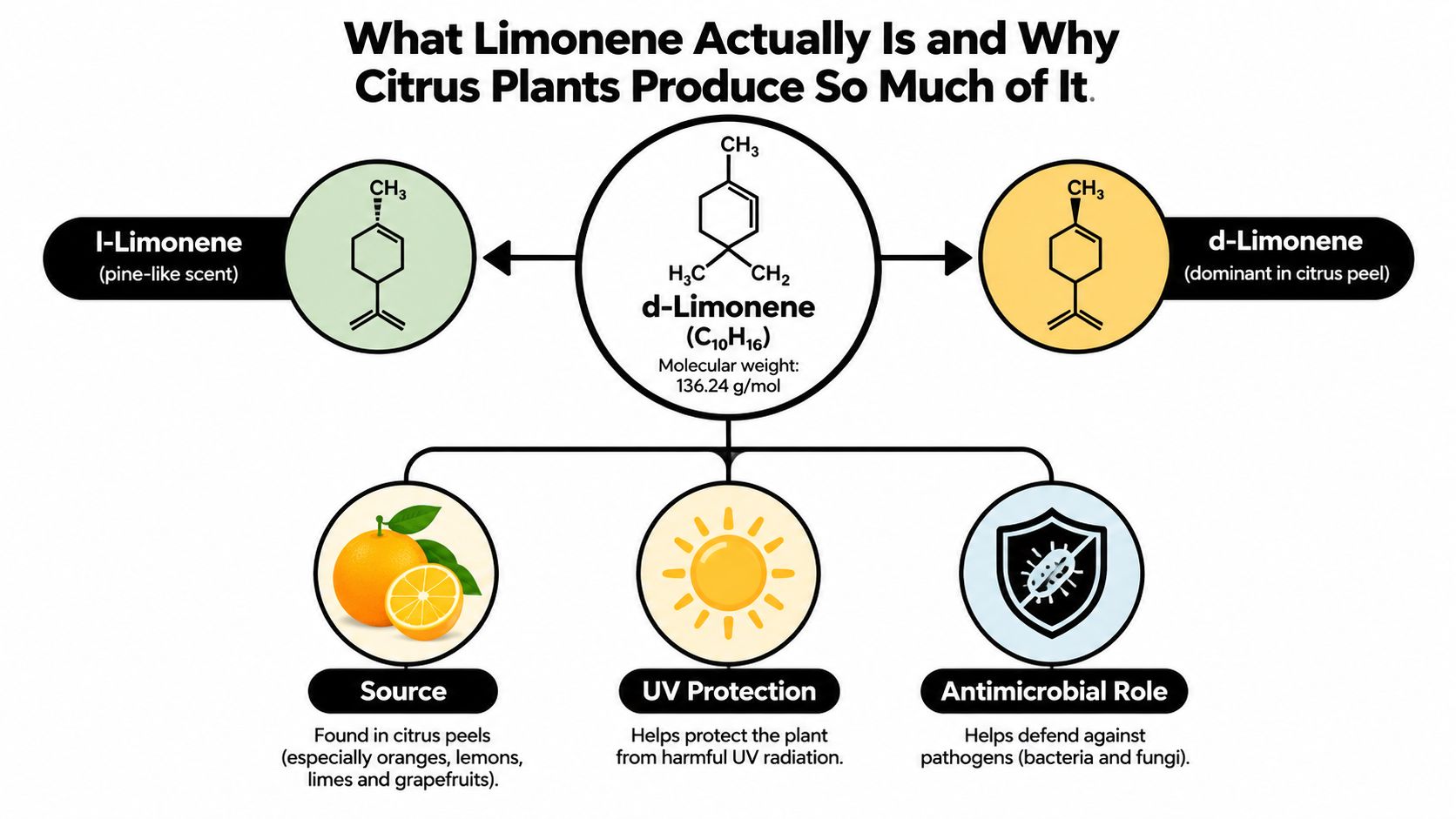
Limonene is a monocyclic monoterpene with the molecular formula C10H16 and a molecular weight of 136.24 g/mol. It exists as d- and l-enantiomers. D-limonene is the form most closely associated with citrus peel oils, while l-limonene can present a more pine-like aromatic direction.
Citrus plants concentrate limonene in oil glands within the peel. The plant builds the molecule through terpene biosynthesis associated with the mevalonate pathway, producing precursors that are converted into limonene by specialized synthase enzymes. The resulting oil serves biological functions connected with defense, signaling, and protection from environmental stress.
Why citrus oil becomes a commercial feedstock
Citrus rind oils contain limonene at a much higher concentration than many other plant oils. A review reports that limonene generally represents 60% to 95% of citrus rind oils, while sweet orange oils can contain 68% to 98%, lemon oils 45% to 76%, and bergamot oils 32% to 45% according to this citrus essential-oil review. Some sweet orange oils exceed 95% d-limonene, making citrus processing an efficient source of the compound.
That concentration explains why cold-pressed orange and lemon oils can read as almost entirely limonene at the sensory level, even though trace aldehydes and other terpenes shape the final character. For a formulator, the implication is direct: a credible citrus top note usually requires a high-limonene fraction, not a generic “fruity” blend.
From plant biology to product economics
Commercial recovery of limonene from citrus processing has a long history. Its first recovery as a commercial product occurred during the 1941 to 1942 Florida citrus season, and commercial production in Florida was already common by 1946. Florida output was estimated at about 4,500 tonnes in 1971, roughly 8,600 tonnes in 1989, and 6,800 to 7,700 tonnes in 1990. Global orange oil, essence oil, and R-(+)-limonene production was estimated at about 45,000 tons in 1991, while later estimates placed worldwide R-(+)-limonene production above 70,000 tons annually. ACS reported worldwide production around 50,000 t/year, with a 2020 market value of US$323 million, as summarized in this limonene industry overview.
Those volumes matter because they connect aroma intensity to supply and processing. A high-limonene ingredient can be cost-efficient per gram, but its concentration also raises oxidative load and sensory impact. The molecule that makes citrus easy to recognize is the same molecule that demands disciplined handling.
You can find the broader botanical context in this guide to why plants produce terpenoid compounds.
Physical Properties That Change How Limonene Behaves in a Cart
A cart can leave the bench with a clean citrus profile and arrive at stability testing with a flatter, harsher top note. Limonene's physical properties make storage, hardware selection, and dosing part of the same formulation decision. D-limonene has a boiling point of about 175.5 to 176°C and water solubility of roughly 13.8 mg/L at 25°C, according to the NCBI toxicology reference for limonene. It prefers oils and organic phases, so it blends readily into distillate but performs poorly in a water-only system.
| Property | Value | Formulation Implication |
|---|---|---|
| Boiling point | About 175.5 to 176°C | Works in heated vapor systems, but does not remove oxidation or thermal-degradation concerns |
| Water solubility | About 13.8 mg/L at 25°C | Favors oil-phase formulations and requires a suitable co-solvent for water-based products |
| Chemical class | Monocyclic monoterpene | Produces a strong, volatile top note that can dominate the first impression |
| Phase preference | Strongly oil compatible | Supports blending with distillate and other lipid-compatible bases |
| Oxidation sensitivity | Readily oxidizes in air | Calls for controlled headspace, tight sealing, cool storage, and stability checks |
The boiling point sits above the operating range commonly used by many 510 devices, yet that does not guarantee unchanged delivery. Coil temperature, voltage, airflow, wick saturation, and residence time determine the energy applied to the formula. A blend that passes a basic heat check can still taste harsh when the hardware runs hot or partially dry.
What the flash point changes
The flash point is reported at about 48°C in the formulation data supplied for this profile, so treat limonene as a flammable volatile ingredient during handling and storage. Warm warehouses, transport compartments, and retail shelves can increase vapor pressure, especially in open tanks, loose caps, or poorly sealed cartridges.
Cooling helps slow aroma loss, but it does not replace proper packaging. Use tight closures, limit high-temperature exposure, and avoid storing bulk limonene in partially filled containers. For cut-point and hardware planning, this boiling point guide for terpenes helps compare limonene with other volatile ingredients.
The practical distinction is compatibility versus retention. Limonene may mix cleanly into distillate, while the finished SKU still loses its citrus identity if oxygen, heat, or a weak seal removes or alters the volatile fraction. That risk should influence whether a limonene-forward cart uses smaller fills, stronger packaging, or a shorter shelf-life target.
Dose Rates and Loading Targets for Cartridges and Distillate
Set the physical target before chasing a brighter citrus note. A distillate cart needs enough added terpene to move through the hardware without turning harsh or overly thin. Live resin sauce starts with a different texture and often needs less intervention than a heavy, highly refined distillate. Limonene's oxidation risk also makes the loading decision a storage decision. A high initial dose can lose its clean top note faster than a restrained formula in a well-sealed cartridge.
A patent on reducing heavy-oil viscosity reports d-limonene mixed with distillate at 20:80 to 50:50 by volume in the published patent record, with a more preferred range of 25:75 to 45:55. One disclosed example uses 35% d-limonene and 65% distillate. These ratios address viscosity reduction, not routine flavor loading. Using them as the default terpene dose for a consumer cart would produce a substantially different product and raise harshness, volatility, and retention concerns.
For commercial flavor work, a technical guide recommends 3% to 6% total terpenes, with limonene commonly used at 3% to 6% of the blend in this cartridge formulation guide. Another formulation article describes a broader cartridge target of 6% to 10% total terpenes, while keeping limonene commonly at 3% to 6% of the formula in this limonene blending guide. Treat both as development windows, then adjust for base composition, hardware, and expected shelf life.
A practical dosing sequence
Confirm the base. Measure viscosity, aroma, and hardware flow before adding terpenes. Distillate, sauce, shatter, and badder do not respond identically.
Choose the total terpene window. Start at the lower end when the base already has a strong botanical profile or when the hardware produces a hot, concentrated aerosol.
Set limonene inside that total. A bright citrus cart can begin with limonene as the leading fraction. Judge the result after a rest period and a hardware pull, not from the open beaker alone.
Check the product category. A water-based drink or sublingual system needs a compatible co-solvent because limonene has limited water compatibility. Oil compatibility does not carry over to water systems.
| Product Type | Limonene Range | Total Terpene Window | Notes |
|---|---|---|---|
| Standard 510 distillate cart | 3% to 6% | 3% to 6% | Start conservatively and evaluate harshness, flow, and top-note retention |
| Live resin sauce cart | 1.5% to 3% | 3% to 6% | Pull limonene back when the native sauce already carries citrus character |
| Shatter or badder reintroduction | Qualitative starting point | 3% to 6% | Add in staged increments because texture and native aroma vary |
| Viscosity-focused oil adjustment | Reference ratios of 20:80 to 50:50 d-limonene to distillate | Not a flavor target | Use only for deliberate rheology work, not routine flavor loading |
For a detailed mixing workflow, use this guide to how much terpene to add to distillate. The right dose is the one that preserves the intended flavor through filling, storage, and use, not the one that smells strongest immediately after mixing.
The Real Evidence Behind the Uplift and Mood Claims
Formulators should separate a sensory description from a pharmacological claim. Limonene can create a bright, clean, citrus impression, but that aroma alone doesn't prove a broad mood effect.
The strongest human evidence in the supplied research is narrower. A 2024 controlled human study found that vaporized d-limonene selectively reduced THC-induced anxiety in a dose-dependent manner, while producing little effect on other acute subjective, cognitive, or physiological THC outcomes in healthy adults as reported in the controlled human study record. That result supports a specific research direction, not a universal “uplift” promise.
Claim discipline: “May modulate THC-related anxiety under tested conditions” is more defensible than “boosts mood” or “creates focus.”
Rodent and cell research involving pathways such as 5-HT1A and adenosine can help researchers form mechanistic hypotheses, but those findings don't establish what a retail inhaled formulation will do in people. The same caution applies to studies using orange peel oil. An essential oil contains limonene plus other constituents, so its result can't automatically be assigned to isolated d-limonene.
For brand owners, the cleanest positioning is sensory first and evidence-aware second. Describe the formula's citrus, orange-peel, lemon-zest, or clean top-note character. If discussing research, state that controlled human data support anxiety modulation in a specific THC co-administration context, while broader mood claims remain unconfirmed.
Avoid medical language in product copy unless your regulatory and legal teams have approved it for the relevant market. A formulation can be designed around an aromatic profile without turning that profile into a therapeutic promise.
Building a Blend Around Limonene as the Top Note
Limonene works best when the formula gives it somewhere to go. Use it as the top note, then add mid and base materials that preserve identity after the first bright burst fades. The goal isn't to bury limonene under heavier terpenes. It's to give the citrus opening enough structure that the product still reads as intentional later.
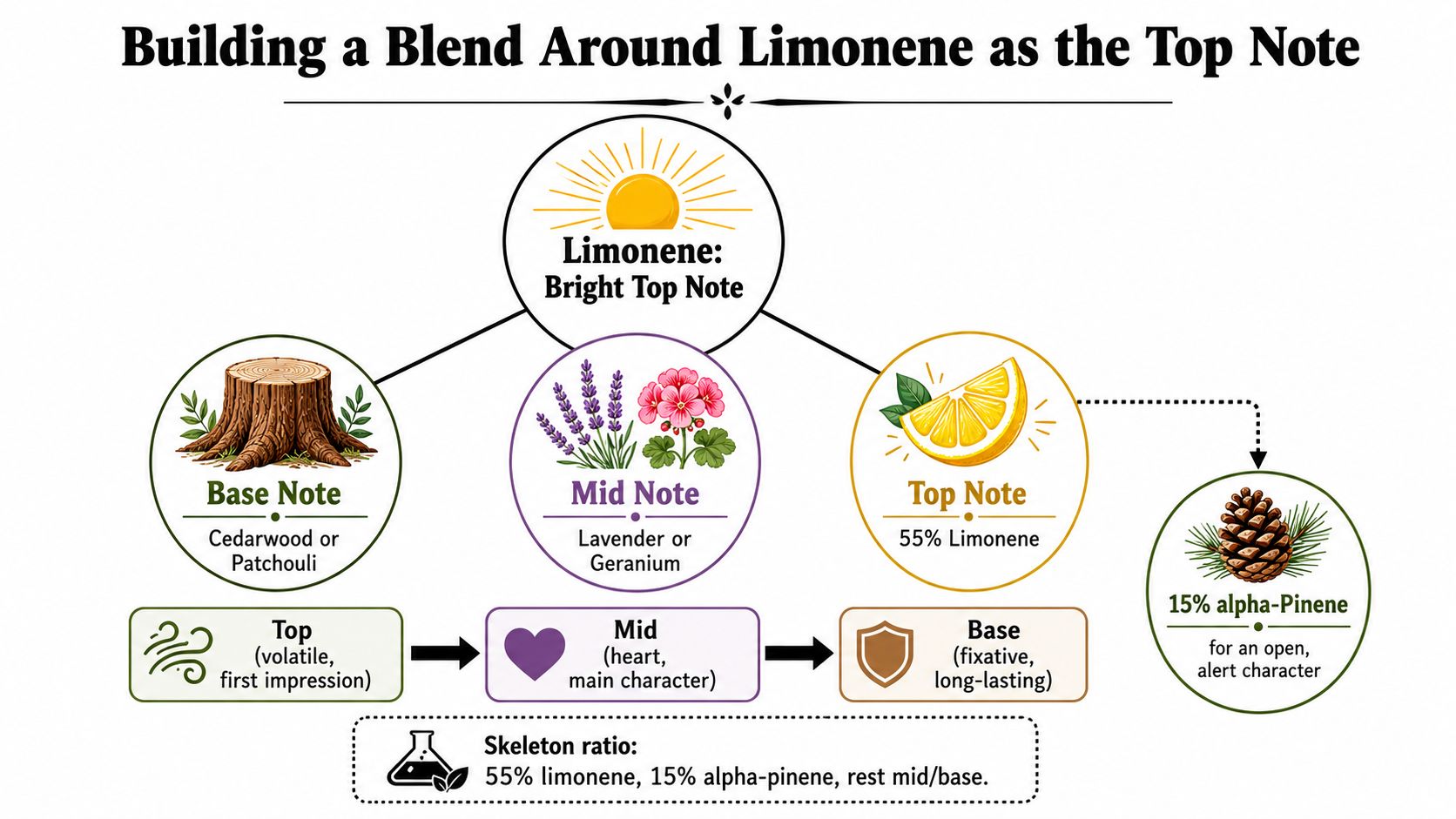
A practical starting skeleton is:
- 55% limonene: Provides the bright citrus opening and establishes the profile's identity.
- 15% alpha-pinene: Adds an open, alert, pine-herbal lift.
- 15% gamma-terpinene: Extends the citrus character with green-peel depth and slight bitterness.
- 10% myrcene: Rounds the middle and prevents the opening from feeling too angular.
- 5% beta-caryophyllene: Gives the dry-down a dry, warm anchor.
This is a terpene-fraction ratio, not necessarily the percentage of the entire cart. The overall formula still needs a separate total terpene loading decision based on the base, hardware, and desired intensity.
Adjusting the architecture
Beta-caryophyllene can stabilize a citrus profile, but pushing it to 5% or higher in this skeleton can muddy the citrus read. If the brief calls for a brighter, more Sativa-leaning direction, replace beta-caryophyllene with terpinolene. That keeps the profile more open and aromatic.
For a heavier, more Indica-leaning direction, push myrcene to 25% and reduce the other supporting materials proportionally. Expect a softer, rounder finish and less separation between the citrus top note and the base.
The pairing should also follow the native extract. Lemon Haze can support a sharp citrus and herbal architecture. Tangie can take a sweeter orange direction with less need for aggressive correction. GMO needs more restraint, because its dark, savory base can make a high-limonene blend feel disconnected if the bridge materials aren't selected carefully.
The Elevated Strains Apple Fritter profile is one example of a catalog flavor reference that can be evaluated by its fit with the intended base, rather than treated as a substitute for bench testing.
Use the following video as a visual reference for blend construction, then verify every ratio against your own sensory panel and stability pulls.
The useful question is whether the blend preserves the target identity after the top note drops. If the answer is no, add structure before increasing limonene.
Safety, Oxidation Risk, and Legal Status for Formulators
Fresh limonene and oxidized limonene shouldn't be treated as the same material. Exposure to air generates hydroperoxides and related oxidation products, and occupational guidance identifies sensitizing effects with oxidized limonene rather than unoxidized limonene. There is no clear threshold for sensitization in exposed workers according to this occupational assessment.
Independent dermatology data make the storage problem more concrete. Oxidized R-limonene triggered reactions in 5.2% of 2,900 dermatitis patients in multicenter patch-test data, while a UK audit found 5.0% positive reactions to limonene hydroperoxides and 7.3% irritant reactions in the summarized dermatology evidence. Limonene was found on patient products and judged relevant to dermatitis in 36% of limonene-allergic cases in that same evidence summary.
What oxidation changes at the bench
Autoxidation can generate hydroperoxides, including limonene oxidation intermediates such as limonene-1,2-epoxide and carveol hydroperoxide species. Sensory drift may present as turpentine, resin, or stale pine rather than clean citrus. In a cartridge system, altered chemistry can also complicate viscosity, seals, and metal-contact compatibility.
Don't infer inhalation safety from oral or topical data. Oral toxicity studies and rodent LD50 values can inform hazard assessment, but read-across to a heated aerosol is limited because the route, temperature, particle behavior, and dose delivery differ. A formulator should ask for route-relevant safety review instead of using a single oral endpoint as a complete answer.
Regulatory status needs market-specific review
Limonene has established food-use history, including GRAS FEMA 2633 status, but food-use acceptance doesn't automatically authorize every inhaled, topical, or cannabis application. FEMA limits, product category, carrier system, impurities, and local cannabis rules still matter.
California packaging requirements and Massachusetts restrictions on certain synthetic additives can affect finished-goods design, but they do not replace a current jurisdictional review. The regulatory question is not just whether limonene is natural. It includes source, purity, intended route, labeling, packaging, and the complete formula.
| Parameter | Value or Status | Formulation Implication |
|---|---|---|
| Oxidation behavior | Air exposure forms hydroperoxides and related products | Control oxygen, heat, light, and headspace |
| Sensitization evidence | Oxidized limonene is the primary concern | Use fresh material and assess oxidation history |
| Food-use status | GRAS FEMA 2633 | Supports food-use review, not automatic approval for inhalation |
| California and Massachusetts considerations | Rules can affect packaging and additive selection | Review current state requirements before release |
| Practical storage | Cool, sealed, low-oxygen handling | Consider nitrogen blanketing, amber glass, and PTFE seals |
For opened material, a practical rotation window is 30 to 60 days, with storage at 2 to 8°C where the product and facility controls permit it. Nitrogen headspace blanketing, amber glass, and PTFE-lined seals reduce exposure, but they don't make an old or already oxidized lot acceptable.
Lab Testing, Storage, and Three Limonene-Forward SKU Ideas
A limonene program needs more than a flavor check. The minimum useful quality system connects incoming material identity, oxidation status, water content, blend purity, and cartridge stability.
Bench-ready QC
- Peroxide value: Test incoming lots and discard limonene exceeding 20 meq/kg peroxide.
- Moisture: Use Karl Fischer testing and reject blends above 0.5% water.
- Purity: Use GC-FID to verify the limonene fraction and identify unexpected contaminants or drift.
- Chiral ratio: Use chiral analysis to confirm the intended d-limonene versus l-limonene balance.
- Stability pulls: Quarantine any cart showing more than 10% terpene loss during stability testing.
Those thresholds should sit inside a validated quality system, not operate as isolated guesses. Record lot number, container condition, opening date, headspace treatment, storage temperature, and the time between opening and compounding.
Before compounding, stage cold material only as long as needed to reach a workable temperature. Return the remainder to controlled storage promptly. A nitrogen blanket is most useful when paired with a tight closure and a rotation log. If the container is repeatedly opened, the original headspace protection loses value.
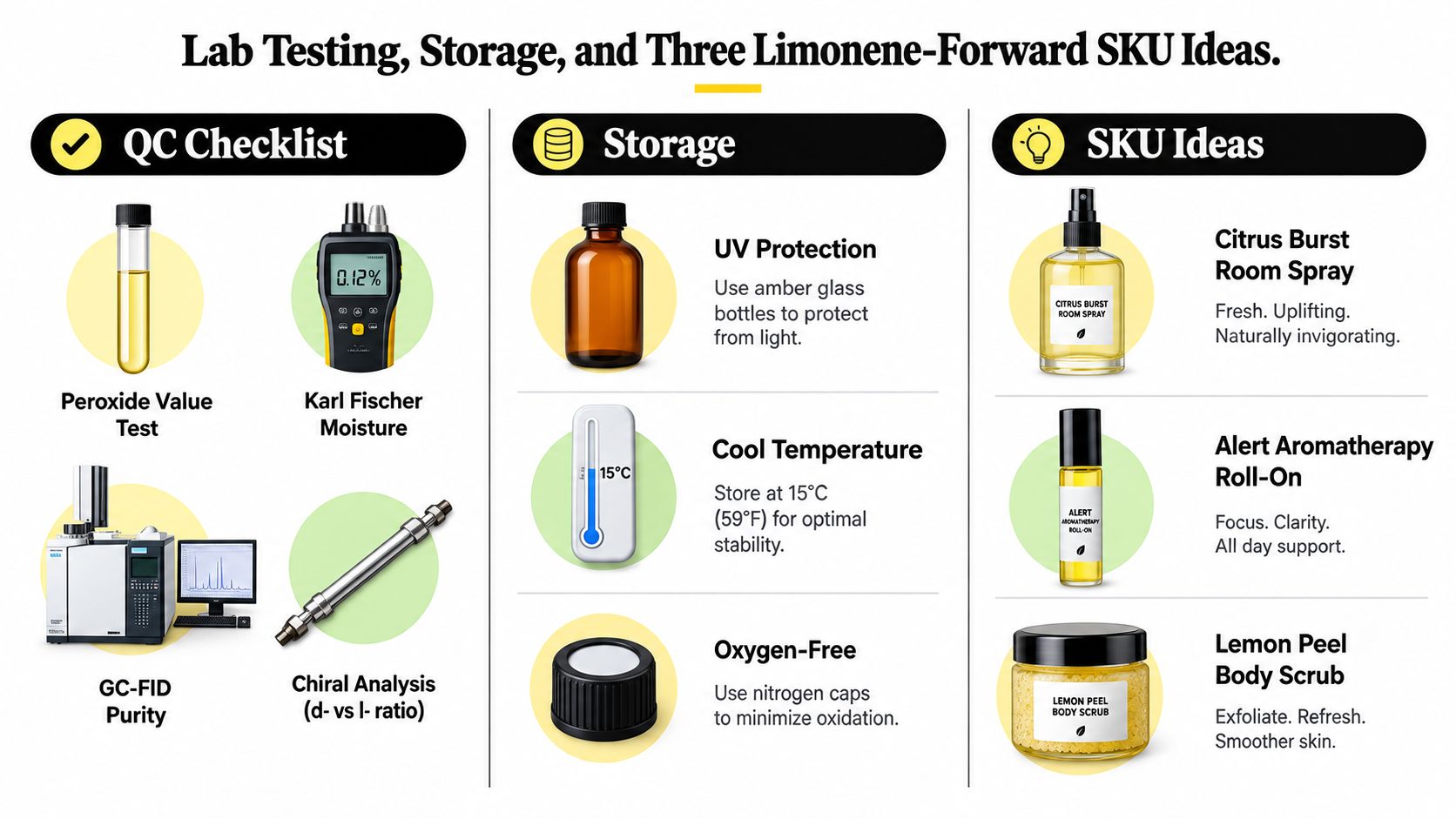
Three SKU directions
Sativa-leaning 510 cart: Build around limonene, alpha-pinene, and terpinolene at a 5% total terpene load. Use hardware with consistent oil feed and validate the opening against later pulls. The stability challenge is preserving the volatile citrus and terpinolene impression without allowing the pine side to dominate.
Cold-storage live resin badder: Rebalance a native citrus-deficient badder with limonene to restore the top note, using staged additions rather than a single heavy correction. A cold-storage requirement can become part of the operational design because the product's value depends on retaining a fresh top note.
Topical entourage balm: Use limonene as a scent driver and penetration enhancer, with a formula-specific review for skin sensitization and oxidation. The stability challenge is more direct here because oxidized limonene has established sensitization relevance, so packaging, batch age, and labeling need close control.
Gold Coast Terpenes offers isolated compounds, strain-specific profiles, formulation resources, and lab-verified THC-free terpene components for cartridge and concentrate development. Visit Gold Coast Terpenes to compare limonene options and use the available formulation tools when building a citrus-forward SKU.