
A product team has a familiar problem: the brief says bright lemon, the first cartridge smells promising, and the retained sample later loses its clean peel character. The top note turns sharp, thin, or solvent-like, while the blend that sounded fresh on the bench no longer reads as rain, citrus, or anything close to the intended flavor.
The children's lyric “If all the raindrops were lemondrops and gumdrops” offers a useful formulation prompt. It asks for more than a strong lemon aroma. It asks for a profile that arrives quickly, feels transparent through the pull, and finishes softly. In practical terms, that means building a strain-inspired terpene blend for distillate around lemon's brightness without letting volatility, oxidation, or excessive terpene loading undermine the cartridge.
Reading the Lyric as a Formulation Brief
The lyric begins with a playful sensory image: rain becomes lemon drops and gumdrops, and the listener opens their mouth to catch it. That image translates cleanly into a bench brief. Each droplet should carry a fresh citrus lift, a lightly sweet center, and a clean finish rather than a heavy perfume or aggressive solvent note.
The song has a documented history across children's music. “If All the Raindrops” appeared in Barney Goes to School on August 15, 1990, then appeared on Barney's Favorites, Volume 1 in 1993. A separate record traces an earlier version to a Pete Seeger camp-song recording from 1955, placing the lemon-drop image within at least 35+ years of documented circulation before and after its television-era popularity (the song's documented history). The point for a formulator isn't nostalgia alone. A durable sensory image usually has a simple, recognizable signature, and lemon supplies that signature immediately.
Turning imagery into cartridge behavior
For a cartridge, “lemon rain” should behave as three coordinated layers:
- Sharp top note: a quick peel-like opening that establishes lemon before the vapor settles.
- Transparent mid note: enough body to prevent the profile from collapsing into a one-dimensional monoterpene burst.
- Soft dry-down: a restrained finish that keeps the citrus readable without leaving a harsh or medicinal impression.
The profile also needs boundaries. Harsh aldehydic edges, excessive citral-like sharpness, and premature oxidation can turn a bright citrus concept into something closer to cleaner or turpentine. Limonene is central to the brief, but it can't carry every sensory job by itself.
The chemistry creates the central tension. Limonene is highly volatile, has a vapor pressure of about 200 Pa at 25 °C, and has low water solubility of about 7.5–13.8 mg/L (research on citrus aroma compounds). It can provide the opening lift, but it also needs supporting structure and controlled handling. A sound formulation therefore treats lemon as a layered architecture, not as a single-isolate dosing exercise.
What Limonene Brings to a Lemon-Led Profile
A lemon-rain cartridge needs to announce citrus on the first part of the pull, then stay recognizable through the finish. Limonene is the structural backbone of a lemon-led profile, but it cannot supply every sensory function alone. In citrus peel oils, it commonly represents about 60–95% of the essential oil fraction, which helps explain its dominance in lemon and orange systems. Its odor combines sweet peel, orange-rind warmth, and a faint pine edge, giving the cartridge immediate citrus identity.
Limonene's physical behavior shapes the vapor impression as much as its aroma. Its volatility creates fast lift, while low water solubility and strong odor make small additions perceptually powerful. The trade-off is a thin mid-palate when the blend relies too heavily on it. The opening flashes forward, then leaves limited material to support the finish.
The instability problem
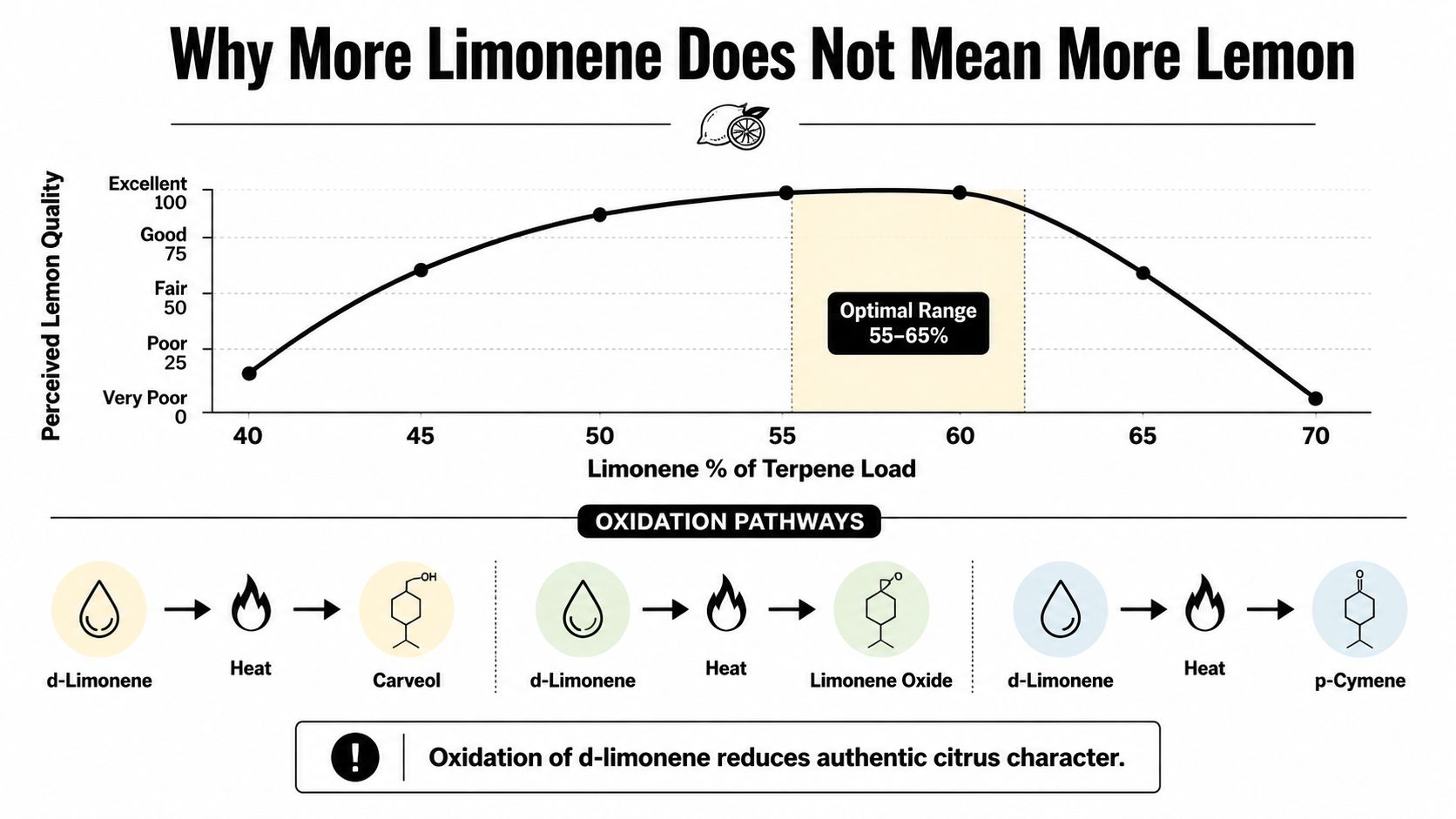
Limonene autoxidizes in air and can form oxidation products with different odor qualities. Acid-catalyzed hydration and rearrangement can also move the profile away from fresh citrus toward compounds such as alpha-terpineol. Oxygen exposure, light, heat, metal contact, and repeated headspace exchange all matter in a cartridge. A blend that smells excellent at batching can lose its lemon authenticity if limonene is handled like an inert diluent.
Cold-pressed peel material and purified distilled cuts require different formulation choices. A peel-derived fraction may deliver broader citrus character because residual citral, alpha-pinene, or gamma-terpinene add freshness and green-peel nuance. A purified cut offers tighter control and repeatability, yet often needs deliberate support from other terpenes to avoid sounding flat.
Practical rule: Use limonene to set the headline, then use supporting terpenes to carry that headline through the pull.
| Property | Value | Implication for Formulation |
|---|---|---|
| Share of many citrus essential oils | About 60–95% | Explains limonene's dominant citrus identity, but not its ability to provide full structure |
| Vapor pressure at 25 °C | About 200 Pa | Supports fast lift and increases the need for closed handling |
| Water solubility | About 7.5–13.8 mg/L | Reinforces its oil-phase behavior and limited compatibility with water-rich systems |
| Common citrus aroma role | Dominant peel note | Useful as a headline note, vulnerable as a complete formula |
Formulators developing a terpene profile for vape cartridges can consult d-limonene formulation guidance before validating the actual lot through sensory evaluation and analytical testing. The working principle is direct: limonene establishes unmistakable citrus, while the rest of the blend controls roundness, persistence, and hardware behavior. Its volatility is useful for the bright opening, but oxidation control determines whether that opening remains fresh.
Building the Top, Mid, and Base Around the Citrus Note
A citrus cartridge can open like cool lemon rain and still finish flat, harsh, or woody. Build the profile in layers: the top delivers immediate brightness, the middle keeps it from feeling hollow, and the base gives the finish enough persistence to remain recognizably lemon. The lemon terpene profile guide offers a useful reference for these relationships.
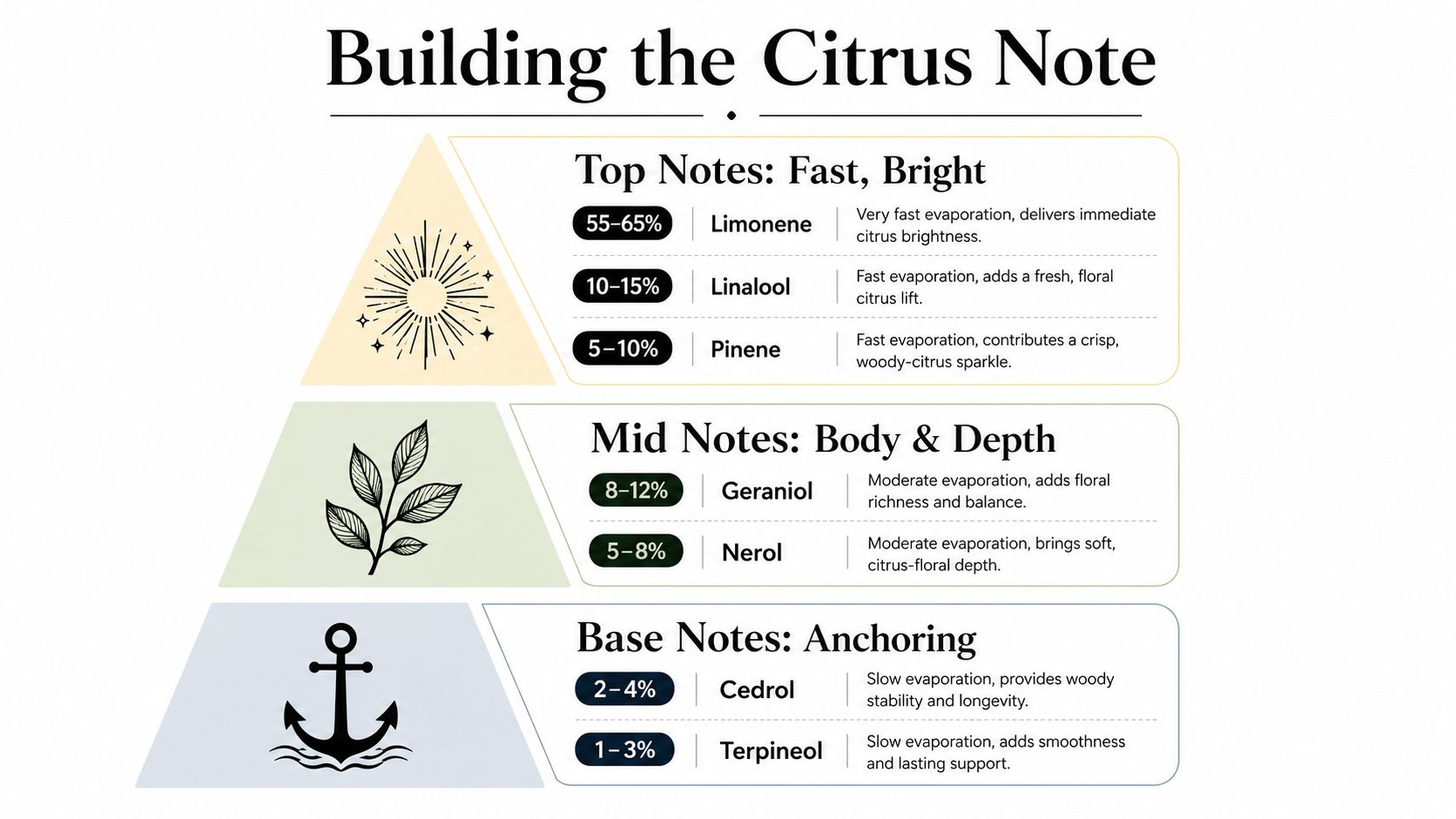
Top notes
Set the opening with 55–65% limonene in the total terpene blend. Add alpha-pinene at 5–8% for lift and gamma-terpinene at 3–5% for green-peel character. They solve different problems. Pinene sharpens the first impression, while gamma-terpinene shifts lemon away from candy and toward freshly expressed peel.
Mid notes
The middle should round the opening without masking it. Terpinolene, linalool, and beta-caryophyllene can each contribute at 1–3%, depending on the bridge required. Terpinolene adds aromatic body, linalool supplies floral sweetness, and beta-caryophyllene contributes a dry texture that keeps bright citrus from tasting watery.
The terpene flavor chart lists limonene as a top note with a boiling point of 176 °C, and linalool as a mid note at 198 °C. It gives linalool a usage range of 0.2–1.5%, compared with 0.5–2.5% for limonene in distillate formulation. Treat those figures as starting references. Cartridge temperature, airflow, extract composition, and sensory testing still determine the workable balance.
Base notes
Keep the base restrained. Valencene, nootkatone, and a small cedrol fraction can total 5–10%, adding grapefruit depth and slowing the perceived loss of the finish. Excess base pushes the profile toward wood or bitterness, especially after heating. The back end should support lemon, not replace it with cedar.
Set total terpene loading against the oil matrix and hardware. Guidance on balanced terpene loading for cartridges places a practical target at 6–10% total terpenes, with limonene commonly at 3–6%. Higher loading can thin the base and affect fill behavior or coil performance. The formulation succeeds when the first pull is bright, the finish remains supported, and the cartridge does not pay for that brightness with excess volatility or throat hit.
Two Blend Recipes That Capture Lemon Rain
A bright lemon cart can fail in two opposite ways: the opening disappears quickly, or the citrus becomes sharp and irritating. These recipes address that trade-off with different aromatic shapes. Summer Shower delivers a sparkling, fast-opening profile. Late Afternoon Rain rounds the lemon into a softer, candied-peel direction with more support underneath.
The percentages refer to the total terpene load, not the finished oil. They are starting architectures for a strain-inspired terpene blend for distillate. Confirm the balance against the actual extract, since the matrix may already supply volatile background notes.
| Component | Summer Shower % | Late Afternoon Rain % |
|---|---|---|
| d-Limonene | 60% | 55% |
| Beta-pinene | 8% | 3% |
| Gamma-terpinene | 5% | 4% |
| Terpinolene | 5% | 3% |
| Linalool | 3% | 5% |
| Beta-caryophyllene | 2% | 4% |
| Citronellol | 2% | 8% |
| Alpha-terpineol | 3% | 6% |
| Valencene | 5% | 7% |
| Nootkatone | 3% | 3% |
| Cedrol | 4% | 2% |
| Total | 100% | 100% |
Summer Shower
d-Limonene, beta-pinene, and gamma-terpinene create the clearest interpretation of “lemon rain.” Terpinolene links the bright opening to the middle, while linalool softens the finish before it turns angular.
Its cost is volatility. The larger monoterpene share can lose its cleanest top-note character sooner under heat, light, or excess headspace. It suits a ceramic-core 510 cartridge under 2.4 ohm, provided the finished oil meets the hardware manufacturer's viscosity and operating specifications.
Late Afternoon Rain
Late Afternoon Rain reduces limonene and increases citronellol, alpha-terpineol, and valencene. The profile is softer and more candied, with peel-like depth that stays present through the back end. Its heavier support may work more readily with a standard wick coil than Summer Shower, but the finished distillate still requires compatibility testing.
Total terpene dosage depends on the oil matrix. A Lemon Haze-style formulation reference places inclusion at 5–10% by weight (Lemon Haze terpene formulation guidance). Treat that range as a starting point, then adjust for volatility, throat feel, fill behavior, and the hardware test result rather than chasing maximum lemon intensity.
Translating the Recipe into Cartridge and Distillate Targets
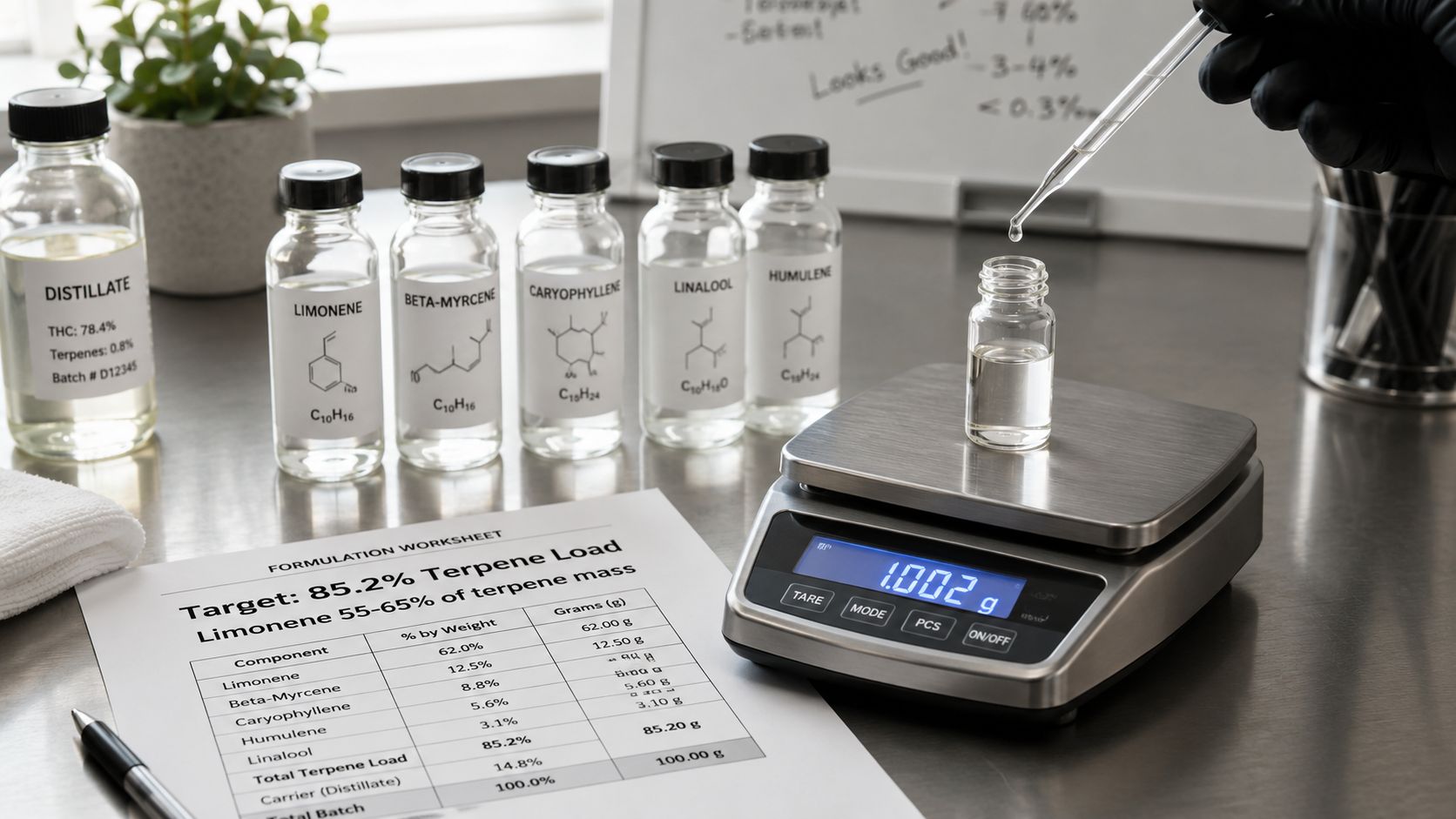
A recipe becomes useful only when the bench team can weigh it consistently. Start by selecting the total terpene load as a percentage of distillate mass, then calculate each component from that total rather than dosing every terpene independently by eye.
For example, with a 1 gram distillate batch at a chosen total load, multiply the total mass by each blend percentage. If the selected load is 6%, the terpene blend weighs 0.06 grams, or 60 milligrams, and the 60% d-limonene portion of Summer Shower represents 36 milligrams. The same calculation works for every component and prevents small percentage errors from becoming large sensory shifts.
Controlled addition
Warm the distillate to 40–50 °C, add the terpene blend below 55 °C, and avoid unnecessary exposure to open air. The temperature ceiling matters because volatile top notes can escape during prolonged heating. A formulation resource on how much terpene to add to distillate can support the initial load calculation, but the final target should reflect viscosity, hardware, and sensory testing.
Use a magnetic stir bar at low speed for 4 minutes. High-shear mixing can aerate the oil and increase contact with oxygen, which is counterproductive for a limonene-forward profile. Fill cartridges within 30 minutes of blending to limit top-note drift in the vessel.
Hardware and sensory checks
Use a 510-thread ceramic-core cartridge as the starting point for Summer Shower. Its bright profile benefits from hardware that doesn't exaggerate wick limitations. Late Afternoon Rain can be tested in a standard cotton-wick cartridge because its heavier support layer gives the lemon more persistence, but the finished oil still needs a fill and draw test.
Run sensory checks at one week and two weeks after filling. Look for three changes:
- Opening: Does the first impression still read as fresh peel?
- Middle: Does the floral or aromatic bridge remain present?
- Finish: Does the dry-down stay clean, or has it moved toward pine, solvent, or anise?
A short sealed-cartridge observation window of roughly 7–14 days can reveal whether the top note is muting before a larger production run. That window is a screening tool, not a shelf-life guarantee.
Why More Limonene Does Not Mean More Lemon
The instinct to push limonene higher is understandable. More limonene produces a stronger initial citrus signal, but strength at the first second isn't the same as lemon accuracy across the whole pull. Once supporting notes are crowded out, the profile can become louder and less authentic.
The verified chemistry supports caution. Limonene can autoxidize in air and produce altered odor qualities, while acidic conditions can shift citrus chemistry toward less-fresh notes. Unpolluted rain is about pH 5, while acid rain can range from pH 3.5 to 4.5 (pH background reading). A real cartridge isn't rainwater, but the comparison clarifies why oxygen, acidity, light, metals, and heat deserve attention in a lemon-led system.
What the brief does not support
Several highly specific claims are often repeated in citrus formulation discussions, including a fixed lemon-quality peak at a particular final-oil percentage or a precise aging multiplier between two limonene loads. Those figures aren't established in the verified data available for this article, so they shouldn't be presented as bench law.
The practical conclusion remains firm without invented precision. Limonene should lead, not dominate blindly. Linalool, beta-caryophyllene, terpinolene, and carefully selected deeper citrus notes give the vapor a rounded center and a more stable finish. A formulation guide for vape cartridges should optimize the sensory curve, not the largest possible limonene number.
For teams deciding whether to add citral or related citrus materials, what citral contributes to a citrus profile is a useful comparison point. The decision should come from the target sensory profile and stability result, not from the assumption that every sharper lemon note improves freshness.
Bench Checklist for a Fresh Lemon Profile
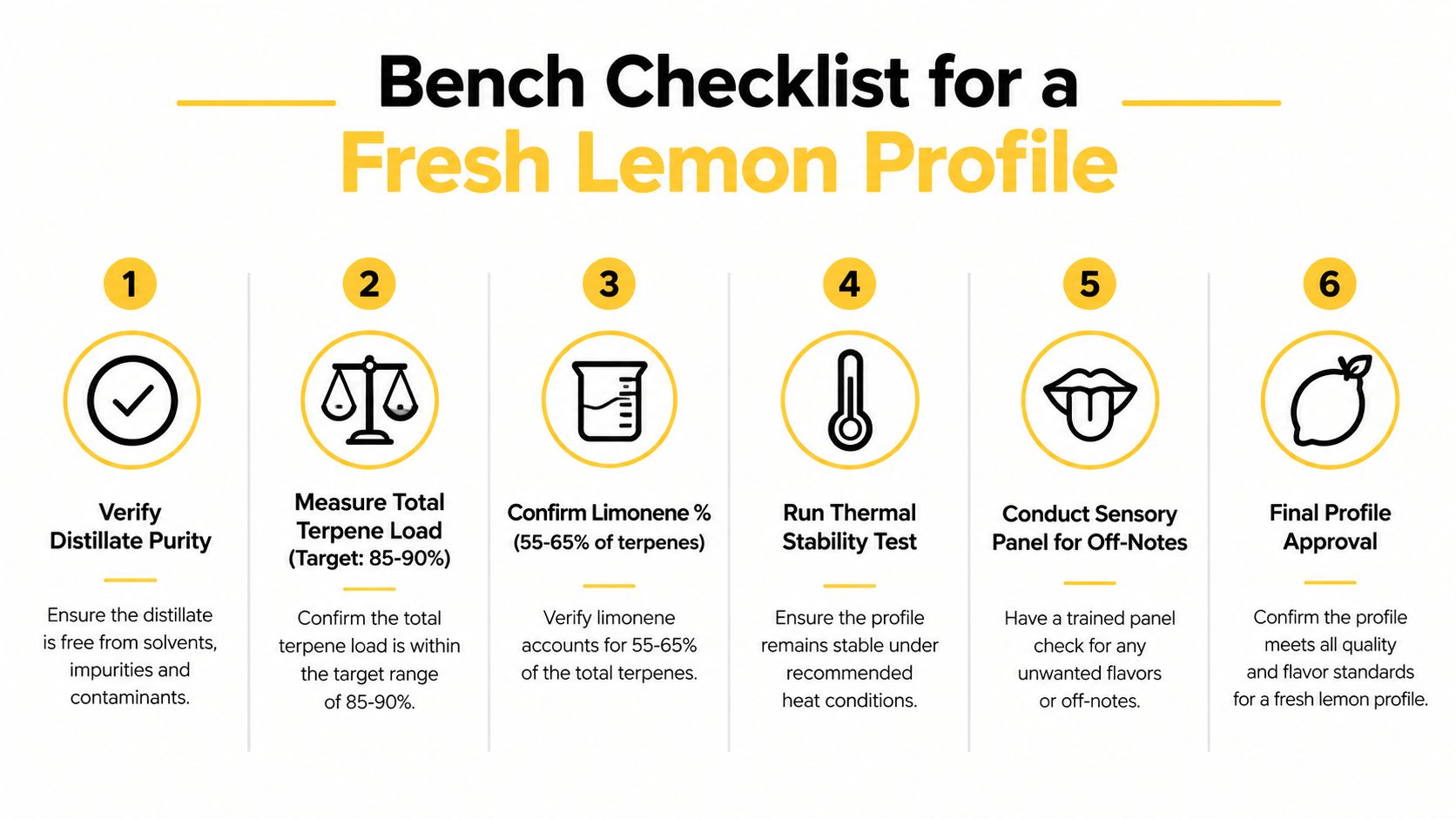
A production-floor checklist keeps the “lemon rain” idea connected to measurable controls. Run these checks in order before approving a limonene-led cartridge batch:
- Confirm the analytical profile: Verify that GC-MS limonene content falls within the 35–55% target window selected for the blend.
- Check lot freshness: Confirm that the d-limonene lot is within 30 days of opening.
- Measure flow behavior: Record viscosity at 40 °C before filling.
- Record the dose: Weigh the total terpene load and compare it directly with distillate mass.
- Condition the hardware: Pre-warm the cartridge hardware to 45–50 °C when the process permits.
- Control the headspace: Seal purged tanks under nitrogen to reduce unnecessary oxygen exposure.
Reject a cart that shows darkening after 48 hours at 25 °C. Also reject a blend when the top-note citrus reads sharper than the mid-note floral layer, because that imbalance usually means the formula is announcing lemon without delivering the soft, transparent center the brief requires.
Gold Coast Terpenes offers natural terpene blends, strain-specific profiles, isolated compounds, and formulation tools for teams developing cartridges and concentrates, including lemon-forward systems that need controlled layering. Visit Gold Coast Terpenes to compare blend components and build a repeatable lemon profile around your distillate, hardware, and sensory targets.