
Coffee is one of the clearest examples of why terpenes in coffee aren't just another flavor story. The cup chemistry is dominated by diterpenes, especially cafestol and kahweol, not the monoterpene-heavy patterns most formulators reach for first, and those compounds sit in the bean's lipid fraction where they behave very differently from volatile botanical notes (coffee diterpene review, coffee oil terpene review). For anyone building a terpene profile for cannabis product formulation, that changes the entire brief.
A coffee-inspired blend that tastes convincing in a cartridge or distillate doesn't come from copying “coffee aroma” in the abstract. It comes from deciding which compounds should carry the base, which should lift the nose, and which ones need to survive heat, dilution, and storage without falling out of solution. That's why coffee belongs in the same conversation as formulation guides, not just beverage flavor lore.
Why Coffee Terpenes Are Not What Most Formulators Expect
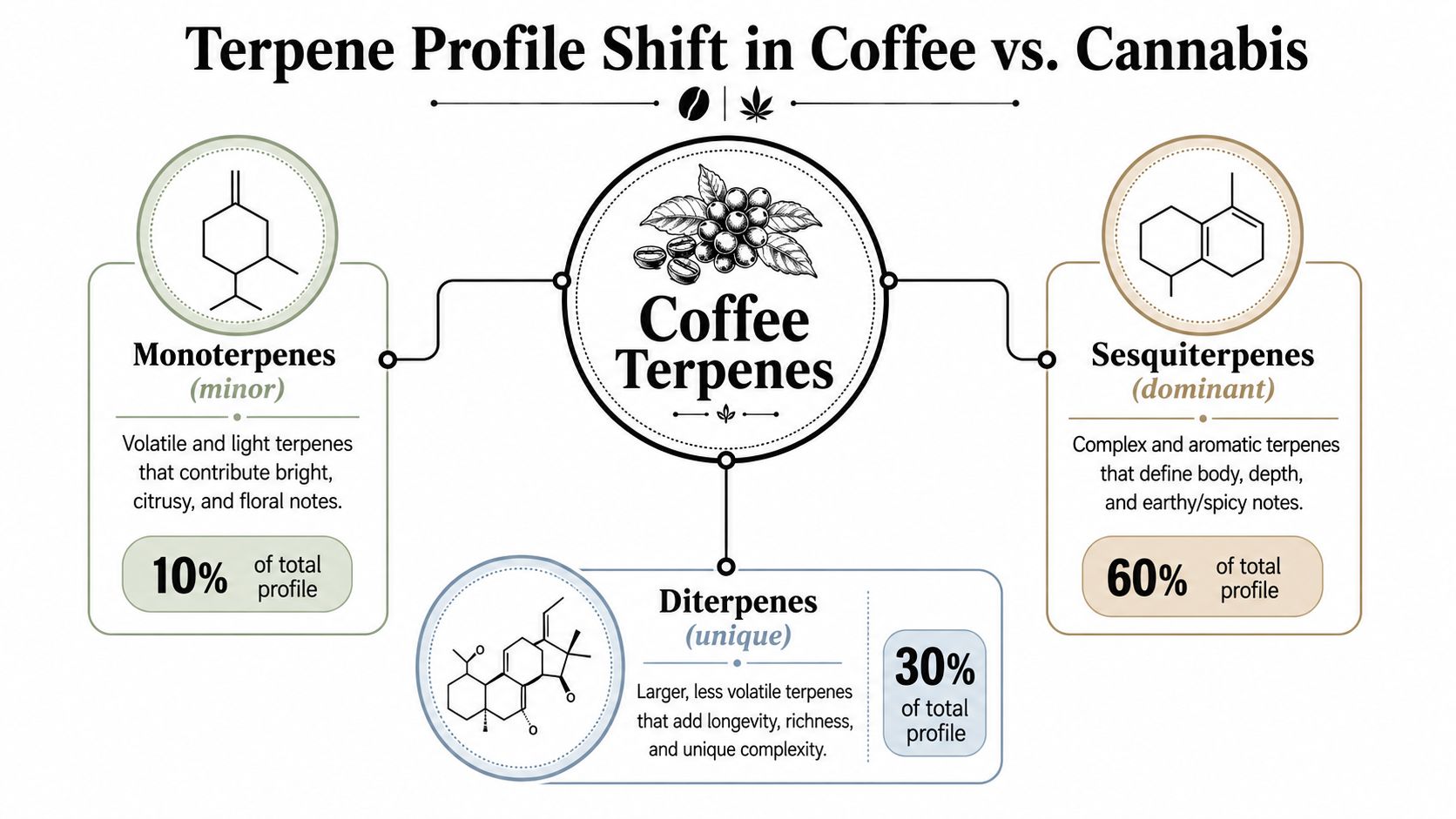
Coffee forces a different formulation mindset. Most terpene work in cannabis starts with monoterpenes, especially limonene, myrcene, and pinene. Coffee's terpene identity is built around diterpenes such as cafestol and kahweol, compounds concentrated in the bean's lipid fraction rather than in a simple volatile aroma pool. In green Arabica beans, total diterpenes have been reported at 1.3% to 1.9% by weight, while the Robusta cultivar ranges from 0.2% to 1.5% by weight in the same review (coffee diterpene review).
Why that matters in formulation
Coffee oil can contain diterpenes at about 7%–20% of the lipid fraction, and quantified compounds like cafestol at 182–1308 mg/100 g and kahweol at 0–1265 mg/100 g in green and roasted beans show that these are measurable markers with enough mass to matter in flavor chemistry and in finished product behavior (coffee oil terpene review, ibid). A formula that copies citrus or pine behavior will usually miss the target, because coffee brings heavier, lipid-bound material that behaves differently in solution and under heat.
Practical rule: if the profile is supposed to read as coffee, do not build it around a top-note aroma alone. Build the base around lipid-associated markers, then use lighter notes only to frame them.
For formulators, the main trade-off is solubility versus sensory weight. A coffee-inspired product has to be set up like a layered system, not treated as a single flavor drop. That distinction matters even more once you compare botanical terpenes with cannabinoid and synthetic options, as outlined in this terpene comparison guide.
Key Diterpene Markers That Define Coffee Flavor Chemistry
The coffee side of terpene formulation gets easier once you stop treating it as a generic “coffee flavor” problem and start working from the markers that carry the profile. The names that matter most are cafestol, kahweol, and 16-O-methylcafestol. These compounds are distinct enough to be measured separately in coffee oil and brew analysis, which is exactly why they work as practical targets in terpene profile for product development (coffee marker review).
What each marker contributes
Cafestol is the main anchor for a dense, coffee-forward base. In bench work, it behaves like the marker that gives the blend weight and an oily roast impression, so I treat it as the backbone rather than as a garnish. Kahweol sits close to that space, but it is not interchangeable with cafestol. If you blur the two, the result can flatten out or read as generic roasted material instead of brewed coffee. 16-O-methylcafestol helps separate coffee from other toasted or nutty profiles, especially when the goal is sensory accuracy rather than broad brown flavor character (coffee oil terpene review).
For formulators, the practical point is ratio control. A coffee-inspired blend that overweights cafestol can turn heavy and dull in a cart or distillate system, while too little kahweol leaves the profile short on lift and dryness. I usually treat 16-O-methylcafestol as a trace-level authenticity marker, not a dominant flavor driver, because it reads more as identity than as volume. That makes it useful in low-dose support roles where the blend needs to signal “coffee” without becoming muddy.
The bean source matters too. Arabica and the Robusta species do not express these markers the same way, and that difference gives formulators a practical choice. Arabica-style targets generally read cleaner and more layered, while the Robusta species can push harder into dense, heavier roasted character.
| Diterpene Concentrations in Coffee Beans | Arabica Range | Robusta Species Range | Sensory Role |
|---|---|---|---|
| Cafestol | 182–1308 mg/100 g | included within lower diterpene profile ranges | Coffee base, oily depth, roast realism |
| Kahweol | 0–1265 mg/100 g | included within lower diterpene profile ranges | Roast lift, dry cocoa edge, structure |
| 16-O-methylcafestol | measurable marker in coffee oil | measurable marker in coffee oil | Coffee specificity, profile authenticity |
That table is most useful as a formulation map, not as a literal blend recipe. In practice, the heavier diterpene markers can become a solubility problem long before they become a sensory problem, especially in vape-style systems that do not tolerate excess polar drag or unstable residue. A true strain-inspired terpene blend for coffee has to account for which markers are present, how much heat they can tolerate, and how much base weight the carrier can hold without haze or drop-out.
How Roast Level and Origin Shape Terpene Expression
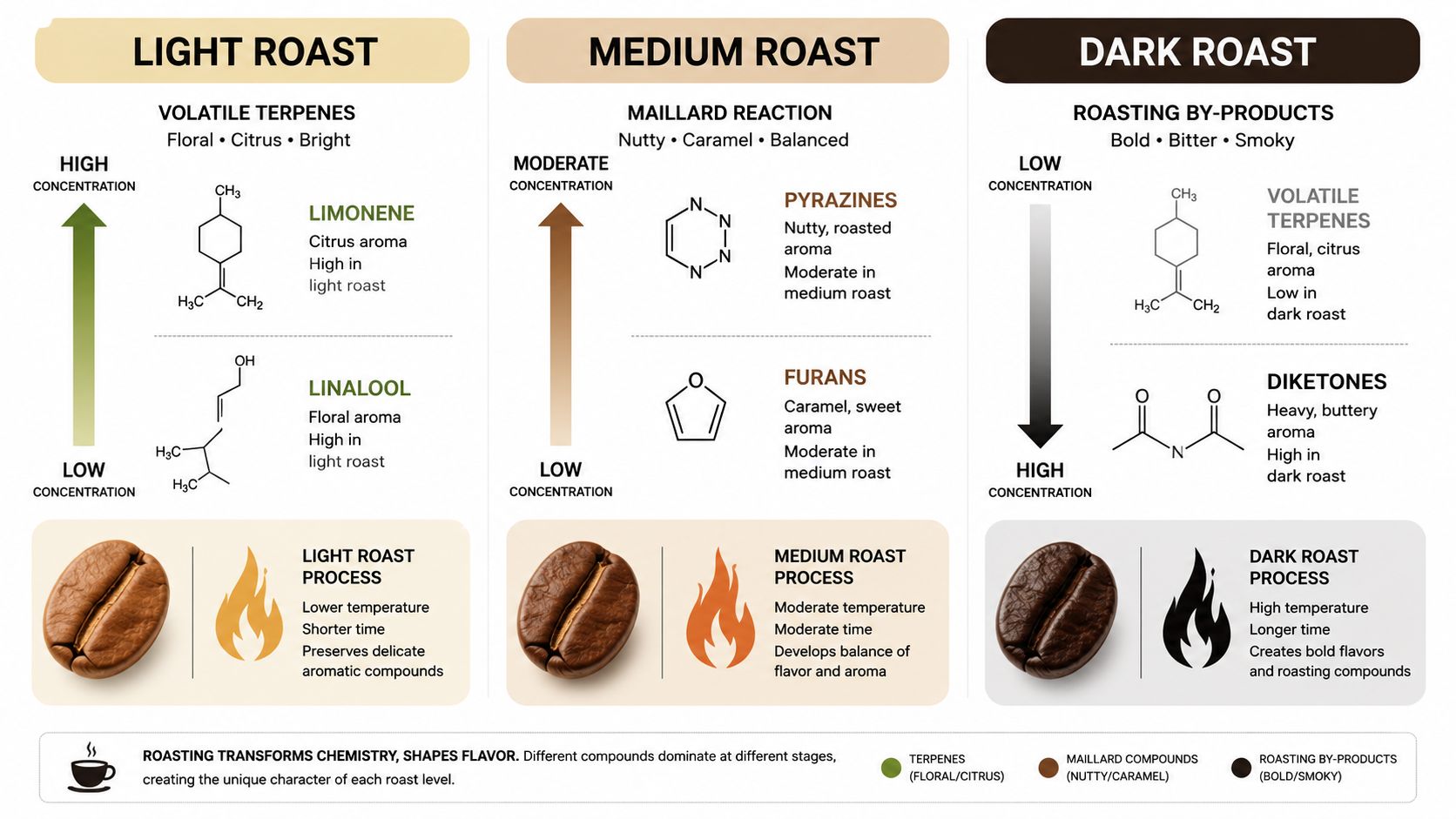
Coffee chemistry keeps changing as beans move from green to roasted, and that is where formulation decisions get more useful. Roasting sharply reduces total diterpenes in dark roasts, so a dark-roast target is not just a stronger version of a light-roast target. It is a different sensory map with different surviving molecules and a different balance between aroma and body (recent coffee terpene analysis).
Origin and cultivar change the target
Recent analytical work has shown that green coffee and certain genotypes can be richer in monoterpenes such as limonene, beta-pinene, p-cymene, and terpinolene, and one study found Geisha Especial had higher limonene in both green and roasted beans. That matters because it lets formulators separate a bright coffee concept from a heavy roast concept without guessing. If the brief is citrus-bright coffee, the cultivar side of the chemistry carries more weight. If the brief is deep roasted coffee, the profile has to rely more on the terpene survivors that remain after heat, plus the heavier base notes that read as brewed rather than green.
Choosing the right coffee direction
A light-roast target usually needs more top-note brightness, more perceived lift, and less reliance on heavy base material. A dark-roast target needs the opposite, with lower volatility and a firmer base that reads as roasted rather than merely sweet. That is why asking which coffee tastes most terpene-forward can be misleading unless the question also separates aroma volatiles from lipid-bound diterpenes.
Terpene transformation and environmental factors
Formulation insight: do not pick coffee inspiration by name alone. Pick it by roast axis, then choose the molecular family that supports that axis.
A replicating flavor of coffee profile for a cartridge should be built differently from a coffee profile for a distillate-rich edible or an inhalable extract. In a light-roast style blend, I would keep the coffee base lean and add a small amount of brighter support to preserve lift. For a dark-roast target, I would push the base heavier and trim the bright notes back so the finish stays roasted instead of sharp. The chemistry changes, and the sensory target should change with it.
Formulation Challenges With Diterpene-Heavy Profiles
Diterpene-heavy blends create a different bench problem from the monoterpene systems formulators handle every day. These compounds are lipid-soluble and often esterified, so they do not behave like bright top notes that dissolve quickly and stay cooperative in simple carrier systems (coffee brew extraction review). In practice, coffee-inspired formulas can separate, haze, or drift if the carrier strategy is too thin or built for a lighter botanical profile.
What usually fails
The most common mistake is trying to force a coffee note into a low-viscosity formulation that was really designed for lighter botanicals. That usually gives weak homogeneity or a muted finish, because the base material is not holding the heavier markers well. Another common error is overloading top notes to compensate. The blend can smell coffee-like on first sniff, then go hollow after a few draws.
A cleaner approach is to treat the coffee profile like a layered oil system. Keep the base anchored to the heavier marker set, then add small amounts of brighter compounds only where they support the impression. For vape cartridges and distillate, that means watching viscosity, keeping the blend uniform, and checking whether the finished oil still behaves consistently after it sits. A practical bench target is a body that stays in the roughly medium-viscous range, around 50 to 100 cP at room temperature, or a comparable carrier ratio that keeps the oil moving without feeling watery.
Bench rule: if the blend looks fine right after mixing but changes after a rest period, the formulation is not finished. It is only temporarily mixed.
What works better
Use carrier systems that are compatible with lipid-like materials and test small batches before scaling. Start by checking whether the base stays clear, then confirm whether the aroma still reads as coffee after heat exposure and storage. A strain-inspired blend does not need to be loud to be accurate, but it does need to be stable.
If you are building a coffee-forward SKU, a formulation resource like the Gold Coast Terpenes Mixing Calculator can help you keep ratios repeatable during bench work. The value is consistency, not guesswork.
When I build for vape cartridges or for distillate, I also keep notes on what failed, not just what smelled good. Hazy mixes, overly thin oils, and profiles that collapse under heat usually tell you more than the first sniff does.
What Brew Method Data Reveals About Terpene Extraction
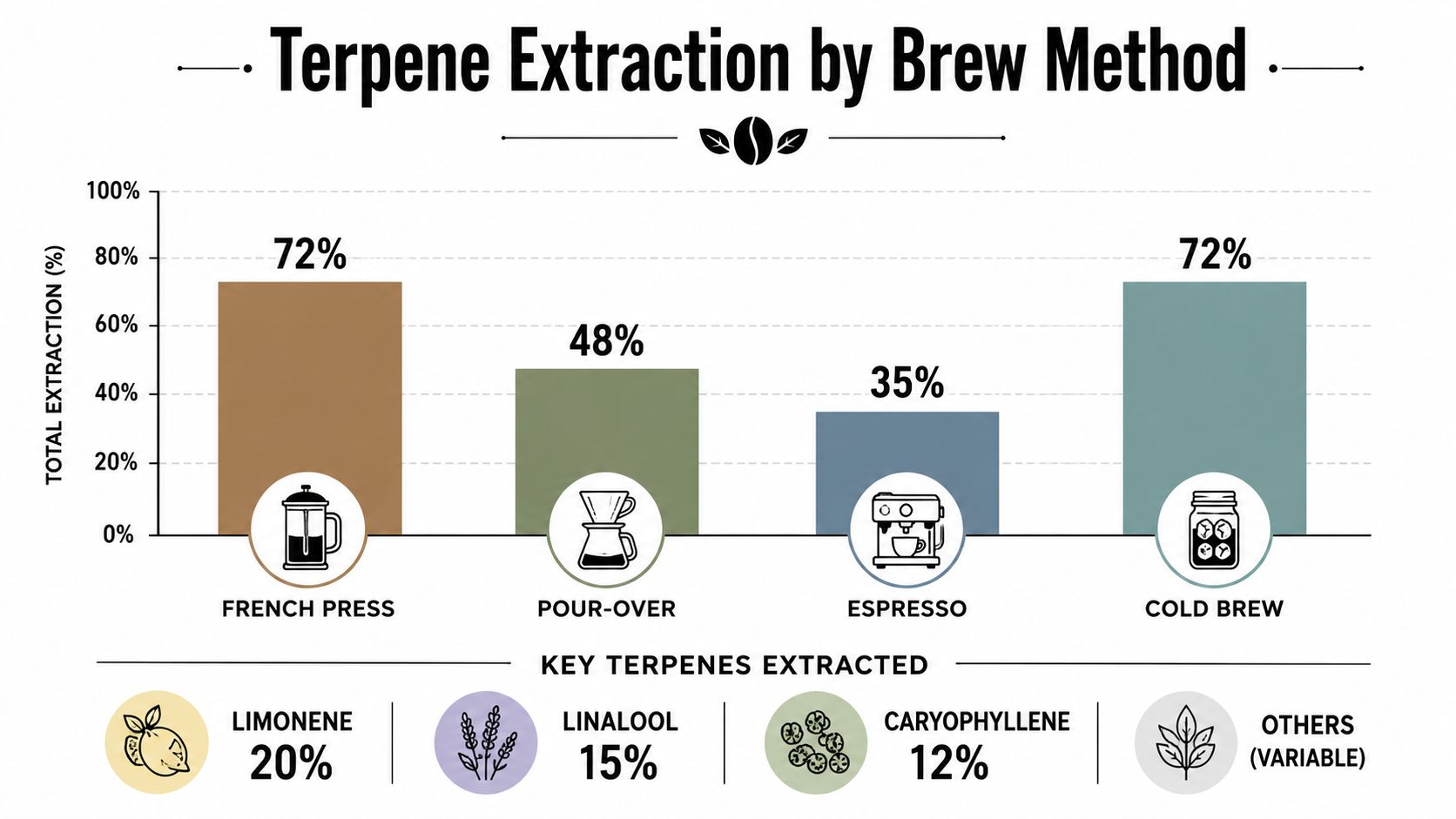
Coffee brewing gives formulators a practical model for understanding how contact method changes terpene transfer. In Scandinavian-type coffee, about 23% of the diterpene esters present in the grounds can appear in the beverage, while filtered coffee retains the lowest amount at only 0.3% of the initial quantity, and espresso sits in between at up to 2.5% of the initial concentration (coffee brew review). A classic analytical study also found Scandinavian-style boiled coffee at about 7.2 mg cafestol per cup and 7.2 mg kahweol per cup, Turkish-style coffee at about 5.3 mg cafestol and 5.4 mg kahweol per cup, espresso at about 1 mg of each, while drip-filtered and instant coffee contained negligible amounts (coffee brew review).
The extraction lesson for formulators
The formulation parallel is straightforward. More contact and less filtration move more heavy material into the finished product. Less contact and tighter cleanup produce a cleaner result, but they also leave less terpene load in the final experience.
That matters most for coffee-inspired profiles built around diterpene-heavy character, not bright top-note mimicry. Cafestol and kahweol are the right markers to watch because they carry weight, body, and the dense roasted impression that makes coffee read as coffee. If the system strips too aggressively, the profile may smell acceptable on paper and still taste thin in use.
Recent review data report classical brews with total cafestol esters of 5–232 mg/L and kahweol esters of 2–1016 mg/L, compared with commercial blends at 1–54 mg/L and 2–403 mg/L, which shows how strongly method changes the amount of heavy material that survives extraction (coffee brew review). The exact numbers do not map one-to-one onto cannabis or vape formulation, but the bench lesson is the same. Extraction conditions decide what dissolves, what stays behind, and how much low-volatility character makes it into the final oil.
For cartridge formats targeting heavy coffee character, a base oil with about 15–25% lipid-soluble fraction is a practical starting point if you want to mirror the heavier Scandinavian-style extraction window without pushing the blend into instability. That kind of base gives the diterpene-heavy portion room to stay in solution, while still leaving enough mobility for the oil to wick and perform. A formulation that is too lean tends to lose the darker coffee impression first.
A coffee-inspired cart does not need to copy brew methods exactly. It does need to respect the same principle, heavier coffee character depends on a carrier system that holds low-volatility material instead of filtering it away.
Building a Coffee-Inspired Terpene Blend From Scratch
A coffee profile works best when the layers are deliberate. I start with the base, then add warmth, then give the nose enough lift to keep the blend from reading flat. For a strain-inspired terpene blend that needs to read as coffee rather than generic roast, the order matters more than the wording on the label.
A simple build sequence
Base notes carry the coffee identity. That means putting the diterpene markers discussed earlier at the center of the formula, because they give the profile its weight and realism. In practice, I treat the base as the backbone that keeps the flavor from collapsing into sweet brown vapor after the first few pulls. A practical build usually puts roughly 60–70% of the profile in the base, so the heavier material stays present without making the oil hard to work with.
Mid notes add roast-associated warmth and dryness. A blend can pick up cocoa, toasted nut, or a faint earthy edge without turning bitter. If the middle is too soft, the profile becomes thin. If it is too aggressive, the coffee reads burnt. I usually keep this layer around 20–30%, because that range gives enough shape without burying the base.
Top notes should stay modest. Small amounts of brightness help the nose, but coffee is not citrus-first. A little lift can make the profile feel fresher, especially in cartridges, but overdoing it creates a mismatch between sniff and inhale. Top notes usually sit in the 5–15% range, just enough to keep the blend from feeling closed in.
Useful ratio logic: keep the base dominant, use the middle to shape realism, and let the top note support rather than announce itself.
For bench work, I document every pass, every rest period, and every heat test. That is the difference between a lucky sample and a reproducible formulation. If the goal is formulating SKUs that can scale, repeatability matters more than a single good jar.
I also keep one eye on compatibility with the finished product format. A cartridge, a distillate blend, and a concentrate additive do not all need the same balance. Heavy coffee character usually behaves better in a carrier system that can hold low-volatility material without making the oil too stiff, so the build has to respect both aroma and flow. For a broader food-aroma reference, the Terpenes in food page is useful when you are deciding how sweet, roasted, or neutral you want the final read to be.
Safety Testing and Regulatory Considerations for Coffee Terpene Products
Coffee-inspired terpene products need the same compliance discipline as any other commercial formulation. If the profile uses distinct markers such as cafestol, kahweol, and 16-O-methylcafestol, those compounds should be identified clearly in product documentation, because sensory accuracy and regulatory clarity both depend on what is in the blend. That matters more when a blend is heading into cartridges or other consumer-facing cannabis products.
Third-party lab verification should be standard, and the lab should be ISO 17025 accredited whenever possible. A finished oil needs to match the specification on paper, so terpene concentrations, carrier compatibility, and contaminant status all need to be documented in the certificate of analysis. For commercial buyers, THC-free certification and a clean safety data sheet make internal review easier and reduce friction during onboarding.
Compliance rule: label the chemistry you used. Coffee is a flavor target, not a substitute for precise ingredient disclosure.
Keep in mind that coffee-inspired does not mean casual. Diterpene-rich materials can behave differently in storage and in use, so documentation should be as specific as the formulation itself. If you cannot describe the profile beyond “coffee flavor,” it is not ready for a product file.
Gold Coast Terpenes supplies terpene blends, isolates, and formulation support that can help you build coffee-inspired profiles for cartridges, distillate, and other cannabis products. If you are working on a coffee-forward SKU, visit Gold Coast Terpenes to review product options, mixing resources, and terpene guides that fit this type of formulation work.