
Global exports of essential oils, concretes and absolutes under HS 3301 reached about $6.21 billion in 2024, according to global trade data for that customs category. That's a commodity market, not a craft niche, and customs codes bundle several oils and related preparations together, so treat the total as a benchmark rather than a precise headcount of oil. At drum scale, the money isn't in the price per kilogram. It's in whether the lot in front of you is the same material you approved last time.
Most buying guides stop at origin, aroma and a "100% pure" label. A manufacturer needs more than that, because one drum feeds hundreds or thousands of finished units, and a small compositional gap becomes a large recall, reformulation or complaint problem. Here's how I'd buy bulk essential oils and botanically derived terpene blends as a formulation buyer: verify the batch, control the storage, prove the ratio, then scale.
Why Bulk Essential Oil Buying Needs a Process
Global essential oil consumption was 324,000 tons in 2024, according to IndexBox's world market overview. Material moves at that volume through brokers, repackers and distributors, and each handoff is a chance for a lot number to stop matching the paperwork.
Say a cosmetic brand switches lavender suppliers to shave a few dollars per kilogram. The first drum smells right on a blotter, so it goes straight into production. Six weeks in, the fragrance in the finished body butter has drifted, and the brand now has three options: rework the batches, add a masking note, or ship a product that smells different from the one customers reviewed. The savings on that one drum don't cover any of them.
Two drums with identical labels can smell alike on day one and still differ in marker compounds, oxidation level or adulterant risk. That's the whole problem in one sentence.
Practical rule: Price is a number you negotiate once. Consistency is a number you verify on every lot, forever.
A workable buying process runs in a fixed order:
- Pick the form first. Whole oil, single isolate, or a set-profile blend.
- Test and document every lot. Not just the qualification sample.
- Control storage so the oil you approved is the oil you use.
- Set a pilot ratio and record it before scale-up.
- Pressure-test the decision against real buying situations.
- Request a sample and run your own checks before committing to a drum.
None of these steps need a lab budget the size of your production line. They need a written specification and the discipline to hold a drum when the numbers don't match.
Essential Oils, Isolates and Terpene Blends Compared
An essential oil works like a whole recipe written by the plant. An isolate is one ingredient pulled out of that recipe. A terpene blend is a premade profile built to hit the same target each time you reach for it.
A whole essential oil carries many compounds in the proportions the plant produced. That is why its character moves with harvest, weather, distillation and origin. That variation helps when the goal is a natural, living aroma. It creates a problem when the product has to smell identical in every production run.
An isolate such as limonene or myrcene gives you one precise note and clean math on the batch sheet. It will not reproduce a full character by itself. Stacking isolates to imitate a whole oil takes trial batches, careful records and a tolerance for drift. If you supply cartridges, the practical question is whether the finished profile can be repeated at scale, not whether a small sample smells interesting.
A blend sits between those two options. Someone sets the ratios, then holds them. For distillate, cartridges and flavor matching, that repeatability usually matters more than a slightly lower unit price on a variable whole oil. Gold Coast Terpenes' terpenes are extracted from fresh plants and are free of mixtures, chemicals, and additives. That is the kind of sourcing statement a formulator should require in writing before approving a drum.
Bulk essential oil types by composition and use
| Product | What It Is | Composition Pattern | Typical Manufacturing Use |
|---|---|---|---|
| Essential oil | Whole oil extracted from a plant | Many compounds in natural proportions | Fragrance, flavor and personal-care base |
| Isolated compound | One purified molecule, such as limonene or myrcene | Single compound, usually high purity | Targeted flavor or aroma note and precise adjustment |
| Terpene blend | Several compounds combined to a set profile | Ratios set by the formulator or supplier | Repeatable profile for distillate, cartridges or flavor matching |
The table is useful only if everyone uses the same analytical language. ISO Technical Committee 54, the body responsible for essential-oil standards, was created in 1947 and focuses on analytical methods and specifications for essential oils. That work lets a buyer in one country read a supplier's composition report and know what was measured.
Crop concentration adds another reason to lean on specifications. A few high-volume oils carry much of the exposure in the category, including harvest variation, weather effects and adulteration risk. A cheap drum only stays cheap if the composition, documentation and performance all hold when the lot reaches your facility.
The two most confused categories deserve a closer look before you set a specification. Our breakdown of the key differences between terpenes and essential oils explains where each one fits in a formula.
Rule of thumb: whole oil for natural character, an isolate for a precise adjustment, a blend when the product must smell or taste the same batch after batch.
Lot Tests and Release Checklist Before Each Drum
Start with a GC-FID fingerprint of every incoming lot, compared against your approved reference profile. Appearance and odor can't confirm identity. A diluted or partly substituted oil can still smell correct on a strip, especially when the top notes were rebuilt deliberately.
UNIDO's guidance on quality testing of essential oils identifies gas chromatography with flame-ionization detection as an ISO Technical Committee 54 reference method for most essential-oil preparations, with GC-MS supporting compound identification and chiral GC separating and quantifying enantiomers. That last capability matters because natural and synthetic versions of a molecule can share a similar bulk composition while differing in stereochemical profile.
Lot tests and what each one confirms
| Test | What It Confirms | When to Run It |
|---|---|---|
| GC-FID fingerprint | Batch compound pattern matches the reference | Every incoming lot |
| GC-MS | Individual compounds are identified | When the fingerprint looks unusual |
| Chiral GC | Natural and synthetic forms of one molecule are told apart | When the origin of a key compound matters |
| Key-marker ranges | Marker compounds sit inside the agreed window | Every lot, trended over time |
| Density or refractive index | Physical properties match the specification | Where the monograph sets limits |
| Adulterant screen | Dilution or substitution is absent | Every lot |
Run the cheap physical checks first. Density and refractive index take minutes and catch crude dilution before you pay for chromatography. Then read the fingerprint against the applicable ISO or pharmacopoeial monograph, which is where substitution, dilution, origin anomalies and process drift show up.
One limit worth knowing: gas chromatography sees volatile compounds. A non-volatile diluent such as a fixed vegetable oil won't march across your chromatogram, so pair the fingerprint with physical constants and a targeted adulterant screen rather than treating one clean report as proof of purity.
The release checklist to copy into your purchase file
Government safety guidance for essential oils, published in this regulatory assessment document, states that evaluation should determine the oil's quantitative composition as fully as possible and assess exposure under actual use conditions, including dermal exposure and inhalation. The same material notes that solvent-assisted production can leave residues that alter quality or cause irritation, and that allergic contact dermatitis is a recognized risk. "Natural" and "pure" don't establish identity or safe use.
Approve each drum against these seven items:
- Quantitative composition analysis for the specific batch, not a generic product sheet.
- Batch-specific chromatographic data, with the full chromatogram and peak table.
- Identity test against your approved reference lot, run in your lab or a referee lab.
- Contaminant screen appropriate to the extraction method and intended use.
- Storage history from harvest to delivery, including container type and temperature exposure.
- Extraction method and any solvent use, documented in writing.
- A retained sealed sample from every accepted lot, labeled with batch number and receipt date.
A certificate of analysis records what someone measured on one batch. It isn't independent verification, and one generic certificate can't cover multiple harvests or suppliers.
Trend your marker percentages over time in a simple spreadsheet. When a marker moves outside its window, ask the supplier whether the source, harvest, distillation or storage changed, and hold the drum until the answer is documented. Our guide to reading a certificate of analysis covers which fields should change from lot to lot and which should never move.
Ask every supplier which documents come with each lot, not only the first one. That single question filters out more bad vendors than any price negotiation.
Storage and Shelf-Life Controls for Bulk Drums
Three things degrade a drum while it waits: oxygen, light and temperature. Everything else in your storage SOP exists to control those three.
A quality inspection at the drum is where you catch the damage before it reaches a batch.
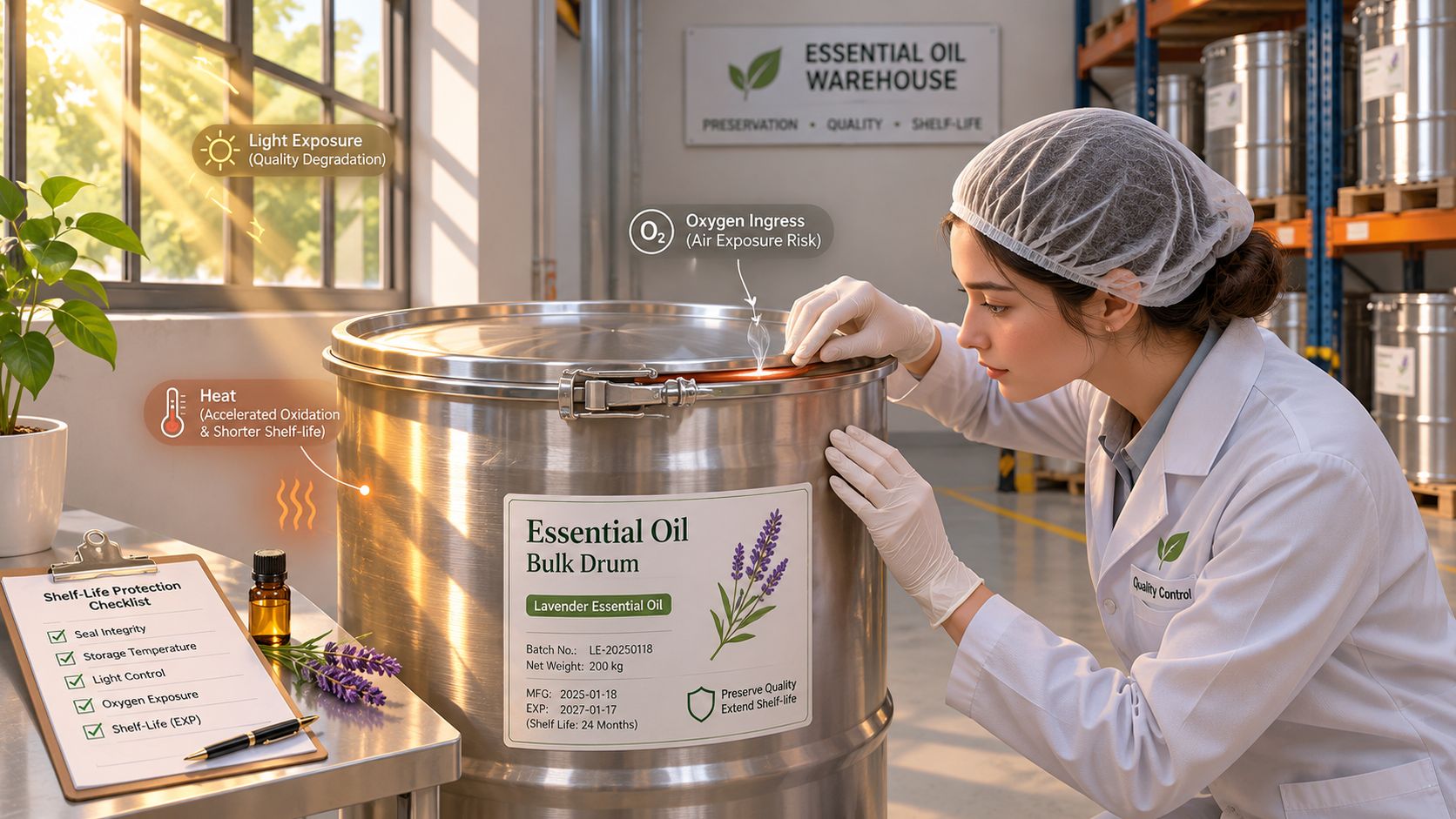
Oxidation isn't a slow theoretical risk. A storage study of culinary-herb and spice oils monitored for 10 weeks at 10 °C found statistically significant increases in hydroperoxide formation, measured through rising peroxide values, across all tested oils. Cool storage slowed the process; it didn't stop it.
A bulk drum left partly empty and repeatedly opened is like a loaf of bread left on the counter. It goes stale from the outside in, and the part you use last is the part that sat in air the longest. Oxidation products can change aroma and irritation potential even when the original major constituents are still detectable, which is why a smell test won't clear an old drum.
Controls that actually hold up on a production floor
- Cut headspace. Transfer to a container sized for the remaining volume, or blanket the headspace with inert gas before resealing.
- Seal and shade. Use tightly closed, light-protective containers, and keep them off sunlit floors and away from steam lines.
- Avoid warm and cold cycling in transit and in the warehouse. Repeated swings pull air and condensation into a container that breathes.
- Split into working containers. Decant a week's worth into small amber bottles so the main drum opens once, not twice a day.
Set a retest interval based on peroxide value plus chromatographic markers, not on the calendar alone and never on odor. Write acceptance limits for peroxide value, characteristic-marker retention and sensory deviation under the storage conditions you run, then retest at that interval and record the result against the batch number.
Here's a walkthrough of handling and storage practice worth watching before you write your own SOP.
These limits matter most when oil is diluted, blended or held for a long stretch before filling, because the risk builds while the drum waits. Our notes on how to preserve terpenes cover the container and temperature choices in more detail.
Pilot Ratios and Dosing Before Scale-Up
Dose small, verify, then scale. Federal food-flavoring rules under 21 CFR Part 172, Subpart F require natural flavoring substances and natural adjuvants to be used only in the minimum quantity needed to produce the intended technical effect, in accordance with good manufacturing practice. Food rules don't authorize inhalation use, but the minimum-effective-dose discipline transfers directly to botanically derived terpene inputs.
A worked pilot you can repeat on the next drum
Say you're matching a citrus-forward profile in winterized distillate. Run a 100 g test batch with 0.5 g of blend, which is 0.5% by mass. Weigh both on a calibrated bench scale with fine resolution, and record the exact mass added, the total batch mass and the carrier used.
Mix, then evaluate in the hardware or the base, not in a glass vial. Aroma in an open vial and aroma in a filled cartridge are different tests, and only one of them resembles your product.
If the target profile is met, run a second pilot at 1.0% to see how the character shifts. Keep the sensory notes with the mass record so the next buyer can reproduce your decision without guessing.
| Stage | Blend Share of Batch | Record Kept | Go or No-Go Check |
|---|---|---|---|
| Pilot 1 | 0.5% (0.5 g in a 100 g batch) | Exact mass, batch mass, carrier | Aroma and flavor match the target after mixing |
| Pilot 2 | 1.0% (1.0 g in a 100 g batch) | Same records plus sensory notes | Character shift stays inside the approved range |
| Scale-up | Set by passed pilots | Final percentage on batch sheet | Matches the SOP range before release |
Scale only in steps tied to a passed pilot. Doubling a batch size and doubling a ratio at the same time gives you two variables and no explanation when the flavor lands wrong.
Write the range into the SOP, not into someone's head
Nevada's terpene guidance requires manufacturers to submit a standard operating procedure documenting the percentage range of every ingredient in the finished mixture, and restricts total terpene content in inhalable products to no more than 10% of the final product, with the exact percentage stated in that SOP. Your batch sheet should carry the target ratio, the ingredient range and the final blend percentage before production starts.
Check the final percentage against any market limit before release, not after the fill run. Our guide on how to scale recipes walks through the arithmetic from pilot mass to production batch.
Buyer's habit: The record you keep on a 100 g pilot is the record that lets you match a new drum six months from now.
Bulk Buying Examples for Cosmetic and Cartridge Makers
Three buying situations, three different checks that changed the outcome.
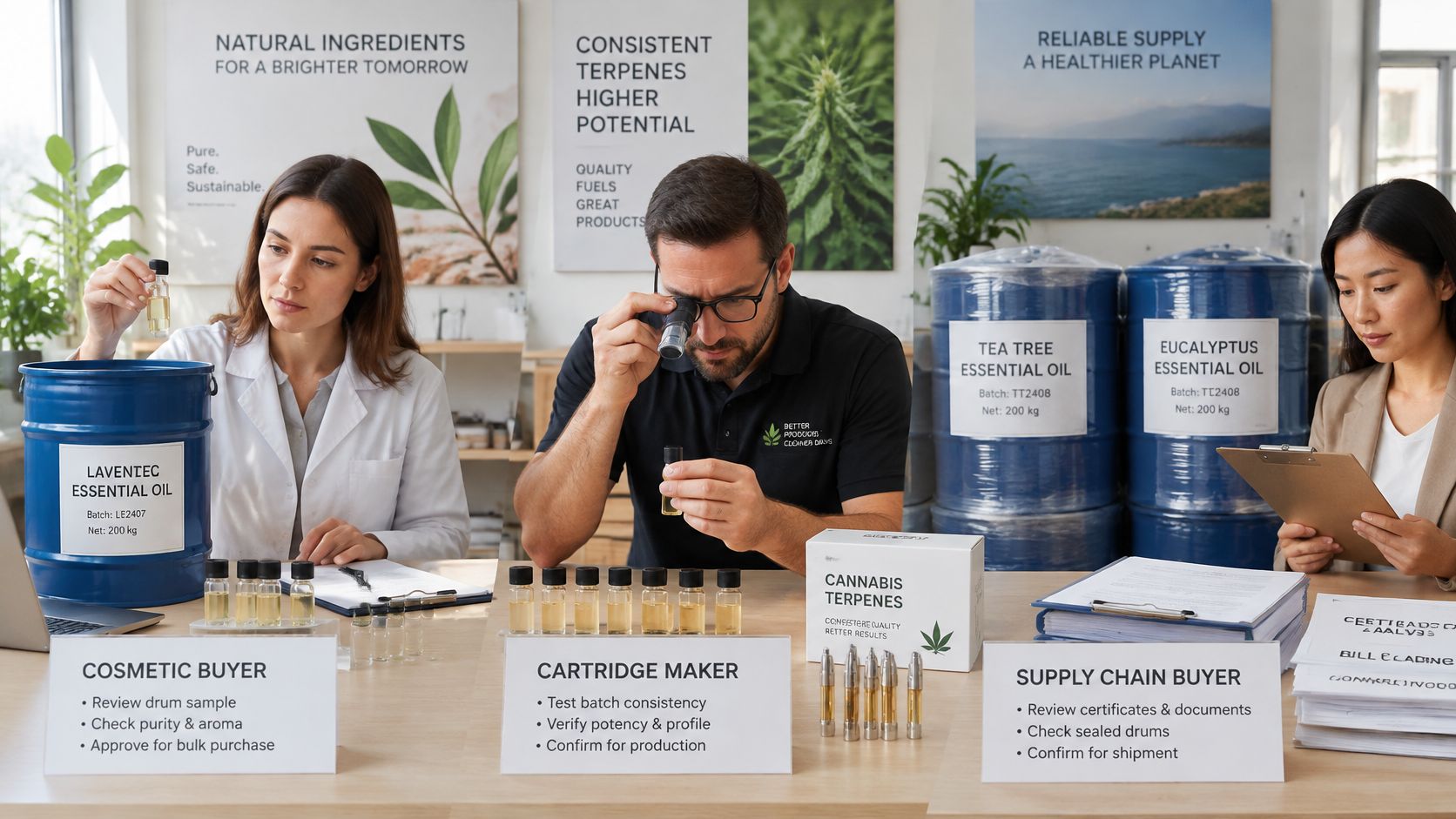
A body-care brand and a moving marker. A cosmetic buyer receives a drum of whole oil for a lotion line. The fingerprint matches the species, but one key marker sits near the edge of the agreed window. Instead of rejecting outright, the buyer asks for harvest and distillation details and runs a pilot batch in the actual emulsion. The aroma holds after mixing, so the drum is approved with a note in the file and a tighter window on the next order. Next time, that buyer would set the marker range in the purchase terms before the first shipment, so the conversation isn't a negotiation.
A cartridge maker matching a flavor. A manufacturer wants a specific fruit-forward profile in winterized distillate. The buyer starts at a low pilot ratio, records the exact mass added to each batch, and checks the flavor in filled hardware rather than in a vial. Only after two passed pilots does the ratio move to production. Washington's research brief on flavored cannabis vape products notes that plant-derived terpenes are commonly used instead of cannabis-derived terpenes because they can provide lower cost and greater consistency, which is exactly the reason to lock a single blend and re-verify it in hardware. Next time, that buyer would keep a sealed retain from the approved blend lot alongside the hardware test notes.
A distributor running two suppliers. A wholesaler dual-sources the same profile to protect supply. It keeps a reference sample from every accepted lot and compares incoming drums against those retains each quarter. One supplier's material drifts, and the trend chart shows it before a customer does. The distributor keeps both vendors but shifts volume. Next time, it would put the quarterly comparison in the supplier agreement rather than treating it as internal housekeeping.
Documentation changes with the product, not just the formula. Vermont's product labeling and registration guidance requires separate product registration for each size, strain, formulation and concentrate type, so a cartridge brand that changes its oil-to-terpene ratio or cartridge size may need new regulatory paperwork rather than a packaging update.
Request Samples and Confirm Specs Before Your Next Order
Turn all of this into four moves you can make this week.
- Choose the form. Whole oil for natural character, an isolate for a precise note, a blend for batch-to-batch repeatability.
- Write a lot-release specification. List the fingerprint, marker ranges, adulterant screen, retained-sample rule and the documents required with every lot.
- Ask each supplier three questions. Which documents ship with every lot? How are failed lots handled, and who decides disposition? How do you explain a harvest or source change?
- Order a sample lot and test it yourself before you commit to a drum.
We supply botanically derived terpene blends and single-compound isolates, including Alpha Pinene, Beta Caryophyllene, Limonene, Linalool, Myrcene and Terpinolene, extracted from fresh plants and free of mixtures, chemicals and additives. Orders above $100 ship free, which makes a sample-and-test order cheap to run. Run the same checks on our samples that you'd run on any supplier's. That's the standard, and it should apply to us too.
Where a cheap price hides cost: A low per-kilogram number on an unverified lot is a loan against your next production run, and the interest is rework.
The buyers who stay out of trouble aren't the ones with the best noses. They're the ones with a written specification, a retained sample from every accepted lot, and a pilot record someone else can repeat.
Bring your target profile, your carrier and your batch size, and we'll help you match a botanically derived blend or isolate that holds its character from the pilot to the drum. Shop the blends, request a sample to run your own fingerprint and marker checks, or contact us for bulk and custom orders at Gold Coast Terpenes. Start with a sample lot, approve it against your specification, then scale on a ratio you've already proven.