
Your production team filled the batch cleanly while it was warm. By the next morning, the cartridges wick slowly, fill checks look inconsistent, and someone suggests adding more terpenes. Before changing the formula, you need to know whether you're dealing with cold oil, mismatched hardware, or a batch that shouldn't move forward.
When a production ticket says “distillate too thick for cart,” treat it as a diagnosis, not a dosing instruction. Check the batch first, then test the smallest justified adjustment. Botanically derived terpenes can help manufacturers tune flow and flavor, but they can't correct contamination or make unsuitable material acceptable.
Diagnose Thick Distillate by Symptom
A batch that flows at the filling station hasn't necessarily passed a cartridge performance test. Warm filling tells you how the oil behaves during processing. It doesn't tell you whether the wick can draw that oil through its small channels after cooling.
Temperature is the first variable to investigate when an otherwise uniform batch stalls after an overnight hold. In a controlled application study described by RheoSense's cannabis viscosity application note%20Cannabis%20Temp%20Extrapolation.pdf), three commercial products became less viscous across 30–70°C, with an approximately two-orders-of-magnitude decline across that temperature range.
That's a large enough change to make a warm visual check misleading. Viscosity means resistance to flow, and cooling can increase that resistance through the reservoir, feed openings, and wick.
Match the symptom before changing the formula
Thick distillate symptoms, causes and first checks
| Symptom | Likely cause | First check |
|---|---|---|
| Flows when warm, stalls when cool | Viscosity rises as temperature drops | Test flow at storage and use temperature, not only at fill |
| Slow wicking or dry hits | Oil too viscous for capillary movement in the wick | Check wick material and oil flow at room temperature |
| Leaking or flooding after thinning | Too much terpene, mix too fluid | Cut the addition rate in a new pilot and retest the ratio |
| Crystals, sediment or cloudiness | Waxes, crystallization or particulates | Stop and send for lab review, don't dilute |
| Burnt taste or off color | Degradation or contamination | Reject the batch and review the certificate of analysis |
| Fill weight drifts after thinning | Uneven mixing or dosing | Recheck mixing time and run gravimetric fill checks |
Work through the symptoms in order. Cold-stalling points toward temperature sensitivity, while slow wick saturation calls for a closer look at hardware compatibility. Leaking after an adjustment suggests you've moved too far in the other direction.
Crystals, sediment, abnormal color, or a burnt result belong on a quality hold, not in another blending trial. A calculation can help you measure an approved adjustment, but it can't establish whether the starting batch is suitable.
Production habit: Record the oil temperature whenever a symptom appears, alongside the cartridge model and batch lot.
Use the mixing oil viscosity calculator to support documented blend calculations, not to replace temperature-controlled testing. That temperature record helps your team separate a cold-flow problem from a hardware or material failure.
Check the Batch Before You Thin It
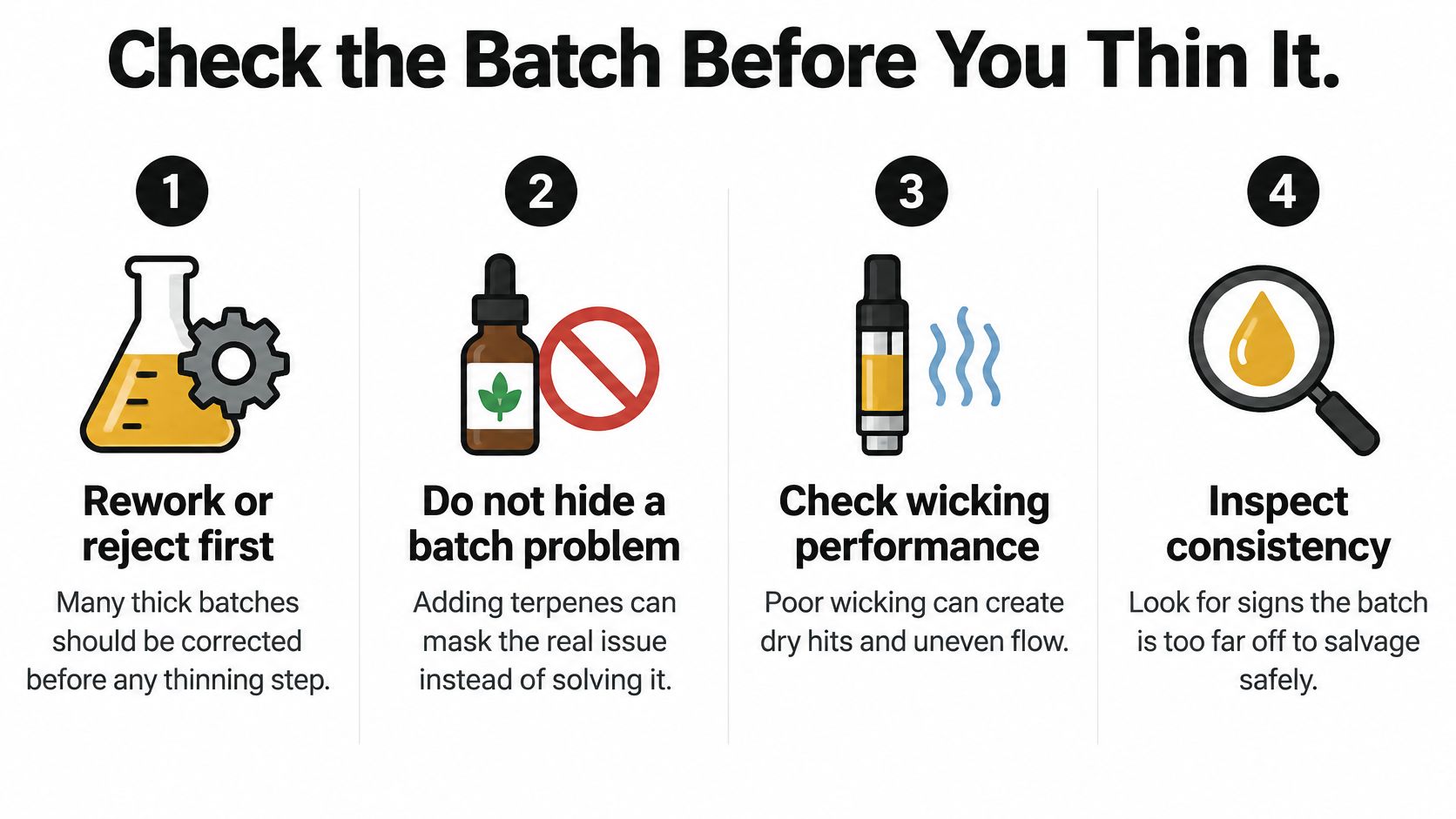
A thick batch is often a rework or rejection decision before it's a dosing problem. Adding botanically derived terpenes may change its appearance and flow without removing the underlying defect.
The Barney's Farm cartridge-clogging guide connects inefficient wicking with excessive heating. For a production team, that's a reason to inspect the material and feed system rather than treating every blockage as a request for more flavoring.
Run the pre-addition checks
- Inspect consistency. Look for crystals, sediment, and cloudiness under consistent lighting. Don't warm away visible evidence before documenting it.
- Compare with the approved reference. Check color and smell against the retained sample. An unexpected change needs investigation, not flavor masking.
- Review the certificate of analysis. Confirm lot identity, residual-solvent results, contaminants, and potency against your release specification.
- Run a gravimetric fill check. Weigh the empty and filled cartridge using a calibrated balance. Confirm that the intended hardware receives a repeatable mass.
Stop decisions come before flow adjustments:
- Crystals or sediment: Hold for laboratory review and an approved filtration or rework decision.
- Abnormal color or burnt results: Reject from production pending quality disposition.
- Leaks after thinning or failed fill checks: Stop the trial and investigate the formula, mixing, and filling setup.
Only when every pre-addition check passes should you treat thickness as a flow problem worth adjusting. Log each result before adding anything, including the reviewer's disposition and the lot numbers involved.
Safe flow fixes in order of risk
| Fix | How to run it | Main risk |
|---|---|---|
| 1. Check hardware match | Confirm coil, wick and tank specs match the oil before any change | Low risk, and often the real cause |
| 2. Controlled warming | Water bath at the SOP temperature, gentle stirring, short hold, log each step | Low to moderate; overheating darkens the oil and can form byproducts |
| 3. Terpene addition at test point | Small weighed pilot batches at or below the 9:1 test point, compared with an untreated control | Moderate; too much terpene leaks and floods the atomizer |
| 4. Reject or rework | Use when crystals, sediment, odd color, burnt taste or failed fill checks appear | Not a flow fix; send for filtration, rework or lab review |
The final row overrides the others. A stop signal means the batch leaves the adjustment workflow.
Terpene Ratios and Compliance Limits
The ratio most formulators want isn't automatically the ratio they should manufacture. A published cannabis-vaping study used a 9:1 concentrate-to-terpene ratio as a model that balanced viscosity for vaporization without added solvents, equivalent to 10% of the finished mixture when the measurement basis stays consistent.
Treat that as a test point, not a production specification. A blend still has to pass your legal limits, flavor specification, stability checks, and hardware trials.
Compare benchmarks without confusing their purpose
Terpene share benchmarks for cartridge trials
| Benchmark | Terpene share | What it tells you |
|---|---|---|
| Untreated control | 0% added terpene | Baseline viscosity, fill weight and wick saturation |
| 9:1 distillate to terpene test point | About 10% of the mix, if the basis is consistent | Starting point for flow, leakage and flavor trials |
| Beta-myrcene study reference | 14%, evaluated in a published atomizer study | Lower viscosity that may facilitate wicking and improve atomizer efficiency under that study's conditions |
| Nevada guidance ceiling | Up to 10% of final product, under Nevada Cannabis Compliance Board guidance | Maximum allowed, with the exact percentage recorded in the SOP |
The control row means no added terpene, not necessarily an absence of terpenes already present in the starting material. The study reference is also not a recommended addition rate, especially where the legal ceiling is lower.
The Nevada guidance requires documentation of the specific terpene percentage in submitted standard operating procedures. Confirm the rules for the actual market before approving any trial for commercial release.
A legal ceiling is a boundary, not a formulation target.
Write down the percentage basis
“Percent added to starting distillate” and “percent of finished batch” use different denominators. Your calculation sheet should name the basis rather than leaving operators to infer it.
For finished-batch percentage, divide terpene mass by the combined mass of distillate and terpene. Use weight consistently when your formula is weight-based, and don't substitute measured volume without a validated conversion.
Use the guide to how much terpene to add to distillate alongside your approved calculation sheet. File the ingredient statement, concentration information, and lot documents for the botanically derived blend before production approval.
More terpene isn't a reliable route to better performance. You're balancing wick feed, leak resistance, and flavor, not trying to make the thinnest possible liquid.
Heating Limits and Additives to Avoid
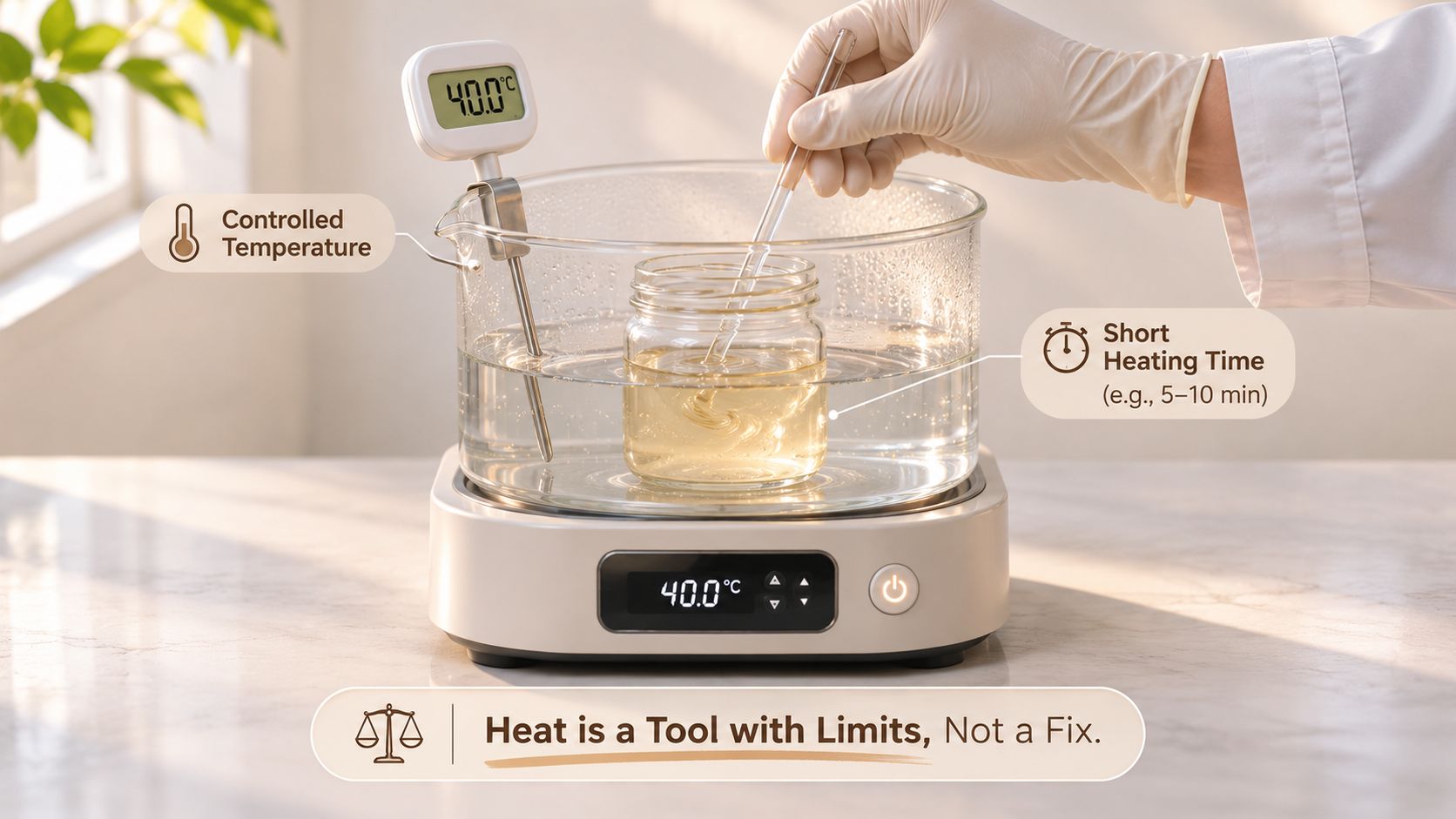
Heat is a processing tool with limits, not a permanent flow correction. A batch that needs constant warmth to function hasn't demonstrated acceptable performance under its intended storage and operating conditions.
Use a controlled water bath at the temperature established in your standard operating procedure. Measure the oil temperature with suitable calibrated equipment rather than assuming it matches the bath display.
Keep warming controlled and traceable
Stir gently so the batch reaches a uniform condition without unnecessary agitation. Keep the hold short, protect the vessel from water entry, and record the actual temperature, hold time, and observations.
Don't use an open flame or an uncontrolled hot plate with local hot spots. Heating that boils or visibly darkens the oil is outside an acceptable adjustment process.
- Control the vessel: Use compatible equipment and keep the container stable in the bath.
- Measure the material: Record the batch temperature, not just the heater setting.
- Limit exposure: End warming when the approved processing condition is reached.
- Preserve evidence: Retain samples and log any change before further handling.
Don't substitute an unapproved diluent
Household oils and unvalidated carriers aren't acceptable shortcuts. Natural and food-grade describe neither inhalation suitability nor compatibility with a cartridge formulation.
Some jurisdictions specifically test for vitamin E acetate and MCT oil. Your quality team should verify the market's prohibited ingredients and testing requirements before any carrier enters the formulation workflow.
The guide to polyethylene glycol alternatives can support ingredient screening, but an alternative still needs a defined use, supporting documentation, and product-specific validation. A supplier's general description doesn't replace those checks.
Hardware deserves the same scrutiny. Metal migration is a material-compatibility concern, so review coil construction, wetted materials, and supporting hardware documentation before pairing a new blend with an existing cartridge.
Stop-use rule: Reject a trial showing burnt smell, color change, separation that won't re-mix, or leaking after heating. Don't rescue it with another additive.
Keep rejected material out of routine filling until quality staff authorize a documented disposition. Rework, where permitted, is a separate controlled process, not permission for operators to keep adjusting the batch.
How to Test a Terpene Addition in Pilot Batches
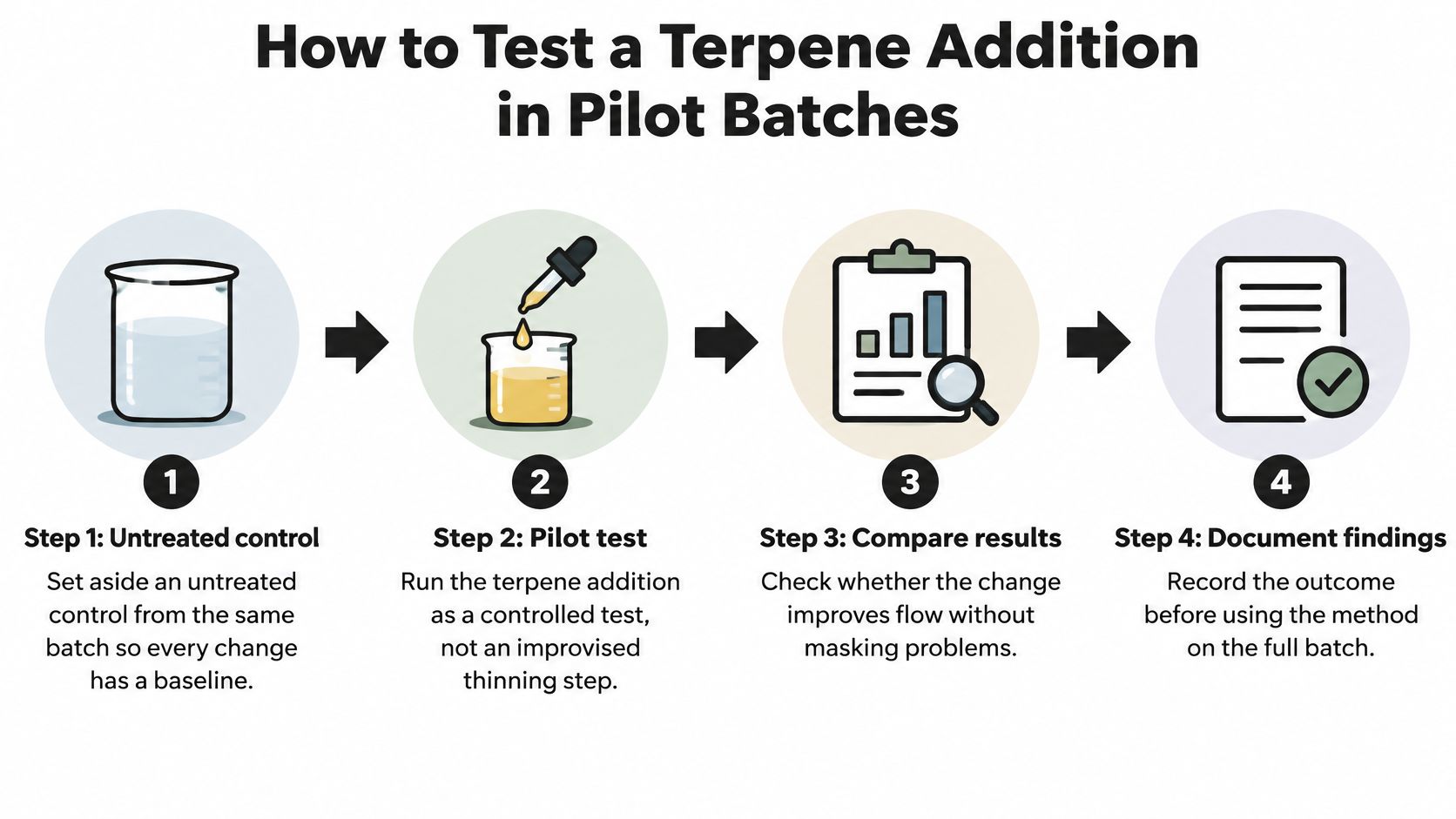
Run a terpene adjustment as a controlled experiment. The question isn't whether the blend looks thinner in a jar. It's whether the finished cartridge meets your flow, flavor, filling, and delivery specifications without introducing new failures.
The CannaLabs Consulting guide to thinning distillate recommends checking visual homogeneity after 24–72 hours, together with temperature cycling, leak testing, draw resistance, gravimetric fill checks, and chemical testing. Build those checks into the pilot record before blending starts.
Build a comparison you can trust
Reserve an untreated control from the same batch. Give it the same handling and storage conditions as the test material. The common slip is comparing a fresh pilot with an older sample that had a different heat history.
Weigh and calculate before opening the blend. Record the distillate mass, intended terpene mass, and whether the percentage uses starting material or finished mixture. Have another qualified operator check the calculation. Confusing the percentage basis can cause over-dilution before mixing even begins.
Add the botanically derived terpene blend in small increments. Use a compatible vessel and a documented mixing method until the material is uniform. Keep equipment, mixing conditions, and addition order consistent across pilots. A mismatched carrier or an undocumented substitution makes the comparison unreliable.
Hold and inspect the mixture. Check for cloudiness, sediment, and separation throughout the defined observation period. A clear surface doesn't prove the whole vessel is uniform. Don't approve a sample because it looked homogeneous immediately after stirring.
Test the complete cartridge system
Fill the exact hardware planned for sale. Use the intended tank, coil, and battery configuration, then compare fill accuracy, time to wick saturation, draw resistance, dry-hit frequency, and leakage with the control. Too much fluidity can flood the atomizer even when filling becomes easier. Don't swap hardware between pilots without recording it as a separate variable.
Run accelerated temperature cycling and leak testing. Apply the approved conditioning protocol and inspect cartridges afterward. Track oil movement into the mouthpiece, seal leakage, and changes in draw behavior. Testing only newly filled cartridges can miss problems that appear after storage.
Submit the final formulation for laboratory release testing. Include cannabinoid potency and degradation testing, plus any additional market-required panels. File the results against the actual blended lot. Testing only the starting distillate leaves the finished formulation unverified.
Flavor belongs in the comparison too. A botanically derived profile that improves flow but overwhelms the approved flavor target is not a successful formulation.
Choose the smallest change that meets flow and delivery specifications. Keep failed pilots in the record so the next operator understands both the approved formula and the boundaries that caused trouble.
Go or No-Go Checklist Before You Scale
A batch that cleared pilot testing can still fail at production volume if the release decision rests on one good-looking sample. Approval should rest on evidence the team can reproduce. Before increasing batch size, give quality and production staff the same release checklist so a promising fill never substitutes for a documented pass.
Approve the evidence, not the appearance
- Flow confirmed: The cartridge performs at storage and use temperatures over several days, rather than only while freshly filled.
- Pilot results logged: Every trial step has a recorded result compared with the untreated control, including failed samples.
- Formula controlled: The percentage basis and exact terpene content are in the SOP and checked against the destination market's rules.
- Documents filed: Ingredient statements, lot records, and laboratory results are available for both the blend and the finished batch.
- Stop criteria written: Operators know which observations require a hold, rejection, or authorized rework.
If any item fails, the decision is no-go. Rework or reject the batch as appropriate, but don't scale an unresolved problem. A thick batch that misses release criteria is a rework or rejection decision, and adding more terpenes at scale won't rescue it.
Use the recipe-scaling guide to organize the move from pilot to production. Preserve the approved calculation basis and mixing method, then verify uniformity and fill performance at the larger scale rather than assuming they'll remain unchanged. Viscosity behavior that looked acceptable in a small vessel can shift once the blend sits in a larger tank or runs through faster fill cycles, so treat the first production lot as a second pilot with full checkpoints.
For side-by-side screening, the 3ml Strain Picker Pack lets you select any three different botanically derived terpene profiles from the catalog in 1.5ml or 3ml sizes. Its listed use cases include terpene testing and custom vape or tincture formulation, so it works as a practical option for comparing flow and flavor before committing to a larger order. The terpenes for cartridges are SC Lab-tested.
A controlled profile comparison gives your purchasing team a clearer specification. Order against the profile, documentation, and performance your team approved, not just the blend that made warm oil pour fastest.
Gold Coast Terpenes offers botanically derived, THC-free blends for controlled flow and flavor trials in cartridge manufacturing. Visit Gold Coast Terpenes to shop strain profiles, curated packs, isolates, and diluents, or review the bulk program once your pilot meets every release check.