
The most repeated advice about super lemon haze terpenes is to lead with limonene. Follow it and you'll build a blend that smells like lemon candy and carries none of the pine, pepper and floral weight that makes the profile recognizable.
Published lab panels put terpinolene or beta-caryophyllene on top as often as they put limonene there. Limonene's share moves from a supporting accent to more than 1% depending on the product. So the useful question for a buyer isn't which single terpene matches the name. It's which chemical pattern you're trying to reproduce, and whether a certificate can prove you got it.
What follows is the makeup, the variation between panels, a build order you can run on the bench, what degrades in storage, and the documents to demand before a lot gets approved.
Terpene Makeup of Super Lemon Haze
Super Lemon Haze terpenes are a citrus-led group built from several compounds working in the same direction. The lemon reads loud because a few of them point at the same note at once. The Haze weight comes from the heavier compounds underneath.
One published certificate of analysis for a Super Lemon Haze formulation put total terpenes at 2.394% (Planet 13 lab data summary). Read the ranking before you read the strain description, because the order on the page surprises.
Reported terpene values in a Super Lemon Haze certificate of analysis
| Terpene | Reported value | Aroma role |
|---|---|---|
| trans-Caryophyllene | 0.999% | Peppery, woody depth |
| Limonene | 0.651% | Direct lemon brightness |
| Beta-myrcene | 0.305% | Herbal, earthy base |
| Alpha-pinene | 0.187% | Fresh pine |
| Linalool | 0.158% | Soft floral note |
| Beta-pinene | 0.094% | Green pine |
On this certificate the profile reads closer to a pepper product than a lemon product. Trans-caryophyllene out-measures limonene by a wide margin, limonene sits second, and myrcene, linalool and the two pinenes make up the rest. The six values sum to the 2.394% total. Terpinolene doesn't appear on this certificate at all. Other published panels report it between 0.55% and 0.72%, so a spec sheet that treats it as guaranteed will misread any batch that doesn't carry it.
What each row does on a spec sheet
- Trans-caryophyllene (0.999%) gives pepper and wood. It's the largest measured share here, and it's what keeps the blend from collapsing into candy.
- Limonene (0.651%) delivers the lemon brightness a buyer smells first. In this sample it's an accent rather than the base.
- Beta-myrcene (0.305%) is the herbal, earthy floor under the citrus.
- Alpha-pinene (0.187%) and beta-pinene (0.094%) supply fresh pine and green pine. These carry the lift people call hazy.
- Linalool (0.158%) adds a soft floral note that rounds the citrus edge.
- Terpinolene (0.55% to 0.72% where it appears) brings sweet citrus with floral and pine complexity. Budget it as a variable row: this certificate omits it, other panels include it.
The name itself comes from a Lemon Skunk and Super Silver Haze cross by Green House Seed Co. that won first place at the High Times Cannabis Cup in Amsterdam in 2008 and 2009, back to back (Burlington Dispensaries strain spotlight). That history explains why buyers ask for the name. It doesn't hand anyone a formula.
Rule for the spec sheet: one certificate is a snapshot of one lot. Before you compare any blend to this profile, confirm that your supplier's certificate lists the same compounds and reports each of them lot by lot.
Why the Strain Name Does Not Fix One Formula
The name is a target, not a recipe. A review of eight Super Lemon Haze panels found terpinolene ranked first or second in every one, while everything below it moved between samples (Entour Brand strain panel review). That's the useful finding. Terpinolene is a stable anchor, not a fixed lead.
Lab panel patterns for Super Lemon Haze
| Panel pattern | Leading terpene | Reported values | Sensory result |
|---|---|---|---|
| Terpinolene-led | Terpinolene | 0.72% terpinolene | Sweet citrus, floral, pine |
| Limonene-led | Limonene | 1.02% to 1.12% limonene; 0.55% to 0.65% terpinolene; 0.45% to 0.48% beta-caryophyllene | Sharper lemon with pepper |
| Caryophyllene-forward retail panel | Beta-caryophyllene | 0.39% beta-caryophyllene; 0.36% terpinolene; 0.12% ocimene | Peppery, woody, less citrus lift |
The three patterns behave differently in a cartridge. A terpinolene-led build reads sweet, floral and piney, with citrus behind it. A limonene-led build hits sharper lemon and leans on caryophyllene to keep it from tasting thin. A caryophyllene-forward panel reads pepper and wood first, with less citrus lift than the name promises.
What moves a batch between patterns
Six variables do most of the work: phenotype, growing conditions, harvest timing, curing, extraction method and the testing method itself. A cut harvested early can carry more terpinolene and less caryophyllene than the same cut left another ten days in the room. A distillate run hot strips volatiles that a gentler extraction keeps. Two labs testing the same oil can report different totals because methods and detection limits differ.
None of that is visible on a strain label. A buyer who specifies a cultivar name and nothing else is buying a name, not a chemical outcome.
How to write the spec instead
Name the sensory target first, in three words if you can. Lemon brightness, pine-floral lift, peppery depth. Then write a compound range for each note, and confirm every incoming lot against its own certificate. Copying a single percentage off a strain page fails the first time a batch tests differently, and it fails badly when that batch is already in cartridges.
A name can start a conversation with a supplier. Only a certificate can close one.
How to Build a Super Lemon Haze Blend
Change one variable at a time so a result can be traced to the change that caused it. The order below works at bench scale and scales to production.
Three steps carry most of the decision. The detailed build follows.
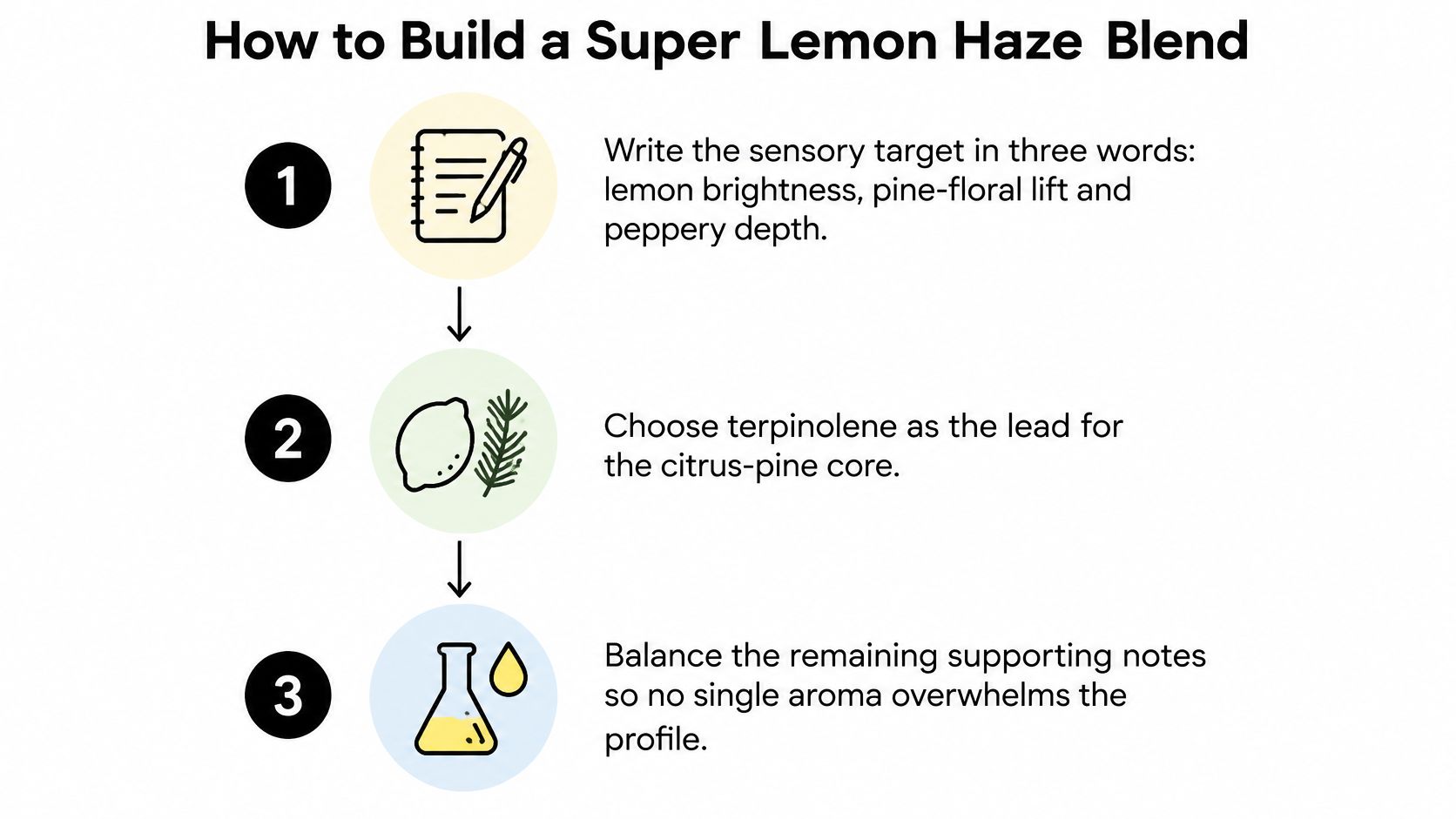
Start from the chemistry, not the name. The profile behaves as a variable chemovar rather than a fixed formula: published datasets consistently place terpinolene and beta-caryophyllene among the leading constituents, while limonene, myrcene, beta-phellandrene and ocimene shift rank with genetics, processing and product format (Abstrax Tech Super Lemon Haze notes). Limonene supplies direct citrus brightness. Terpinolene supplies sweet citrus with floral, herbal and pine complexity. Beta-caryophyllene supplies warm peppery depth.
- Write the target in three words. Lemon brightness, pine-floral lift, peppery depth. A written target is the only thing you can test a sample against six weeks later.
- Put terpinolene in the lead. Most published profiles place it first or second, and it covers both the citrus and pine sides of the name.
- Add limonene as a measured accent. It sharpens the lemon top note. Push it past everything else and the blend loses the Haze weight entirely.
- Keep beta-caryophyllene restrained. It provides the pepper and wood that make the profile read as Haze, and it buries the citrus when it dominates.
- Use myrcene, alpha-pinene and linalool as trace support. Small amounts add herbal, pine and floral depth. Heavy amounts turn the blend earthy or soapy.
- Bench-test in your own base. Mix at a small loading into the distillate or oil you sell, then smell at 24 hours once the blend settles.
- Verify by GC-MS or an equivalent panel. Approve only a lot whose certificate matches your target ranges.
A reference split you can weigh
Normalize the sample certificate to its 2.394% total and the shares come out near 42% beta-caryophyllene, 27% limonene, 13% beta-myrcene, 8% alpha-pinene, 7% linalool and 4% beta-pinene. Treat those shares as a starting point, not a target. For a 100 g trial at a 2% total terpene load, weigh 2 g of blend and split it roughly as 0.83 g beta-caryophyllene, 0.54 g limonene, 0.26 g beta-myrcene, 0.16 g alpha-pinene, 0.13 g linalool and 0.08 g beta-pinene. For a citrus-pine target, keep the same 2 g load, make terpinolene the lead and retest the aroma.
If you're undecided between adjusting an existing blend and starting from a fresh base, this walkthrough covers the mixing side:
The guide to mixing terpene strains covers how to combine two profiles without losing the target. Adjust in small steps and retest after each one. A blend that shifts three compounds at once tells you nothing about which change worked.
Which Terpenes Lose Balance in Storage
The peppery note goes first. Beta-caryophyllene is strongly UV-sensitive, and in one stability experiment it was nearly completely degraded after 400 hours of exposure (peer-reviewed terpene stability study). A blend that starts bright and peppery can finish thin and flat, and packaging is usually the reason.
The same study found limonene held up better against heat and UV than alpha-terpinene and gamma-terpinene. Terpinolene wasn't covered, so the compound many formulators put in the lead has the least stability data behind it. A lead component with no published retention numbers needs its own pull schedule, not assumptions borrowed from the compounds that were tested.
Stability of key terpenes under heat and UV
| Terpene | Stability finding | Storage control |
|---|---|---|
| Limonene | More resistant to heat and UV than alpha- and gamma-terpinene | Opaque containers, cool storage, retention check at each pull |
| Beta-caryophyllene | Strong UV sensitivity; nearly fully degraded after 400 hours | Block UV fully, minimize headspace, test peppery note at each pull |
| Alpha-terpinene | Less resistant than limonene | Track retention at each stability pull |
| Gamma-terpinene | Less resistant than limonene | Track retention at each stability pull |
| Terpinolene | Not covered by the stability data above | Run your own stability pulls before release |
The controls that actually change the outcome
- Opaque or UV-blocking packaging. Clear glass and clear plastic pass the wavelengths that break caryophyllene down. For a profile that leans on the peppery note, this is the control that carries the result.
- Minimum headspace and fewer openings. Every reopen exchanges air and drives oxidation across the blend, not only in the UV-sensitive fraction.
- Cool, stable storage. A swinging temperature does more damage than a consistently cool room.
- Component-level release specs. Limonene, caryophyllene and the terpinenes degrade at different rates, so a single total terpene number can hold while the profile underneath it shifts.
- Stability pulls on the filled unit. Test the filled cartridge or finished oil at defined intervals, not just the incoming blend.
- Sensory checks beside the lab data. Track lemon brightness, pine-floral complexity and peppery depth at each pull. The first losses show in the jar before they show in a total.
Judge retention compound by compound. A blend can hold its total terpene number while losing the exact note the customer bought it for.
The breakdown of terpene degradation covers the mechanisms behind those losses if you need to explain them to a brand team.
Approve Each Lot With Supplier Documents and Device Tests
Approval is a document check first and a lab exercise second. Run the supplier questions before anything goes on the bench.
- Intended-use information. State the format on the request: cartridge, oil, food. A food-flavor designation doesn't establish inhalation safety. The Flavor and Extract Manufacturers Association's respiratory report notes that inhalation data are not required by the FDA to establish authority for food flavors, because historical evaluation focused on ingestion (New York cannabis program flavor requirements).
- Purity and contaminant results. Residual solvents, pesticides, heavy metals, with the method named.
- Safety documentation for your format. Ask for the assessment that matches how the product is used, not a general food-use statement.
- A lot-specific certificate of analysis. Every compound reported by lot, not a generic profile sheet reused across batches.
- A statement that the terpenes are botanically derived, with the source named. Botanical origin keeps supply predictable and keeps cannabis-derived material out of markets that don't allow it.
Terpene information for our products comes from SC Labs, so a request for the lot panel is one we can answer directly.
Test the device, not just the blend
Then run three checks in order. Confirm total terpene loading against the destination market's rules and your own spec. Validate the blend in the hardware and carrier matrix you sell, because a bench smell test doesn't predict what a coil does. Finish with aerosol or emissions testing on the finished product, including carbonyl screening where your lab supports it.
The loading number deserves care. Adding terpene mixtures at 7.5% and 15% by mass to cannabinoid distillates significantly increased carbonyl emissions, in some cases by up to ninefold (ACS ES&T Air study). The findings come from specific devices, temperatures, matrices and terpene compositions, so they don't condemn any one recipe. They do undercut the assumption that more terpene means a better product. Start low: set the target, confirm aroma and stability, then test emissions before raising the load.
Any change of supplier, lot or ratio resets the device test. Log supplier and lot changes next to each approval record so a complaint six months out can be traced to a document. Never approve on a flavor label or a strain name. Our COA guide walks through what a usable certificate contains.
Request a Sample Blend Before a Bulk Order
Commit no bulk money until a small amount has cleared the same checks a production lot would face. Treat the smallest size you can buy as the test lot: blend it into your own base at a low loading, judge it against the written target and the lot certificate, and only then pay for device and stability work.
Judge the small lot before the big one
Let the mix settle in the carrier overnight before you smell it, because a fresh blend reads sharper than a rested one. Score it against the three target words you set earlier, not against the strain description on the label. Then lay the certificate next to your spec and check each compound against its range.
A lot that clears every range but misses the leading compound is a different profile wearing the right name.
Isolates are the correction tool. If the pepper sits high or the lemon does not lift, buy the single compounds and rebuild the ratio yourself instead of reworking the whole blend. Gold Coast Terpenes offers isolates including Alpha Pinene, Beta Caryophyllene, Limonene, Linalool, Myrcene and Terpinolene, so small adjustments are practical at bench scale.
The same small-lot logic holds on paper. Terpenes for cartridges are SC Lab-tested and legal worldwide, and new strains are added each month, so a profile missing from the catalog today may appear before your next production run.
From a passing lot to a bulk run
Two moves cover it. Shop the strain profiles and isolates and pick the smallest quantity that still fills a test device; the entry sizes are grouped under terpene samples. Once a lot clears spec and hardware, contact Gold Coast Terpenes about its bulk programs for the production volume.
A trial amount that misses your target is a cheap answer. A bulk run that misses it is not.
Gold Coast Terpenes supplies strain-specific terpene profiles and isolated compounds for cartridge and distillate formulation, extracted from fresh plants, free of mixtures, chemicals and additives, and SC Lab-tested. Shop the blends and isolates, prove the lot on your own base, and contact the team about bulk programs once the profile holds up in device testing. Start at Gold Coast Terpenes.