
Most of the advice about Trainwreck terpenes stops at one line: it's a terpinolene strain, so load up on terpinolene. Follow that and you'll get a sharp, piney, faintly floral oil that still misses the note your customer recognizes as Trainwreck. The lead terpene is where the match starts, not where it ends.
The job is narrower than a strain review and harder than a recipe. You have to hit a target aroma in a finished cartridge or a winterized distillate blend, dose it by weight, and then prove with numbers that the next lot lands in the same place. That's a purchasing and formulation problem, not a flavor-description problem.
Trainwreck Terpene Profile at a Glance
A Trainwreck terpene profile is sharp, fresh and piney, with a lemon lift over the top and a sweet herbal note underneath. Terpinolene carries the lead, myrcene builds the earthy body, and limonene supplies the citrus kick. That's the description. Hitting it in a filled cartridge is a different job.
Think about how a recipe name works. The name tells you what dish is coming. The ingredients, their ratios and the oven setting decide how it tastes, and two cooks working from the same name can put out two different plates. Trainwreck behaves the same way in manufacturing. The name is the target, the terpene ratio is the ingredient list, and your base oil, your total load and your hardware are the oven.
Three decisions decide whether the product lands. Which terpenes drive the aroma and at what share. Why two lots carrying the same name can smell different. How to build, dose and test a blend so batch two matches batch one.
Practical rule: a blend gets approved by a certificate of analysis plus a blind sniff, never by the name on the bottle.
Three things you can do today, before you spec anything:
- Write down three aroma words. For Trainwreck that's sharp, piney and sweet herbal. If your list reads "lemon candy", you're building a different product and you'll buy the wrong blend.
- Tie each word to a lead terpene. Pine and fresh point to terpinolene and alpha-pinene. Earthy body points to myrcene. Citrus points to limonene. A word with no terpene behind it is a word you can't formulate.
- Ask your supplier for a certificate of analysis on every blend, not just the flagship. If the COA only covers one lot from two years ago, you're buying a label, not a specification.
Trainwreck's Terpene Benchmark and Aroma Roles
A Trainwreck spec starts with ranges. The cultivar name is a target aroma direction, and the work is matching that direction lot by lot with lead-terpene limits and a certificate-of-analysis check on the batch going into oil.
Use this as a working benchmark table. The first four rows are shown as mean-plus-or-minus spread converted into practical range; the last three are single reference levels where no spread was given.
| Terpene | Typical working range (mg/g) | Role in the blend |
|---|---|---|
| Terpinolene | about 4.8-14.4 | Lead note; fresh, piney and floral |
| Myrcene | about 1.4-6.0 | Earthy depth and body |
| Limonene | about 1.5-5.3 | Citrus lift |
| trans-Ocimene | about 0.9-4.3 | Sweet herbal character |
| Beta-pinene | around 1.5 | Resinous, green edge |
| Beta-caryophyllene | around 1.5 | Spice and woody warmth |
| Alpha-pinene | around 0.9 | Sharp pine |
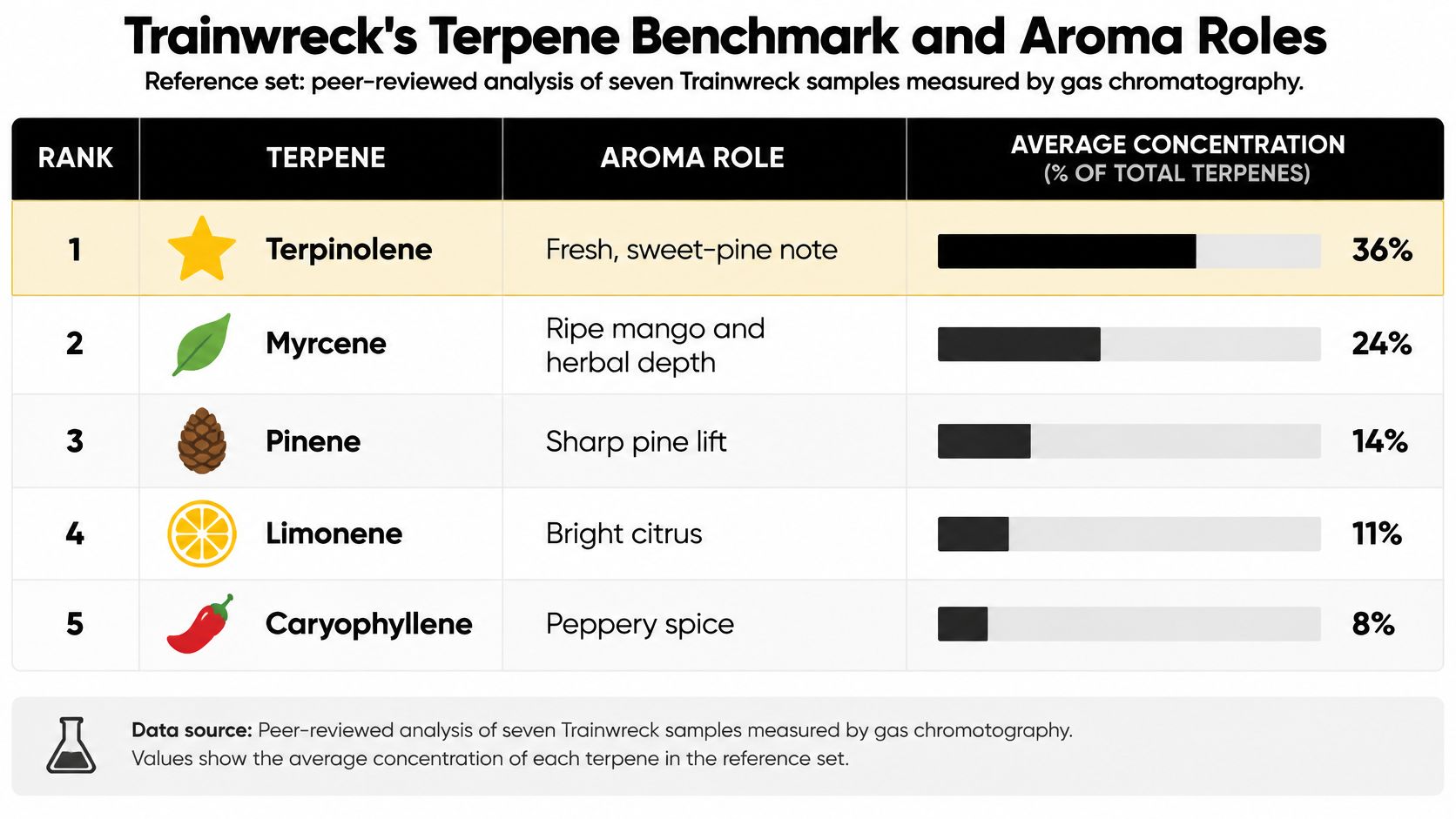
Read the table from the top down and you have a build order. Terpinolene is the note a customer smells first, and it is the one that separates Trainwreck from lemon-forward hybrids. Myrcene is the counterweight that keeps the blend from smelling like household cleaner. Limonene adds the citrus lift many people describe as lemon, and it sits close enough to terpinolene that a small slip turns the profile generic.
The back half of the table is where the character lives. trans-Ocimene softens the sharpness and gives the sweet herbal middle. Beta-pinene and beta-caryophyllene supply the resinous green edge and woody warmth that make the aroma read as plant material rather than fragrance oil. Alpha-pinene is the needle-sharp pine top note, and it is potent enough at low level that doubling it can push the blend toward cleaner.
Terpinolene should still dominate the major-terpene stack, with myrcene and limonene doing earthy and citrus support underneath. I would treat any candidate with limonene crowding the lead as a citrus blend wearing a Trainwreck label, then adjust terpinolene upward or pull limonene back until the pine-floral top returns.
The spreads matter as much as the centers. A terpinolene range that wide means two compliant lots can sit far apart and still smell related, so set an acceptance window around the lead ratio rather than chasing one perfect point. When you need to translate aroma words into compound targets across a wider catalog, our terpene flavor chart is the quick cross-reference.
The Minor Compounds That Shape the Sweet Edge
Matching all seven rows above still won't get you all the way to the aroma. The headline terpenes explain the pine, the citrus and the herbal middle, and then a taster smells the finished cart and says it's close but flat. In a 2023 chemical-and-sensory study of cannabis concentrates, Trainwreck was the only terpinolene-rich variety in the set, and it scored low on both chemical similarity and sensory similarity to the others, which points to a distinct volatile profile rather than a slightly shifted version of the same compounds.
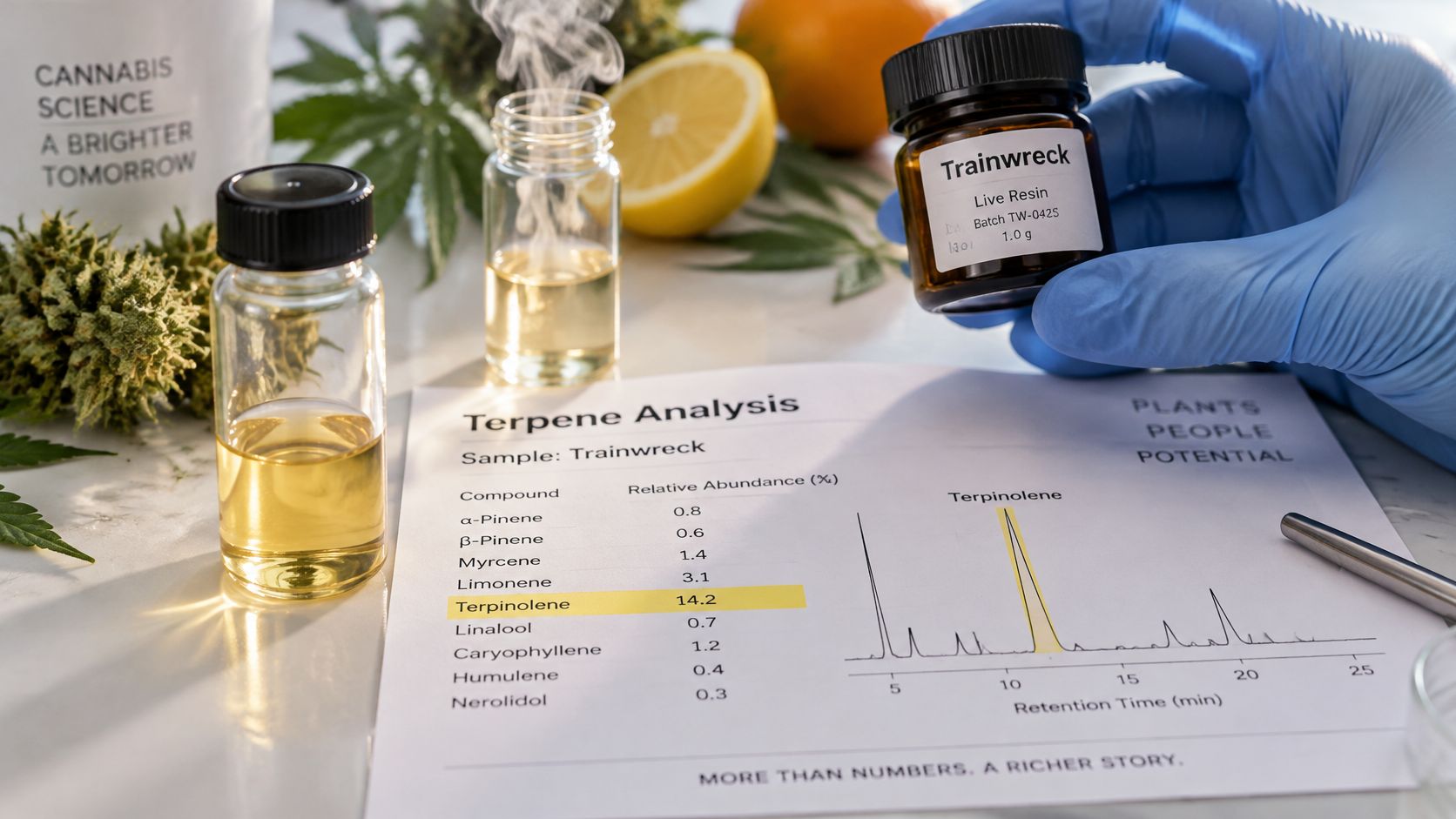
The cherry propanol finding
That 2023 chemical and sensory study of cannabis concentrates found cherry propanol at 0.739 μg/mg in Trainwreck against an average of 0.016 μg/mg across the other samples, roughly 46 times higher at an absolute concentration low enough that most standard terpene panels would not flag it.
What the study reports is a concentration difference, not proof of cause. A gap that size is still worth treating as a working hypothesis: a trace compound at that level may contribute to the sweeter read, and it's the kind of detail a seven-compound major-terpene panel will never surface. Build a blend from terpinolene, myrcene, limonene, ocimene and the pinenes and you get pine, citrus and herbs. Whether the missing edge comes from this compound or another trace volatile is a question your sensory panel has to answer, because the COA alone will not.
A two-stage matching process
Match the majors by analysis first, because that's a checkable, repeatable step. Then run a blind sensory check with two or three tasters and adjust the trace notes.
- Analytical pass: build to the benchmark ratio, weigh every isolate, and confirm by COA that the lead terpene share is where you intended.
- Sensory pass: code the samples, hand them over without labels, and record which one reads as Trainwreck. Adjust one variable per round.
Watch stability: trace notes are the first thing to shift with heat and air. Test the blend right after mixing and again after your normal storage interval, and don't sign off on the first sniff.
Questions worth putting to a supplier in writing: which minor volatiles sit outside the standard terpene panel, what method was used to measure them, and how much lot-to-lot drift you should expect on the trace compounds. A supplier who can't answer the third one is telling you something useful.
Why Trainwreck Batches Do Not Match Each Other
One label does not mean one chemistry. Two products both called Trainwreck can differ enough that swapping suppliers mid-run changes the taste of your cart, and that's less a sourcing failure than a naming problem. "Trainwreck" describes a sensory direction, not a fixed formula.
Three things move the numbers. First, sample preparation. Peer-reviewed analytical work shows that extraction method, solvent use, evaporation and decarboxylation can change the measured terpenoid profile, and while most major terpenes held up reasonably well in some chemovars, certain samples came out substantially different. The lab measures what survives the prep, not what grew.
Second, cultivation. Emissions research in sampled cultivation rooms has found that environmental conditions and day-to-day room activity can shift beta-myrcene output substantially, and the response doesn't scale in a straight line. A room running hotter with more foot traffic isn't producing the same oil as the room next door, and neither room stays constant across a grow cycle.
Third, the lab method itself. Different instruments, different columns, different integration settings. Two competent labs can return two different terpinolene figures for the same lot and both be right within their own method. The mechanics behind chromatography testing for terpene analysis are worth understanding before you compare COAs across labs.
Two target directions compared
| Target direction | Lead terpene | Supporting terpenes | Product fit |
|---|---|---|---|
| Terpinolene-forward pine and lemon | Terpinolene at 9.6 mg/g benchmark | Limonene and alpha-pinene for citrus and sharp pine | Bright, fresh product target |
| Myrcene-heavier earthy | Myrcene raised above the 3.7 mg/g benchmark | Caryophyllene and terpinolene as lighter notes | Deeper, earthy product target |
Both are defensible products. What fails is not choosing. A brand that sells a "bright Trainwreck cart" and a "deep earthy Trainwreck cart" under the same SKU description will get complaints, because the customer can't tell which one they're buying.
Name drift adds another layer. The Northern California cultivar has a documented history and a mixed Mexican, Thai and Afghani lineage, and later crosses sold under similar names, including Pineapple Trainwreck, Purple Trainwreck and OG Trainwreck, carry materially different aromatic and chemical characteristics. If a buyer asks for Trainwreck and you quote a Pineapple cross, you've solved a different problem.
How to read the COA before you approve a lot
Check the lead terpene and its range first, not the total terpene count. A blend can post a healthy total while the terpinolene share sits far below the benchmark, and the paperwork still looks clean. Then check the test method and the batch date, and compare the lot against your last approved lot rather than against the certificate from the original sample.
That last comparison is the one that catches drift. The original sample's certificate tells you what you were promised. The last approved lot tells you what your customers tasted. When a supplier's new COA lands inside the lead-terpene range but skews low three lots running, that's drift you can raise in writing before it reaches the cartridge.
Terpene information for Gold Coast Terpenes products is provided by SC Labs, so the numbers you receive trace back to a named lab rather than an unnamed internal test.
Dosing Ratios for Distillate and Cartridges
A good profile at the wrong load still fails. Terpene loading is the second variable that decides whether the cart tastes like Trainwreck or like a solvent spill, and it's the one formulators most often set by eye. Published guidance puts total terpene loading at 5% to 15% by weight, with narrower starting windows by base type.
| Base | Suggested load | Per 100 g of base | Note |
|---|---|---|---|
| Distillate, starting range | 8% to 12% | 8 g to 12 g | Most common starting point for carts |
| Live resin | 3% to 5% | 3 g to 5 g | Native terpenes already present |
| Full published range | 5% to 15% | 5 g to 15 g | Test in the intended cartridge before approval |
The numbers come from published terpene dosing guidance by product type, and the logic is simple. Live resin already holds its own native terpenes, so it needs a lower addition to reach the same intensity. Distillate has had most of that stripped out, so it takes more.
Work the math by weight
At a 10% load, one gram of distillate takes 0.1 gram of terpene blend. Scale that to production and it's 10 g of blend per 100 g of base. Do the calculation on a balance, not in drops. Drop size changes with viscosity, temperature and the dispensing equipment, so a 30-drop recipe from one lab bench can be a different load on a different day with a different bottle.
If you're scaling a pilot batch and want to skip the arithmetic, our mixing calculator handles the weight math for you.
Set the load, then tune it
Treat your first load as a fixed test variable. Terpenes for cartridges are added to winterized distillate oils, and our cartridge terpenes are free from additives, VG, PG, PEG and MCT, so the load you calculate is a clean percentage rather than a percentage plus filler.
Run the first batch at the low end of your chosen range, then adjust on evidence:
- Too soft on flavor: step the load up in small increments rather than jumping to the top of the range, and re-test wicking at each step.
- Oil thins out: drop the load or blend a thicker base before you touch the terpene ratio.
- Wicking problems, dry hits or leakage: these are hardware and viscosity signals. Reduce total load first and re-test in the same device.
Bench mixing tells you whether the aroma is right. It tells you nothing about wicking, leakage or how the cart performs after a week on the shelf. Approve the formula only after it has run in the intended cartridge.
How to Build a Trainwreck-Style Blend Step by Step
Treat Trainwreck as a target aroma direction: lead-terpene ranges set the frame, and each batch is matched inside that frame. The work is to hold the lead share steady, place the supports, and change only one variable per pilot.
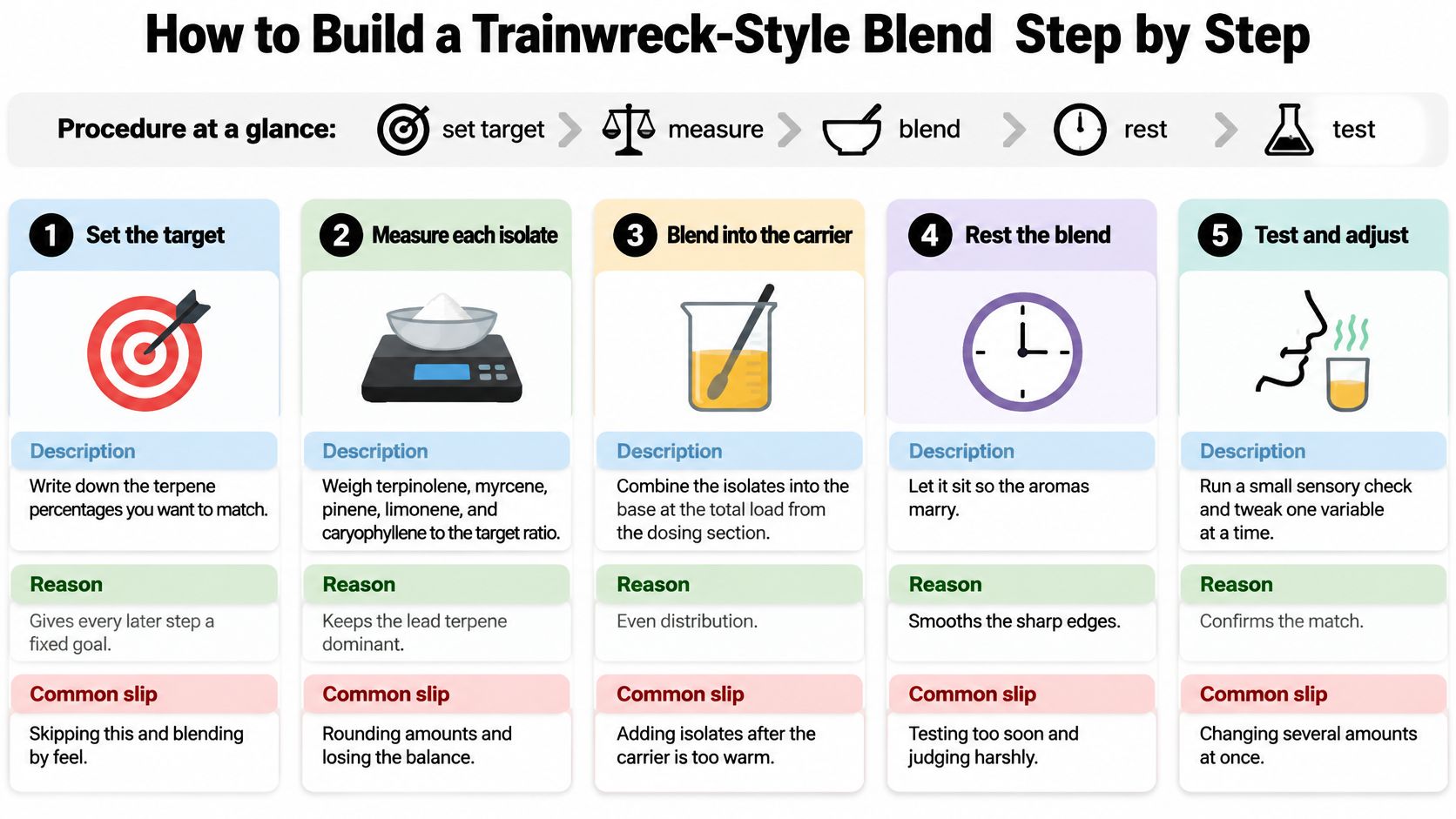
- Set the target in words and numbers. Write three aroma words and the lead-terpene share range you are aiming for. Reason: a fixed target ends open-ended tweaking. Slip: blending by feel and then trying to reverse-engineer what you made.
- Anchor on terpinolene. Keep it the clear lead inside the benchmark range and build every other addition around that position. Reason: it is the note that identifies the profile. Slip: letting limonene creep until the blend reads as generic lemon.
- Add the supports in order. Myrcene for depth, limonene for lift, beta caryophyllene where the target needs spice. Reason: the supports make the lead note read as plant material rather than fragrance. Slip: pushing depth so hard that the top turns dull.
- Tune the minor notes last. Add trans-ocimene and alpha-pinene in small steps, one component per test batch. Reason: if you change three things at once, you cannot tell which one fixed the aroma. Slip: chasing sharpness with pinene after the balance was already close.
- Keep heat low and holds short. Use only enough warmth to keep the carrier workable, mix until uniform, then get the batch off heat. Heat and long holds degrade the more volatile terpenes, so the slip here is hot mixing with a long hold, which strips the delicate notes you paid for.
- Record everything. Blend lot, terpene percentage by weight, mixing temperature, hold time and post-mix analytical results. Reason: without the record, a good batch is a one-off you cannot reproduce. Slip: writing the recipe after the sensory panel has already moved on.
- Compare against the benchmark and your tasting notes. If the finished blend drifts, the record shows which variable moved. Change that variable on the next pilot and leave the rest alone.
Starting from isolates gives you control that a pre-mixed bottle cannot. Alpha pinene, beta caryophyllene, limonene, linalool, myrcene and terpinolene are enough to build a Trainwreck ratio from scratch and adjust one number at a time.
What a good first result looks like
A clear pine and fresh note on the first sniff. A sweet herbal lift a few seconds later as the ocimene and caryophyllene come through. No harshness at the back, which usually means alpha-pinene or limonene is running high relative to terpinolene. If the blend reads flat rather than sharp, the lead share is probably low, and the correction is a higher terpinolene share.
Rest the blend before you judge it. A freshly mixed batch reads sharp and disconnected, and the notes settle into each other after a short rest.
Request Samples and Test a Trainwreck Blend Before Ordering
Order a small quantity before the drum. A Trainwreck blend is a specification question, and a 30 g sample answers it for a fraction of the cost of a full lot that turns out wrong.
Three checks decide the purchase:
- Analytical match. Does the lot hit the lead-terpene benchmark, with a certificate of analysis that names the method and the batch date?
- Blind sensory match. Does it read as Trainwreck to tasters who can't see the labels?
- Cartridge validation. Does it perform in your hardware at your calculated load, after storage?
Calibrate the first load before you test anything, so the sensory result reflects the blend rather than an accidental overdose of terpenes. Then ask for the paperwork alongside it: terpene information provided by SC Labs for the profile you're evaluating, plus the supporting files on the Terpene Safety & Documents page. The terpene samples listing is a practical place to start a small order.
Ask two questions in writing before you commit: where the material is sourced and how it's tested. Our terpenes are extracted from fresh plants, free of mixtures, chemicals and additives, and the cartridge terpenes are SC Lab-tested, so the answer shouldn't be a conversation.
You can shop the isolates and terpene profiles on the site based on personal preference, run a small order against your benchmark, and contact the team about bulk and wholesale orders once the blend passes all three checks.
One last note for the label. Terpene statements on the product page have not been evaluated by the Food and Drug Administration, and the same discipline should apply to your own copy. Keep product descriptions on aroma and flavor, describe the profile as chemovar-specific, and avoid implying that every lot of a named cultivar carries identical chemistry.
Gold Coast Terpenes supplies strain-specific terpene profiles and the isolates to build a Trainwreck ratio from scratch, including alpha pinene, beta caryophyllene, limonene, linalool, myrcene and terpinolene, with terpene information provided by SC Labs. If you're matching a Trainwreck target across batches, run a small order against the benchmark in your own hardware before you commit to volume. Visit Gold Coast Terpenes to shop blends and isolates or ask about bulk and wholesale orders.