
Copying a strain page's terpene percentages is the wrong starting point for a White Truffle cartridge. Gold Coast Terpenes' formulation guidance treats a blend as a balance of aroma roles, a more useful approach when the same strain name can cover different genetics and batch chemistry.
For product developers, the task is replicating the flavor of White Truffle for vape cartridges, not reproducing a retail description. Define the reference aroma, verify the source lot, and qualify the finished oil in its intended hardware before approving the formula.
Which Terpenes Build the White Truffle Aroma?
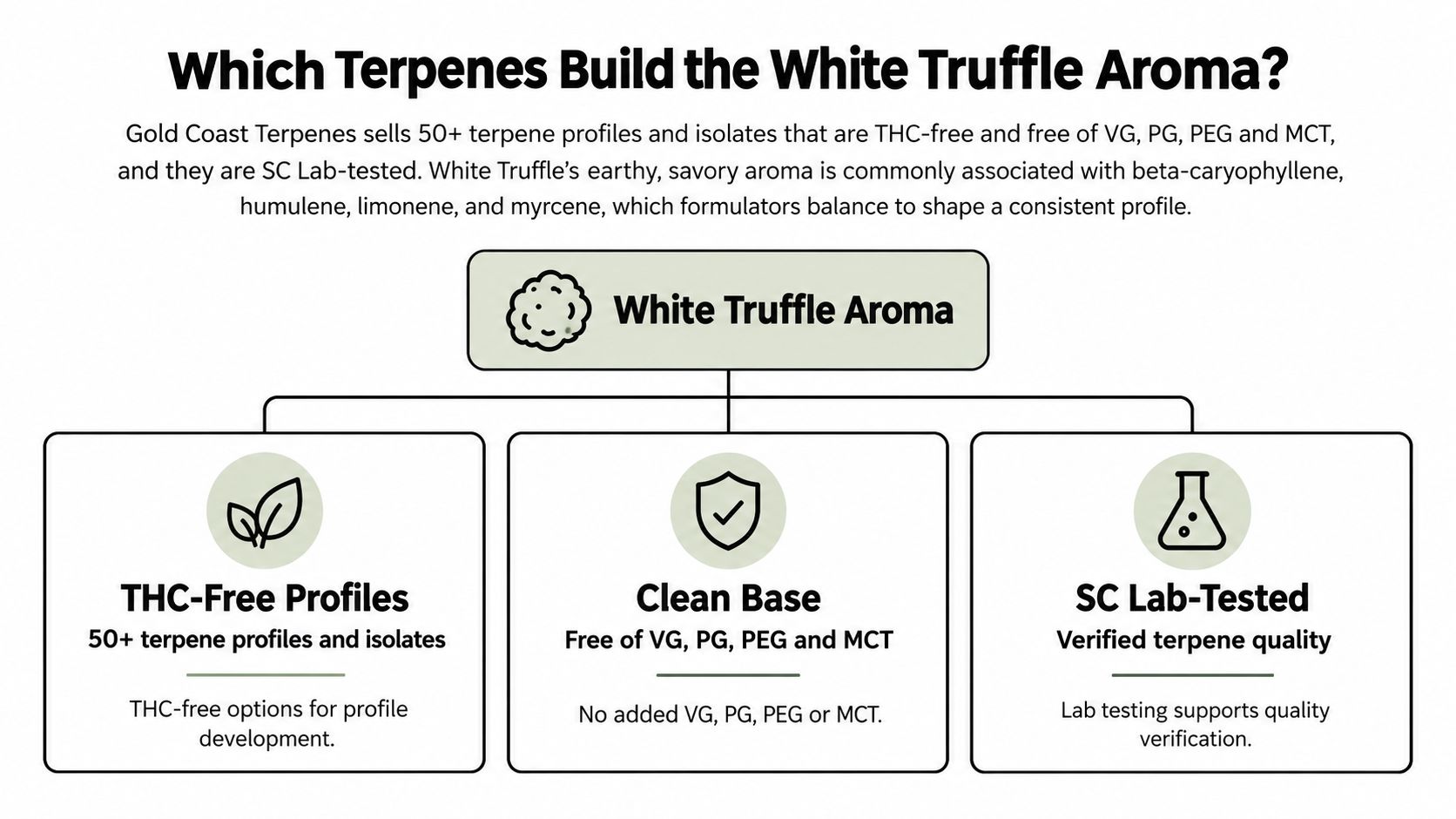
The White Truffle name does not specify a fixed terpene formula. Several lineages and batch chemistries can sit behind the label, so build the blend around a defined aroma target and confirm each lot against its certificate of analysis, or COA. Gold Coast Terpenes offers terpene profiles and isolates; verify THC-free status, testing, and the absence of VG, PG, PEG, and MCT against the specific lot's COA rather than treating those attributes as guaranteed.
A practical starting architecture is caryophyllene-led, with limonene, humulene, and myrcene considered for supporting roles. The Gold Coast Terpenes blend framework separates a blend's first impression from its defining middle and lingering finish.
White Truffle terpene architecture by role
These are proposed bench-development starting ranges, not measured White Truffle specifications or finished-cartridge concentrations. Treat them as trial settings, then compare the result with the aroma target and documented specifications for the materials.
| Role | Terpene | Sensory cue | Working share of total terpenes |
|---|---|---|---|
| Top | Limonene | Bright citrus lift | Proposed 20–30% |
| Top | Myrcene | Green, herbal, lightly musky | Remainder to reach 100%, roughly 5–30% |
| Middle | Beta-caryophyllene | Peppery, spiced, core identity | Proposed 40–50% |
| Base | Humulene | Woody, earthy, hop-like finish | Proposed 10–15% |
Select values within the proposed ranges and calculate myrcene as the remainder needed to reach 100%. That calculation is arithmetic, not evidence of myrcene content in a particular flower. Check the target lot's COA before scaling, and adjust if its profile or the sensory match calls for a different balance.
The blend works like a chord: limonene gives the first lift, beta-caryophyllene carries the recognizable peppery center, and humulene contributes a woody, earthy finish. Myrcene can add green, herbal detail, but include it only when the reference aroma supports that note.
Keep the peppery center clear without letting it become blunt or overly spiced. Limonene provides contrast; humulene adds depth. The terpene flavor chart can help standardize sensory language across bench trials. These roles describe a working blend, not fixed categories that predict every terpene's behavior in every oil.
Formulation boundary: Reconstructing an aroma does not reproduce the cannabinoid-driven effects of flower.
Keep the development target sensory: pepper, citrus lift, herbal detail, and woody finish. Do not turn those descriptors into effect claims on a specification sheet or finished-product label.
Where Does the White Truffle Lineage Come From?
The White Truffle name does not identify one guaranteed lineage or aroma profile. A commonly cited route runs through Gorilla Butter, while a separate Parabellum Genetics lineage also uses the name. For cartridge formulation, identify the source material first, then build and verify the blend against the target aroma and the actual lot's COA.
The White Truffle lineage account from Katsu Seeds describes Gorilla Butter as Gorilla Glue #4 crossed with Peanut Butter Breath. It credits Fresh Coast Seed Co. with the F2 generation and BeLeaf Cannabis with selecting White Truffle around 2020. The account also refers to emergence in 2019 and a separate Parabellum Genetics lineage. Those dates alone cannot establish which cut or batch a supplier is selling.
White Truffle lineage routes and formulation consequences
| Lineage route | Parent genetics | Breeder or selector | Formulation consequence |
|---|---|---|---|
| Gorilla Butter-derived White Truffle | Gorilla Glue #4 × Peanut Butter Breath | Fresh Coast Seed Co. for F2; BeLeaf Cannabis for selection | Use this lineage as a starting reference, then verify each lot against its COA |
| Parabellum Genetics line | Not established by the cited account | Parabellum Genetics | Request lineage details and build a separate reference rather than assuming the Gorilla Butter profile |
| Unlabeled White Truffle product | Not established | Not disclosed | Request breeder and propagation details before treating it as a lineage-specific reference |
The commercial expression was propagated from a selected plant. That makes propagation history relevant to cut identity: a strain name on a label cannot confirm that two suppliers provide the same cut. Aroma also varies by lot, so lineage information does not replace batch-level verification.
Ask the flower or extract supplier for a concise provenance package:
- Breeder or selector name: Establish which White Truffle lineage the supplier identifies.
- Clone chain or cut source: Record where the production material originated.
- Exact-lot COA: Match the certificate to the material used as the sensory reference.
An unlabeled sample can still serve as a sensory reference, but record it as unverified. Do not present its chemistry as representative of an authenticated lineage.
For the Gorilla Butter route, use its documented lineage as context, not as a fixed terpene recipe. A separate lineage needs its own reference material and analytical baseline. In either case, compare the target aroma with the actual lot's COA before setting blend ratios; a strain page cannot establish the chemistry of the material in hand.
Record the lineage and lot in the formula file, not just “White Truffle.” That gives purchasing a clear reference and makes any supplier substitution visible as a change requiring review.
Does the White Truffle Name Mean One Chemical Profile?
White Truffle does not identify one fixed chemical profile. The name appears across material with different reported cannabinoid and terpene measurements, so a strain-page description is not a formulation specification. Build around a target aroma, then verify each source lot against its COA.
The discussion of conflicting White Truffle descriptions illustrates why strain names alone cannot establish chemical consistency. Published results can help frame what to check, but they are not interchangeable formulation targets.
Published White Truffle batch results
| Reported source | THC or THCA | Total terpenes | Dominant terpenes reported |
|---|---|---|---|
| Strains of Malta independent test, 2025 | 16.34% total THC | 0.83% | Not specified in the available summary |
| Published flower COA, unnamed lab | 29.18% THCA | 2.397% | Not specified for this particular result |
| Published THCA flower laboratory results and certificate-based reporting | 29.43% THCA; 32.66% total cannabinoids | Not reported in the available summary | Not specified for this particular result |
| PharmLabs San Diego ISO 17025 report, May 2026, included in the certificate-based reporting above | 23.6% THCA; 20.9% total THC | Not reported in the available summary | Not specified for this particular result |
None of these listed results specifies dominant terpenes. A caryophyllene-led architecture may be a practical starting hypothesis for a blend, but these results do not document it as a recurring White Truffle pattern. Confirm the aroma target against the actual source material and its lot-specific COA.
The certificate-based results cited above show a 5.83-percentage-point THCA spread between reported products. Phenotype, cultivation, harvest timing, curing, and testing methodology can affect a measured profile; the individual results do not isolate the effect of any one factor. Understanding cannabis phenotype variation provides context for differences between related plants, but cannot substitute for testing the material being used.
THCA, total THC, and total cannabinoids are different measurements. Compare like with like, and don't treat one value as a specification for another.
What the differences mean for dosing
The reported terpene totals vary, and the summaries do not establish a shared dominant-terpene profile. Don't transfer a flower's total terpene percentage directly into a cartridge formula.
A flower result describes that tested flower. For a distillate blend, assess the receiving oil's existing volatile content, the aroma concentrate, and the intended sensory strength. Set the blend against the target aroma architecture, then check it against the specific lot rather than copying a strain-page profile.
A strain name is a purchasing descriptor. The lot COA is the analytical reference.
Record the reference lot used in development. If the source lot changes, review its chemistry and aroma before carrying the formula forward.
Should You Buy Botanical or Cannabis-Derived Terpenes?
Choose botanical-origin terpenes when verified botanical sourcing and a THC-free ingredient specification fit the SKU. Choose cannabis-derived material when documented cannabis origin is part of the product requirement, subject to the applicable market's rules.
Neither origin alone establishes flavor accuracy, inhalation suitability, or finished-product compliance. The botanical versus cannabis-derived terpene guide provides a framework for separating origin decisions from formulation decisions.
| Decision point | Botanical terpenes | Cannabis-derived terpenes |
|---|---|---|
| Origin claim | Botanical origin documented on the product sheet | Cannabis origin documented on the product sheet |
| Cannabinoid check | Verify any THC-free claim against the COA | Review residual cannabinoids before approval |
| Carrier check | Confirm absence of VG, PG, PEG, and MCT where required | Apply the same carrier check |
| Labeling rules | Use botanical wording only when documented | Check jurisdiction-specific cannabis-origin wording |
| Best fit | Formulas requiring a verified THC-free ingredient | Licensed products requiring documented cannabis origin |
How to choose a terpene supplier
Start with the individual product, not the supplier's broad marketing description. A company may offer different ingredient types, and a botanical claim isn't automatically a nature-identical claim.
- Documentation: Request the origin statement, product specification, safety documents, and lot-specific COA from an accredited laboratory.
- Consistency: Compare retained samples and analytical results across supply lots.
- Commercial terms: Confirm MOQ, pack size, lead time, and bulk pricing for the exact SKU.
- Technical support: Check whether the supplier can explain ingredient identity, handling, and change-control procedures.
Gold Coast Terpenes lists limonene, myrcene, and beta-caryophyllene among its isolates, which makes those roles identifiable purchasing inputs. Confirm humulene availability and documentation before designing a production formula around it.
Treat the company's bulk program and shipping terms as pilot-budget inputs, not evidence of technical suitability. Obtain a current quotation rather than building a production commitment around a published promotion.
The supplied Apple Fritter Elevated Strains product page identifies a different profile, not a White Truffle equivalent. Don't substitute an available flavor for the approved target just because it belongs to the same commercial range.
Confirm MOQ and lead time per SKU before purchase approval. A technically acceptable component still needs a workable replenishment plan.
How Does the Blend Perform in Vape Cartridges?
A White Truffle blend for vape cartridges is an inhalation formulation, not just a bottle-aroma exercise. Loading, aerosol chemistry, and hardware behavior must be evaluated together.
A peer-reviewed review of terpene inhalation exposure reports that cannabis electronic-cigarette products may contain approximately 10–20% terpenes by weight, with aerosol concentrations around 2,500–5,000 ppm, while many toxicology studies examined environmental exposures below 100 ppm. Those reported concentrations describe exposure conditions, not recommended production targets or established safe limits.
Don't borrow reassurance from ambient studies
A result obtained under low environmental exposure can't establish the suitability of a concentrated vape aerosol. Likewise, an ingredient COA confirms reported analytical properties; it doesn't by itself qualify the finished oil in a heated device.
Avoid using "natural," "botanical," or "lab-tested" as substitutes for a product-specific evaluation. Keep any safety conclusion within the scope of the testing performed.
The guide to terpene boiling points is useful handling background. A list of boiling points, however, can't predict the complete behavior of a mixed oil in cartridge hardware.
What to qualify before release
Set the validation plan before changing the loading:
- Controlled loading window: Work around a target established for the receiving oil, not a percentage borrowed from another product.
- Batch homogeneity: Confirm that the terpene system is distributed consistently.
- Device conditions: Evaluate the intended cartridge and intended operating conditions, including coil temperature.
- Storage behavior: Compare flavor drift under a cooler and a warmer condition chosen for the product's distribution plan.
- Aerosol assessment: Include appropriate finished-product analysis rather than relying only on ingredient documents.
Top-note loss is especially important when matching the aroma in hardware. The formulation framework cited earlier explains why a blend can smell convincing immediately after mixing yet lose defining detail during filling, storage, or use.
If citrus lift disappears, don't automatically add more limonene. First determine whether processing loss, storage, or device behavior caused the change, then rebalance the middle and base if needed.
Release discipline: A stronger bottle aroma isn't proof of a better cartridge.
Describe the blend's aroma and flavor accurately. Don't attach health or effect claims to a sensory match.
How to Build, Verify and Release a White Truffle Blend
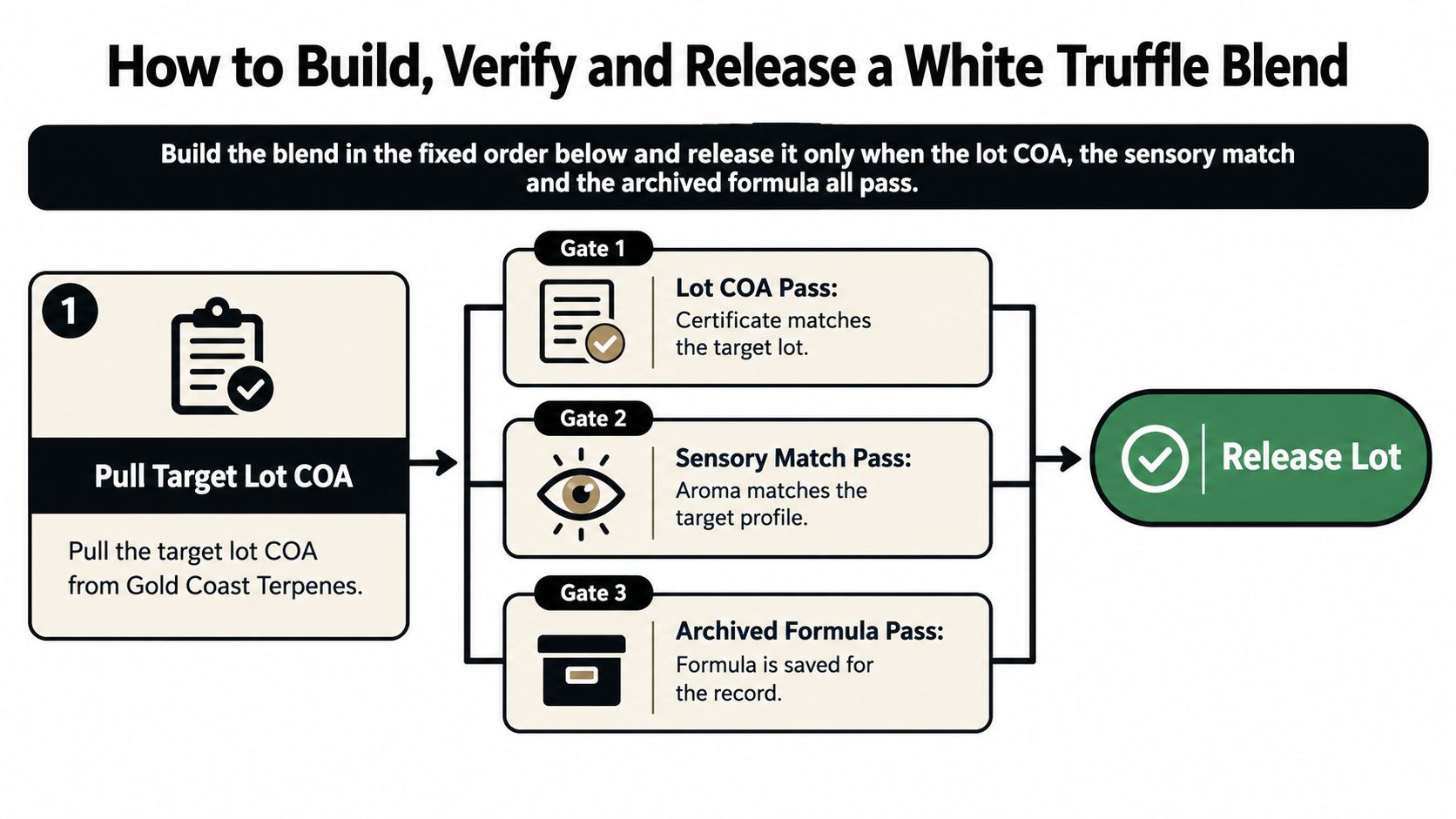
Build the blend in a fixed sequence and release it only when the lot analysis, sensory match, and archived formula pass the approved criteria. Establish those criteria before the pilot so operators aren't deciding what “close enough” means after mixing.
The sequence below puts the structural notes into the blend before the more volatile additions. It also separates aroma development from finished-oil loading, which prevents an adjustment to one from becoming an uncontrolled change to the other.
Establish the reference and calculate the batch
Pull the target-lot documentation. Obtain the reference flower or extract COA, then obtain the component-lot COAs from Gold Coast Terpenes or the chosen supplier. Record dominant terpenes and total terpene content separately for the reference and purchased ingredients; they answer different questions.
Convert the architecture into weighed quantities. Normalize the selected role shares before calculating component masses. Use the Mixing Calculator on the supplier's site as an arithmetic aid, then independently check the calculation and distinguish terpene-concentrate composition from finished-oil loading.
Weigh the receiving oil. Use a calibrated scale and record the actual mass. Describe the oil accurately in the batch record rather than using “neutral carrier” as a substitute for its cannabinoid and volatile specifications.
Avoid calculating from the nominal container size. The manufacturing record should reflect what was weighed, not what the container label suggested should be present.
For staff who need role definitions before weighing materials, Gold Coast Terpenes' Terpenes 101 resource can support training. The approved batch sheet should still contain the specific ingredient names and calculations needed at the bench.
Add components and evaluate the result
Add humulene and beta-caryophyllene first. Use this as the proposed development sequence for establishing the structural portion of the aroma. Record the order so later operators can reproduce the trial rather than improvising it.
Add limonene and myrcene last. Keep the process at a controlled low temperature suitable for the actual materials and mixing system. Record the measured temperature; don't rely on descriptions such as “slightly warm.”
Mix and rest under defined conditions. Establish full homogeneity, then hold the sample for a rest period selected in advance. Keep the container and handling conditions consistent so differences between trials aren't merely differences in exposure.
Compare against the retained reference. Evaluate immediately after mixing, after the defined rest, and in the intended cartridge. Record whether the mismatch concerns citrus lift, peppery identity, herbal detail, or finish rather than writing only “good” or “weak.”
A reference sample should be stored and handled consistently with the comparison procedure. If the reference itself changes noticeably, investigate before using it to reject or approve new material.
Pilot fills and the release gate
Qualify filling behavior around the validated target. A published cannabis-concentrate vaping study used a 9:1 THC-to-terpene ratio as an experimental model and noted that excessive terpene proportions can make concentrate fluid enough to leak. Treat that ratio as a research benchmark, not a universal production specification.
Check viscosity, fill behavior, leakage, and the sensory result after hardware exposure. Carrier composition, cannabinoid concentration, cartridge geometry, coil temperature, and terpene chemistry all affect the working window.
Apply the documented release gate. Approve only material whose designated role terpenes fall within the pre-established tolerance bands, whose total terpene content is analytically confirmed, and whose sensory result meets the reference. Archive breeder, clone chain, reference lot, component lots, COAs, formula version, ratios, process temperature, and order of addition together.
The chromatography testing guide provides context for the analytical side of that decision. Sensory approval and analytical approval serve different purposes; neither should silently replace the other.
If a check fails, return to target-setting or investigate the process deviation. Don't correct an unidentified problem by repeatedly adding terpene concentrate until the bottle smells stronger.
A formula is ready for production when another trained operator can reproduce it from the record. That's a more useful standard than whether the original developer recognizes the aroma from memory.
Frequently Asked Questions
A purchasing decision should rest on repeatable supply, a retained sensory reference, and complete lot records. The questions below address the remaining supplier and labeling decisions.
How many lots should I test before choosing a White Truffle supplier?
As a practical qualification plan, test at least three consecutive lots to assess drift in caryophyllene and limonene; that's a proposed purchasing protocol, not a published industry threshold. Ask Gold Coast Terpenes or another candidate supplier for an accredited-laboratory COA tied to each lot, then compare both the measured chemistry and the sensory result.
Do I need a retained reference sample for sensory matching?
Yes, retain material from the first approved batch and compare new lots side by side with it at mixing, after rest, and in hardware. Document storage and handling so a changed reference doesn't become an unnoticed source of approval errors.
Does the THC-to-terpene research model set my loading level?
No, the experimental ratio discussed above doesn't establish your production loading. Gold Coast Terpenes components, like any supplier's materials, must be evaluated against the receiving oil, cartridge geometry, and intended operating conditions.
What if my White Truffle came from a different breeder?
Build a separate reference profile and COA baseline rather than reusing Gorilla Butter targets. Keep that lineage visible in the formula name so purchasing and production staff don't treat different source materials as interchangeable.
How should the label describe a White Truffle-inspired blend?
Describe its aroma and flavor without claiming to reproduce flower's effects or provide health benefits. Use botanical-origin wording only when Gold Coast Terpenes' product documentation confirms that origin, and have the finished label reviewed for the intended market.
{ “@context”: “https://schema.org”, “@type”: “FAQPage”, “mainEntity”: [ { “@type”: “Question”, “name”: “How many lots should I test before choosing a White Truffle supplier?”, “acceptedAnswer”: { “@type”: “Answer”, “text”: “As a practical qualification plan, test at least three consecutive lots to assess drift in caryophyllene and limonene. This is a proposed purchasing protocol, not a published industry threshold. Request an accredited-laboratory COA tied to each lot.” } }, { “@type”: “Question”, “name”: “Do I need a retained reference sample for sensory matching?”, “acceptedAnswer”: { “@type”: “Answer”, “text”: “Yes. Retain material from the first approved batch and compare new lots against it at mixing, after rest, and in hardware. Document reference storage and handling.” } }, { “@type”: “Question”, “name”: “Does the THC-to-terpene research model set my loading level?”, “acceptedAnswer”: { “@type”: “Answer”, “text”: “No. The experimental model does not establish a production loading. Evaluate the components against the receiving oil, cartridge geometry, and intended operating conditions.” } }, { “@type”: “Question”, “name”: “What if my White Truffle came from a different breeder?”, “acceptedAnswer”: { “@type”: “Answer”, “text”: “Build a separate reference profile and COA baseline rather than reusing Gorilla Butter targets. Keep the lineage visible in the formula name.” } }, { “@type”: “Question”, “name”: “How should the label describe a White Truffle-inspired blend?”, “acceptedAnswer”: { “@type”: “Answer”, “text”: “Describe aroma and flavor without effect or health claims. Use botanical-origin wording only when product documentation confirms it, and review the finished label for the intended market.” } } ] }Gold Coast Terpenes offers strain-inspired profiles, individual terpene isolates, and formulation resources for developing a defined aroma target. Visit Gold Coast Terpenes to review components for your White Truffle-inspired blend, then request current lot documentation, MOQ, and lead time before scheduling the pilot.