
You've got a reference oil that smells right in the jar, but the finished cartridge comes across as sharp citrus, flat candy, or burnt resin. That gap usually isn't solved by adding more limonene. Gold Coast Terpenes supplies 100% botanically derived blends for this kind of formulation work, including 37 classic profiles and 40 Elevated Strains, but the supplier choice is only the starting point. A fruit-forward cartridge succeeds when its compound ratios, loading, hardware, temperature, labeling, and finished-aerosol testing agree.
What Fruit Terpenes Actually Are in Formulation
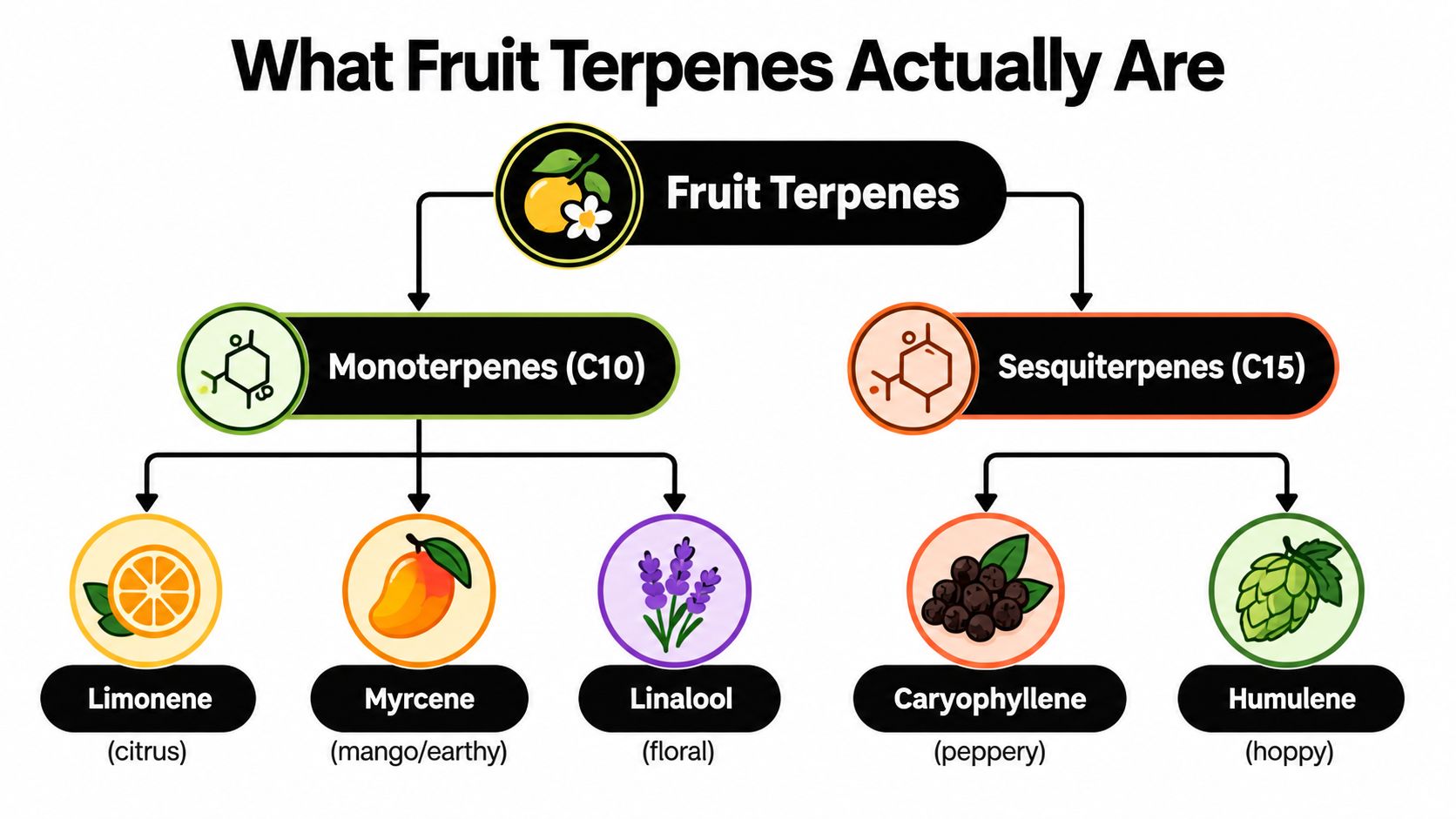
Fruit terpenes are chemically defined volatile compounds, not a guarantee of fruit origin or a single flavor ingredient. They're primarily C10 monoterpenes and C15 sesquiterpenes, produced by terpene-synthase enzymes from geranyl diphosphate or farnesyl diphosphate, as described in this review of fruit aroma biosynthesis.
Gold Coast Terpenes operates from Redondo Beach, California, and positions its blends as botanical rather than cannabis-derived. Its catalog combines 37 classic profiles with 40 Elevated Strains, giving formulators reference points for strain-inspired terpene blends, fruit-forward profiles, and custom distillate work. The useful distinction is that a profile name is a sensory target, not a chemical specification.
Why the ratio matters
A terpene synthase can generate cyclic and acyclic molecules with citrus, floral, woody, or tropical associations. Small changes in enzyme expression can therefore alter the final aroma, even when two fruits or cannabis chemovars share a headline compound.
The same principle applies in a cartridge. Limonene may establish the citrus direction, but supporting compounds determine whether the result resembles lemon peel, sweet orange, lime, or a generic cleaning note. Stereochemistry, concentration, volatility, and interactions with esters, aldehydes, and alcohols all affect what reaches the nose during use.
A practical formulation brief should define:
- Target aroma: lemon zest, orange peel, tropical fruit, berry, or a dessert-fruit hybrid.
- Chemical target: the relative contribution of major and minor terpenes, not only the profile name.
- Use route: oral, topical, or inhalation, because evidence and compliance requirements differ.
- Hardware target: cartridge resistance, coil behavior, operating temperature, and wick performance.
- Label position: botanical, nature-identical, or cannabis-derived, supported by supplier documentation.
Practical rule: Treat “fruit” as the sensory output of a measured mixture. Never treat it as proof that every ingredient came from fruit.
The Chemistry Behind Citrus, Berry, and Tropical Fruit Profiles
Limonene supplies much of the recognizable citrus foundation, but odor activity explains why minor compounds can control the final impression. In a comparative citrus study, limonene represented roughly 59–89% of detected volatiles at 20.28–56.21 mg/kg, while ocimene and beta-myrcene produced higher odor-activity values than limonene in sweetie fruit. See the comparative citrus terpene data for the measured profile.
That's why a blend built around a high limonene percentage can smell bright but incomplete. Ocimene can add fresh lift, beta-myrcene can broaden the fruity body, and gamma-terpinene can move a citrus profile toward tangerine. A formulator should adjust these contributors by sensory impact, not just by their GC-MS peak area.
| Compound | Fruit association | Odor character | Sensory role |
|---|---|---|---|
| Limonene | Lemon, lime, orange | Bright citrus peel | Establishes the main citrus direction |
| Ocimene | Sweet citrus, tropical fruit | Fresh, green, airy | Adds volatile lift and freshness |
| Beta-myrcene | Tropical fruit, mango-like profiles | Soft, fruity, earthy | Builds body and rounds sharp citrus |
| Gamma-terpinene | Tangerine and citrus | Warm, sweet citrus | Shapes a tangerine-like identity |
| Alpha-phellandrene | Tropical and aromatic fruit | Green, spicy, citrus-like | Adds complexity to the upper profile |
| Beta-pinene | Citrus, botanical fruit | Piney, fresh | Prevents citrus from becoming one-dimensional |
| Para-cymene | Fruit and spice accents | Warm, dry, aromatic | Adds depth at low relative abundance |
A terpene chemistry guide is useful when translating a sensory brief into ingredient choices. The point isn't to copy a fruit label word for word. It's to decide which compounds should lead, which should support, and which should remain low enough to avoid overpowering the target.
For berry and tropical profiles, the same logic applies. A broad terpene repertoire can supply nuance, but a small group of dominant compounds usually establishes recognition. The finished blend should therefore be judged in the oil, in the cartridge, and during the intended draw, not only in a neat sample vial.
How Top, Mid, and Base Notes Build a Fruit-Forward Blend
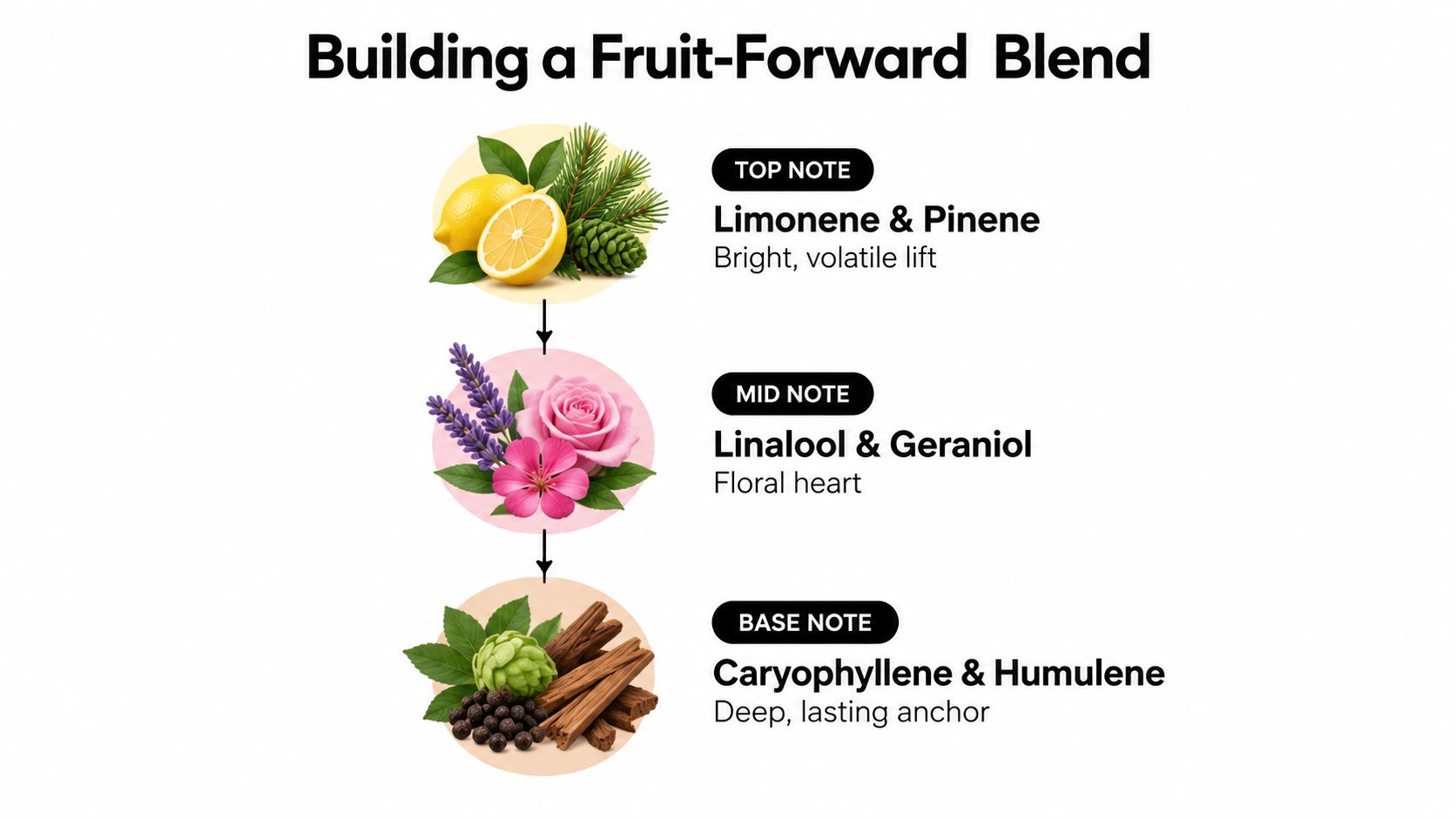
Top notes create the first fruit impression, mid notes provide juiciness and body, and base notes keep the profile from disappearing during the vapor stage. A reliable blend is layered, not overloaded.
Start with the volatile top. Limonene, pinene, ocimene, and related lighter compounds can make a cartridge smell bright immediately after opening. If the top is too dominant, the profile may feel thin, harsh, or detergent-like.
Build the middle before chasing intensity
Mid notes create the recognizable heart. Linalool and geraniol can add floral softness, while myrcene, selected aldehydic notes, and compatible esters can make a fruit impression feel fuller. These materials should support the target rather than turn a citrus profile into perfume.
Base notes are usually heavier and less immediately volatile. Caryophyllene and humulene can anchor a blend with peppery, woody, or hoppy depth. In a strain-inspired terpene blend, they can also help keep the profile recognizable after the brightest compounds have flashed off.
A fruit profile can contain many minor compounds without any one of them dominating the analysis. Cape gooseberry, for example, had 62 detected terpenes, with terpenes representing about 14% of the total volatile fraction, while only five compounds exceeded 1% of relative peak area, as reported in this comparative fruit terpene study. That pattern is a useful formulation model.
Use a repeatable sequence:
- Set the direction. Choose the dominant citrus, berry, tropical, or dessert-fruit identity.
- Add lift carefully. Use the top-note fraction to create freshness without making the oil smell solvent-like.
- Add body. Introduce floral, fruity, or ester-like support so the profile survives dilution and heating.
- Anchor the blend. Add compatible heavier terpenes only when the profile needs persistence or a cannabis-style backbone.
- Evaluate at use conditions. A vial test measures headspace aroma. It doesn't predict the full cartridge experience.
The terpene flavor chart can help buyers map profile families before ordering samples. Gold Coast Terpenes' classic and premium ranges can serve as reference directions, but every production target still needs a defined ratio and a finished-oil check.
Botanical vs Cannabis-Derived vs Nature-Identical Terpene Sources
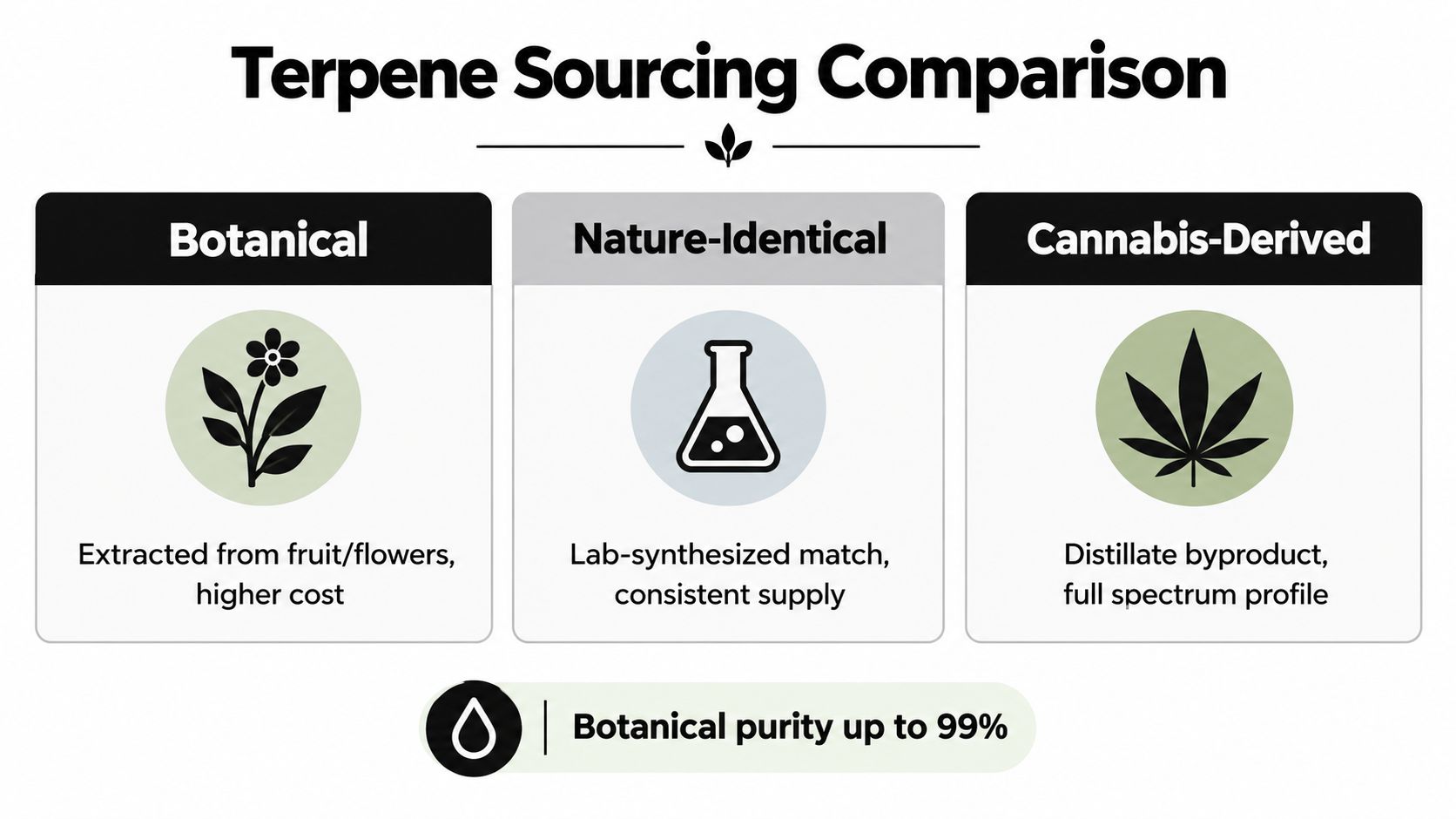
Source classification affects labeling, procurement, consistency, and compliance, but it doesn't establish inhalation safety by itself. Botanical materials come from plants, nature-identical compounds are synthesized to match naturally occurring molecules, and cannabis-derived materials originate from cannabis processing.
Compare the procurement decision, not just the aroma
| Source | Commercial advantage | Main buyer question |
|---|---|---|
| Botanical | Supports botanical-origin positioning and broad sourcing | Is the botanical identity, purity, and allergen information documented? |
| Nature-identical | Can offer consistent availability for defined molecules | Does the documentation support the intended label and route of exposure? |
| Cannabis-derived | May align with a cannabis-derived positioning | Is the cannabinoid status, chain of custody, and batch profile documented? |
Gold Coast Terpenes describes its blends as 100% botanically derived, rather than cannabis-derived. That distinction can matter for SKU positioning, shipping decisions, and the wording used on a finished product. It doesn't allow a buyer to skip finished-product compliance review.
Every incoming lot should be checked for:
- Identity: compound names, botanical source where relevant, and stereochemical information.
- Purity: assay results and material specifications.
- Contaminants: residual solvents, pesticides, heavy metals, and microbiological information where applicable.
- Allergens: declared constituents and relevant sensitization information.
- Route suitability: documentation specific to the intended product category.
- Batch traceability: lot number, production date, retest information, and storage conditions.
- Finished formulation fit: viscosity, color, flavor drift, and compatibility with the selected hardware.
The phrase “natural fruit flavor” can describe an origin, a sensory direction, or a marketing category. Those aren't interchangeable. Buyers should require documentation that supports the exact claim they intend to print.
Dosing, Dilution, and Loading for Distillate and Live-Resin Carts
Start with the lowest loading that delivers the required aroma, and treat 15% as an upper guardrail rather than a target. An industry safety review noted that terpenes naturally make up less than 5% of cannabis flower by weight and cited a recommendation to cap vape-oil terpene concentration at 15%, while warning that some terpenes can degrade into volatile organic compounds at excessive concentrations. The review is summarized in this vape-oil terpene safety discussion.
For distillate, viscosity is the first production constraint. Add the terpene blend gradually to a measured oil batch, mix until uniform, and confirm that the resulting viscosity works with the cartridge hardware. A profile that smells excellent in a beaker can wick poorly, leak, or produce inconsistent vapor if the finished oil is too thin or too thick.
Keep the blend and oil warm enough to mix evenly, but don't use unnecessary heat. Excessive temperature exposure can strip volatile top notes before filling and can change the ratio you approved during bench evaluation.
A practical production sequence looks like this:
- Prepare a small pilot batch. Record oil mass, terpene mass, temperature, mixing time, and container type.
- Add in stages. Check homogeneity after each addition instead of dumping the entire blend into viscous distillate.
- Rest and recheck. Evaluate the oil after the blend has equilibrated, because the first headspace reading may not represent the final mixture.
- Fill representative cartridges. Test more than the beaker. Hardware changes aroma delivery, airflow, and perceived intensity.
- Record draw conditions. Compare low-temperature and normal-use settings where the device allows it.
Gold Coast Terpenes describes its materials as THC-free and free of VG, PG, PEG, and MCT. Buyers should still verify the current product specification, COA, and intended route before approving a lot.
A visual production walkthrough can help teams align mixing and filling practices:
The guide to terpene loading for distillate can support pilot planning, but no generic loading level replaces testing in the final oil and cartridge.
Why Natural and Fruit-Flavored Do Not Equal Inhalation-Safe
A buyer approving a natural strawberry or citrus blend for cartridges is approving an engineered ratio, not a single fruit ingredient. Botanical origin and a fruit descriptor do not establish inhalation safety. The relevant questions cover compound identity, concentration, coil temperature, aerosol chemistry, hardware, and evidence from the finished system.
A 2025 peer-reviewed study found that heating myrcene, linalool, limonene, and a commercial terpene mixture generated methacrolein, isoprene, benzene, aldehydes, and acids. The authors also reported significant unknowns requiring further research in this study of heated terpene degradation.
The result does not establish that every fruit-terpene cartridge produces the same emissions. It does establish that a liquid COA cannot answer the full exposure question. Increasing the blend to make a berry, citrus, or tropical note louder can change the concentration entering the aerosol and the compounds formed during heating.
Use a risk-based formulation posture
Lower-temperature operation may reduce thermal stress compared with more aggressive heating, but coil temperature still varies with priming, repeated draws, low oil levels, and wicking performance. Cartridge use and dabbing also create different delivery conditions.
A defensible program should:
- Separate route claims. Oral or topical documentation does not automatically support inhalation.
- Control concentration. Do not raise total terpene loading merely to compensate for weak hardware delivery.
- Test the finished system. Assess the oil, cartridge, operating conditions, and emitted aerosol where appropriate.
- Document uncertainty. Record what has been measured and what remains unresolved.
- Avoid therapeutic claims. Fruit aroma is a sensory property, not evidence of a medical effect.
Fruit profiles have clear market pressure. They appeared in 38.2% of online intoxicating-vape product descriptions, while flavor claims appeared in 79.6%, according to the separate analysis of online vape descriptions. Heated-emissions evidence and market-prevalence evidence are different evidence types, so each claim needs traceable sourcing.
For buyer-facing guidance, consult this terpene vaping safety guide alongside product-specific documentation. “Natural” should describe sourcing, not substitute for exposure assessment.
Verifying a Replicated Fruit Profile With Analytical Methods
A strain name is a useful sensory reference, but a measured compound ratio is the replication target. Cultivar labels can vary across growers, harvests, and batches, so a strain-inspired terpene blend should be matched to analytical data from the reference oil or flower whenever possible.
A validated cannabis method quantified 93 terpenoids and reported recoveries of 75–103%, repeatability below 5% RSD, and intermediate precision below 12%. Those figures, reported in the validated cannabis terpene method, illustrate the type of method-performance information a technical buyer should look for.
A practical verification workflow
- Define the reference. Capture the sensory target, source batch, storage history, and intended cartridge hardware.
- Profile the reference. Use GC-MS or GC-MS/MS to identify the major and supporting compounds.
- Set ratio tolerances. Decide which compounds are critical to identity and which can vary without changing perception.
- Test incoming materials. Confirm identity, purity, and lot consistency before production use.
- Blend a pilot. Record exact mass ratios, temperature exposure, mixing conditions, and rest time.
- Test finished oil. Look for drift caused by dilution, storage, or interaction with the extract.
- Evaluate the cartridge. Compare aroma and vapor delivery under defined operating conditions.
A COA that lists only a generic “terpene content” result isn't enough for reliable replication. Ask whether the laboratory reports individual compounds, method scope, calibration information, precision, recovery, detection limits, and sample identity.
Buyer checkpoint: If the supplier can't connect the lot number to a compound-level result, you can't reliably investigate why the next production run tastes different.
Sourcing Fruit Terpenes and Frequently Asked Buyer Questions
A fruit cartridge can smell right in a vial and still miss the target after dilution, heating, and aerosol delivery. Choose a supplier that supports sensory development alongside production control. Gold Coast Terpenes offers classic and contemporary profiles, isolated compounds such as limonene, myrcene, and beta-caryophyllene, and a specialty line aimed at unusual fruit and dessert notes.
A German market study analyzed 140 medicinal cannabis flowers through individual terpene profiles generated by GC-MS. That approach gives buyers a practical reference for comparing source material and setting reproducible targets for distillate and cartridge work. The method is described in this GC-MS market study of medicinal cannabis flowers.
Ask suppliers for samples, MOQs, bulk pricing, lead times, documentation, and repeat-order support. Confirm current commercial terms directly. Gold Coast Terpenes lists wholesale, affiliate, and bulk programs, including free U.S. shipping over $100 and discounts on orders exceeding 64 oz, but those terms may change.
A Mixing Calculator, Terpenes 101 material, safety documents, and state information can help during bench work. Treat them as development aids, then apply your own release specifications for identity, concentration, lot traceability, and cartridge performance.
Which source should a vape brand choose
Botanical blends suit brands seeking botanical-origin labeling and a broad sensory palette. Nature-identical materials can simplify control of a specific isolated compound. Cannabis-derived inputs may support a different positioning strategy, but buyers must review documentation, cannabinoid content, chain of custody, and jurisdictional requirements before placing an order.
Frequently asked buyer questions
Are Gold Coast Terpenes botanical or cannabis-derived?
Gold Coast Terpenes describes its blends as 100% botanically derived, rather than cannabis-derived. Verify the current product documentation, then confirm that the finished-product label matches the selected material and the target jurisdiction.
What MOQ should a manufacturer expect?
MOQ varies by product, pack size, and wholesale program. Request a quote for the intended profile, volume, destination, and documentation package. A small pilot using 10 to 50 g of oil can expose ratio, viscosity, heating, and aerosol issues before a larger purchase.
Can a supplier match the flavor of a reference oil?
A supplier can use a reference oil as a starting point. Reliable matching requires compound-level analysis, sensory review, and testing in the finished oil and cartridge. The reference strain name alone does not define a fixed chemical target.
What is the difference between the classic profiles and the elevated-strain collection?
The 37 classic profiles offer established strain-inspired directions. The 40 Elevated Strains focus on more unusual, exotic, fruit, and dessert-oriented notes. Confirm the current catalog because profile counts and availability can change.
Should a brand buy an isolate or a finished blend?
Use an isolate when one compound, such as limonene or myrcene, needs adjustment against a controlled base. Choose a finished blend when speed and a defined sensory direction matter more than constructing every ratio from individual materials.
Gold Coast Terpenes offers botanical blends, isolated compounds, fruit-oriented options, formulation tools, and bulk purchasing support. Visit Gold Coast Terpenes to compare profiles, request current documentation, and begin a controlled pilot matched to the oil and hardware.