
Botanical terpenes are plant-derived aroma molecules, not cannabis-derived ingredients. Gold Coast Terpenes supplies 100% botanically derived blends intended for vape, distillate, and concentrate formulation.
The counterintuitive point is that a botanical label says almost nothing about inhalation performance by itself. A California-supported study found that adding a commercial terpene mixture to delta-8-THC and delta-10-THC distillates at 0%, 7.5%, and 15% by mass increased carbonyl emissions, with increases reaching as high as ninefold. That makes terpene loading, blend composition, device temperature, and emissions testing formulation variables, not merely flavor decisions (California study on terpene-related emissions).
What Botanical Terpenes Are and Why Formulators Specify Them
Botanical terpenes are volatile aroma compounds isolated from non-cannabis plants. They're built from five-carbon isoprene units and can be sourced from plant materials such as citrus, conifers, lavender, hops, clove, and black pepper. Gold Coast Terpenes, based in Redondo Beach, California, supplies 100% botanically derived blends for manufacturers working with cartridges, distillate, and concentrates.
The commercial advantage is control. A botanical input can be specified by named compounds, analytical concentration, source documentation, and lot information, rather than by a strain name that may describe a marketing profile more than a reproducible chemical composition. That distinction matters when a brand needs to replicate flavor across batches, develop a strain-inspired terpene blend, or document the origin of an inhaled ingredient.
Practical rule: Treat a strain name as a flavor target. Treat the certificate of analysis as the actual formulation specification.
Plants collectively synthesize more than 30,000 different terpenoids, and those molecules differ substantially in volatility, aroma, structure, and functional behavior (plant terpene chemistry review). A buyer doesn't need all of them. A buyer needs to know which compounds are present, at what concentration, and whether the finished mixture behaves consistently in the intended matrix.
A serious cartridge specification should therefore identify:
- Compound composition, including the principal analytes and their concentration ranges.
- Total terpene loading, calculated in the finished product rather than estimated from the dominant flavor note.
- Botanical origin, with source and lot traceability.
- Residual-solvent and contaminant testing, where applicable.
- Post-blend verification, because the distillate matrix can change the final analytical profile.
Gold Coast Terpenes is relevant to this workflow because its botanical blends are positioned as defined components for formulation, not as a substitute for finished-product testing. The supplier's product documentation should be reviewed alongside the brand's own cartridge, distillate, and shelf-life data.
Botanical vs Cannabis-Derived vs Nature-Identical Terpenes
Botanical terpenes come from non-cannabis plants, cannabis-derived terpenes come from cannabis material, and nature-identical terpenes are produced synthetically to match compounds found in plants. Choose among them by documented origin, regulatory fit, analytical composition, and the emissions profile of the finished formulation. A strain name is a flavor reference, not a specification.
| Attribute | Botanical | Cannabis-Derived | Nature-Identical |
|---|---|---|---|
| Source | Non-cannabis plants | Cannabis plant material | Chemical synthesis |
| Formulation use | Defined blends and isolated compounds | Cannabis-origin aroma fractions | Precisely produced individual molecules or blends |
| Main buyer question | Is the botanical origin documented? | Is cannabis origin and facility documentation available? | Is synthetic production permitted for the intended product? |
| Quality control focus | Composition, oxidation, residual solvents | Composition, extraction losses, origin, lot consistency | Purity, stereochemistry, residual reagents, regulatory status |
| Labeling consideration | Botanical source and finished concentration | Cannabis-derived source and applicable cannabis rules | Synthetic or nature-identical designation |
The term botanical describes origin, not inhalation suitability. Cannabis-derived describes source, not analytical accuracy. Nature-identical ingredients can reproduce target molecules, but a single molecule or simplified blend may produce a different aroma from a broader plant-derived profile.
For inhaled products, treat terpene selection as a compliance and emissions-control decision. Review the ingredient identity, major analytes, concentration range, total loading in the finished cartridge or distillate, and contaminant results. The same profile name can conceal different compositions, so compare certificates of analysis rather than relying on strain labels.
Gold Coast Terpenes places its Botanical line and reconstructed strain-style profiles in the botanically sourced category. These profiles use botanical isolates and fractions. Evaluate them by composition, loading, and testing, not by the profile name alone. One example is the Apple Fritter flavor-hybrid profile.
For a source comparison, review Gold Coast Terpenes' guide to cannabis-derived and botanically derived terpenes. Ask the supplier for the source plant, extraction approach, country of origin, lot number, and current certificate of analysis.
A defensible specification should connect the declared category to documented evidence. A COA that lists only a flavor name and brief analyte summary does not support a thorough audit file. Require enough detail to verify identity, composition, total loading, and suitability for the intended product.
The Chemistry Behind a Botanical Terpene Profile
A terpene profile is a quantitative mixture of molecular classes, not a strain name. Plants use two compartmentally distinct pathways to assemble five-carbon precursors, and those pathways help determine whether a profile is dominated by lighter monoterpenes, heavier sesquiterpenes, or a combination of both.
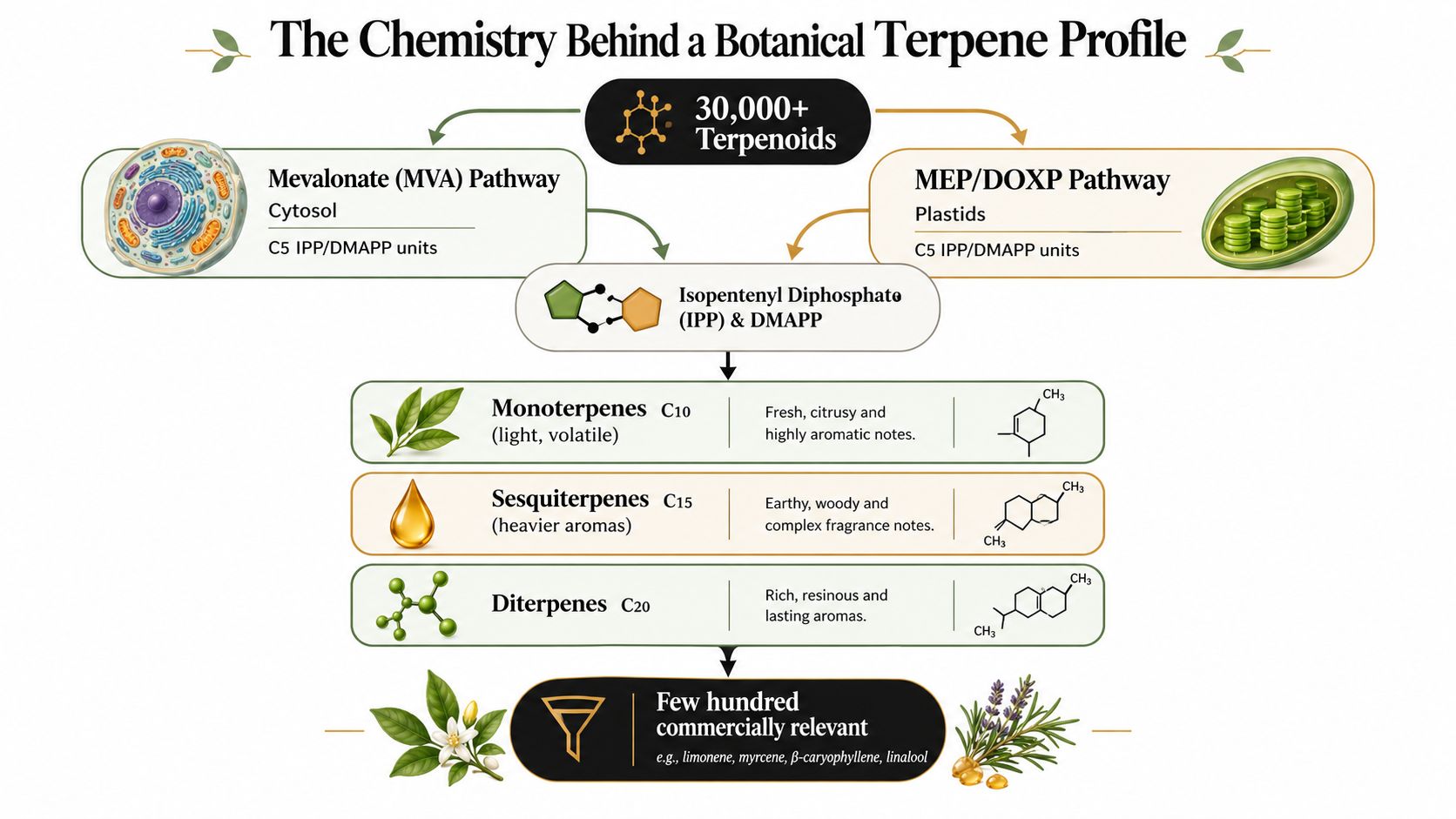
Plants produce more than 30,000 terpenoids, but only a much smaller commercial subset is normally relevant to a specific aroma or formulation (plant terpene chemistry review). The cytosolic mevalonate pathway, commonly called the MVA pathway, contributes primarily to sesquiterpenes and triterpenes. The plastidial MEP pathway supplies many monoterpenes and diterpenes.
At the precursor level, plants use isopentenyl diphosphate, or IPP, and dimethylallyl diphosphate, or DMAPP. Geranyl diphosphate, or GPP, is the principal C10 precursor for monoterpenes. Farnesyl diphosphate, or FPP, is the C15 precursor for sesquiterpenes. Terpene synthases then convert those intermediates into diverse volatile compounds (plant terpene biosynthesis research).
How molecular class changes the profile
Monoterpenes include limonene, myrcene, pinene, and linalool. Their lower molecular size and greater volatility generally make them important top-note drivers. They can provide the first impression in a cartridge, but they also require careful control during storage, blending, and heating.
Sesquiterpenes include beta-caryophyllene, humulene, and farnesene. They're heavier aroma molecules that can contribute persistence and base-note weight. Their presence can make a blend feel less sharply top-heavy, although the final result still depends on concentration, matrix, hardware, and thermal conditions.
A strain name is a target description. The product you're buying is a measured ratio of compounds.
A useful specification should list the principal analytes individually, show total terpene content, and identify whether testing used GC-FID, GC-MS, or another validated chromatographic method. Don't approve a profile because its name matches a reference product. Approve it because the composition, concentration range, and sensory result match the intended target.
For a practical explanation of molecular classes and formulation behavior, consult the Gold Coast Terpenes chemistry guide.
Common Botanical Sources and Strain-Inspired Blends
A strain-inspired terpene blend should be reconstructed from compounds and sensory roles, not copied from a name. Start with a target profile, identify the dominant analytes, then build the top, middle, and base notes with compatible botanical isolates and fractions.
Common source mapping helps, but it isn't a substitute for testing:
- Citrus peels can contribute limonene and bright citrus character.
- Pine and rosemary can contribute alpha-pinene and beta-pinene.
- Lavender and coriander seed can contribute linalool.
- Hops and bay can contribute myrcene.
- Geranium and citronella can contribute geraniol.
- Clove and hops can contribute humulene.
- Black pepper and clove can contribute caryophyllene.
These sources don't create identical finished profiles. Extraction conditions, plant material, fractionation, oxidation, and blending accuracy all affect the result. Botanical materials can offer broad citrus, pine, herbal, and floral options, while a cannabis-derived fraction may carry a different balance of heavier compounds and minor volatiles.
A practical reconstruction method
- Define the target chemotype. Use a published analytical reference, an internal house sample, or a retained finished-product lot.
- Separate the dominant notes. Identify which compounds create the bright opening, which fill the middle, and which provide persistence.
- Select isolates for precision. Use isolated limonene, myrcene, pinene, linalool, or caryophyllene when the target requires tight quantitative control.
- Use fractions for texture. A botanical fraction can soften a narrow isolate blend and add related aroma compounds.
- Blend by mass, then test. Sensory matching is useful for development, but it shouldn't replace chromatographic verification.
A strain-inspired terpene blend should have a written composition and an acceptance range. If the name is the only specification, the profile can drift while still carrying the same label.
Gold Coast Terpenes' educational material on terpenes in essential oils is useful background for connecting botanical sources with aroma chemistry. Keep the commercial decision narrower: choose the compounds and fractions that reproduce the target in the actual distillate or concentrate matrix.
Formulating With Botanical Terpenes for Cartridges and Distillate
For vape cartridges and distillate, use the lowest terpene loading that delivers the target aroma, then validate the heated aerosol. A liquid COA cannot predict the inhaled profile on its own. Coil temperature, hardware, headspace, and aerosol sampling can all change what reaches the user.
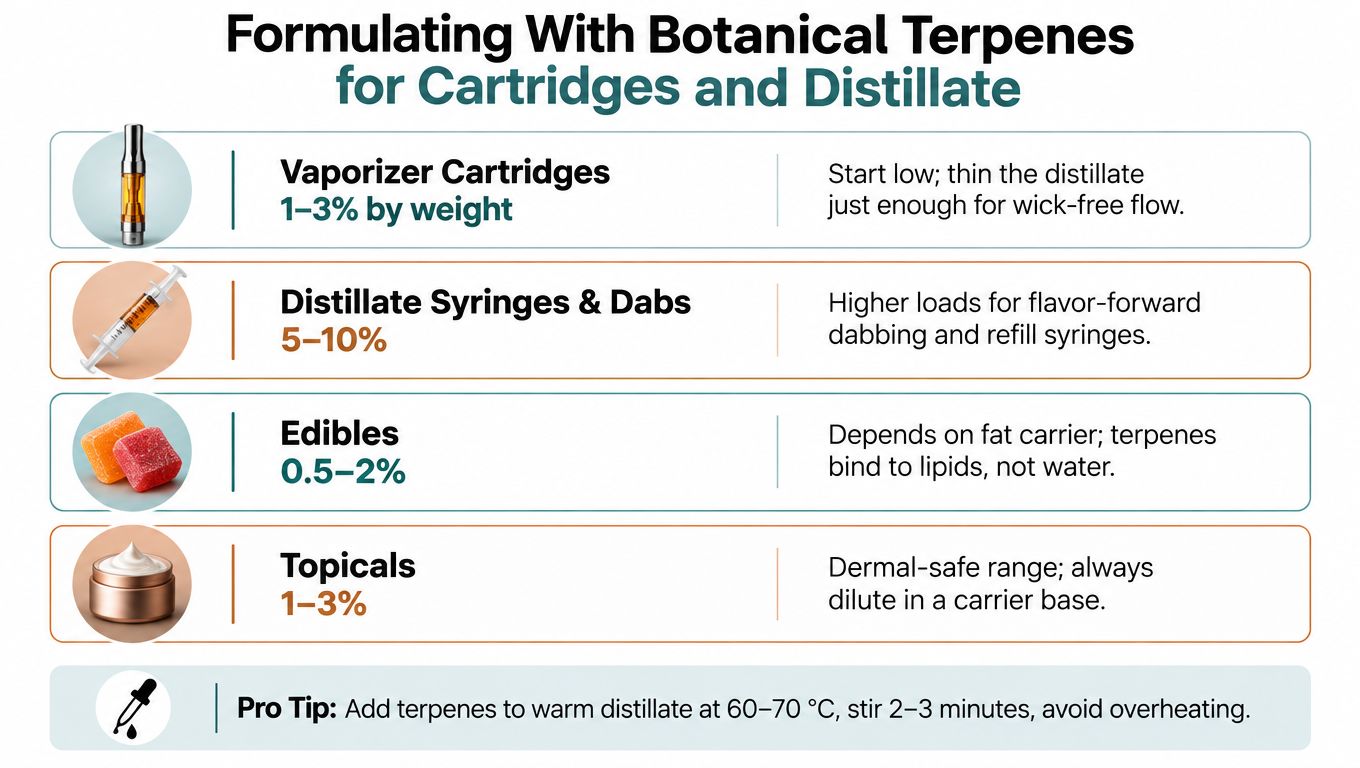
As the introduction's emissions data shows, concentration is both a sensory and emissions-control variable. Do not copy a flavor recipe into a new device without testing the finished formulation. The California emissions study provides the earlier context for that decision.
Build the profile in three note levels
- Top notes: Limonene and pinene deliver immediate citrus and pine impressions. Their volatility means excessive loading can dominate the liquid and heated aroma.
- Middle notes: Linalool and terpinolene add floral, herbal, and more complex body between the opening and finish.
- Base notes: Caryophyllene and humulene contribute heavier peppery, woody, or hoppy persistence.
Specify the blend by analytical composition and total loading, not by strain name alone. The same strain-inspired label can conceal different dominant compounds, fractions, and thermal behavior.
Hardware changes the result. A peer-reviewed analysis examined 12 California cannabis cartridges heated to 200°C and identified more than 100 terpenes and natural extracts across the tested materials (heated cartridge analysis). In that study, total terpenes accounted for more than 60% of measured chromatographic peak area after heating. Individual compounds, including caryophyllene and 2-pinene, exceeded 20% of peak area.
Test three points: the liquid, the headspace, and the aerosol. Record the device, coil, power conditions, fill age, and sampling method. If aroma shifts after filling, investigate hardware interaction and volatility before changing the strain target.
For the blending workflow, use the Gold Coast Terpenes distillate mixing guide. Pre-blend carefully, avoid unnecessary heat, limit oxygen exposure, and verify the final batch analytically before scaling.
Safety, Testing, and Legal Considerations for Inhaled Products
“100% botanical” does not mean “automatically safe to inhale.” Terpenes can oxidize before use and generate additional compounds during heating, so an inhaled-product review must cover the ingredient, the finished liquid, and the device-generated aerosol.
A peer-reviewed review reports that cannabis oils may contain approximately 10% to 20% terpenes by weight, producing estimated aerosols of 2,500 to 5,000 ppm total terpenes. It also reports sensory irritation, airflow limitation, and inflammatory responses from some terpenes at substantially lower exposure levels in experimental studies (review of vaping chemistry and pulmonary toxicology).
More recent concentrate-vaping research found that myrcene, linalool, limonene, and commercial terpene mixtures can generate volatile organic compounds, including benzene, methacrolein, and isoprene, during vaping. Removing PG, PEG, VG, or MCT doesn't remove the need to evaluate terpene-derived thermal degradation products.
Documents a buyer should require
- GC-MS or GC-FID data: Request the chromatogram and analyte table, not only a product description.
- Lot-traceable COA: The document should identify the tested lot and match the material shipped.
- Botanical origin statement: Ask for source plant, country of origin, and the declared botanical percentage.
- Residual-solvent testing: Botanical extraction can involve solvents, so the panel must match the extraction process.
- Oxidation and stability information: Track aroma drift, color, viscosity, and composition over time.
- SDS documentation: Confirm handling, storage, and hazard information for the specific mixture.
New York's adult-use cannabis rules permit botanically derived terpenes in vaporized or inhaled adult-use products, prohibit synthetic terpenes in those products, and limit total terpenes to no more than 10%. The limit applies to the finished formulation, not only to its dominant compound (New York inhaled-product requirements).
Gold Coast Terpenes buyers should treat that rule as a compliance checkpoint, not a universal approval standard. State requirements differ, and the final brand remains responsible for confirming the applicable rules for its product, market, labeling, packaging, and manufacturing location.
Sourcing, Storage, and Your Next Steps With Gold Coast Terpenes
Buy botanical terpenes by documentation, store them like volatile raw materials, and approve them in the finished matrix. A profile that smells correct in a sample bottle can still fail after blending, shipping, storage, cartridge filling, or heating.
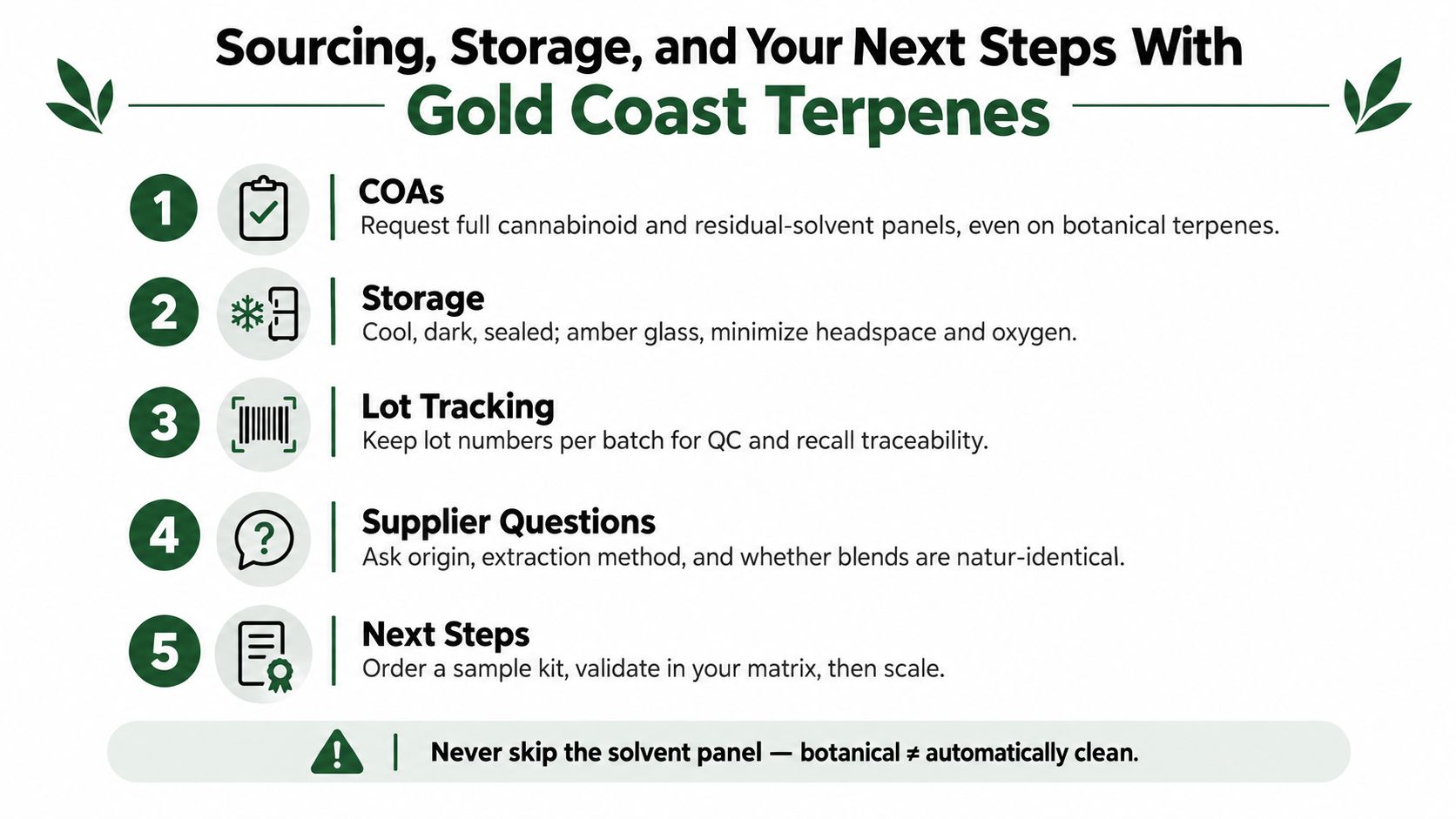
Use this purchasing checklist:
- Request complete testing: Ask for individual-compound data, total terpene content, residual solvents, and relevant contaminant panels. A botanical SKU shouldn't bypass documentation just because it contains no cannabis extract.
- Control oxygen and light: Use tightly sealed, compatible containers, minimize headspace, and avoid unnecessary heat. Monoterpene-rich profiles need particular attention because they evaporate more readily than heavier sesquiterpenes (plant terpene extraction and handling research).
- Track every lot: Record the supplier lot, blend date, matrix, operator, storage conditions, and finished-product test results.
- Test fresh and aged material: Compare retained samples over time for aroma, color, viscosity, and analytical composition.
- Ask four direct supplier questions: What's the origin country? What extraction method was used? How long are lots retained? When are re-tests performed?
Gold Coast Terpenes can be evaluated as one botanical supplier option for brands developing terpene profiles for vape cartridges, concentrates, and distillate. The decision should rest on the actual COA, source documentation, sample performance, and the supplier's ability to support the required lot and formulation records.
Frequently asked questions
What bottle sizes does Gold Coast Terpenes offer?
Gold Coast Terpenes provides botanical terpene blends and isolated compounds for product developers, but the appropriate bottle size depends on the development stage and purchasing program. Confirm current sizes and wholesale options directly with Gold Coast Terpenes before placing a production order.
What mixing ratio should I use for distillate?
There's no single ratio that works across every distillate, cartridge, and device. Start with a controlled low-load screen, evaluate viscosity and aroma, then confirm the finished composition and heated emissions before approving a production percentage.
How do I convert botanical terpenes for edibles?
Edible formulation requires a compatible fat-based carrier and product-specific sensory testing. Botanical origin doesn't establish an edible dose or guarantee suitability, so review the supplier documentation and validate the complete finished recipe.
How long does a custom profile take?
Gold Coast Terpenes' custom profile timing depends on the target composition, sample review, testing requirements, and production scope. Ask the supplier for a current development schedule rather than relying on a generic estimate.
Gold Coast Terpenes supplies 100% botanically derived terpene blends, isolated compounds, and strain-inspired profiles for cartridge, concentrate, and distillate development. Review the analytical documentation, request a sample for matrix testing, and visit Gold Coast Terpenes to evaluate options for your next formulation.