
Gold Coast Terpenes supplies botanical-derived terpene blends, which makes the Lemon Cherry Pie strain indica or sativa question less useful for a product team than the actual terpene panel. For vape cartridges and distillate, the practical target is a repeatable lemon, cherry, and pastry profile supported by batch data, not a broad cultivar label.
Lemon Cherry Pie is commonly described as a balanced or near-balanced hybrid, but market references disagree on its exact identity and potency. One profile lists a 50% indica and 50% sativa balance, while other lineage records describe indica-dominant versions. The result is a formulation problem: treat the name as a flavor direction, then verify the chemistry of the material or reference product you're trying to replicate.
Why the Indica or Sativa Question Does Not Answer Lemon Cherry Pie
Lemon Cherry Pie is a flavor direction, not a reliable formulation specification. The indica or sativa label can describe a breeding position, while the cartridge buyer experiences the terpene balance. For a repeatable product, identify the sensory target, then define it through quantified terpene data and the exact genetic reference.
Gold Coast Terpenes approaches botanical-derived blend work from that practical angle. A formulator can brief lemon, cherry, pastry, spice, or floral notes from the cultivar name, then set a target using limonene, beta-caryophyllene, linalool, and myrcene. The same name can produce different proportions because phenotype selection and cultivation conditions affect the final aromatic expression.
For a concise explanation of why the category label fails in terpene work, see our breakdown of indica versus sativa terpenes and why the label fails for formulation.
Chemotype and chemovar answer different questions. Chemotype describes the dominant cannabinoid pattern, such as a THC-forward profile. Chemovar covers the wider phytochemical fingerprint, including cannabinoids and terpenes. A flower lot can carry an indica-leaning market description while its lemon-forward aroma presents as bright, citrus-led, and stimulating on the palate.
The name also covers more than one genetic reference. Different breeders and producers may attach Lemon Cherry Pie to different parental combinations, cuts, and cultivation outcomes. That variation matters when a team converts a flower reference into a distillate or cartridge brief. Record the breeder, lot, lab panel, and intended aroma before selecting a blend ratio.
| Attribute | Indica/Sativa Label | Terpene Reality |
|---|---|---|
| Primary use | Broad cultivar categorization | Sensory and formulation direction |
| What it predicts | General breeding position | Citrus, cherry, pastry, spice, and floral balance |
| Main limitation | Labels vary by breeder and cut | Batch results still require laboratory review |
| Cartridge relevance | Weak on its own | Stronger for flavor matching and repeatability |
Reported potency also varies across market references. A high-potency listing gives a ceiling of 41% THC and an average band of 21–41%, while other retail-facing references list 20–31% THC and one medical menu reports 27.48% total THC. The comparison of these market references supports the formulation rule: the cultivar name does not establish a fixed chemical result.
For product developers, the working question is, “Which Lemon Cherry Pie expression are we matching, and what terpene ratio defines it?” That answer gives the team a specification it can test, adjust, and reproduce across batches.
Lineage and Chemotype Behind Lemon Cherry Pie
Lemon Cherry Pie is a family of breeding projects, not one fixed genetic standard. Reported versions include Candy Store x Cherry Pie, Lemon Cherry Gelato x Georgia Pie, and Velvet Pie x LCG. Before setting a flavor target, record the breeder or producer, cut, product lot, and certificate of analysis.
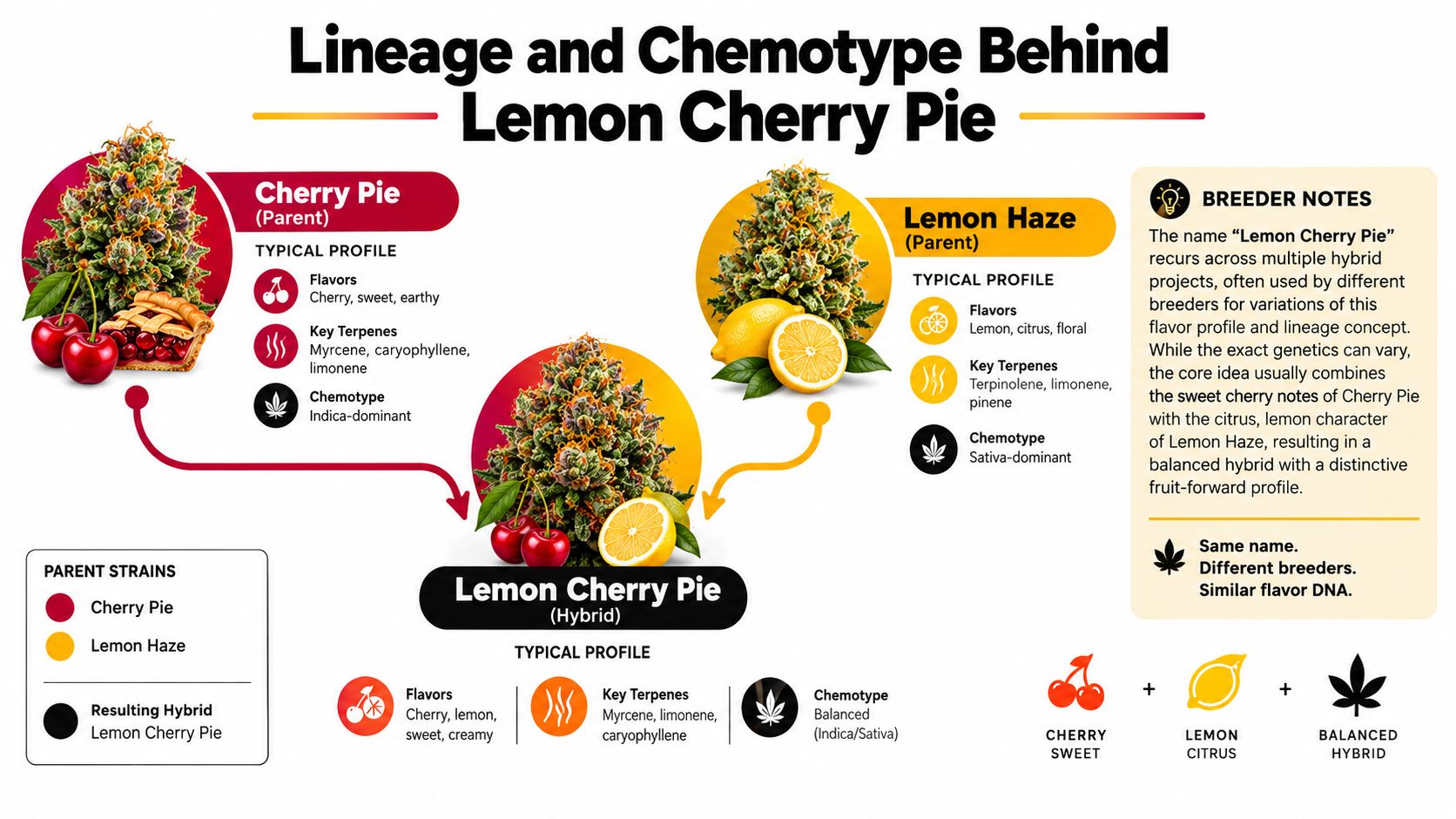
Lineage sets the initial hypothesis. GC-MS results decide whether that hypothesis belongs in a cartridge or distillate specification.
Start with the exact genetic reference
Capture the breeder or producer, lot number, harvest information, and available lab panel. One recorded family describes Lemon Cherry Pie as an indica-dominant hybrid descended from Candy Store and Cherry Pie. Another listing identifies an Ethos Genetics R1 with a 60/40 indica-sativa structure. The lineage data also associates a separate Lit Farms line with Velvet Pie and LCG.
Those differences affect flavor forecasting. Cherry Pie genetics can support baked, sweet, spicy, or fruit-led notes, while lemon-forward parents can point the brief toward brighter citrus. Treat both as working hypotheses, not as evidence of a repeatable chemotype.
Use lineage to set the first sensory brief
Set a defined sensory direction: lemon zest at the opening, tart cherry through the middle, and sugary pastry with peppery depth on the finish. The formulation team can then compare that brief with measured limonene, beta-caryophyllene, linalool, and myrcene levels in the reference batch.
A related Cherry Pie terpene reference can help establish the baked-fruit and spice direction before the lemon component is introduced. It supports the brief, but it does not prove that every Lemon Cherry Pie batch shares the same profile.
Genetic variation also affects resin character and extraction behavior. Different projects may produce different aromatic intensity and oil performance, so a distillate manufacturer should not promise one universal Lemon Cherry Pie result from the name alone. Define the blend against reference material, quantified terpene data, and the intended hardware.
Reading the Terpene Profile of Lemon Cherry Pie
The most useful verified panel available for this profile reports 1.87% total terpenes, with 0.66% limonene, 0.65% beta-caryophyllene, and 0.56% linalool. The product-level terpene panel gives formulators a clearer starting point than a generic indica or sativa classification.
The sensory architecture is dessert-forward but not one-dimensional. Limonene supplies the citrus opening, beta-caryophyllene adds pepper and dryness, and linalool contributes floral sweetness that can soften the finish. Other profiles also identify myrcene as a supporting driver, but the available data show that the ratio can shift across cuts and producers.
| Note Tier | Terpene | Typical % by Weight | Sensory Role |
|---|---|---|---|
| Top | Limonene | 0.66% in one listed panel | Lemon peel and bright citrus |
| Mid | Beta-caryophyllene | 0.65% in one listed panel | Pepper, spice, and dry structure |
| Mid | Linalool | 0.56% in one listed panel | Floral sweetness and soft finish |
| Base support | Myrcene | Reported as a supporting driver in independent profiles | Earth, fruit, and roundness |
These values shouldn't be copied directly into a cartridge formula. They describe a flower or product panel, while a formulated oil needs a controlled dilution that survives processing, storage, and hardware exposure. The correct use is as a relative aroma map.
Top, middle, and base notes
Limonene is the top-note driver. It creates the immediate lemon impression, but too much can make a blend smell sharp or thin. Beta-caryophyllene gives the profile a mid-note bridge between citrus and pastry, while linalool rounds the transition with floral sweetness.
Myrcene can add weight and fruitiness, but it needs restraint when the target is lemon-cherry pastry rather than a heavy earthy profile. A second independent profile places total terpenes in the 1.5–3.0% range and identifies limonene, beta-caryophyllene, linalool, and myrcene as the main contributors. That formulation-oriented guide supports using the panel as a structured target rather than relying on a single universal recipe.
For a lab workflow, document the reference panel, identify the dominant compounds, and separate the bright opening from the persistent finish. The terpene testing resource is useful for teams building a repeatable analytical process.
Practical rule: Match the relative balance first. Fine-tune the absolute concentration only after the blend behaves correctly in the intended cartridge and distillate base.
Building a Cartridge and Distillate Formula
A Lemon Cherry Pie cartridge formula should begin with a controlled pilot, not a fixed recipe copied from flower percentages. The target is a stable lemon-cherry-pastry impression in the selected distillate and hardware combination.
Start by deciding whether the product will use THC distillate, CBD distillate, or another compliant carrier. The carrier can mute bright notes, change viscosity, and alter how quickly the aroma appears during a pull. Run a small pilot at a conservative terpene load, then increase gradually only if the reference profile remains thin or incomplete.
Build the blend by sensory function
Use limonene as the opening note, beta-caryophyllene as the peppery structural note, and linalool as the floral-sweet bridge. Myrcene belongs in the base architecture when the reference has a softer, fruitier finish. Alpha-humulene can support dry, woody depth, but the available verified panel does not establish a universal target amount for it.
The requested formula should therefore be treated as a development hypothesis, not a factual standard. A product team can use a pre-blended profile or build from isolates, then adjust the ratios against a retained reference cartridge.
| Component | Percentage | Function | Sensory Role |
|---|---|---|---|
| Limonene | Set from the reference panel | Citrus top note | Lemon zest and peel |
| Beta-caryophyllene | Set from the reference panel | Mid-note structure | Pepper and dry spice |
| Linalool | Set from the reference panel | Aromatic rounding | Floral sweetness |
| Myrcene | Set from the reference panel | Base support | Earthy fruit and body |
| Distillate | Balance of formula | Carrier | Delivers the finished blend |
Hardware matters as much as the ratio. Ceramic systems can preserve a more detailed profile than hardware that runs excessively hot, but every cartridge should be assessed under its intended voltage, resistance, airflow, and draw conditions. Don't approve the flavor from a glass vial alone.
Use the distillate mixing guide to document blend order, mixing conditions, and compatibility checks. The formula should include a written sensory specification, such as lemon peel on the first impression, cherry pastry in the middle, and a soft pepper-floral finish.
That language gives sales and retail teams a defensible product description without making medical or efficacy claims. It also tells the manufacturing team what to investigate when a batch tastes flat, harsh, overly floral, or too earthy.
Botanical vs Cannabis-Derived Terpenes for This Profile
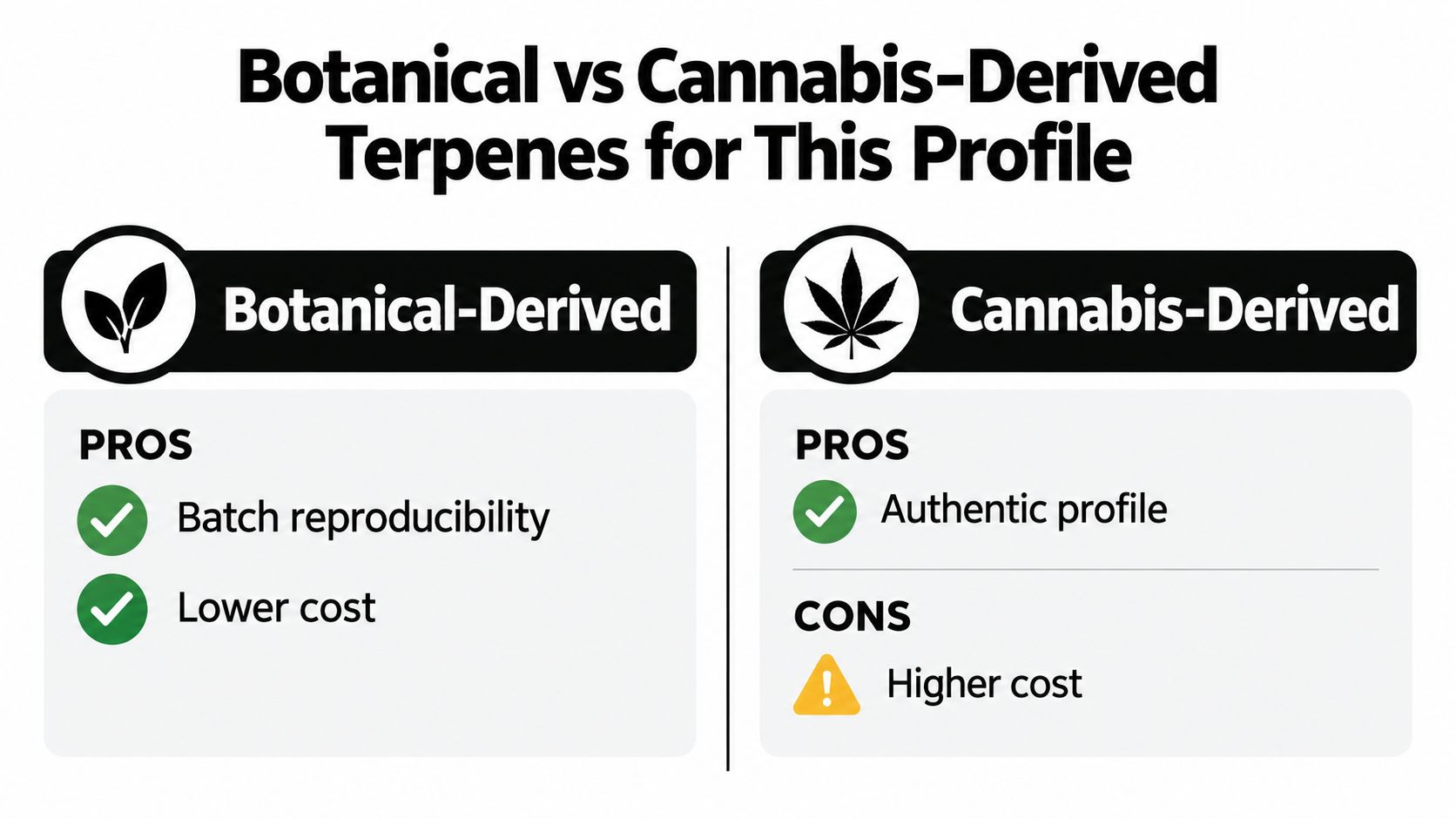
Botanical-derived terpenes generally offer better batch-to-batch control for a strain-inspired profile, while cannabis-derived terpenes can provide a closer connection to a particular cannabis extract but may vary with harvest and source material. Neither option automatically reproduces Lemon Cherry Pie. The decision depends on the reference, compliance strategy, cost model, and required repeatability.
Gold Coast Terpenes supplies botanical-derived options, including isolated compounds such as limonene, linalool, and beta-caryophyllene. That approach lets a formulator adjust a lemon-cherry profile without depending on a variable cannabis harvest or a single extract lot.
The sourcing trade-off
Botanical isolates are useful when the brand needs a repeatable aroma, straightforward inventory planning, and precise adjustment of a single note. They also make self-reformulation easier when a product team wants more citrus or less floral character.
Cannabis-derived material may preserve additional minor constituents from the source extract, but it can introduce more variation. The aroma can shift with cultivar, harvest, extraction method, storage, and producer. That may be desirable for a limited release, but it creates more work for a national or multi-batch SKU.
Labeling requires separate review for the destination market. Botanical and cannabis-derived ingredients can trigger different documentation and disclosure requirements, including allergen statements and rules governing cannabis-derived materials. A flavor claim also shouldn't become a strain-specific efficacy claim. The label can describe sensory character, but it shouldn't imply a guaranteed physiological outcome.
The decision rule is simple: choose botanical-derived terpenes when consistency and independent ratio control matter most, and choose cannabis-derived material when the exact source extract and its broader chemical signature are central to the product identity. In both cases, require a current certificate of analysis and document the lot used in the finished batch.
A Flavor-Matching Workflow With Gold Coast Terpenes
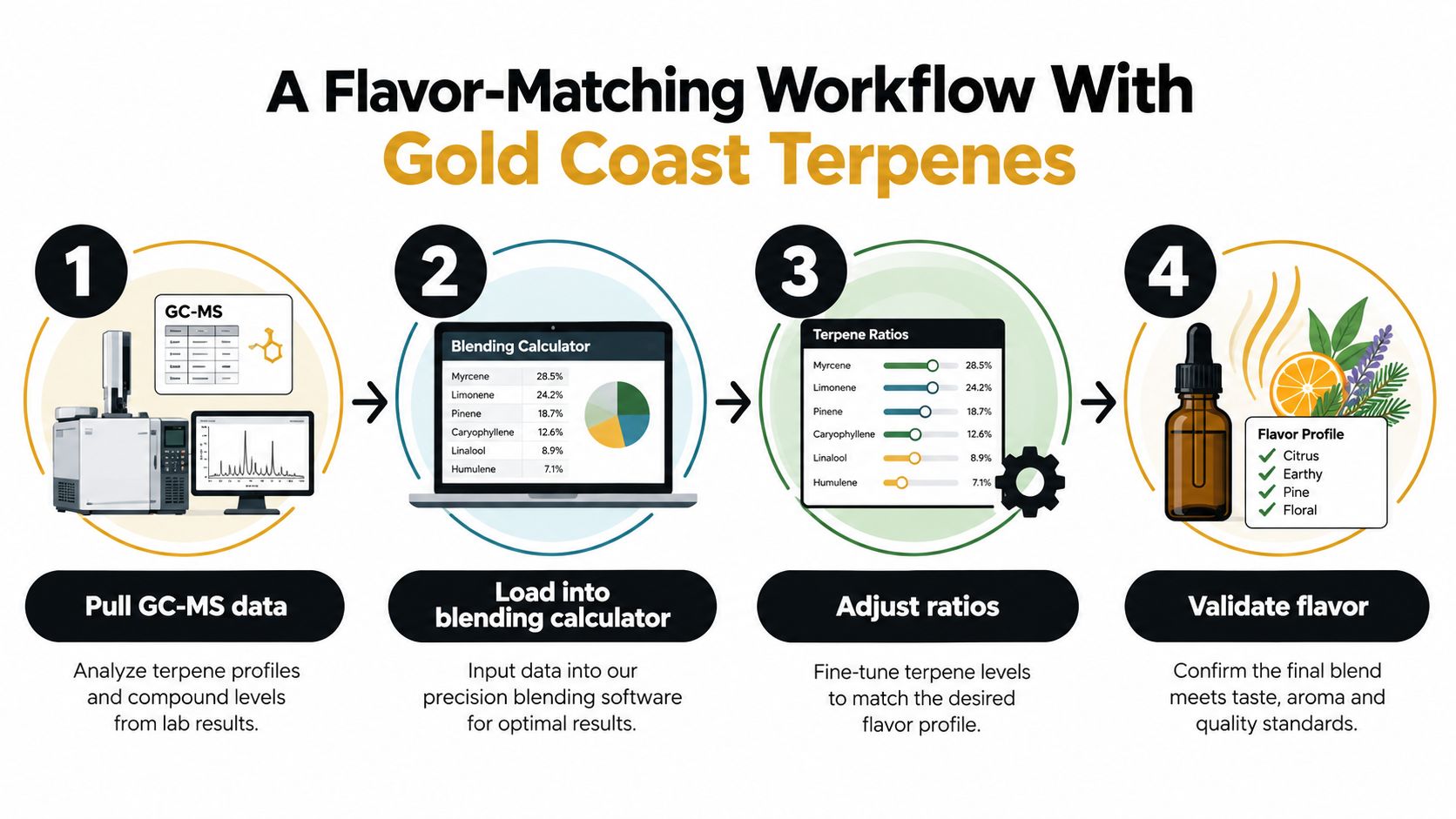
A repeatable flavor match begins with the reference product's laboratory data and ends with a hardware test. Gold Coast Terpenes can support that workflow through botanical profiles, isolated compounds, and a blending calculator, but the manufacturer still has to validate the result in the final oil system.
1. Pull the target data
Start with the reference batch's GC-MS report. Record total terpenes and the relative position of limonene, beta-caryophyllene, linalool, myrcene, and any secondary compounds that materially affect the aroma.
If the reference report isn't available, use sensory evaluation to create a provisional target and label it accordingly. Don't present an inferred ratio as a measured fact.
2. Load the profile into the calculator
Enter the desired compounds into the Gold Coast Terpenes blending calculator or the company's internal formulation tool. Select single-compound isolates where the profile needs precise adjustment, rather than adding a broad blend that could introduce unwanted floral, pine, or gas notes.
Gold Coast Terpenes is one option for sourcing the finished strain-inspired profile and the individual compounds used to rebuild it. The purchasing team should confirm the product specification, lot identity, safety documentation, and intended application before ordering.
3. Build a controlled pilot
Prepare a small pilot and keep the ratio sheet with the sample. Evaluate the blend in the distillate, not only as a neat terpene mixture. The distillate can change the perceived intensity of citrus, cherry, pastry, and spice.
Use a retained control cartridge whenever possible. Compare first impression, mid-palate development, finish, vapor harshness, and aroma after storage. If the result is too sharp, reduce the citrus emphasis. If it is too flat, inspect the balance between limonene and the softer supporting notes rather than just increasing total terpene load.
4. Validate in hardware
Test the finished oil in the intended cartridge and operating range. A vial match isn't enough because ceramic, wick, airflow, voltage, and coil temperature all influence delivery.
Before shipment, the record should include:
- COA: Match the ingredient certificate to the material received.
- Batch identity: Record supplier lot numbers and internal batch numbers.
- Ratio sheet: Preserve the exact blend composition and revision.
- Reference result: Store the sensory grade against the control cartridge.
- Label review: Confirm ingredient and allergen language for the market.
This process separates a credible strain-inspired blend from a name-only flavor.
Verifying Every Batch Before You Scale
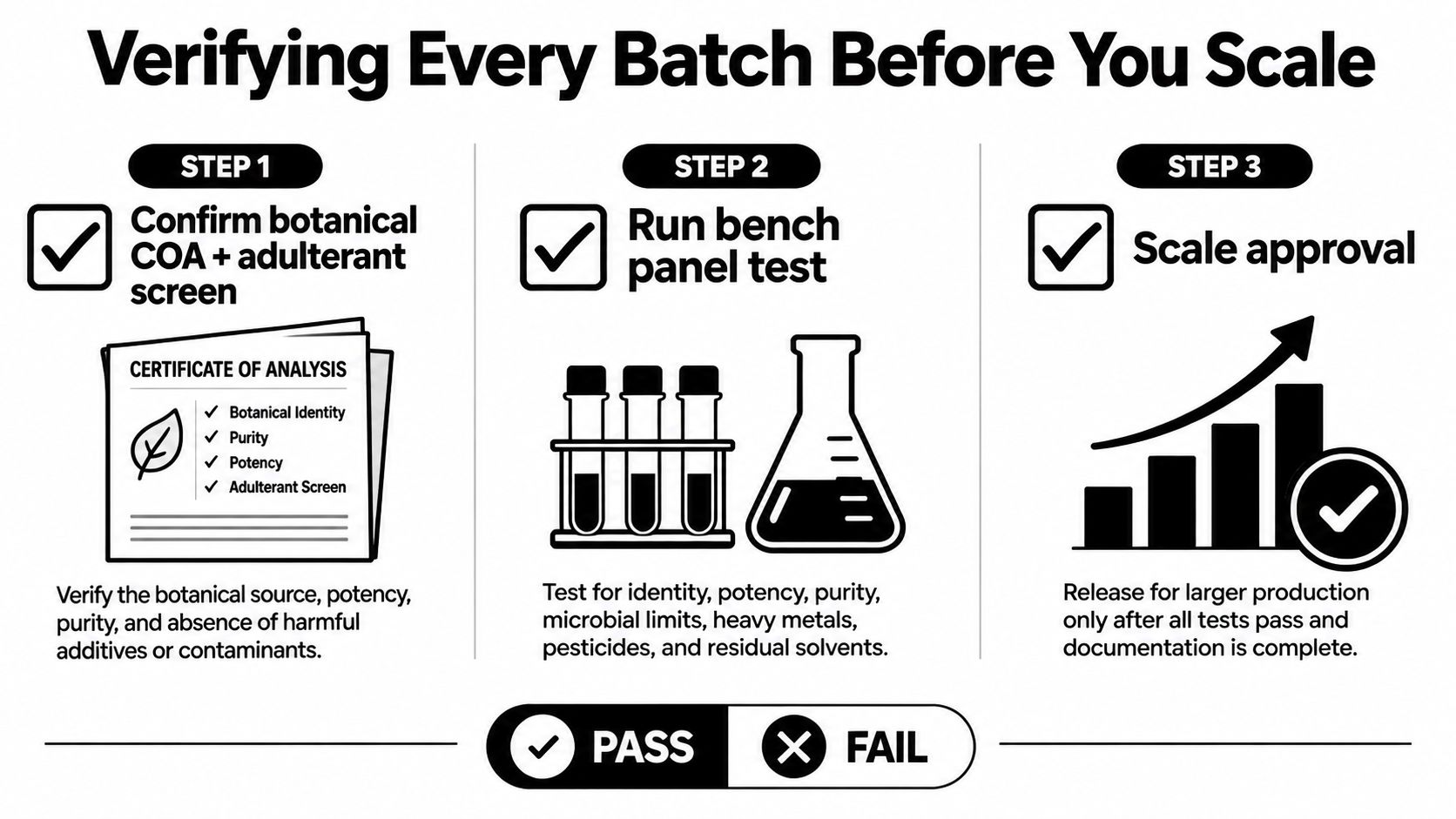
Verification should happen before a Lemon Cherry Pie formula becomes a production standard. A product team needs ingredient identity, physical stability, sensory consistency, and documentation that can survive an internal or regulatory review.
Confirm the incoming material
Review the botanical-derived COA and check that the named compounds are present at the stated purity. An adulterant screen should be part of the intake process, especially when the blend will be used in inhalation products.
For cannabis-derived components, require appropriate third-party analytical data and retain the source documentation with the batch file. Don't assume that a strain name or supplier description proves the composition.
Run the bench panel
Evaluate the blend at the intended working dilution in the actual distillate. Check for haze, separation, viscosity changes, and flavor drift during the planned hold period. Record the lemon-cherry-pastry impression in specific terms, including whether the citrus remains bright and whether the finish becomes excessively dry or floral.
A control sample gives the panel something concrete to compare. Without a control, evaluators tend to grade against memory, which makes small but important changes difficult to track.
Approve the pilot, then lock the record
A larger cartridge pilot should be judged against a written specification before the formula is approved. The record should include the blend ratio, batch ID, ingredient lots, test observations, and final disposition.
Gold Coast Terpenes can be included in that traceability system through its lot documentation and formulation resources. The supplier name alone isn't enough. The finished manufacturer must connect the supplier lot to the exact formula used.
Reproducibility compounds. Verification is what turns a recognizable Lemon Cherry Pie flavor into a scalable, label-defensible product.
Frequently Asked Questions for Formulators
Is Lemon Cherry Pie indica or sativa for product formulation?
It's generally treated as a balanced or indica-leaning hybrid, but the name covers multiple modern breeding projects. For formulation, use the cultivar name as a sensory reference and verify the exact lineage and terpene panel before setting a production target.
What is a practical MOQ for a Lemon Cherry Pie profile blend?
MOQ depends on whether you're ordering a finished blend, single-compound isolates, or a custom development batch. Gold Coast Terpenes can be contacted directly about sample-scale purchasing, production quantities, and bulk program requirements rather than assuming that a retail pack size fits a manufacturing run.
How should botanical-derived terpenes appear on the label?
Use ingredient language that accurately identifies the materials and follows the requirements of the destination market. Review allergen statements and avoid strain-specific efficacy claims. A product can describe lemon, cherry, pastry, citrus, or spice character without promising a particular effect.
What compliance documents should a buyer request?
Request a current COA, SDS, product specification, lot information, and any relevant allergen or regulatory statements. Gold Coast Terpenes provides safety and product documentation resources, but the finished brand remains responsible for reviewing the documents against its formula and market.
Can a formulator buy individual compounds instead of a finished strain-inspired blend?
Yes, isolated compounds can support self-reformulation when the team needs to adjust a specific note. Limonene can sharpen the citrus opening, beta-caryophyllene can reinforce peppery structure, linalool can soften the finish, and myrcene can add roundness, but every change should be tested in the final distillate and hardware.
Should a vape brand use botanical-derived or cannabis-derived terpenes?
Choose botanical-derived materials when you need controlled ratios and repeatability across production runs. Choose cannabis-derived materials when the exact source extract is central to the product identity and the additional variability, documentation, and cost are acceptable.
Gold Coast Terpenes offers strain-inspired botanical blends, isolated compounds, and formulation resources for teams developing Lemon Cherry Pie cartridges and distillate products. Use the available Gold Coast Terpenes tools and product documentation to build a measured flavor target, test it in your hardware, and scale only after the batch record and sensory specification agree.