
A brief lands on your bench: develop a tropical-citrus cartridge that feels bright on the first pull, carries enough resinous structure to survive a ceramic coil, and never turns into candy or soda. The obvious move is to reach for a limonene-heavy mango or papaya panel. That often produces sweetness without definition, especially after the oil is heated and the top notes thin out.
A better starting point is a Baja Smash strain-inspired terpene blend built around citrus, pine, and a controlled tropical middle. Public product descriptions mention lime, pineapple, mango, and tropical soda, while lab-derived listings repeatedly point toward limonene, pinene, myrcene, and caryophyllene. The useful formulation question isn't whether a blend smells “tropical.” It's which compounds create that impression, how those compounds shift across batches, and how the finished profile behaves in distillate and hardware.
Why Baja Smash Matters to a Formulator
A Baja Smash brief can send a blender toward ripe fruit, extra limonene, and a sweet tropical accent. That combination may look convincing in a low-temperature aroma test, yet lose its strain-inspired identity in a cartridge. Heat can flatten generic citrus, push the blend toward fruit candy, and expose a weak finish without pine or resin tension.
The reported profile also deserves careful interpretation. An independent strain listing describes Baja Smash as a modern boutique hybrid, with THC reported between 22% and 27% and flowering typically lasting 8 to 9 weeks, or 56 to 63 days. It attributes the line to craft-breeding activity tied to Green Team Genetics and describes Baja Blast lineage crossed with resin-heavy smash stock. For formulation, those details establish a recent, terpene-forward hybrid with variable expression, not a legacy cultivar with one fixed aroma. The strain terpene profiles guide offers a practical framework for converting cultivar descriptions into a bench target.
Bench-side rule: Treat the strain name as a sensory brief, not as a formula.
Build the profile as a three-part arc. Give the first draw a defined citrus and pine flash. Shape the middle with tropical flesh and a lightly hazy floral quality, keeping the sweetness dependent on the surrounding citrus and resin rather than syrupy isolates. Leave light pepper, resin, and wood in the finish so the flavor remains recognizable after volatile top notes leave the coil.
Flower data and finished vape data answer different questions. The listing reports flower potency in the upper contemporary craft range, while retail and laboratory product pages show Baja Smash products reaching 81.61% THC in flower and 88.241%, 88.62%, 88.8%, and 89.28% THC in vape and disposable formats (retail product data). Those matrices should not become interchangeable formulation targets. Rebuild the aroma architecture, then test it in the actual oil, coil, and package combination, because perceived sweetness and pinene lift can shift substantially outside the initial bench vial.
Lineage and Aroma Notes That Drive the Profile
Lineage is useful when it helps a blender decide what to preserve. Baja Smash is described as a Baja Blast lineage crossed with a resin-heavy smash stock, a combination that supports a brighter citrus opening alongside a denser, more grounded body (independent strain listing). The lineage shouldn't be treated as proof that every batch will produce the same aroma. Cultivation, extraction, storage, and reintroduction can all change the final expression.
Start by converting the reported notes into sensory jobs:
- Citrus and lifted pine: Build the opening around limonene and alpha-pinene. This gives the draw definition before the tropical notes arrive.
- Ripe tropical flesh: Use myrcene and a restrained fruit-supporting pool to create body. The goal is fruit texture, not confectionery sweetness.
- Floral haze: Terpinolene and a small amount of linalool can create the soft, almost floral middle described in strain coverage.
- Resinous finish: Beta-caryophyllene, beta-pinene, and humulene can hold the profile together after the citrus peak fades.
The aroma vocabulary becomes more useful when you map it to time. Pineapple and tangerine belong near the first sensory impact. Basil, pine needle, and soft floral notes should appear through the middle of the draw. Earth, musk, pepper, and light resin belong at the tail, where they prevent a bright blend from sounding artificial. A practical guide to cannabis tasting notes can help teams standardize those descriptors across a panel instead of relying on one person's idea of “tropical.”
A related catalog example is Elevated Strains, which shows how strain-inspired flavor work can be presented as a defined profile rather than a loose list of fruit adjectives. For Baja Smash, the same discipline means documenting the desired opening, mid-palate, and finish before selecting isolates.
The strongest reconstruction path starts with the compound stack, not with a premade tropical flavor. Premade fruit systems can supply useful references, but they often obscure which material is creating sweetness, sharpness, floral lift, or resin. That makes reformulation harder when a botanical lot changes or a hardware partner reports a stronger throat hit.
Expected Terpene Stack and Compound Roles
Published Baja Smash specifications vary by product and market, so a formulator should treat them as reference points, not a universal recipe. One lab-derived profile lists alpha-pinene at 26.8% to 44.7%, beta-myrcene at 22.7% to 38.0%, limonene at 9.3% to 15.4%, beta-pinene at 6.6% to 11.0%, and beta-ocimene at 4.0% to 6.8% (published terpene specification). Separate menu data also identifies alpha-pinene, beta-myrcene, and limonene as dominant materials. The spread is enough to justify a sensory reconstruction rather than name matching.
Use the following architecture as a flavor-first working template:
| Terpene | Typical Range (%) | Role in Vapor Profile |
|---|---|---|
| Limonene | 28% to 34% | Tangerine, citrus peel, and pineapple brightness |
| Alpha-pinene | 18% to 24% | Pine needle lift, clarity, and sharper opening |
| Myrcene | 10% to 14% | Soft tropical body and rounded mid-palate |
| Terpinolene | 8% to 12% | Hazy floral, green, and tropical complexity |
| Beta-caryophyllene | 5% to 8% | Pepper, resin, and warmth in the finish |
| Linalool | 3% to 5% | Floral smoothing and edge control |
| Ocimene | 2% to 4% | Fresh fruit lift and airy brightness |
| Humulene | 2% to 3% | Dry wood, hops, and structural depth |
| Minor contributors | Trace levels | Valencene, bisabolol, and geraniol support nuance |
The compound roles matter more than the labels. Limonene supplies the citrus entry, but excessive loading can make the blend glossy and generic. Alpha-pinene provides the sharp pine edge that separates citrus-pine from tropical candy. Myrcene adds body, while terpinolene bridges fruit, green notes, and floral lift. That bridge is often where perceived sweetness develops. It comes from the interaction of citrus and rounded mid-notes, not from a single “tropical” material.
Beta-caryophyllene and humulene function as structural materials rather than headline flavors. They add pepper-resin warmth and dry wood, helping a high-citrus blend finish cleanly. Linalool and ocimene are better used for smoothing and lift, since either can dominate quickly in a cartridge. A practical terpene properties guide can support material selection, but panel feedback should decide the final balance.
Commercial results reinforce the need for batch verification. Finished products have been reported at roughly 3.93% to 4.45% total terpenes and 85.6% to 88.8% THC (independent dispensary COA and menu data). Another listing reports 8.44% total terpenes, including alpha-pinene at 1.13% and beta-myrcene at 0.84% (commercial product listing). A blend that reads bright in one load may become sharp, thin, or throat-forward in another. Run the intended ratio through the actual distillate and hardware before treating the profile as finished.
Top, Mid, and Base Notes in the Profile
A top, mid, and base model gives the blender a better control surface than a single “tropical” descriptor. In a Baja Smash-inspired profile, the top tier carries the first-second signal, the mid tier creates identity, and the base tier determines whether the finish feels natural or manufactured.
The top tier creates recognition
Limonene and alpha-pinene should establish the opening. Limonene contributes citrus peel and bright fruit, while alpha-pinene adds pine needle, basil-like lift, and a clean edge. If the combined top tier rises above 40% of the total note structure, the profile can move toward a more overt pineapple-pine expression and lose the softer Baja Smash balance. That threshold is a formulation starting point, not a verified botanical specification.
The mid tier controls the tropical impression
Beta-caryophyllene, valencene, and linalool can carry the mid-palate when used with restraint. This sounds counterintuitive because caryophyllene isn't a sweet fruit note, but its pepper-resin warmth gives citrus and tropical materials something to sit on. Valencene can add orange-peel and ripe-fruit character, while linalool softens the transition without turning the blend floral.
The base tier uses myrcene, humulene, and guaiol to preserve residual mouthfeel. Myrcene rounds the fruit, humulene dries the finish, and guaiol can add a restrained woody character. Too little base makes the cartridge flash bright and then disappear. Too much creates a heavy, soft, or overly earthy ending.
| Note Tier | Compounds | Expression A, Bright | Expression B, Tropical | Expression C, Soft |
|---|---|---|---|---|
| Top | Limonene, alpha-pinene | 45% | 30% | 25% |
| Mid | Beta-caryophyllene, valencene, linalool | 35% | 40% | 40% |
| Base | Myrcene, humulene, guaiol | 20% | 30% | 35% |
A 45/35/20 split reads sharp and piney. A 30/40/30 split reads riper and more tropical. A 25/40/35 split leans softer and heavier. These are starting points, not targets, and hardware temperature can shift the perceived balance. Higher heat tends to make the volatile opening more obvious while shortening the time available for the mid and base notes to register.
A tropical profile becomes credible when the citrus is allowed to rest on structure. Sweetness alone won't create depth.
Isolate Pairings for Product Makers
A practical isolate shelf for Baja Smash work should cover identity, correction, and finish. Limonene and beta-caryophyllene are the two essential anchors. Limonene establishes the citrus opening, while beta-caryophyllene prevents the blend from ending as a thin fruit note.
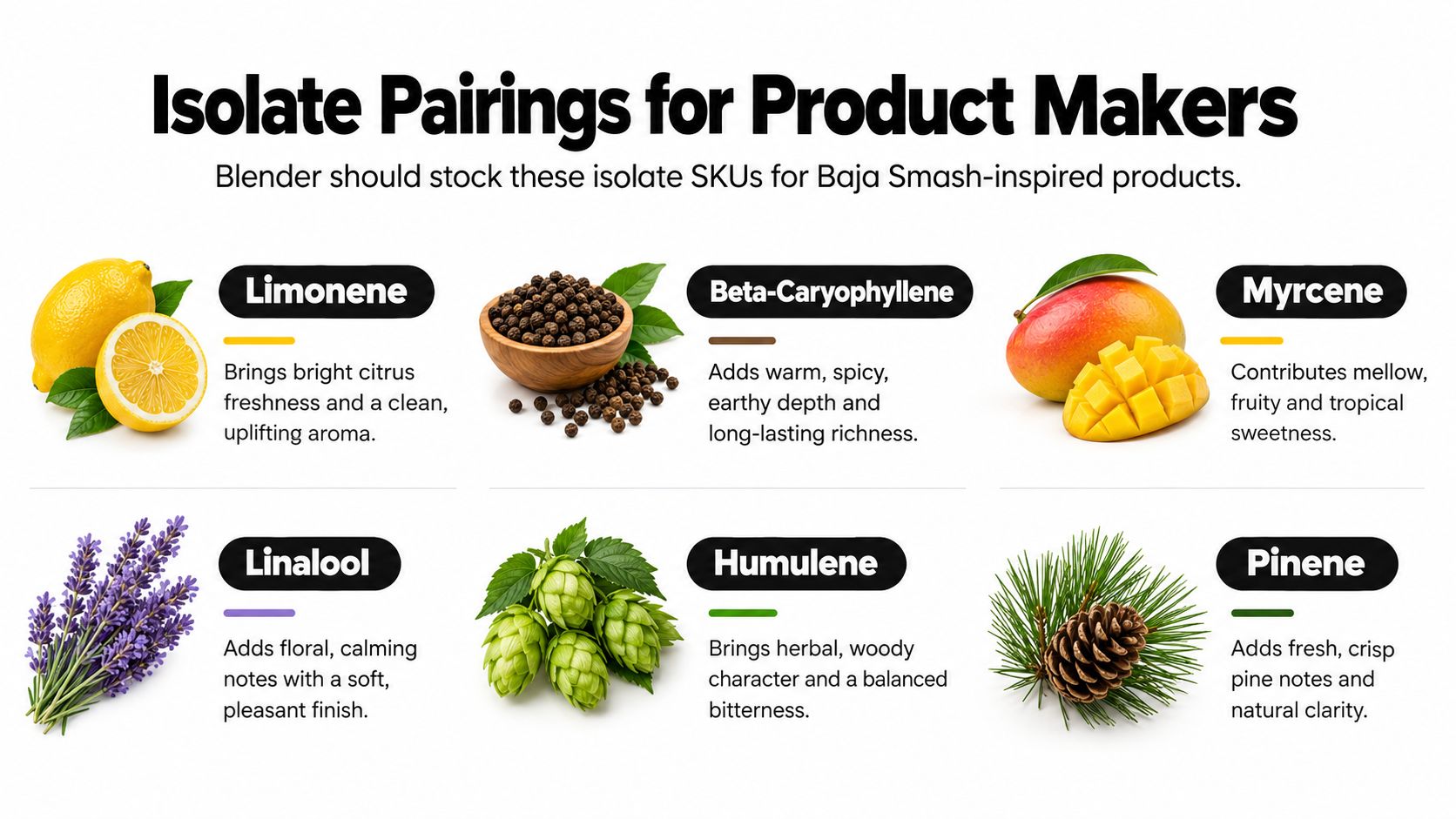
Use valencene at 2% to 4% of the total terpene load when the orange-peel and ripe-mango character needs more presence (strain coverage and terpene profile). It adds fruit depth without forcing the blend into a syrupy direction. Alpha-pinene belongs in a narrower lane, around 1% to 2% of the total terpene load when the goal is a clear pine lift. Above that range, it can dominate the citrus and make the draw feel angular.
Terpinolene is the useful complexity lever. Add it when the blend smells like citrus fruit but lacks the green, floral, and tropical haze associated with the profile. Linalool is better used below 1% when a high-distillate load needs edge control. It should round the blend, not announce itself as lavender.
| Isolate | Use it to correct | Sensory effect |
|---|---|---|
| Limonene | Flat opening | Tangerine peel and bright citrus |
| Beta-caryophyllene | Weak finish | Pepper, resin, and warmth |
| Myrcene | Thin middle | Mango-like softness and body |
| Linalool | Excessive sharpness | Floral smoothing |
| Humulene | Overly sweet finish | Dry wood and hop-like depth |
| Alpha-pinene | Missing lift | Pine needle clarity |
Ocimene helps when the fruit needs air and lift. Beta-pinene can add resinous depth when alpha-pinene has already supplied enough brightness. Guaiol works as a dry woody correction when the profile needs a quieter, more grounded tail.
For compliant vape work, use food-grade isolates from documented botanical sources and verify every lot with a current COA. Don't assume that a familiar isolate name guarantees suitable purity, identity, or inhalation documentation. The terpene isolate usage guide is a useful reference for handling and blending decisions.
Cartridge and Distillate Formulation Considerations
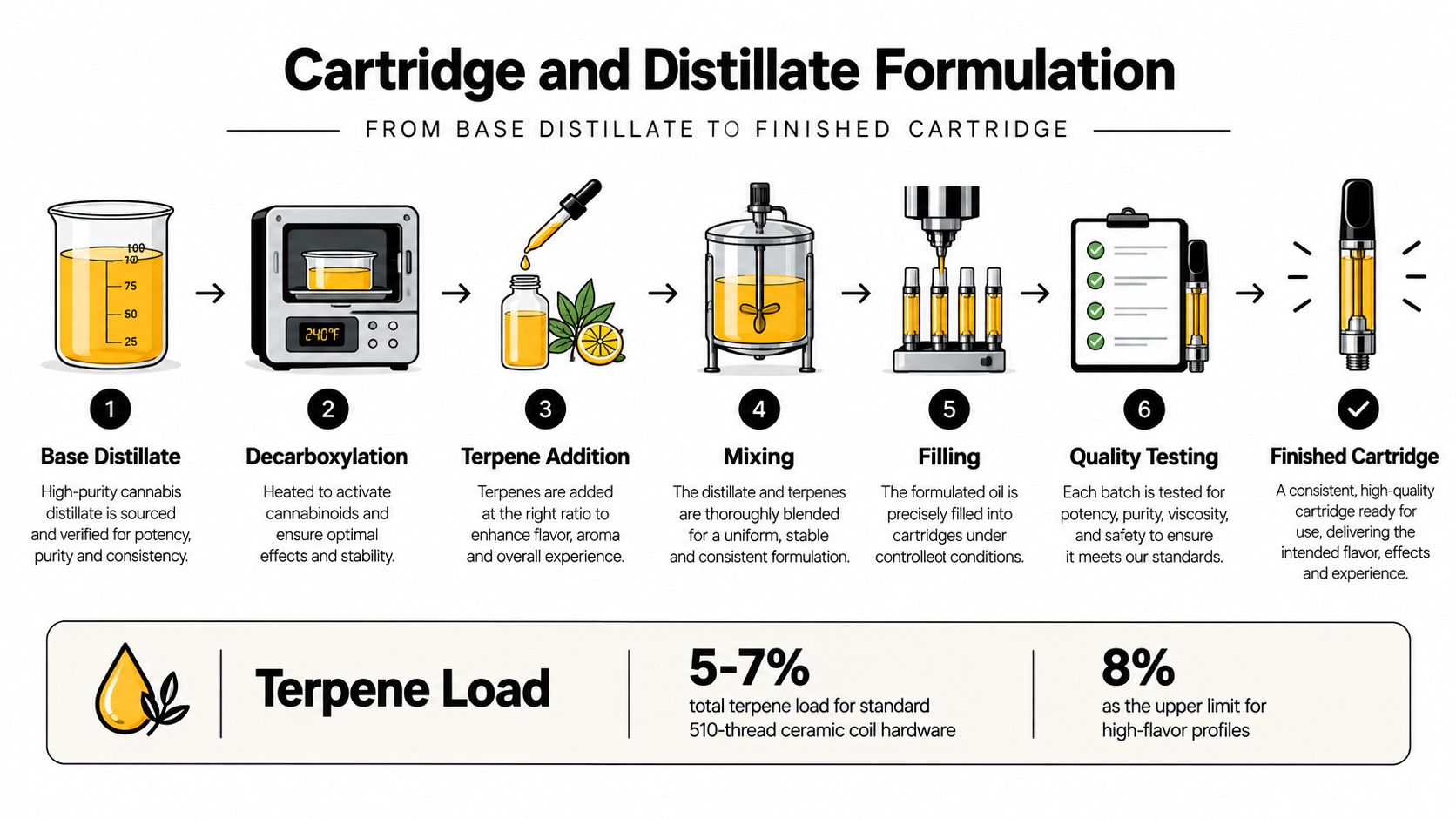
A fill room should set the hardware target before adjusting the flavor load. For standard 510-thread ceramic coils, 5% to 7% total terpene load is a practical starting window. Wickless mesh systems below 3.2 V may handle up to 8%, but that ceiling is not a universal target. Distillate purity, isolate intensity, coil geometry, draw duration, and the desired first-pull impact all change the workable ratio. Baja Smash reads sweeter when citrus and pinene stay bright, so pushing total terpenes higher can make the profile sharper rather than more tropical.
Set the pour temperature between 105°F and 115°F. The oil remains mobile enough for filling, while the lower heat reduces unnecessary loss of volatile top notes. Mix gently and limit open-vessel time. Treat the terpene phase as a volatile ingredient throughout weighing, blending, and transfer.
Protect the volatile fraction
Keep decarboxylation and purge cycles at or below 105°C for this profile. Valencene and terpinolene support its tropical complexity, while excessive heat can leave a generic fruit impression in place of the intended citrus-pine structure. Published product descriptions can diverge significantly on total terpene content, so validate the actual batch and set process conditions from the measured load rather than copying a menu description.
Nitrogen headspace purging before capping can help retain top notes during storage, based on the provided product formulation data. Confirm that result with the finished package, oil, and storage protocol. Oxygen control still matters because citrus and pine notes often flatten before heavier base notes do.
Match the oil to the hardware
A 1.0 to 1.2 ohm ceramic coil generally preserves this profile more accurately. Sub-ohm mesh below 0.8 ohm can exaggerate the pinene edge and consume citrus character too quickly. Allow a 48-hour steep at 40°F before sensory approval, giving the blend time to settle beyond its immediate post-mix aroma. Hold voltage, coil resistance, and oil temperature constant during evaluation. Small changes in those variables can shift the apparent balance from bright top notes to heavier base notes.
Compliance and Lab Verification Practices
Compliance belongs at the beginning of the formula, not at release. State rules can impose different THC limits, terpene caps, labeling requirements, and hardware standards. The provided formulation guidance identifies 10% by mass as a common total-terpene cap in regulated markets and notes that many jurisdictions require child-resistant hardware certification. Those requirements still need to be checked jurisdiction by jurisdiction before production.
A broad-spectrum or isolate-only approach can reduce the variability created by botanical reintroduction. It also makes the formula easier to document because each intended compound has a defined identity and lot record. That doesn't remove the need for testing. It makes the test result easier to interpret.
COA checkpoints
- Review individual compounds: The terpene panel should identify compounds separately instead of reporting only a generic total.
- Check minor constituents: Investigate minors above 0.1% when they weren't part of the intended formula.
- Compare the blend to the specification: Confirm detected compounds sit within ±15% of the intended ratio before approving the batch.
- Confirm lot identity: Match supplier COAs, receiving records, and the actual batch used in production.
- Document the strain reference: Any label using the Baja Smash name should connect to a reproducible formula and complete batch records.
The strain name is a quality claim in practice, even when the label doesn't describe it that way. If one batch leads with citrus and pine while the next tastes like sweet mango, the brand has a consistency problem. A documented ratio, controlled process, and third-party COA give the product team a defensible path when a regulator, distributor, or customer asks how the flavor was produced.
Build Sheet and Next Steps for Your Run
Start with a high-clarity distillate and a 6% total terpene load. The following build keeps the central identity in the citrus-pine opening, gives the middle enough myrcene and terpinolene to avoid a flat fruit impression, and reserves a balancing pool for minor corrections.
| Component | Target Value | Notes |
|---|---|---|
| Total terpene load | 6% | Starting point for high-clarity distillate |
| Alpha-pinene | 1.2% | Pine lift and opening clarity |
| Limonene | 1.8% | Tangerine and citrus brightness |
| Terpinolene | 0.6% | Floral-tropical complexity |
| Myrcene | 0.9% | Soft tropical body |
| Linalool | 0.3% | Edge rounding |
| Supporting isolate pool | 1.2% | Balance with caryophyllene, valencene, ocimene, or other approved materials |
| Hardware | 510-thread ceramic core | Use flavor-preserving hardware |
| Resistance | 2.6 to 3.0Ω | Pair with a controlled draw and conservative heat |
Run the first three batches as a controlled experiment, not as three unrelated production attempts. Vary the terpinolene ratio, hardware temperature, and oxygen exposure one at a time so the panel can identify which variable changes the tropical character, throat feel, and top-note persistence.
The QC sequence should include a pre-fill viscosity check at room temperature, a post-fill pull test, accelerated stability at 40°C for 14 days, and a third-party COA before release. Keep the sensory panel blind to the batch variable. For teams also building recurring product operations, a resource such as Shopify subscription management for supplements can provide useful context for repeat-order workflows, although the formulation and compliance controls still belong in your cannabis production system.
The most reliable Baja Smash reconstruction won't copy a published strain percentage. It will preserve the sensory relationship between citrus, pine, tropical body, and resin, then prove that relationship in the chosen oil and hardware.
Gold Coast Terpenes supplies strain-inspired blends and isolated compounds for cartridges, concentrates, and cannabis product formulation, including materials such as Limonene, Myrcene, and Beta-Caryophyllene. Review the formulation resources and build your next Baja Smash-inspired panel with Gold Coast Terpenes.