
A Gas Chamber-inspired blend can smell perfect in the mixing vessel and still arrive flat, thin, or overly sharp in the finished cartridge. The first aromatic burst may be present during bench evaluation, yet disappear after distillate warming, filling, storage, and repeated ceramic-coil cycles. That gap between beaker aroma and hardware performance is where most replication work succeeds or fails.
For formulators, the Gas Chamber strain isn't mainly a naming exercise. It's a problem of preserving a fuel-forward identity while giving volatile top notes enough support to survive processing. A credible profile needs structure, not more terpene load. The right blend separates the immediate diesel impact from the earthy body and the heavier notes that hold the finish together.
This guide focuses on terpene profile for vape formulation, analytical ratio conversion, distillate handling, ceramic hardware, and sensory validation. Use the strain terpene profile reference alongside your own certificate of analysis, then treat the result as a strain-inspired formulation rather than a guaranteed botanical fingerprint.
Introduction Why Gas Chamber Demands Precision Formulation
A Gas Chamber cart can smell convincing in the mixing vessel, then lose its identity after filling. The fuel-forward top notes may read clearly over earth and spice during bench evaluation, yet flatten after distillate warming and repeated ceramic-coil cycles. What remains can be generic sweetness, harshness, or a thin chemical edge instead of a rounded gas profile.
The blend is only one part of the system. Distillate viscosity, terpene volatility, coil material, airflow, fill conditions, and storage determine which compounds reach the user and in what order. Fuel-forward profiles expose weak formulation choices quickly because their impact depends on volatile notes arriving first while deeper compounds support the finish.
Why fuel-forward profiles are commercially useful
A gas-forward SKU gives a cartridge or concentrate a recognizable sensory position beside fruit-led, candy-led, and broadly herbal products. That position has value only when the flavor survives production and hardware testing.
For product developers, repeatability depends on four checks:
- Identity: The blend should express diesel, fuel, pungent earth, and spice without collapsing into one sharp note.
- Retention: The first aromatic lift needs enough mid and base support to remain present after heating.
- Hardware fit: The oil must wick and vaporize without creating harshness or stripping the profile.
- Batch control: A documented ratio and process matter more than a memorable first beaker test.
Practical rule: If the profile works only before filling, the formulation is unfinished.
Treat Gas Chamber as a delivery-system problem, not only a flower label. Map the aroma into top, mid, and base roles, choose a loading window that suits the base oil, and control heat during blending. A strain terpene profile reference can organize the starting work, while final decisions should come from sensory checks in the actual cartridge. That comparison shows whether the fuel-forward top notes remain intact through distillate heating and ceramic-coil use.
Understanding Gas Chamber Strain Identity and Market Position
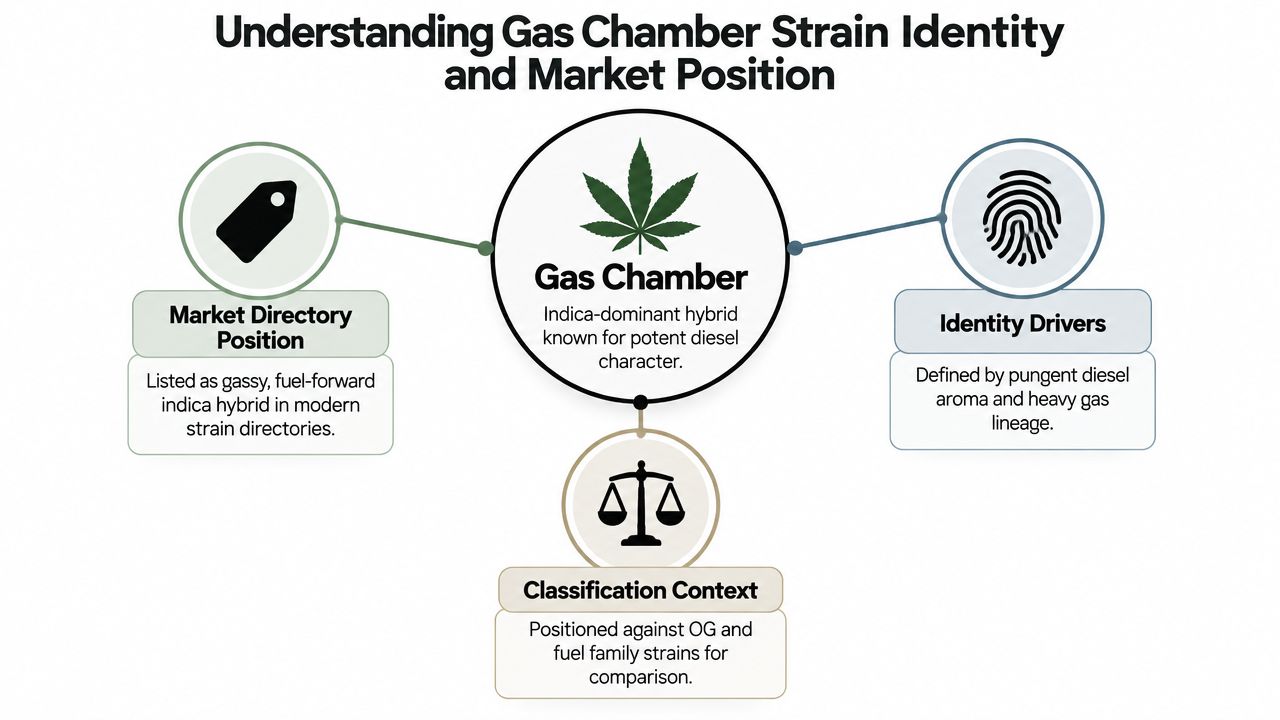
Gas Chamber is widely documented as an indica-dominant hybrid. One major strain directory lists it as a 70% indica and 30% sativa cross of Gas Mask and Green Ribbon BX, with an average THC level of 21% to 23%, and a flowering window of about 50 to 60 days. These figures are listed by AllBud's Gas Chamber strain directory, and they establish useful formulation context without proving that every market sample shares identical chemistry.
The identity problem matters. Gas Chamber doesn't circulate through one universally standardized pedigree, so breeder listings, regional cuts, directory entries, and retail labels may overlap without describing precisely the same plant. For a formulator, that means the name should be treated as a sensory and market reference point, not as a complete chemical specification.
What the classification tells a product team
The indica-dominant classification and relatively short bloom window help position the profile among modern high-potency hybrids. They don't tell you the final terpene ratio, but they do support a practical expectation of dense, assertive aroma architecture rather than a delicate floral presentation.
That expectation influences SKU development in several ways:
- Reference selection: Choose source material or a strain-inspired blend that clearly expresses fuel and pungent depth.
- Sensory target: Define the desired profile through descriptors such as diesel, solvent-like fuel, earth, herbal spice, and woody depth.
- Replication tolerance: Allow for natural variation in parentage instead of forcing a false claim of exact botanical equivalence.
- Hardware target: Prioritize retention and balance because a strong initial aroma can become abrasive when overloaded.
Why “gas” became a market category
The broader gas naming trend developed after the ChemDog, OG Kush, and Sour Diesel era. By the mid-2010s, retailers and consumers increasingly used “gas” as a flavor and aroma descriptor, and fuel-forward cultivars became recognizable market categories rather than incidental traits. Background from Joint Commerce's Gas Chamber strain guide places Gas Chamber within that shift toward aroma-led branding.
That history changes how a brand should brief a formulator. The objective isn't to reproduce an uncertain lineage through name matching. It's to deliver a repeatable combination of fuel impact, pungency, earthy body, and lingering depth that makes the SKU legible in a crowded product set.
Deconstructing the Gas Chamber Terpene Profile for Formulation
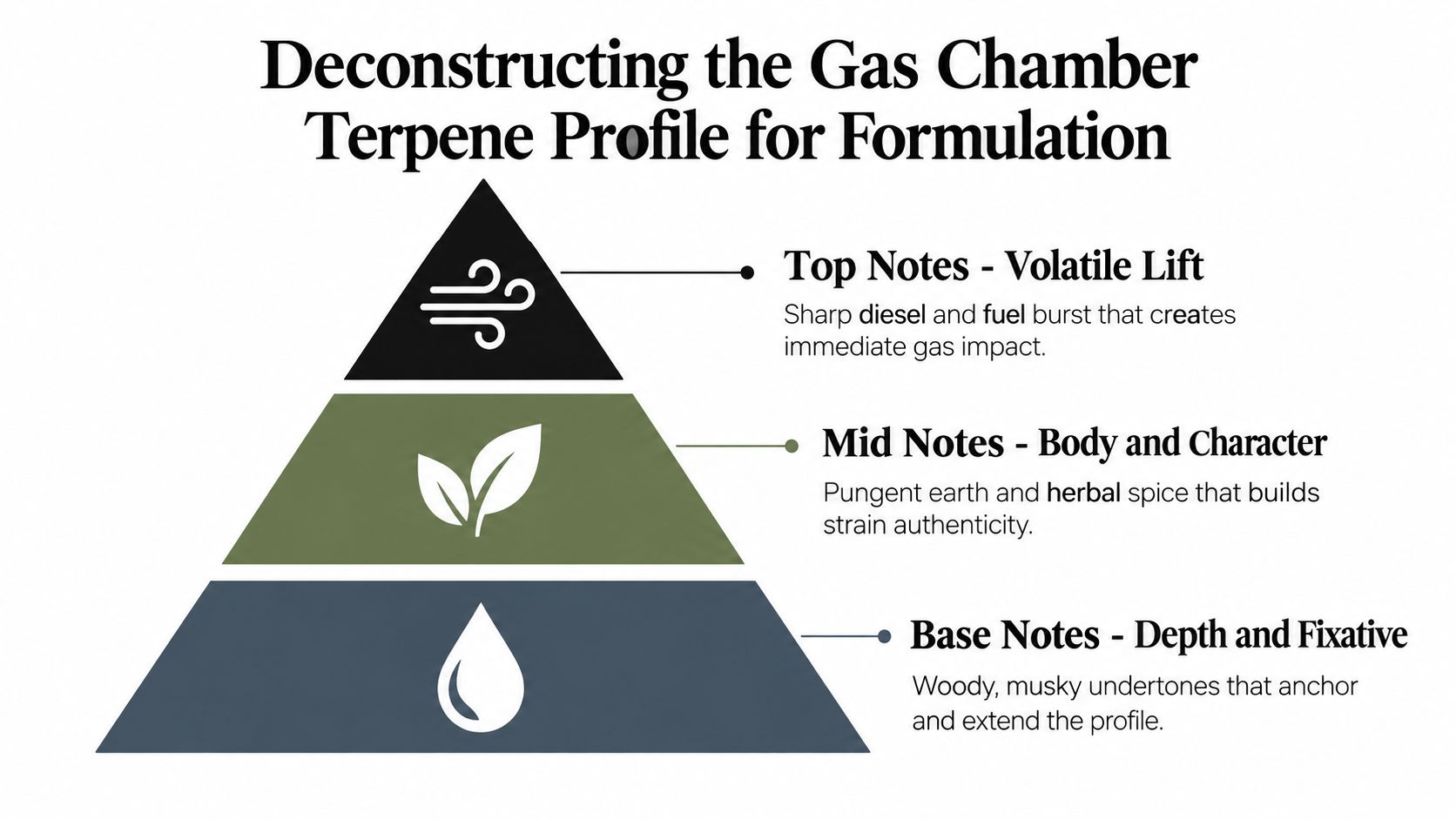
A useful Gas Chamber profile behaves more like a perfume than a single scent. The opening should deliver the fuel impression quickly, the middle should make the aroma feel substantial, and the base should stop the blend from disappearing after the first heating event. If all compounds are selected for immediate intensity, the cartridge may smell impressive at the cap and disappoint during use.
Top notes create the gas impact
Top notes are the first aromatic signals. In this profile, they should create a sharp diesel and fuel impression, with enough lift to make the cartridge immediately recognizable. Volatile monoterpenes often contribute to that fast arrival, but they also present the greatest retention challenge during warming and repeated coil exposure.
A top-heavy blend can smell excellent in a cold sample and then lose its identity quickly. It may also become piercing if the volatile fraction is pushed too far. The goal isn't maximum brightness. The goal is a controlled opening that leads into the rest of the profile.
Mid notes provide authenticity
Mid notes give the fuel character a body. Pungent earth, herbal spice, citrus lift, and pine-like accents can keep the blend from reading as a generic solvent note. This layer does the work of making the aroma feel strain-inspired rather than engineered to smell loud.
Think of the middle as the recognizable fingerprint of the blend. It should support the diesel opening without competing with it. A small amount of brightness can improve definition, while earthy and spicy elements add weight and connect the opening to the finish.
The lab report interpretation guide is useful when deciding whether a certificate of analysis supports your sensory description. Analytical data can guide selection, but it shouldn't replace evaluation in the intended base and device.
Base notes hold the finish
Base notes are the slower, heavier part of the architecture. Woody, musky, earthy, and spicy undertones can act as anchors and fixatives, extending the perception of fuel after the fastest compounds have moved through the vapor path. Sesquiterpenes are particularly useful here because they generally contribute more persistence than highly volatile top notes.
The balance is delicate. Too little base support creates a brief aroma with no finish. Too much can make the cartridge taste dense, muddy, or overly woody. The most reliable blends create contrast, a fast fuel arrival, a substantial center, and a controlled lingering note.
Evaluate the three layers separately before judging the blend as a whole. Smell the diluted sample, the loaded cartridge, and the vapor after the hardware has warmed. A profile that has the right pyramid on paper can still fail if one layer dominates during actual delivery.
How to Translate Analytical Ratios Into a Vape Ready Blend
A flower certificate and a vape formula serve different purposes. The certificate shows the relative presence of compounds in the plant sample. The formula must convert that profile into a blend that can be scaled to a chosen terpene load, then adjusted for volatility, distillate behavior, and ceramic coil heating. Gas Chamber's fuel-forward character depends on keeping that hierarchy intact through repeated vape cycles, not on copying flower percentages without modification.
Use 1.2% myrcene, 0.4% limonene, and 0.3% caryophyllene as a working example. These values produce an approximate 60:20:15 base ratio, as described in this distillate mixing ratio guide. That ratio defines the starting architecture. It does not mean those flower percentages should be transferred directly into a cartridge.
The conversion process
List the analytical compounds you intend to preserve, then divide each value by the combined total of the selected compounds. The result is a normalized ratio, which is easier to scale than the original certificate percentages.
Set the total terpene load for the chosen distillate and hardware. Multiply each normalized share by that load, then adjust for stability. The formulation guidance recommends reducing highly volatile monoterpenes by 10% to 15% and giving more relative support to stable sesquiterpenes such as caryophyllene. That adjustment helps retain structure after heating, as detailed in the same formulation guidance.
| Terpene | Analytical % | Base Ratio | Adjusted for Vape Stability |
|---|---|---|---|
| Myrcene | 1.2% | 60 | Reduce the volatile share by 10% to 15% |
| Limonene | 0.4% | 20 | Retain lift, but avoid allowing the top note to dominate |
| Caryophyllene | 0.3% | 15 | Increase its relative support as monoterpenes are trimmed |
The table shows the calculation method, not a universal Gas Chamber recipe. A certificate may present a different profile, and a strain-inspired blend may need additional compounds for fuel, earth, spice, or woody depth.
Why one-to-one copying fails
A flower ratio can overstate compounds that remain expressive on the plant but fade quickly during distillate processing or vaping. The first draw may then taste bright and aggressive, while later ceramic coil cycles lose the intended Gas Chamber character.
Use the mixing ratios calculator to scale the normalized ratio, then confirm every component by weight rather than by drops. Keep the working formula separate from the source certificate. That record distinguishes the analytical observation from deliberate adjustments made for distillate, volatility, and hardware.
Strong replication preserves the aroma's hierarchy, not every analytical value at face value.
Formulating for Vape Cartridges and Distillate Stability
A Gas Chamber cart can smell right at fill and flatten after repeated ceramic-coil cycles. The formulation has to protect the fuel-forward top notes while keeping the distillate workable in the chosen hardware. Terpene loading must therefore match both the base material and cartridge design.
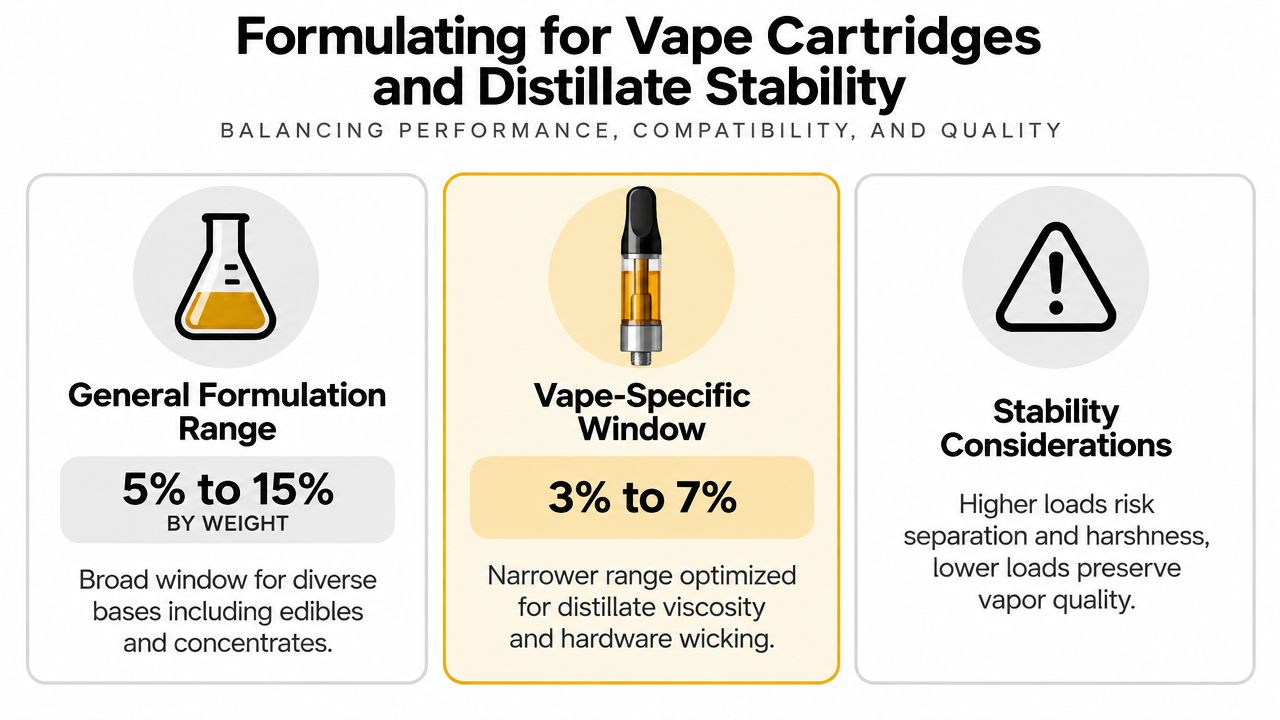
A technical formulation reference places broad cartridge formulas in the 5% to 15% by-weight range. Vape-specific applications may use 3% to 7%, or 10% to 15% when stronger aroma and taste are required. For ceramic coil cartridges, the same reference identifies 8% to 12% by weight as a strong-performing range, with 10% described as a commercial sweet spot. These windows come from Entour's vape applications guide.
Choose the load by formulation objective
A lower vape-specific load can keep the vapor cleaner and reduce the chance that terpenes overwhelm the distillate. A higher load produces a more obvious aroma, but increases the need to check separation, harshness, viscosity, and coil behavior. Ceramic hardware may allow a wider working target than other designs, yet the cartridge must be evaluated as a complete system.
Set the load according to the result you need:
- Flavor accuracy: Use enough terpene fraction to express Gas Chamber's fuel and earth structure, then avoid adding volume to increase intensity.
- Wicking behavior: Confirm that the finished oil moves through the hardware consistently instead of assuming it will behave like the original distillate.
- Vapor quality: Compare the first draw with later draws. Excessive top-note loading can create a strong opening that fades quickly.
- Production repeatability: Choose a window that equipment can measure and operators can reproduce.
Heat discipline protects the blend
Warm distillate only to the minimum temperature needed for flow. Add terpenes at about 90°F to 110°F, then mix gently without applying direct heat to the terpene blend. This process guidance is documented in the Gas Chamber formulation reference from SupHerb.
Keep monoterpenes ideally below 6% of the total blend, while sesquiterpenes contribute 3% to 5% to help retain flavor across repeated heat cycles. These are stability targets, not substitutes for testing. Source profile, base oil, and coil construction can still change the result. Separation and viscosity problems often trace back to handling, so review how to prevent crystallization before locking the fill procedure.
Heat control matters more than a dramatic first smell. Excessive warming can remove the top notes that make a fuel-forward profile recognizable.
Bench Workflow for Replicating Gas Chamber Flavor Accurately
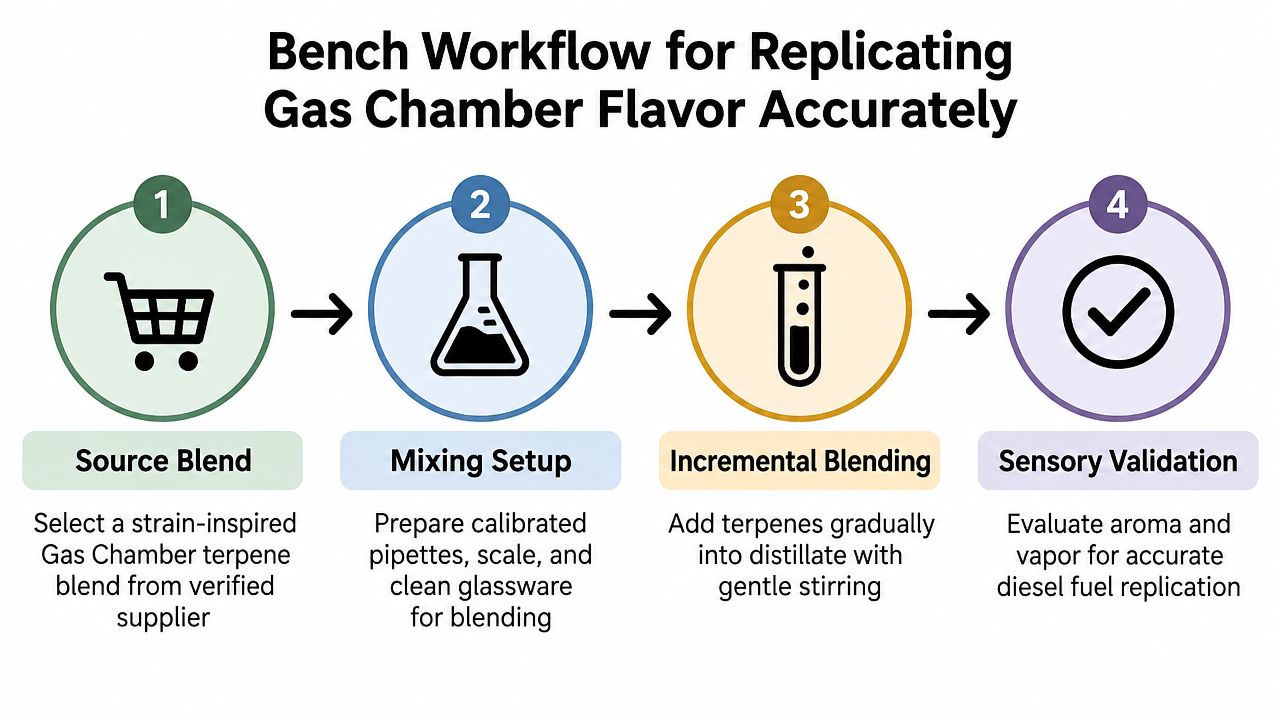
Replication becomes manageable when the team separates sourcing, dosing, homogenization, rest, and hardware validation. Each stage answers a different question. Sourcing asks whether the selected blend has the right sensory direction. Dosing confirms the formula. Hardware testing reveals whether the profile survives delivery.
Start with a defined reference
Source a verified strain-inspired terpene blend or build from isolates when the target requires tighter control. Gold Coast Terpenes offers strain-specific blends and isolated compounds, including profiles built for concentrates and cartridges, so a formulator can compare a ready profile against a custom reconstruction. Keep the source lot, certificate, and sensory notes attached to the bench record.
A ready blend saves time, but isolates provide more control over top, mid, and base adjustments. Neither option removes the need for cartridge testing. The correct choice depends on whether speed, sensory matching, or full compositional control matters most for the project.
Measure, blend, and allow integration
Use calibrated pipettes or a precision scale, clean glassware, and a documented target weight. Add the terpene fraction gradually into the distillate while maintaining gentle agitation. Avoid direct heat on the terpene blend, and stop mixing once the oil is visibly uniform.
Give the sample time to integrate before making a sensory judgment. A freshly mixed sample can present a sharper top note than the finished, settled oil. Record the aroma at the same stage for every development batch, or the team will mistake process variation for formula variation.
Validate in the actual cartridge
Fill the intended hardware and compare the loaded sample with the reference oil. Check the initial draw, the developing vapor, and the later character after repeated use. Look for a fuel opening that remains connected to earthy and spicy body rather than turning into a thin chemical note.
Elevated Strains can also be useful when a product brief needs a more nuanced fruit or dessert direction alongside a heavier profile, but that choice should serve the SKU rather than distract from the Gas Chamber target. Document every adjustment, especially changes to volatile and sesquiterpene balance, so production receives a formula that can be repeated rather than a verbal sensory impression.
Final Checklist for Consistent Gas Chamber Cartridge Production
A consistent Gas Chamber-inspired cartridge depends on controlled architecture, not on adding more aroma. The finished product should present a clear fuel opening, retain enough mid-note body to feel authentic, and leave a grounded finish after the vapor passes through the hardware. Precision also supports reliable sensory profiles and the intended interaction of THC-free, lab-verified terpene components within a formulated product, without turning the blend into a medical claim.
Before moving from development into production, verify the following:
- Confirm the reference: Record the source blend, isolate selection, certificate, and sensory target.
- Lock the ratio: Keep the normalized analytical ratio separate from the adjusted vape formula.
- Verify total load: Check the final terpene percentage by weight against the chosen base and cartridge.
- Control temperature: Warm only enough to make the distillate flow, then add terpenes within the documented low-heat process.
- Inspect the hardware: Test wicking, vapor, flavor retention, and later-cycle performance in the actual cartridge.
- Document the SOP: Record mixing order, agitation method, rest conditions, fill procedure, and acceptance criteria.
- Release by evidence: Scale only after the loaded hardware matches the approved sensory reference.
The practical position is simple. Flavor accuracy creates repeatable SKU execution, and repeatable execution supports buyer confidence more effectively than a strain name alone. Use a calculator for dosing, use lab data for direction, and use the finished cartridge for the final decision.
Gold Coast Terpenes supplies natural strain-specific blends and isolated compounds for cartridges, concentrates, and cannabis product formulation, with THC-free, lab-verified options made without VG, PG, PEG, or MCT. For a Gas Chamber-inspired project, visit Gold Coast Terpenes to review terpene blends, isolates, formulation tools, and bulk sourcing options, then order a small development sample for bench and hardware validation.