
A client sends three COA sheets, all labeled Mango Ice, and asks for the next cartridge batch to match an approved sample exactly. The terpene rankings don't line up, the distillate has a different native aroma, and the first bench blend reads more like generic fruit candy than ripe mango with a cool, creamy finish. That situation is common because Mango Ice isn't a chemically standardized name across every market. For a formulator, the useful target isn't the name alone. It's a documented sensory profile, a repeatable terpene architecture, and a release process that can identify drift before customers do.
Why Mango Ice Strain Profiles Matter in Formulation
A Mango Ice project usually fails before mixing begins. The team treats the label as a fixed recipe instead of asking which cultivar, breeder, extraction method, and batch produced the reference. One listing associates Mango Ice with Mango x Vanilla ICE and describes a 60% indica / 40% sativa structure, while another listing reports a different potency range and cultivation context. Those differences show why a name can identify a profile family without guaranteeing the same chromatogram. AllBud's Mango Ice profile provides one lineage and composition reference, while a separate market-facing Mango Ice listing illustrates the naming variability that formulators need to account for.
The commercial risk sits between batches
The first approved sample becomes an implicit specification, even when nobody has written one down. If version two has more limonene but less myrcene, the opening may smell brighter while the body becomes thinner. If the base is overbuilt with heavy woody notes, the same SKU can lose its tropical identity and finish as earthy or skunky.
That matters for vape cartridges and concentrates because the consumer experiences the finished formulation, not the source flower's label. Flavor accuracy supports recognition and repeat purchase. A mismatch creates practical complaints: the oil is harsh, the mango disappeared, or the replacement batch tastes like a different product.
Bench rule: Treat Mango Ice as a sensory brief supported by analytical data, not as a name that automatically supplies a finished formula.
Build around the signature, not every minor peak
Dominant analytes carry the recognizable structure. Minor terpenes add floral, peppery, creamy, or cooling nuance, but they shouldn't be allowed to pull the blend away from the reference. A useful workflow begins with the highest-impact fruit and body notes, then uses smaller components as controlled modifiers.
For background on how terpene families are organized and compared, the terpene profiles guide is a practical reference point. The commercial decision is straightforward. A precise profile reduces rework, improves communication between extraction and flavor teams, and gives quality assurance a measurable basis for approving a batch.
Lineage and Structure of Mango Ice
For formulation work, treat Mango Ice as a family of related profiles, not a single fixed cultivar formula. The reported Mango x Vanilla ICE parentage provides a useful sensory map, while the 60% indica / 40% sativa split suggests a fruit profile with enough density for a creamy finish. It does not determine cartridge performance or dictate exact terpene percentages. AllBud attributes this lineage and split to Mango Ice is a reference used earlier, so the formulation record should retain the lineage without repeating that citation here.
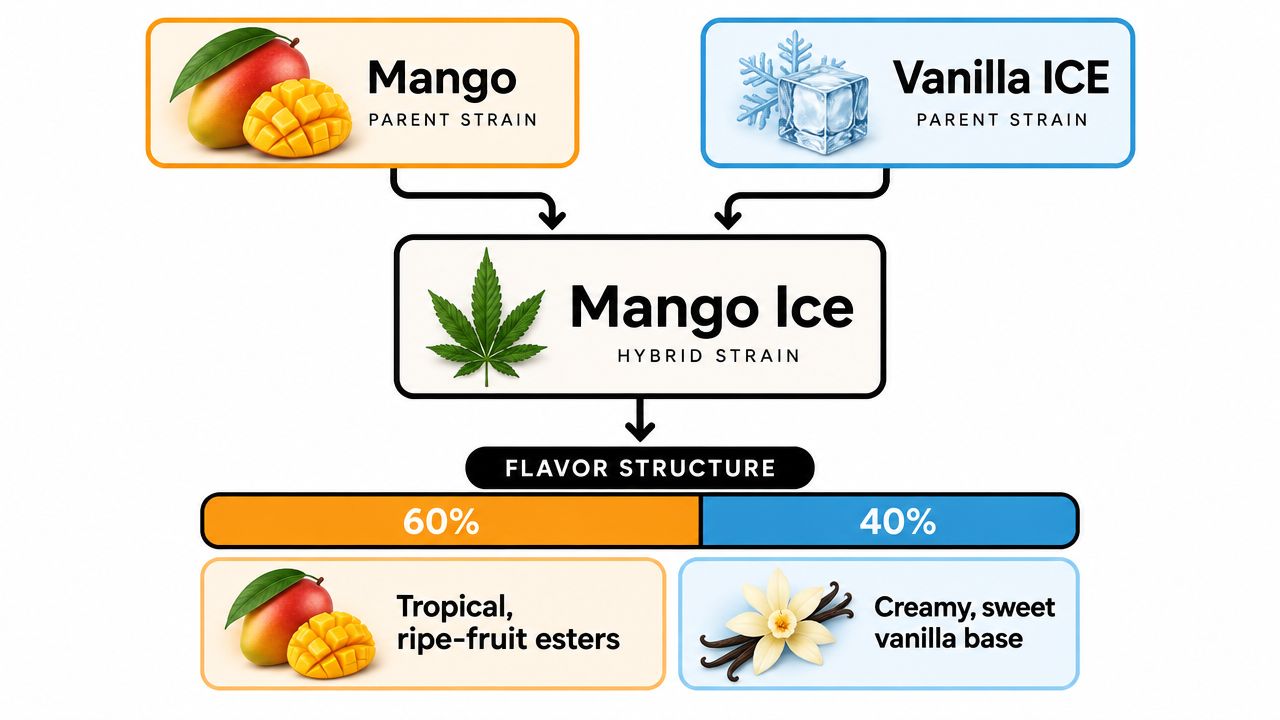
Assign each parent a formulation role
Mango sets the opening and fruit direction. Build that impression with tropical citrus lift and ripe-fruit body. Limonene supplies brightness, while myrcene gives the mango accord enough weight to avoid reading as simple citrus candy.
Vanilla ICE broadens the palate. Creamy sweetness, floral softness, and a restrained gassy impression need mid-palate and base support, with caryophyllene, linalool, and bisabolol serving as useful options. Keep the “Ice” cue controlled. Clean volatility, floral lift, and a smooth finish can suggest coolness without turning the blend minty or menthol-heavy.
A practical starting architecture for a strain-inspired system is top 30%, mid 50%, base 20% within the terpene blend. The exact split can move with the lab profile, but the mango identity depends more on preserving a ripe, rounded middle than on maximizing the brightest top note. For a distillate load, begin around 5% total terpene blend, then adjust for viscosity, hardware, and sensory strength during validation.
- Fruit-forward opening: tropical citrus and ripe mango.
- Rounded finish: creamy sweetness, peppery depth, and a subtle cool edge.
The Mango Gelato strain reference helps compare mango placed inside a richer dessert frame. Elevated Strains provides a separate strain-inspired flavor reference, useful for contrast rather than direct replication.
Dominant Terpenes Behind the Mango Ice Flavor
Independent Mango Ice listings consistently point toward limonene, myrcene, and caryophyllene as the main aromatic group. A lab-oriented entry reports total terpene content of about 1.70%, with myrcene at 0.630%, caryophyllene at 0.470%, linalool at 0.310%, and bisabolol at 0.150%. Those values are best used as a representative reference rather than a universal specification. The Mango Ice terpene listing from Royal King Seeds supplies the cited laboratory-style breakdown.
What each terpene contributes
Limonene is the volatile top-note driver. It supplies citrus brightness and helps connect a mango accord to a fresh, recognizable opening. In poorly sealed cartridges, it can be one of the first notes to fade, leaving the blend heavier and less expressive.
Myrcene supplies the ripe-fruit body. It prevents limonene from making the profile feel like lemon candy and acts as the structural anchor for mango realism. The myrcene terpene guide is useful when comparing isolated myrcene against a complete strain-inspired blend.
Caryophyllene adds peppery, woody warmth. It keeps the profile from becoming syrupy and gives the finish a grounded cannabis-like character. Its lower volatility makes it valuable when the finished product needs a base that remains present after the brighter notes soften.
Linalool bridges fruit and cream. Its floral sweetness can round a sharp citrus opening, but excessive use can move the profile toward perfume. In Mango Ice, it works best as a supporting mid-to-base note.
Bisabolol contributes a soft chamomile and apple-like nuance. It can smooth an aggressive edge at low inclusion, though it should remain controlled in cartridges because heavier minor components can affect clarity, wicking, and coil cleanliness.
The available reference gives exact analyte values, but it doesn't establish universal percentage windows for a finished formulation. The table therefore uses qualitative volatility and functional roles, not invented specification ranges.
| Terpene | Aroma Role | Volatility | Typical Range % |
|---|---|---|---|
| Limonene | Citrus lift and mango bridge | High | Varies by source COA |
| Myrcene | Ripe mango body | Medium | Varies by source COA |
| Caryophyllene | Peppery, woody warmth | Lower | Varies by source COA |
| Linalool | Floral cream bridge | Medium | Varies by source COA |
| Bisabolol | Soft chamomile-apple finish | Lower | Varies by source COA |
Translating the Lab Profile into a Mango Ice Terpene Blend
A COA becomes useful only after the analytical peaks are converted into jobs. Start by assigning each material to a note class, then build around the lead compounds instead of copying every measured value directly into a cartridge blend.
The representative entry cited above is myrcene-forward, followed by caryophyllene, linalool, bisabolol, and smaller listed compounds. A practical formulation approach places limonene and terpinolene in the top-note group, myrcene in the fruit-body group, and caryophyllene, linalool, and bisabolol in the supporting base. Ocimene can also function as a bright modifier when it appears in the selected source material, but it shouldn't be assumed unless the COA confirms it.
Use a layered starting architecture
For a cartridge-oriented blend, a defensible starting point is approximately 35% to 45% top notes, 30% to 35% mid notes, and 25% to 30% base notes. These are formulation starting bands, not claims about the composition of Mango Ice flower, and they should be adjusted for hardware, distillate viscosity, and the intended throat profile.
Anchor the build on the highest two or three relevant analytes. Smaller components can begin at roughly one-fifth to one-tenth of the lead weight, then move through sensory review. The flexible area is the minor sesquiterpene balance. The load-bearing relationship is the limonene-to-myrcene balance. Too much limonene produces a bright fruit-candy effect. Too much myrcene creates a dense, earthy fruit profile that may lose lift.
| Terpene | Lab % approx. | Note Class | Blend Weight | Function |
|---|---|---|---|---|
| Myrcene | 0.630% | Mid | Lead anchor | Ripe mango body |
| Caryophyllene | 0.470% | Base | Secondary anchor | Peppery depth and finish |
| Linalool | 0.310% | Base or mid | Controlled modifier | Floral cream bridge |
| Bisabolol | 0.150% | Base | Light modifier | Softening and roundness |
| Limonene | Source-dependent | Top | Tune to sensory target | Citrus lift |
| Terpinolene | Source-dependent | Top | Small modifier | Fresh, complex brightness |
The terpene mixing calculator can help convert a selected blend ratio into actual batch weights. Keep the calculation separate from sensory approval. A mathematically correct blend can still miss the reference if the distillate contributes native terpenes or if the hardware changes vapor delivery.
Formulation principle: Match the opening, body, and finish in that order. Don't let minor peaks dictate the entire flavor.
Building a Mango Ice Strain Inspired Blend for Distillate
Distillate selection determines how much work the terpene blend must do. A high-clarity, narrow-cut THC distillate at 85% to 92% provides a cleaner canvas, according to the specified formulation target. Broad-cut material brings its own aromatic content, which can shift the intended Mango Ice ratio and make a previously approved blend taste heavier or more herbal.
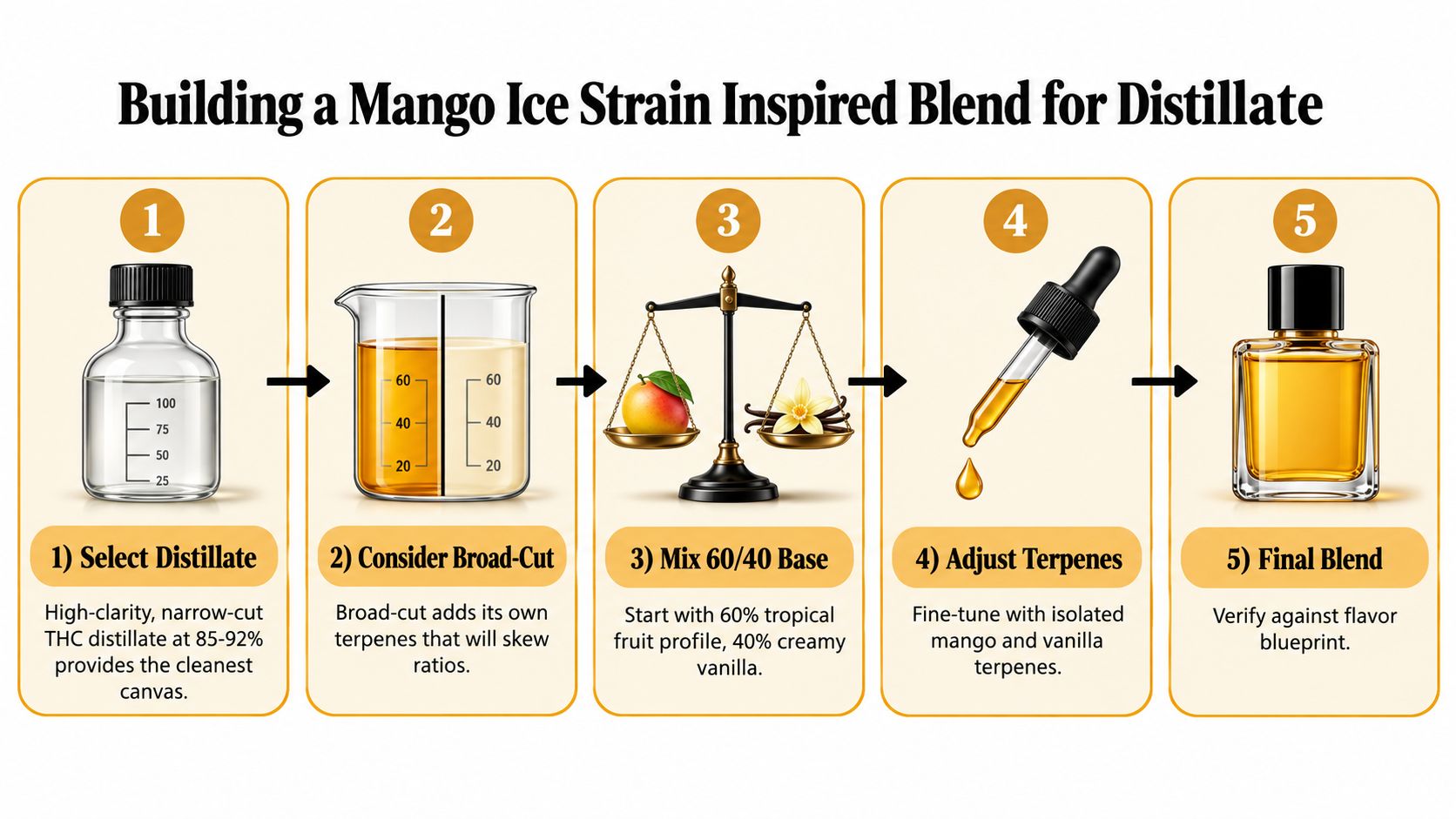
A practical bench sequence
Select the distillate. Record its cannabinoid result, clarity, color, viscosity, and native aroma before adding anything. If the starting material already smells strongly fruity or gassy, reduce the external blend rather than stacking notes blindly.
Set the total terpene load. For standard 510 cartridges, begin between 5% and 8% total terpenes by weight. For high-THC live resin or HTFSE blends with substantial native aroma, begin between 3% and 5%. These load rates are starting points for development, not universal release specifications.
Weigh the terpene concentrate separately. Combine the top, mid, and base materials before introducing them to the distillate. This creates a more uniform aromatic concentrate and makes batch-to-batch weighing easier.
Mix gently at about 40°C to 45°C. The goal is to lower viscosity without unnecessarily driving off volatile top notes. Use controlled agitation and avoid open, prolonged heating.
Homogenize and steep. Mix until the oil looks uniform, then hold it at room temperature for 12 to 24 hours before final sensory evaluation. The steep lets the distillate and terpene system settle into a more coherent profile.
Account for shelf exposure
The specified stability target anticipates a 10% to 20% drop in top-note intensity after two weeks, so a shelf-bound cartridge may need a small limonene adjustment during development. Don't compensate by adding large amounts of citrus material. First check the seal, fill temperature, headspace, and storage conditions. A blend that loses its opening because of packaging shouldn't be repaired only through flavor loading.
Adapting the Profile for Vape Cartridges Versus Concentrates
The same Mango Ice architecture behaves differently in a cartridge and a concentrate. A cartridge needs predictable flow, controlled vapor delivery, and a top note that survives storage and repeated heating. A dab or concentrate format can carry more base character because the user receives a denser aromatic event and hardware wicking isn't the same constraint.
Format-specific decisions
For vape cartridges, keep the limonene-to-myrcene relationship as the primary flavor anchor. Let the top and mid notes carry the first impression, and keep bisabolol below 5% of the terpene blend to reduce the risk of an overly heavy minor-component load that can contribute to coil fouling. Caryophyllene should remain a supporting base rather than the dominant impression.
For distillate dabs and ceramic-chamber concentrates, the base can move higher without the same cartridge-flow penalty. Linalool can also be raised carefully to deepen the creamy floral center. The trade-off is sensory density. A blend that feels balanced in a dab can become sluggish, woody, or overly floral in a 510 cartridge.
| Parameter | Vape Cartridge | Concentrate / Dab |
|---|---|---|
| Primary focus | Volatility and wicking | Full aromatic depth |
| Top notes | Carry more of the opening | Can be moderated |
| Mid notes | Preserve mango body | Can be expanded for richness |
| Base notes | Keep restrained for flow and clarity | Can be pushed higher |
| Bisabolol | Hold below 5% of terpene blend | Adjust through sensory testing |
| Linalool | Use as a controlled bridge | Increase carefully for creaminess |
| Total load | Format-specific development target | Native aroma may support a lower external load |
The ratios that transfer cleanly are the limonene-to-myrcene anchor and the caryophyllene ceiling. The variables that need rework are total load, minor sesquiterpene content, and the balance between linalool and the brighter top notes. A cold-start dab can tolerate a richer base, while a cartridge needs the profile to open quickly and remain clear through the oil path.
Verifying Flavor Accuracy and Maintaining Batch Consistency
A Mango Ice reference should become a sensory and analytical control, not a memory of the last batch. Establish a gold sample from an approved cartridge or concentrate, then score each new blend against it using a 1 to 5 intensity scale. The scale should measure the profile, not personal preference.
Use a simple sensory specification
- Top-note dominance: Tropical fruit and citrus should lead the initial inhale, with a target intensity of 4 to 5 on the internal scale.
- Mid-note body: Creamy sweetness and soft earth should sit behind the opening, with a target of 3 to 4.
- Base-note linger: Floral, citrus, and grounded notes should remain present without becoming heavy, with a target of 2 to 3.
The reference visual specifies a finish that lingers 30 seconds or more, but that duration should be treated as an internal sensory target requiring validation against the approved standard, not as a universal property of every Mango Ice source.
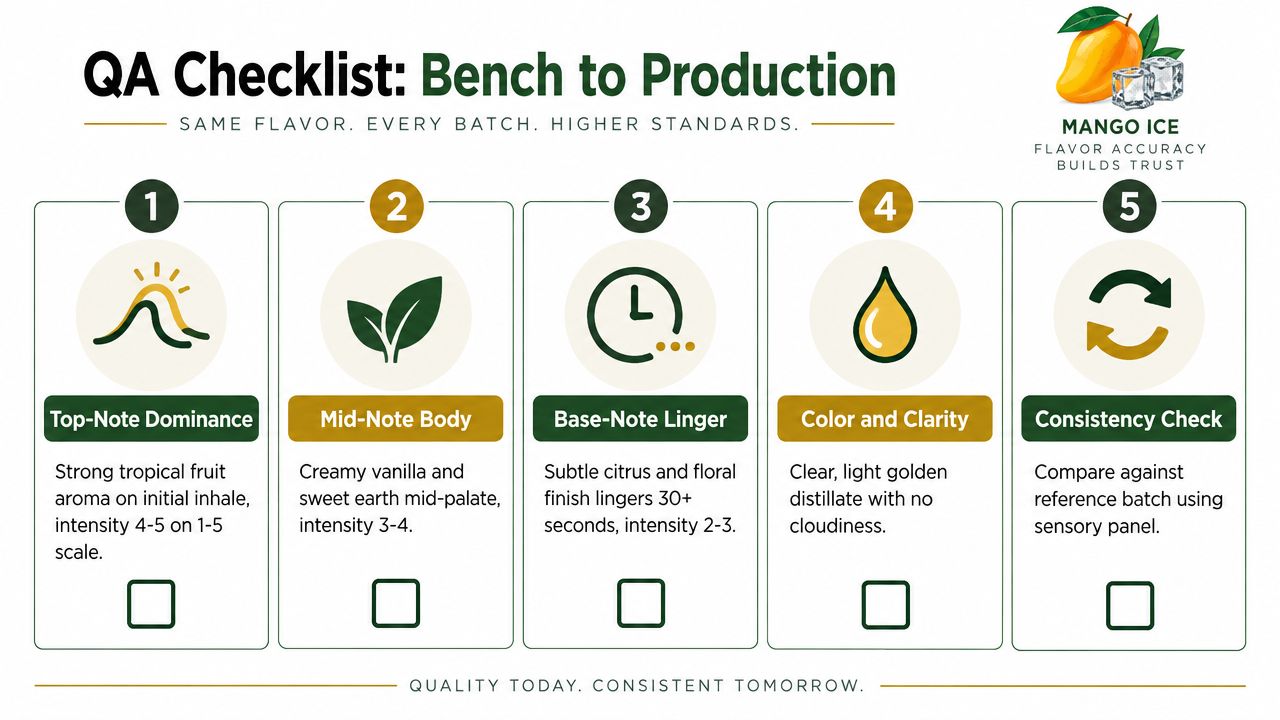
Release controls that catch drift
Run GC-FID or GC-MS checks at fill and after steeping. Track viscosity at 25°C, record color and clarity, and compare dominant terpene results with the approved specification. Limonene drift deserves special attention because it can change the opening quickly, while shifts in myrcene and caryophyllene alter body and finish.
A practical release checklist includes:
- Panel sign-off: The sensory panel approves top, mid, and base intensity against the gold reference.
- Analytical compliance: Results fall within the documented terpene and cannabinoid specifications.
- Hardware testing: Filled cartridges pass leak and performance checks.
- Accelerated stability: Samples are held at 40°C for 14 days as an internal stress condition.
- Retention library: Keep source distillate, terpene concentrate, finished oil, and an approved reference cart for later comparison.
Blind triangle tests are especially useful during scale-up. Give panelists one approved reference and two coded samples, then record whether the production blend can be distinguished from the gold batch. That process exposes sensory drift more reliably than a label review or a single operator's approval.
Gold Coast Terpenes supplies THC-free, lab-verified terpene blends, strain-specific profiles, and isolated compounds for cartridges, concentrates, and product formulation, including materials such as limonene, myrcene, and beta-caryophyllene. Visit Gold Coast Terpenes to review terpene options and formulation resources for building a more consistent Mango Ice-inspired profile.