
A strain-inspired cartridge can taste right on the bench, then lose its clarity, consistency, or stability once it reaches production. Humulene often sits at the center of that problem because it supplies a dry, earthy, woody, and spicy base note without behaving like a dominant top-note terpene. The useful question for a formulator isn't which strains high in humulene exist. It's which terpene architecture can be reproduced, tested, and scaled without turning muddy or unpredictable.
This list ranks seven strain profiles by formulation usefulness, not by recreational appeal. Humulene is treated as a structural base-note anchor, while caryophyllene and myrcene commonly build the middle, and limonene, pinene, ocimene, or terpinolene can provide brighter top notes. Minor compounds matter because they change how the main notes read together, particularly in distillate and vape cartridges.
Use Terpenes 101 to establish the chemistry, then move from a target profile to a small blend screen, hardware test, COA review, and production specification. A terpene mixing calculator can help with batch scaling, while a strain-specific product such as Apple Fritter Elevated Strains can serve as a reference point for broader flavor development.
1. Strain-Inspired Terpene Blend Formulation Guide for Humulene-Forward Profiles in Vape Cartridges
A humulene-forward blend works best when the woody foundation stays defined while brighter terpenes remain audible through the full cartridge experience. Humulene is commonly described as earthy, woody, spicy, and hoppy, making it useful as a dry middle-to-base note rather than a sweet opening aroma (Leafly's humulene profile). In cannabis resin, α-humulene is closely associated with β-caryophyllene because the enzyme CsTPS9FN produces both compounds from FPP, and a peer-reviewed study identified them as the most abundant sesquiterpenes in the profiles it examined (PLOS One study).
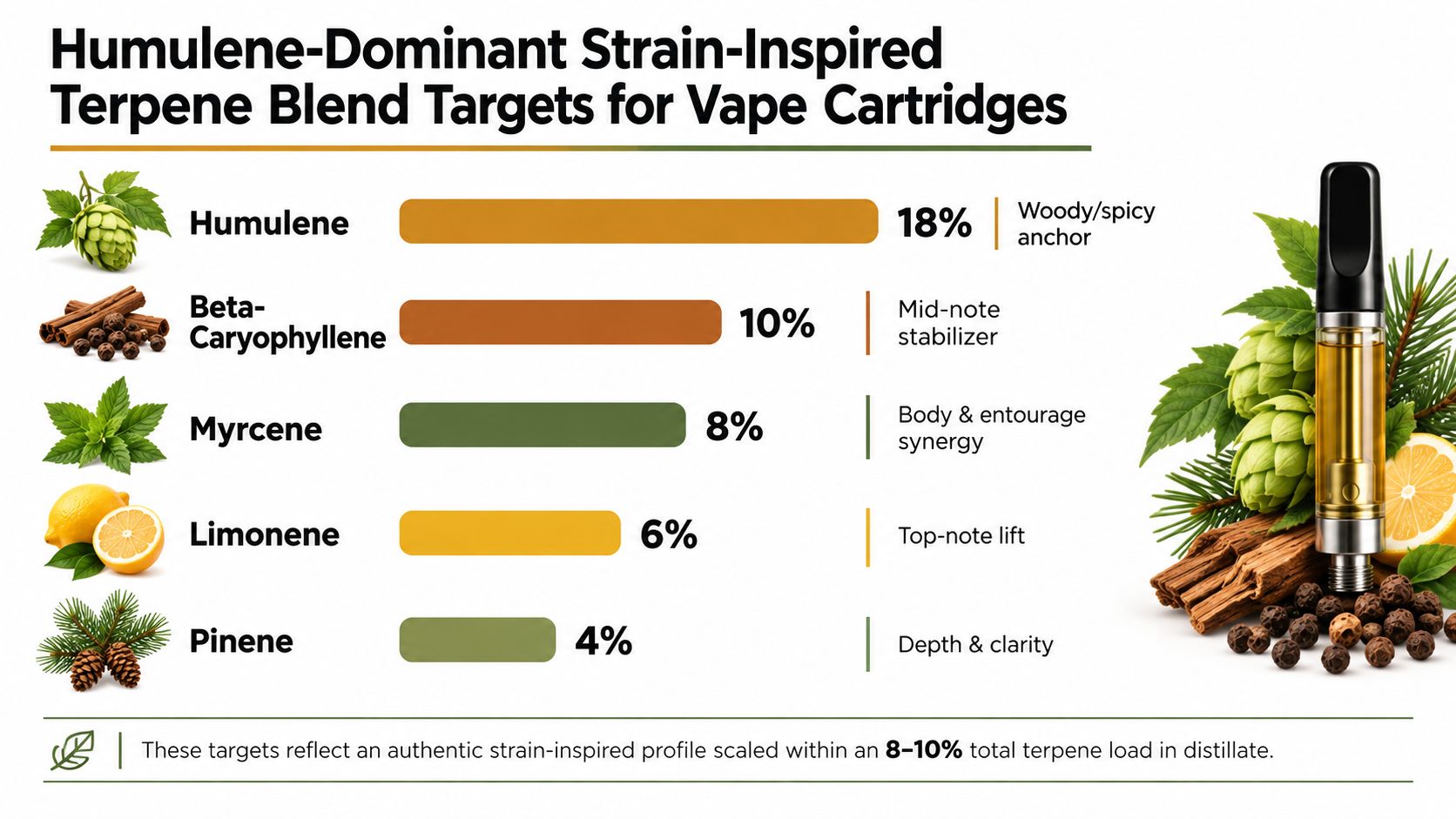
For a strain-inspired cartridge, start with humulene as the anchor, then use caryophyllene to sharpen the spice and myrcene to soften the transition into the distillate. Pinene can supply a resinous top note, but pinene alone often leaves the profile sounding like dry wood with little depth. A caryophyllene pairing gives the base more structure.
Practical rule: Treat the named cultivar as a sensory brief, not as a guaranteed chemical specification.
A useful bench workflow is deliberately conservative:
- Set the humulene anchor: Screen the blend around the lower end of your intended humulene range first, then increase only if the base note disappears in the finished oil.
- Build the middle: Add caryophyllene before relying on pinene or other bright compounds. This keeps the profile connected to the earthy, spicy character associated with OG and Kush-adjacent chemovars (peer-reviewed cannabis terpene review).
- Check the hardware: Compare ceramic and quartz elements with the intended distillate. Higher heat can exaggerate dryness and suppress the subtler supporting notes.
- Document the batch: Record total terpene load, addition order, mixing temperature, and the final COA rather than documenting only the strain name.
This profile is most useful for earthy vape cartridges, OG-inspired distillate, and craft-style SKUs where a dry finish is part of the identity. Use the humulene flavor reference to compare the target aroma with the actual sensory result, but approve the formulation only after analytical and hardware validation.
2. Replicating Flavor of High-Humulene Cannabis Strains Through Terpene Ratio Mapping
The strongest commercial reference profiles aren't necessarily the ones with the highest isolated humulene result. They're the ones with a recognizable relationship between the base, middle, and top notes. Public strain names can point toward an aroma family, but the same cultivar label can produce different terpene profiles across growers, batches, and laboratories. Independent coverage also notes that there isn't a standard definition for “high humulene” strain naming, so a product COA has more value than the name on the package (independent humulene coverage).
For formulation work, rank the profiles by the clarity of their sensory architecture:
Sour Diesel
Sour Diesel is useful when the target needs a dry, sharp, fuel-like direction with an earthy foundation. Humulene should sit behind brighter pinene and citrus notes, while caryophyllene prevents the profile from becoming thin or aggressively volatile. This is a strong reference for a cartridge that needs lift without becoming a limonene-led blend.
Skywalker OG
Skywalker OG is more useful for a heavy, rounded profile. Myrcene can widen the middle, caryophyllene can reinforce the spice, and humulene can keep the finish from becoming soft or sweet. The formulation risk is excess weight. If the middle dominates, the cartridge may taste dull rather than grounded.
Pink Kush
Pink Kush offers a balanced direction for brands that want humulene without committing to a sharply fuel-forward profile. Pairing humulene with myrcene, caryophyllene, and a measured citrus accent can create a profile that works across multiple product positions. The exact ratio must come from the target flower or reference COA, not from the cultivar name alone.
Chemdawg
Chemdawg is useful when the product needs pungency, resin, and a more technical aromatic edge. Humulene can provide the dry base, while pinene and caryophyllene keep the profile articulate. Test carefully for harshness in the intended cartridge hardware.
Gelato 41
Gelato 41 is the most challenging of these references if the goal is humulene visibility. Sweet, creamy, or dessert-associated notes can easily mask the base. Use humulene as a contrast element, not as the sole identity, and verify whether the finished product still communicates the intended profile after heating.
A master formulation sheet should track h individual terpene targets, secondary-terpene hierarchy, total load, lot numbers, and sensory deviations. Test caryophyllene and humulene together rather than changing multiple variables at once. For mixing procedures, use Gold Coast Terpenes' distillate mixing guide.
3. Formulating for Vape Cartridges With Humulene-Dominant Terpene Profiles
Humulene-rich oils need a stability program, not just a flavor approval. The terpene is commonly present at relatively low levels in flower, often around 0.05 to 0.3% in general flower profiles, while humulene-focused material is more often identified through its relationship with β-caryophyllene and its earthy, herbal signature (strain-profile and analytical guidance). That difference matters when a formulator moves from native flower chemistry to a concentrated strain-inspired blend.
Begin with the distillate matrix. Winterized material and crude-derived material can respond differently to terpene addition, so a blend that looks homogeneous immediately after mixing may still separate or change viscosity during storage. A static hold before filling is more informative than a visual check taken directly after agitation.
Stability controls that belong in the batch record
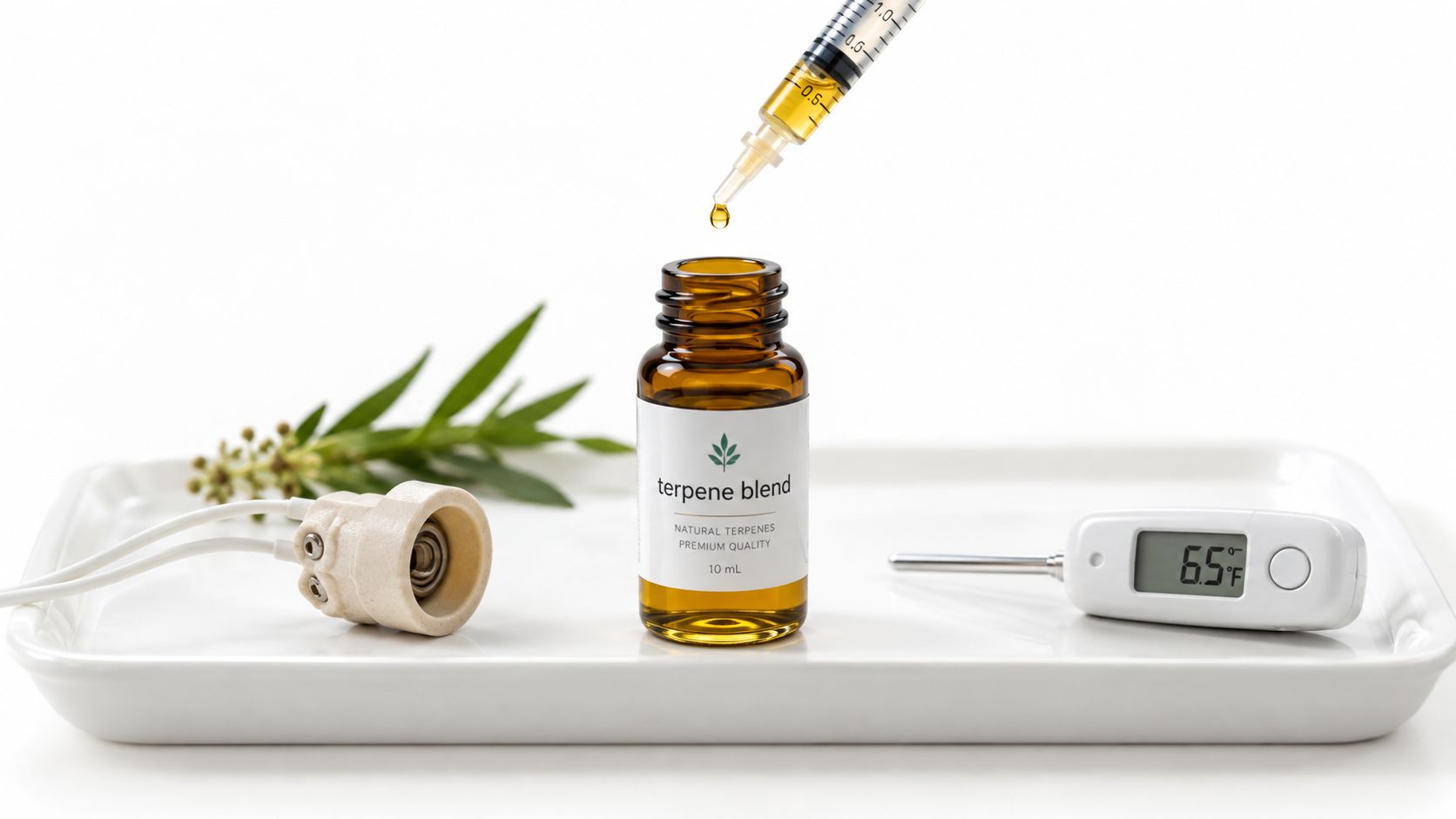
- Mix mechanically: Use a magnetic stirrer or low-speed paddle mixer. Hand stirring may not integrate the blend consistently at production scale.
- Record temperature: Track the temperature during addition and integration, then record the cooling period before filling.
- Measure viscosity: Test the finished oil at the actual storage and operating temperatures relevant to the hardware.
- Inspect before filling: Hold the batch under static conditions and inspect for haze, layering, precipitation, or visible changes in flow.
- Test the cartridge: Ceramic and quartz elements are appropriate candidates for comparison. Nichrome hardware may push the woody character toward a harsher expression, depending on device behavior.
Humulene also volatilizes relatively early compared with some other formulation components. One technical reference lists its boiling point at 106°C, or 222.8°F (technical humulene reference). That figure isn't a complete vaporization model because coil temperature, airflow, residence time, and oil delivery all matter, but it supports a practical conclusion: don't evaluate the blend only at room temperature.
A Chemdawg-inspired oil, for example, should be tested at low, nominal, and high device settings. Record first-puff aroma, mid-session flavor, aftertaste, visible leakage, and oil movement. The crystallization prevention guide can support the physical-stability side of the process, but the finished cartridge still needs product-specific validation.
4. Humulene Terpene Profile Blending for Distillate Without Flavor Mudding
A complex terpene profile can become less recognizable when every available note is added at once. Humulene provides useful structure, but too much earthy material combined with myrcene, caryophyllene, and heavy floral notes can flatten the sensory map. The formulator's job is to preserve separation between the opening, middle, and finish.
Use the three-note architecture as a working model:
- Top notes: Limonene, pinene, ocimene, and terpinolene can create brightness, lift, and initial recognition.
- Middle notes: Caryophyllene and myrcene connect the brighter opening to the heavier base.
- Base notes: Humulene supplies dry wood, herbal depth, and a lingering grounded finish.
This framework doesn't prove an entourage effect or establish a predictable consumer response. Research into cannabis terpenes and combinations remains an area where preclinical findings shouldn't be converted into medical promises. Product language should describe aroma, flavor, and intended experience, not claim that a blend treats anxiety, pain, insomnia, or another condition.
A practical screen changes one variable at a time. Hold the cannabinoid base and total terpene load constant, then compare a humulene-only adjustment with a humulene plus caryophyllene adjustment. Next, add the top note. This approach shows whether the profile became clearer or louder.
The best blend isn't the one with the most recognizable individual terpenes. It's the one where each note remains identifiable after heating.
For a calm, grounded positioning, humulene can support a deeper profile with myrcene and a restrained floral note. For a clearer daytime direction, limonene and pinene can lift the opening while humulene keeps the finish from becoming thin. Those are sensory directions, not verified effect formulas. Keep cannabinoid composition, hardware, and batch history attached to every sensory result.
A useful internal panel should describe first impression, middle palate, finish, harshness, sweetness, dryness, and profile accuracy. Don't ask panelists whether the blend “works” in the abstract. Ask whether the target profile remains recognizable after repeated draws and whether the base overwhelms the top note.
5. Scaling Humulene-Inspired Terpene Formulations for Vape Cartridge Production
Scale-up exposes weaknesses that a bench blend can hide. A small beaker may integrate smoothly while a larger vessel creates temperature gradients, uneven addition, or localized terpene concentration. Humulene-forward products need a written addition sequence because the final sensory result depends on distribution, not merely on the ingredient list.
Use a staged process:
- Prepare the distillate: Confirm its identity, cannabinoid profile, viscosity, and starting appearance.
- Add the structural components: Introduce humulene and myrcene under controlled agitation.
- Build the middle: Add caryophyllene and any other supporting sesquiterpenes.
- Finish with volatile notes: Add pinene, limonene, ocimene, or terpinolene later in the cycle to limit unnecessary exposure to heat and agitation.
- Hold and sample: Pull representative samples from the vessel only after integration is complete.
The equipment should match the batch. A jacketed mixing tank, monitored agitation, calibrated temperature probes, and a positive-displacement metering system offer more control than gravity-fed additions. Small processors can still achieve disciplined production with simpler equipment if they standardize the procedure and retain complete records.
The records that protect consistency
- Ingredient identity: Record supplier, lot, incoming test result, and storage condition.
- Process conditions: Record mixer speed, addition time, temperature, and integration duration.
- In-process checks: Compare appearance, density, viscosity, and odor against the approved reference.
- Release testing: Confirm the terpene profile and inspect for separation before cartridge filling.
- Deviation handling: Hold any batch outside specification for root-cause review instead of blending the problem away.
A successful pilot should produce a golden batch reference. Keep a retained sample and use it for sensory comparison, instrument checks, and training. The reference won't replace a COA, but it gives production and quality teams a shared physical standard for flavor accuracy.
The most useful scale-up question isn't whether the blend can be made in a larger vessel. It's whether every operator can reproduce the same result from the same written process.
6. Market Positioning for Humulene-Dominant Terpene Profiles
Humulene-forward products serve a defined flavor niche rather than a broad, high-volume category. Limonene- and myrcene-led blends are often easier for consumers and retailers to recognize. A humulene-led product can stand apart through dryness, woody depth, herbal realism, and caryophyllene-linked spice, provided the profile is explained clearly and reproduced consistently.
For formulation usefulness, rank profiles by their ability to create a recognizable sensory structure. First, humulene paired with caryophyllene offers the clearest dry, resinous, peppery foundation for strain-inspired cartridges and distillates. Second, humulene with limonene adds brightness and broader shelf appeal while preserving the base. Third, humulene supported by softer herbal or woody notes can create realism, but may require tighter ratio control to avoid a flat or muddy result.
Positioning that supports the formulation
- Lead with flavor: Use earthy, woody, herbal, spicy, resinous, or hoppy descriptors only when sensory review supports them.
- Show the architecture: Present humulene as the base anchor, then identify supporting middle notes and brighter top notes.
- Match the application: For cartridges, validate vapor character, draw behavior, and flavor persistence. For distillates, check that the same hierarchy survives dilution and storage.
- Offer controlled variants: A humulene and limonene version can serve customers who want the same base with more brightness. Treat it as a separate sensory target, not a minor adjustment.
- Publish batch evidence: Give wholesale buyers access to the relevant COA or terpene ratio information.
A strain-inspired cartridge should communicate the target lineage while stating that the finished product is a formulated profile. This wording is more defensible than using a strain name as proof of exact chemistry. Current laboratory data from the actual material or blend still determines whether the claimed profile is present.
Avoid unsupported claims about popularity, pricing, customer satisfaction, margin, or purchase behavior. The supplied strain lists are useful starting references, but cultivar labels cannot replace testing. The 2020 review compiled cannabis terpene data across 1,454 entries, showing humulene as a recurring analyte in research and chemovar work, while generally appearing as a secondary or tertiary compound rather than the dominant terpene (2020 cannabis terpene review data).
Publish the blend logic. Explaining why humulene is paired with caryophyllene helps buyers judge flavor accuracy, application fit, and batch consistency instead of comparing the product only with sweeter, brighter cartridges.
7. Testing and Validation Protocols for Humulene-Inspired Products
A strain-inspired product earns its name through documentation. Start with the incoming terpene material, then validate the blend, the hardware, the storage behavior, and the finished package. Testing should answer four practical questions: did the right compounds enter the batch, did they remain distributed, does the cartridge perform correctly, and can the brand support its description?
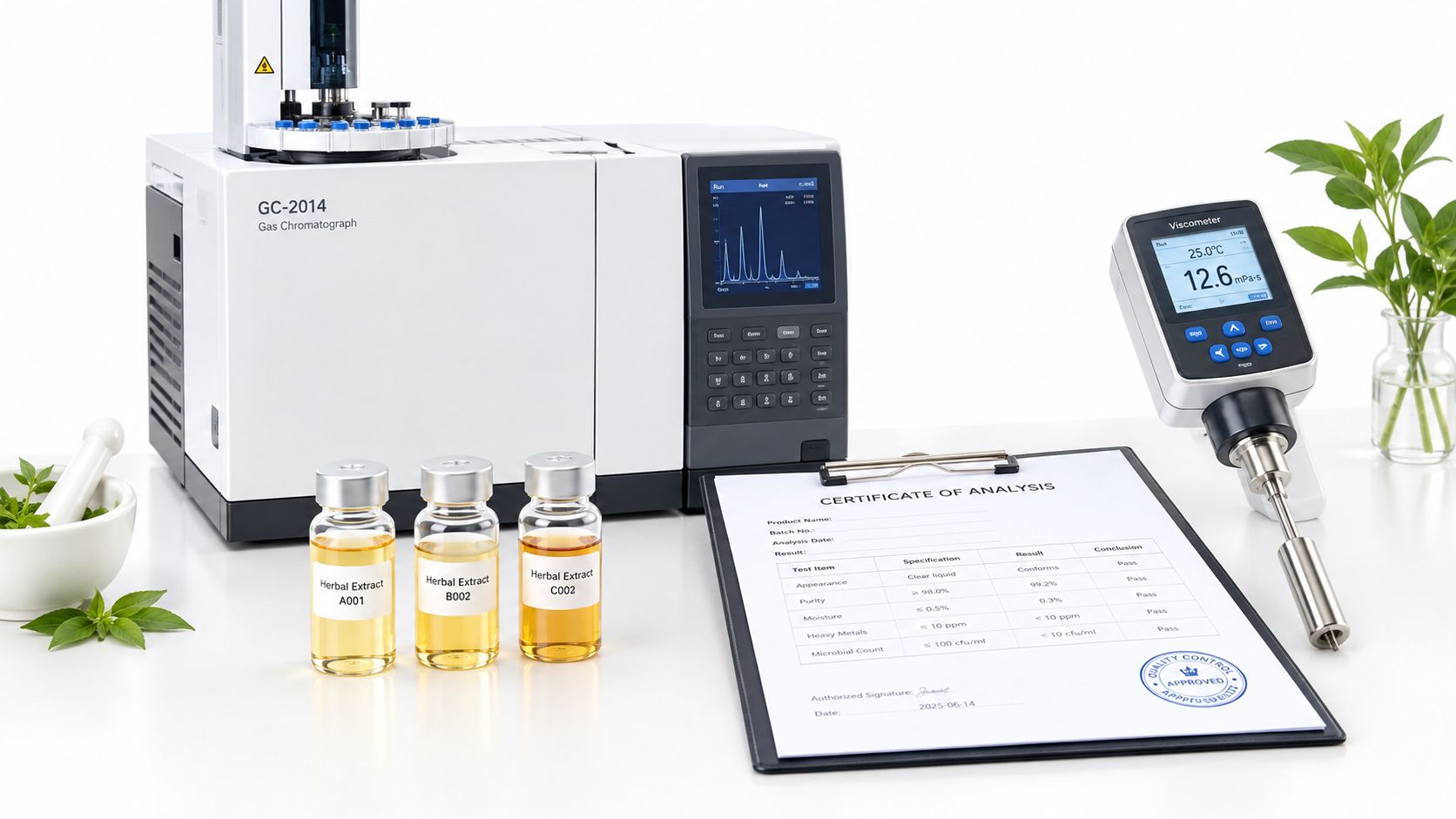
Use analytical testing to confirm identity and composition. GC-MS is appropriate for terpene profiling, while qNMR may provide an additional method for selected compounds and reference standards. The method should be validated for the matrix, and the laboratory should report how it handles co-elution, detection limits, and sample preparation.
A release sequence for production teams
- Incoming material: Confirm the identity and quality of each terpene lot before use.
- Pre-mix baseline: Record distillate appearance, density, and viscosity.
- Post-mix analysis: Test a representative sample for the intended terpene hierarchy.
- Static observation: Hold the oil before filling and inspect for layering, haze, or precipitation.
- Hardware review: Fill representative cartridges and evaluate draw, leakage, vapor character, and residual oil.
- Stability program: Combine accelerated testing with real-time storage rather than relying on a short observation period.
Sensory panels should use blind samples and a defined vocabulary. Ask evaluators to score profile fidelity, dryness, spice, wood, brightness, harshness, and finish. Test the cartridge at the device settings that customers will use, because a blend can appear balanced in a vial but change substantially during vaporization.
Quality principle: A COA confirms chemistry. It doesn't confirm that the cartridge tastes correct, feeds properly, or remains stable in its hardware.
Packaging should avoid implying that a strain name guarantees a fixed chemotype. State the actual terpene profile where permitted, retain batch records, and connect every marketing description to the tested product. The quality control testing resource can help organize the analytical side of the workflow.
7-Point Comparison: High-Humulene Strain Formulation & Validation
| Item | 🔄 Implementation Complexity | 💡 Resource Requirements | 📊 Expected Outcomes | ⚡ Ideal Use Cases | ⭐ Key Advantages |
|---|---|---|---|---|---|
| Strain-Inspired Terpene Blend Formulation Guide for Humulene-Forward Profiles in Vape Cartridges | High, precise ratio & flash‑point balancing; 48–72h integration | Analytical testing (GC‑MS), high‑flashpoint isolates, mixing calculator, small‑batch equipment | Distinct woody/spicy carts; stable flavor across 3.0–4.2V when validated | Craft/heritage strain SKUs and premium 0.5g cartridges | Authentic humulene character; pairs with high‑potency distillates; supports premium pricing |
| Replicating Flavor of High-Humulene Cannabis Strains: Terpene Ratio Mapping for Distillate Formulation | Moderate–High, ratio mapping + sensory tuning; depends on data quality | Access to GC‑MS strain data, terpene isolates, formulation templates, small‑batch testing | Reproducible strain‑inspired profiles; faster SKU iteration; fewer failed runs | Startups and brands reverse‑engineering popular strain flavors | Enables authentic replication and credible marketing claims; efficient iteration |
| Formulating for Vape Cartridges with Humulene-Dominant Terpene Profiles: Viscosity, Separation, and Stability Management | High, viscosity tuning, distillate compatibility, hardware considerations | Crude distillate baseline, mechanical mixers, viscometer, temp control, cartridge hardware testing | Improved shelf stability, reduced phase separation, optimized hardware performance | Manufacturers solving stability/compatibility issues for production fills | Better viscosity management; longer perceived shelf life; allows use of crude distillates |
| Humulene Terpene Profile Blending for Distillate: Entourage Effect Optimization Without Flavor Mudding | High, needs cannabinoid mapping and sensory threshold control | Cannabinoid profile data, multiple terpene isolates, trained sensory panels, analytical support | Effect‑aligned products (relax/focus) with preserved flavor clarity; possible lower terpene load | Effect‑based product lines (sleep, focus, chill) and education‑led brands | Optimizes perceived entourage effects; supports premium, data‑backed positioning |
| Scaling Humulene-Inspired Terpene Formulations for Vape Cartridge Production: Batch Consistency and QA Protocols | High, SOPs, SPC, equipment calibration, strict documentation | Jacketed tanks, variable‑speed mixers, portable GC, viscometer, QA personnel, batch tracking | Lower failure rates, regulatory compliance, consistent flavor across scales | Contract manufacturers and mid‑size brands scaling to commercial volumes | Improves batch consistency, audit readiness, enables multi‑site production |
| Competitive Landscape: Humulene-Dominant Terpene Profiles in the Commercial Vape Market | Moderate, market research + education strategy; branding effort | Marketing/content budget, distributor partnerships, budtender programs, sampling | Niche market capture with premium pricing; slower awareness ramp but higher margins | Brands seeking differentiation in dispensaries and DTC channels | First‑mover educational advantage; higher unit margins; white‑space opportunities |
| Testing and Validation Protocols for Humulene-Inspired Products | Moderate, structured QC program and validation workflows | GC‑MS, qNMR, viscometer, stability chambers, sensory panels, lab access | Objective QC, reduced recalls, CoA‑ready products, documented shelf‑life | Quality‑focused producers and regulatory‑compliant launches | Early issue detection, supports premium claims, reduces audit/regulatory risk |
Turn a Humulene Profile Into a Repeatable SKU
The most useful way to work with strains high in humulene is to stop treating the cultivar name as the formulation. Use it as a starting sensory reference, then verify the chemistry behind the target. Humulene is one of the major sesquiterpenes identified in cannabis resin profiles, and its recurring association with β-caryophyllene explains why many earthy, woody, herbal, and Kush-adjacent profiles share a similar base architecture (peer-reviewed biosynthesis research). The finished product still depends on the full terpene ratio, distillate matrix, hardware, storage, and processing conditions.
A practical decision path looks like this:
- Choose the sensory target: Decide whether the SKU should be dry and woody, earthy and spicy, sharp and resinous, or balanced with brighter top notes.
- Verify the chemotype: Obtain current laboratory data from the reference flower, extract, or approved terpene profile. Don't use a strain label as a substitute for a COA.
- Assign terpene roles: Place humulene in the base, use caryophyllene or myrcene to build the middle, and add limonene, pinene, ocimene, or terpinolene only as needed for lift.
- Run a small screen: Change one variable at a time and evaluate the oil in the intended cartridge hardware.
- Test stability: Check viscosity, separation, precipitation, vapor character, and storage behavior before committing to a production run.
- Lock the approved version: Record the formula, ingredient lots, process conditions, analytical result, sensory reference, hardware, and packaging language.
The supplied formulation percentages and performance examples are starting points, not universal specifications. A concentration that works in one distillate may taste harsh, separate, or lose its top notes in another. The same is true of cartridge voltage, heating element, oil path, and storage environment. Validate the finished product rather than assuming that a published ratio will transfer unchanged.
Avoid medical claims and guaranteed effect language. Humulene research is relevant to terpene chemistry and formulation, but sensory positioning isn't clinical evidence. Describe the product's aroma, flavor, finish, and intended experience, then support those descriptions with current testing.
For the next pilot, use a terpene calculator, review isolate and strain-profile resources, and compare bulk sourcing options before selecting the final blend. Gold Coast Terpenes offers natural terpene blends, strain-specific profiles, and isolated compounds for cartridges, concentrates, and cannabis product formulation, giving development teams components they can evaluate against a defined humulene architecture.
Gold Coast Terpenes offers strain-inspired blends, isolated compounds, and formulation resources for teams developing humulene-forward cartridges, concentrates, and distillate products. Visit Gold Coast Terpenes to review terpene options, use the mixing tools, and source components for a documented pilot blend.