
Bisabolol is a naturally occurring chamomile-derived sesquiterpene alcohol, C15H26O, prized for its sweet-floral aroma and skin-friendly functional behavior. Independent safety assessments recorded 184 cosmetic formulations in 1997 and 999 formulations in 2015, showing how widely this low-dose ingredient has been adopted. The Cosmetic Ingredient Review safety assessment documents typical use around 0.1% to 0.2% in the earlier review, with later reported concentrations ranging from 0.00002% to 1% depending on product type.
You're likely asking because a distillate profile is technically clean but sensory-flat. The citrus flashes, the pine arrives, and then the finish drops away or turns slightly sharp. Bisabolol rarely fixes that gap by taking over. It works by putting a soft floral bridge beneath the brighter terpenes, which is why it matters in a strain-inspired terpene blend, especially for cartridges and distillate products where small sensory imbalances become obvious.
Why Formulators Are Asking What Bisabolol Brings to a Blend
A distillate batch can pass appearance and potency checks yet still feel unfinished at the bench. The bright notes arrive, but the middle lacks shape and the finish turns thin or sharp. A controlled addition of alpha-bisabolol can soften that edge and add restrained floral sweetness without making the formula smell like chamomile oil.
Bisabolol, also called levomenol, is a monocyclic sesquiterpene alcohol with the molecular formula C15H26O. A modern review of α-bisabolol describes its natural occurrence and use in skin-conditioning and soothing formulations. Chamomile is a major botanical source, while lavender, rosemary, and cannabis species can also contain it. The documented chemical profile identifies its cosmetic use at low concentrations.
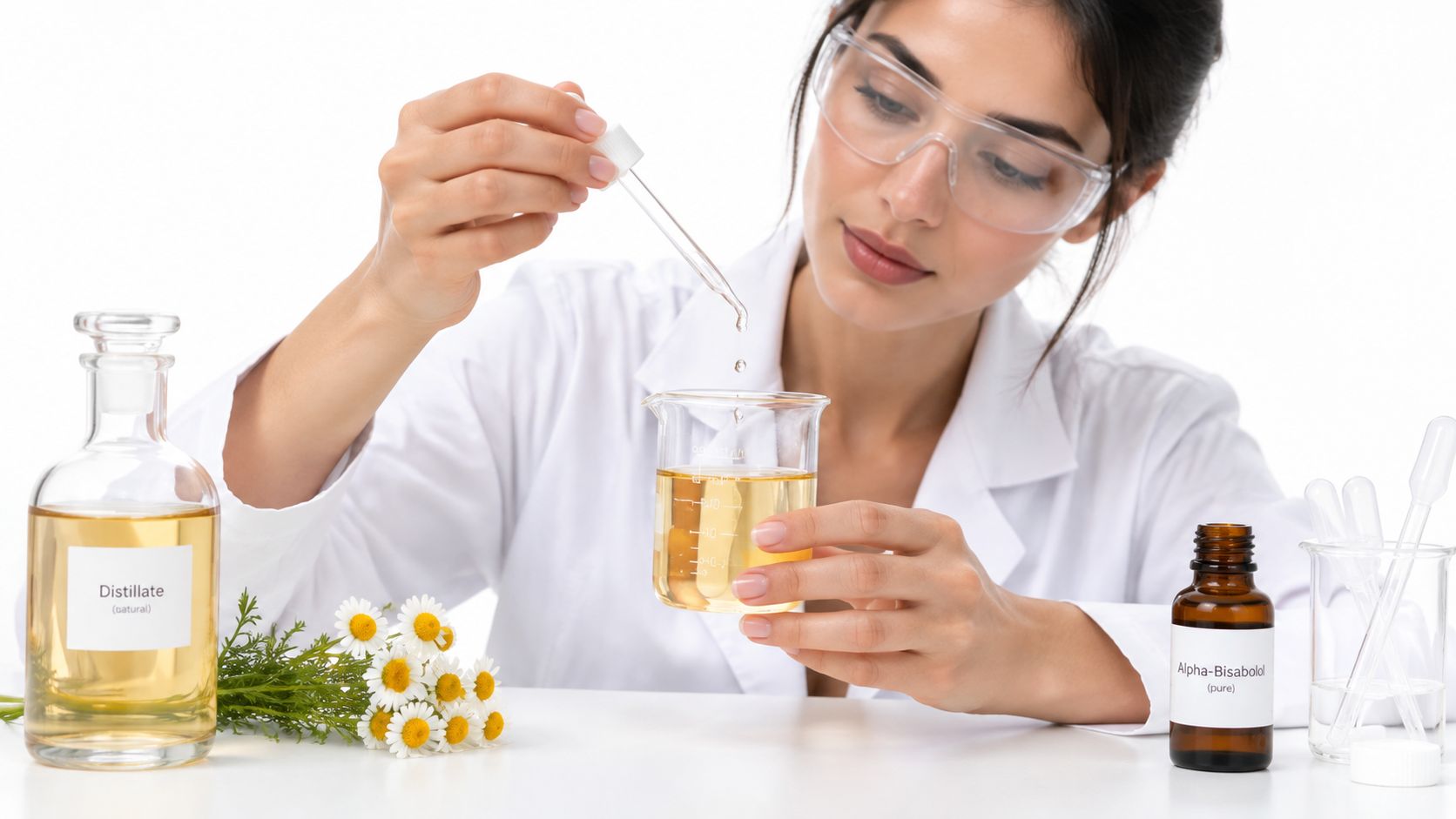
Why the quiet compounds matter
A cannabis developer replicating a cultivar profile cannot judge the formula by dominant peaks alone. A generic pine-citrus blend may be recognizable, yet supporting compounds determine whether it feels specific. Bisabolol supplies a soft floral layer that can suit expressions associated with ACDC, Harle-Tsu, Kush, or chamomile-like hash character. Confirm those associations against the batch COA, because botanical expression varies.
The molecule's commercial history also shows why formulators treat it as a supporting material. The CIR assessment recorded 774 leave-on products and 215 rinse-off products in 2015, compared with 142 leave-on and 41 rinse-off products in 1997. Concentrations remained low across mainstream categories, even as its formulation footprint expanded.
Practical rule: Start with bisabolol as a supporting note. If it presents as a distinct headline aroma, the dose may already be too high for a nuanced replication.
In vape and distillate work, that restraint is the point. Bisabolol can connect aroma chemistry with skincare-adjacent positioning, but it is not a medical ingredient and must not be marketed as one. For a broader explanation of how minor compounds can contribute to a combined profile, see this entourage effect guide. The formulator's target is simple: a quieter finish that makes the blend sound complete.
The Chemistry and Sensory Profile of Alpha-Bisabolol
The defining formulation feature of alpha-bisabolol is its combination of a sesquiterpene backbone and an alcohol group. The chemical reference for bisabolol identifies it as a monocyclic sesquiterpene alcohol, also known as levomenol, with molecular formula C15H26O and molecular weight 222.37.
In sensory work, that structure translates into a slower, softer arc than a bright monoterpene flash. Bisabolol's aroma is commonly described as sweet, floral, citrus-tinged, and lightly spicy, with a chamomile character that can read clean rather than medicinal. It doesn't bring the aggressive pine, fuel, or pepper impact that often dominates a terpene blend when a sharp top note is overdosed.
How it behaves in the note stack
A useful way to place bisabolol is between the fast-moving top of a blend and the heavier base. Limonene and pinene establish immediate recognition. Myrcene supplies a fuller herbal body. Linalool adds floral lift, while beta-caryophyllene provides dry pepper and woody depth. Bisabolol connects those layers with a sweet floral cushion.
The comparison below is a practical sensory map, not a substitute for GC-MS or a controlled panel.
| Terpene | Note Position | Aroma Family | Relative Volatility |
|---|---|---|---|
| Bisabolol | Mid to base | Sweet floral, chamomile, light citrus and spice | Low to moderate |
| Limonene | Top | Bright citrus | High |
| Pinene | Top | Pine, resin, fresh wood | High |
| Myrcene | Mid | Herbal, earthy, soft fruit | Moderate |
| Linalool | Mid | Floral, herbal, lightly sweet | Moderate |
| Beta-caryophyllene | Base | Pepper, dry wood, spice | Moderate to low |
Bisabolol's role is most obvious when the formula has a harsh edge rather than when it needs more volume. A small amount can round alpha-pinene, temper botanical bitterness, and extend the perceived finish of a winterized distillate. That doesn't mean every cart needs it. A bright citrus SKU can lose definition if the supporting floral layer becomes too noticeable.
For a deeper primer on how molecular structure influences aroma behavior, use the chemistry of terpenes guide. The practical takeaway is that bisabolol is neither a fleeting top-note accent nor a dense, dominant base. It is a mid-to-base bridge with enough character to be recognized, but usually not enough to lead a balanced blend.
Natural Sources and Extraction Paths for Bisabolol
Chamomile is the usual starting point for natural bisabolol. It offers a recognizable floral profile, but it is not the only botanical route. Bisabolol also occurs in lavender, rosemary, and cannabis species, giving formulators several sourcing options with different co-extracted aroma profiles.
Chamomile-derived material suits blends that need a soft floral thread. Lavender and rosemary sources may carry more herbal, camphoraceous, or green character. Cannabis-derived fractions can support cultivar replication, although availability and batch consistency depend on the source material and extraction method.
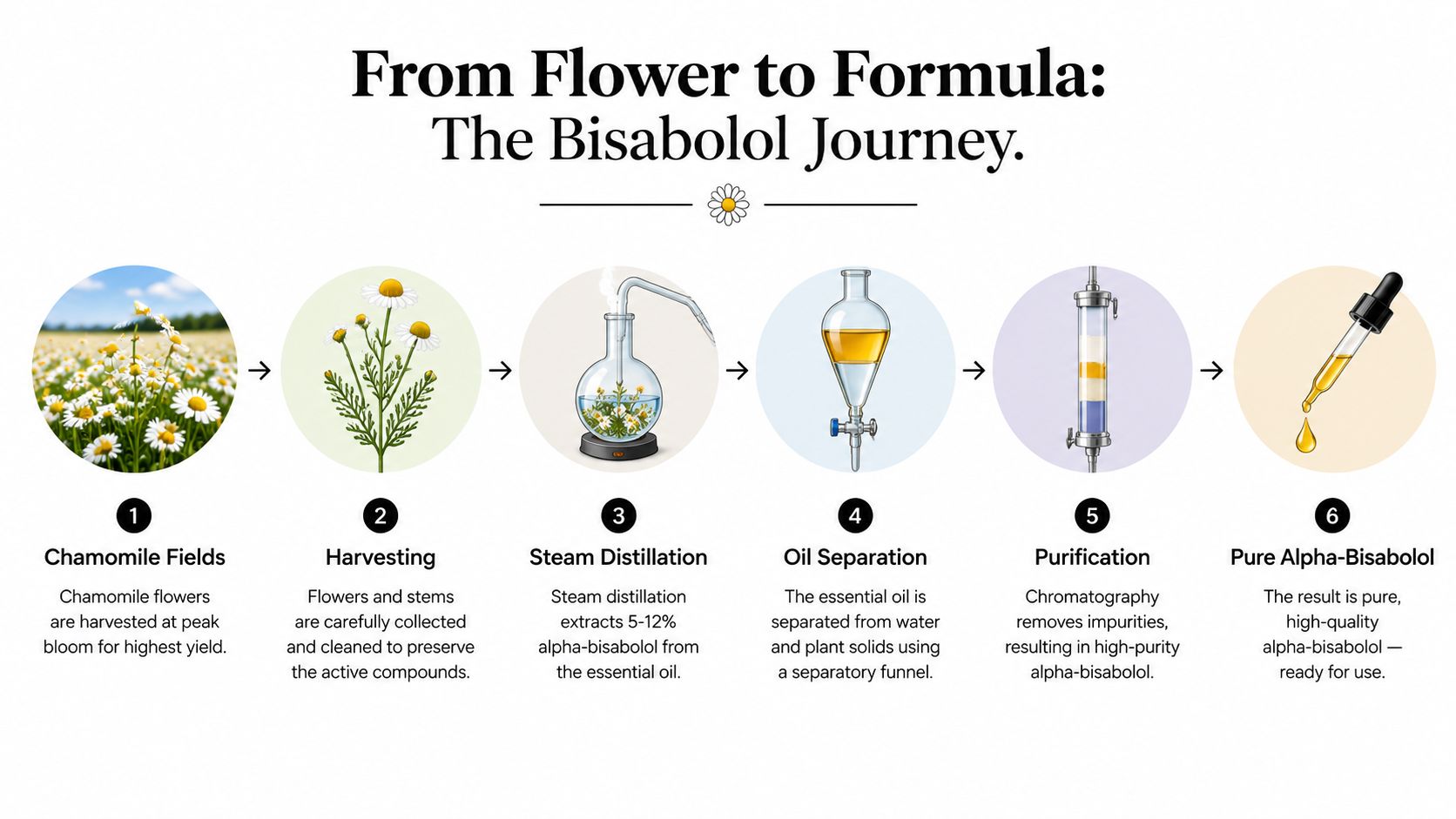
Source choice changes the result
The extraction route affects what reaches the finished blend. A natural isolate may retain trace co-distillates that change how bisabolol connects with limonene, pinene, or myrcene. A synthetic material can smell close in a simple comparison, while a natural fraction may create a more textured transition. That distinction matters when the goal is replicating the flavor of a cultivar, rather than adding a generic floral note.
A natural label does not guarantee a better cart result. Botanical source, processing history, and purification all affect repeatability. A purified isolate may be easier to standardize than a complex essential-oil fraction. Conversely, residual co-components can add character, but they can also complicate stability work and make sensory attribution less clear.
The isolation of terpenes guide helps frame the choice between an isolate, a botanical fraction, and a broader strain-inspired blend. In production, match the material to the target aroma, batch consistency requirement, and supplier documentation. Chamomile, cannabis, and synthetic origin each involve trade-offs. Select the source that reproduces the intended sensory result and passes the quality gate.
Formulating With Bisabolol in Vape Cartridges and Distillate
Treat bisabolol as a concentrated flavoring material, not a carrier. It can fit into distillate systems that use MCT, VG, PG, PEG, or other documented diluents, yet compatibility must be checked in the actual oil matrix and cartridge hardware. The same percentage can behave differently across viscosities, formulations, and devices.
Keep the total terpene load conservative for cart work. A practical ceiling is 1% to 3% total terpenes, with bisabolol commonly taking 5% to 15% of the terpene blend, or approximately 0.05% to 0.45% of finished oil, depending on the SKU. The established safety assessment provides context for low-dose cosmetic use and a reported leave-on concentration of 1%, but it is not a universal cannabis dosing instruction.
A workable bench sequence
Warm the distillate gently. Bring the oil to approximately 40°C to 45°C so it moves without unnecessary thermal stress.
Build the terpene premix first. Combine the lighter volatiles before introducing the sesquiterpene. This gives the technician a clearer read on whether bisabolol is filling a sensory gap or just increasing intensity.
Add bisabolol late. Add it after the brighter terpenes, then mix at low shear. High shear can introduce air and make a small batch more difficult to assess consistently.
Sample before filling. Pull a homogeneity sample from the finished oil and compare it with the intended aroma. Bulk appearance alone does not confirm uniform mixing.
| Cart Format | Total Terpene Load | Bisabolol % of Blend | Bisabolol % of Finished Oil | Mixing Notes |
|---|---|---|---|---|
| Light botanical cart | 1% | 5% to 10% | 0.05% to 0.10% | Use for subtle floral rounding |
| Balanced strain-inspired cart | 2% | 5% to 15% | 0.10% to 0.30% | Evaluate after full homogenization |
| Dense dessert or floral cart | 3% | 10% to 15% | 0.30% to 0.45% | Confirm that top notes remain distinct |
Older ceramic hardware can reveal a formulation problem that did not appear in the beaker. A viscous, sesquiterpene-rich blend may saturate the wick more slowly, so filling behavior and draw performance require separate checks. Allow the blend to rest for 48 hours at room temperature before sensory QC, then assess both the oil and the filled device.
The guide to mixing distillate with terpenes covers the broader workflow. In practice, bisabolol usually works better below the amount suggested by an initial bench impression, because its value is often sensory rounding rather than headline intensity.
Functional Properties Without the Medical Claims
Bisabolol earns its place in a blend through controlled sensory function, not medical positioning. Its chamomile-like character can soften sharper notes, add a botanical cue, and give a distillate profile a more finished impression. Research has also examined antioxidant, anti-inflammatory, antimicrobial, and anti-apoptotic activity, but those findings belong to ingredient and laboratory contexts.
Keep that evidence boundary clear in every brief and label review. A formulation observation does not show that inhaling a vape containing bisabolol produces a therapeutic result. Cannabis brands should avoid turning ingredient-level research into claims about pain, inflammation, recovery, anxiety, or other medical effects.
What brands can say responsibly
Use sensory and cosmetic-adjacent language:
- Chamomile association: Its aroma can support a floral, botanical, or tea-like product story.
- Skin-conditioning history: Cosmetic use explains why bisabolol appears in personal-care formulations, without establishing an inhalation benefit.
- Antioxidant and anti-inflammatory research language: These terms can describe published ingredient research when properly qualified. They should not become unqualified claims about a vape.
- Soft sensory character: The sweet-floral profile can support a calmer-feeling brand aesthetic, provided the copy does not promise a physiological effect.
That distinction gives a formulator room to build a wellness-adjacent identity while keeping product language tied to aroma, flavor, and blend design. A SKU may suggest chamomile or lavender through its profile and botanical narrative, while avoiding unsupported promises.
Bisabolol's commercial relevance also includes its cosmetic safety history. A cosmetic safety assessment found it safe as used in cosmetics under current practices and concentrations. That conclusion is not blanket approval for every inhalation route, device, or finished oil. The manufacturer still has to evaluate the intended route, hardware, concentration, and complete formulation.
Comparing Bisabolol With Other Terpenes in a Blend
A cart can have enough brightness, body, or spice and still feel disconnected. Bisabolol earns its place when the formula needs a quiet connector, adding sweetness and floral softness between sharper top notes and a heavier base. Myrcene supplies herbal volume, linalool gives a clearer floral lift, and beta-caryophyllene brings peppery depth. Bisabolol rarely leads the profile. It improves the handoff between layers.
The boiling-point comparison below offers a practical starting point for these materials. It does not predict the complete sensory result. Matrix, concentration, headspace, and detection threshold also determine which notes appear first and how long they remain noticeable.
| Terpene | Class | Boiling Point (C) | Aroma Role | Best Used When |
|---|---|---|---|---|
| Bisabolol | Sesquiterpene alcohol | 153 | Sweet floral mid-note with chamomile and light spice | The blend needs a soft bridge between sharp top notes and a heavy base |
| Myrcene | Monoterpene hydrocarbon | 167 | Herbal, earthy, rounded body | The profile lacks broad green or earthy volume |
| Linalool | Monoterpene alcohol | 198 | Floral, herbal, cooler lift | The blend needs a cleaner floral accent |
| Beta-caryophyllene | Sesquiterpene hydrocarbon | 129 | Peppery, woody, dry base | The profile lacks spice, wood, or depth |
Choose by the missing sensory function
Use bisabolol when limonene or pinene feels too pointed and the formula needs floral sweetness to connect those notes with a heavier body. It suits a clean, rounded finish better than a peppery or resinous one.
Choose linalool for an obvious floral or herbal lift. Its floral character arrives more immediately, while bisabolol usually sits lower and feels integrated. Choose beta-caryophyllene when the missing layer is dry spice, wood, or pepper. Bisabolol can soften that formula, but it will not supply the structure that beta-caryophyllene provides.
Myrcene remains useful when the oil lacks broad mid-note mass. It can give the blend herbal, earthy volume, while bisabolol contributes a sweeter, chamomile-like direction. The choice should follow the sensory gap, not terpene fashion.
For vape and distillate work, test the candidate in the complete base rather than judging it alone. A small addition can connect a sharp top note to the body, while an unnecessary addition can blur definition. Bisabolol does its best work when the blend needs cohesion and the formula has room for softness.
Lab and Quality Checks Before Bisabolol Hits a Cart
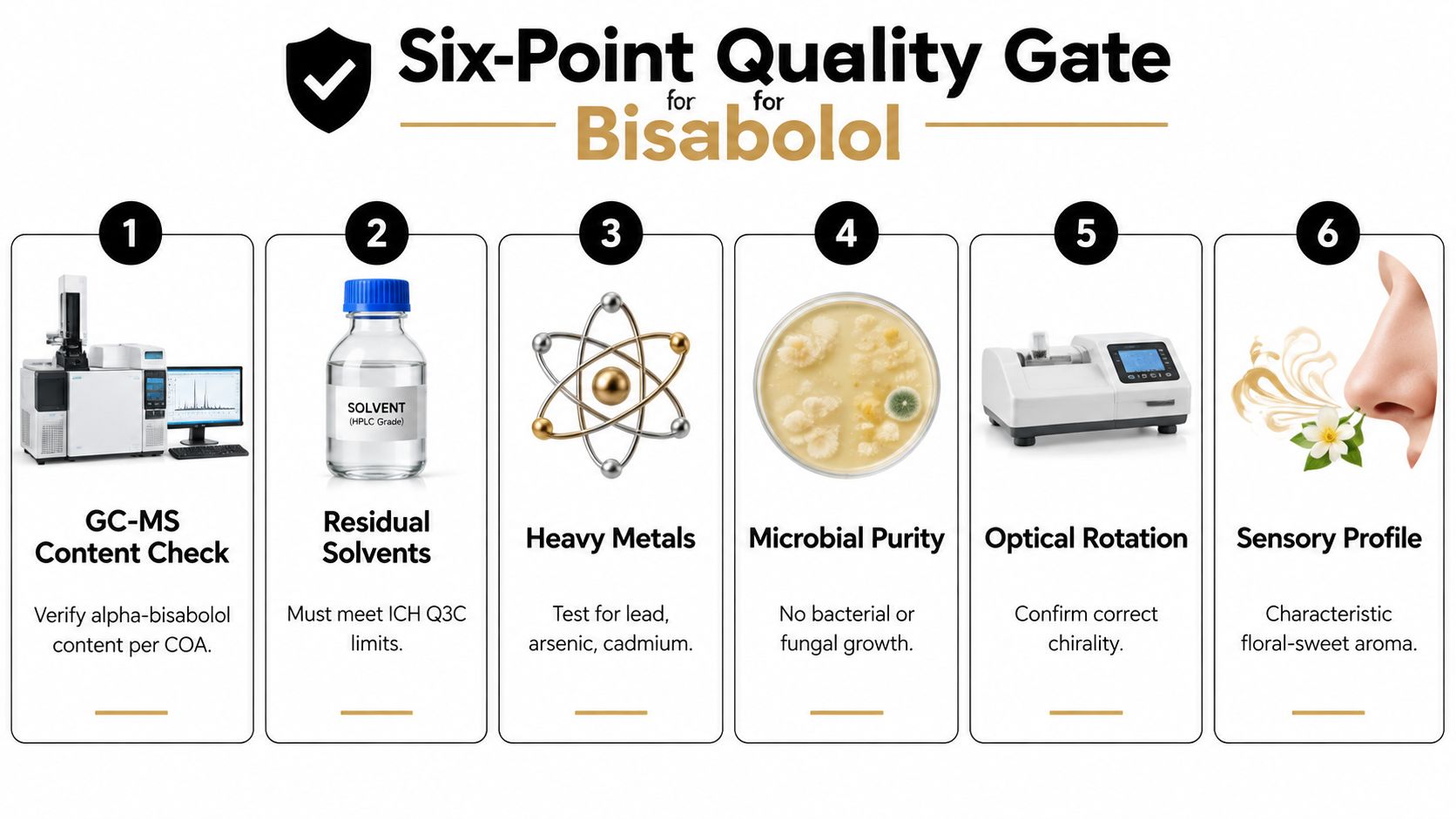
Every incoming bisabolol lot should pass a defined quality gate before it touches distillate. The COA needs to identify alpha-bisabolol content by GC-MS and document the tests relevant to the finished product. Cosmetic safety history doesn't replace raw-material verification, especially when the material is going into a heated device.
Six checks for incoming material
Content and identity: Confirm alpha-bisabolol content, retention time, and mass spectrum against an appropriate reference standard.
Residual solvents: Review the supplier's solvent panel against the applicable ICH Q3C limits. A missing result isn't a clean result.
Heavy metals: Require a heavy-metals screen suitable for the raw material and intended product pathway.
Microbiological status: Review microbial counts and acceptance criteria before release.
Chiral information: Flag lots that omit chiral data. Natural levorotatory material and racemic material can behave differently during aroma evaluation, even when the headline identity appears correct.
Sensory and physical check: Pure bisabolol should present a clean, sweet-floral aroma without camphor, solvent, or burnt off-notes. Test a small dilution in MCT and PG, then check for phase separation at room and refrigerated temperatures.
Make sensory release reproducible
Use a blind-coded comparison against a retained reference with a three-person sensory panel. If the panel identifies a drift greater than 10%, escalate the lot for deeper review rather than blending around the problem. That threshold is a practical internal control, not a universal regulatory standard, and your quality system should define how the panel scores it.
Record the supplier lot, internal batch number, storage condition, dilution matrix, panel result, and retest interval. This documentation lets the production team trace a finished SKU back to the raw material that passed release. It also helps separate a bisabolol issue from a hardware issue, a distillate issue, or an aging issue.
The following video can supplement technician onboarding, but it shouldn't replace your own validated SOPs.
Putting Bisabolol to Work in Your Next SKU
Start with the hardware and sensory result you need. In a botanical live-resin-style cart, a restrained bisabolol dose can round sharp pinene or limonene while keeping the blend bright. A dessert-leaning distillate may support a clearer floral note when vanilla, cocoa, or other heavy sweet cues already anchor the base. The cartridge remains the final judge, because heat and airflow can change the balance found in a beaker.
A repeatable production brief
Turn the target into instructions another technician can follow:
- Define the gap: Identify whether the formula needs less sharpness, more floral sweetness, stronger mid-note continuity, or a fuller finish.
- Build the premix: Combine bisabolol with lighter terpenes before adding the mixture to the oil.
- Control temperature: Add the premix to cooled distillate below 40°C when practical. Poor mixing should be corrected through process, not extra heat.
- Record the order: Log ingredient order, temperature, stir time, vessel, and batch size.
- Test the device: Assess filled hardware, not only a beaker sample.
- Review stability: Check sensory performance at 14 and 30 days before release.
The best use of bisabolol is quiet. It improves continuity without flattening the blend's identity, masking a weak distillate, or turning a floral profile into perfume. If the bright top note disappears, the dose or surrounding terpene structure needs revision.
For teams building a terpene profile for cannabis product formulation, Gold Coast Terpenes supplies Alpha Bisabolol isolate, strain-specific terpene blends, and formulation resources for cartridges and concentrates. Its catalog also includes lab-verified terpene materials, application education, and tools for progressing from raw-material dosing to hardware evaluation.
Gold Coast Terpenes supplies Alpha Bisabolol isolate and strain-inspired terpene blends for carts, distillates, and concentrates. Visit Gold Coast Terpenes to review available materials, compare formulation options, and source bisabolol for a controlled bench trial.