
Most brands treat a COA like a finish line. In real production, it's only a receipt. If the lab wasn't independent, the method wasn't fit for the sample, or the report can't be tied back to the exact lot on your bench, the paper looks clean and the batch still fails the room.
That's why third party lab testing matters in cannabis terpene and concentrate work. Done right, it's not a sticker, it's a chain of evidence, with an accredited lab, a documented sample, validated methods, and a report you can defend in a release meeting. The broader market is already built around that reality, with one industry analysis estimating the third-party medical testing laboratory market at USD 12.75 billion in 2025 and projecting USD 24.36 billion by 2032 (All Market Analysis).
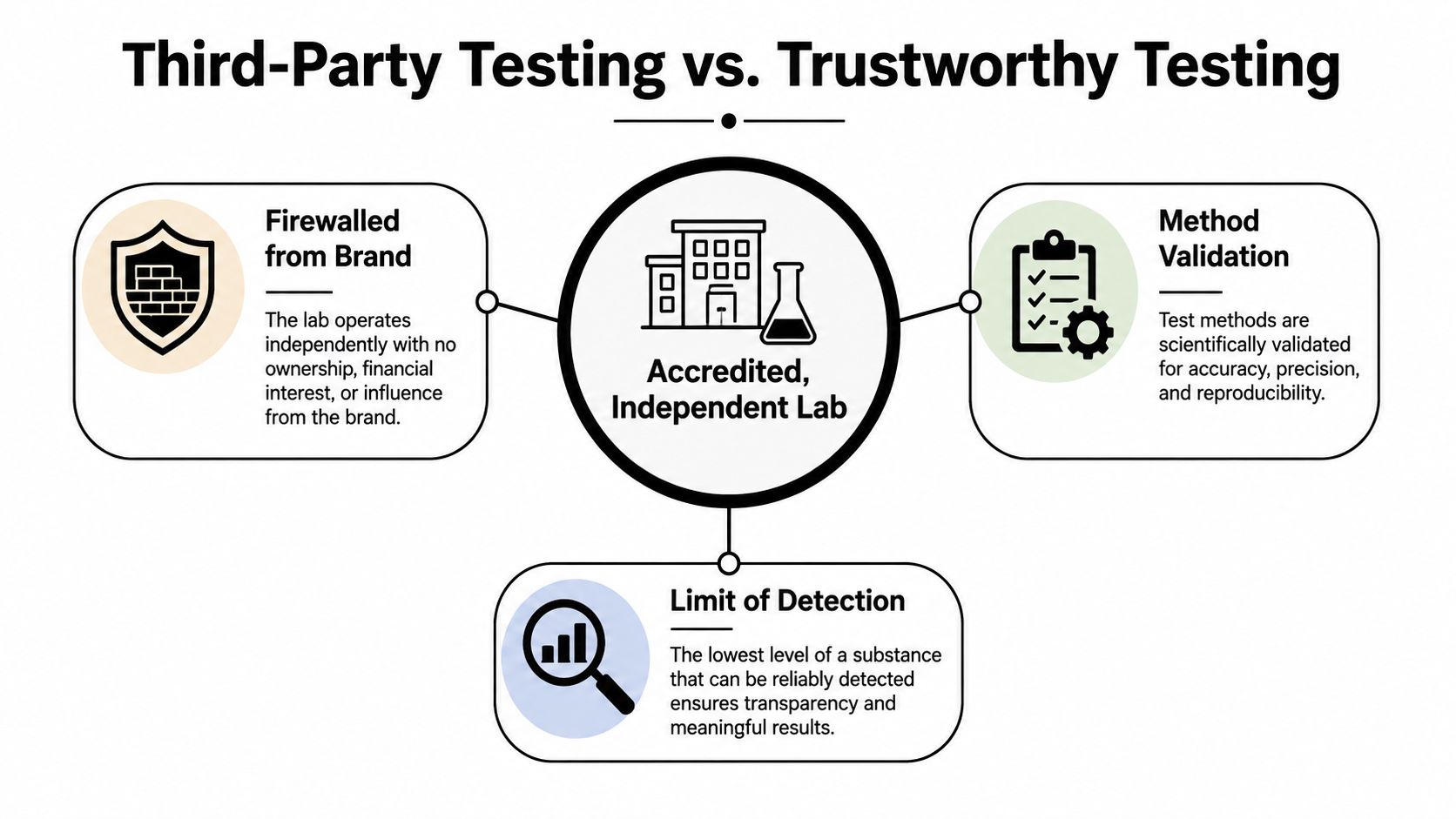
Why Third-Party Lab Testing Is Not the Same as Trustworthy Testing
A tested product is not automatically a trustworthy product. In formulation work, third-party lab testing only matters when the lab is independent from the brand or supplier, the method fits the analyte, and the report can be traced to the exact sample and lot that entered production. Without that, you have a document with numbers on it, not proof you can defend.
That distinction matters because self-reporting, in-house QC, and outsourced verification solve different problems. In-house checks help a team move fast, but they do not remove conflict of interest. Third-party verification is the layer that still stands when a retailer asks for backup, a regulator asks for records, or a buyer asks whether the result matches the batch on the bench.
Practical rule: if you cannot identify the lab's scope, method, and sample chain in a minute or two, you do not have a release-ready report.
Independent testing is a mature market, especially in healthcare. All Market Analysis places North America at 42% share and the United States at 36%. That tells you outsourced testing already sits inside regulated quality infrastructure. It is not an optional upgrade for cautious brands.
For cannabis terpene and concentrate teams, that maturity does not remove the need for judgment. It raises the bar. A lab can be independent and still be a poor fit for your use case if the sample handling is sloppy, the method is outdated, or the report omits the details you need for procurement.
Auditing a lab starts with independence, then moves to method validity and COA integrity. That matters more in terpene and concentrate work than in generic product testing, because volatile fractions, viscous matrices, and blend variability expose weak methods fast. If you want a useful primer on why chromatography matters in that context, this overview from Gold Coast Terpenes is a practical place to start. The test is whether the lab can show that its independence, methods, and paperwork all line up with the sample you submitted.
That is the lens to use here. Independent is the starting point, not the answer.
The Core Analyses Every Terpene and Concentrate Lab Should Run
A credible lab scope starts with the panels that change formulation decisions. For carts, concentrates, and terpene blends, that usually means potency, full terpene profile, residual solvents, heavy metals, pesticides, and microbial contamination, with moisture or water activity added where the product format makes it relevant. Each panel answers a different question, and if one is missing, you're filling in the gap with guesswork.
Potency and identity checks
Potency confirms what's really in the oil, not what the label assumes is there. For distillate and finished carts, that matters because diluent choice, terpene load, and flavor balance all shift when the base oil is stronger or weaker than expected. A good lab usually uses a chromatography-based method family, often HPLC or a related assay for cannabinoid content, because you need repeatable identity and concentration data, not an estimate.
Terpene profiling belongs in the same conversation. GC-MS is common here because it separates the volatile fraction that drives flavor and aroma. If you're replicating a strain-inspired profile, top notes, mid notes, and base notes stop being marketing language and start becoming formulation inputs.
Contaminants and stability risks
Residual solvents, heavy metals, pesticides, and microbes are the panels that protect the batch from hiding bad upstream decisions. ICP-MS is common for elemental contamination, while pesticide and solvent testing typically rely on their own validated chromatography methods. These are the checks that keep a pretty-smelling oil from becoming a procurement problem.
The 2022 CBD brand audit is the cautionary example every team should keep in mind. Only 7% of brands tested all products for pesticides, heavy metals, and microbes, only 12% had all products within acceptable potency variance limits, 20% did no purity testing at all, and 88% of brands that did potency testing had at least one product exceed the 10% potency variance threshold (Leafreport summary). That's not a niche compliance issue, it's a reminder that incomplete panels let bad assumptions survive into finished goods.
For cannabis and terpene formulations, I'd rather see a narrower product line tested well than a broad line tested lazily. The lab scope should match the risk, the matrix, and the claim.
Chromatography testing guidance for product developers
Reading a Certificate of Analysis Like a Formulator
A useful COA tells a story. A decorative COA just tells you the marketing team got involved. The difference shows up in the fields most buyers skim past, because those fields determine whether the document is defensible.
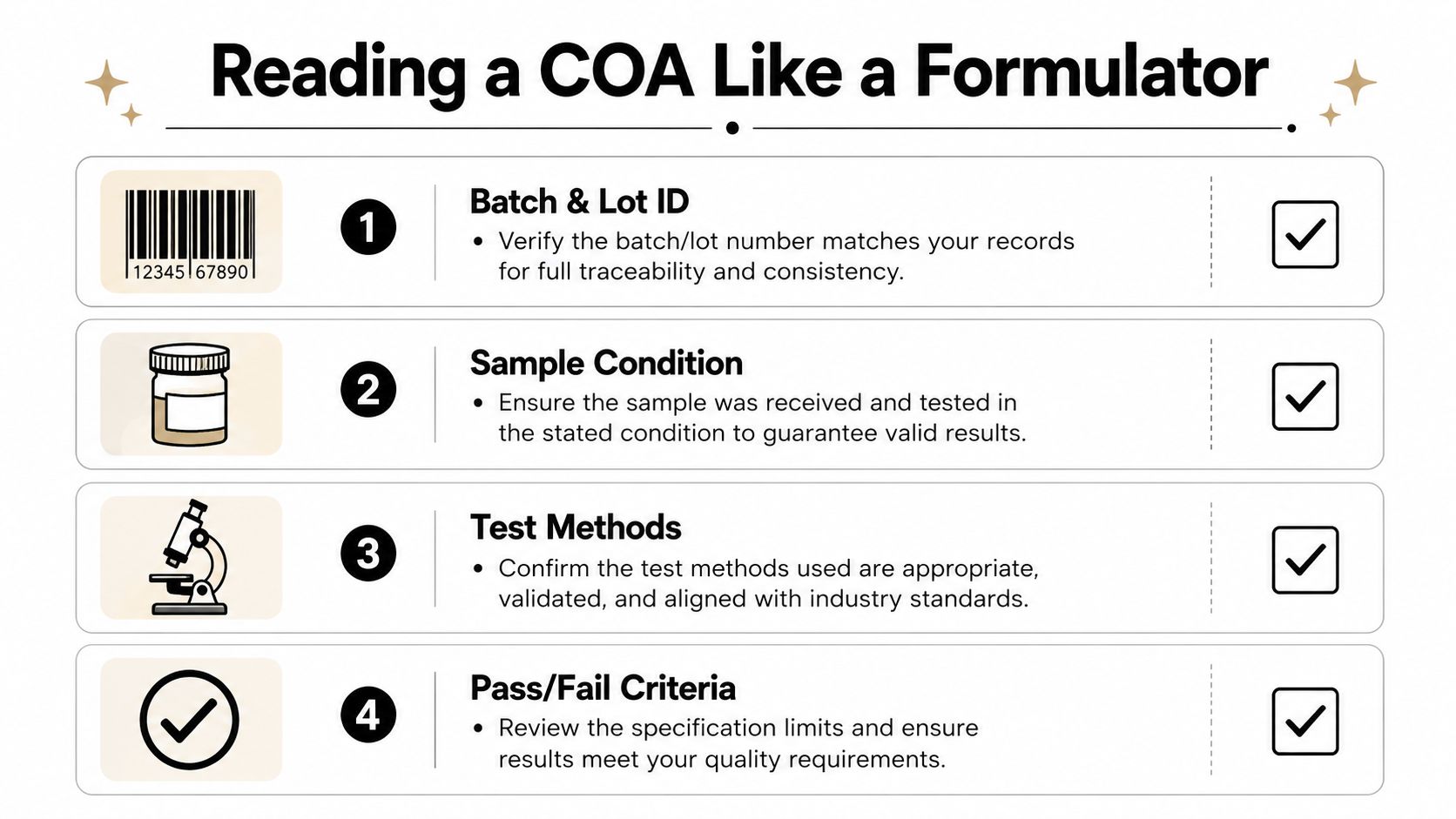
Start with identity, method, and traceability
Look first for batch or lot identity, sample receipt condition, and the exact test method and revision. If the report doesn't tie back to the exact material you released, it's a spreadsheet, not a control document. The report should also show units, detection limits, and measurement uncertainty, because those details tell you how much confidence to place in the number.
A defensible lab report should also carry chain-of-custody logic, sample traceability, calibrated equipment, validated methods, and pre-defined acceptance criteria. Those controls matter because a result can be analytically plausible and still be useless for compliance or procurement if you can't prove the sample was preserved, tested properly, and judged against the right spec (Textileschool guidance).
Don't confuse non-detect with proof
A non-detect isn't the same thing as “nothing is there.” It only means the analyte wasn't detected above the method's reporting threshold. If the lab doesn't state the limit of detection or the right reporting basis, a buyer can easily overread the result.
When the lab doesn't show the method version or the decision rule, I treat the COA as incomplete, even if the numbers look clean.
The signed-off report matters too. If there's no responsible analyst or review signoff, the document lacks accountability. For release decisions, that's a red flag that the lab values throughput more than defensibility.
Accept or reject with the spec in front of you
If the batch identity matches, the sample condition is intact, the method is appropriate, and every result sits within the acceptance criteria, you can release with confidence. If any one of those pieces is missing, the right move is to hold the lot and ask for the underlying data before anyone blends, fills, or labels.
Certificate of analysis interpretation resources
Choosing a Lab You Can Trust
Accreditation is the first filter, not the final answer. For regulated consumer products, third-party testing only counts when the lab is independently accredited to ISO/IEC 17025 and accepted for the specific rule or test scope. The CPSC also says that accreditation must come from an ILAC-MRA full member, and the lab needs safeguards against internal or external commercial pressure that could affect results (CPSC lab accreditation FAQ).
What to ask before you approve the vendor
Start with scope. A lab can have a solid quality system and still be weak on the exact analytes you care about for terpene and concentrate work. Ask for the method list, the accredited scope, and the evidence that the method is validated for your matrix, not just for a generic extract.
Then ask how the lab handles out-of-specification results, reanalysis, and retained samples. Industry guidance says buyers should check accreditation, scope, methods, and documented procedures for handling OOS data, while FDA-oriented guidance supports due diligence, method verification, and independent reanalysis or raw-data benchmarking when needed (NPI-DM guidance).
A lab that avoids those questions is a problem. The release team needs to know whether the lab can show method versioning, traceable raw data, and a clear path from an unexpected result to a documented decision.
Watch the governance, not just the logo
A lab can be technically competent and still be too close to the commercial pressure around it. That's why firewalls matter. UL's Third-Party Test Data Program is a useful model here, because it requires a fully documented ISO/IEC 17025 quality program, qualified personnel, validated methods, documented procedures for accuracy and precision, and annual reassessment of an established test lab (UL program document).
Vendor rule: if the lab can't explain how it stays independent from the people paying for the work, keep looking.
Independence is a starting point, not a conclusion. For terpene and concentrate work, I want to know whether the lab can defend its methods under pressure, whether the analyst can trace the result back to a run file, and whether the COA reflects the actual sample that was tested. A clean logo does not tell you that.
If you're comparing a general commercial lab, a cannabis-specific lab, and internal QC, use the same standard. Internal QC is fine for process control. A commercial lab is acceptable only if the scope fits. A cannabis-specific lab is useful when it understands the matrix and the regulations, but it still needs the same accreditation, validation, and firewalled governance. A good review of quality control testing resources can help you pressure-test those claims before you sign off on a vendor.
Sample Handling, Chain of Custody, and Testing Frequency
Bad sampling breaks good chemistry. If the material sent to the lab does not represent the batch in the tote, drum, or cartridge fill line, the result can be precise and still misleading. The first job is homogenization, then subsampling into the right container, then storing it under conditions that do not change the analytes before analysis.
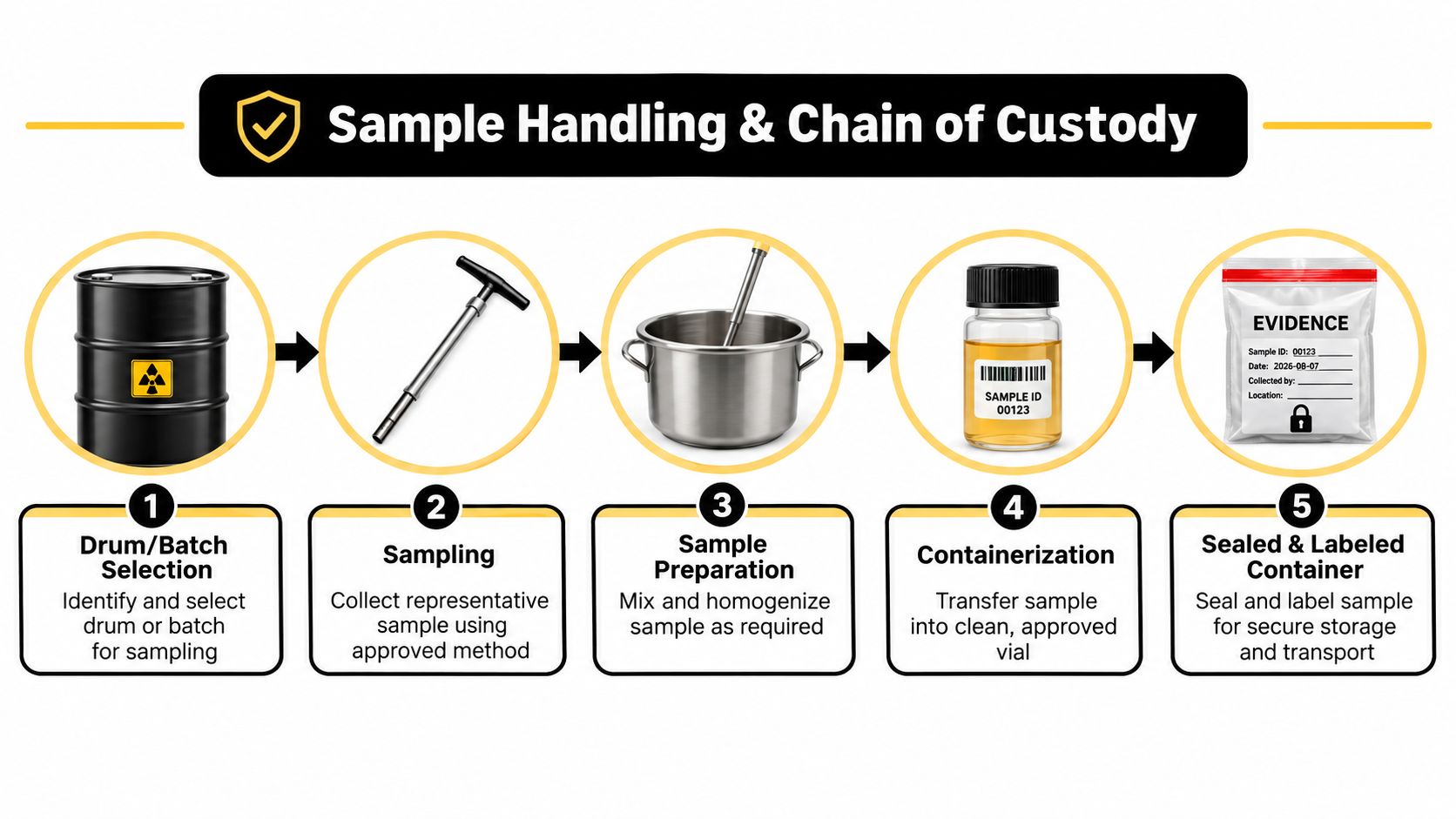
Build a chain of custody that survives questions
A defensible handoff needs seals, transfer logs, and clear sample identity from the moment the material leaves your control. If a seal is broken, unlabeled, or undocumented, the lab result may still be analytically correct, but it will not be clean enough for a release file. That matters most for high-value terpene blends and concentrate lots where one substitution can change the sensory profile and create a release dispute.
Testing frequency should follow risk. Incoming raw material deserves one cadence, in-process checks another, and finished-product release a third. Stability or shelf-life retests belong in the plan too, because a lot that passed at receipt can drift after storage, heat exposure, or blend changes.
Treat retesting as a control, not a punishment
A retest is not a sign the first lab failed. It is proof that the brand cares about continuity across the lot's life cycle. If your SOP cannot explain when to retest, who holds the retain sample, and how a mismatch gets escalated, the release process is too loose.
Cross-border shipments add another layer of control. Sample movement needs to follow the right paperwork and packaging rules, and international shipping and sample movement guidance is worth checking before a specimen leaves your site. That is where a clean chain of custody either holds up or falls apart.
Buyer and QA Checklist for Cartridge and Concentrate Makers
The easiest way to use third party lab testing well is to map each check to a formulation stage. That keeps the team from treating the COA like a one-time purchase and turns it into a living control in the approved-vendor file.
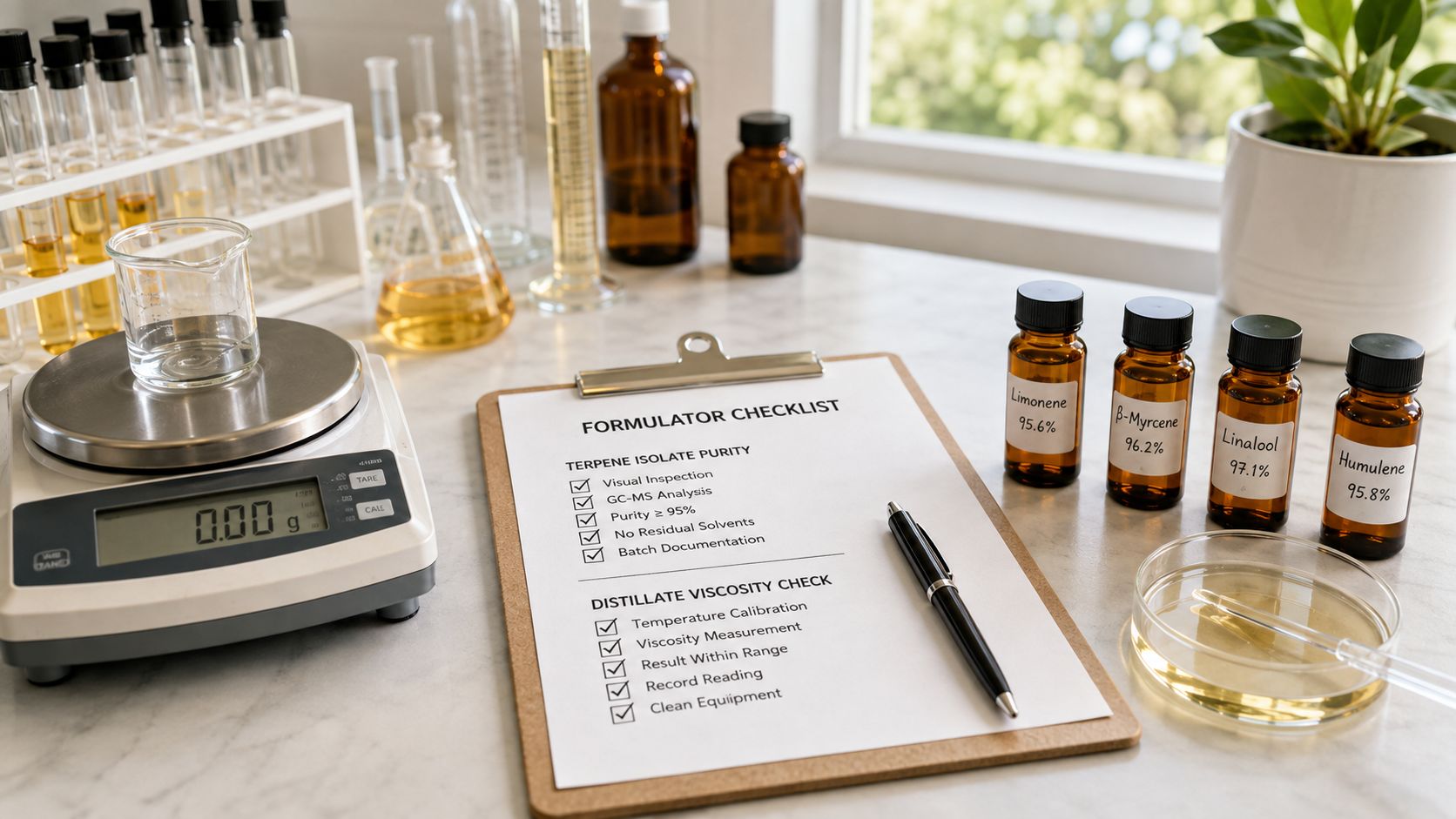
Use the same standard from inbound to finished goods
Incoming terpene isolates need identity and purity checks before they ever hit a blend tank. Distillate diluent verification protects the fill line from chasing viscosity or flavor issues that were really caused by a bad base oil. Finished-cart potency confirmation protects the label, while shelf-life retest protects the next production run from copying a drifted lot.
| Stage | Check | Why It Matters |
|---|---|---|
| Incoming terpene isolate | Verify identity, lot traceability, and report scope | Stops the wrong aroma component from entering the blend |
| Distillate approval | Confirm potency and contaminant panel | Protects the base oil before dilution or flavoring |
| Formulation trial | Match terpene profile to the target sensory brief | Keeps top, mid, and base notes aligned with the spec |
| Finished cart release | Review COA, acceptance criteria, and signoff | Supports label accuracy and batch release |
| Retain and shelf-life hold | Recheck for drift or substitution risk | Catches changes after the original test date |
Don't outsource your judgment
A lab COA is one input, not the whole decision. You still need to check whether the sample came from the right lot, whether the method fits the matrix, and whether the report matches the spec sheet you approved in R&D. That's especially important if you're using a strain-inspired terpene blend, because sensory mismatch usually starts with bad assumptions upstream.
One practical option for terpene and concentrate teams is to pair a trusted lab workflow with a supplier that already publishes formulation tools and product documentation. Gold Coast Terpenes sits in that category, with terpene profiles, isolates, and formulation resources that can be matched against your own release criteria, but the lab file still has to stand on its own.
Where Third Party Testing Still Leaves Gaps
A COA doesn't guarantee stability after the sample leaves the lab. It doesn't stop a supplier substitution, and it doesn't prove the whole production lot behaved the same way as the vial that got tested. That's why the safest teams keep internal controls alive after the third-party result comes back.
The other trap is method limitation. Some contaminants are easy to under-report when the scope is too narrow or the matrix is unusual, so buyers need to ask what the test covers, not just whether it passed. The trend toward faster, more distributed testing helps access, but it also makes buyer diligence more important, not less.
If you want terpene profiles, isolated compounds, and formulation support that fit real cartridge and concentrate work, review the options at Gold Coast Terpenes and compare them against your own COA requirements. Bring your current spec sheet, your target flavor brief, and your release criteria, then build the next batch around evidence instead of assumption.