
The last cartridge run came back from the filler tasting flat. The oil tested clean, the hardware was the same as always, and nobody could say what percentage of terpenes went in, because the number never made it onto the batch record.
That's the usual failure. A terpene blend is an input with a dose, a volatility curve, an oxidation risk and a paper trail, not a finishing touch added until the smell feels right. Set the dose close, choose isolates that survive the device, keep stock cold and sealed, and the flavor holds its shape from the mixing tank to the shelf.
The decisions that matter run in a fixed order. Loading first, then the notes, then the blend, then proof it holds, then the paperwork for the market you're selling into. Each step leaves you with a number or a document you can check.
Terpene Dosing Ratios for Each Product Type
Say a 1,000 g batch of winterized distillate is on the bench and the target is 4% terpenes by weight. Someone adds a splash, the batch gets filled, and three weeks later the cartridges read thin. The terpenes didn't fail. Nobody set the dose.
Start from a loading that's known to work as a first attempt, then test up or down from there.
| Product type | Typical loading (by weight) | Mixing note |
|---|---|---|
| Vape cartridge on distillate base | 2-5% | Start low; higher loads thicken oil and change flow |
| Flavor-forward cartridge | 5-10% | Use bold blends sparingly; test heat behavior first |
| Concentrate or dab flavoring | 3-6% | Blend into warm base and cool before sealing |
| Topical or non-ingestible fragrance-style product | 1-3% | Check compatibility with the carrier system |
| Food or beverage flavoring | Under 1% | Use only substances permitted for the destination market |
The gram math behind a percentage
Grams of terpene equal batch weight times the target percentage. A 1,000 g batch at 4% needs 40 g of blend. Weigh on a scale precise enough to hit the target, and write the exact figure on the batch record, because "about 4%" is how batches drift.
Working rule: a percentage that isn't written down can't be repeated, defended or corrected. Put the grams on the record sheet before the bottle comes off the shelf.
These ranges are starting points, not limits and not specifications. Run a test batch, then move in 0.5% steps, which is enough to shift aroma and small enough that you won't overshoot in one pass.
Heavier loads aren't only a cost problem. Past a point the oil thickens, and the cartridge that wicked well at 3% may pull and heat differently at 8%. The coil and the viscosity of the base decide where that ceiling sits for your hardware.
Oxidation gives you a second reason to stay deliberate near the top of the range. A 2025 study in ACS ES&T Air found that adding a commercial terpene mixture to delta-8 and delta-10 THC distillates at 7.5% and 15% by mass raised carbonyl emissions by as much as ninefold, with the researchers attributing the increase to terpene oxidation and raising inhalation-toxicology concerns (2025 ACS study on terpene oxidation in aerosols). A bold note and a heavy load are two separate decisions, and only one of them is about flavor.
The order of operations for mixing into a distillate base, including when to warm the oil, is set out in how much terpenes to add to distillate.
Three checks that confirm a loading is right
- Aroma on the first draw. The lead note should read clearly without the user hunting for it. If you taste carrier oil first, the load is light or the blend is wrong.
- Flow at room temperature. The oil should still move and feed. Viscosity is the earliest signal that the load is above what the device tolerates.
- The seven-day recheck. Pull a retained sample a week later and compare it to the fresh one. Flavor that has already moved isn't stable, it's a draft.
What Terpenes Are and Why Molecular Size Matters
Treat terpenes as the spice rack of the plant kingdom. Each jar holds a small aromatic molecule, and the whole shelf is built from the same part: a five-carbon isoprene unit.
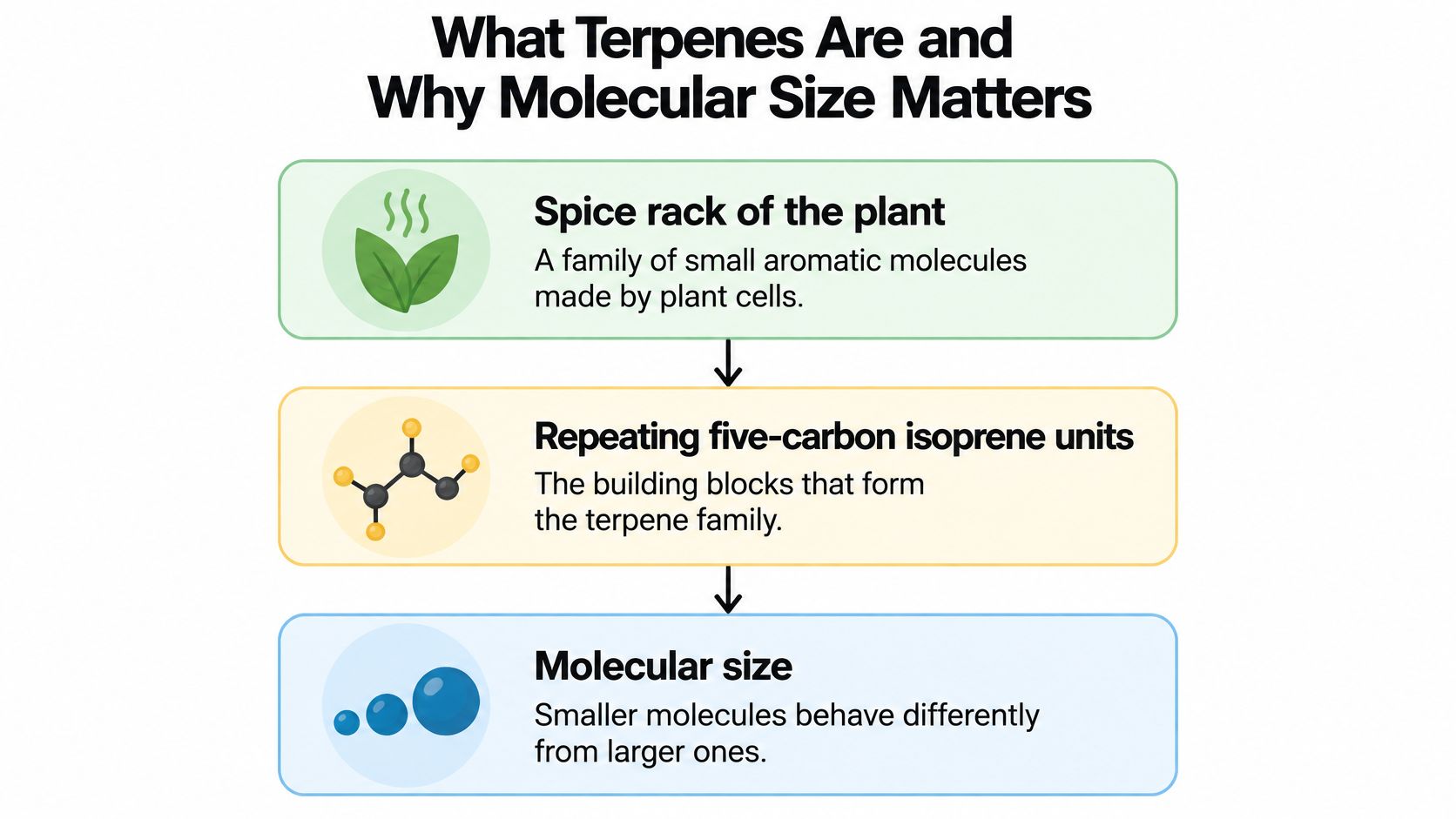
Count those units and the shelf sorts itself. A review in the Journal of Endocrinology lays out the classification: monoterpenes carry two units and 10 carbon atoms, sesquiterpenes three units and 15 carbons, diterpenes four units and 20 carbons, with larger classes at 30 and 40. Limonene, pinene and myrcene sit in the first group. Beta-caryophyllene sits in the second.
Why size decides where a note lands
Molecular size predicts behavior in a formula better than any aroma description does. The same review notes that smaller monoterpenes generally evaporate more readily, while larger sesqui- and diterpene structures tend to be less volatile. That's the mechanism behind a note that disappears and a note that lingers.
Translate it into product terms. Top notes, the citrus peel and cut-grass impressions that hit first, come from volatile monoterpenes, and they're the first thing a warm cartridge loses. Warm, lasting depth comes from heavier molecules that stay in the oil longer. Same bottle, different clock.
A note you can smell across the room on day one and can't find on day thirty wasn't a bad blend. It was a volatile lead with no anchor under it.
Our isolates are botanically derived. We extract from fresh plants, and they're free of mixtures, chemicals and additives, sold as single compounds for blend building or as finished blends when you'd rather start from a profile.
The takeaway is procedural. Check the volatility of an isolate before it goes into a dosing plan, not after the first batch comes back thin.
Blend design and the chemistry that ties the family together are covered in the chemistry of terpenes.
Common Isolates, Their Aromas and How Fast They Fade
Plants produce approximately 25,000 terpenoid compounds, according to a review in Planta. That's the size of the shelf you're buying from, and a flavor profile is a chosen subset of it, not a single active ingredient. It's also why a blend beats one heroic isolate every time.
The six below cover most of what a cartridge, concentrate or fragrance program needs. Learn them by aroma first, then by how fast they leave.
| Isolate | Common aroma notes | Relative volatility | Usual role in a blend |
|---|---|---|---|
| Limonene | Citrus, lemon | Higher (monoterpene) | Lead citrus note |
| Alpha-pinene | Pine, fresh wood | Higher (monoterpene) | Fresh, green lift |
| Myrcene | Earthy, herbal, musky | Higher (monoterpene) | Base or body note |
| Linalool | Floral, lavender | Higher (monoterpene alcohol) | Floral accent |
| Terpinolene | Fresh, piney, floral | Higher (monoterpene) | Bright top note |
| Beta-caryophyllene | Peppery, clove-like | Lower (sesquiterpene) | Warm, spicy depth |
The supporting cast worth knowing
Three more isolates fill the gaps the main six leave open. Beta pinene adds a pine and turpentine note that cuts sharper than alpha-pinene. 3-carene carries a sweet, pungent resin odor and is a main constituent of pine and cedar resin, which makes it useful when a blend needs a woody backbone. Terpineol brings a clean floral smell of the kind used in soaps and perfumes, and it rounds off a sharp citrus top without adding sweetness.
Ratio thinking starts with one decision: which note leads. A citrus cartridge might take limonene as most of the terpene load, then pinene for lift and caryophyllene for depth at a fraction of the limonene weight. Get the hierarchy wrong and you get a blend that smells like three things arguing.
Practical sequencing: name two to four lead notes before you touch any ratios. Blends fail at the concept stage more often than at the bench.
How to Build a Flavor Blend Step by Step
A repeatable blend starts as a spec, not a hunch. Write the target, set the hierarchy, then scale only after the panel agrees.
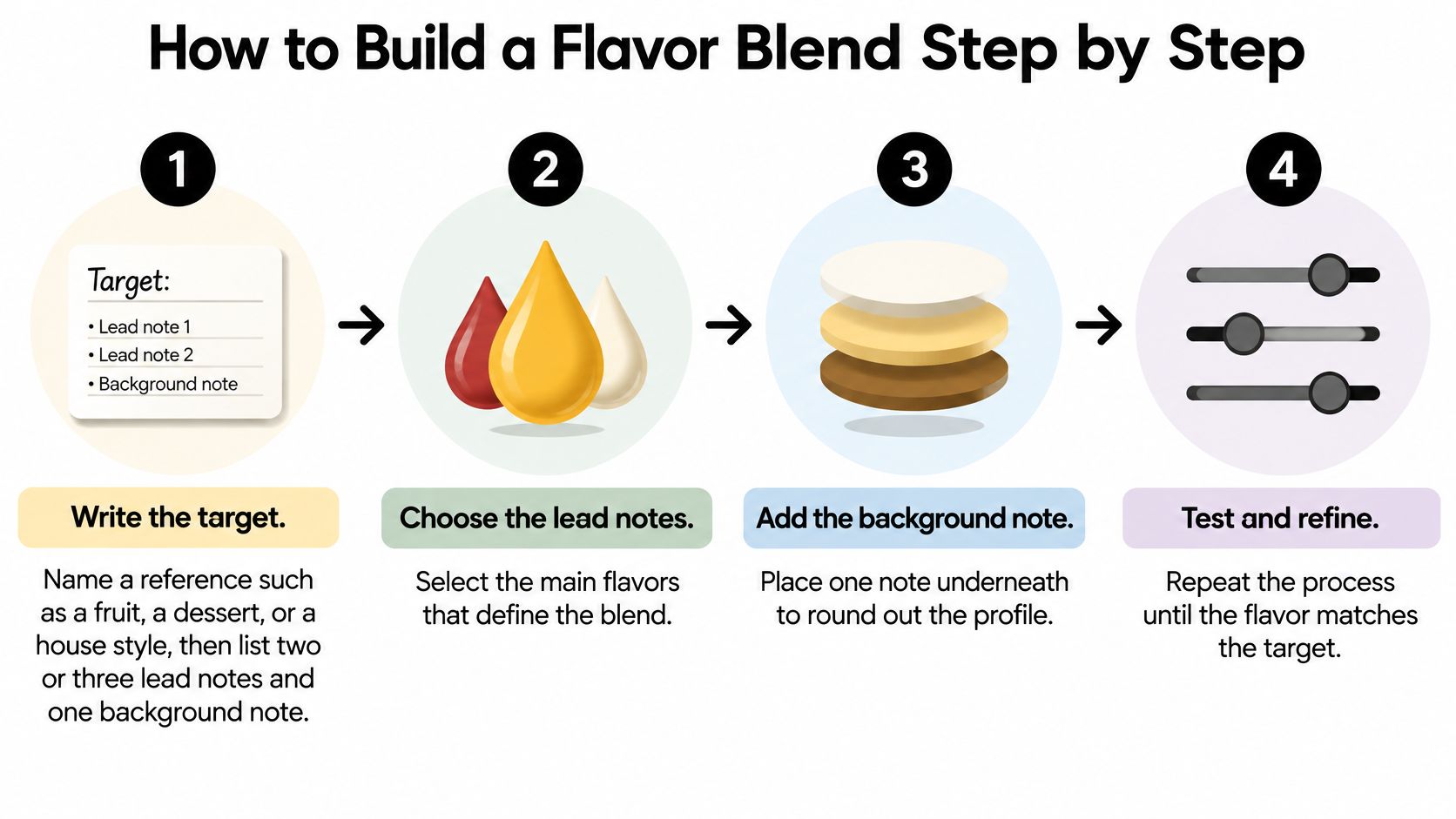
Run the same seven checks every time.
- Write the target before you open a bottle. Name a reference such as blueberry, lemon, strawberry, grape or peach, or define a house style. List two or three lead notes plus one background note. If the target only exists in someone's head, the blend becomes whatever the last addition happened to be.
- Pick the base isolate that carries the lead note. For citrus, that is usually limonene. For a floral direction, linalool is the cleaner anchor. One isolate should own at least half the load, or no single note reads clearly.
- Add background notes at a quarter to a third of the lead load. That range keeps them under the lead instead of beside it. Two background notes at 30% each tend to fight, so pick one and commit.
- Blend small. Mix 10-20 g test batches in a clean, sealed container and stir until clear. Small batches are cheap to discard and let you run several versions in an afternoon.
- Taste on a neutral carrier, then in the base. Terpenes for cartridges are added to winterized distillate oils to add a distinct flavor to the product, so judge the blend in that oil before locking it. A profile that is crisp on a strip can go flat or muddy in a heavy base.
- Change one variable at a time and log the exact percentage moved. Two changes at once teach you nothing. The log is what turns a lucky batch into a repeatable one.
- Record the final ratio, lot numbers and sensory notes. Include who ran the panel and what they found. When a new isolate lot arrives, that record is how you know whether the flavor moved or the material did.
Each target needs its own hierarchy. A peach blend leaning on linalool behaves nothing like a lemon blend built around limonene, even at the same total loading.
A bench walkthrough
Here is the same process run end to end, from first mix to final adjustment:
Keeping Flavor Stable From Batch to Shelf
The starting formula doesn't guarantee the aroma at the end of shelf life. Two variables decide that: how concentrated the terpene is when it's stored, and what the base does to it afterward.
The concentration point is well documented. A stability study found no decrease in limonene concentration and no detectable accumulation of typical oxidation products in hydroalcoholic fragrance formulations across a 9-month study, including products exposed to repeated bottle opening and oxygen contact, while the same research notes that concentrated limonene is more prone to oxidation when exposed to air (Flavour and Fragrance Journal stability study). Diluted and formulated, limonene held. Concentrated and opened repeatedly, it didn't.
Carrier oils add their own drift. Research on chia and flaxseed oils found that terpene levels, including limonene, decreased significantly during accelerated storage while oxidation-related compounds such as hexanal increased; alpha-pinene, beta-myrcene, d-limonene and p-cymene were among the major odor-active compounds (Applied Biological Chemistry study on stored seed oils). The base oil participates in the flavor. It doesn't just carry it.
| Factor | What it changes | Control |
|---|---|---|
| Heat | Speeds loss of volatile terpenes and oxidation | Store cool and log temperature |
| Light | Degrades stock over time | Use opaque, tightly closed containers |
| Oxygen and headspace | Raises oxidation-related off-notes | Use right-sized containers and limit repeated opening |
| Time | Moves aroma away from the starting formula | Keep retained samples and test at set intervals |
| Carrier oil | Shifts the balance of volatile compounds | Test the blend in the actual base |
Run each control against a specific risk
- Heat. Shave 10 degrees off a storage room and the volatile fraction lasts longer. Put a thermometer in the room and write the reading into the lot record, because a hot month stays invisible until the retain sample proves it.
- Light. Amber or opaque containers, closed lids, stock kept away from window light. Clear glass on a shelf is a slow leak with a nice label on it.
- Oxygen and headspace. A part-full bottle with a big headspace oxidizes every time it's opened. Order the container size that matches how fast you use the material.
- Time. Retain a sample from every lot and test it at fixed intervals against a reference. That's how you set a shelf life you can defend instead of one you inherited.
- Carrier oil. Compare fresh and aged samples in the base, not on a strip. Side by side is the only test that tells you whether the base is the problem.
A retained sample costs a few grams. A reformulation after a complaint costs a pallet.
Our cartridge terpenes carry no additives, VG, PG, PEG or MCT, so what changes on the shelf is the terpene fraction and the oil it sits in. Nothing else in the bottle is reacting.
The supplier's storage guidance and lot documentation should set the shelf life your inventory system uses. If a supplier can't provide both, that's a qualification problem, not a paperwork nuisance.
Handling, container choice and shelf-life practice are covered in how to preserve terpenes.
Compliance Checks Before You Buy in Bulk
A botanical origin label doesn't settle compliance. It settles sourcing. A terpene blend that's fine in a cartridge or a non-ingestible application may not qualify for an ingestible product at all, and the recipe won't be the reason.
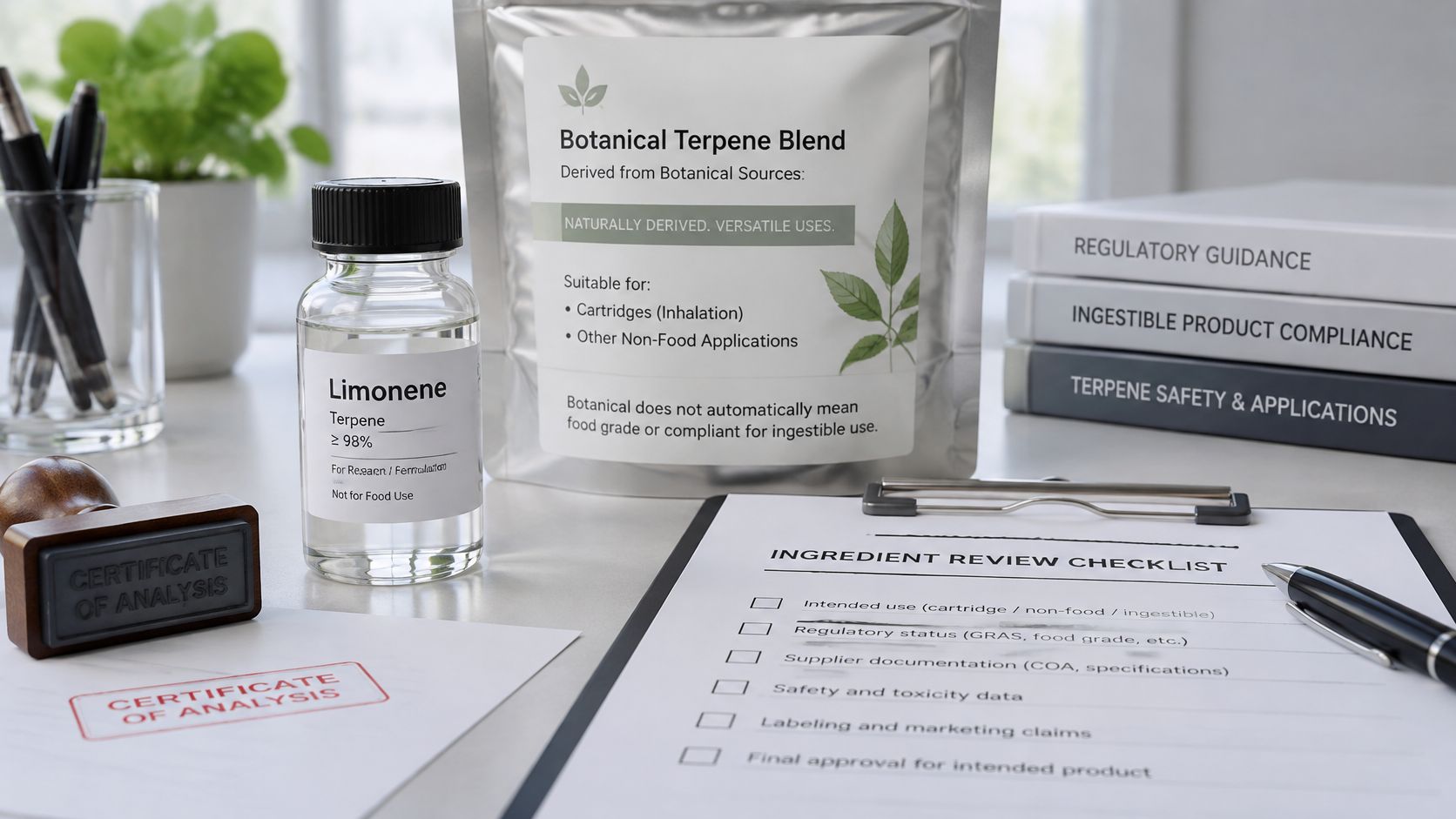
For products sold into the European Union, terpene-based flavor ingredients must be checked against Regulation (EC) No. 1334/2008. Annex I holds the authorized flavoring-substance list, and food manufacturers may use only substances included on it, with specific restrictions or maximum levels applying to some naturally occurring substances (European Commission rules on flavourings).
Matching a flavor across markets is where this bites. The blend doesn't change. The finished product's regulatory category does. Buyers should confirm the category and the destination market before ordering, not after the pallet lands.
The document set to request
Ask for the exact chemical identity of every isolate, not only the common name. "Limonene" on a line item and a full identity with a specification range are different levels of documentation, and the second is what a formulation review needs.
The consolidated text of Regulation (EC) No. 1334/2008 sets out what a new flavoring or a new use has to document, including identity, manufacturing process, chemical composition, specifications, stability, and the substance's reaction and fate in the finished food. Flavoring substances are generally used according to good manufacturing practices unless a specific restriction applies.
| Document | What to confirm |
|---|---|
| Certificate of analysis | Batch identity, purity or specification range and lot number |
| Exact chemical identity | Full name and identity for each isolate or blend, not only a common name |
| Manufacturing information | How the isolate was produced and from which botanical source |
| Stability data | Shelf-life evidence and written storage guidance |
| Intended-use statement | Product category and destination market |
| Regulatory status | Whether each isolate is authorized for the destination market, such as an Annex I listing under Regulation (EC) No. 1334/2008 |
Third-party lab results should arrive with the certificate of analysis, not three emails later. Our cartridge terpenes are SC Lab-tested, with terpene information provided to us by SC Labs, and our Terpene Safety & Documents page collects the starting materials in one place.
Choosing a Supplier for Bulk Terpene Orders
Shortlist on six criteria before you ask for a sample, so the samples you get come from suppliers who can supply.
- Documentation. The full document set above, for every isolate and blend, not just the flagship product.
- Batch consistency. Lot-to-lot aroma that matches, backed by certificates of analysis. Ask for two consecutive lots of the same blend and compare them yourself.
- Storage guidance. Written instructions for temperature, light and container handling, specific enough to set your usable shelf life.
- Range. Single isolates for building your own blends, plus ready blends for fast testing. A supplier with only finished blends limits what you can fix later.
- Custom capability. The team can match a reference flavor and supply bulk or custom orders with lead times stated in writing.
- Sample access. A small quantity you can test in your real base before committing to a drum.
Ask two questions beyond the list: how batch records are kept, and whether the supplier can explain the volatility difference between isolates in plain terms. A team that can't answer the second is repackaging someone else's material, and your formulation will inherit their blind spots.
Qualification shortcut: a supplier who answers all six in writing on the first request is worth a second conversation. One who answers three of them verbally is a risk.
Buying channels, minimums and what to verify before the first order are covered in where to buy terpenes.
Request a Sample and Confirm Documents First
Four steps take you from reading to ordering, and none of them is "buy the largest bottle because the price per gram looks better."
- Shortlist two or three blends that match your lead notes and product type, using the criteria above.
- Request a sample from each and ask for the document set before you commit to bulk. Documents are easier to obtain while money is still on the table.
- Run the test batch in your real base, following the blend-building steps, then re-test it once it has sat in the oil. A sample that smells right in the bottle and wrong after time in the base is telling you something useful.
- Scale only after the blend holds and the documents match your destination market. Scaling a blend you haven't shelf-tested just moves the risk into inventory.
For a fast start, the Pioneer Pack includes one bottle each of beta-caryophyllene, limonene, myrcene, linalool, alpha-pinene and terpinolene, which covers the core palette most blends are built from. The Mixing Calculator handles the batch math, and the Client Portal keeps orders and reorders in one place.
Gold Coast Terpenes supplies botanically derived isolates and blends built for cartridge, concentrate and flavor work, with SC Lab-tested terpene information and documentation you can put in front of a buyer. Test a blend in your own base first, confirm your documents against your destination market, then scale once the flavor holds. Visit Gold Coast Terpenes to shop blends, request samples, or contact the team for bulk and custom orders.