
Humulene typically represents 8–9% of total terpenes in THC-dominant cannabis, and it works best as a mid-to-base note anchor in distillate and vape cartridge formulation rather than as the primary flavor driver. For product developers, humulene terpene strains are most useful as references for structure, dryness, and persistence, not as simple recipes to copy.
Gold Coast Terpenes supplies 100% botanically derived, THC-free terpene blends and isolated compounds for cartridge, concentrate, and formulation work. That distinction matters because humulene's contribution is easy to lose when a formula relies too heavily on bright monoterpenes. A convincing strain-inspired terpene blend needs a top note that opens quickly, a mid note that carries the recognizable cultivar character, and a base layer that keeps the profile from becoming thin after heating.
What Makes Humulene Essential in Cannabis Formulation
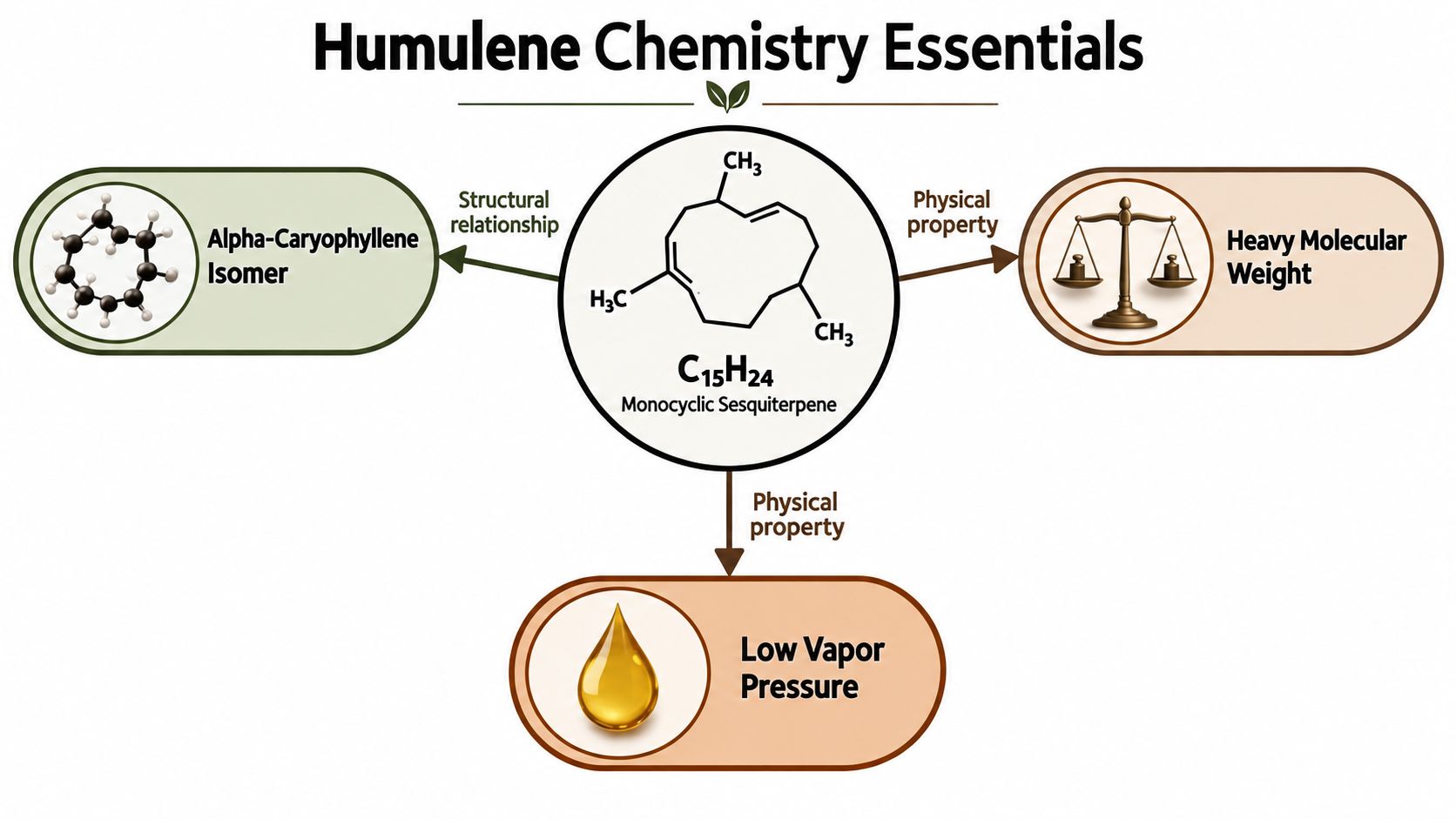
Humulene is an α-caryophyllene isomer and a monocyclic sesquiterpene with the molecular formula C15H24. In formulation terms, its heavier sesquiterpene structure makes it better suited to a stable mid-to-late aroma role than lighter monoterpenes, giving cartridges and concentrates a woody, earthy, hoppy, and subtly bitter foundation. (Humulene's chemistry and aroma profile)
A distillate built almost entirely around limonene, pinene, or other fast-opening notes can smell impressive at first evaluation and then feel one-dimensional during a full session. Humulene helps create the impression of depth. It doesn't need to dominate the headspace to matter. At a restrained level, it can dry down sweetness, reinforce herbal character, and make a citrus or fruit profile feel closer to plant material rather than confectionery flavoring.
Why the molecule matters in a cartridge
Sesquiterpenes are generally heavier and less volatile than monoterpenes. That physical distinction supports humulene's role as a mid-to-late aroma anchor, although formulators shouldn't treat it as permanently fixed in the oil. Heat, airflow, hardware geometry, and the rest of the terpene system still affect what reaches the user.
For vape cartridges, the practical sequence is straightforward:
- Build the opening with volatile top notes. Bright citrus, pine, or floral materials establish the first impression.
- Use humulene to shape the middle and finish. Its woody and hoppy character adds dryness and a grounded edge.
- Support persistence with complementary mid and base materials. Caryophyllene, myrcene, and pinene can help maintain an earthy cannabis impression without asking humulene to carry the entire profile.
Practical rule: Treat humulene as architecture, not decoration. If the blend tastes sweet but lacks a believable plant-like finish, the problem may be missing structural depth rather than insufficient flavor intensity.
Humulene is chemically distinct from cannabinoids, so it shouldn't be used to predict cannabinoid potency or pharmacological outcomes. Its commercial value here is sensory. For a deeper formulation reference, see Humulene terpene benefits, while keeping aroma decisions separate from unproven health narratives.
Understanding Humulene Concentrations in Natural Strains
Natural humulene levels are usually modest, yet the terpene can define a strain profile when it sits alongside compatible earthy compounds. Lab-tested strain data commonly averages 0.06% and reaches about 0.12% in high-humulene entries. Strain guides describe well-grown, well-cured potent cultivars in the 0.3% to 0.6% range. These figures and strain context are documented by PhenoDB humulene data and strain context.
Flower percentages are not finished vape targets. They describe one sample's terpene composition. A manufactured blend must also account for the carrier oil, total terpene load, heat exposure, cartridge hardware, and neighboring compounds. Use the flower certificate of analysis to set the direction, then confirm the profile with controlled bench samples after dilution and cartridge heating.
A practical reading of the ranges
The difference between background humulene and a humulene-forward profile is sensory, not only mathematical. At lower levels, humulene can add dry woodiness that supports myrcene or caryophyllene. At higher relative levels, its hoppy, herbal, and mildly bitter character becomes easier to detect.
| Strain Category | Typical Humulene % | Flavor Contribution |
|---|---|---|
| Lab-tested average profile | 0.06% | Background woodiness and herbal dryness |
| Higher entry in strain data | About 0.12% | More noticeable hoppy and earthy structure |
| High-humulene cultivar description | 0.3% to 0.6% | Clearer woody, herbal, and bitter character |
The figures in this table come from the PhenoDB humulene strain list noted above. Treat the higher cultivar range as a reference category, not a guaranteed result for every harvest from a named strain.
Why caryophyllene changes the result
Humulene frequently appears alongside beta-caryophyllene. Together, they can produce a more convincing earthy profile than either compound alone. Caryophyllene contributes pepper and spice, while humulene supplies dry wood, hops, and subtle bitterness. The formulation decision depends on whether the final balance feels botanical and strain-authentic or harsh and medicinal.
Increasing humulene is a common response when a test sample lacks realism. That adjustment can push the finish toward bitterness without repairing a weak mid-note. Compare humulene with caryophyllene, myrcene, and pinene through small, controlled changes. Evaluate each blend after dilution and cartridge heating, not only from the neat concentrate.
The large Cannabis terpene review identified alpha-humulene 1,454 times across its literature corpus and found it in a substantial subset of cannabis samples. This supports humulene as a recurring strain marker rather than an unusual outlier, even when it is not the loudest component in the analytical report.
Botanical vs Cannabis-Derived Humulene for Product Developers
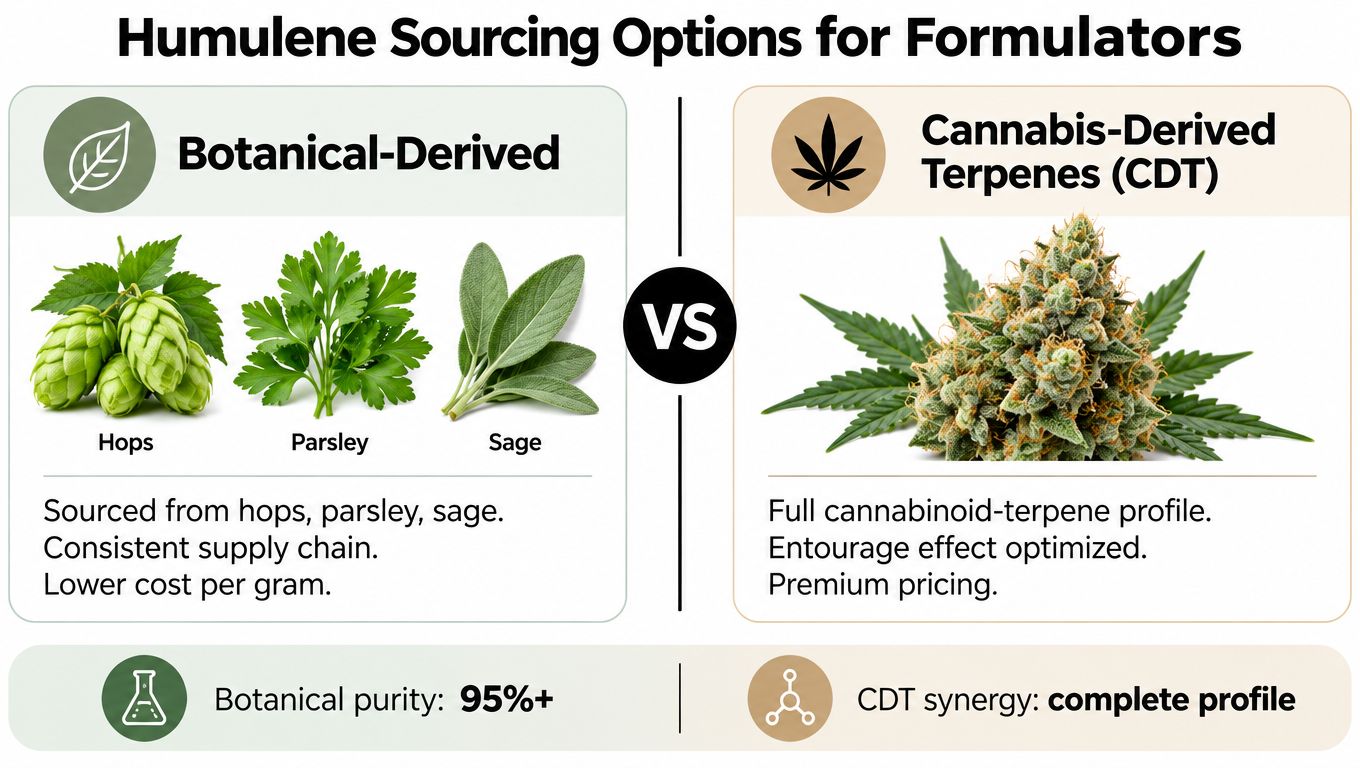
Botanical-derived humulene is usually the more practical choice for scalable, THC-free vape, CBD, and hemp formulations, while cannabis-derived humulene can make sense when the project requires a cannabis-derived terpene system and the compliance program supports it. Neither source automatically produces better flavor. Source consistency, analytical documentation, and the intended market determine the better fit.
Gold Coast Terpenes describes its blends as 100% botanically derived, THC-free, and lab-verified, with no VG, PG, PEG, or MCT. For manufacturers working with CBD isolate, hemp-derived extracts, or markets that restrict cannabis-derived inputs, that sourcing model can simplify the raw-material specification. Confirm the current certificate of analysis and jurisdictional requirements before production.
Choose by application, not by marketing language
Botanical humulene is a strong fit when the manufacturer needs:
- A repeatable supply chain: Botanical inputs can be specified as individual isolates or controlled blends without depending on a particular cannabis harvest.
- THC-free documentation: This is relevant to CBD isolates, hemp products, and finished goods sold under strict cannabinoid limits.
- Flavor architecture: A formulator can add humulene independently, then tune caryophyllene, myrcene, pinene, and brighter top notes around it.
Cannabis-derived terpenes may be appropriate when:
- Strain fidelity is the leading requirement: A cannabis-derived fraction can provide a broader source profile than a single botanical isolate.
- The regulatory pathway permits it: Trace cannabinoids, testing obligations, labeling, and state or national rules must be reviewed before committing.
- The brand accepts higher complexity: Cannabis-derived sourcing can introduce harvest variation and a more involved documentation process.
Gold Coast Terpenes also publishes a comparison of CDT versus BDT sourcing. The decision should be made at the product-specification stage, not after a batch has already been blended.
For vape cartridges, botanical humulene often offers the cleanest control over a repeatable sensory target. For distillate intended to imitate a specific flower lot, a cannabis-derived fraction may be worth evaluating alongside botanical materials, but the manufacturer still needs batch-level testing and sensory validation. For tinctures and edibles, heat and delivery conditions differ, so a cartridge-optimized profile shouldn't be assumed to perform identically in another format.
How to Formulate with Humulene in Vape and Distillate
The most reliable way to formulate with humulene is to build it as one part of a top, mid, and base architecture, then validate the finished oil in the actual cartridge. A fixed universal percentage would be misleading because the right level depends on the target strain, the total terpene load, the hardware, and the intensity of the supporting materials.
Humulene has a reported vaporization point of about 106 °C, which means it can flash early during heat-up despite its role as a heavier sesquiterpene. (Technical terpene guide) Formulators should therefore pair it with less volatile mid and base materials instead of assuming that a heavy molecule will automatically persist through every session.
Build the profile in layers
Start with the target sensory description, not the ingredient list. “Dry forest, hops, pepper, and herbal finish” gives the bench team a more useful direction than “high humulene.” Then assign each part of the impression to a role:
- Top notes: Pinene or another bright material can provide lift and prevent a woody profile from opening dull or heavy.
- Mid notes: Myrcene can connect the top notes to the deeper cannabis character, while humulene adds dry herbal and hoppy definition.
- Base notes: Caryophyllene can reinforce pepper and spice, helping the profile remain recognizable after the initial volatile notes decline.
Use a humulene isolate when the analytical target calls for precise correction or when a house profile needs a controlled dry finish. Use a pre-blended strain profile when the goal is faster replication and the supplier provides enough technical documentation to support batch consistency. Don't assume a named strain blend matches a flower certificate unless the aroma, analytical profile, and heated performance all agree.
Adjust by sensory failure
A useful bench method is to create a control sample, one humulene adjustment, and one complementary-terpene adjustment. Keep the rest of the formula unchanged. Evaluate the samples neat, diluted into the intended distillate, and after cartridge heating.
A strong humulene formula should become more believable, not simply more bitter.
If the blend opens too sweet, humulene can reduce the perception of sugar-like brightness by adding dryness. If the finish is harsh, reduce the humulene contribution and examine caryophyllene, pinene, and the total terpene load before adding more diluent. If the profile disappears quickly, pair the early-flashing material with more persistent mid and base notes and review the hardware temperature rather than treating the isolate as the only variable.
The Humulene terpene flavor guide is useful for organizing this sensory work. The commercial objective is repeatability. Record the raw material lot, blend sequence, mixing conditions, distillate characteristics, cartridge hardware, and sensory result for every approved version.
Top Humulene-Rich Strains and Their Flavor Profiles
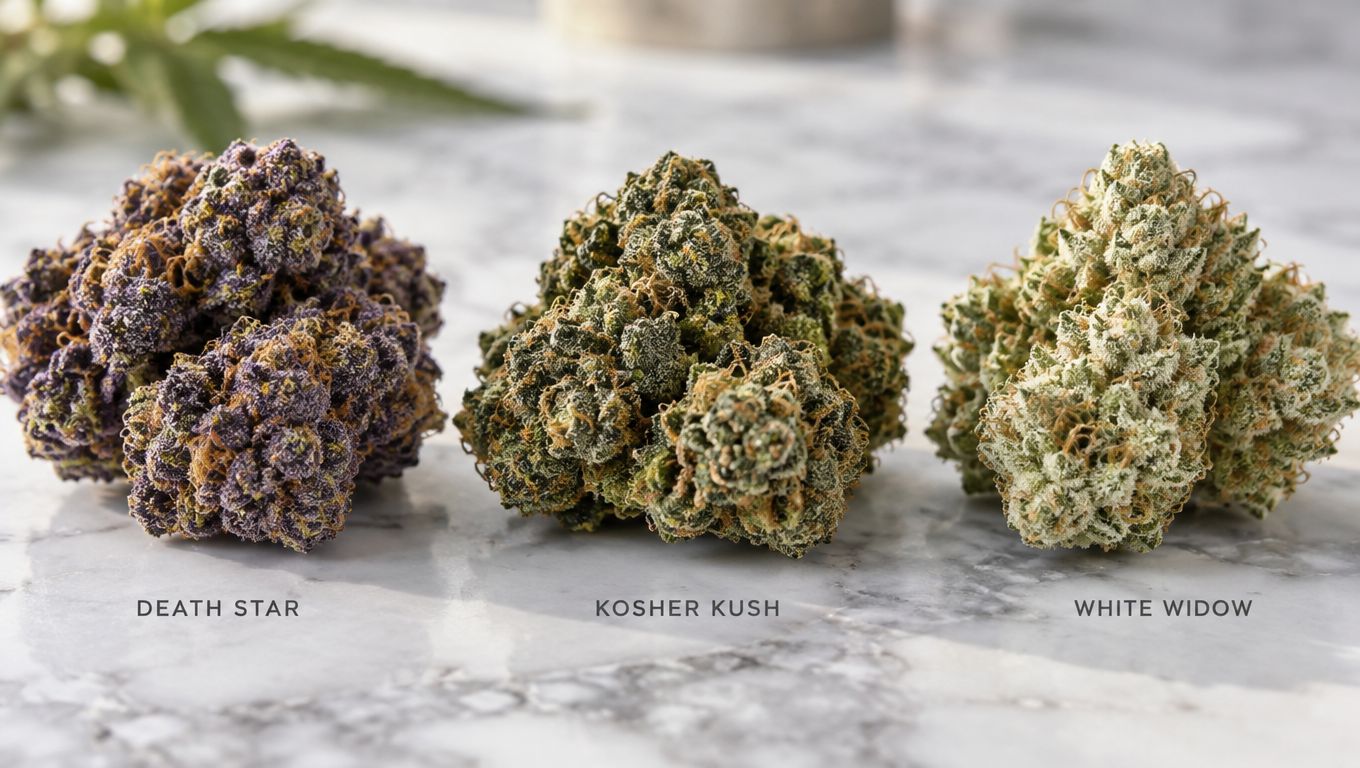
Death Star, Kosher Kush, and White Widow are frequently cited as high-humulene cultivars, but their names should function as flavor references, not guarantees of a fixed chemical profile. Genetics, cultivation, curing, storage, and testing conditions can shift the actual terpene balance from one sample to another.
For product developers, the useful question is what each name contributes to a formulation brief:
- Death Star: A suitable reference for a darker, earthy direction with a pronounced herbal and hoppy backbone.
- Kosher Kush: Useful when the target calls for deep woodiness, dry earth, and a heavier aromatic impression.
- White Widow: A helpful reference for balancing earthy structure with brighter, sharper notes rather than building a purely dark profile.
The high-humulene strain guide can support early profile selection, but it shouldn't replace a certificate of analysis from the specific flower or terpene material being replicated. A brand that wants a recognizable cartridge profile should define the target by aroma descriptors, analytical markers, and heated performance.
Gold Coast Terpenes' Elevated Strains line provides a strain-inspired reference point for developers comparing cultivar-style flavor directions. The product page is one example of how a named flavor profile can be considered during early concept development without assuming that the name alone proves a particular humulene concentration.
A useful replication workflow starts with the intended identity, then asks what must remain stable after heating. If the product should read as earthy and hoppy, humulene may provide the structural cue. If it becomes too dry, myrcene can soften the transition. If it lacks pepper and spice, caryophyllene may be the better adjustment. Strain names help teams communicate, but the final formula must be judged by the actual sensory result.
Use the video as a visual reference during internal review, then document the profile in language that your production and compliance teams can reproduce. Avoid medical or effect claims. “Woody, herbal, hoppy, and dry” is a defensible flavor description. Claims about appetite, inflammation, analgesia, or other human outcomes require evidence that current humulene literature doesn't provide.
Building Your Humulene-Forward Product Line
A humulene-forward product line should begin with a controlled flavor brief, not a list of popular strain names. Define the desired opening, mid-palate, finish, source type, cannabinoid matrix, hardware, label language, and testing requirements before ordering production material.
Gold Coast Terpenes offers strain-specific profiles, isolated compounds, formulation education, safety documents, a Mixing Calculator, wholesale options, and bulk programs. Those tools can support a workflow in which the formulator creates a measured prototype, compares botanical and cannabis-derived sourcing where permitted, and then moves the approved formula into a documented production specification.
A workable commercial sequence
- Select the sensory target. Choose whether the product should emphasize dry hops, forest wood, herbal cannabis character, or a brighter profile with an earthy finish.
- Choose the source strategy. Use botanical-derived material when THC-free documentation and supply consistency are central. Evaluate cannabis-derived inputs only when the market and compliance program allow them.
- Build the architecture. Assign top, mid, and base roles before adjusting humulene. This prevents one isolate from being used to solve every sensory problem.
- Test in finished hardware. A bench vial won't show the same result as a filled cartridge. Review initial aroma, vaporized flavor, finish, and storage behavior.
- Lock documentation. Keep certificates of analysis, lot information, ingredient specifications, mixing records, and final label review together.
Gold Coast Terpenes should be evaluated as one possible supplier against the same criteria applied to any vendor: documentation, botanical or cannabis-derived labeling, batch consistency, technical support, minimum order requirements, and fit with the destination market. The strongest supplier relationship is the one that helps a manufacturer reproduce the approved profile without obscuring what is in the formula.
Marketing should stay close to the sensory truth. Describe humulene-rich products as woody, earthy, hoppy, herbal, or dry when those descriptors match the tested profile. Don't turn preclinical findings into medical promises, and don't imply that a named strain profile guarantees a particular consumer outcome.
Gold Coast Terpenes provides botanically derived terpene blends, strain-inspired profiles, isolated compounds, formulation tools, and bulk options for teams developing humulene-forward distillates and vape cartridges. Review the available materials and contact Gold Coast Terpenes to compare a suitable humulene source and build a documented flavor prototype.
Frequently Asked Questions
Is humulene useful for vape cartridge formulation?
Yes. Humulene is useful as a woody, earthy, hoppy structural note that supports a fuller finish in a cartridge profile. Gold Coast Terpenes offers botanical-derived blends and isolates that can be evaluated as part of a controlled vape formulation.
Should formulators use botanical or cannabis-derived humulene?
Botanical-derived humulene is often easier to scale when a product requires THC-free documentation and consistent sourcing. Cannabis-derived material may suit a strain-replication project where the regulatory pathway permits it, but manufacturers still need source testing and compliance review.
Which humulene terpene strains are useful as flavor references?
Death Star, Kosher Kush, and White Widow are commonly cited references for high humulene profiles. Their names should guide the sensory brief, while the actual batch certificate and finished-product evaluation determine whether the resulting blend matches the target.
Can humulene be used by itself in distillate?
It can be evaluated as an isolate, but using it alone usually won't create a complete strain profile. A finished distillate blend needs coordinated top, mid, and base notes, with humulene balanced against materials such as caryophyllene, myrcene, and pinene.
Does humulene produce medical effects in a vape product?
Current evidence does not establish human analgesic or anti-inflammatory outcomes for humulene. A review reports that published clinical studies have not tested humulene's analgesic or anti-inflammatory efficacy in humans, so product teams should limit claims to verified sensory and compositional information. (Review of humulene evidence)