
A vape brand has a new Durban Dream COA on the bench, a production slot approaching, and a familiar problem: the cultivar name suggests one sensory direction, while the batch data may point somewhere else. Gold Coast Terpenes supplies 100% botanically derived terpene blends, isolates, and strain-specific profiles that can help a formulation team reproduce a target profile without using cannabis-derived inputs.
For product developers, the useful question isn't just what Durban Dream smells like. It's which chemovar the current lot represents, how that profile survives heating, and how to translate its COA into a repeatable cartridge formulation for distillate, extract, or another oil matrix.
What Durban Dream Means for Vape and Distillate Formulation
Durban Dream should be treated as a chemovar-to-COA matching problem, not as a fixed flavor description. A formulator must start with the lot's cannabinoid and terpene data, then decide which aromatic features deserve reinforcement in the finished oil.
A practical brief might begin with a Durban Dream flower COA showing 1.91% total terpenes, followed by a requirement to express the same sensory direction in a distillate cartridge. That doesn't justify copying a standard recipe. It creates a reference target: citrus brightness, anise-like depth, berry lift, and enough structure to remain coherent after dilution and heating. The actual input list depends on the source COA, the oil matrix, the hardware, and the intended sensory endpoint.
The profile is difficult to reproduce with one dominant ingredient because its identity is layered:
- Top notes provide the first citrus and herbal impression.
- Mid notes carry berry, floral, and soft spice character.
- Base notes keep the heated vapor from becoming sharp or hollow, supporting earth, anise, and persistence.
A distillate build also behaves differently from a live resin fill. Distillate often needs a more deliberate aromatic architecture because refining can remove much of the original volatile signature. Live resin may already contain substantial native terpene material, so adding a full strain blend can overshoot the target and distort the reference profile.
Practical rule: Don't formulate from the Durban Dream name alone. Formulate from the COA, then use the name as a sensory and commercial reference.
The terpene guide on what terpenes do in cannabis is useful background for separating aromatic roles from unsupported functional promises. Gold Coast Terpenes can be evaluated here as a botanical source for isolate-level adjustments or a strain-inspired starting profile. Its catalog includes strain blends and individual compounds, which lets a team choose between a faster premade route and a more controlled custom build.
The deliverable is straightforward: a cartridge that reproduces the selected Durban Dream reference, remains compatible with the oil and hardware, and can be rebuilt when the next COA changes.
Durban Dream Genetics and Cannabinoid Range You Should Build Around
Durban Dream is consistently described as a sativa-dominant hybrid created from Durban Poison and Blue Dream. That parentage matters commercially because it combines the anise and energetic aromatic heritage associated with Durban Poison with the widely recognized fruit-forward identity of Blue Dream. The Durban Dream strain reference from MÜV places the reported THC range between 19% and 28%, while CBD figures vary from 0.1% to 0.8% across reported products and references.
The range is wide enough to change formulation decisions. A flower lot reported near the lower end of that THC window shouldn't automatically receive the same positioning or sensory assumptions as a lot reported near the upper end. The strain name also doesn't tell a formulator whether the current batch is limonene-forward, myrcene-heavy, or driven by terpinolene and ocimene.
The terpene data show similar movement. One reported flower sample measured 1.91% total terpenes, with beta-myrcene at 0.59%, beta-caryophyllene at 0.21%, and alpha-terpinene at 0.20%. A concentrate sample measured 2.43% total terpenes, with beta-caryophyllene at 0.61% and limonene at 0.15%, according to batch-level Durban Dream terpene data from CannaHub.
Use the matrix to decide what gets added
| Matrix | THC range | CBD range | Total terpenes | Formulation implication |
|---|---|---|---|---|
| Reported flower products | 19% to 28% | 0.1% to 0.8% | Batch-specific, including a reported 1.91% sample | Use the flower COA as the sensory reference rather than assuming a fixed strain recipe |
| Reported concentrate sample | Product-specific | Product-specific | 2.43% in the reported sample | Account for native terpene content before adding botanical material |
| Custom cartridge oil | Must be confirmed from the oil COA | Must be confirmed from the oil COA | Must be calculated from the complete formulation | Set the botanical addition only after native terpenes, viscosity, and hardware requirements are known |
The table isn't a recipe. It's a decision framework. If the reference flower is the target, the finished cartridge may need a selective aromatic reconstruction rather than a direct numerical copy. If the concentrate already contains a strong terpene fraction, adding a full botanical profile can make the result too volatile, too sharp, or unlike the source material.
For comparison work, a catalog entry such as Elevated Strains shows how strain-inspired products can be organized separately from isolated compounds. That distinction is useful when a brand needs a fast starting point but still wants the ability to adjust a specific terpene after reviewing the COA.
Mapping the Durban Dream Terpene Pyramid
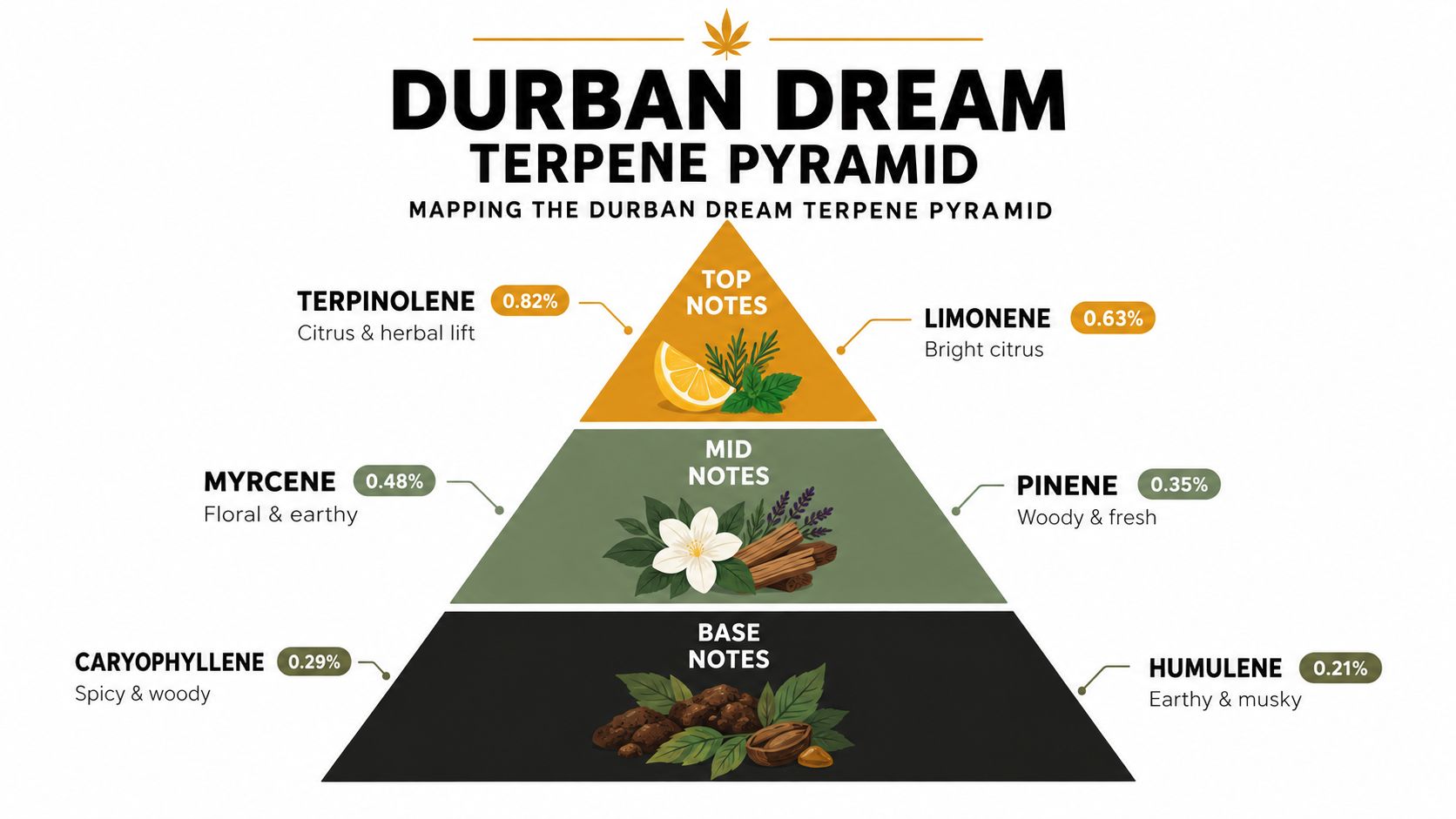
A Durban Dream reconstruction works best as a three-layer profile, with volatile citrus and herbal notes above berry and spice, then a restrained earthy base. The exact percentage of each layer must come from the reference COA, because available data don't support a universal Durban Dream ratio.
Top notes carry the first impression
Terpinolene is a useful candidate for the bright herbal and citrus lift often associated with this profile. Limonene can sharpen the citrus impression with an orange-peel edge. These are the first materials a sensory panel is likely to notice, but they also need restraint because a top-heavy cartridge can become pointed after heating.
The available strain descriptions aren't perfectly aligned. One reference emphasizes limonene, while another lists myrcene, limonene, linalool, and alpha-pinene, and other descriptions include terpinolene and ocimene. That disagreement is exactly why a formulator should not label a fixed pyramid as the authentic profile without checking the source lot.
Mid notes create the recognizable bridge
Ocimene can support a fresh, lifted middle, while beta-caryophyllene supplies dry spice and structure. Together, they can connect citrus top notes to the sweeter berry and soft aromatic character associated with Durban Dream descriptions.
This middle layer does more than add flavor. It prevents the profile from reading as generic citrus. If the formulation contains only bright top notes, the result may be pleasant but not strain-specific. The mid layer is where the product begins to resemble a deliberate chemovar reconstruction.
Base notes determine the finish
Myrcene contributes fruit and soft earth, while a restrained amount of humulene can reinforce dryness and depth. Anise is especially sensitive to balance. Too little base material leaves the profile thin, while too much can bury the citrus and make a daytime-oriented product feel heavy in the sensory presentation.
Heating also changes the comparison. A cartridge isn't judged from a cold vial. The panel should assess the oil through the intended hardware and operating conditions, then compare the opening, middle, and finish against the reference flower or extract. Don't assign numerical callouts to the pyramid until the COA identifies the relevant compounds and their relative mass.
Translating the Profile into a Vape Cartridge Build
A cartridge build should begin with the oil's existing terpene load, not with a universal dilution number. The supplied data support a reported flower sample at 1.91% total terpenes and a concentrate sample at 2.43%, but they don't establish a safe or suitable botanical addition rate for every distillate, cartridge, climate, or device.
Start by documenting the matrix. Record cannabinoid concentration, native terpene percentage, viscosity at the intended fill temperature, and the cartridge's operating behavior. Then define the sensory target. For Durban Dream, that target may include a citrus-herbal opening, berry and soft spice through the middle, and anise-earth depth at the finish.
Build the blend by role
A junior chemist shouldn't be handed a strain name and asked to guess. Provide a role-based worksheet:
| Terpene | Role | Share of total terpene load | Source |
|---|---|---|---|
| Terpinolene | Bright herbal and citrus lift | Set from the reference COA | Botanical isolate or strain-inspired blend |
| Limonene | Orange-peel sharpness and citrus definition | Set from the reference COA | Botanical isolate or strain-inspired blend |
| Ocimene | Fresh, lifted mid note | Set from the reference COA | Botanical isolate or strain-inspired blend |
| Beta-caryophyllene | Dry spice and structural middle | Set from the reference COA | Botanical isolate or strain-inspired blend |
| Myrcene | Fruit, earth, and rounded base | Set from the reference COA | Botanical isolate or strain-inspired blend |
| Humulene | Dry supporting depth | Set from the reference COA | Botanical isolate or strain-inspired blend |
This table intentionally uses COA-derived shares rather than invented percentages. If the reference batch is myrcene-heavy, a fixed top-heavy formula won't match it. If limonene is present but modest, raising it aggressively may create a citrus product that shares the name but not the batch identity.
Gold Coast Terpenes can fit into the workflow in two ways. A formulator can use botanical isolates when one compound needs correction, or start with a Durban Dream strain-inspired blend when speed and repeatability matter more than building every layer from scratch. The guide to using terpenes in formulations should be paired with the supplier's current technical documentation rather than used as a substitute for an oil-specific validation plan.
Hardware testing belongs in the same development cycle. Check wick saturation, leakage, vapor density, throat feel, and the persistence of the citrus and anise notes after repeated draws. For teams sourcing heated cart system supplies, the device specification should be recorded alongside the oil formula because the same blend can present differently across hardware.
A one-week accelerated stability screen at 40°C is a useful requested test condition when the brand's protocol calls for it, but passing that screen doesn't replace real-time stability, packaging review, or applicable regulatory evaluation. The final build should be released only when the sensory result, viscosity, hardware behavior, and documentation agree.
Reading a Durban Dream COA Before You Finalize the Blend
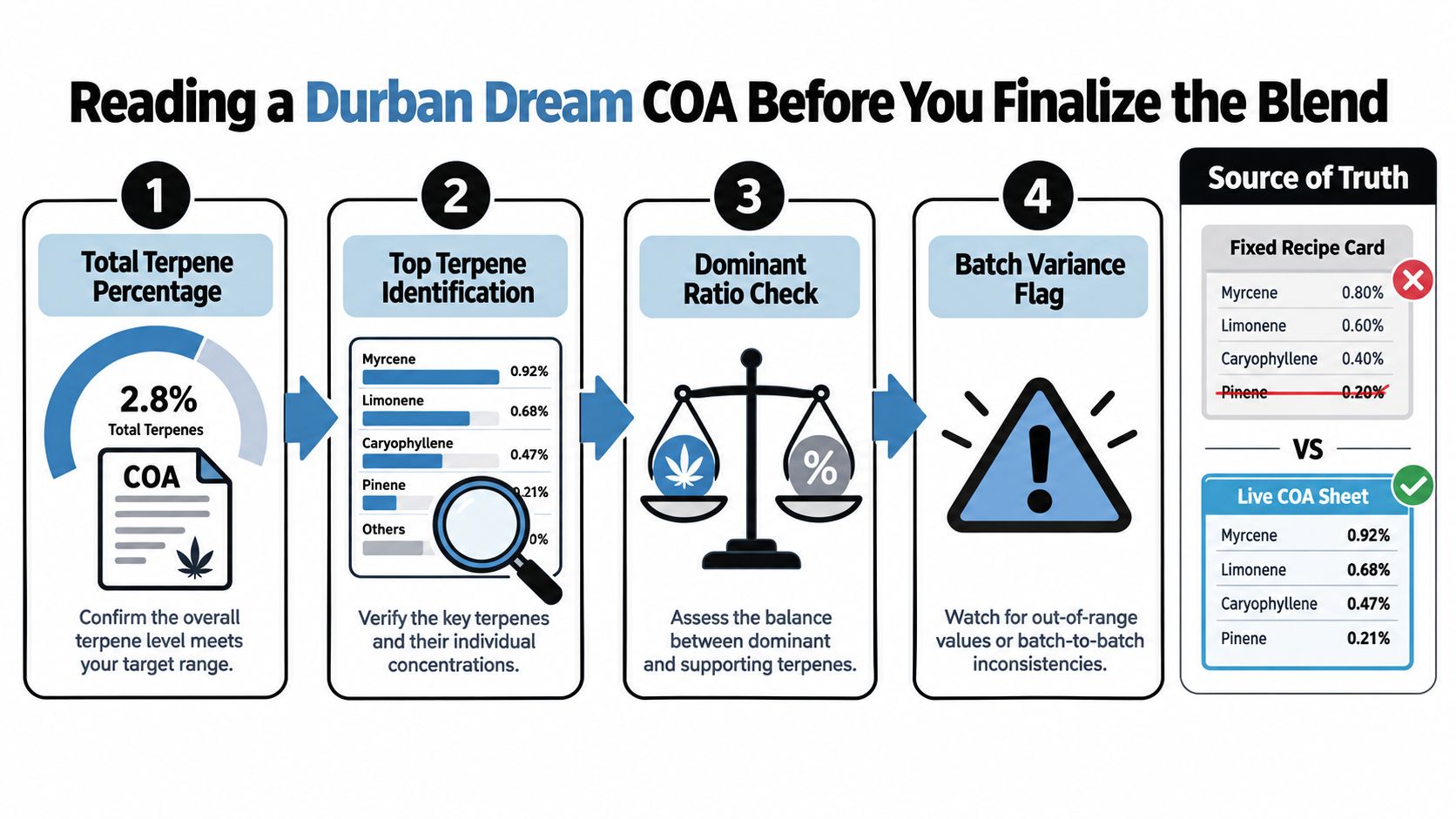
The COA is the source of truth, and a fixed Durban Dream recipe is only a starting hypothesis. Read the total terpene percentage, identify the leading compounds, and confirm the cannabinoid ceiling before weighing any botanical input.
Consider two reference materials. The flower sample reported 1.91% total terpenes, while the concentrate sample reported 2.43%. Those figures don't tell you to add a matching amount to a cartridge. They tell you that the two matrices express different native aromatic loads and may require different correction strategies.
Read the fields in order
- Total terpene percentage. Establish how much native aromatic material is already present.
- Top terpene identification. Record the leading compounds by mass, not only the flavor description.
- Dominant ratio check. Compare the relationship between citrus, floral, spice, fruit, and earthy materials.
- Batch variance flag. Mark any meaningful difference between the reference COA and the current production lot.
If the flower reference is the commercial target, a botanical blend may need to restore a missing top note or reinforce a weak base. If the concentrate already carries a higher native terpene fraction, the correct move may be a smaller correction or no addition to one layer at all.
Gold Coast Terpenes can provide a strain-matched starting point when the in-house team doesn't want to weigh every isolate. Before approval, request the relevant lot documentation and compare it with the internal target. The COA and certificate resource helps organize that review, but the brand still needs to confirm that the paperwork corresponds to the material being purchased.
Why Durban Dream Is a Daytime Strain With a Late-Session Slowdown
Durban Dream shouldn't be positioned as a pure productivity profile. Consumer reports describe an initial clear or uplifting phase in some batches, followed by heavier head or body effects later, and those reports vary enough that the product claim should remain measured.
The practical formulation implication is a daytime-leaning aromatic direction with a rounded finish. Terpinolene, limonene, and ocimene can maintain the bright opening, while myrcene, linalool, and beta-caryophyllene may contribute to the softer later impression reported in some descriptions. That isn't a medical claim, and it doesn't predict an individual's response. It is a sensory and positioning consideration.
Avoid flattening the opening
A formulator who overbuilds the base may erase the very lift that distinguishes the profile. A formulator who ignores the base may create an aggressive first draw that lacks the berry, earth, and anise continuity expected from the reference.
The best approach is to test the complete vapor arc:
- Opening: Does the citrus and herbal lift appear without dominating?
- Middle: Does the berry and spice character remain identifiable?
- Finish: Does the base round the profile without making the product read as sedating or heavy?
The Durban Dream strain review documents the inconsistency in reported effects and helps explain why a single retail label can oversimplify the experience. Position the cartridge around a bright, daytime-oriented flavor profile, but avoid promising stimulation, productivity, anxiety relief, or any other health-related outcome.
Choosing a Terpene Supplier for a Durban Dream Build
Evaluate a terpene supplier as a raw-material vendor, not as a flavor catalog alone. Gold Coast Terpenes describes its inputs as 100% botanically derived, and its catalog structure includes 37 Strains and 40 Elevated Strains lines, which gives a formulator a defined starting point for comparing strain-inspired products with individual compounds.
Audit the raw material
Ask for documentation that answers the questions a quality team or auditor will ask:
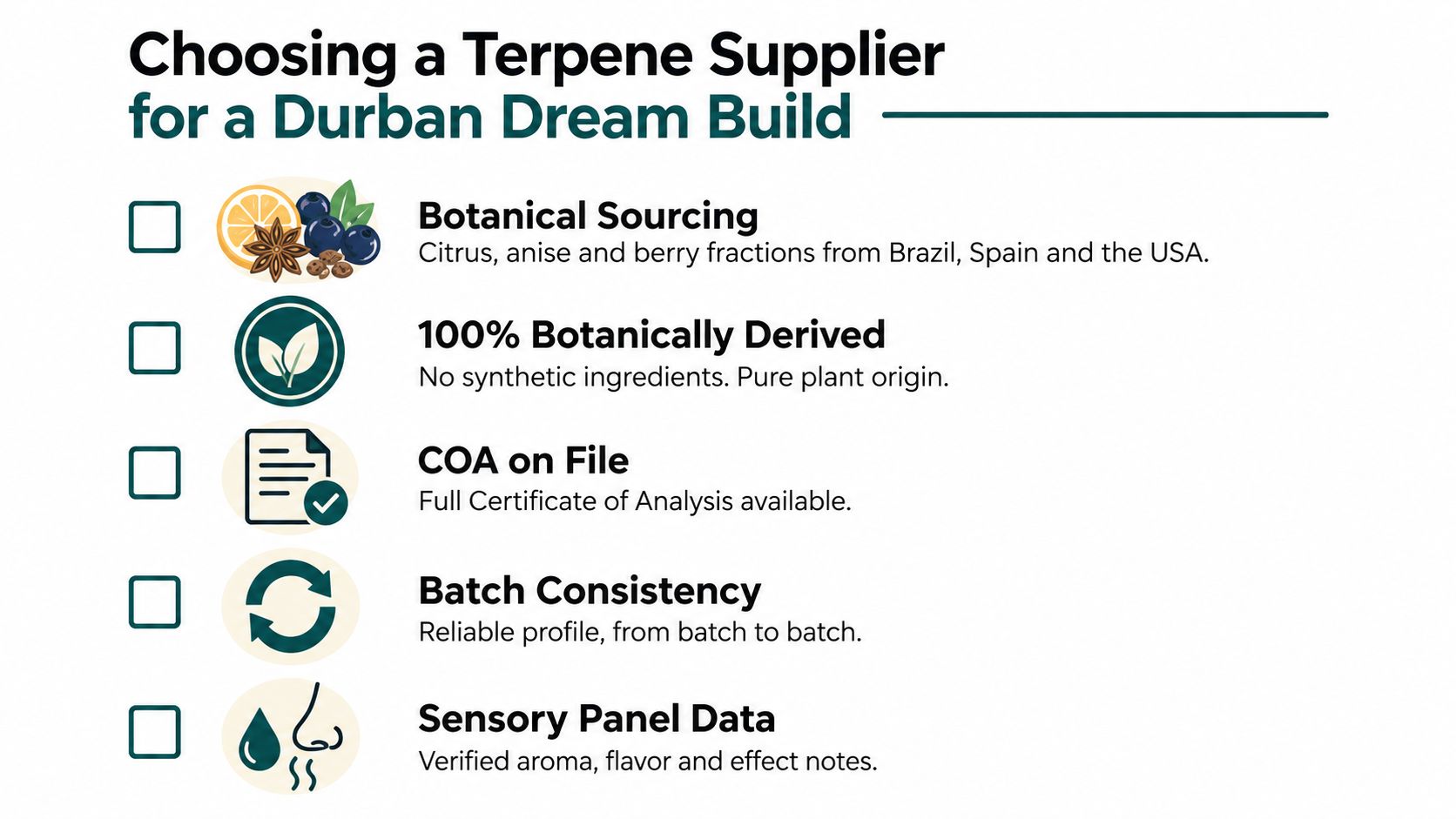
- Botanical sourcing: Can the supplier identify the botanical origins used for citrus, anise, berry, spice, and earthy fractions?
- Cannabis-derived status: Are the selected inputs botanical, and is the documentation clear enough for a THC-free SKU review?
- Analytical support: Is a current GC-MS chromatogram available for the Durban Dream blend and its individual isolates?
- Lot consistency: Can the supplier explain how sensory and analytical variation is controlled between lots?
- Safety documentation: Are applicable residual solvent, heavy metal, and other quality documents available for the specific lot?
- Packaging and labeling: Can the materials support child-resistant packaging decisions and state-specific label review?
- Technical fit: Does the supplier provide viscosity, dilution, storage, and hardware guidance for the intended oil?
The distinction between a botanical blend and a cannabis-derived terpene input should appear in the technical file, not only in sales copy. Gold Coast Terpenes is relevant when a brand needs botanical materials for a strain-inspired profile, but the purchasing team should still verify current specifications, legal requirements, and lot-level paperwork before approval.
Test commercial fit before the purchase order
A supplier shortlist should cover more than flavor accuracy. Ask about MOQs, sample sizes, lead times, white-label options, and custom blend turnaround. If the reference flower differs materially from the supplier's standard Durban Dream profile, the brand needs to know whether the supplier can adjust the blend or only provide the catalog version.
Request a build sheet showing how the material is intended to behave in distillate, live resin, and other extract matrices. Ask the supplier to separate recommendations for a 510-thread cartridge and a higher-terpene pod. The formulation team should also define its own acceptance criteria for aroma, vapor, throat feel, viscosity, and stability.
The terpene purchasing guide can support vendor research, but a defensible decision still depends on traceability and independent internal testing. The right supplier is the one whose documentation, material consistency, and technical response survive the same review as any other critical ingredient.
Frequently Asked Questions for Durban Dream Formulators
What is the minimum order quantity for a Durban Dream botanical blend?
Don't assume an MOQ or sample size from a general product page. Ask Gold Coast Terpenes for the current MOQ, whether a 30 mL bench sample is available, and the documentation supplied with that sample, then record the answer in the development file.
Are the inputs 100% botanically derived?
Gold Coast Terpenes presents its terpene blends and isolates as 100% botanically derived, but the purchasing team should confirm the status of the exact product and lot. For a THC-free SKU, request written confirmation and review the relevant technical documents before approval.
How should the blend be labeled for state submission?
Labeling depends on the jurisdiction, product category, and final formulation. Ask Gold Coast Terpenes for CAS-level and lot documentation, then have regulatory counsel or the brand's compliance team map those materials to the applicable state requirements.
Can a supplier match a custom COA?
Yes, a formulator can request a COA-matched revision, but the supplier must first receive the reference COA and the intended matrix details. Explain whether the target is the reported 1.91% flower profile or the reported 2.43% concentrate profile, then request a sample for sensory and hardware testing.
Which catalog line fits a cartridge or live resin pod?
Don't select between the 37 Strains and 40 Elevated Strains lines by name alone. Send Gold Coast Terpenes the oil type, hardware, native terpene result, and sensory target, then ask for a strain-matched sample and a written recommendation for the intended device.
Gold Coast Terpenes offers botanically derived strain profiles and isolated compounds for teams developing Durban Dream cartridges, distillate products, and extract formulations. Visit Gold Coast Terpenes with the reference COA, target matrix, and hardware details ready, and request a sample plan built around the batch you need to reproduce.