
The popular advice is to copy a Purple Punch lab report and call the result finished. That approach fails in commercial production. Gold Coast Terpenes supplies strain-specific profiles and isolated compounds that can help formulators build a repeatable sensory target instead of depending on one inconsistent flower sample.
The Purple Punch strain terpene profile is best treated as a formulation architecture: a caryophyllene-led backbone, citrus and pine lift, a soft floral layer, and a grape-dessert impression that depends on more than terpene names alone. For vape brands, extractors, and cannabis product developers, the practical question is not just what Purple Punch smells like. It's which parts of that aroma survive extraction, curing, heating, and scale-up, and which parts must be rebuilt with a controlled strain-inspired terpene blend.
Why Static Strain Profiles Fail in Commercial Formulation
Purple Punch doesn't have one fixed terpene recipe. Reported profiles vary by phenotype, cultivation conditions, cure, and product batch, even when the label carries the same cultivar name. One neutral analysis placed 96% of Purple Punch product averages in a high caryophyllene-limonene cluster, while other reporting describes pinene-forward, myrcene-forward, linalool-forward, or limonene-forward examples (Trapothecary's Purple Punch product profile).
That variation matters because a flower COA describes one sample at one point in its handling history. It doesn't guarantee that the same balance will appear after drying, curing, extraction, winterization, filtration, storage, or cartridge filling. Volatile top notes can diminish while heavier spicy, woody, or earthy impressions become more prominent.
The commercial problem with copying one COA
A formulator who copies a single test result may match the original flower but miss the sensory target customers recognize as Purple Punch. A batch can show the expected dominant terpene and still smell too sharp, too piney, too earthy, or insufficiently sweet because the fruit perception depends on interactions among terpenes, esters, phenotype, and post-harvest handling.
Practical rule: Formulate toward a sensory specification, not toward a cultivar name alone.
The more reliable approach is to define the target as a layered aroma. Start with a warm, peppery base. Add citrus and pine for lift. Build the middle with berry, floral, and soft dessert impressions. Then compare the finished oil against a retained reference standard under controlled conditions.
Gold Coast Terpenes makes 100% botanically derived terpene blends, according to its product information, giving product teams an option for building a consistent strain-inspired profile without using a batch-dependent flower extract. Its strain profile resources can help teams organize this work through a strain terpene profile reference, but the final specification should still be based on the aroma and performance of the finished product.
A better specification
Write the Purple Punch target in sensory terms before selecting ingredients:
- Top: bright citrus and a light pine lift.
- Heart: grape, blueberry, soft fruit, and floral-lavender character.
- Base: pepper, warm spice, vanilla, and kush-like depth.
This structure is more scalable than treating “Purple Punch” as a universal formula. It also gives quality control teams something actionable to evaluate when a new lot is chemically similar but sensorially different.
Deconstructing the Dominant and Secondary Terpenes
The Purple Punch profile is caryophyllene-forward, not a myrcene-dominant older indica profile. Reported practical guardrails place beta-caryophyllene around 0.5–0.9%, limonene around 0.3–0.6%, and myrcene around 0.2–0.4% in more detailed profiles (The Library NJ's Purple Punch terpene breakdown).
Those values should be treated as reference ranges rather than a universal recipe. The commercial objective is to preserve the relationship among the materials. If caryophyllene is too low, the blend can lose the warm peppery structure associated with Purple Punch. If it dominates without enough fruit and floral support, the result can read dry, spicy, or earthy rather than grape-dessert.
The primary backbone
Beta-caryophyllene supplies the spicy, peppery backbone. It also helps keep the aroma from becoming a thin candy note. In formulation work, it belongs closer to the base architecture than to the volatile top-note layer.
Limonene contributes citrus brightness and helps open the profile. It can make a dense dessert aroma feel more energetic, but excessive citrus emphasis can push the blend toward generic lemon or orange rather than grape and vanilla.
Myrcene supports fruit depth and softness. It shouldn't automatically become the headline ingredient just because myrcene appears frequently in cannabis profiles. For Purple Punch replication, its role is usually to round the caryophyllene-led structure.
Supporting notes and analytical caution
Pinene is commonly reported as a supporting terpene in Purple Punch descriptions, contributing a clean pine lift. Linalool adds a floral, lavender-like softness that can prevent the fruit layer from becoming hard or confectionary. An industry profile cited a lab result containing limonene at 8.2 mg/g, linalool at 3.8 mg/g, myrcene and caryophyllene at 2.2 mg/g each, beta-pinene at 1.6 mg/g, and alpha-pinene at 1.4 mg/g (Leafly's Purple Punch profile).
| Terpene | Target range (%) | Sensory role |
|---|---|---|
| Beta-caryophyllene | 0.5–0.9% | Pepper, warm spice, structural base |
| Limonene | 0.3–0.6% | Citrus lift and brightness |
| Myrcene | 0.2–0.4% | Fruity depth and softness |
The table provides a useful starting framework, not a finished cartridge formula. A product team should test the blend in the actual distillate or resin matrix because the same aromatic materials can express differently after dilution, heating, and storage.
Engineering the Grape and Vanilla Aroma Stack
A static Purple Punch description is a starting hypothesis, not a production formula. Phenotype, harvest conditions, curing, and extraction can shift the balance between grape, spice, citrus, and floral notes. The cultivar is repeatedly described as a Larry OG × Granddaddy Purple cross, with a terpene structure built around caryophyllene, limonene, and pinene. That combination helps explain the candy-grape and warm-kush impression, but it does not define one universal recipe (Abstrax Tech's Purple Punch profile).
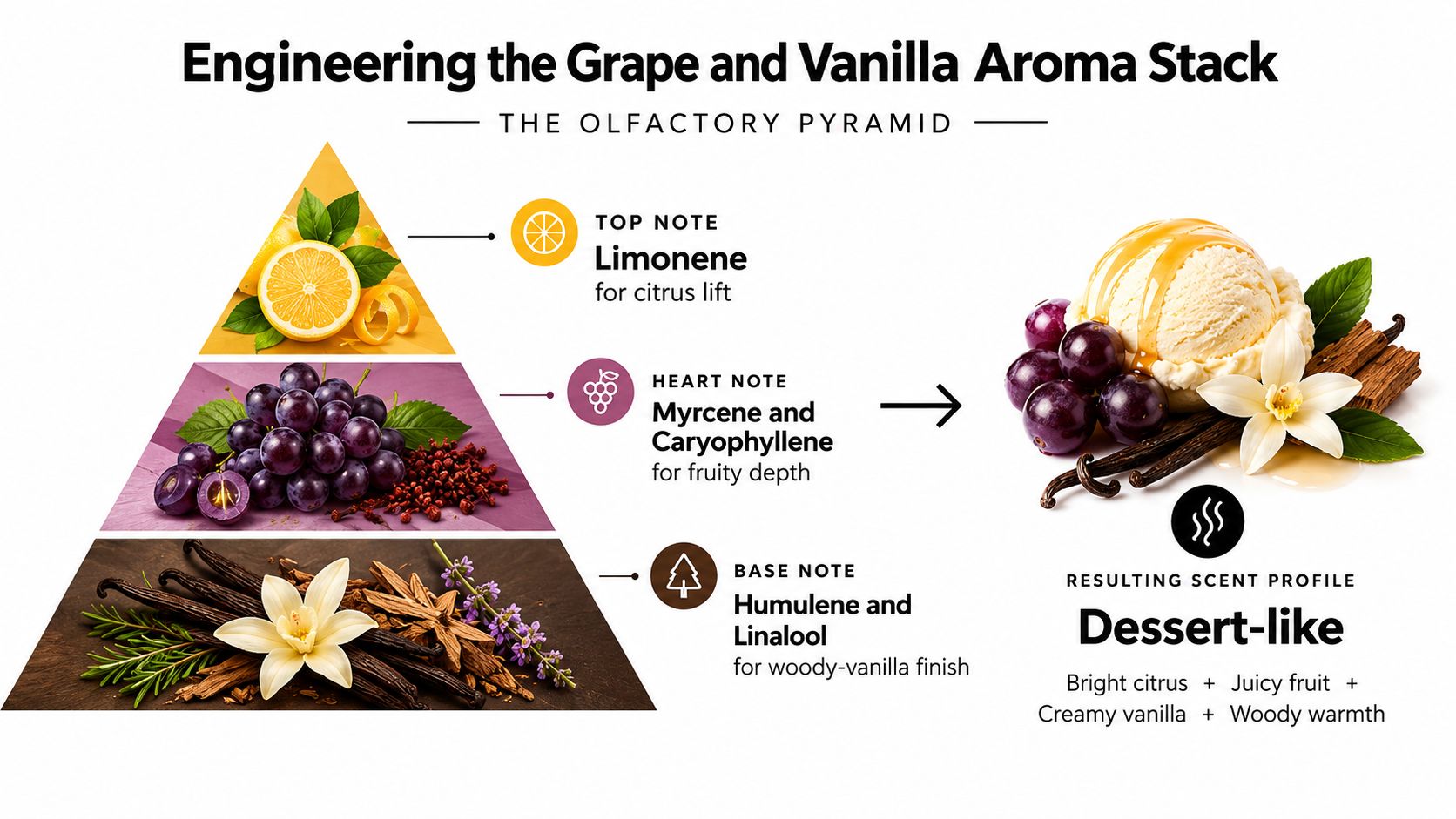
A practical aroma model uses three layers. The top supplies citrus and brightness. The heart carries fruit, berry, and floral softness. The base contributes pepper, vanilla, and warm kush depth. Formulators can adjust these layers independently, which is more reliable than copying the most prominent terpenes listed in a dispensary description.
Why esters and curing change the result
Fruity sweetness depends on esters and other volatile aroma compounds, alongside the headline terpenes. Drying, curing, and heat exposure alter how those materials present. Two flower lots can show similar caryophyllene and limonene readings while producing different sensory results because their minor volatiles and oxidation states differ.
That variation creates a formulation gap for brands using “Purple Punch” as a flavor cue. A single cannabis-derived extract carries the source flower's phenotype and volatile-loss risks into the finished product. A defined grape-dessert target gives the team a better control point. Set the desired opening, mid-palate, and finish, then adjust the blend against a retained reference.
Use this terpene flavor chart to group candidate materials by sensory function, then test them in the intended oil rather than relying on blotter evaluation alone. A practical screening sequence is:
- Establish the caryophyllene-led base.
- Add limonene and pinene until the profile opens without becoming citrus-forward.
- Introduce fruit and floral materials gradually.
- Add dessert support after the core structure is stable.
- Compare each trial with a retained reference under matching conditions.
Gold Coast Terpenes lists isolated compounds and strain-specific profiles for this type of adjustment. Its Apple Fritter profile in the curated strains collection provides one named flavor example, while a Purple Punch target still requires its own sensory specification.
A successful grape-dessert profile finishes rounded rather than syrupy. Fruit candy at the opening followed by exposed pepper indicates an overactive base. Vanilla and spice appearing immediately indicate insufficient top-note lift.
Formulating for Vape Cartridges and Distillate
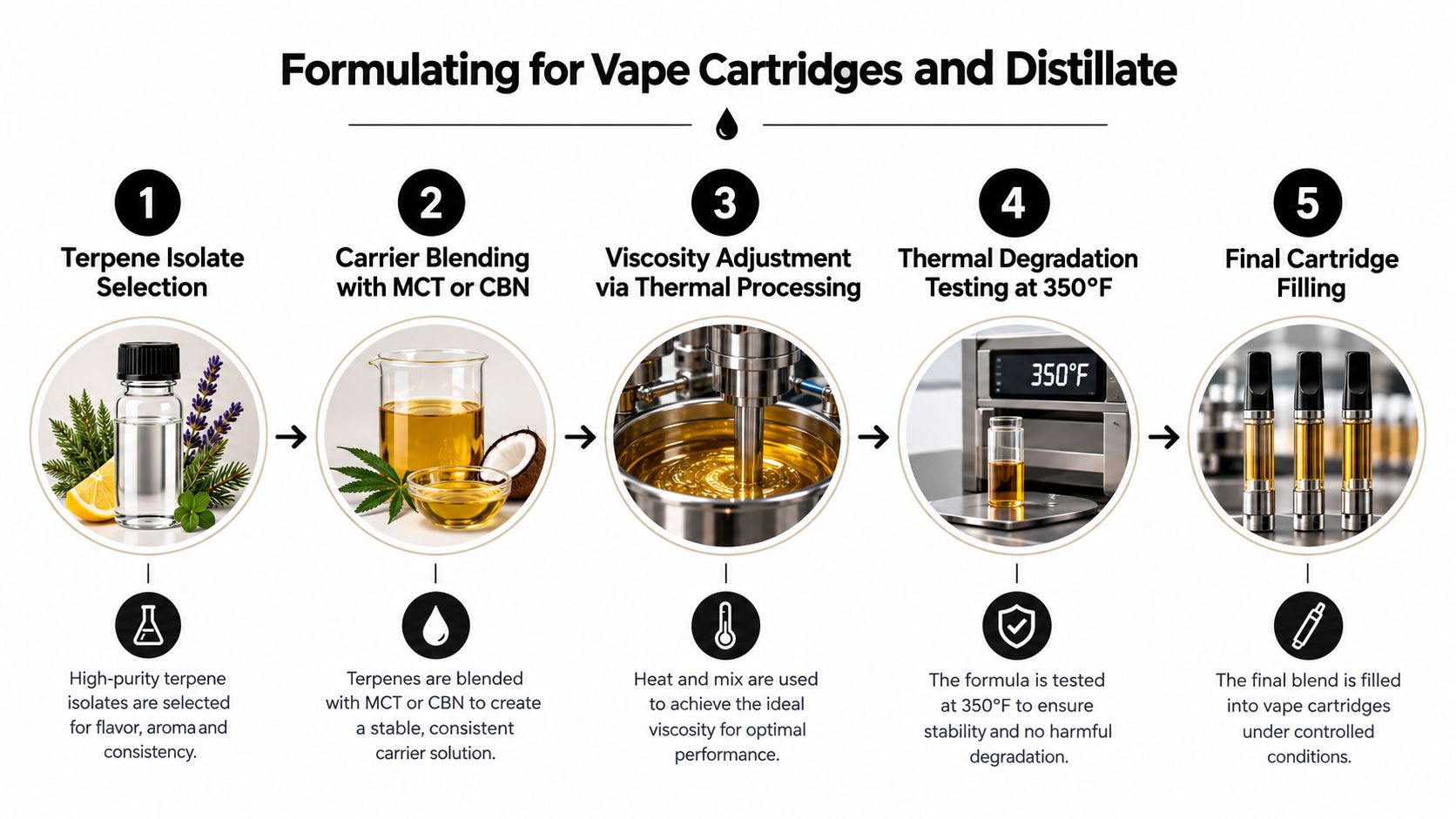
For vape cartridges, the Purple Punch profile must be evaluated as both an aroma system and a physical oil system. Wicking, viscosity, thermal exposure, and material compatibility can change the result even when the blend smells correct before filling.
The supplied formulation brief identifies 5% to 15% total terpene concentration as a working range for cartridge development, but that range isn't part of the verified Purple Punch data and shouldn't be treated as a universal specification. The correct level depends on the distillate or resin, cartridge hardware, desired intensity, and applicable regulations. Start with small bench batches and confirm performance in the intended device.
A workable bench sequence
Select the matrix first. Winterized distillate, live resin, and other concentrates can carry different native aroma and viscosity. Record the starting material's appearance, odor, viscosity behavior, and available analytical data before adding a strain-inspired blend.
Weigh materials accurately. Use a validated terpene calculator or formulation worksheet to convert the target blend into mass quantities. Record each isolate, lot, supplier, addition order, and final concentration. Volume-based additions are less reliable when material densities differ.
Blend gently. Avoid unnecessary heat and extended open exposure. Limonene and pinene are volatile, so aggressive processing can reduce the bright lift that makes the profile recognizable.
Check the finished oil. Inspect clarity, separation, flow, and wicking in the selected cartridge. A blend that performs in a vial may still clog, flood, or wick unevenly in hardware.
Gold Coast Terpenes describes its lab-verified, THC-free terpenes as free of VG, PG, PEG, and MCT. That composition is relevant when a brand wants to assess the terpene blend itself rather than introduce an unrequested carrier into the oil system. Teams can also consult guidance on how to use terpenes while building internal handling procedures.
Thermal and sensory controls
Don't use a high processing temperature as a shortcut for viscosity adjustment unless the matrix and equipment have been validated. Heat can change the balance of volatile top notes and may make a bright Purple Punch profile seem flatter after filling than it did during bench evaluation.
Test the oil at the point of use. Evaluate the first draw, repeated draws, and the retained oil after storage. A formulation that smells strongly of grape in the mixing vessel but develops harsh pine or dry pepper in the cartridge needs adjustment in both composition and thermal exposure, not just more sweetener-style aroma.
Botanical Versus Cannabis-Derived Terpene Selection
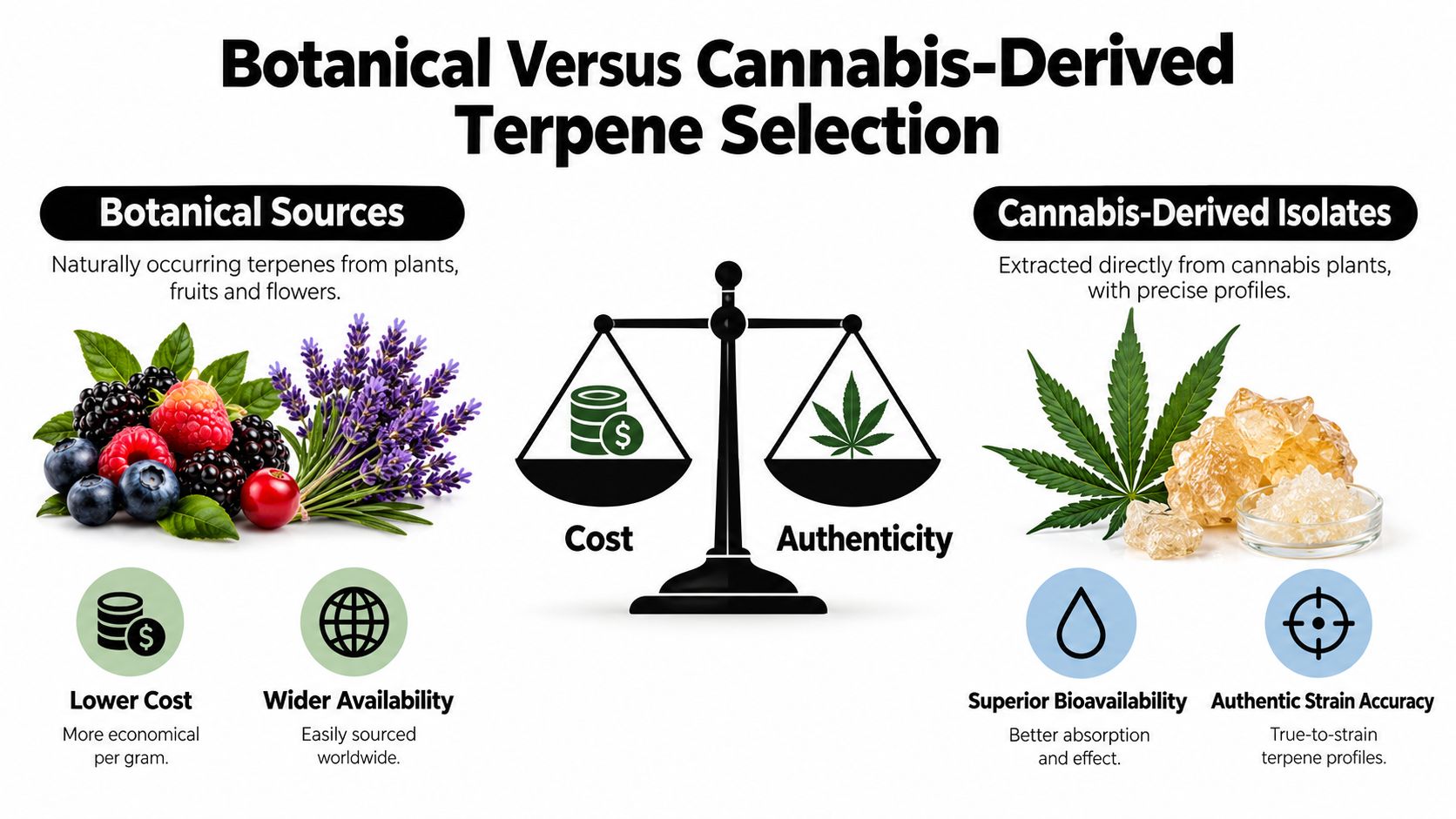
For a strain-inspired Purple Punch blend, botanical isolates generally offer better control and repeatability, while cannabis-derived materials can offer a closer connection to a particular flower lot. Neither option automatically reproduces the cultivar. The right choice depends on whether the product specification prioritizes scalable consistency, lot-specific authenticity, or a controlled balance of both.
Botanical materials
Botanical isolates let a team set the caryophyllene, limonene, myrcene, pinene, and linalool structure directly. That makes it easier to correct a batch that is too spicy, too citrus-heavy, or too soft without changing the whole blend.
They also simplify supply planning when the same aroma must appear across multiple production runs. A supplier can provide a defined material identity and documentation, while the formulator controls the final sensory balance.
The trade-off is that a botanical blend is strain-inspired, not proof that the product contains cannabis-derived terpenes from Purple Punch flower. Labeling and marketing language must reflect the actual ingredients and the rules of the market in which the product is sold.
Cannabis-derived materials
Cannabis-derived terpenes can preserve the character of a specific extraction, but that character may shift with phenotype, cultivation, harvest, cure, and volatile loss. If the commercial promise requires the same flavor across large production runs, the raw material itself may introduce the inconsistency the formulator is trying to eliminate.
Cannabis-derived inputs can still make sense for limited, lot-specific products where authenticity to a defined harvest is more important than broad standardization. The team should then retain the source lot, test the finished blend, and avoid assuming that another Purple Punch harvest will behave the same way.
For a deeper comparison of sourcing choices, use the cannabis-derived terpene resource. Gold Coast Terpenes supplies botanically derived options alongside isolated compounds, which allows a product team to build a controlled profile while documenting its ingredient origin.
Quality Control and Batch Consistency Testing
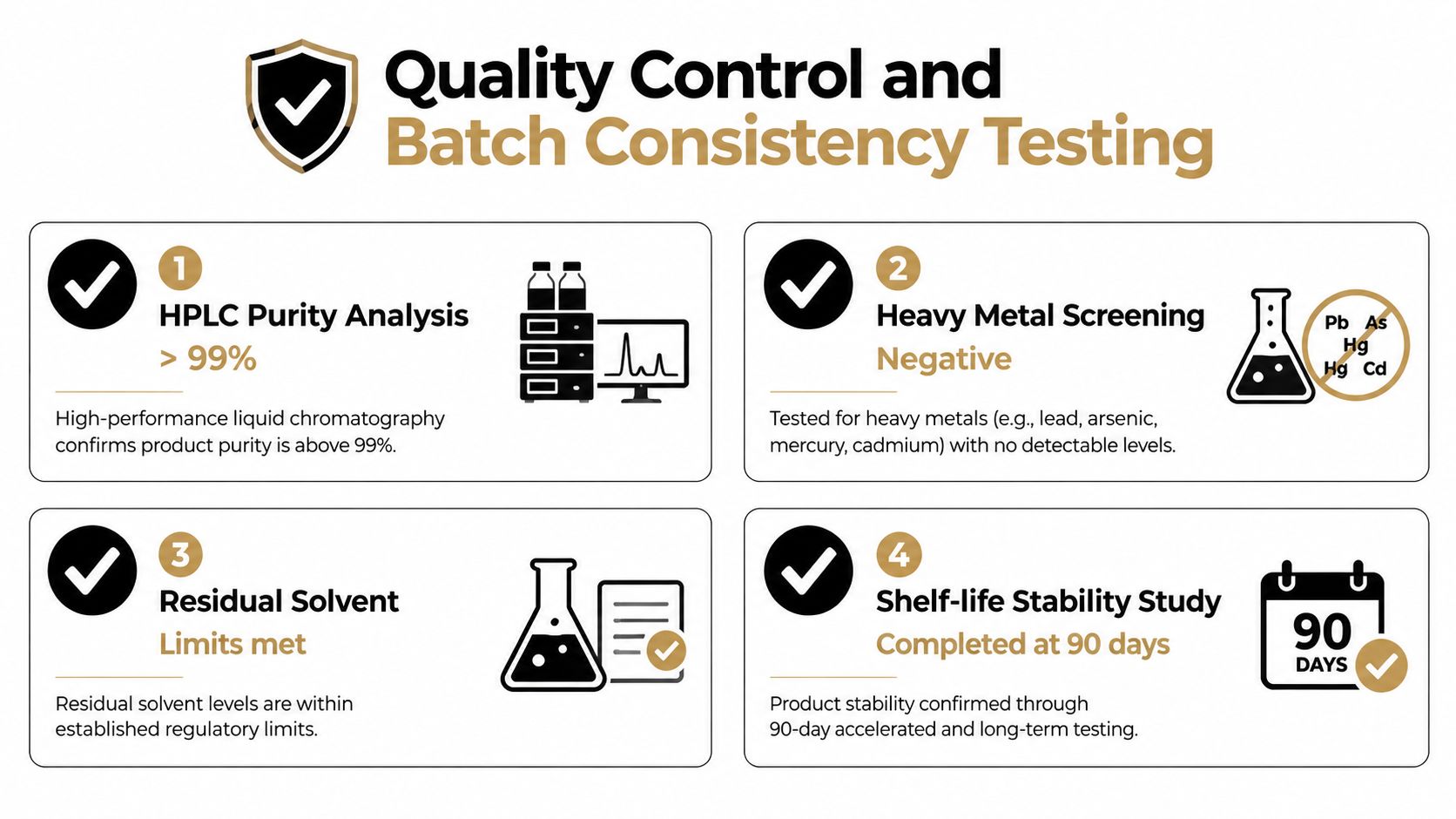
A finished Purple Punch formulation needs more than a successful aroma check. The quality system should verify identity, retention, physical performance, and sensory consistency from incoming material through filled hardware.
The minimum practical control set
Incoming review: Confirm supplier documentation, lot identity, storage condition, and appearance. Don't blend an unfamiliar lot into production just because the product name matches a prior purchase.
Composition testing: Use gas chromatography or another qualified analytical method to verify the expected terpene pattern and identify meaningful drift. Compare the finished oil with the approved formulation record, not only with the raw-material COA.
Physical testing: Measure viscosity using a consistent method and temperature. Check clarity, phase separation, sediment, and cartridge wicking because an aroma match is commercially useless if the oil doesn't perform in the selected hardware.
Sensory retention: Keep a sealed reference from each approved batch. Evaluate fresh material and stored material against the same reference, using consistent sample preparation and trained evaluators.
Stability and documentation
Accelerated stability work can reveal whether fruit notes fade, whether the base becomes harsher, or whether the oil changes physically during storage. The protocol should reflect the actual package, closure, cartridge, light exposure, and temperature conditions used in commerce.
Oxidation can reduce bright citrus character and leave a sharper, more piney or stale impression. Headspace management, container selection, and minimized heat exposure deserve the same attention as the terpene formula itself.
Gold Coast Terpenes states that it provides lab documents and state information with its bulk terpene products. Those documents can support incoming-material review, but they don't replace finished-product testing. For production teams formalizing sanitation, documentation, process control, and release procedures, this guide to GMP principles in manufacturing offers useful manufacturing context.
Scaling Production and Technical Troubleshooting
The scalable Purple Punch strategy is simple in principle: define the aroma target, build the caryophyllene-led structure, control the fruit and dessert layers, then validate the blend in the final oil and hardware. Problems usually appear when teams scale the batch before they understand which variable caused the sensory shift.
Common failures
Separation: Check the matrix, addition order, mixing energy, and temperature history. Don't assume that adding more terpene material will solve an incompatibility problem.
Cloudiness: Review the concentrate, filtration, water exposure, and any carrier or diluent. Compare the affected batch with a known-clear control before changing the aroma formula.
Clogging or poor wicking: Evaluate viscosity at the actual filling and use conditions, then inspect the cartridge design. A terpene adjustment can't compensate for unsuitable hardware.
Flat grape character: Recheck volatile handling and the balance between citrus lift, floral softness, and warm base notes. Adding more sweet fruit material can make the opening louder while leaving the finish unbalanced.
Frequently asked questions
What should a Purple Punch formulation target first?
Start with the caryophyllene-led backbone, then add limonene, pinene, myrcene, and linalool as supporting elements. Gold Coast Terpenes can be evaluated as a source of botanically derived blends and isolated compounds, but the finished oil still needs its own sensory and performance specification.
Are botanical terpenes more suitable for commercial vape brands?
They can be more practical when the brand needs repeatable sourcing and a controlled strain-inspired profile. Cannabis-derived terpenes may better represent a particular flower lot, but they can also carry phenotype and batch variation into the finished product.
How can a team replicate grape and vanilla without using flower extract?
Treat grape and vanilla as a layered sensory target rather than a single terpene note. Build citrus top notes, a fruit and floral heart, and a warm spice base, then validate the blend in the intended distillate or resin.
What should a supplier provide before a bulk purchase?
Request ingredient identity, lot documentation, applicable safety information, and clear labeling details. Gold Coast Terpenes describes its products as lab-verified and THC-free, but each brand should still confirm documentation against its own market and release requirements.
How should strain-inspired profiles be labeled?
Use language that accurately describes the ingredient source and formulation, especially when botanical materials are used to create a cannabis-inspired aroma. Regulatory requirements differ by jurisdiction, so have the final label and claims reviewed for every market where the product will be sold.
Is one Purple Punch COA enough to approve a production blend?
No. A single COA can inform the target, but it can't define every phenotype, cure, extraction, or storage outcome. Approve the finished blend through composition testing, physical checks, sensory comparison, and hardware evaluation.
Gold Coast Terpenes offers botanically derived strain profiles and isolated compounds for teams developing Purple Punch-inspired distillates, concentrates, and vape cartridges. Review the available formulation materials and visit Gold Coast Terpenes to select components for a controlled grape-dessert aroma target.