
Gold Coast Terpenes, a Redondo Beach, California supplier, makes 100% botanically derived terpene blends for cartridge, concentrate, and product formulation work. The popular advice that a “Mai Tai” label tells you exactly what you're buying is wrong, and that assumption can produce a bright, convincing prototype that becomes inconsistent at commercial scale.
For product developers, the useful question is not just what the Mai Tai strain tastes like. It is which lineage, phenotype, terpene ratio, extraction target, and hardware profile you are trying to reproduce. A reliable Mai Tai strain-inspired terpene blend for vape cartridges starts with verified chemistry, not strain mythology.
Why the Mai Tai Strain Lineage Complicates Formulation
Mai Tai isn't a single fixed cultivar. Reputable strain references describe at least two major lineages in circulation, including a Clearwater Genetics version reported as Sunset Sherbet crossed with Purple Punch, and an older tropical lineage described as Maui Wowie crossed with Tutti Frutti. Independent strain coverage documents the disagreement directly.
That split matters because a formulation team can order material labeled Mai Tai and receive a profile that leans creamy, berry-like, and dessert-forward, or one that presents more tropical fruit and citrus. The name functions more like a brand family than a single botanical identity, particularly across North American retail and seed markets where naming conventions aren't standardized.
Practical rule: Treat “Mai Tai” as a flavor direction until the batch has a verified terpene profile.
Why the label creates commercial risk
A generic strain description usually promises citrus, fruit, sweetness, and a soft spicy finish. Those descriptors are useful for creative direction, but they don't tell you whether the target batch is limonene-heavy, myrcene-heavy, or supported by meaningful linalool, pinene, ocimene, or humulene.
That uncertainty affects more than aroma. It changes the ratio of volatile top notes to heavier mid and base notes, which influences distillate blending, viscosity behavior, vapor character, and the way a cartridge tastes after repeated heating. A product team that matches the name instead of the actual profile can pass an initial bench tasting and still miss the reference flower or extract.
The practical response is to document the exact target:
- Lineage or breeder attribution: Record whether the reference is associated with Sunset Sherbet and Purple Punch, Maui Wowie and Tutti Frutti, or another named selection.
- Batch chemistry: Use a current certificate of analysis where available, rather than relying on a menu description.
- Sensory sequence: Note whether citrus arrives first, whether stone fruit follows, and whether the finish is peppery, earthy, creamy, or floral.
- Manufacturing target: Decide whether you're replicating flower aroma, live extract character, or a stable strain-inspired profile for distillate.
A product page such as Elevated Strains can help teams think in terms of named flavor profiles, but it shouldn't replace batch-level validation. Gold Coast Terpenes is one potential source of strain-oriented profiles and isolated compounds, while the final target still needs to be defined by the manufacturer.
For a deeper selection framework, use this terpene-profile approach to strain selection before approving a Mai Tai reference lot.
Deconstructing the Core Terpene Ratios
The most repeatable Mai Tai formulation starts with a limonene-led profile, then uses beta-caryophyllene and myrcene to control depth. Published references commonly describe limonene as the dominant terpene, with caryophyllene and myrcene acting as principal supporting notes. A strain chemistry overview explains the broader supporting profile.
Published guides place total terpene content in well-grown Mai Tai material around 1.5% to 3.2% by weight, while reported phenotype ranges for key compounds vary with cultivation and genetics. The reported total and compound ranges are summarized in this formulation-focused guide.
The ratio matters more than the label
Limonene supplies the opening citrus brightness. It can read as lemon peel, sweet orange, or a sharper citrus zest depending on the rest of the blend and the matrix. Myrcene fills out the profile with a rounder tropical-earthy character, while beta-caryophyllene contributes pepper, warmth, and a drier finish.
A higher limonene-to-myrcene relationship produces a cleaner, brighter, more immediately citrus-led profile. Increasing myrcene relative to limonene makes the same general concept feel heavier, softer, and more tropical-earthy. Beta-caryophyllene then determines how much spicy structure remains after the fruit fades.
| Terpene | Target range (%) | Sensory role |
|---|---|---|
| Limonene | 0.3% to 0.9% | Bright citrus top note and sharp aromatic lift |
| Beta-caryophyllene | 0.2% to 0.7% | Peppery mid-note and grounding finish |
| Myrcene | 0.2% to 1.0% | Tropical, earthy depth and roundness |
| Linalool | Supporting trace to moderate contribution | Soft floral sweetness |
| Pinene, ocimene, humulene | Supporting contribution by phenotype | Pine, tropical brightness, herbal and dry accents |
The ranges for limonene, beta-caryophyllene, and myrcene come from published Mai Tai profile references, including this independent terpene analysis. They're useful as a starting envelope, not a universal recipe.
Build the sensory arc, not just the chemical list
The first inhalation should present citrus. The middle should move toward stone fruit or tropical sweetness. The finish should retain enough caryophyllene and supporting heavier terpenes to prevent the profile from collapsing into a one-note orange flavor.
Some guides report total terpene levels around 1.5% to 3.0%, with exceptional material reaching 3.5% under optimal environmental control. That upper range is discussed in this Mai Tai profile reference. In a commercial blend, chasing the highest possible terpene load isn't automatically better. Excessive top-note intensity can make a cartridge taste sharp, while insufficient base support makes the profile disappear after the first few pulls.
Use the table as a sensory map. Confirm the final blend through analytical testing and controlled tasting against the selected reference batch.
For broader pairing work, the terpene flavor chart is useful when choosing supporting isolates without drifting into an unrelated fruit profile.
Replicating the Flavor with Isolate Pairings
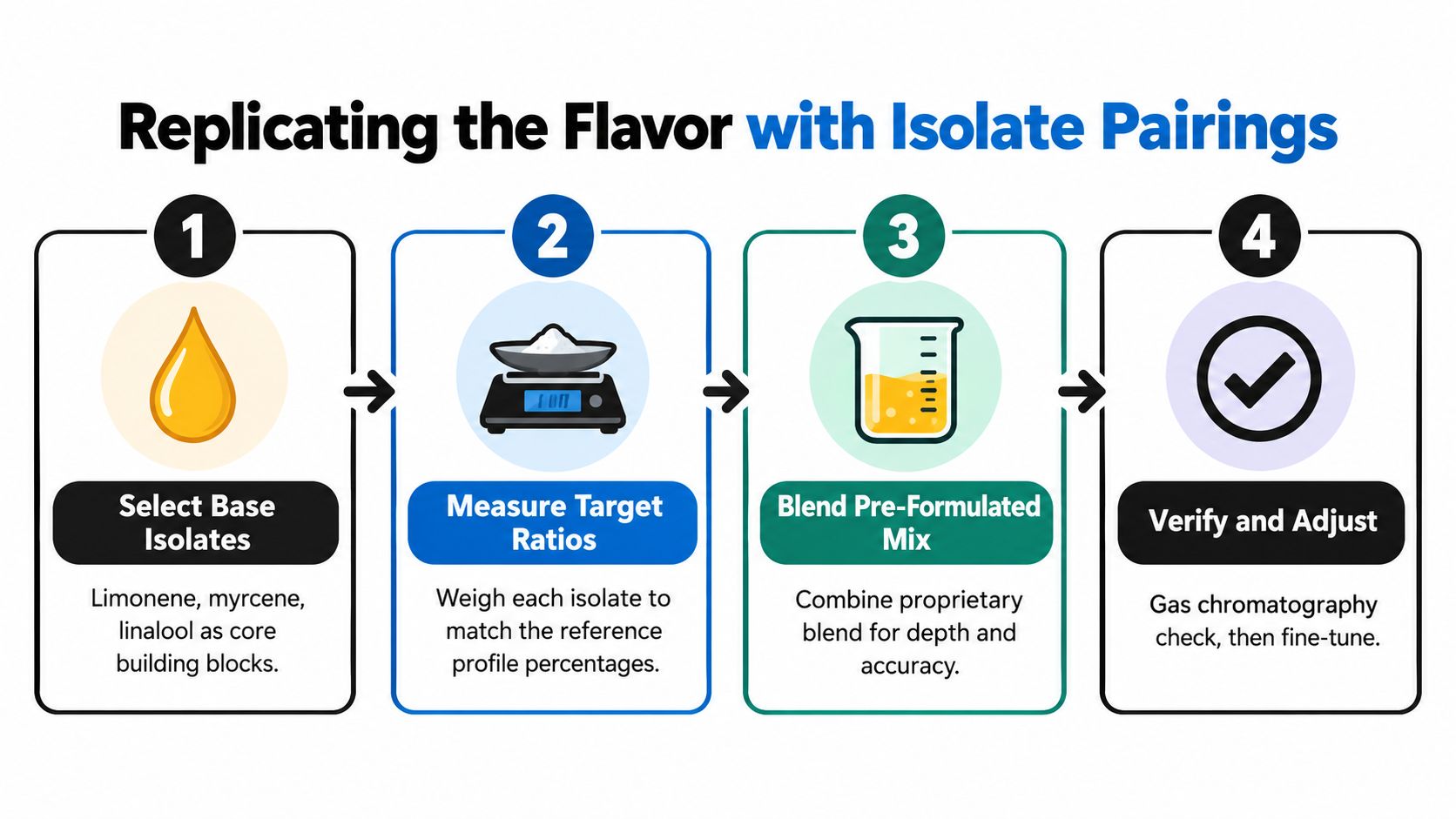
A reliable strain-inspired terpene blend for distillate uses isolates for control and a pre-formulated profile for complexity. Start with limonene, myrcene, and beta-caryophyllene as the measurable backbone, then add smaller supporting contributions only when the reference batch calls for them.
Gold Coast Terpenes supplies 100% botanically derived blends and isolated compounds, including common formulation materials such as limonene, myrcene, and beta-caryophyllene. Its Elevated Strains range can serve as a pre-formulated flavor baseline when a simple isolate stack doesn't reproduce the creamy fruit or dessert character of the reference.
A workable development sequence
Select the base isolates. Begin with limonene for the citrus opening, myrcene for tropical depth, and beta-caryophyllene for peppery structure. Add linalool only if the reference has a soft floral or creamy quality.
Measure against the reference profile. Use the target ranges above as boundaries, then adjust the ratio rather than adding compounds indiscriminately. If the blend tastes too earthy, reduce myrcene before increasing limonene. If it tastes thin, add structure through the supporting compounds instead of just raising the total terpene load.
Introduce a pre-formulated blend carefully. A botanical Mai Tai-style or fruit-dessert blend can supply minor aromatic complexity that a three-isolate formula may lack. Gold Coast Terpenes' strain-oriented options are relevant here because the supplier offers both blended profiles and individual isolates, allowing a team to compare a complete baseline with a custom reconstruction.
Verify and adjust. Test the finished blend analytically where appropriate, then evaluate it in the actual distillate matrix and cartridge hardware. A flavor that works in a glass vial may become sharper, flatter, or more peppery after dilution and heating.
The isolate route gives you control, but it can also become sterile. Limonene, myrcene, and beta-caryophyllene can establish the architecture without fully reproducing the nuanced transition from citrus to stone fruit to dessert. A pre-formulated blend gives you more complexity, but it can make troubleshooting harder if you don't know which component is driving the result.
Formulation insight: Use isolates to correct the profile, not to erase its identity.
Read the guide to using terpene isolates before preparing a production-scale blend. Weighing errors, incomplete homogenization, and poor storage can make a good target look chemically inconsistent.
Managing Thermal Degradation in Vape Hardware
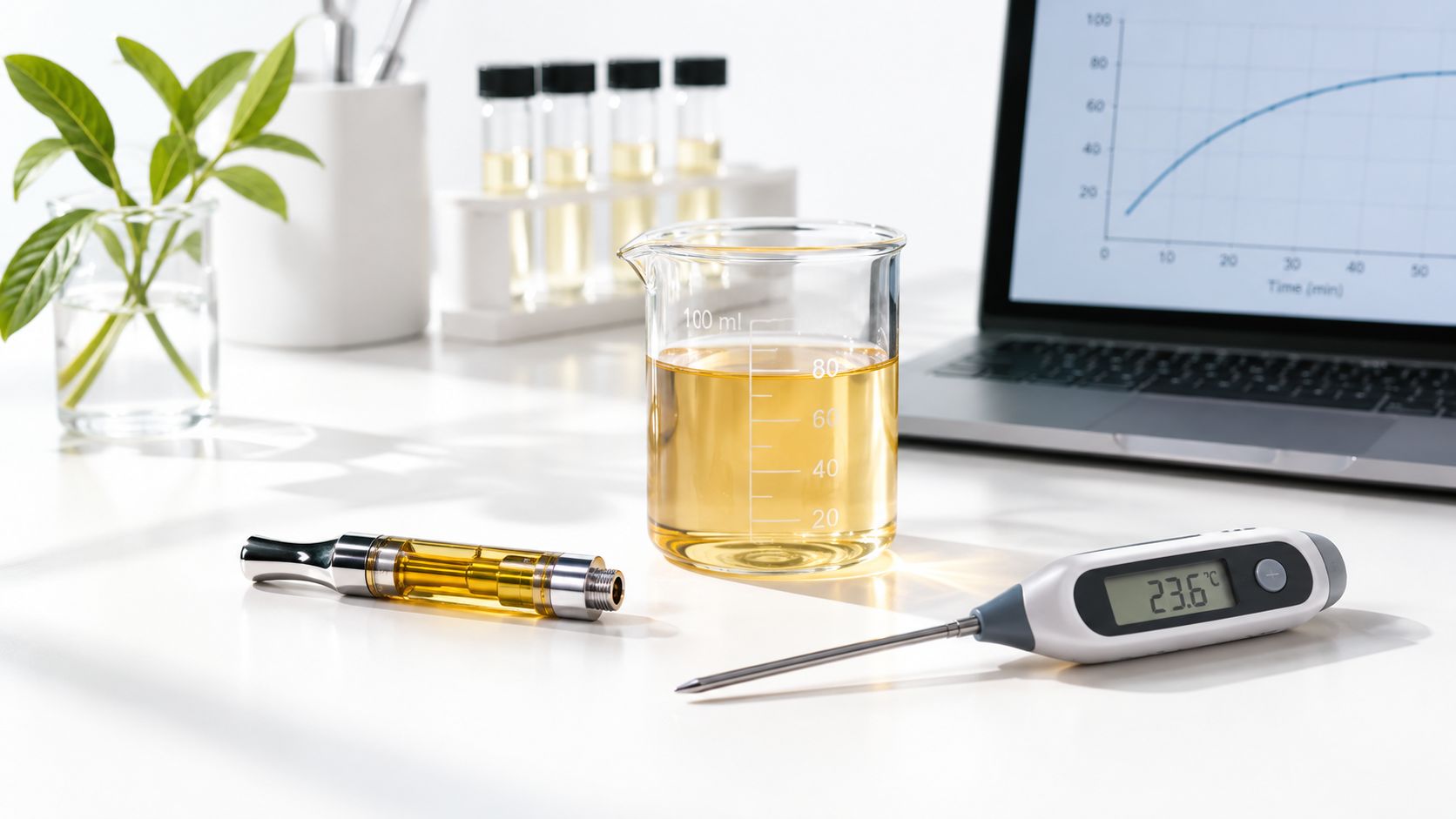
A Mai Tai cartridge can lose its defining citrus character when the hardware delivers more heat than the blend can tolerate. The goal isn't to select a voltage from a generic chart. It's to qualify the cartridge, oil, and battery as one system and confirm that the limonene-led top notes survive repeated use.
Why bright profiles expose hardware problems
Limonene and other lighter aromatic components contribute strongly to the first sensory impression. Excessive heating can strip or transform those volatile notes faster than the heavier peppery and earthy components, leaving a cartridge that tastes harsher and less fruit-forward over time.
The result is familiar in development rooms. The first pull tastes like citrus and tropical fruit, while later pulls lose brightness and emphasize spice, dryness, or burnt residue. That isn't necessarily a failed terpene blend. It may be a mismatch between coil behavior, oil flow, battery output, and the blend's volatility.
Use a controlled qualification plan:
- Start with a low-heat operating condition: Establish the lowest setting that produces consistent vapor and acceptable draw behavior.
- Test repeated pulls: Evaluate the first, middle, and later pulls rather than approving the cartridge from a single taste.
- Compare hardware formats: Ceramic and wick systems can express the same oil differently, especially as viscosity and flow change.
- Inspect after storage: Check for separation, darkening, leaking, clogging, and flavor drift before release.
- Record the complete system: Document cartridge construction, oil composition, battery behavior, and test conditions.
Temperature rises can make pepper and herbal notes more noticeable. One Mai Tai reference specifically describes deeper caryophyllene and humulene expression as temperature approaches 195°C. That sensory shift is covered in this heat-focused Mai Tai guide.
The video below can support internal training on terpene behavior and product development:
For a technical review of oxidation, heat exposure, and aromatic loss, use this resource on terpene degradation. The commercial lesson is simple. Don't approve a Mai Tai formulation in a vial and assume the cartridge will deliver the same sensory sequence.
Botanical Versus Cannabis-Derived Sourcing
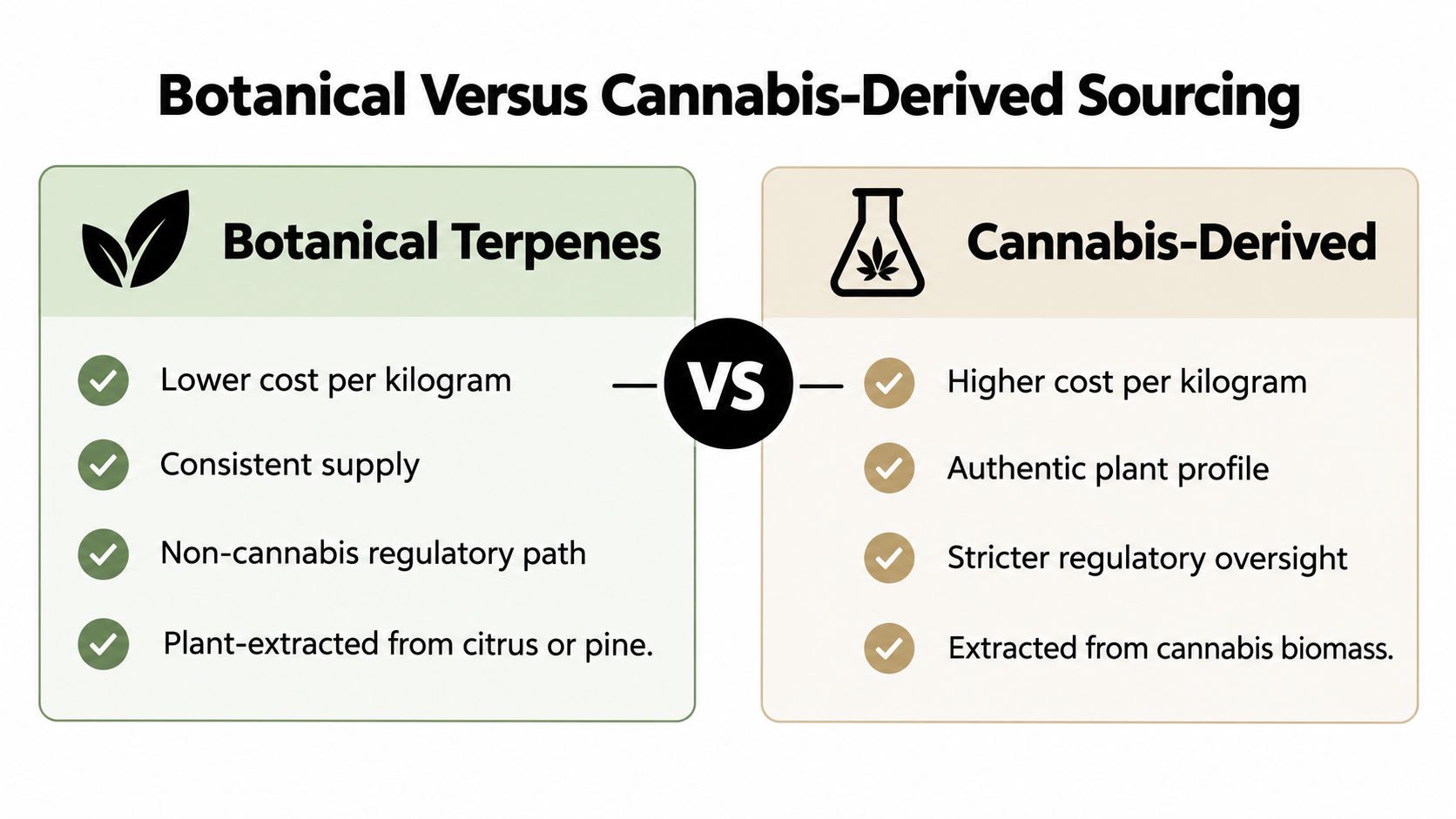
For most commercial Mai Tai-style products, botanical terpenes offer the easier path to consistent supply and repeatable flavor, while cannabis-derived terpenes can provide stronger provenance and a closer relationship to a specific cannabis extract. Neither option automatically reproduces the reference batch.
Gold Coast Terpenes describes its botanical materials as THC-free and free of VG, PG, PEG, and MCT, with SC Lab-tested products. Those attributes can simplify internal specifications, but every manufacturer still needs to verify the applicable rules for its market, product type, claims, and labeling.
The practical sourcing comparison
Botanical terpenes are useful when the formulation team needs a controlled Mai Tai-inspired flavor, predictable documentation, and scalable purchasing. Citrus, pine, and other botanical sources can supply the same named molecules found in cannabis, but the final sensory result depends on purity, ratios, minor compounds, and the distillate matrix.
Cannabis-derived terpenes may be preferable when the product's positioning depends on cannabis provenance or when the source extract already carries the desired profile. The trade-off is that agricultural variation, extraction conditions, regulatory requirements, and supply constraints can make batch matching more difficult.
For a vape brand, evaluate both sources against the same criteria:
- Identity: Can the supplier document the source and composition?
- Consistency: Does each lot support the same target ratio and sensory result?
- Compliance: Are certificates, contaminant results, and labeling documents available?
- Matrix compatibility: Does the material remain uniform in the intended distillate?
- Commercial continuity: Can the supplier support the required production schedule and purchasing model?
Gold Coast Terpenes is one botanical sourcing option for brands comparing strain-inspired blends with isolated compounds. The important decision isn't whether “natural” sounds better on a label. It's whether the selected source gives the product team enough control to reproduce the Mai Tai profile without creating an avoidable compliance or supply problem.
Safety Protocols and Dilution Standards
A Mai Tai formulation should never move from bench work to production without validated dilution, viscosity, contaminant, and stability testing. Terpenes are concentrated solvents, and an attractive aroma doesn't prove that the finished oil will wick correctly or remain safe and uniform in its intended hardware.
Gold Coast Terpenes states that its materials are SC Lab-tested, but the manufacturer remains responsible for reviewing current certificates, confirming identity, and testing the finished product. Supplier documentation supports due diligence. It doesn't replace finished-batch compliance testing.
The pre-production checklist
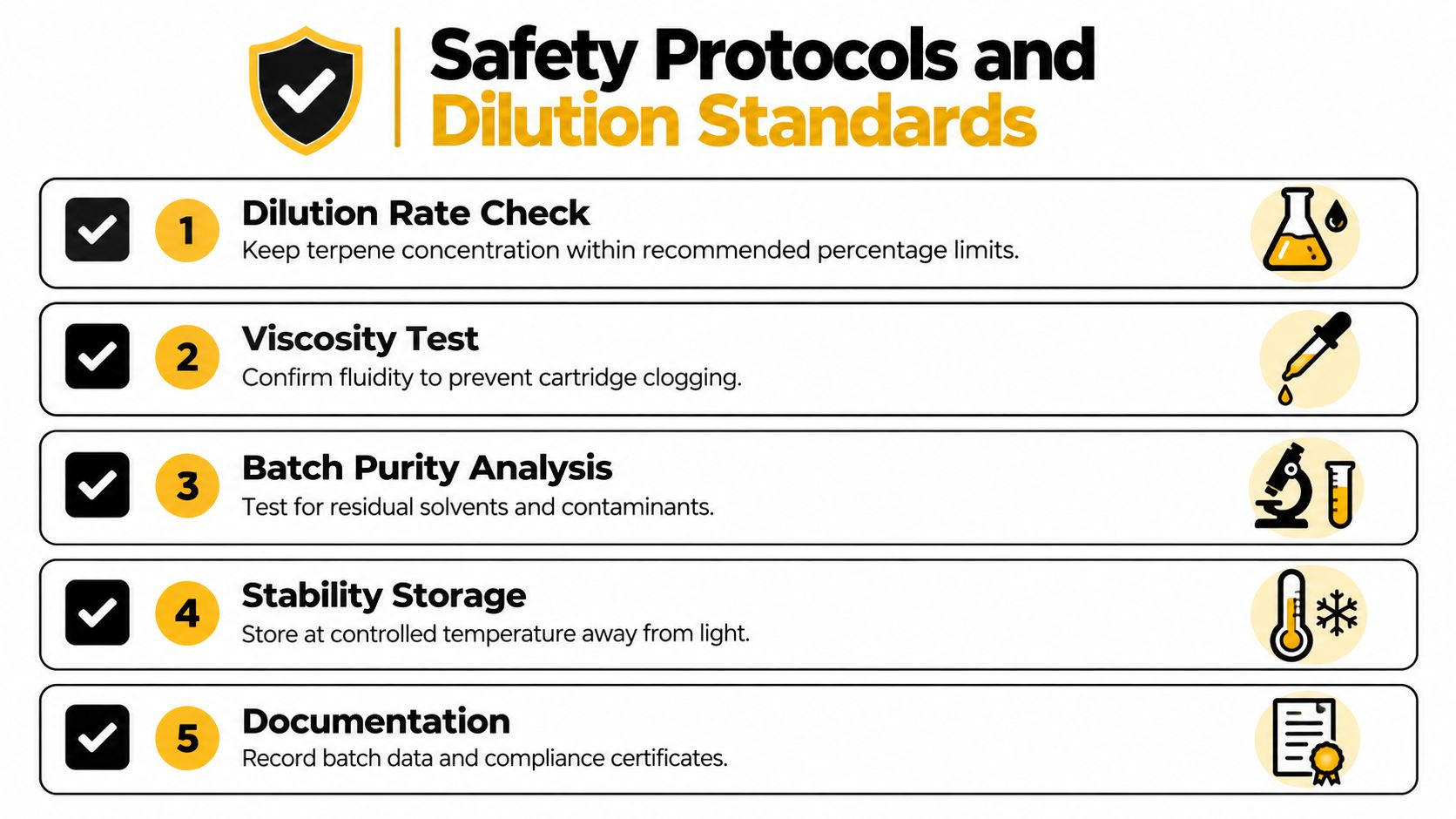
- Dilution rate check: Establish a validated terpene concentration for the specific distillate and cartridge rather than copying a generic recipe.
- Viscosity test: Confirm that the finished oil feeds through the hardware without flooding, clogging, or dry hits.
- Batch purity analysis: Review residual solvents, pesticides, heavy metals, and other contaminants through appropriate third-party testing.
- Stability storage: Protect bulk blends from heat, light, oxygen, and unnecessary headspace during storage.
- Documentation: Retain lot numbers, certificates, mixing records, test results, and final-batch approvals.
Run a small pilot before committing production inventory. Inspect the oil immediately after blending, after a controlled hold, and after hardware filling. Look for visible separation, color change, sediment, unusual viscosity, or a loss of the citrus top note.
Don't use a terpene calculator as a substitute for product testing. A calculator can help with arithmetic, but it can't predict how a particular distillate, cartridge, coil, or storage condition will behave.
Technical Formulation Questions Answered
How do you prevent separation in high-THC distillate? Start with compatible materials, controlled mixing, and a validated addition sequence. Add the terpene blend gradually to the distillate under controlled agitation, then allow the mixture to equilibrate before judging clarity or viscosity. If separation appears, investigate matrix compatibility and process temperature instead of just adding more terpene.
What should you change if the cartridge tastes harsh? First qualify the hardware and operating condition. If the blend is chemically sound, reduce the sharpness of the top-note fraction or rebalance the supporting notes. Increasing limonene alone can make a harsh profile feel even more piercing, so the correction may require reducing excess citrus intensity and restoring a softer mid-note.
How should bulk Mai Tai blends be stored? Use tightly closed, compatible containers kept away from light and unnecessary heat. Minimize repeated opening because oxygen exposure can shift a bright citrus profile toward flatter, heavier notes. Record storage conditions and inspect the blend before it enters production.
Should the target be the flower or the finished cartridge? Target the finished product whenever the commercial goal is a vape cartridge. Flower aroma is a useful reference, but extraction, dilution, storage, and heating all alter the final sensory result. The best formulation is the one that preserves the intended citrus, fruit, and pepper sequence in the actual consumer format.
Gold Coast Terpenes offers botanical strain-inspired blends and isolated compounds that can support Mai Tai replication, correction work, and distillate development. Review the available formulation materials and contact Gold Coast Terpenes when you're ready to match a reference profile to a scalable cartridge program.
Frequently Asked Questions
Is Mai Tai a single standardized cultivar?
No. Published references describe multiple Mai Tai lineages, including Sunset Sherbet crossed with Purple Punch and Maui Wowie crossed with Tutti Frutti. Gold Coast Terpenes can provide a strain-inspired flavor direction, but manufacturers should define the target by verified terpene chemistry and sensory characteristics.
Which terpenes lead a Mai Tai formulation?
Limonene generally leads the profile, with beta-caryophyllene and myrcene providing peppery structure and tropical-earthy depth. Supporting compounds such as linalool, pinene, ocimene, and humulene can change the finish depending on the phenotype.
Are botanical terpenes suitable for Mai Tai vape cartridges?
They can be suitable when the supplier provides appropriate documentation and the finished blend passes compatibility, stability, and compliance testing. Gold Coast Terpenes supplies botanical blends and isolated compounds, allowing product teams to choose between a pre-formulated baseline and a more controlled isolate approach.
How can a formulator preserve Mai Tai's citrus top notes?
Qualify the blend in the final cartridge rather than only in a vial. Control heat exposure, evaluate repeated pulls, and avoid assuming that a battery setting or hardware format that works for another flavor will preserve a limonene-forward Mai Tai profile.
What should a supplier provide before commercial production?
Request current certificates, ingredient identity information, contaminant documentation, lot details, and any relevant safety or handling documents. The manufacturer should then test the finished product in its actual distillate and hardware system before scaling.