
A beta-caryophyllene-led Wedding Cake profile can contain more than 30% of the total terpene blend, which changes how a formulator should build the flavor. Gold Coast Terpenes supplies botanical strain-specific blends and isolated compounds, giving vape and distillate manufacturers a practical way to reproduce the peppery, citrusy, dessert-leaning character without relying on a cannabis-derived input.
The commercial target isn't a generic “cake” flavor. It's a controlled balance between spicy caryophyllene, bright limonene, earthy myrcene, and supporting floral or woody notes. The finished product should open with citrus and sweet dough, develop into pepper and resin, then leave a rounded, creamy finish. That profile must remain recognizable when the flower phenotype, extraction method, hardware, or distillate lot changes.
What the Wedding Cake Terpene Profile Actually Looks Like
A reliable Wedding Cake strain terpene profile starts with beta-caryophyllene as the structural backbone, followed by limonene and myrcene. Independent strain data places beta-caryophyllene above 30% of the total terpene blend in strong profiles, while limonene and myrcene provide the citrus lift and earthy depth that keep the aroma from becoming one-dimensional. The Hemp Doctor's Wedding Cake profile also reports THC commonly ranging from 22% to 29%, with some cuts reaching 30%, but cannabinoid potency isn't the formulation target here. The terpene hierarchy is.
The name suggests vanilla frosting, but the aroma isn't produced by vanilla compounds alone. A caryophyllene-forward blend creates the warm pepper and resin underneath the pastry impression, while limonene supplies tang and myrcene fills out the earthy body. Leafly's Wedding Cake profile describes the same broad structure, with caryophyllene leading and limonene and myrcene forming the secondary layer.
Wedding Cake's history also helps explain the character. Published accounts connect the cultivar to California breeding circles in the early 2010s, with one lineage commonly described as Cherry Pie crossed with Girl Scout Cookies and other accounts identifying Triangle Kush and Animal Mints or a Triangle Mints phenotype. Skunk Labs' strain history documents those competing lineage descriptions, so a formulation should be built around sensory chemistry, not a name on a certificate.
The working build spec
The table below uses the verified caryophyllene and limonene ranges as a reference point. Exact batch percentages vary by phenotype, grower, cure, and product format, so this is a sensory framework, not a claim that every Wedding Cake sample follows one fixed ratio.
| Terpene | Reference position | Sensory role |
|---|---|---|
| Beta-caryophyllene | More than 30% in strong profiles | Pepper, warm spice, resinous backbone |
| Limonene | Around 15% to 20% in one independent formulation reference | Citrus brightness and volatile top-note lift |
| Myrcene | Consistent supporting terpene | Earth, ripe fruit, musk, body |
| Linalool | Supporting terpene | Soft floral rounding |
| Humulene | Supporting terpene | Dry earth, hop-like structure |
| Nerolidol or selinene | Phenotype-dependent support | Creamy, woody, lingering depth |
Gold Coast Terpenes' botanical sourcing model fits this build-spec approach because a producer can adjust individual components instead of accepting the full variability of a cannabis extract. For background on the cultivar's naming and lineage, see the Wedding Cake strain reference. The practical objective is simple: hold the caryophyllene-led identity steady, then tune the lift and finish around the intended hardware and oil base.
Top Mid and Base Notes in the Wedding Cake Profile
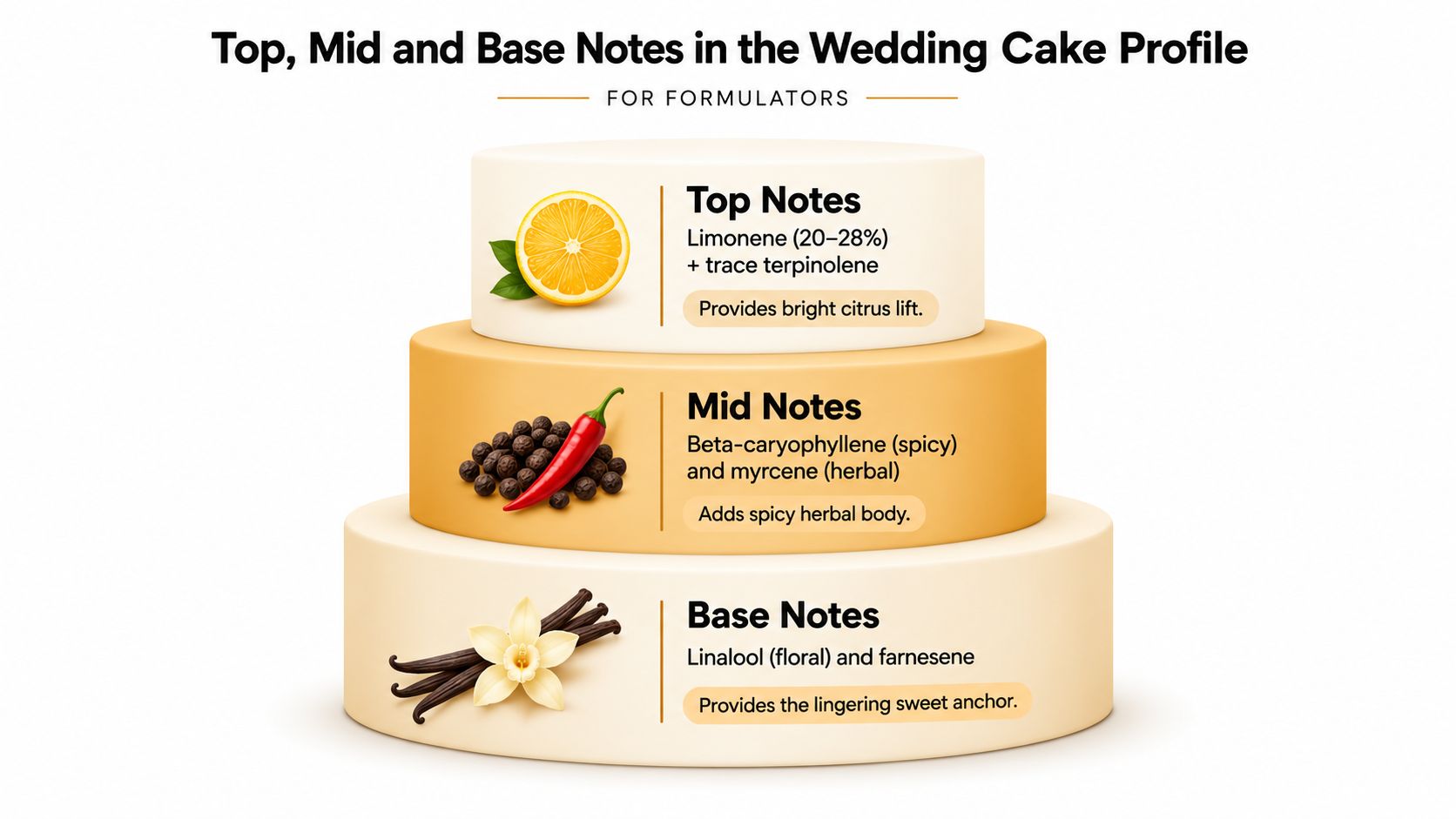
The top notes make Wedding Cake noticeable on the first pull, the mid notes make it identifiable, and the base notes determine whether the finish feels creamy or flat. In a strain-inspired terpene blend, each tier should have a defined job rather than being added because it appears on a lab report.
Top notes open the vapor
Limonene provides the clearest top-note function. Independent Wedding Cake references commonly place it behind caryophyllene, and one formulation-oriented source reports limonene around 15% to 20% of the blend. This Wedding Cake terpene analysis is useful as a directional reference because it connects the citrus component to the stronger caryophyllene backbone.
A small amount of a highly volatile floral or sweet terpene can lift the first impression, but the top should not become lemon candy. Too much limonene makes the profile read as citrus-forward rather than cake-like. In a cart, the first aromatic burst should suggest tangy frosting, not a cleaning product.
Mid notes carry the identity
Beta-caryophyllene is the mid-note anchor even though it also contributes to the dry-down. Its peppery warmth gives the blend the gassy, spicy edge associated with many Wedding Cake expressions. Humulene can reinforce that structure with dry earth and hop-like bitterness, while myrcene provides a softer transition into the base.
The mid layer is where many dessert profiles fail. If the formulator relies on sweet aromatics alone, the product may smell pleasant in the bottle but lose strain identity after vaporization. Caryophyllene gives the blend a recognizable center, and humulene keeps that center from becoming syrupy.
Base notes control the finish
Myrcene adds earthy body and ripe-fruit depth. Linalool can soften the pepper without removing it, while phenotype-dependent compounds such as nerolidol or selinene may contribute woody, floral, or creamy depth. Public strain references also list linalool, humulene, and sometimes nerolidol among the supporting compounds, as shown by the Spinach Wedding Cake product profile.
Use the terpene flavor chart to map each isolate to a sensory function before blending. The most useful question isn't “Which terpenes are present?” It's “Which note disappears first when this oil is heated?”
Practical rule: Build the mid-note identity first, then adjust the opening and finish. A bright top can't rescue a Wedding Cake blend with no peppery center.
Phenotype and Batch Variability in Wedding Cake
There isn't one universal Wedding Cake ratio. Grower selection, cure, post-harvest handling, extraction method, and product format can all change which terpene leads and how strongly the dessert character comes through.
A formulator should therefore compare three things separately: the reference flower, the extracted input, and the finished oil. A cured flower may present a rounded pepper and pastry profile, while fresh-frozen material can emphasize volatile citrus or sharper resin. A heavily handled input may lose some top-note lift before it reaches the tank.
What the available data actually support
Verified strain references consistently place caryophyllene first, with limonene and myrcene supporting it. One public database discussion cites limonene around 9.2 mg/g in a 2024–2025 sample set, illustrating why a single lab snapshot shouldn't be treated as the universal Wedding Cake standard. Entourage Brand's Wedding Cake profile discussion specifically highlights the effect of grower, cure, phenotype, and format on the ranking.
| Input type | Caryophyllene | Limonene | Humulene | Myrcene |
|---|---|---|---|---|
| Strong reference profile | More than 30% | Around 15% to 20% in one independent reference | Supporting | Supporting |
| Flower batch | Usually leading | Variable | May be present | Usually supporting |
| Fresh-frozen input | Often leading | Can present more prominently | Variable | Variable |
| Cured or processed input | Often leading | Can soften with handling | Variable | Can become more noticeable |
This comparison is intentionally conservative. The verified data don't provide a complete, standardized panel for each input type, so precise ranges would create false certainty. The operational lesson remains clear: use the strain name as a starting hypothesis, not as a guaranteed chemical specification.
For brands replicating flavor of Wedding Cake across multiple production lots, botanical reconstruction reduces dependence on the terpene ratio in a single extract. Gold Coast Terpenes' environmental terpene guide provides useful context for why environmental and post-harvest variables matter. A stable caryophyllene isolate can restore the backbone, while limonene and linalool can correct a dull or overly sharp batch.
Matching Gold Coast Terpenes Isolates and Blends
Treat Wedding Cake as a chassis, not a single bottle. The chassis is caryophyllene-led, citrus-supported, and rounded by earthy and floral compounds. Start with a Wedding Cake profile blend, then make small isolate adjustments only after comparing the diluted blend with a reference sample.
Build in this order
Start with the profile blend. Use the Wedding Cake blend as the initial sensory frame. Smell it on a blotter and in the intended oil base because the carrier and concentration can change the perceived balance.
Correct the backbone. Add beta-caryophyllene when the profile loses pepper, warmth, or strain recognition. A caryophyllene isolate shouldn't be used to mask a poor-quality base, but it can restore identity when the incoming extract is unusually soft.
Restore the opening. Limonene is the adjustment for a muted citrus and sweet-tang impression. Add it carefully. A sharp lemon top can quickly overpower the dough and resin that make the profile recognizably Wedding Cake.
Round the center. Linalool can soften an aggressive pepper note and make the finish feel more integrated. Humulene or bisabolol can add dry structure when the blend feels too sweet or lacks a clean dry-down.
For a stronger vanilla-bakery impression, a measured layer of an Apple Fritter or Gelato profile can work better than pushing limonene alone. The Apple Fritter Elevated Strain profile is relevant because it can add a dessert-oriented top, but it should remain a supporting layer. Too much secondary dessert character blurs the Wedding Cake signature.
| Gold Coast Terpenes component | Role in profile | Suggested inclusion |
|---|---|---|
| Wedding Cake profile blend | Primary chassis | Establish as the reference blend |
| Beta-Caryophyllene isolate | Pepper and warm resin correction | Adjust to sensory target |
| Limonene isolate | Citrus and volatile lift | Add in small increments |
| Linalool isolate | Floral softness and finish rounding | Use sparingly |
| Apple Fritter profile | Vanilla-fruit dessert reinforcement | Use as a measured secondary layer |
| Humulene or bisabolol isolate | Dry-down control | Add only when the finish needs structure |
Use a mixing calculator to convert the intended ratio into batch weights, then make a finished sample before scaling. The best result is the one that matches the reference jar after heating, not the one that smells closest in a concentrated bottle.
Mixing Ratios for Vape Carts and Distillate
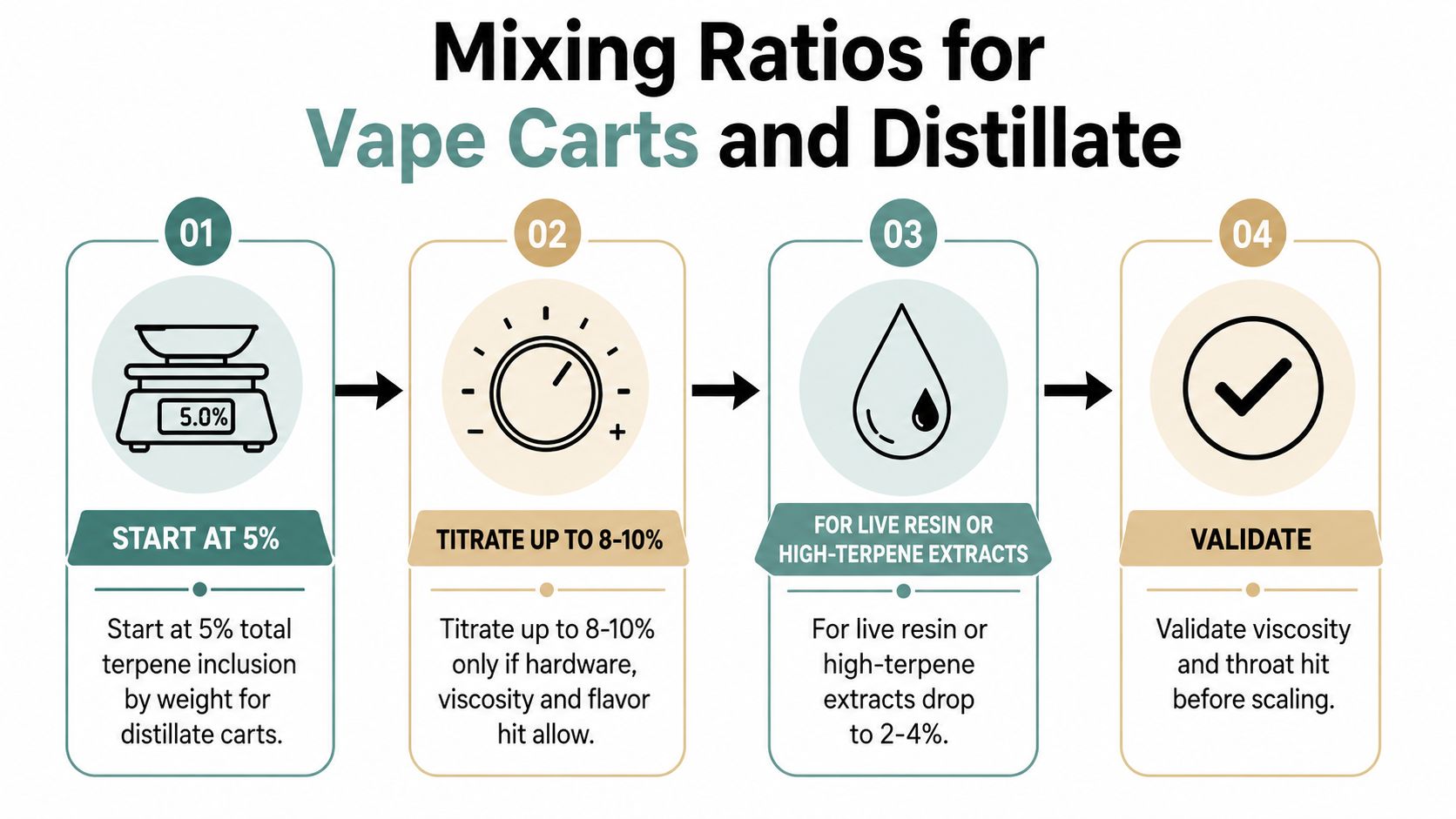
For distillate carts, a common development starting point is 5% total terpene inclusion by weight, with adjustment toward 8% to 10% only when the hardware, viscosity, and flavor response support it. For live resin or another extract that already carries substantial native aroma, a lower starting point of 2% to 4% can prevent the added profile from muting the source material. These operational ranges come from the requested formulation specification, not from a verified source in the research data, so validate them against the applicable product, hardware, and regulatory requirements.
A controlled bench sequence
Weigh the distillate first. Warm it to 40°C to 45°C only if the oil and equipment specifications allow that temperature, add the Wedding Cake profile blend, then add isolates in the order established during bench testing. Stir for 90 seconds and document every addition by lot, weight, and operator.
The mixing ratios calculator helps convert percentage targets into grams per batch. It doesn't replace a viscosity test or a hardware compatibility test. A formulation that looks correct on paper can still wick poorly, flood, or produce an overly sharp throat sensation.
Run a 1 mL pilot cart before committing to a production batch. Check wick saturation, oil movement, throat feel, and aroma after heating. If the vanilla-cream note is thin, a small limonene adjustment may restore lift. If pepper dominates, reduce caryophyllene slightly and test whether linalool provides a cleaner correction than adding more sweet profile.
The associated mixing demonstration is useful as a process reference:
Don't scale from a bottle sniff alone. Heat the actual oil in the intended cartridge, because ceramic, airflow, coil temperature, and oil viscosity all change the perceived ratio.
Sourcing Botanical Terpenes and Lab Verification
Botanical and cannabis-derived terpenes are different sourcing choices, and the label must reflect the actual source. Botanical inputs can offer a consistent supply for brands that need repeatable flavor across non-cannabis and cannabis product lines, while cannabis-derived inputs may align more closely with a particular extract but can introduce additional sourcing and compliance requirements.
Gold Coast Terpenes describes its line as 100% botanically derived, THC-free, and free of VG, PG, PEG, and MCT, with SC Lab testing. Those specifications matter for vape manufacturers because carriers can affect viscosity, ceramic hardware performance, label declarations, and state-specific product requirements. A supplier's marketing page isn't enough. Request current documentation for the actual lot being purchased.
Documents to request before production
- Current Certificate of Analysis: Confirm the lot number, test date, identity, and panel scope.
- Contaminant testing: Review heavy metals, pesticides, residual solvents, and microbial results where applicable.
- THC-free documentation: For non-cannabis SKUs, confirm the supplier's stated THC-free status and the applicable laboratory result.
- Carrier declaration: Verify the absence or presence of VG, PG, PEG, MCT, and other diluents on the lot documentation.
- Sensory reference: Keep a retained sample and compare the new lot in a controlled sniff jar and finished oil.
GC-MS testing can help lock the caryophyllene, limonene, and myrcene relationship when a brand needs a repeatable strain-inspired profile. Sensory work still matters, because a chemical match doesn't automatically produce the same aroma in a heated cart. Use both methods when the SKU has enough commercial importance to justify the testing cost.
Common Formulation Mistakes and Compliance Checks
The most common failure is treating a dessert profile as a sweetener system. Wedding Cake needs pepper, citrus, and earth in proportion. Remove the caryophyllene backbone and the blend becomes generic frosting; overemphasize it and the product becomes harsh, dry, or aggressively spicy.
Errors that flatten the profile
- Over-terping: Higher inclusion can overwhelm the distillate, dull the intended balance, and make volatile citrus notes seem harsh after heating. Test the lower end first, then increase only when the hardware and throat response are acceptable.
- Under-terping: A very low inclusion may leave the distillate nearly expressionless. The solution isn't always more total terpene. Identify whether the missing note is caryophyllene, limonene, or the base layer.
- Stacking dessert profiles: Combining two sweet blends can cancel contrast and produce a muddy aroma. Keep one profile dominant and use the second as a controlled accent.
- Ignoring hardware: A carrier-free terpene system still needs compatibility testing. Confirm viscosity, saturation, leakage, and coil behavior in the selected cartridge.
- Mislabeling the source: Don't call a botanical blend cannabis-derived. Don't add unsupported THC claims or medical and structure-function language to packaging.
Before release, compare the finished cart with a retained reference using a small trained sensory panel. Then review the lab data and repeat the check after storage. A two-week retention check at room temperature is a useful internal checkpoint for aroma drift, viscosity change, and hardware behavior, but it doesn't replace the stability program required for the finished product.
Building a Repeatable Wedding Cake SKU
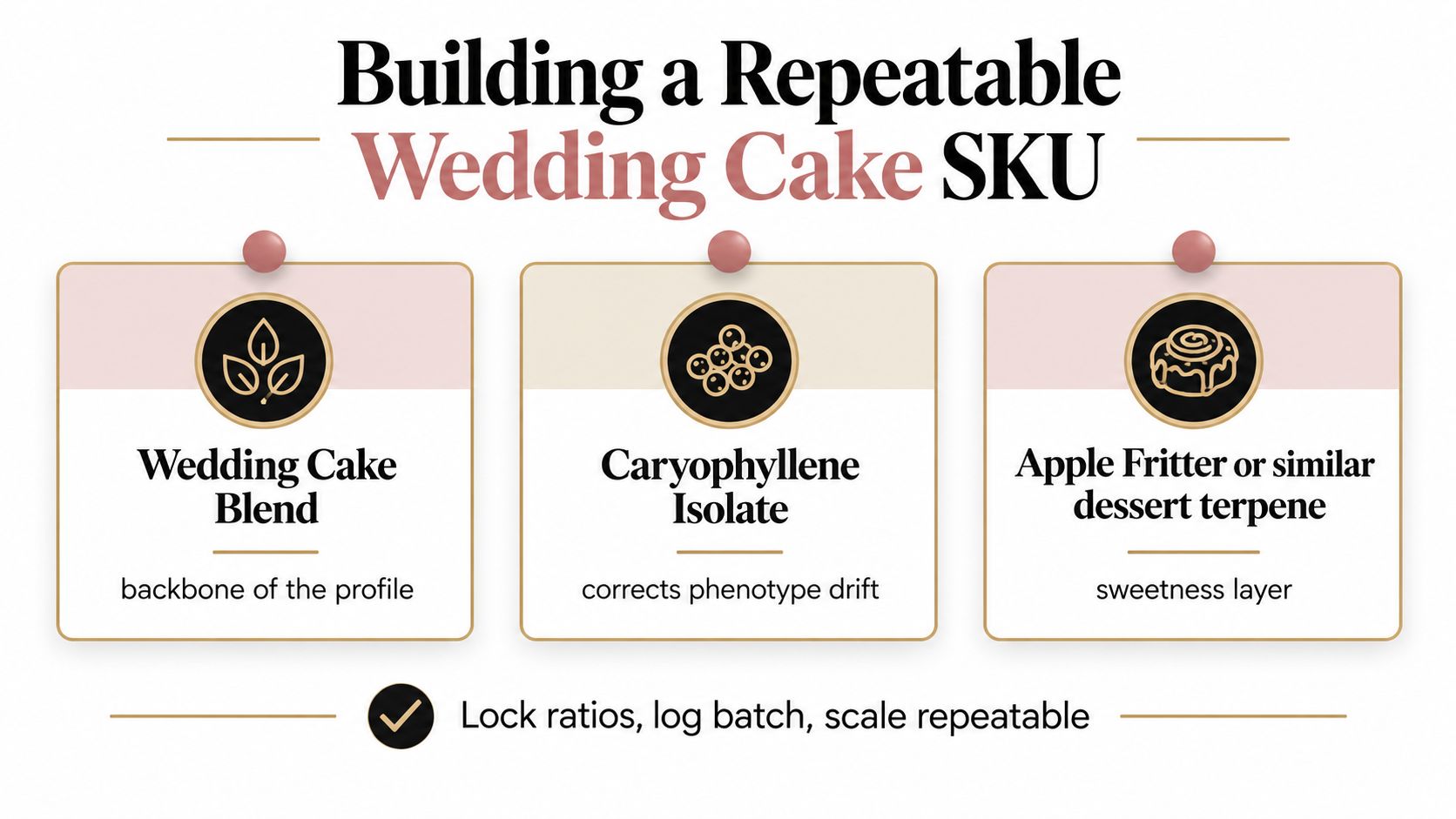
A repeatable SKU needs a stocked component set, a written ratio, and a retained reference. It shouldn't depend on an operator remembering how much isolate was added to the last batch.
Keep three core components available: a Wedding Cake profile blend for the chassis, a Caryophyllene isolate for phenotype correction, and an Apple Fritter or comparable dessert profile for controlled sweet-top reinforcement. Set MOQs and bulk-tier thresholds against actual monthly distillate volume, and don't wait until the last bottle is open to reorder the backbone blend.
The operating system behind the flavor
Create a batch sheet that records supplier, lot number, input weights, blend date, operator, dilution base, cartridge hardware, and sensory result. Pull a retained reference sample for every production run, then schedule periodic full-panel testing through the laboratory used for your compliance program.
Gold Coast Terpenes offers profile blends, isolates, formulation tools, safety documents, and bulk purchasing options that can support this kind of component strategy. Compare MOQs, lead times, documentation, and lot consistency before choosing a supplier for vape brands. The most useful supplier is the one that can provide the right material, the right paperwork, and a repeatable reorder process.
Frequently asked questions
What leads a Wedding Cake terpene profile?
Beta-caryophyllene usually leads, with limonene and myrcene supporting it. Gold Coast Terpenes can be used as a botanical blend and isolate source when a manufacturer needs to correct that hierarchy in a finished formulation.
Is a botanical Wedding Cake blend the same as a cannabis-derived blend?
No. Botanical and cannabis-derived terpenes can share individual aromatic compounds, but their source and labeling treatment differ. Gold Coast Terpenes identifies its terpene products as botanically derived, so brands should preserve that source distinction on documentation and packaging.
How should formulators match Wedding Cake flavor in a vape cartridge?
Start with the caryophyllene-led chassis, then adjust limonene for lift and linalool or another support terpene for finish balance. Always test the finished oil in the intended cartridge because heat and hardware can change the sensory result.
Can Apple Fritter reinforce a Wedding Cake formulation?
It can add a dessert-oriented layer, but it should remain subordinate to the Wedding Cake backbone. Gold Coast Terpenes' Apple Fritter profile is one option for testing a sweeter top without rebuilding the entire formulation from separate compounds.
What documentation should a terpene supplier provide?
Request a current Certificate of Analysis, contaminant panels, source information, carrier declarations, and lot-specific safety documents. Brands should also retain a sensory sample and verify the finished product through their own quality program.
A repeatable Wedding Cake SKU is a stocked shelf, a tested reference, and a written ratio. Gold Coast Terpenes provides botanical Wedding Cake-oriented blends, isolated beta-caryophyllene and other compounds, Apple Fritter options, and mixing resources for manufacturers developing cartridges and distillate products. Visit Gold Coast Terpenes to review the available profiles, isolates, documentation, and formulation tools, then build your next batch against a measured reference instead of memory.