
You're comparing suppliers for CDT terpenes for sale, but the decision isn't which bottle has the most convincing strain name. It's whether the material has lot-specific documentation, behaves predictably in your distillate, fits your target cartridge, and can move through the markets where you plan to sell. A terpene blend can taste accurate at the bench and still create leakage, harsh aerosol, labeling problems, or an unusable supply plan at commercial scale.
For formulators, cannabis-derived terpenes are product-specification ingredients. They influence aroma and flavor, but they also affect viscosity, hardware performance, emissions, and the documentation attached to a finished SKU. The sourcing process should therefore look more like an ingredient audit than a casual flavor purchase.
Navigating the Commercial Terpene Landscape
A small test order can hide problems that become expensive during production. Commercial buyers need more than a profile name and a total-terpene statement. They need a clear source description, repeatable batch identity, dependable packaging, relevant safety documentation, and a supplier that can support the same formulation after the first production run.
The category has already moved beyond niche flavoring. The global terpene market is projected to grow from USD 1.59 billion in 2026 to about USD 2.95 billion by 2035, representing roughly 85% total growth and a projected 7.14% CAGR over that period, according to Precedence Research's terpene market snapshot. The same source places 2025 revenue at USD 1.48 billion, showing that the broader ingredient category entered the mid-2020s at substantial scale.
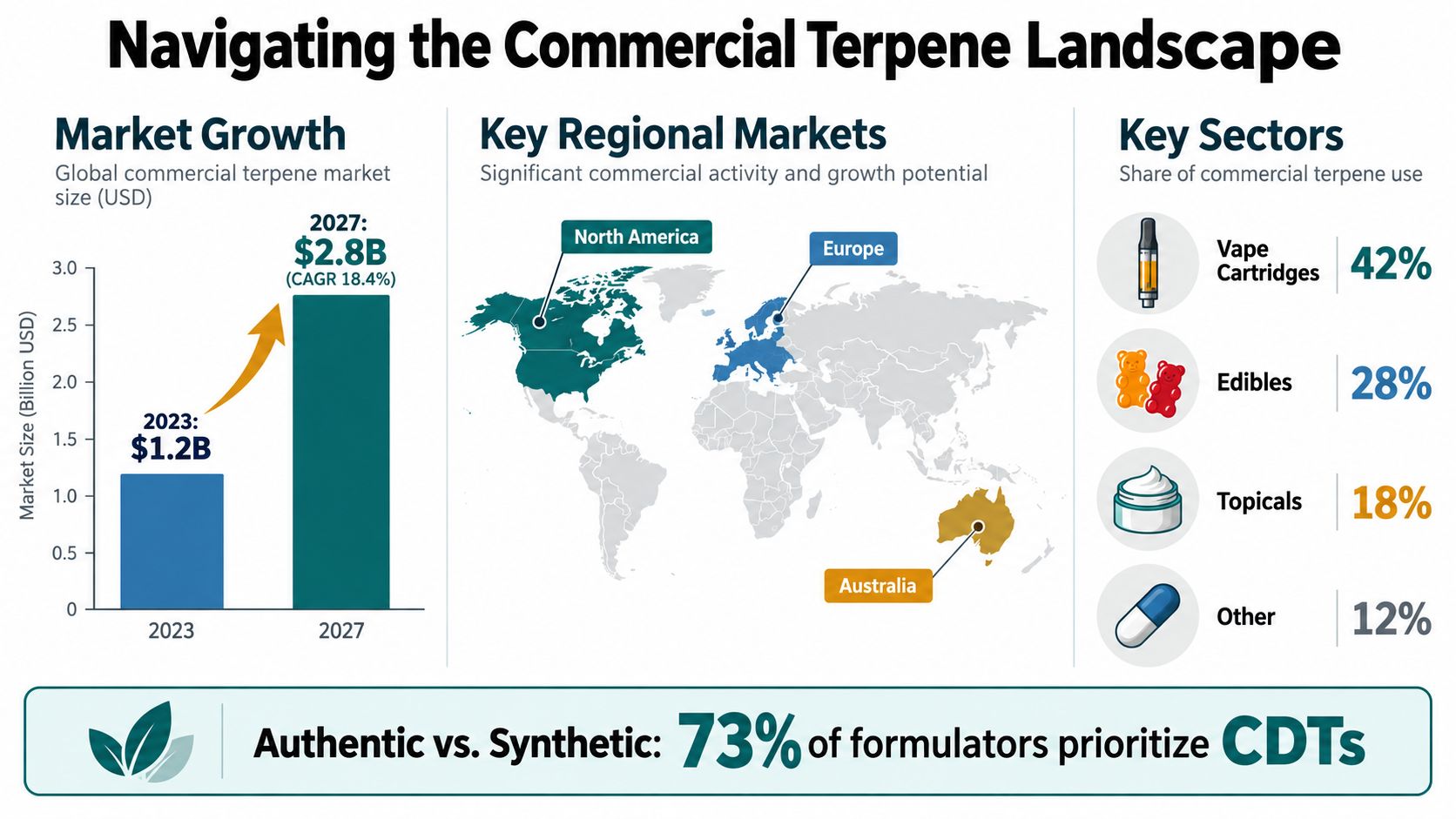
Why scale changes the buying decision
Cannabis-derived terpene demand is expanding faster in one independent market estimate. The cannabis-derived terpene segment is projected to rise from USD 1.8 billion in 2025 to USD 6.2 billion by 2034, with a projected 14.2% CAGR from 2026 to 2034, as reported by Business Research Insights. That projection describes a category increasingly used for cartridges, concentrates, and custom profiles, not merely as a minor flavor addition.
The commercial implication is straightforward. A supplier should be evaluated on batch-to-batch profile control, wholesale reliability, and formulation support, not only on whether the first sample resembles a target cultivar. For a strain-inspired terpene blend, request a retained sample or reference profile that lets your team compare future lots against the approved version.
Practical rule: Treat the terpene blend as part of the finished product specification. If a change in its composition can alter viscosity, aroma, or aerosol behavior, procurement needs change-control procedures.
A useful supplier conversation should cover lead times, available pack sizes, storage conditions, lot coding, and how the vendor handles profile substitutions. The guide to where to buy terpenes can help organize that initial comparison, but your internal approval process still needs to connect the ingredient to the exact SKU, hardware, and market.
Verifying Authenticity and Certificate of Analysis Standards
A COA is only useful when it identifies the material you're buying. A polished PDF with a passing headline result doesn't replace lot-level traceability or a method that matches the risk of the application.
Start with identity. The report should show the supplier or manufacturer, laboratory information, sample identification, lot or batch number, test date, and a clear match to the container you received. Compare the COA's lot code with the purchase order and bottle label before the material enters production. If those identifiers don't align, quarantine the material until the supplier resolves the discrepancy.
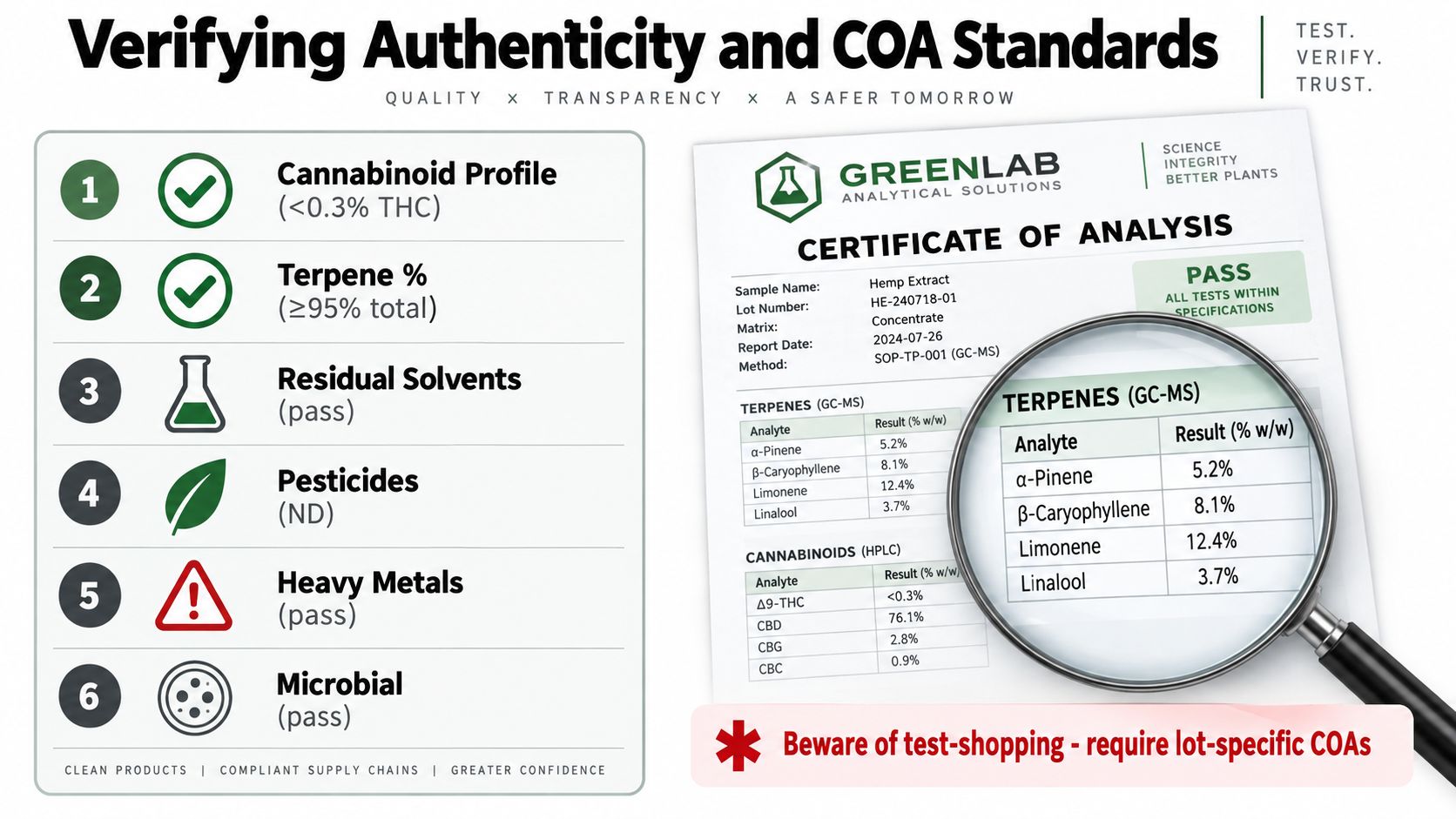
The documentation checklist
Use the report to answer specific questions rather than accepting a generic “lab tested” claim.
- Terpene composition: Look for individual analytes, not only a total-terpene line. A chromatogram or detailed profile helps you assess whether the blend matches the approved sensory target.
- Residual solvents: Materials made through extraction should have a relevant residual-solvent panel. A simple pass statement is less informative than named analytes, reporting limits, and results.
- Pesticides and heavy metals: These screens matter because contamination can originate in source biomass or processing equipment. Confirm that the panel is appropriate for your market and finished-product pathway.
- Microbial quality: The report should identify the tested sample and show the applicable result, rather than relying on an undated supplier declaration.
- Cannabinoid and THC status: If THC-free status matters for your product or distribution plan, require documentation that directly addresses it. Don't infer it from the word “terpene.”
- Cutting agents: Your specification should exclude unwanted diluents such as VG, PG, PEG, and MCT oil when they aren't part of the approved formula.
A missing chromatogram isn't automatically proof of poor material, but it reduces your ability to verify authenticity. Outdated reports, mismatched lot numbers, unexplained profile changes, and vague laboratory identification are stronger reasons to pause purchasing.
For a practical document review, use this COA certificate of analysis guide alongside your own incoming-material checklist. The aim is not to collect paperwork. It's to establish evidence that the ingredient's identity, purity, and intended use have been evaluated.
The report should also support a sensible inhalation decision. Food-grade or GRAS status alone doesn't establish that a terpene mixture is suitable for heating and inhalation. That distinction belongs in the risk review, not buried in a marketing description.
Managing Formulation and Compliance Risk
A supplier can offer cannabis-derived terpenes with a clean aroma profile and still create regulatory, handling, or device risks. Approve each material against its hazard classification, intended route of administration, and finished-product requirements, rather than treating botanical origin as a compliance shortcut.
D-limonene-rich materials show why procurement and regulatory review must work together. Commercial reporting describes increasing friction around hazard classification and labeling, particularly for d-limonene-rich products subject to ECHA/CLP requirements in Europe, as discussed in Market.us coverage of the terpene market. Classification can change label language, storage controls, transport arrangements, and cross-border sales. Before approving an international SKU, have the responsible compliance reviewer confirm the classification and required documentation. For a broader overview of whether terpenes are legal, review the rules for the destination market rather than assuming one jurisdiction's treatment applies elsewhere.
Why inhalation changes the standard
Food-grade status does not establish vape suitability. Heating monoterpenes across an approximate 100°C to 200°C range can generate oxidation products and carbonyls, according to the technical guidance summarized in this terpene inhalation safety review. Aroma and clarity cannot identify those emissions. Validate the finished formulation under representative heating conditions, not only the incoming terpene.
Loading also affects viscosity, flavor intensity, aerosol behavior, and hardware compatibility. Guidance for vape-cartridge formulation commonly places total terpene loading around 5% to 15% by weight. Distillate fills often target 5% to 10% or 5% to 8%, while another formulation reference cites 3% to 7% by weight for cartridge work. Treat these as development ranges, then set the commercial target from the base oil, profile, cartridge construction, and test results.
The formulation that smells strongest in a bottle isn't automatically the formulation that performs best in a cartridge.
ASTM D37 vape-ingredient safety standards further support screening terpenes and other non-cannabinoid additives. Record the approved source, maximum loading, mixing temperature and hold time, target hardware, and required emissions or compatibility tests. Any change to those variables should trigger another validation review.
Architecting Strain-Inspired Terpene Blends
Strain replication works better as profile architecture than as name matching. A strain name can point the team toward a sensory direction, but a reproducible blend needs a defined relationship between opening aroma, mid-palate character, and persistence.
A practical model uses top, middle, and base notes. Limonene can provide a bright top note, beta-caryophyllene can add peppery mid-body, and myrcene can support an earthy, lingering base. Linalool can sit between mid and top support, helping a profile move from a sharp opening into a softer central character. These roles describe blend behavior, not medical effects, and they shouldn't be turned into therapeutic promises.
Build the structure before chasing the name
A perfumery-style formulation article proposes a split of 30% top notes, 50% middle notes, and 20% base notes for effective terpene combinations, using more volatile monoterpenes for the opening, sesquiterpenes for body, and heavier compounds for the lingering base, as outlined in this terpene blending guide. That architecture gives a team a starting framework for evaluating a complex profile, rather than adding isolated compounds until the bottle smells intense.
A second aroma guide describes myrcene as a base note, limonene as a top note, beta-caryophyllene as a mid note, and linalool as mid-to-top support, which provides a useful vocabulary for sensory trials. Use those roles to diagnose imbalance:
- Too much top: The blend opens brightly but disappears quickly or feels sharp.
- Too much middle: The profile may become dense, peppery, floral, or indistinct.
- Too much base: The finish lasts, but the opening can feel flat or heavy.
For fruit profiles, start with a clean citrus or bright opening, then add enough middle structure to prevent a thin, candy-like result. Dessert profiles usually need restrained top notes and a rounded base so the aroma doesn't become solvent-like or excessively sweet. Gas-forward profiles depend on body and persistence, but the blend still needs an opening that communicates the intended direction quickly.
Avoid copying a published example as a production formula. The infographic's illustrative profile lists Myrcene at 22%, Pinene at 14%, and Caryophyllene at 9%, but any example must be treated as a reference architecture, not a validated recipe for your oil or hardware. Approve the blend by analytical profile, sensory panel, viscosity, and device testing.
Executing Precision Distillate Mixing Protocols
A batch can meet its aroma target and still fail during filling. Thermal mixing must lower viscosity enough for uniform incorporation while limiting heat exposure that strips volatile compounds or creates inconsistent cartridge performance.
Start with the distillate. Warm the base to roughly 140°F to 150°F, or 60°C to 65°C, before adding pre-weighed terpenes, following this distillate and terpene mixing protocol. A separate cartridge workflow uses a 120°F water bath for 30 minutes as a controlled preheating method. Select one validated operating window, measure the product temperature directly, and avoid direct high heat or uncontrolled hot plates.
A controlled addition sequence
- Confirm the batch. Record the distillate lot, terpene lot, target loading, vessel identity, and intended cartridge model before heating.
- Preheat gradually. Bring the distillate into the approved range and verify the material temperature, rather than relying only on the bath or vessel display.
- Weigh the terpene phase. Use a balance suited to the batch size. The illustrated workflow specifies 0.1 g precision and shows a 5% to 7% total loading example. Treat those figures as process references. The production formula must come from compatibility and emissions testing.
- Add slowly. Introduce the pre-weighed terpenes over 30 to 60 seconds. Controlled addition reduces local concentration differences and gives the mixer time to distribute the terpene phase.
- Mix without aeration. Use low shear or low RPM. Avoid whipping air into the oil, continue until the batch looks uniform, and record mixing time and appearance.
- Fill under controlled conditions. Keep the transfer path warm enough for reliable flow, then minimize the thermal hold before filling.
Process note: Volatility control begins before opening the terpene container. Limit headspace exposure, close containers between additions, and record the temperature history.
The illustrated protocol advises staying below 140°F, while the separate workflow describes warming distillate to 140°F to 150°F before addition. Resolve that difference in the approved SOP. Define the temperature window, measure it at the product, and train operators to follow the same sequence. That control matters more than copying an internet recipe, especially when scaling from bench batches to commercial filling.
Validating Hardware Performance and Emissions
A batch can look clear in a beaker and still fail during filling or use. Approve the blend only after testing the finished formulation in the cartridge, battery, and operating conditions specified for the SKU.
Begin with physical checks. Confirm that the oil stays homogeneous after resting and flows consistently through the fill path. Inspect the cartridge for seepage, flooding, and inconsistent feed. Evaluate draw harshness and flavor at the intended voltage or wattage. Standard coil cartridges and ceramic-cell cartridges can respond differently to the same viscosity and terpene load, so hardware approval belongs in the formulation record.
Keep total terpene loading conservative. Formulation guidance commonly places vape products within a broad 5% to 15% by weight range, while distillate-focused targets are often lower. One guide describes ceramic-cell cartridges using 8% to 12% by weight in some formulations, but these figures remain starting points rather than universal specifications. Begin near the minimum effective level, test the actual device and electrical settings, and increase in controlled increments only when compatibility and emissions data support the change.
Emissions are part of product performance
A 2025 cannabis-vape chemistry study found that adding a blend rich in limonene, beta-caryophyllene, and beta-myrcene at 7.5% and 15% by mass to delta-8 and delta-10 THC distillates increased carbonyl emissions. The higher loading produced up to a 9-fold rise versus the control, according to the technical vape formulation review. Treat terpene loading as an emissions variable, not a shortcut for correcting a weak profile or poor hardware match.
Retest after changing the terpene ratio, cartridge model, or voltage and wattage settings. Measure viscosity, leakage behavior, sensory quality, aerosol harshness, and finished-product emissions. Supplier documentation can establish terpene identity and composition, but the manufacturer remains responsible for validating the complete oil and hardware combination.
Gold Coast Terpenes offers natural terpene blends, strain-specific profiles, isolated compounds, product documentation, and formulation resources for cartridge and concentrate development. For teams sourcing CDT terpenes for sale, review the available profiles and supporting materials at Gold Coast Terpenes, then request documentation matched to the oil, hardware, and market before placing a production order.