
You've got a distillate cut that looks clean, a cartridge that fills without obvious problems, and a profile labeled Thin Mintz. Yet the first pull reads as generic mint candy, the peppery core disappears, or the finish becomes harsh before the batch reaches production. That gap between a cultivar name and a repeatable vapor profile is where formulation work begins.
For product teams, Thin Mintz isn't a novelty flavor to approximate with a broad “cookie” blend. It's a strain-inspired terpene blend built around a caryophyllene-led structure, bright limonene lift, and a softer earthy-floral finish. The useful target is the chemical and sensory architecture, not the name alone.
Why the Thin Mintz Strain Matters in Formulation
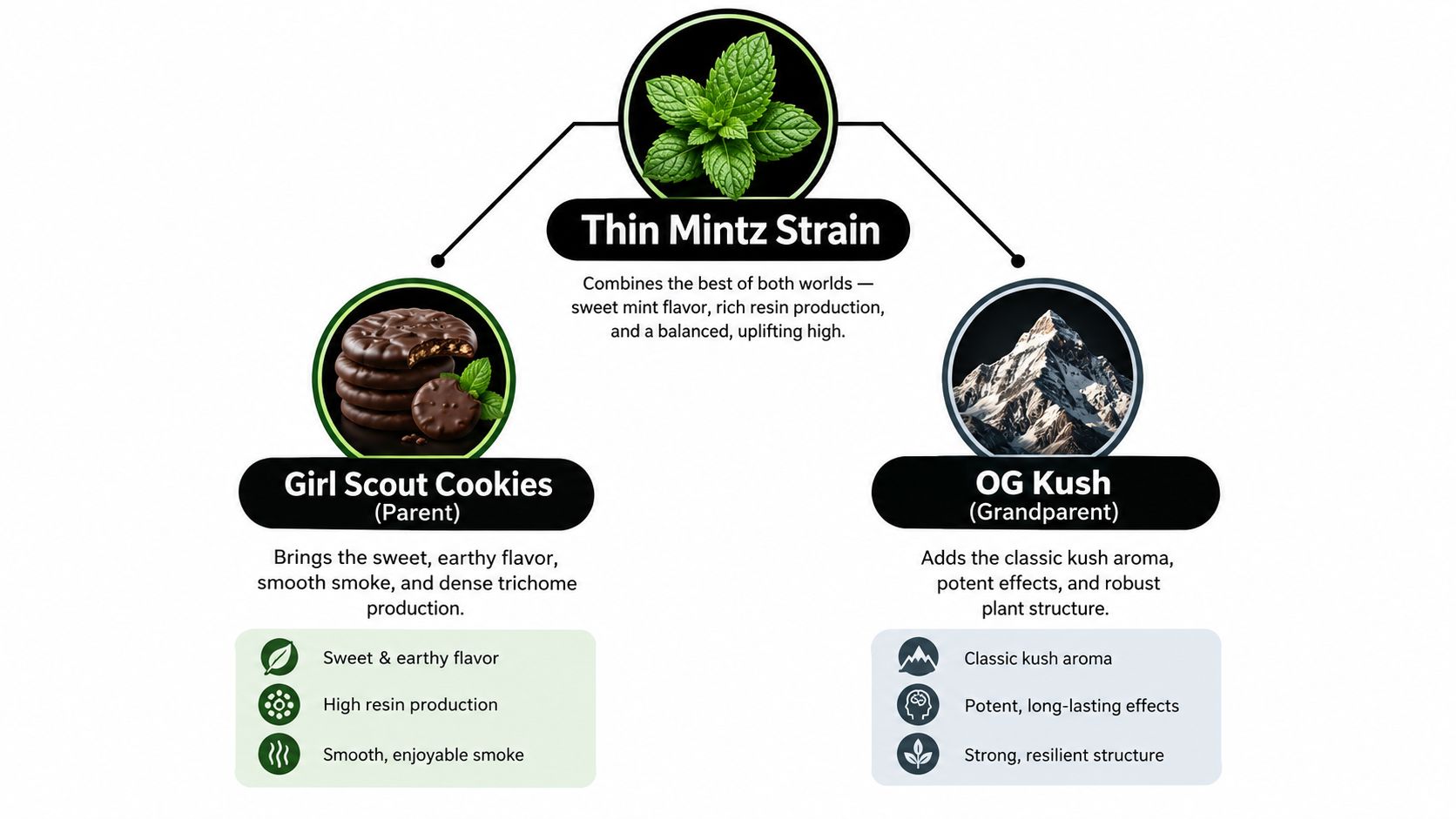
A Thin Mintz target earns bench space because its identity comes from a recognizable genetic and aromatic lineage. It's widely described as a prized phenotype of the Girl Scout Cookies family, with foundational genetics tracing to OG Kush and Durban Poison. Industry accounts place Girl Scout Cookies in San Francisco medical cannabis circles in the mid-2000s, with circulation around 2007 to 2010 and broader recognition by 2011 to 2012. Thin Mint's profile became especially important in the early 2010s, when pheno-hunters selected expressions marked by mint-chocolate aroma, purple coloration, and strong potency. Later breeders used it as a parent in the Gelato line, helping establish the dessert-strain era that dominated menus from roughly 2015 onward. Secret Nature's Thin Mintz history provides the broader lineage context.
That history matters commercially because it gives formulators a practical sensory target. The profile sits between dessert sweetness, peppery gas, citrus brightness, and herbal coolness. A generic mint additive can create freshness, but it won't automatically reproduce the cookies-family backbone. Conversely, a heavy cookie or fuel profile can bury the mint impression and leave the cartridge tasting dense rather than layered.
Start with the chemical target
A useful workflow starts with a verified flower or extract certificate of analysis, then asks four questions:
- What leads the profile? Caryophyllene should establish the spicy, woody, gassy center.
- What opens the draw? Limonene supplies citrus lift and keeps the blend from feeling flat.
- What rounds the body? Myrcene and linalool soften the transition into the finish.
- What gives depth? Humulene and minor compounds support earthy, hop-like complexity.
The cultivar name can guide the first hypothesis, but it can't replace batch data. Commercial listings show Thin Mintz flower testing across a broad range, including examples from 20.11% to 23.98% THC, while another listing reported 16% THC and described a 60% indica / 40% sativa hybrid. These differences show why a formulator should treat the name as an initial reference, not a guaranteed recipe. A recent Thin Mintz retail listing illustrates that batch and producer variation can materially change the starting material.
Practical rule: Rebuild the dominant terpene relationship first. Don't chase “mint” as an isolated flavor note.
Terpene Chemistry Behind the Thin Mintz Strain
The most defensible Thin Mintz formulation begins with a caryophyllene-led terpene architecture. Independent strain references consistently identify caryophyllene as a major component, commonly accompanied by limonene and myrcene. One lab-style profile for a Thin Mint GSC-related batch measured total terpenes at 1.75%, with myrcene at 0.560%, limonene at 0.480%, caryophyllene at 0.340%, bisabolol at 0.220%, and valencene at 0.150%. Leafly's Thin Mint profile provides this type of batch-level reference and helps show why a simple mint-forward recipe can miss the cultivar's actual balance.
The practical implication is straightforward. Caryophyllene establishes the mid-palate, limonene provides opening brightness, and myrcene, linalool, bisabolol, and related minor compounds influence the softness and persistence of the finish. A technical guide places total terpene content for Thin Mint Cookies flower commonly around 1.5% to 3.0% by weight, with beta-caryophyllene often around 0.4% to 0.9%, limonene around 0.3% to 0.7%, and humulene around 0.1% to 0.4%. The Thin Mint Cookies formulation reference offers a useful target envelope for comparing certificates of analysis.
Use ratios as a sensory map
| Terpene | Typical Range (%) | Sensory Role |
|---|---|---|
| Beta-caryophyllene | 0.4% to 0.9% | Pepper, spice, woody gas |
| Limonene | 0.3% to 0.7% | Citrus lift and sharp brightness |
| Myrcene | Batch-dependent | Earthy, herbal rounding |
| Linalool | Batch-dependent | Soft floral sweetness |
| Humulene | 0.1% to 0.4% | Earthy, woody, hop-like depth |
| Bisabolol and valencene | Minor contributions | Floral softness and aromatic lift |
These flower ranges shouldn't be copied directly into a cartridge. They describe the source material, while a cartridge requires a much higher total terpene load to express flavor through hardware and distillate. The ratio is the transferable element.
For a terpene profile for vape cartridges, anchor the first bench trial to caryophyllene, then adjust limonene until the opening feels bright without becoming lemon-cleaner sharp. Myrcene and linalool should support the finish rather than dominate it. This chemistry guide is useful when mapping individual compounds to a broader formulation strategy.
Decoding Flavor and Aroma as Top, Mid, and Base Notes
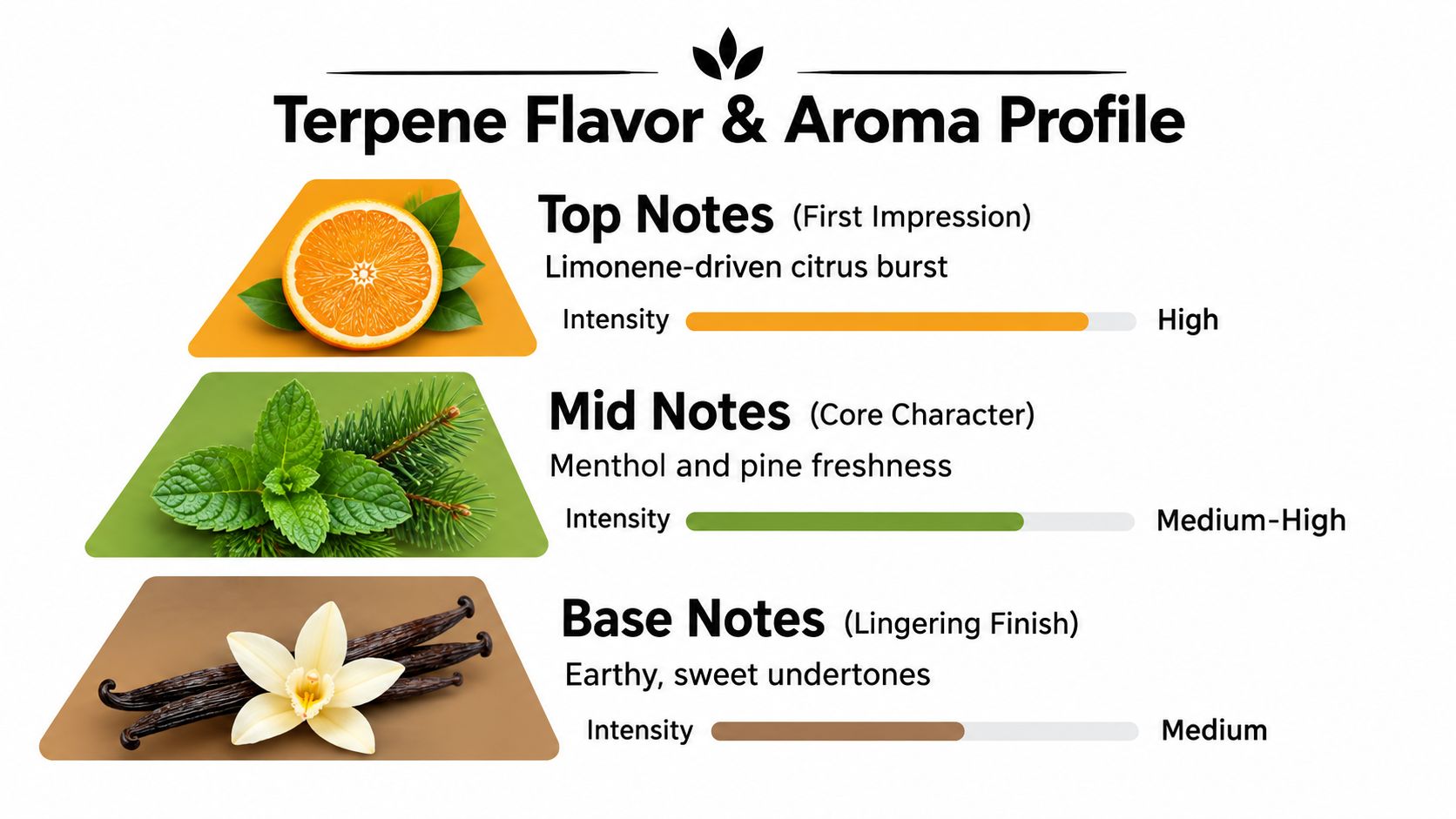
A certificate of analysis tells you what's present. A top, mid, and base framework tells you what the user experiences during a draw. Thin Mintz works when those layers arrive in sequence instead of competing at the same volume.
Top notes create the opening impression. Limonene supplies the clearest citrus lift, while the mint-like perception comes from the interaction of fresh, volatile aromatics rather than from a single guaranteed “mint terpene.” A trace of pine or green brightness can sharpen the first moment, but too much top-note material makes the blend smell like confectionery flavoring rather than cannabis.
Build the palate in layers
The mid notes carry the cultivar's identity. Caryophyllene contributes pepper, clove, and woody spice, while humulene adds earthy, hop-like depth. The cookies lineage becomes recognizable. If the mid layer is too weak, the blend may open brightly but finish as an undifferentiated herbal profile.
The base notes remain after the sharpest aromatics fade. Myrcene supplies herbal softness, and linalool contributes floral sweetness that can make the transition feel smoother. The base shouldn't become perfumed. Its job is to connect gas and spice to a rounded finish.
| Layer | Main formulation role | Common failure |
|---|---|---|
| Top | Brightness, freshness, first-pull identity | Candy-like or solvent-sharp opening |
| Mid | Pepper, gas, cookie structure | Thin, generic herbal body |
| Base | Softness, persistence, finish | Floral or earthy heaviness |
When evaluating a cart, sample the opening, middle, and exhale separately. A blend can have the right total terpene content and still fail because the limonene arrives too forcefully or the caryophyllene fades under a sweet base. The guide to terpene aromas and flavors gives a useful vocabulary for documenting those transitions.
A strain-inspired product such as Elevated Strains can also serve as a comparison point when a team is evaluating how dessert-oriented profiles are framed, though it shouldn't be treated as a Thin Mintz substitute.
Typical Effects and Cannabinoid Positioning
Formulators need to separate flower expectations from what a terpene-only recreation can deliver. Thin Mintz flower is generally positioned as a high-THC, low-CBD cultivar. One licensed-market guide cites THC in the 18% to 25% range with CBD below 1%, while another places modern batches around 20% to 28% THC. This Thin Mintz cannabinoid guide shows why final product claims should follow the finished certificate of analysis, not a strain label.
Reported experience around the flower tends to be a balanced-leaning hybrid envelope, with cerebral uplift, body relaxation, and a calm finish. That description belongs to a flower chemovar containing cannabinoids and its native minor compounds. Isolated terpenes don't produce the same pharmacological effect as the complete flower, so a strain-inspired blend should be positioned around aroma and sensory character unless the final cannabinoid formulation supports broader claims.
For cartridge development, THC distillate can sit inside a realistic potency window of 70% to 92%, depending on the SKU and final composition. As total cannabinoid concentration changes, the perceived intensity of the same terpene blend can change as well. A terpene load that feels balanced in a high-THC formulation may seem disproportionately sharp in a lower-potency product.
| Cartridge Type | THC Range | CBD Range | Positioning |
|---|---|---|---|
| THC-forward distillate | 70% to 92% | Typically low | Potency-led, strain-inspired flavor |
| Balanced cannabinoid formulation | Depends on final COA | Depends on final COA | Sensory profile paired with cannabinoid balance |
| Terpene-only reference blend | Not applicable | Not applicable | Aroma and flavor benchmark, not a flower-equivalent effect |
Label language should match the actual cannabinoid load. Don't use a cultivar name to imply a predictable effect when the cartridge contains a different cannabinoid profile from the flower reference.
Formulating a Strain-Inspired Blend for Vape Cartridges
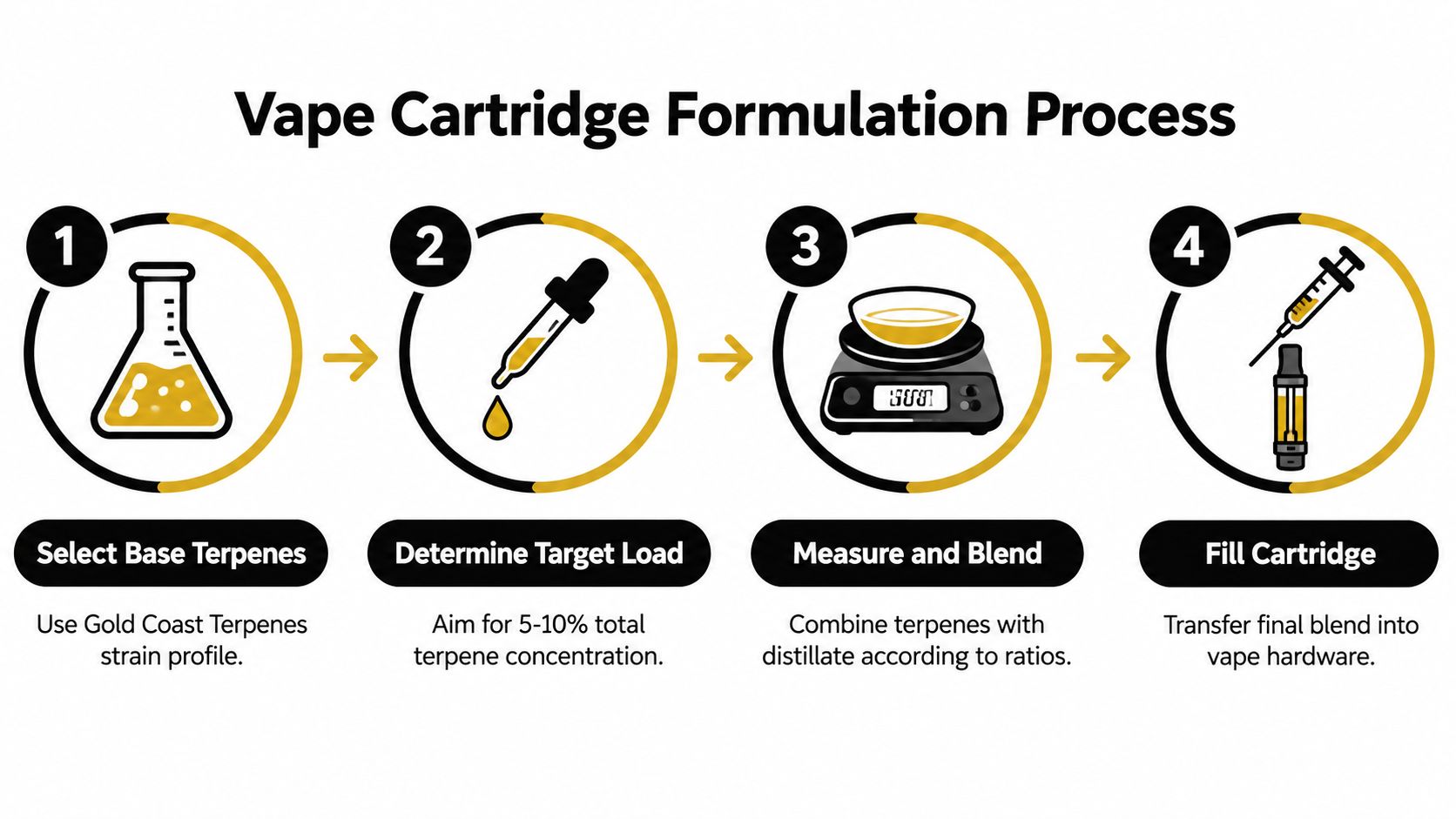
A practical formulation guide for vape cartridges starts with a measured pilot, not an open-ended flavor adjustment. Use a verified Thin Mintz-style profile as the sensory reference, then build the blend against the finished cartridge weight. Gold Coast Terpenes strain profiles can serve as one starting material, while isolated compounds let the formulator correct a specific imbalance.
Target a 5% to 10% total terpene concentration in the finished cartridge for the initial trial. The lower end can preserve a heavier distillate character, while the upper end creates a more assertive aromatic expression and may increase harshness depending on hardware and oil composition.
A workable starting architecture
| Component | Starting Range of Finished Cartridge Weight | Purpose |
|---|---|---|
| Beta-caryophyllene | 1.5% to 2.5% | Peppery, gassy mid note |
| Limonene | 0.8% to 1.2% | Bright citrus and fresh lift |
| Myrcene | 0.6% to 1.0% | Herbal softness |
| Linalool | 0.3% to 0.6% | Floral rounding and cooling nuance |
| Humulene | 0.1% to 0.3% | Earthy, hop-like depth |
These percentages refer to the finished cartridge weight, not the distillate alone. The listed components don't necessarily consume the entire target load, so the remaining fraction can be supplied by a validated strain profile or adjusted with compatible minor terpenes.
Measure for repeatability
- Weigh the distillate and terpene components separately. Use calibrated equipment suitable for the batch size, and record the actual mass rather than relying on volume estimates.
- Pre-dilute when necessary. A small pre-dilution in propylene glycol or MCT can improve dosing accuracy, but the carrier must be approved for the intended product and market.
- Homogenize gently. A magnetic stirrer or heated vortex can help distribute the terpenes through high-viscosity distillate.
- Keep the blend below 40 degrees Celsius during warming. Excess heat can strip volatile top notes before the cartridge is filled.
- Rest the blend for 24 to 48 hours. This gives the aroma time to round before sensory review and filling.
The blend can be filled under nitrogen if the facility has the appropriate equipment and process controls. Before production, verify viscosity, hardware compatibility, draw behavior, and the finished terpene ratio. A useful reference for weighing and blending sequence is this guide to mixing terpene strains.
Use the accompanying process video as a visual supplement for cartridge development:
Distillate Compatibility and Lab Verification
High-viscosity distillate changes how a Thin Mintz blend behaves. Terpenes can lower viscosity and improve flow, but the finished oil still needs to remain stable across storage, filling, and use. Broad-spectrum distillate, THC isolate cuts, and high-terpene extract reintroductions can each behave differently because their residual compounds and physical properties aren't identical.
Watch for crystallization, separation, and uneven aroma distribution. Linalool above 1% can increase compatibility concerns in some carriers, particularly when residual solvents remain present. That threshold isn't a universal failure point, but it's a reason to run a stability check instead of assuming the blend will remain uniform.
Verification should cover the finished oil
SC Lab testing remains relevant even when the added terpenes are THC-free. A finished-product panel should address:
- Potency: Confirm the cannabinoid composition matches the SKU specification.
- Residual solvents: Identify contamination or processing carryover.
- Heavy metals and pesticides: Verify the final product meets applicable requirements.
- Microbial contamination: Check the finished material and packaging process.
- Terpene quantitation: Confirm the caryophyllene-led ratio survived blending.
A separate terpene analysis is especially valuable. The input profile may be accurate, yet the final cartridge can shift after contact with distillate, carrier materials, heat, or hardware.
Batch record standard: Keep the original COA, formulation worksheet, finished-product COA, reference chromatogram, and fill records together for every lot.
Use gas chromatography for third-party comparison against the reference profile. Record batch-to-batch variance rather than treating every deviation as a failure. A COA and certificate guide can help organize the documentation expected around terpene ingredients and finished formulations.
Storage protects the profile after testing. Nitrogen-flushed headspace, amber glass, and cool temperatures reduce exposure to oxygen and light. The lighter, more volatile top notes are usually the first part of a Thin Mintz profile to lose definition when storage conditions are poor.
Building Repeatable Flavor Accuracy Across Production Runs
Thin Mintz-inspired products usually lose accuracy during scale-up, not during the first bench trial. A small lab blend receives close attention, while a production run introduces different distillate lots, mixing times, filling temperatures, hardware resistance, and storage conditions. If the team only checks the final product by memory, it won't know which variable moved the profile.
Start with a reference sample from a verified phenotype or trusted distillate cut. Store it under controlled conditions, document its sensory attributes, and compare every pilot against the same reference. The reference should describe more than “minty” or “cookie-like.”
Use a sensory rubric that separates the profile
Record distinct attributes:
- Cooling intensity: Note whether the freshness feels herbal, menthol-leaning, or sharp.
- Bakery sweetness: Track cookie dough, dark chocolate, and confectionery impressions separately.
- Pepper and gas: Score the caryophyllene-led center independently from the sweet top note.
- Earthy finish: Monitor humulene, myrcene, and other base contributors for heaviness.
- Aroma throw: Evaluate the cartridge at rest and during a controlled draw.
- Viscosity impact: Record whether the blend changes filling behavior or draw resistance.
A GC-MS result should accompany every production batch. Record the lot number, dilution ratio, final terpene percentages, mixing conditions, and the post-cut chromatogram. Hardware resistance and storage temperature belong in the same record because they can change perceived flavor before the package reaches a customer.
| QC Parameter | Target Range | Tolerance |
|---|---|---|
| Caryophyllene-led structure | Match approved reference | Set from reference chromatogram |
| Limonene brightness | Match approved sensory panel | Defined by internal panel |
| Myrcene and linalool finish | Rounded, not dominant | Defined by internal panel |
| Total terpene load | Approved finished-product specification | Batch release limit |
| Viscosity and fill behavior | Compatible with selected hardware | Engineering acceptance limit |
| Aroma after storage | No unacceptable separation or oxidation | Stability protocol limit |
Blind triangle tests can reveal differences that a formulator misses after repeated exposure. Ask panelists to identify the odd sample, then compare the sensory result with the chromatogram. A deviation may point to a real process issue, or it may show that the reference itself needs updating.
Treat every deviation as formulation data. That mindset protects SKU continuity and gives brand owners a defensible explanation when a flower lot or distillate cut changes.
Turning the Profile into a Sellable SKU
A faithful Thin Mintz profile is more useful as a product position than as a decorative strain name. The commercial value comes from a repeatable sensory promise: caryophyllene-led spice, citrus lift, dessert depth, and a controlled cool finish. That promise only works when the final cartridge delivers it consistently.
Start with the formulation blueprint:
- Use a verified profile or reference chromatogram.
- Anchor the blend with beta-caryophyllene.
- Shape the opening with measured limonene.
- Use myrcene, linalool, and humulene to control the finish.
- Verify the finished oil, not only the terpene ingredient.
- Match strain-style language to the actual cannabinoid and terpene data.
Hardware selection deserves equal attention. A cartridge that runs too hot can flatten delicate top notes and amplify harshness. A device with excessive resistance can make the same oil feel muted, while an inconsistent heating element can create different sensory results across units.
Gold Coast Terpenes offers strain-specific profiles, isolated compounds, formulation resources, and a mixing calculator that can support this type of development. Its catalog includes THC-free terpene blends described as free of VG, PG, PEG, and MCT, with SC Lab testing and documentation intended for formulation workflows. For brands scaling a Thin Mintz-style SKU, that kind of ingredient and record continuity can reduce unnecessary reformulation between pilot and production.
The strongest differentiation comes from verified lab data, transparent ingredient records, and consistent sensory performance, not from adding another novelty descriptor. Build a feedback loop between finished-product testing, sensory reviews, cartridge performance, and sales observations. When the next batch changes, your team should know whether the cause was the distillate, terpene ratio, hardware, storage, or filling process.
Gold Coast Terpenes supplies strain-specific blends, isolated terpenes, and formulation tools for teams developing cartridges and distillate products. Visit Gold Coast Terpenes to compare profile options, review formulation resources, and build a more consistent Thin Mintz-inspired SKU.