
A cart team can do everything right on paper, fill a fruit-forward distillate, select a polished cartridge, and still end up with a pull that tastes flat. Then someone opens a jar of Tropical Paradise flower and the room changes. The difference is usually not the cannabinoid base. It's the missing flavor architecture.
For formulators, the Tropical Paradise strain is more useful as a blueprint than as a flower description. Its reported profile combines pineapple and orange character with a layered terpene structure, and one cartridge listing measured 5.12% to 5.63% total terpenes, led by limonene, myrcene, and beta-caryophyllene (commercial terpene listing). The practical question is how to rebuild that stack for distillate, live resin, and cartridge hardware without reducing it to generic mango flavoring.
Why the Tropical Paradise Strain Profile Matters in Formulation
A common failure starts with a simple brief: “Make it tropical.” The formulator reaches for limonene, adds a broad mango or pineapple flavor, and gets an attractive first sniff. The finished cart may taste bright on the first draw, but the profile often loses definition as the vapor cools. Citrus remains, while the fruit body and finish disappear.
That approach treats tropical as a single note. Tropical Paradise works better as a layered strain-inspired terpene blend, with distinct movement from the first inhale through the finish. A widely cited reference describes it as an 80% sativa and 20% indica hybrid, with Tangie and Pineapple Trainwreck as one reported lineage, a fruit-forward pineapple and orange aroma, and a reported THC range of 19% to 20% (Tropical Paradise strain reference). Those details matter less as consumer positioning than as clues about the intended sensory direction.
The problem with one-note tropical flavoring
A flat tropical SKU usually has a strong opening but no middle. Limonene can provide immediate citrus lift, yet it won't create ripe mango flesh, creamy depth, or a dry finish by itself. Artificial mango ketones can make the result read like confectionery rather than plant-derived fruit, especially when the formulation lacks balancing floral, herbal, or spicy compounds.
The better approach is to assign each material a job:
- Top notes create the first impression, especially citrus, peel, and pineapple-pine brightness.
- Mid notes provide fruit weight, mouthfeel, and continuity after the volatile top has passed.
- Base notes prevent the blend from becoming syrupy and give the profile a recognizable finish.
Formulation rule: If the profile only smells tropical in the bottle, but not on the cooled second draw, the blend has a top-note problem and an architecture problem.
The Tropical Paradise reference is valuable because its reported terpene leaders are unusually close in weight, rather than being dominated by one compound. That balance gives a formulator a target for relative proportion, not a reason to copy a laboratory number blindly. The goal is a cart that reads as citrus, tropical flesh, and soft spice in sequence.
Decoding the Top, Mid, and Base Notes
Use the cartridge split cited earlier as a ratio anchor: limonene at 1.23%, myrcene at 1.21%, and beta-caryophyllene at 0.75%. Those values describe that product and hardware system, not a universal Tropical Paradise chemotype. For a cart developer, the useful signal is the proximity of the leading materials and the sensory sequence they create.
Limonene supplies the rapid citrus-peel opening. Myrcene follows closely enough to give the fruit body, keeping the first impression from reading as thin orange or lemon candy. Beta-caryophyllene carries less of the reported load, yet its dry spice and woody warmth give the finish somewhere to settle.
Assigning each material a sensory job
Terpinolene can serve as a secondary top note. In a restrained amount, it links pineapple brightness with an exotic floral edge. Push it too far and the vapor can become sharp, solvent-like, or overly perfumed.
Valencene bridges citrus and tropical flesh. It supports orange-peel sweetness while helping limonene move beyond a simple citrus-candy impression. Linalool or alpha-bisabolol can soften the base with floral character, but either should remain behind the fruit body rather than replacing it.
The table treats the earlier cartridge split as a formulation reference. These roles are practical sensory assignments, not proof that every Tropical Paradise sample expresses the same profile.
| Terpene | Reference Load (%) | Note Role | Function in Blend |
|---|---|---|---|
| Limonene | 1.23 | Top | Fast citrus peel and bright opening |
| Myrcene | 1.21 | Mid | Ripe mango, tropical flesh, and fruit weight |
| Beta-caryophyllene | 0.75 | Base | Dry spice, woody depth, and grounding |
| Terpinolene | Not reported in the cartridge split | Top bridge | Pineapple-pine lift and floral-tropical connection |
| Valencene | Not reported in the cartridge split | Mid bridge | Orange-peel sweetness and citrus-to-fruit transition |
For isolate screening, a terpene flavor chart helps the team compare likely sensory behavior before committing to a production blend. Use it as a mapping aid, not as a substitute for vapor evaluation.
The ratio matters more than the headline number. A limonene-heavy blend may smell vivid in the vial but turn narrow after heating. A myrcene-heavy blend carries fruit longer, though excess can make the profile musky and heavy. Beta-caryophyllene adds structure, while too much shifts the finish toward pepper and earth.
Build the first pass around contrast. Limonene earns attention on the opening draw, myrcene keeps the middle rounded, and beta-caryophyllene gives the cooled second draw a dry, recognizable finish. If the blend smells tropical only before filling, the architecture is incomplete. Rebalance the top, mid, and base roles rather than adding more generic tropical flavor.
Flower Chemotype vs Cartridge Load
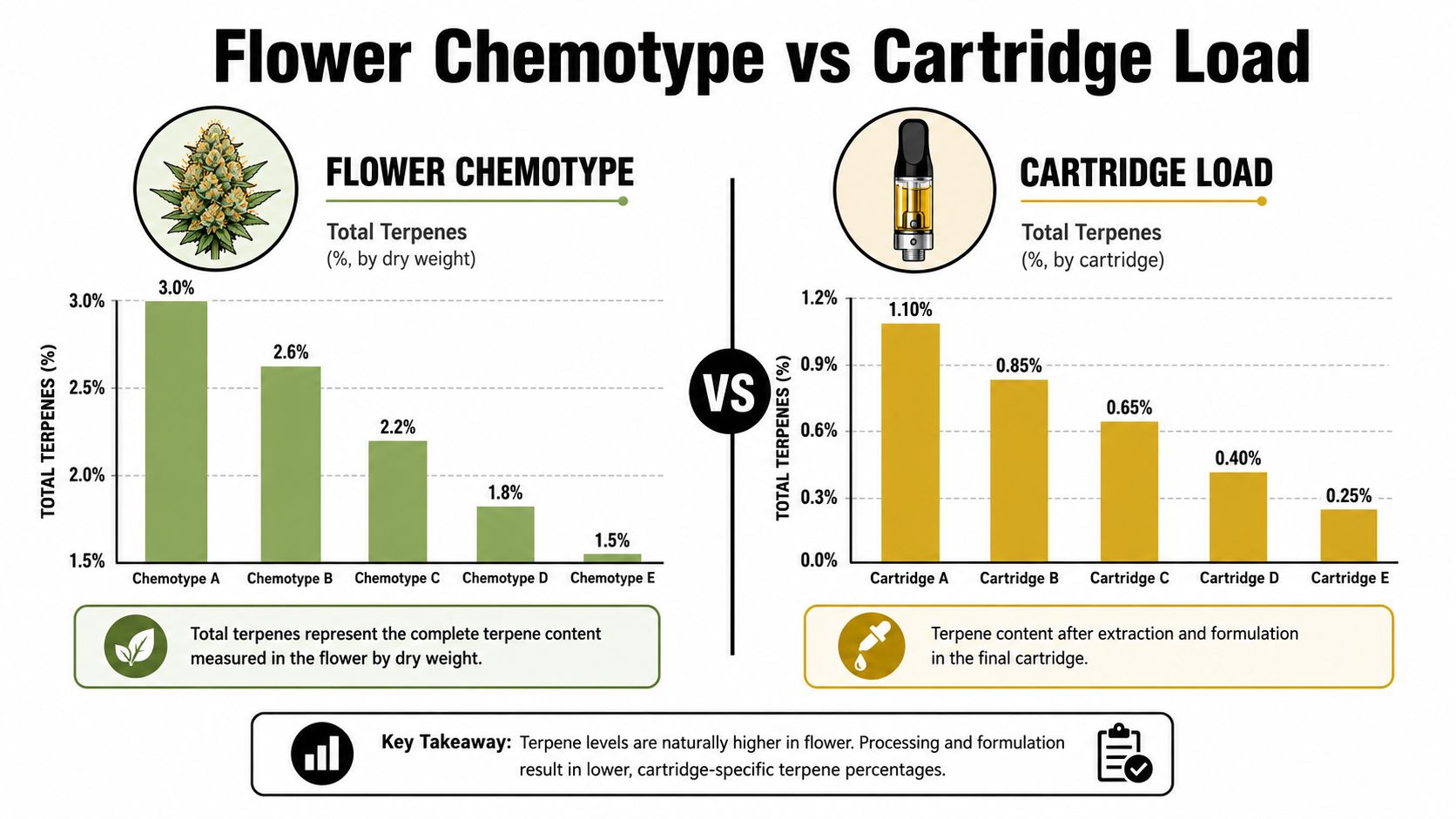
A flower chemotype and a cartridge load describe different formulation problems. Flower data reflects what the plant expresses after cultivation and curing. Cartridge data reflects how much aromatic material enters a concentrated oil system, where viscosity, temperature, and hardware control delivery.
Independent tropical-strain guidance places comparable flower profiles around 1.5% to 3.0% total terpenes by weight, with myrcene around 0.5% to 1.2%, limonene around 0.3% to 0.8%, and beta-caryophyllene around 0.2% to 0.6% (tropical strain formulation guidance). As noted earlier, the Tropical Paradise cartridge listing reports 5.12% to 5.63% total terpenes. That higher load reflects a product designed to deliver a clear aromatic impression through vapor, not a direct copy of flower chemistry.
Do not copy the analytical number blindly
The flower range provides a plant-expression reference. The cartridge range provides a concentrated product reference. Applying the same percentage to every oil ignores the distillate, cartridge construction, viscosity, and heating profile.
A practical target preserves the relative balance of limonene, myrcene, and caryophyllene while remaining compatible with the oil and device. The formulation brief identifies 5% to 7% total terpenes as a working cartridge range and warns that hardware and viscosity problems become more likely above roughly 8% total terpene. Use those figures as development boundaries, not guarantees. Test for leaks, clogging, cracking, and sensory performance.
Strain replication adds another complication. Flower can express a modest terpene percentage, while a vape may need a reinforced aromatic load to create a comparable impression per draw. The finished oil should not taste louder than the flower. It should account for concentration, delivery, and volatility.
For context, this guide to strain-specific terpenes and terpene-enhanced flavors separates cultivar-linked profiles from added flavor systems. Scale the architecture, not just the number.
Two Formulation Builds Compared
Two carts can use the same isolate set and still communicate different versions of Tropical Paradise. Build A emphasizes lift and projection. Build B gives the fruit more body and a longer, creamier finish.
The planned loads below are cartridge-mass examples from the formulation brief. They should be treated as development targets for comparison, then checked against the actual base, hardware, and compliance requirements.
| Terpene | Build A Bright % of cart | Build B Creamy % of cart | Note Role |
|---|---|---|---|
| Limonene | 2.4 | 1.0 | Bright citrus top |
| Myrcene | 0.6 | 1.8 | Tropical fruit mid |
| Beta-caryophyllene | 0.75 | 0.75 | Spiced base and anchor |
| Valencene | 0.15 | 0.15 | Orange-peel bridge |
| Terpinolene | Titrate by hardware class | Titrate by hardware class | Pineapple-pine and floral lift |
Build A for projection
Build A places limonene at roughly 2.4% of cartridge mass and trims myrcene to 0.6%. The result is sharper, brighter, and more citrus-pineapple forward. That makes it a sensible direction for 510 carts and ceramic cell hardware where immediate top-note perception carries more of the product experience.
The risk is thinness. If the distillate already has little native fruit body, the reduced myrcene fraction may leave the second draw hollow. Caryophyllene and valencene help, but they can't fully replace mid-note mass. Terpinolene should be titrated rather than poured in aggressively, because too much floral lift can compete with the pineapple impression.
Build B for persistence
Build B reverses the emphasis, lifting myrcene to 1.8% and dropping limonene to 1.0%. It reads softer at the opening, then develops creamy mango and tropical flesh through the middle. This profile suits live resin disposables and high-viscosity distillate tanks where body and linger matter more than an immediate citrus flash.
The trade-off is reduced sparkle. If the hardware runs cool or the oil has a muted aromatic baseline, the blend can feel dense before it feels tropical. Keep valencene in the structure, and use terpinolene as a controlled bridge so the myrcene doesn't turn the entire profile musky.
Hardware decision: Choose Build A when first-draw brightness is the commercial priority. Choose Build B when the product needs a fuller mouthfeel and a longer fruit finish.
Practical Formulation Workflow for Cartridges
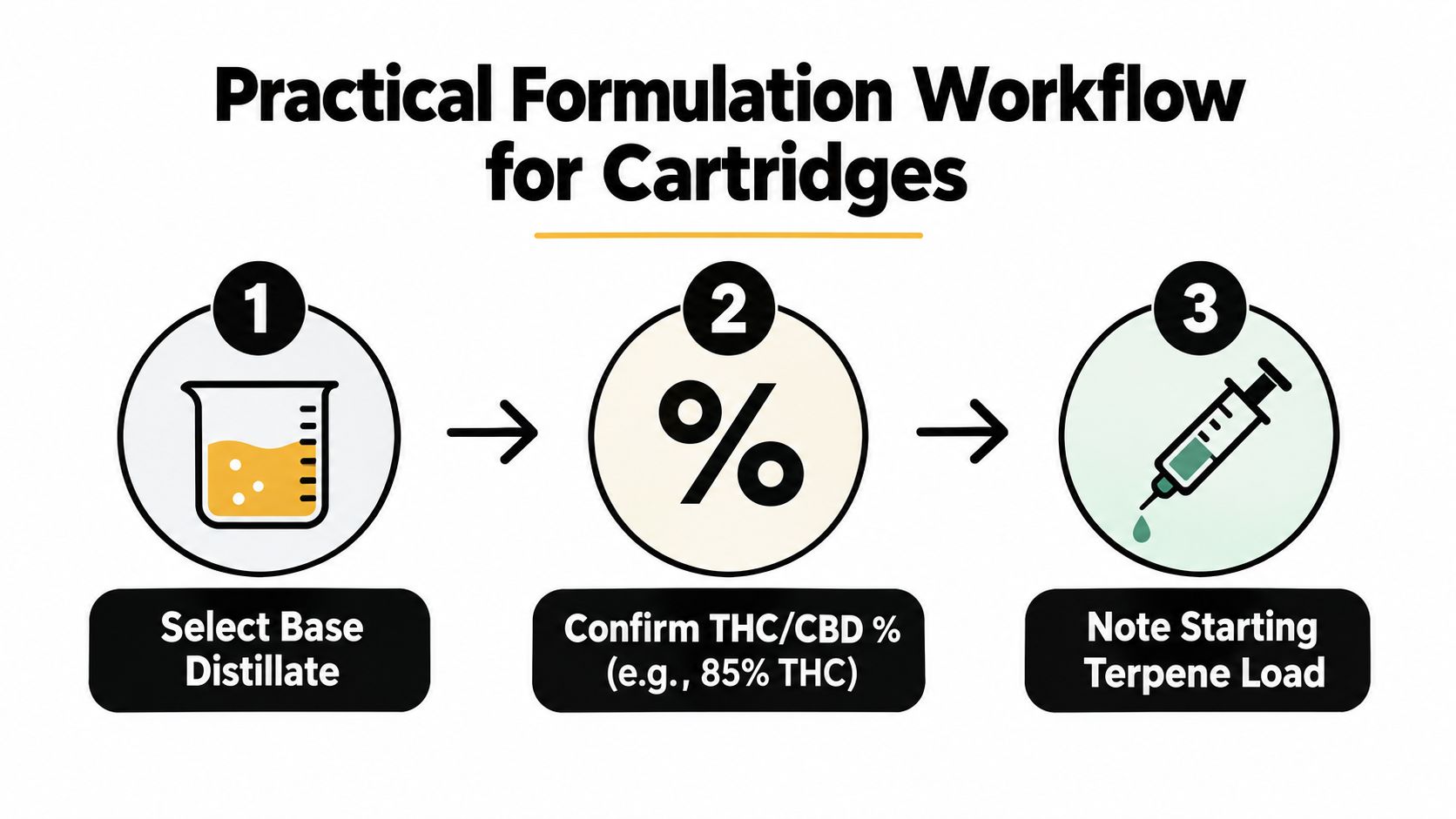
A repeatable Tropical Paradise build starts with the base, not the flavor vial. Select the distillate, record its THC or CBD percentage, and assess its native aroma before adding isolates. The starting terpene load matters because the supplied workflow assumes many distillates arrive with roughly 0.3% to 0.8% native terpenes, which means the added blend must be calculated around what is already present.
Set the total target before weighing individual compounds. For this reference, a working target of 5.0% to 5.6% by cartridge mass follows the cartridge profile while leaving room to adjust for hardware behavior. The calculation must include native terpenes, not just the isolate additions.
Dose in sensory order
Lock the top with limonene. Establish the citrus-pineapple opening first. This gives the formula a clear sensory direction before heavier materials enter.
Build the middle with myrcene. Add enough fruit body to support the top. Don't use myrcene as a generic “mango” shortcut. Its value is continuity and weight.
Ground with beta-caryophyllene. This keeps the blend from reading like candy and gives the finish a dry, spicy edge.
Titrate terpinolene. Add it in small increments to connect pineapple, pine, and floral notes. The correct amount depends on the hardware and the existing distillate aroma.
Finish with valencene. Use it as an orange-peel bridge, not as the main citrus engine.
Mix the bulk under nitrogen at ambient temperature, then rest it for 12 to 24 hours so the materials equilibrate. Load carts in 0.2 gram increments to reduce the chance of hardware flooding during filling, and validate the final ratios with the Gold Coast Mixing Calculator before scaling.
A useful explanation of the workflow is included below.
Don't approve the formula from a vial evaluation alone. Check the first draw, the cooled second draw, the late-batch draw, and the cart after storage. A blend that smells accurate but floods, clogs, or loses its citrus opening isn't production-ready.
Pairing Tropical Paradise With Dessert Profiles
Tropical Paradise works best as the lead rather than the entire composition when the product brief calls for fruit and dessert together. The tropical profile should own the opening, while the dessert profile fills the lower register. If both profiles compete for the top, the result becomes crowded and the citrus loses definition.
Apple Fritter is a strong pairing because its caryophyllene and farnesene direction can sit below the tropical fruit layer. The baked-apple character gives the profile a sequel after the pineapple and orange opening, instead of turning the blend into a second fruit note fighting for attention.
| Pairing Profile | Blend Ratio TP : Pair | Format Fit | Flavor Outcome |
|---|---|---|---|
| Apple Fritter | 70:30 | Live resin carts | Tropical fruit crown with baked-apple warmth |
| Apple Fritter | 80:20 | Distillate carts | Brighter tropical projection with restrained pastry depth |
| Vanilla-forward profile | 80:20 | Heavier pastry formats | Fruit-led opening with a softer dessert base |
Protect the top note
The 70:30 Tropical Paradise to Apple Fritter direction is appropriate for live resin carts when the extract already contributes body and the product can support a broader flavor arc. In distillate, dropping Apple Fritter to 20% leaves more room for the tropical top to project. The blend should still be checked in the actual oil, because distillate variability can change how quickly the fruit profile emerges.
A vanilla-forward pairing at 80:20 takes the profile toward pastry without removing its fruit crown. Keep vanilla underneath the terpene architecture. If vanilla becomes the first recognizable note, the product no longer reads as Tropical Paradise inspired.
Use a calculator before sensory approval
Pairing ratios change the total terpene load as well as the individual note balance. Validate the combined profile through the Gold Coast Mixing Calculator before production, then confirm that the cartridge remains within the intended formulation and hardware limits.
The broader lesson applies to any dessert pairing. Fruit needs a base, but the base shouldn't become the headline. Caryophyllene, farnesene, linalool, and a controlled vanilla direction can extend the finish. They shouldn't erase limonene, valencene, and the tropical mid.
Building a Strain-Inspired SKU That Sells
Generic tropical flavoring is easy to recognize and easy to forget. A strain-inspired Tropical Paradise SKU has a clearer reason to exist because the profile can be documented as a repeatable sensory system: citrus brightness up front, tropical fruit through the middle, and soft spice or floral depth underneath.
Three differentiation pillars support that position.
Authenticity comes from building the top with limonene, terpinolene, and valencene rather than relying on a broad mango flavor. The result should suggest a chemotype-inspired profile, not candy. Replay value comes from myrcene and caryophyllene carrying the middle and finish across repeated pulls. Brand storytelling comes from a documented flavor blueprint that buyers can compare with lab reports and batch records.
The commercial comparison is straightforward:
| Attribute | Generic Tropical Flavor | Strain-Inspired Tropical Paradise |
|---|---|---|
| Sensory structure | Usually one dominant fruit idea | Defined top, mid, and base |
| Opening | Bright but often one-dimensional | Citrus-pine lift with tropical transition |
| Finish | Can become sweet or artificial | Myrcene body with caryophyllene grounding |
| Development method | Broad flavor shortcut | Isolate-based ratio and hardware testing |
| Product story | Flavor name alone | Documented strain-inspired architecture |
| Scaling | May need repeated adjustment | Designed for controlled adaptation across formats |
The brief's cost comparison places a generic mango blend at $0.40 per milliliter and a strain-inspired build at $0.55 to $0.65 per milliliter. Those figures should be treated as the stated formulation comparison, not a universal market price. A premium only makes sense when the producer can explain the isolate work, provide per-terpene documentation, and show that the flavor survives distillate variability.
Skipping that work creates predictable problems. An overloaded terpinolene direction can contribute to harsh or unstable sensory behavior, under-dosed valencene can leave citrus without its orange-peel bridge, and artificial mango ketones can pull the profile away from a botanical strain reference. Product teams should document these decisions in the same way they document oil specifications and hardware compatibility.
For teams developing the commercial story, brand differentiation strategies can support the positioning work, while boosting product page visibility helps connect a technically specific SKU with buyers searching for formulation-led products. The Elevated Strains Apple Fritter profile is one catalog example of a complementary flavor direction that can sit beneath a tropical lead.
A strain-inspired Tropical Paradise profile should function as a repeatable flavor architecture, not a one-off batch impression. Build the ratios once, document the hardware adjustments, and carry the sensory logic across one-gram carts, disposables, and all-in-one hardware without starting from generic mango every time.
Gold Coast Terpenes offers natural terpene blends, strain-specific profiles, and isolated compounds for cartridges, concentrates, and cannabis product formulation. Visit Gold Coast Terpenes to compare Tropical Paradise components, review formulation resources, and build a terpene system that fits your oil and hardware.