
You're staring at a spec sheet, a COA, and a half-finished bench note that all seem to describe a different Citrus Haze. That's normal. For a cartridge team, the name is only useful if it can be translated into a stable terpene target, a filling plan, and a label that won't wobble under review.
The practical problem isn't whether Citrus Haze sounds bright or citrusy, it's whether the profile can survive decarb, dilution, hardware selection, and shelf time without drifting into generic lemon. A cartridge built from flower assumptions alone usually misses the mark because the name covers multiple chemistries, not one locked formula. For product formulators, the job is to choose a source profile, decide how much of the nose comes from a strain-inspired blend versus isolated terpenes, and then keep the finished oil consistent enough to reproduce.
Why Citrus Haze Matters as a Formulation Target
Citrus Haze is useful because it behaves like a flavor brief more than a fixed chemical standard. One lab-facing profile leans on myrcene, limonene, and pinene, while another commercial listing shifts the emphasis toward caryophyllene, terpinolene, and myrcene. Those aren't interchangeable, and a cartridge developer who treats them as the same strain ends up with an oil that smells plausible in the bottle but lands wrong in the pod.
Build from notes, not from the name
A strain-inspired blend works best when you think in top, mid, and base notes. The top note is the first thing the user gets off the cart, the mid note carries the recognizable body of the profile, and the base note keeps the blend from feeling thin or sharp. That structure is how a citrus haze profile becomes usable in formulation, because it gives you levers to adjust brightness, herbal depth, and finish without rebuilding the whole recipe.
Practical rule: if the source cut smells like citrus-pine, lead with bright top notes. If it reads citrus-herbal with a spicy tail, build around a warmer lift and let the finish do more work.
That matters because flower data alone doesn't tell you what happens after extraction, dilution, or heat exposure. What smells vivid on the plant can flatten in distillate if the load is too light, or turn harsh if the top notes are pushed too hard. A good Citrus Haze cartridge starts with a defensible target, not a nostalgic memory of the flower jar.
For formulators working inside a broader terpene library, a strain-inspired base can be paired with isolate support and a validated blend workflow. A practical reference is the terpene flavor chart, which helps map aroma families before you start adjusting ratios. Once you choose a direction, the rest of the process becomes a controlled exercise in balance, not guesswork.
The outcome you want is simple. Pick the target profile, build a starting blend, dose it into distillate, and document the batch in a way that survives both the lab and the shelf.
Cannabinoid and Genetic Background of Citrus Haze
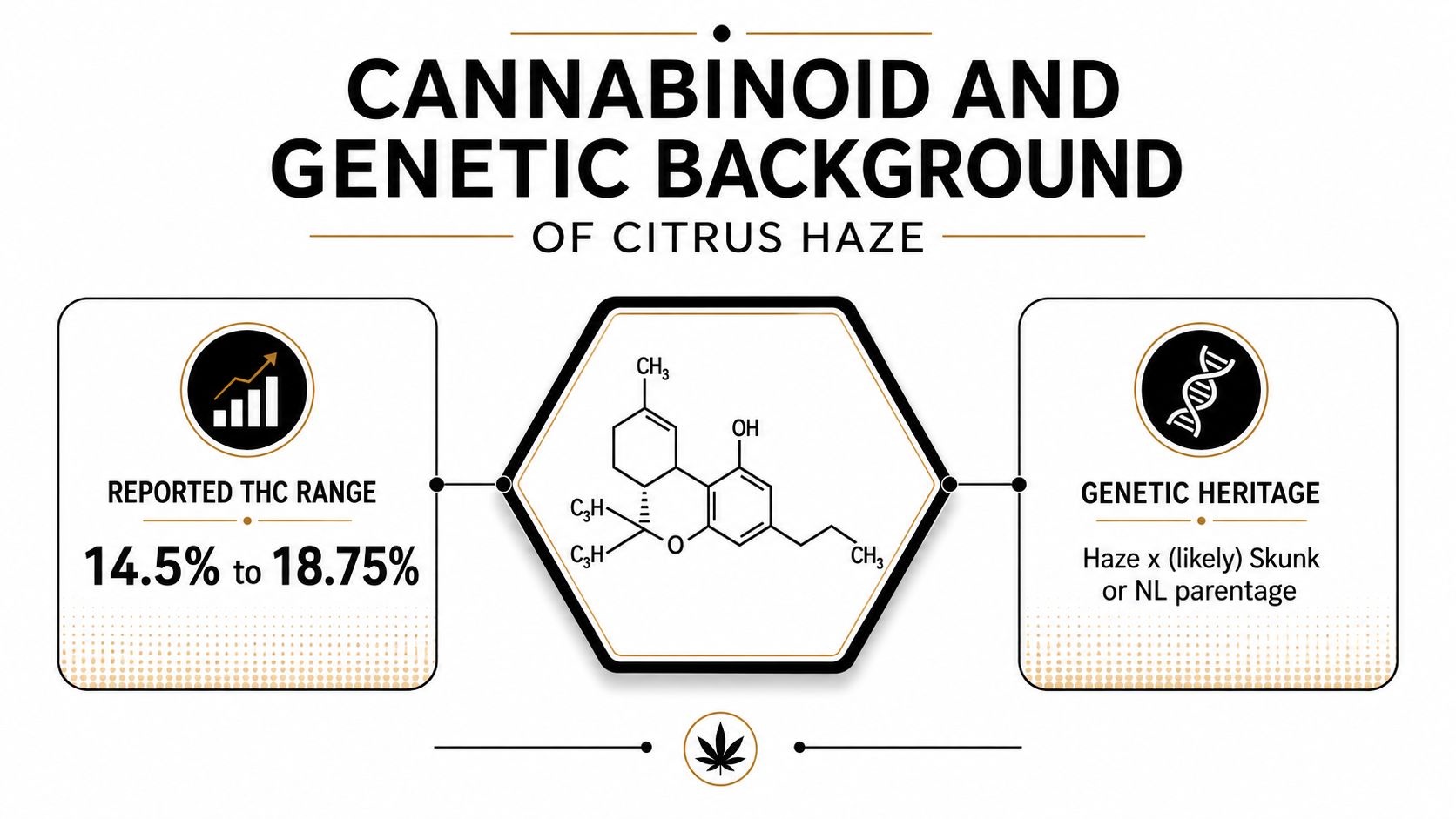
The cannabinoid story points to a cultivar that's THC-centered, but not chemically identical across cuts. In one review, lab-tested THC figures range from 14.5% to 18.75% in the best-documented legal-market band, while broader market listings stretch from 10% to 25% THC depending on cut and grow conditions (AskGrowers review) (AllBud market range) (Hashery listing). For formulation, that means you should never assume a fixed potency or sensory intensity just from the name.
What the minor cannabinoids tell you
CBD shows up at roughly 0.62% to 1.04%, which is low enough that it doesn't change the core formulation strategy, but it does tell you the material isn't completely one-dimensional (Joint Commerce genetics guide). In a COA, that small fraction can help explain why two lots with similar THC still feel different in the nose or in the back end of a vape blend. It's a useful check, not a launch driver.
The breeding-history context matters just as much. One genetics source says more than 10 breeding cycles were needed to stabilize the desired traits, and it describes the genetic composition as about 40% indica, 50% sativa, and 10% ruderalis (Joint Commerce genetics guide). That framing helps explain why the cultivar is relatively fast-finishing for a haze-style line, with a flowering cycle of 54 to 61 days and harvest around 66 days (AskGrowers review).
That same review places indoor yield around 1 to 2 oz/ft² and outdoor yield around 15 to 20 oz per plant, which are useful production benchmarks for growers evaluating throughput (AskGrowers review). The key takeaways for a cartridge team are straightforward. Citrus Haze is fast-finishing, THC-forward, and phenotype-sensitive enough that no single COA should be treated like a universal reference.
Formulation takeaway: use the lab result from the actual lot, not the strain name, as your ceiling for potency and your first check on aromatic direction.
Reading the Terpene Layer as Top, Mid, and Base Notes
The terpene layer is where Citrus Haze stops being a label and starts becoming a build sheet. One analysis says myrcene, limonene, and pinene can make up nearly 60% of the volatile terpene content in mature buds (Joint Commerce genetics guide). Another commercial listing shifts the dominant set to caryophyllene, terpinolene, and myrcene, which gives the same name a noticeably different sensory shape (Hashery listing).
Two workable terpene signatures
In a limonene-forward cut, limonene and pinene sit at the top because they read first as citrus and bright pine. Myrcene works better as the mid note there, because it softens the edges and keeps the profile from turning into pure peel or solventy citrus. The base is whatever holds the balance in place, usually a lower, less volatile support layer that keeps the nose from collapsing after a week on shelf.
In the alternate signature, terpinolene carries the brighter citrus-floral lift while caryophyllene provides a spicy, grounding finish. Myrcene still acts as connective tissue, but now the profile feels more herbal and textured than sharp and airy. That version is often easier to frame as a hybrid-leaning cartridge because it has a more obvious mid-palate and a more persistent tail.
| Signature Source | Dominant Terpenes | Top Note | Mid Note | Base Note |
|---|---|---|---|---|
| Mature bud analysis | Myrcene, limonene, pinene | Limonene, pinene | Myrcene | Supportive base fraction |
| Commercial THC listing | Caryophyllene, terpinolene, myrcene | Terpinolene | Myrcene | Caryophyllene |
The decision rule is simple. If the source cut leans citrus-pine, lead with limonene. If it leans citrus-herbal with a spicy tail, lead with terpinolene and reinforce with caryophyllene. That's more useful than chasing a single “correct” terpene percentage, because the market data already shows the name moving across different chemotypes.
For reference during blending, Gold Coast Terpenes publishes a strain flavor guide for terpene ratios that works well as a starting framework when you're mapping top, mid, and base notes. Use it to anchor the direction, then let your own lot data decide the final slope of the profile.
Extraction and Cartridge Format Considerations
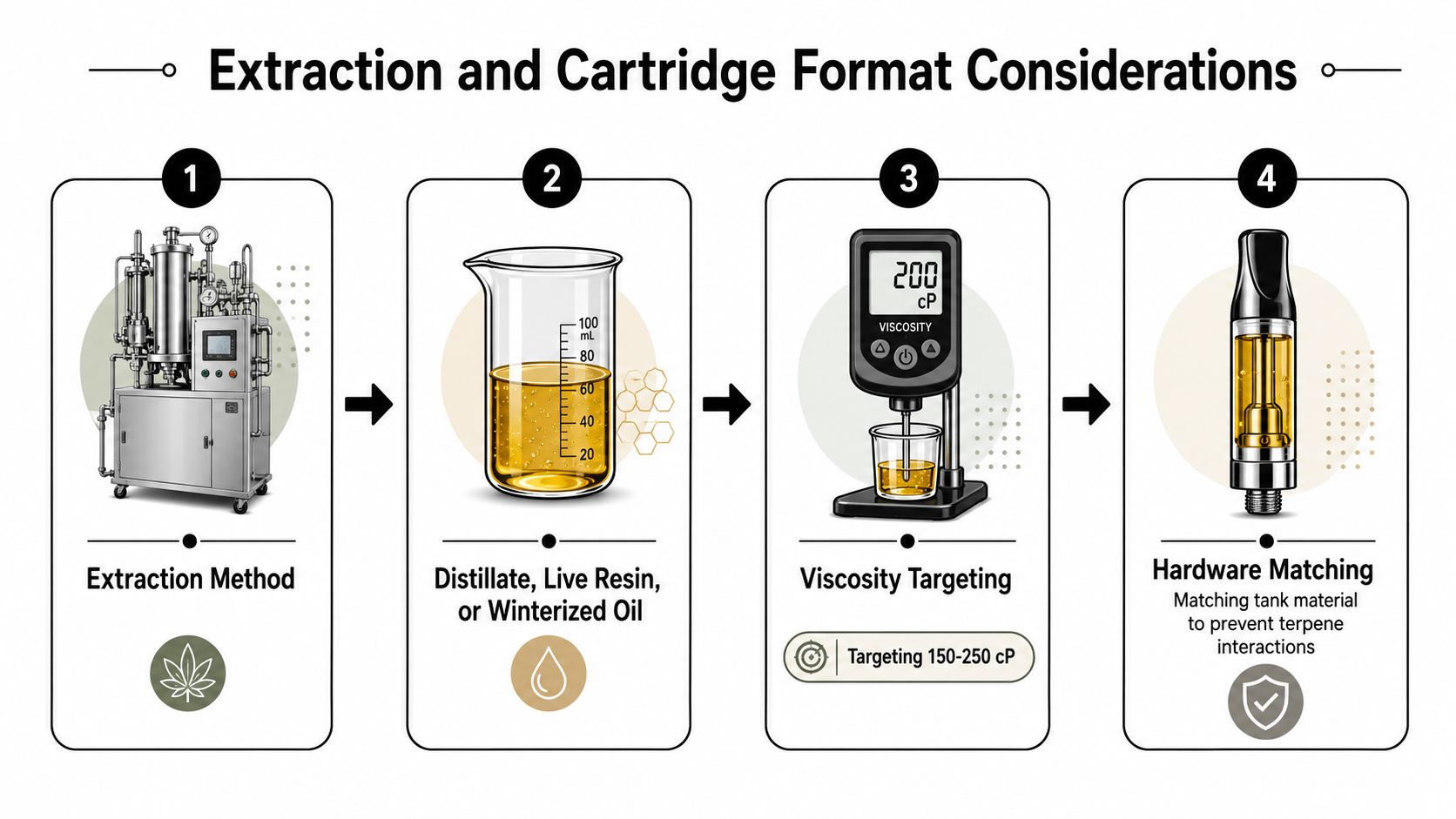
Once Citrus Haze leaves the flower, the profile becomes much more fragile. Terpene-heavy citrus material is easy to over-handle during decarboxylation and post-terping, and the brighter top notes are the first to disappear if heat exposure runs too long. That's why a limonene or terpinolene leaning oil usually needs gentler handling than a caryophyllene-forward blend, which can tolerate a slightly heavier sensory hand.
Match the oil to the hardware
Distillate, winterized oil, and live resin don't behave the same way in a cartridge. Distillate gives you the cleanest canvas, but it also depends most on reintroduced terpenes for identity. Live resin preserves more of the native aroma, while winterized oil sits between them and can still need careful viscosity tuning before fill.
The hardware decision matters as much as the extract base. Ceramic cores usually handle terpene-rich oil more gracefully than cheap wick systems, especially when the load is on the thinner side. A 510 thread cart gives flexibility for scale and fill operations, while all-in-one pods often demand tighter control over viscosity and fill consistency because the reservoir and heater are less forgiving.
Keep the fill oil stable first, then chase flavor. If the blend leaks, clogs, or scorches, the profile won't matter.
A Citrus Haze cartridge also can't be built by scaling flower chemistry into distillate. The flower benchmark includes about 0.99% total terpenes, which is a useful aromatic marker in plant material, not a finished-cart dosing target (AskGrowers review). In practice, the terpene fraction in a cartridge has to be built back into the oil at a cartridge-appropriate level, with the final viscosity and thermal behavior still intact.
Stability is the last part people underestimate. Citrus profiles oxidize more readily than heavier, earthier blends, so headspace management, sealed storage, and careful post-mix hold times matter. If the oil sits too long before fill, the top note drifts first, and the cart no longer tastes like Citrus Haze, it tastes like a generic citrus oil.
Building a Citrus Haze Blend with Gold Coast Terpenes
A practical starting point for a 1 g distillate cartridge is a 5% to 8% total terpene load, with roughly 60% to 70% of that coming from a strain-inspired backbone and the remainder used to steer the profile with isolates. For a Citrus Haze-style build, that gives you enough aromatic presence without making the oil too thin or too aggressive in hardware. It also leaves room to tune the final nose toward either of the two documented terpene signatures.
A limonene-led starting blend
For a cut that leans citrus-pine, start with a strain-inspired Citrus Haze blend as the core, then support it with Limonene, Myrcene, and a small amount of Pinene. A workable directional target inside the terpene fraction is roughly 45% strain-inspired blend, 25% Limonene, 15% Myrcene, and 15% Pinene. That tends to read as bright on the inhale, rounded in the middle, and clean on the exit.
A terpinolene-led starting blend
For a cut that leans citrus-herbal with more finish, keep the strain-inspired backbone, then push Terpinolene higher and use Beta-Caryophyllene to ground it. A practical direction is about 50% strain-inspired blend, 20% Terpinolene, 15% Beta-Caryophyllene, and 15% Myrcene. That version feels more layered and usually fits hybrid positioning better when the source lot has a spicy or pine-herbal undercurrent.
A cartridge team should always confirm the final ratio with the Mixing Calculator before scaling to 5 g, 100 g, or 1 kg batches. That keeps batch math consistent when you move from pilot fill to production fill. If you want to push fruit or dessert accents beyond the standard profile, the Elevated Strains line is a reasonable place to look, since it's designed to highlight more unusual aromatic edges without forcing the whole blend into candy territory.
For a cleaner starting point, Limonene guidance for formulation is useful when you're deciding how far to let the citrus top note run before it starts flattening the mid-palate. Don't overbuild the first batch. Citrus blends often look weak in the beaker and feel strong in the cart, especially once heat and airflow start amplifying the top notes.
Dosing, Safety, and Compliance for Cartridge Release
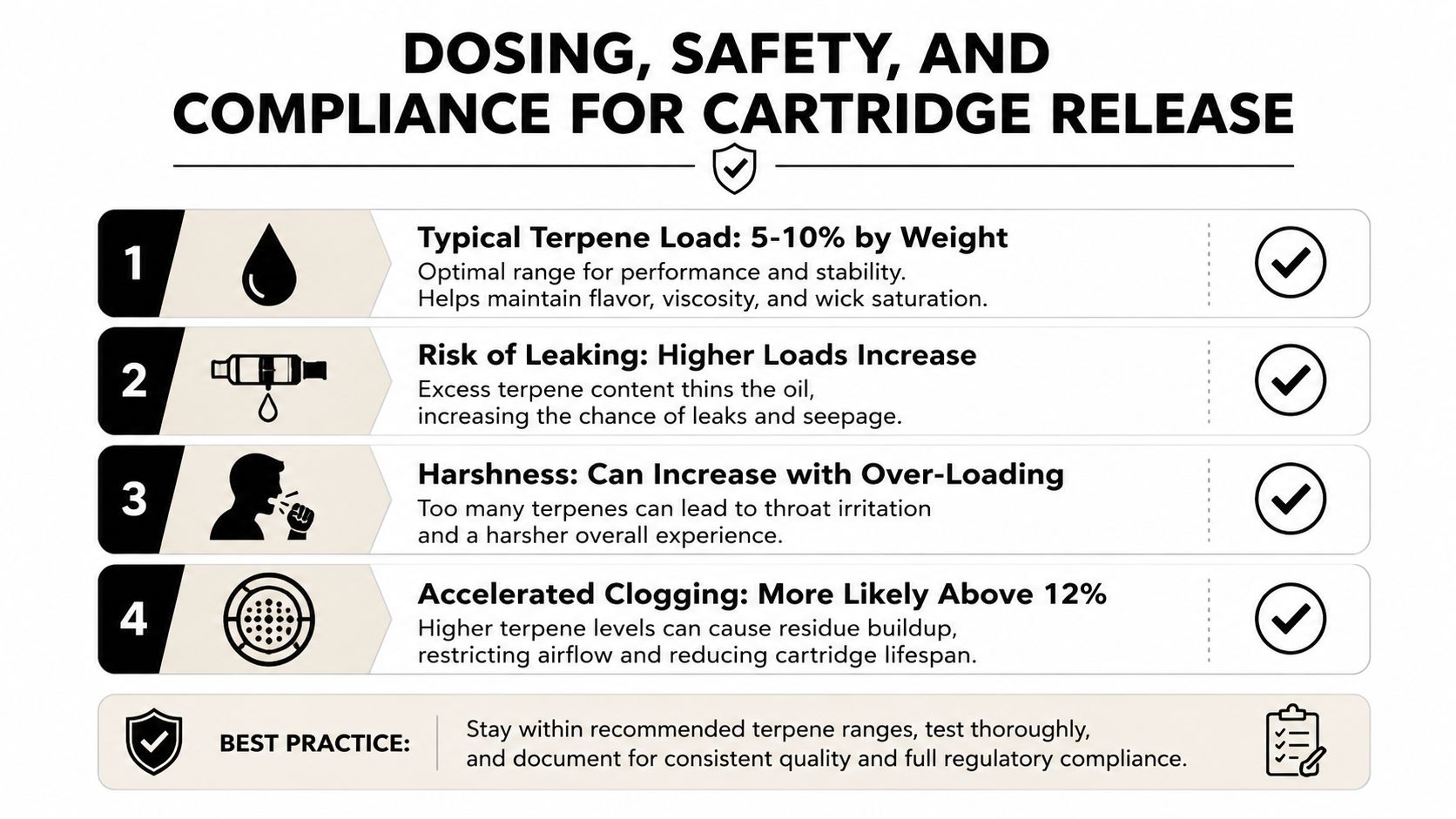
A finished 510 cart usually lives happiest in a 5% to 10% by weight terpene window, and pushing far beyond that often creates avoidable problems. Higher loads can increase leaking, make the hit harsher, and accelerate clogging at the nozzle. For a Citrus Haze profile, those risks show up faster because the brighter top notes already push volatility.
What has to clear before fill
Gold Coast Terpenes states that its terpene products are SC Lab-tested and free of VG, PG, PEG, and MCT, which matters for hardware compatibility and for a cleaner label claim set. The absence of those diluents doesn't guarantee success by itself, but it does remove a common source of residue, irritation, and labeling friction. That makes the terpene portion easier to defend in a product file when the COA is reviewed.
Compliance rule: the SKU name and the dominant terpene fingerprint need to agree closely enough that the label doesn't read like a different strain family.
That's especially important for Citrus Haze, because the name can point to either a limonene-led or terpinolene-led structure. If the final COA shows something materially different from the chosen target, the marketing team needs to adjust the claim or the batch needs to be reformulated. Shelf stability also depends on basic handling, so keep mixed oil cool, dark, and sealed, and move from blend to fill as quickly as the operation allows.
The operational checkpoint is simple. Verify the terpene load, confirm hardware behavior, and make sure the finished flavor still reads as Citrus Haze after short hold time. Regulatory compliance guidance for cartridge release is worth keeping close when the batch is approaching sign-off, especially if the SKU is going into a multi-state product line.
Positioning Citrus Haze Against Competing Profiles
Citrus Haze earns shelf space when the brand wants a citrus SKU with a little more structure than a straight lemon profile. Compared with Lemon Haze, Super Lemon Haze, and Tangie-style offerings, it sits in a useful middle zone, bright but not one-note, citrus-forward but with enough herbal or spicy support to feel more composed. That matters for buyers who want something that reads daytime and energetic without sounding identical to every other lemon cartridge.
The 50% sativa-leaning genetic split gives you room to position it as a hybrid-leaning haze rather than a pure lemon lane filler. If the chosen signature is the caryophyllene/terpinolene version, the profile can be marketed as citrus with a warmer finish. If the cut is more limonene/pinene driven, the brand should lean into crisp citrus-pine and keep expectations tight.
That distinction is not cosmetic. If the packaging promises a bright lemon profile but the COA shows a different terpene center of gravity, the mismatch erodes both compliance confidence and repeat purchase behavior. Citrus Haze works best when the label language matches the dominant terpenes, not when it borrows the appeal of a neighboring citrus cultivar.
Quick Reference and Common Formulator Questions
Use the limonene/pinene/myrcene or terpinolene/caryophyllene/myrcene path, keep total terpene load around 5% to 8%, and verify the COA, hardware stability, and label claim before release. If no source COA is available, choose the terpene signature that best matches the lot's actual nose, not the menu description. A Citrus Haze profile can be built from isolates alone, but the strain-inspired backbone usually gives the blend better cohesion. Distillate wants a cleaner, more deliberate top-note push, while live resin usually needs less correction and more restraint. If a cart tastes flat after a week, shorten hold time, reduce oxidation exposure, and move a small portion of the blend back toward the brighter top note.
Gold Coast Terpenes supplies strain-inspired terpene blends, isolates, and formulation resources that fit this kind of cartridge work. If you're building a Citrus Haze-inspired SKU, visit Gold Coast Terpenes to compare profile options, review mixing tools, and source the components you need for a cleaner, more defensible formulation.