
The question what terpenes get you the highest sounds simple, but in formulation work it usually points to a bad premise. Gold Coast Terpenes, a Redondo Beach, CA supplier, focuses on 100% botanically derived terpene blends for cartridge and distillate work, which is the right lens here, because the job is to shape aroma, flavor, and session character, not promise a terpene-only high.
For product developers, the commercial truth is blunt. THC dose and formulation drive intoxication, while terpene identity by itself does not reliably make a product feel stronger. That's why a clean internal reference like Do Terpenes Get You High matters more than strain folklore when you're trying to build a repeatable SKU.
The Reality of Terpene-Driven Intoxication
No terpene has a reliable, stand-alone CB1 or CB2 pathway that makes cannabis feel “higher” at consumer-relevant levels. In practice, the strongest intoxicating driver is still THC dose and formulation, not terpene identity, and clinical guidance still anchors a typical intoxicating dose for a cannabis-naïve person at about 10 mg THC PMC9457791.
What formulators should stop promising
The old retail story says one terpene causes couch-lock and another creates a brighter high. That story is too neat for the data we have. A broader scoping review concluded that the evidence base for the cannabis entourage effect remains soundly weak, contradictory, and inconclusive PMC9457791.
Practical rule: Use terpenes to tune the experience, not to claim they create intoxication on their own.
For brand owners, that distinction matters. If a cart feels harsher, more anxious, or less balanced, terpene choice may be part of the solution, but it's not a substitute for managing potency, viscosity, and hardware behavior. That's the lane where Gold Coast Terpenes fits well, since the company sells strain-specific profiles and botanical blends built for formulation, not fantasy.
The commercial takeaway
The market still rewards products that smell and taste like the expected strain profile. It does not reward a formulation that overpromises a stronger high and then fails on consistency. The smarter approach is to treat terpene selection as a sensory and experiential tool, then build the cannabinoid base to carry the actual intoxicating load.
Clinical Evidence on Limonene and Myrcene Effects
Limonene has the clearest human evidence for changing the subjective THC experience, but not by making users more intoxicated in the simple sense. Myrcene, despite its reputation, still lacks convincing evidence that it directly drives a stronger cannabinoid high at typical levels.
What myrcene data actually show
A 2022 cell-based study found that myrcene at 1 µM produced no change in cannabinoid signaling, with EPSC charge relative to baseline at 1.04 ± 0.03, n = 8, p = 0.225 PMC9457791. At the same concentration, limonene also showed no significant effect, at 1.03 ± 0.03, n = 6, p = 0.10 PMC9457791.
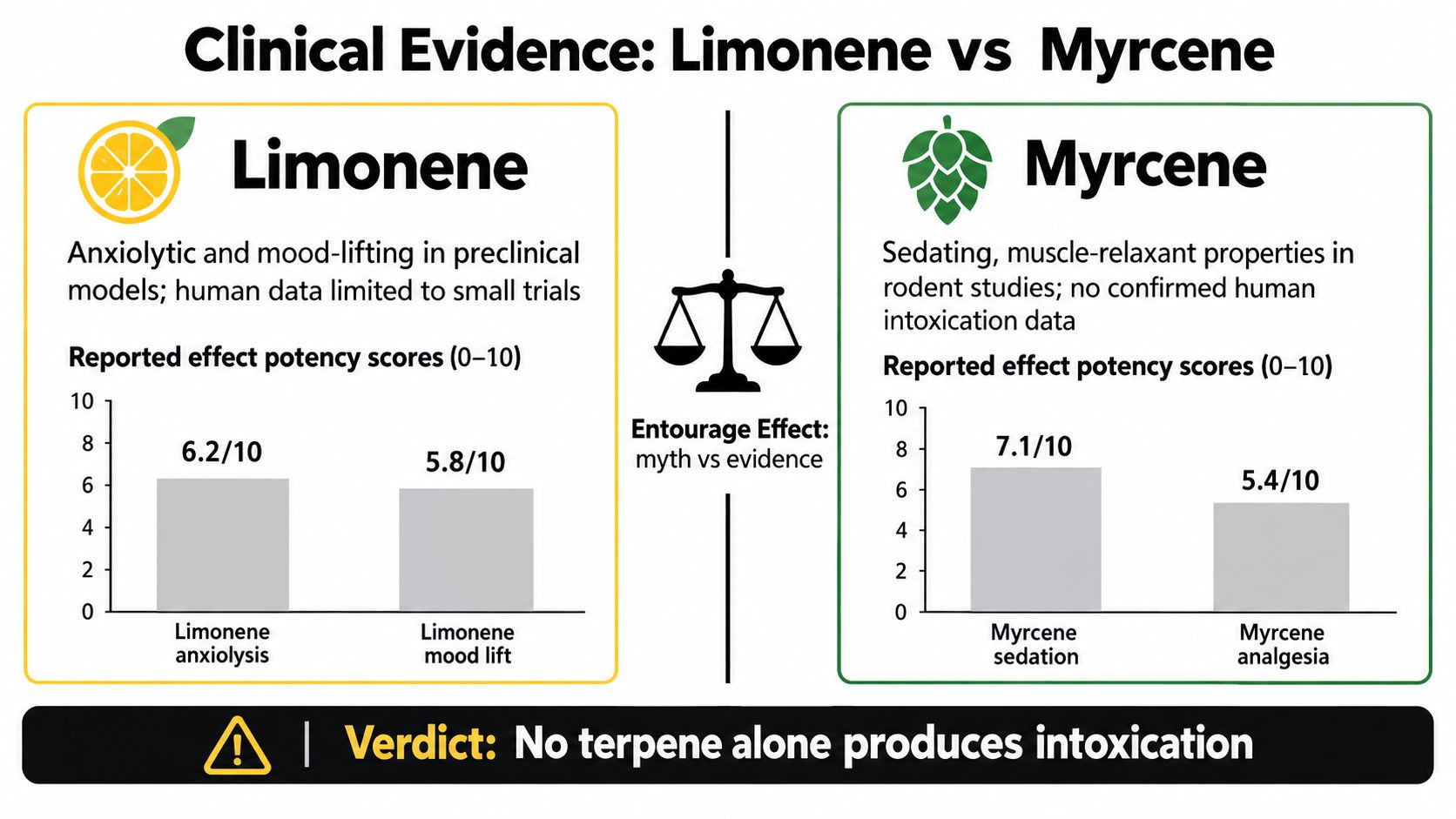
The clean read is that myrcene's “couch-lock” reputation is still more folklore than proven human intoxication science. A second receptor-level review likewise found no reliable evidence of terpene-cannabinoid synergy at the receptor level, which reinforces the point that terpene identity alone doesn't explain a stronger high PMC11870048.
Where limonene stands apart
Limonene is different because human testing has shown it can alter the subjective response to THC. In a Johns Hopkins clinical trial summarized in 2024, participants inhaled vaporized THC alone or with limonene, and at the highest tested THC dose of 30 mg, THC alone increased anxiety and paranoia, while the highest limonene dose significantly reduced those feelings and made participants more likely to report relaxation GreenState.
The important nuance is dose response. Lower limonene doses didn't show statistically significant changes, so this wasn't a blanket enhancement effect. It was a targeted shift in how THC felt, which is exactly the kind of data product developers can use when they want a calmer, cleaner cartridge profile.
Limonene looks less like a “make it stronger” terpene and more like a “change the feel of the same THC dose” ingredient.
For a more focused reference on the myrcene side of the story, see Myrcene Terpene Effects.
Why this matters in vape hardware
In vapes, the user experiences volatility, heat, and cannabinoid load all at once. That means a terpene can influence first impressions, harshness, and perceived smoothness even when it doesn't create more intoxication. For R&D teams, that's a useful lever, because it lets you design for a more relaxed or more balanced session without overstating any pharmacological claim.
Botanical vs Cannabis-Derived Terpene Selection
Botanical terpenes are usually the better fit when your priority is consistency, scale, and compliance. Cannabis-derived terpenes can be valuable when a brand is chasing an exact flower-linked sensory profile, but they tend to bring more sourcing constraints and less flexible manufacturing.
Choosing by business model, not hype
A botanical profile is easier to standardize across batches, especially for vape cartridges and distillate blends that need the same flavor performance every time. Gold Coast Terpenes positions its blends as THC-free and free of VG, PG, PEG, and MCT, which makes them practical for broad product development and international distribution.
That matters when the formulation has to survive labeling review, raw material sourcing, and repeat production runs. The chemistry is only half the equation. The supply chain has to be stable enough to support it.
If the brand wants a fruit-forward profile with a more lifted aromatic character, Elevated Strains is one example of a blend category built around nuanced flavor design rather than a promise of stronger intoxication.
A simple sourcing matrix
- Botanical-derived terpenes: Better for scalability, tighter lot consistency, and broader compliance planning.
- Cannabis-derived terpenes: Better when the brief demands closer flower authenticity and the supply chain can absorb variability.
- Elevated-style profiles: Better when the target is a premium flavor impression with rare or exotic notes, not a raw potency claim.
The article CDT vs BDT is a useful internal comparison if you're deciding between those paths for a new SKU.
Decision rule: Pick the source based on what the cartridge has to do in the market, not on which source sounds more authentic in a sales deck.
For formulators, the practical difference shows up in batch repeatability, not in a mythical terpene-only high. Gold Coast Terpenes is relevant here because the catalog is built for blending workflows, so the sourcing decision can stay tied to manufacturing reality.
Managing Volatility and Note Position in Blends
The right terpene blend starts with volatility, not with strain names. Top notes flash off first, mid notes bridge the profile, and base notes carry the flavor foundation as the cartridge warms and empties.
How note position affects cartridge behavior
Top notes are the most volatile, so they should be added last and kept at the lowest practical temperature. Base notes have the highest boiling points and the lowest volatility, which helps them anchor the flavor in hotter concentrates and during longer use.
| Terpene | Note Position | Boiling Point (°C) | Formulation Role |
|---|---|---|---|
| Limonene | Top note | 176°C | Bright citrus lift and opening aroma |
| Linalool | Mid note | 198°C | Floral bridge and smoothing layer |
| Myrcene | Base note | 167°C | Foundation note in blend design |
Those reference points help you understand how coil heat can reshape the draw over time Gold Coast Terpenes Gold Coast Terpenes. A cartridge that tastes lively on the first pull but goes flat by the middle of the fill usually lacks enough structure across note positions.
A workable blend framework
One independent guide recommends a 30/50/20 split across top, middle, and base notes, then adjusting it to the target effect profile and application Entour Brand. That ratio is a starting point, not a rule carved into stone.
Start with the hardware, then tune the blend. A profile that behaves well in a low-wattage cart can fall apart in a hotter device.
For formulation teams, terpene selection becomes commercial at this point. A profile built around the wrong volatility stack can taste great in the lab and fail in retail. Gold Coast Terpenes also publishes practical terpene temperature guidance, which is useful when the product needs to stay coherent from the first draw to the last.
Precision Blending Protocols for Distillate
Mass-based dosing beats eyeballing every time. In distillate work, consistency comes from weighing the vessel, taring it, warming the base oil to improve flow, and adding pre-weighed terpenes slowly so they integrate cleanly.
The blending sequence that holds up
Start by weighing the vessel and taring it. Add the distillate first, warm it enough to reduce viscosity, then introduce the terpene fraction by weight rather than by volume. Add the terpenes slowly over 30 to 60 seconds into a vortex so they disperse without concentrating in one spot Gold Coast Terpenes.
That sequence matters because localized terpene hotspots can create harshness, separation, and uneven flavor. It also protects label accuracy, since mass-based addition is easier to document batch to batch.
Practical controls for production
- Weigh everything: Use mass, not guesswork, for the final blend.
- Warm before addition: Reduce viscosity before terpene entry so the blend accepts the fraction cleanly.
- Add slowly: Let the vortex do the work instead of dumping the full charge at once.
- Mix until uniform: Stop only when the oil is visually and texturally homogeneous.
Gold Coast Terpenes is relevant for this workflow because the company supplies SC Lab-tested isolates and blends that are meant to be integrated into controlled manufacturing environments. That makes the raw material side more predictable when you're scaling from bench to production.
The point is simple. Poor mixing doesn't just hurt flavor. It can produce carts that hit unevenly, separate on the shelf, or taste hotter than the intended profile.
Formulation FAQs for Vape and Distillate Brands
Are botanical terpenes easier to use for international products?
Yes, they're often easier to manage because the sourcing and compliance story is simpler. Gold Coast Terpenes markets THC-free botanical blends, which can be a cleaner starting point when a brand needs broad market compatibility.
How should terpene percentages be labeled?
Label by actual mass-based formulation data, not by rough estimates. If your process starts with weighed additions and ends with a homogeneous batch, your label can reflect that structure more reliably.
What if a flavor feels good in testing but harsh in hardware?
Check the note balance and volatility stack first. A profile with too much top-note dominance can disappear fast or feel sharp, while a weak base layer can make the cart taste thin before the fill is done.
How should bulk terpenes be stored?
Keep them protected from oxidation, heat, and UV exposure. Stable storage matters because terpene integrity affects both flavor fidelity and how cleanly the blend performs during cartridge filling.
When does a supplier matter more than the recipe?
When your SKU has to repeat across batches. Gold Coast Terpenes is a useful option for formulators who need strain-specific profiles, botanical blends, and mixing support that fit a production workflow rather than a retail story.
If you're building a vape or distillate SKU and need terpene profiles that hold up in real production, Gold Coast Terpenes has strain-specific blends, isolated compounds, and formulation resources built for that job. Visit Gold Coast Terpenes to compare profiles, review blending references, and choose materials that fit your hardware, compliance needs, and target flavor outcome.