
A batch of New York Diesel-inspired oil can smell right in the mixing vessel and wrong by the time it reaches a 510 cartridge. The grapefruit lift flashes off at the nozzle, the fuel note turns harsh, or the finished cart tastes like generic citrus because the blend was built as a flat list of molecules instead of a structured aroma system. Gold Coast Terpenes supplies strain-specific, THC-free terpene blends for cartridges, concentrates, and product formulation, including botanical and nature-identical options that need to be evaluated against the target profile, hardware, and compliance requirements.
For product developers, the useful question isn't “what does New York Diesel smell like?” It's how do you reproduce its lime-grapefruit opening, diesel core, and earthy finish after dilution, filling, storage, and vaporization? This guide treats the cultivar as a formulation problem, with practical decisions for a strain-inspired terpene blend for vape cartridges, distillate reintroduction, and cannabis product formulation.
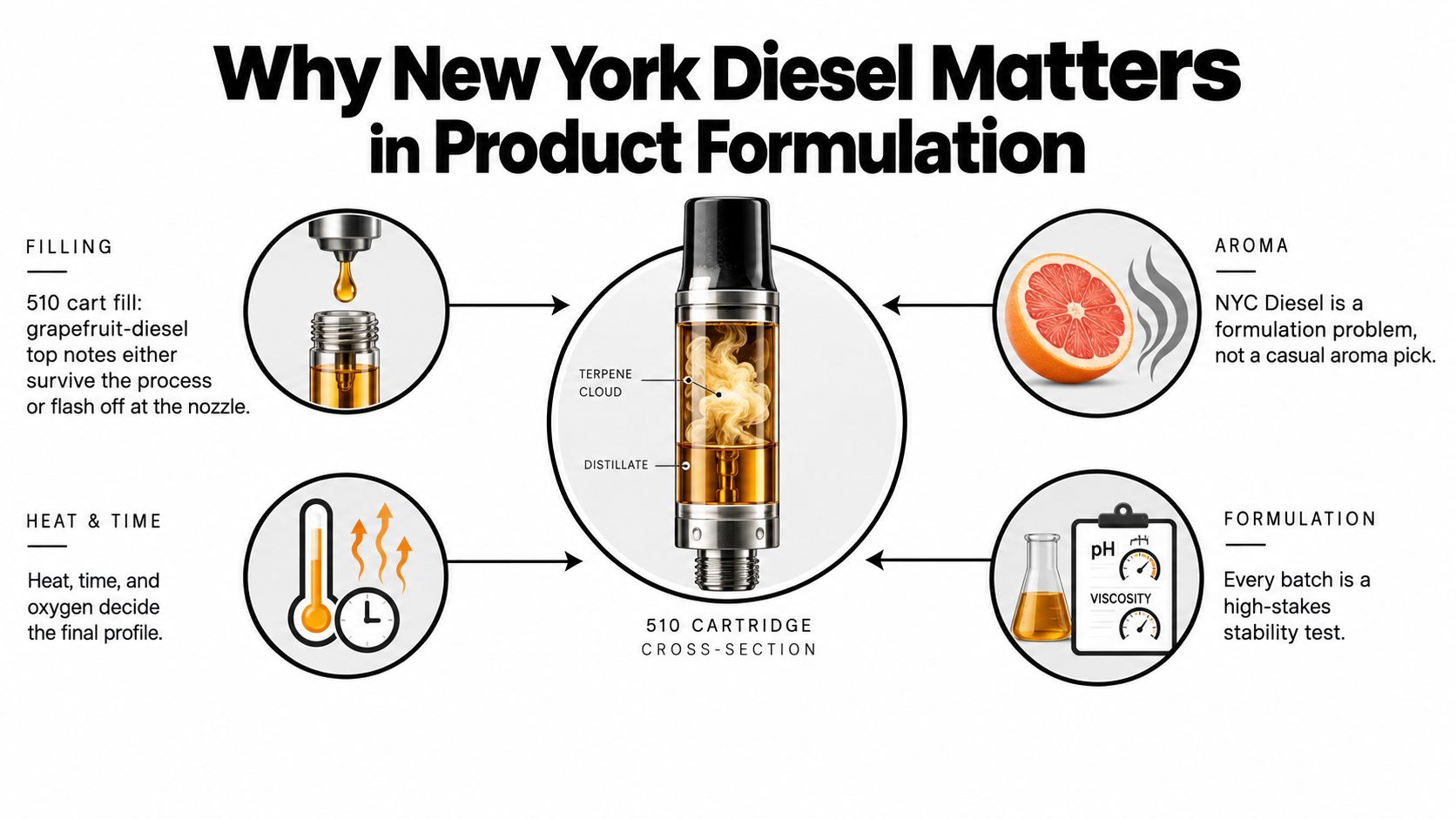
Why New York Diesel Matters in Product Formulation
New York Diesel matters because its recognizable identity depends on contrast. The product has to deliver a bright citrus opening and a pungent fuel body without letting either side dominate. A 510 cart can lose the grapefruit-diesel greeting through heat exposure, oxygen, or an overly aggressive terpene load, so the formulation must be designed for the finished device rather than judged only in the blend bottle.
The cultivar is widely traced to Amsterdam breeder Soma Seeds, with development placed in the late 1990s or early 2000s. Its genetics are commonly described as a Mexican sativa and Afghani landrace cross, and its early-2000s High Times Cannabis Cup record helped establish diesel-type cultivars as premium, globally recognized genetics. The naming is also tied to New York City, with some accounts connecting the name to the breeder's childhood home and its adoption after 9/11. The historical overview in this strain terpene profile resource is useful context, but the formulation target remains sensory and analytical.
Build the aroma as a ladder
Use three working layers:
- Top notes: Limonene supplies citrus brightness, while myrcene gives the opening a rounded, earthy body rather than a thin lemon impression.
- Mid notes: Caryophyllene contributes peppery density, and pinene adds green, woody lift that keeps the fuel character from becoming flat.
- Base notes: Humulene and heavier aromatic constituents provide persistence and an earthy, graphite-like finish. These should support the profile, not bury the citrus.
The practical mistake is treating “diesel” as one note. New York Diesel is a layered citrus-fuel profile, commonly described as lime zest, sour grapefruit, and sweet diesel, with myrcene, caryophyllene, pinene, and limonene repeatedly identified as important contributors in Leafly's New York Diesel profile and a strain-specific formulation reference.
Practical rule: Evaluate the blend three times, fresh, after dilution, and after a controlled rest. If the top note only works fresh, the ratio isn't finished.
The Origin and Cultivar Story Behind NYC Diesel
A New York Diesel-inspired cartridge can smell sharply of grapefruit at filling, then lose its lift after dilution and storage. The cultivar's origin helps explain why. It is generally understood as a European-bred line with Mexican and Afghani ancestry, a combination associated with bright citrus over a darker, earthy fuel body.
Reported High Times Cannabis Cup placements in the early 2000s, including 2001 through 2004 in sativa-related categories, helped establish the cultivar's identity around a complex diesel-grapefruit profile, according to this New York Diesel and Sour Diesel comparison. That history matters to product developers because “NYC Diesel” signals a sensory structure, not just a petrol note.
Treat the lineage as a working hypothesis, not a replacement for a certificate of analysis. Mexican sativa influence offers one explanation for sharper citrus and lifted aromatics. Afghani ancestry plausibly accounts for the heavier earth and darker body. Actual lots can shift toward sour grapefruit, dense gas, herbal notes, or a sweeter finish, depending on selection and growing conditions.
What the lineage changes in a blend
Start with the reference lot, then adjust the formula around what it expresses. For a bright, sour sample, limonene and myrcene should establish the opening without making the blend smell like lemon cleaner. For a dense, peppery sample, caryophyllene and pinene need enough presence to support the fuel character without turning it harsh or overly pine-like. Some interpretations assign terpinolene a larger role in grapefruit-diesel brightness, as described in this industry comparison of gassy profiles.
| Generation | Parent line | Aroma contribution | Formulation implication |
|---|---|---|---|
| Foundational cross | Mexican sativa and Afghani landrace lines | Citrus lift over earthy depth | Build brightness and body together |
| Breeder selection | Soma Seeds-associated New York Diesel line | Sharper diesel and grapefruit identity | Avoid a single-note fuel blend |
| Market recognition | Early-2000s award-era cultivar | Premium diesel benchmark | Match the sensory structure, not just the name |
| Modern interpretation | Strain-specific terpene expression | Variable citrus, gas, spice, and earth | Confirm each lot with sensory and analytical checks |
For purchasing, define the target before approving a supplier. A New York Diesel profile may represent a specific chemotype, a sensory reference, or a broad strain family. Those targets require different blend ratios and should not share one undifferentiated SKU. Record the top, mid, and base balance at filling, after dilution, and after storage so the finished cartridge still reads as NYC Diesel rather than generic gas.
Terpene and Cannabinoid Composition by the Numbers
The most defensible composition target is a high-THC, terpene-forward profile led by myrcene, caryophyllene, pinene, and limonene. Independent listings commonly place New York Diesel around 18% to 25% THC, with some reported peaks up to 28%, as summarized in this New York Diesel strain guide. Those figures describe reported flower listings, not a finished distillate specification.
Leafly identifies myrcene as the most abundant terpene, followed by caryophyllene and pinene, while other databases also list limonene, humulene, and linalool. One database reports relative abundance values of 69.02% myrcene, 54.32% caryophyllene, 30.50% pinene, and 19.16% limonene within its own terpene representation, so those values shouldn't be converted directly into a finished-product dosing formula. They show relative emphasis, not a universal recipe.
Translate the data without pretending it is a fixed fingerprint
For formulation, use the data to define a hierarchy. Myrcene should create the rounded body, caryophyllene should connect pepper and fuel, pinene should keep the profile green and lifted, and limonene should provide the grapefruit-like top. The actual balance still needs sensory correction because a blend that looks plausible on paper can smell too sweet, too pine-heavy, or too solvent-like in vapor.
| Compound | Approximate range | Aroma role | Volatility note |
|---|---|---|---|
| Myrcene | Commonly identified as dominant | Earthy, rounded body | Helps anchor the opening but can make the blend heavy |
| Beta-caryophyllene | Commonly identified as a leading component | Peppery fuel bridge | More persistent than the brightest citrus notes |
| Pinene | Commonly identified as a leading component | Green, woody lift | Excess can pull the profile toward pine |
| Limonene | Prominent in citrus-forward expressions | Grapefruit and lime brightness | Protect from heat, oxygen, and extended open handling |
| Humulene | Frequently listed among detectable compounds | Dry, earthy support | Useful for depth in small amounts |
| Linalool and minor compounds | Detected in some listings | Soft floral or aromatic nuance | Keep subordinate unless the reference lot demands it |
A separate industry guide reports terpene totals commonly around 1.0% to 3.0% by dry weight in comparable Diesel-type cultivars, with citrus-forward samples sometimes showing limonene around 0.4% to 1.2%, beta-caryophyllene around 0.2% to 0.7%, and myrcene around 0.2% to 0.8%. These ranges are best used for understanding flower variation, not for claiming that every New York Diesel lot has the same composition.
Sensory Architecture From Top Notes to Base
The profile works when the top notes arrive first, the mid notes give them shape, and the base remains after exhalation. Limonene and myrcene create the initial citrus-earth impression, caryophyllene and pinene form the fuel-spice bridge, and heavier compounds keep the finish from disappearing. A formulation that gets the GC hierarchy right but loses this sequence will taste flat.
Smell the blend in stages rather than searching for a single “correct” number. First, assess the immediate fizz of citrus and sour grapefruit. Next, wait for the mid-note transition, where pepper, green wood, and fuel should wrap around the opening. Finally, evaluate the lingering base. If the finish is only harsh, the heavier notes are probably compensating for a weak mid structure.
Diagnose the sensory shift
Terpinolene can support a brighter, more complex grapefruit impression in some New York Diesel-like interpretations, but it should be handled cautiously because it can dominate quickly. Caryophyllene is more useful as a structural bridge than as a headline note. A small amount of earthy support can make the profile feel authentic, while too much can turn it muddy.
The terpene flavor chart can help a new developer connect sensory descriptors to individual isolates before assembling a full blend.
| Descriptor | Dominant terpene | Relative weight |
|---|---|---|
| Lime zest | Limonene | High top-note influence |
| Sour grapefruit | Limonene with possible terpinolene support | High, but volatile |
| Rounded earth | Myrcene | High body influence |
| Peppery diesel | Beta-caryophyllene | Medium-to-high structural influence |
| Green wood | Pinene | Medium lift |
| Dry earthy finish | Humulene and heavier supporting compounds | Low-to-medium persistence |
Sensory check: The right blend should read as citrus over fuel, not citrus beside fuel. The mid notes must overlap the two.
Loading Ratios and Formulation Moves for Carts and Distillate
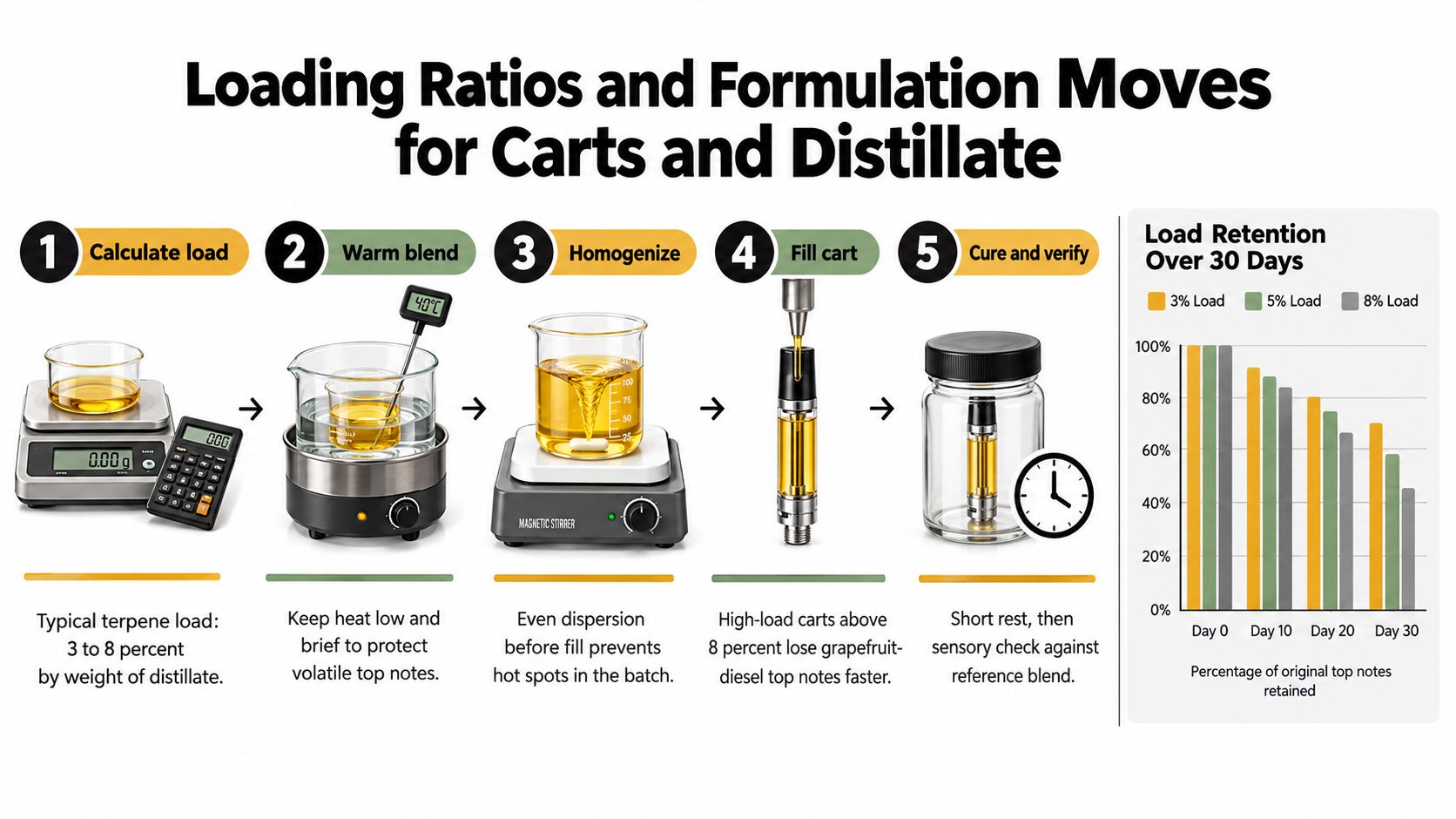
A practical starting window for terpene loading is 3% to 8% by weight of distillate, as reflected in the supplied distillate terpene loading guide. Lower loading usually gives the hardware more room to preserve the distillate body, while higher loading delivers greater initial aroma but can make the top notes disappear faster and can change viscosity, draw, and throat perception.
For a 50 g batch at a 5% target, calculate 2.5 g of terpene blend and 47.5 g of distillate if the target is defined as a percentage of final batch weight. If your internal standard defines load as a percentage of distillate weight, the calculation changes to 2.5 g of terpenes added to 50 g of distillate, producing 52.5 g total. Pick one convention and document it on the batch record.
Choose the load before choosing the hardware
At an 8% fill, the formula carries a strong aromatic charge, but the grapefruit-diesel opening is more exposed to thermal and evaporative loss. A 3% trial is useful for checking whether the base distillate already contributes enough body. A 5% trial is a balanced development point. An 8% trial can show the upper sensory limit, but don't assume the strongest fresh aroma will be the strongest retained aroma.
Keep warming low and brief, mix until homogeneous, and avoid leaving an open vessel on a hot plate. Ceramic hardware often delivers a cleaner transfer of a volatile profile than a poorly controlled cotton-wick system, but the actual result depends on oil viscosity, coil temperature, airflow, and fill procedure. A 510 cart and an all-in-one pod also create different thermal and headspace conditions, so hardware qualification is part of the formula.
For the blend itself, start with a citrus-led top, a restrained terpinolene contribution, and enough caryophyllene and myrcene to keep the aroma from collapsing after filling. Don't treat an isomer ratio as universal. Verify the finished oil in the actual cartridge, then compare fresh and retained samples under the same conditions.
Retention, Oxidation, and How Processing Flattens the Profile
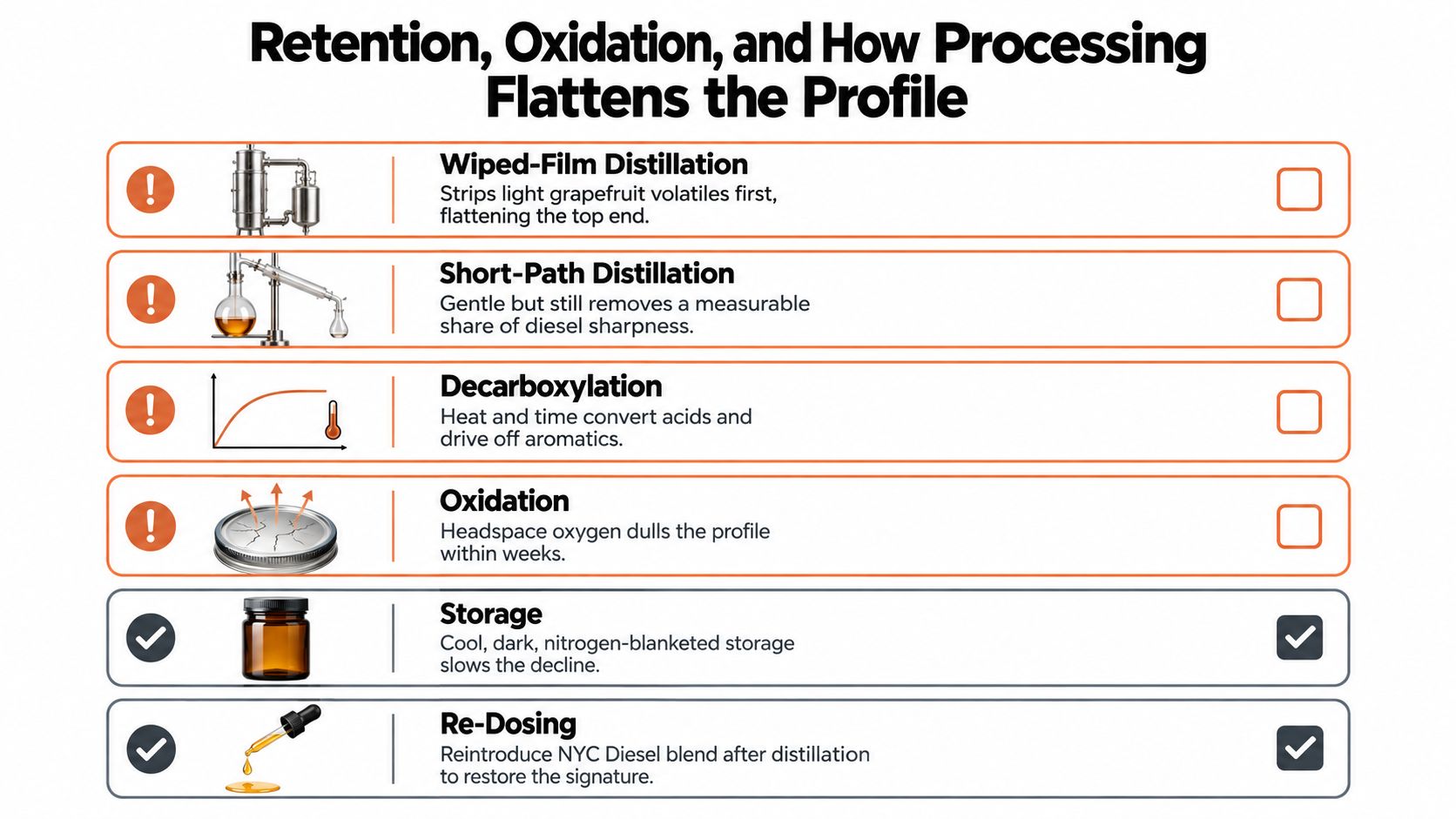
New York Diesel loses its identity when processing removes the volatile top faster than the formulation restores it. Wiped-film and short-path distillation can strip light aromatics, while decarboxylation adds heat and time that further reshape the starting material. The finished oil may retain a heavier caryophyllene-led body while losing the lime-grapefruit signal that made the source recognizable.
A 2025 review of terpene retention found that total terpene content can change materially across processing stages, with the direction varying by cultivar and product form. That finding supports a retention-first workflow, but it doesn't justify claiming a fixed loss percentage for limonene, terpinolene, or any other molecule without matching process data. The review is most useful as a warning that source flower chemistry doesn't automatically survive into a finished cartridge. The broader review is available in this technical report on terpene retention.
Use process controls as formulation controls
The practical sequence is simple:
- Limit heat exposure: Use the shortest workable warm-mixing window and don't hold the blend open near the filling nozzle.
- Reduce oxygen contact: Nitrogen-purged headspace and tightly sealed amber glass can slow oxidation during storage.
- Control holding conditions: Cool, dark storage is preferable to warm, light-exposed staging, but validate the chosen temperature against viscosity and handling requirements.
- Re-dose after processing: If distillation or winterization removed the cultivar's aromatic signature, add the strain-inspired blend after the disruptive step, then homogenize and verify.
A sharp pine-sol or turpentine shift, rising viscosity, or darkening color should trigger investigation before release. These signs don't identify one single failure mode, but they indicate that the product no longer matches the intended sensory reference. The oxidation prevention guide provides additional handling considerations.
Release decision: Don't approve a New York Diesel cart from the blend tank alone. Approve the oil after filling, resting, and tasting through the specified hardware.
Botanical vs Nature-Identical Sourcing for a NYC Diesel Blend
Botanical-derived and nature-identical terpenes can both support a New York Diesel-inspired profile, but they solve different manufacturing problems. Botanical materials prioritize a naturally derived positioning, while nature-identical materials usually make analytical matching and lot consistency easier. Neither label removes the need for supplier documentation, finished-product testing, or market-specific compliance review.
Botanical blends can introduce natural batch variation, especially in the relative balance of limonene, myrcene, and supporting compounds. That variation may be acceptable when the brand wants a naturally derived story and a living, less rigid interpretation of the cultivar. Nature-identical blends can offer tighter repeatability for cartridge filling, which matters when a brand has a defined sensory reference and wants the same profile across production lots.
Gold Coast Terpenes lists both botanical and nature-identical options, along with THC-free, lab-verified terpene products that are free of VG, PG, PEG, and MCT. Treat those product facts as purchasing criteria to verify against the current specification sheet and certificate of analysis, not as a substitute for your own restricted-market review.
| Attribute | Botanical-derived | Nature-identical |
|---|---|---|
| Primary advantage | Naturally derived positioning | Tighter lot-to-lot matching |
| Main trade-off | Greater natural variation | Label and claim review still required |
| Best fit | Brands prioritizing botanical sourcing | Brands prioritizing scale and repeatability |
| Key testing question | Are pesticides and heavy metals screened? | Does the lot match the target analytical and sensory profile? |
| Formulation concern | Limonene and myrcene balance may shift | A precise blend can still behave differently in hardware |
| Packaging review | Confirm permitted terminology | Confirm permitted terminology and ingredient disclosure |
Ask for the current COA, SDS, source statement, allergen information, and recommended use guidance before approving a supplier. “Botanical” and “nature-identical” describe sourcing or composition categories, not automatic compliance status.
Application Scenarios and Buyer Questions on NYC Diesel Terpenes
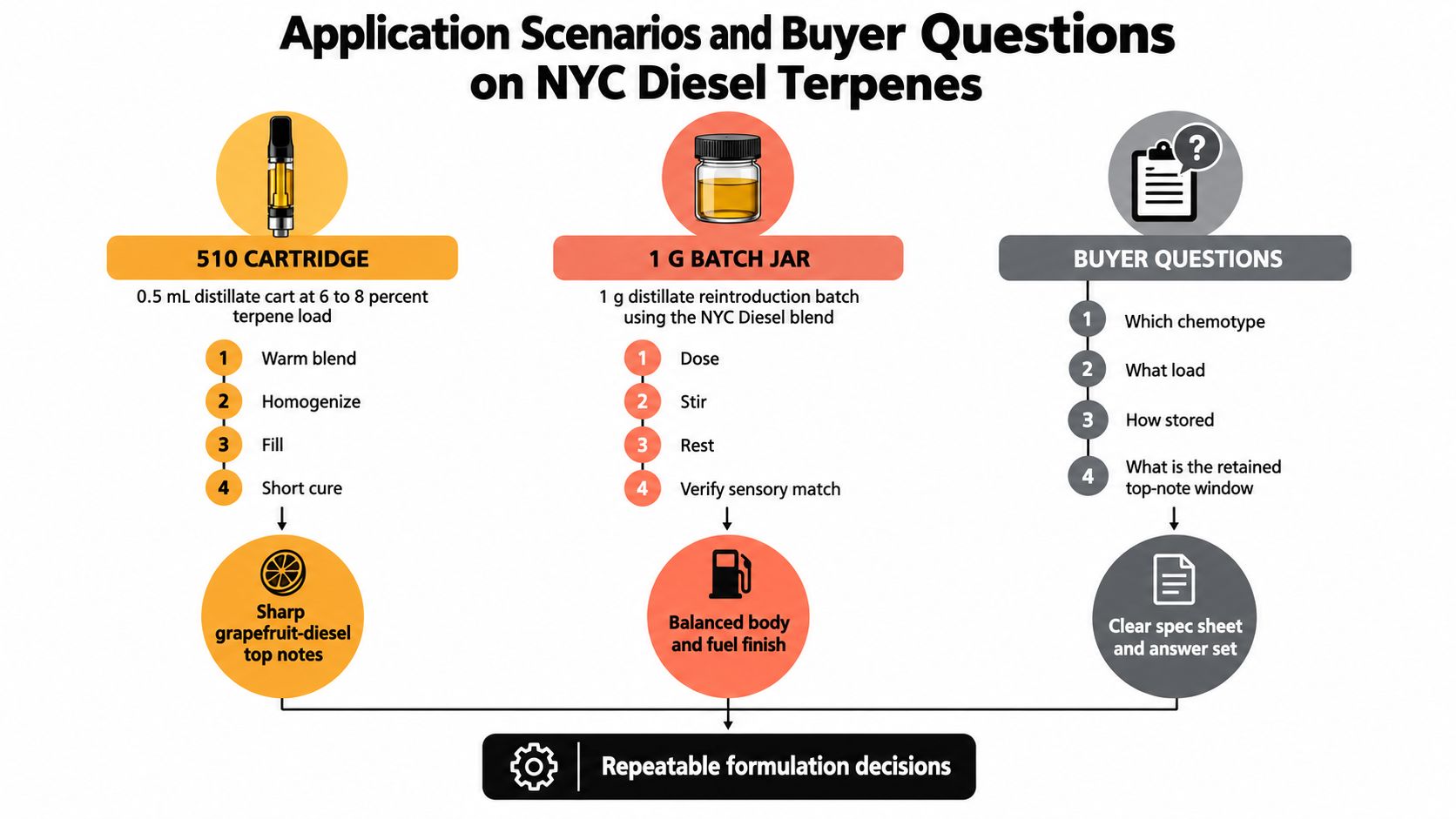
A New York Diesel project can fail in the fill room even when the bench sample smells right. Test the profile in the finished device, after mixing, filling, and storage, because grapefruit and fuel notes do not retain equally. Three development paths cover common use cases: a 0.5 mL distillate cart at 6% to 8% terpene load, a 1 g distillate reintroduction batch, and a hybrid profile that pairs NYC Diesel with a complementary diesel or earthy cultivar. Use the supplied New York Diesel formulation reference as a starting point, then qualify the blend in the intended hardware.
Scenario one for a 0.5 mL cartridge
Begin inside the 6% to 8% load window and warm the distillate only enough to combine. Homogenize fully, then fill with minimal open-air exposure. A fresh cart should present a sharp grapefruit-diesel opening. After several weeks, the top may soften while the fuel body remains, creating an unbalanced result. Compare the filled cartridge with a sealed oil retain to separate formulation change from hardware or exposure effects.
Scenario two for distillate reintroduction
For a 1 g batch, make a small dosing trial before treating the full vessel. Add the blend after the process step that removed the original aroma, mix until uniform, and rest briefly in a sealed container. Compare the result with the reference oil. Aim to restore missing top and mid notes without thinning the distillate or pushing the opening into harshness. Record the actual load, mixing temperature, rest time, and sensory result so the adjustment can be repeated.
Scenario three for a hybrid profile
Pair New York Diesel with Sour Diesel or Hindu Kush while keeping one profile dominant. Sour Diesel reinforces the fuel direction. Hindu Kush adds earth and weight. Set the sensory objective before blending, then document the dominant profile, load convention, hardware, storage condition, and release criteria. A hybrid should broaden the arc, not hide a weak NYC Diesel base.
Buyer questions that affect the purchase
- What is the minimum order quantity for a New York Diesel profile? Confirm the current MOQ and pack sizes directly with Gold Coast Terpenes, since a strain-specific blend may carry different minimums than a stock isolate.
- Is the blend a single SKU or part of a library? Confirm whether the current offering is sold individually, included in a strain-profile collection, or available as a custom formulation component.
- What storage temperature is recommended? Compare the supplier's handling guidance with oil viscosity, filling conditions, and the stability program.
- Does every lot include a COA? Request the current certificate and check identity, purity, and screening information against market requirements.
- Can the profile scale across devices? Validate 510 carts, pods, and concentrates separately for fill behavior, draw, thermal exposure, and retention.
Gold Coast Terpenes offers New York Diesel-inspired blends, isolated compounds, botanical and nature-identical options, and formulation resources for distillate and cartridge development. Review current specifications, COAs, and wholesale options at Gold Coast Terpenes.