
The popular advice is to blame the terpene blend when a distillate or cartridge begins to smell like skunk. That diagnosis is often wrong. The sharper culprit can be a family of volatile sulfur compounds, or VSCs, carried over from cannabis-derived material or formed as sulfur precursors react with moisture.
For cannabis product formulators, that distinction matters. A strain-inspired terpene blend should reproduce the intended fruit, gas, spice, or earth character without introducing an unstable sulfur problem that changes during storage. Gold Coast Terpenes, a Redondo Beach, California supplier, makes 100% botanically derived terpene blends, not cannabis-derived terpenes, giving product developers a more controlled aromatic starting point.
The Real Reason Your Extracts Smell Like Skunk
Terpenes don't automatically cause a skunk odor. In cannabis, the classic skunky character is linked primarily to sulfurous molecules, especially 3-methyl-2-butene-1-thiol, rather than to the terpene fraction alone. A technical overview of why cannabis can smell so strong is useful background, but the formulation implication is more direct: adding more terpene isn't a reliable way to correct a sulfur off-note.
Skunk spray itself demonstrates why the smell is so persistent. Its secretion is dominated by sulfur-containing thiols and thioacetates, and one authoritative analysis found that sulfur represented about 16% of the secretion by weight (McGill University). The spray contains dozens of compounds, with seven especially odor-active molecules. In striped skunk spray, trans-2-butene-1-thiol is a major contributor, alongside compounds such as 3-methyl-1-butanethiol and 2-quinoline methane-thiol.
Cannabis doesn't need to contain the same mixture as skunk spray to create a comparable sensory impression. A very small amount of a potent sulfur compound can dominate a larger terpene profile. That makes raw extract a chemical gamble for a brand trying to replicate a pungent cultivar across vape cartridges, distillate, or infused products.
Practical rule: Treat “skunk” as a sulfur diagnostic category before you treat it as a flavor target.
A botanical blend offers a cleaner way to build the recognizable architecture of a cultivar. You can control bright top notes, aromatic mid notes, and heavier base notes without depending on every volatile compound that survived extraction, winterization, heating, and filling. Gold Coast Terpenes positions its botanical blends for that kind of controlled formulation, while its THC-free, lab-verified materials are described as free of VG, PG, PEG, and MCT.
The commercial benefit is consistency. If a cartridge smells correct immediately after filling but changes later, the problem may be a reactive sulfur precursor, residual moisture, hardware interaction, or storage condition. More terpene can cover the problem briefly, but it won't identify or remove the source.
Volatile Sulfur Compounds and Detection Thresholds
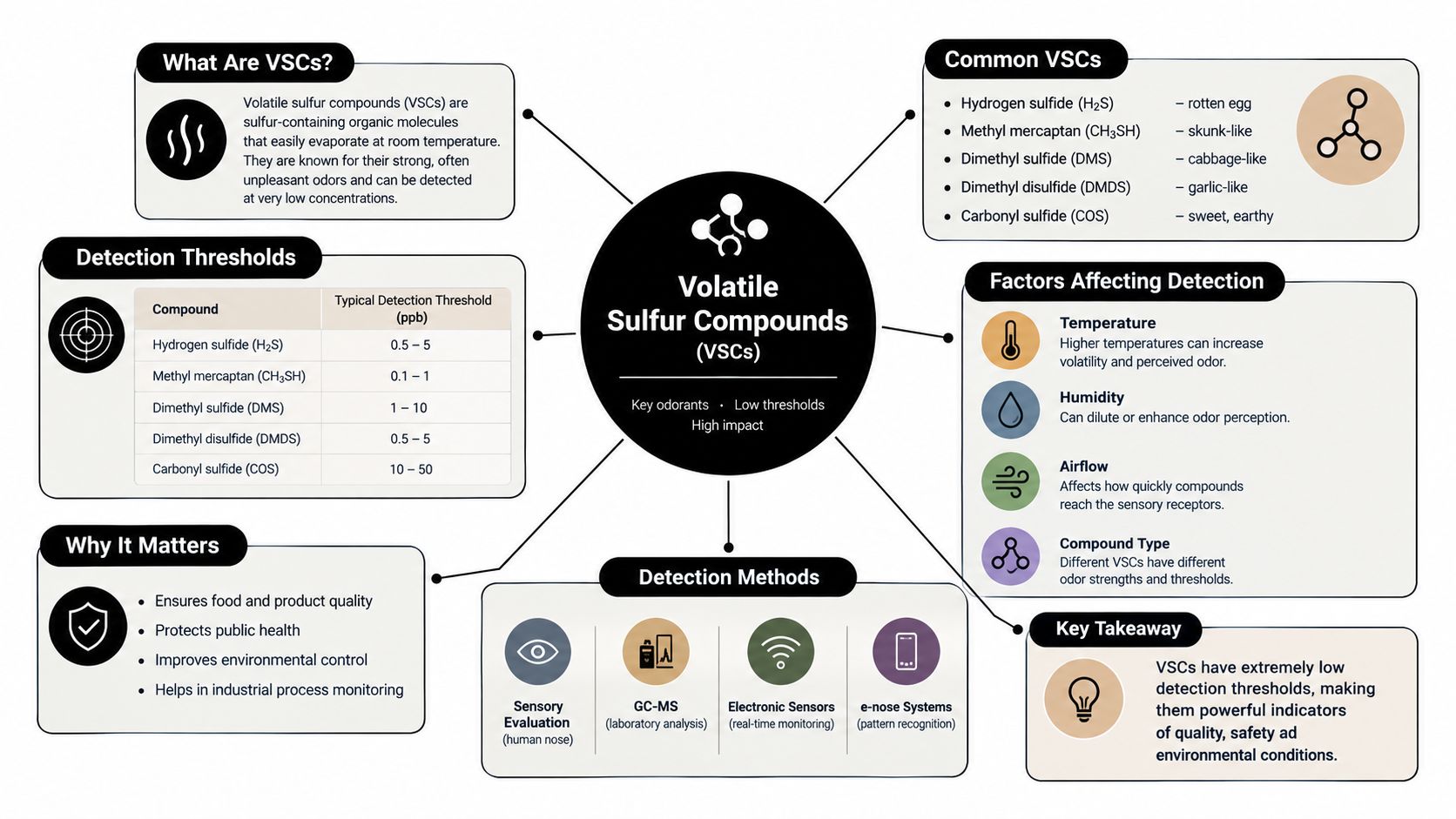
Volatile sulfur compounds (VSCs), not terpenes alone, drive the sharp skunk impression at trace levels. Humans can detect skunk musk at concentrations as low as 10 parts per billion, a sensitivity documented in skunk-chemistry research. That threshold explains why a minor peak on a specification sheet can dominate a sensory panel.
The clearest cannabis example is 3-methyl-2-butene-1-thiol, or 321MBT. A 2021 ACS Omega study linked the classic skunky cannabis odor primarily to 321MBT, rather than to terpenes, and placed it within a newly identified family of prenylated VSCs.
Researchers detected seven volatile sulfur compounds in the cultivar they studied. Five contained a prenyl functional group, and 321MBT was the most abundant VSC in the most pungent samples, according to the American Chemical Society.
Why sensory distance changes the diagnosis
Terpenes often dominate near a flower or freshly blended sample. Thiols can travel farther under some conditions, so the sulfur character may seem stronger outside the immediate headspace. A peer-reviewed cannabis aroma review describes this difference between near-field terpene character and longer-range thiol behavior.
For product developers, test distance and timing deliberately:
- Evaluate the blend immediately after mixing.
- Repeat the evaluation after controlled storage in the same container and headspace.
- Compare the distillate base, terpene blend, and finished hardware separately.
- Use analytical testing where available, especially when a panel reports “gas,” “skunk,” or “rotten egg.”
Delayed odor shifts also warrant a precursor check. In distillate and vape carts, thioacetate hydrolysis can release more odor-active sulfur species after filling, so an initially clean sample may not remain clean. Documenting incoming materials with chromatography and testing information helps separate a VSC, a reactive precursor, and a hardware or storage effect.
The practical objective is controlled sulfur behavior, not a zero-sulfur claim without analytical context. Identify whether the note is intentional, stable, and reproducible, or evidence of conversion or contamination.
Botanical Blends Versus Cannabis-Derived Extracts
Botanical blends generally give formulators a more predictable starting point than cannabis-derived aromatic extracts when delayed sulfur odor is a risk. The difference is chemical control, not preference. A botanical blend can be built from selected inputs and defined ratios, while a cannabis-derived fraction may carry minor source compounds that are difficult to identify before stability testing.
Cannabis-derived terpenes can reproduce extract-associated character, as covered in our CDT vs BDT breakdown, but the aromatic fraction can also carry sulfur precursors from the source material. That broader composition may improve authenticity while making batch-to-batch diagnosis harder. A clean sensory result at blending does not prove that the formulation will remain clean after filling or storage.
Formulation Stability Comparison
| Feature | Botanical Blends | Cannabis-Derived Terpenes |
|---|---|---|
| Primary control | Selected aromatic inputs and defined ratios | Aroma fraction from cannabis source material |
| Sulfur risk | Can be managed through supplier specifications and testing | May include source-associated sulfur compounds or precursors |
| Replication approach | Build top, mid, and base notes deliberately | Reproduce a broader extract signature |
| Batch interpretation | Easier to isolate blend, base, and hardware variables | More complex because source chemistry travels with the aromatic fraction |
| Delayed odor investigation | Focuses on moisture, oxidation, packaging, and incoming materials | Must also consider sulfur precursors carried from the plant material |
The diagnostic implication is straightforward. If a delayed skunk note appears, ask whether the aromatic input contains a volatile sulfur compound, a less-odorous thioacetate precursor, or neither. Thioacetates can hydrolyze in the presence of moisture and form thiols, so a sample may pass an initial bench check before developing an objectionable odor.
Gold Coast Terpenes describes its catalog as including 37 Strains and 40 Enhanced Strains, with botanical formulations aimed at fruit, gas, dessert, and other cultivar-inspired directions. The Apple Fritter profile from the Elevated Strains line is a catalog reference for a flavor direction, not proof that a finished product will behave like a cannabis extract.
Record that distinction in development documents. A strain-inspired terpene blend is a sensory formulation, not automatically a chemical copy of the source cultivar. “Strain-specific” labeling should be reviewed against the applicable jurisdiction, product category, and substantiation requirements.
Troubleshooting Delayed Odor Shifts in Vape Carts
A delayed skunk odor usually requires source isolation before reformulation. Start by separating the distillate, aromatic blend, cartridge hardware, and storage environment. If the smell appears only after filling, the cartridge and its materials belong in the investigation, not just the terpene bottle.
Thioacetates provide a credible mechanism for the delay. They can be less odorous initially, then hydrolyze with moisture into thiols, extending the odor for days or weeks (Iowa Department of Natural Resources). Oxidation or another chemical conversion can neutralize sulfur species more effectively than masking them with a stronger aromatic blend.
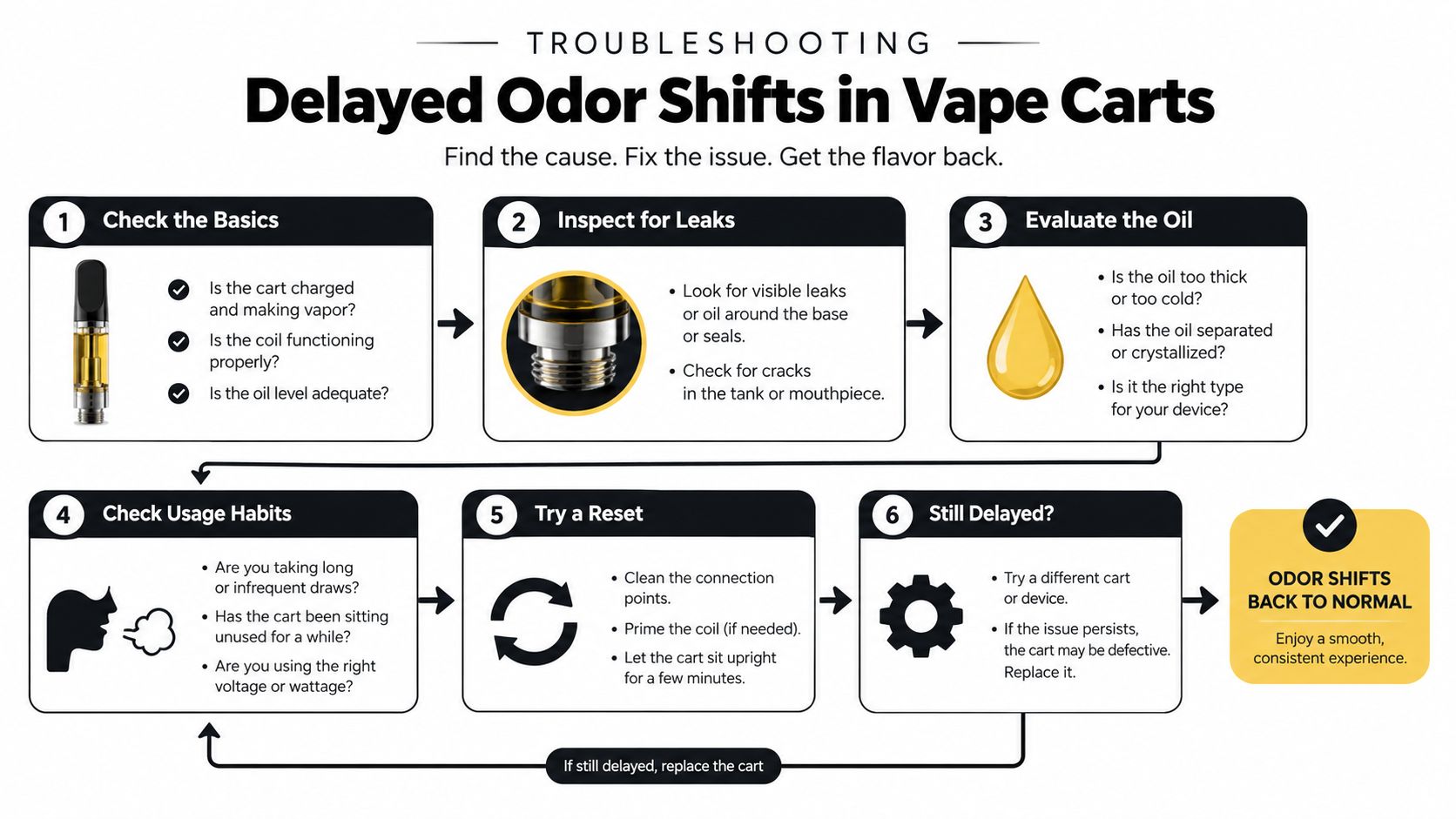
A practical diagnostic sequence
Hold the distillate base. Smell and test the base before adding terpenes. If the off-note is already present, changing the blend won't solve the upstream problem.
Check the aromatic input. Retain a sealed sample of the blend and compare it with the production sample. A change isolated to the finished blend points toward storage, handling, contamination, or an incompatible component.
Run a hardware comparison. Fill compatible control containers where possible. A problem that appears only in one cartridge format may involve the wick, adhesive, elastomer, metal surface, or residual processing material.
Investigate moisture exposure. Review raw-material handling, tank cleaning, drying, storage seals, and filling conditions. Don't assume that visually clear oil is moisture-free.
Repeat sensory checks over time. A single immediate evaluation can't detect a delayed conversion pathway. Keep retention samples in the same packaging used for sale.
Change one variable at a time. If you replace the blend, hardware, and base simultaneously, you'll lose the ability to identify the cause.
For teams dealing with odor contamination beyond the product itself, the resource on how to get rid of smoke smell provides broader remediation context. Product formulation still requires its own analytical and packaging controls.
Gold Coast Terpenes describes its materials as THC-free and lab-verified, which can reduce the variable of hidden sulfur precursors at the aromatic-input stage. Its guidance on preventing oxidation is relevant to storage and handling, but no supplier can replace a finished-product stability program.
Building Accurate Strain Profiles Without Sulfur
You can create a convincing heavy, gassy, or pungent profile without intentionally adding sulfur compounds. The safer approach is to construct the sensory shape with controlled botanical isolates and supporting notes, then validate the finished blend in the actual distillate and hardware.
A useful formulation architecture divides the profile into top, mid, and base notes:
- Top notes create first impact. Limonene can provide brightness and lift, while carefully selected citrus or herbal materials can prevent a dense profile from opening as flat or muddy.
- Mid notes establish identity. Myrcene can support a softer, fuller body, while Beta-Caryophyllene can contribute peppery, woody, and warm dimensions.
- Base notes provide persistence. Heavier sesquiterpene character and restrained earthy or resinous materials can make a blend feel substantial without pushing it into an uncontrolled sulfur impression.
The aim isn't to make the product smell weak. It's to give pungency a structured frame. A heavy profile needs contrast, or the nose may read the entire composition as harsh.
Why less sulfur can produce more accuracy
A 2023 peer-reviewed aroma study found that prenylated sulfur compounds can occur at concentrations often below 1 μg/mg yet still have a large odor impact (peer-reviewed aroma study). The study also identified 3-mercaptohexanol, 3-mercaptohexyl acetate, and 3-mercaptohexyl butyrate as contributors to tropical citrus and fruity notes in some cannabis varieties.
That finding creates an important formulation trade-off. Sulfur compounds can add realism at low levels, but their sensory impact may be difficult to control across bases, temperatures, headspaces, and packaging materials. For a commercial SKU, a cleaner approximation may outperform a chemically literal recreation if the literal version shifts during storage.
Gold Coast Terpenes offers a Terpene Mixing Calculator as part of its formulation tools. A formulator can use a calculator to document ratios, compare iterations, and keep a strain-inspired blend reproducible across batches. The blend should remain free of VG, PG, PEG, and MCT when the specification calls for neat terpene material, but the finished product still needs compatibility testing with its carrier and hardware.
For vape cartridges, evaluate viscosity, fill behavior, coil response, and flavor after the blend has equilibrated. For distillate, compare the aromatic profile before and after processing steps such as winterization. A flavor match that works in a glass vial may not survive the complete manufacturing route.
Commercial Considerations for Scaling Production
Scaling a terpene formulation changes the risk profile even when the bench sample is successful. Larger mixing vessels introduce different shear, heat-transfer, headspace, cleaning, sampling, and filling conditions. The specification must cover more than the name of the flavor.
A vape brand moving from a small pilot to a larger tank should lock down:
- Incoming material identity, including botanical versus nature-identical labeling where applicable.
- Certificate and testing requirements, with retained samples for each lot.
- MOQs and replenishment timing, so a successful blend doesn't become unavailable during a production run.
- Hardware compatibility, including wick behavior, seals, and storage conditions.
- Jurisdictional review, because hemp and cannabis rules can differ by state and product category.
- Finished-product sensory acceptance, not just raw-terpene odor.
Gold Coast Terpenes lists wholesale and bulk programs, including free U.S. shipping over $100 and discounts on orders exceeding 64 oz, according to the publisher's catalog information. Those commercial terms may affect purchasing decisions, but buyers should confirm current conditions directly because supplier policies can change.
A practical purchasing model separates development quantities from production quantities. Use smaller amounts to screen blend direction and hardware, then establish a repeatable bulk specification once the profile passes stability checks. Don't let a volume discount justify buying more material than the team can store under controlled conditions.
Winterized distillate creates another decision point. If the base changes after processing, the aromatic blend may appear to be the problem even when the process altered the underlying sensory matrix. Record the base at each stage, keep the terpene addition consistent, and approve the finished oil rather than approving only the concentrate or the flavor concentrate independently.
Formulation Questions and Technical Answers
Should I add more terpenes if distillate smells like skunk?
No. First test the distillate, terpene blend, hardware, and moisture exposure separately. More aroma can hide sulfur briefly while increasing harshness or distorting the intended profile.
Can botanical terpenes reproduce a pungent cultivar?
Yes. A strain-inspired terpene blend can reproduce selected sensory attributes without matching every compound in the source plant. Gold Coast Terpenes offers botanical profiles and isolates for controlled formulation, while labeling still requires jurisdiction-specific review.
What causes a delayed skunk odor in a cartridge?
Check moisture history, container closure, and heat exposure before reformulating the terpenes. Moisture-driven conversion of thioacetates into thiols is one established pathway. Keep retention samples in sale packaging and assess them at 24 hours, one week, and one month. The Iowa DNR explanation provides useful background on why the odor can emerge after filling.
How should terpene oil be stored?
Use a sealed, compatible container and limit heat, light, oxygen, and moisture. Qualify the finished blend under the same storage conditions used for the product, not only in the supplier's container.
What should a vape brand request from a supplier?
Request lot-specific certificates of analysis, allergen and residual-solvent statements, handling guidance, traceability records, and a written stability commitment. Verify each document against the finished-product specification.
Gold Coast Terpenes offers botanical profiles, isolated compounds, formulation education, and a Mixing Calculator. Review current specifications at Gold Coast Terpenes before approving a sulfur-free blend for distillate or cartridges.