
You're trying to rebuild a recognizable Kush Cake terpene profile for vape cartridges, but the first test tastes either too sharp, too sweet, or generically “kushy.” Gold Coast Terpenes supplies 100% botanically derived, THC-free terpene blends and isolated compounds, which gives formulators a practical starting point when cannabis-derived inputs aren't the right fit.
The Kush Cake strain is better treated as a sensory target than a fixed formula. Commercial and strain-reference sources commonly describe it as an indica-dominant hybrid from Wedding Cake and Kush Mints, with typical THC reported around 22% to 28%, CBD below 0.5%, and a commercial sample showing 24.67% THC with 0.97% total terpenes (commercial Kush Cake listing). The job is to rebuild the pepper, citrus, mint, floral, and dessert layers consistently in distillate, then confirm that the finished cart still resembles authentic flower.
What Formulators Need to Know About Kush Cake
Kush Cake works best as a caryophyllene-led strain-inspired terpene blend with citrus and floral lift, not as a sweet bakery flavor overloaded with limonene. The practical workflow is to establish the backbone first, add the volatile top notes gradually, then validate the oil against a properly handled flower reference before locking the SKU.
Gold Coast Terpenes is relevant here because botanical sourcing can support a repeatable rebuild when the objective is flavor accuracy, supply stability, and clear ingredient documentation, rather than a claim that the oil contains cannabis-derived terpenes. A formulator should still verify each supplier's current certificate of analysis, intended use, and regulatory position before production.
Treat the cultivar as a target
The phrase “Kush Cake” covers related but not identical phenotypes. Reference material describes LA Kush Cake and Detroit Kush Cake selections within the broader Wedding Cake and Kush Mints breeding wave, while terpene summaries consistently place beta-caryophyllene near the center of the aroma. That means a strain-specific profile needs a defined sensory brief:
- Pepper and warm spice must remain noticeable on the exhale.
- Citrus brightness should arrive early without turning the blend into lemon candy.
- Vanilla, dough, and cream should be suggested through balance, not forced with an artificial frosting note.
- Mint and earth should support the kush identity without dominating the cart.
A useful product developer brief reads, “pepper-forward dessert kush with citrus lift and a soft floral finish,” rather than “strong, relaxing, sweet.”
Practical rule: If the first impression is only lemon or the finish is only generic earth, the blend has lost the Kush Cake architecture.
This guide focuses on replicating the flavor of Kush Cake for distillate and cartridges. It covers lineage, compound roles, layered construction, loading math, botanical versus cannabis-derived labeling, SKU positioning, and the quality checks that should happen before a production handoff.
Genetics and Breeding History Behind Kush Cake
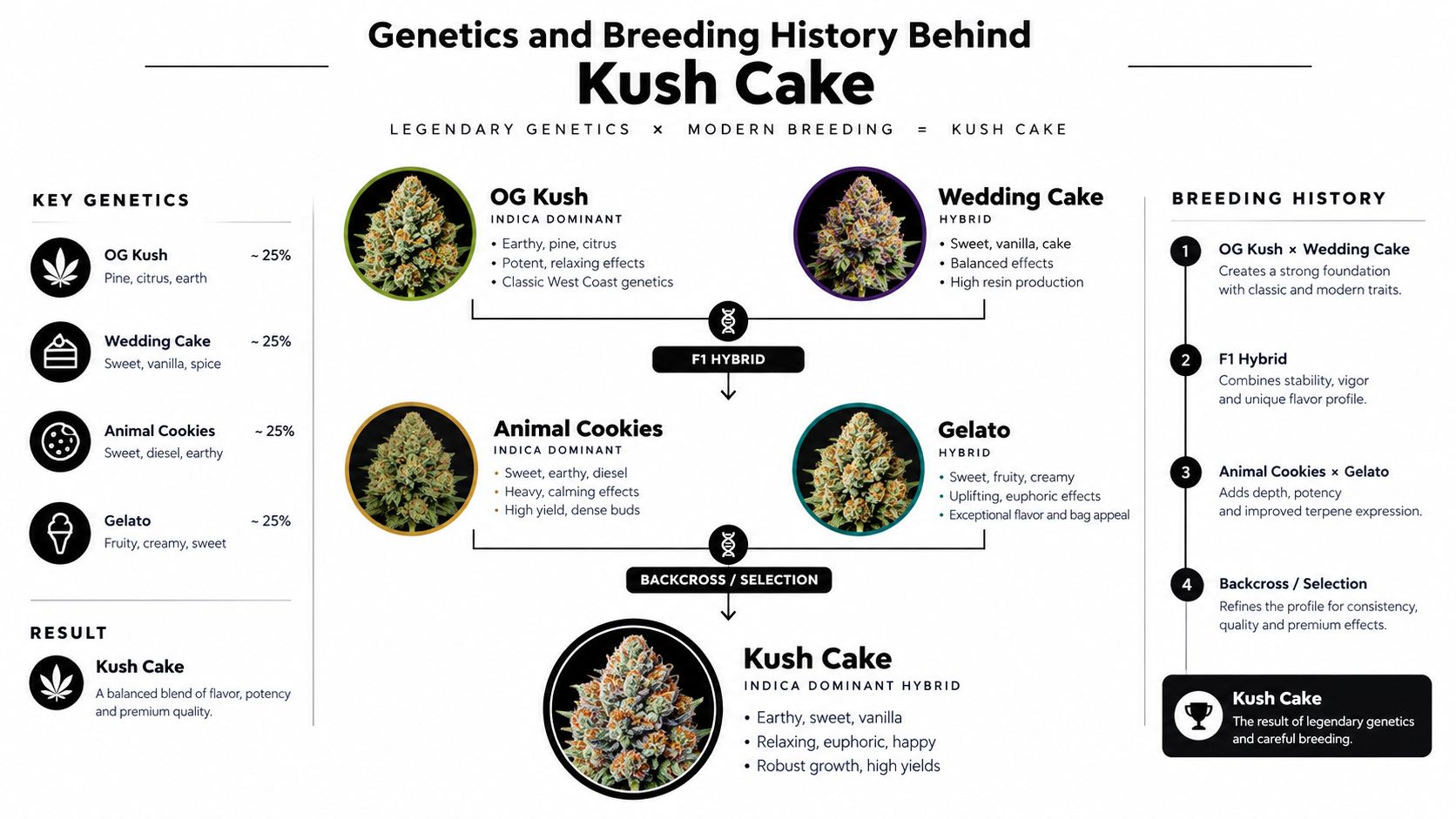
Kush Cake is generally traced to Wedding Cake crossed with Kush Mints, and its formulation identity comes from the intersection of dessert sweetness, mint, kush earth, and peppery spice. LA Kush Cake is associated with Seed Junky Genetics, while Detroit Kush Cake selection work is described as beginning in the Metro Detroit breeding scene during the mid-to-late 2010s (Detroit Kush Cake strain guide).
Wedding Cake supplies the formulator with a recognizable creamy, vanilla-leaning dessert direction and an OG-influenced foundation. Kush Mints contributes the cooler mint character and a sharper, gassier edge. When those traits survive into a selected phenotype, the resulting aroma can move from frosting and citrus into pepper, fresh soil, and warm spice rather than staying purely confectionary.
The breeding context matters because “cake” and “kush” aren't interchangeable flavor labels. A Cake-heavy expression may need more support for cream, vanilla, and sweet citrus, while a Kush-heavy expression may require stronger caryophyllene, humulene, and earthy support. The target should therefore be tied to a reference lot or approved sensory standard, not just the cultivar name.
What the lineage means in a cartridge
For a formulator, the parentage suggests a layered structure:
- Wedding Cake direction: creamy sweetness, vanilla, dough, and a rounded citrus edge.
- Kush Mints direction: cooling mint, earth, gas, and a firmer herbal finish.
- Selected Kush Cake expression: pepper-led spice with dessert softness and enough limonene to prevent heaviness.
The caryophyllene-led pattern is supported by independent strain summaries that place beta-caryophyllene first, followed by limonene and then myrcene or linalool (Kush Cake terpene summary). LA Kush Cake descriptions also identify earthy mint, vanilla, pepper, fresh soil, and spice, with caryophyllene, limonene, linalool, myrcene, and related compounds contributing to the full profile (LA Kush Cake terpene reference).
For teams researching whether the cultivar is indica-leaning or sativa-leaning before writing product copy, the indica or sativa guide offers useful terminology. Keep the final label language sensory and compliant. Genetic lineage can inform the brief, but it doesn't guarantee that every flower lot or oil will express the same aroma.
Kush Cake Terpene Profile by Compound and Aroma Role
The core profile is beta-caryophyllene first, limonene second, with linalool and myrcene shaping the middle and finish. A tested Kush Cake cart reported 2.2% total terpenes, with beta-caryophyllene, limonene, linalool, and beta-myrcene as the leading compounds (Kush Cake cart reference).
A flower reference reports Kush Cake at 22% to 28% THC and CBD below 0.5%, while another retail summary places the broader Kush Cake family around 22% to 29% THC, generally with CBD below 0.5% and terpene totals near 1% to 1.89% in tested or retail-reported lots (Kush Cake formulation data). Those flower figures shouldn't be copied directly into a cart formula. They describe the source material, while a finished oil requires a separate sensory and hardware study.
Functional aroma roles
Beta-caryophyllene supplies the pepper, dry spice, and warm kush foundation. It carries the profile through the middle and finish, which is why a limonene-heavy formula often reads as citrus dessert rather than Kush Cake.
Limonene provides the bright top note. It helps the blend open with citrus sweetness, but too much can flatten the mint and earth relationship into a generic lemon profile.
Linalool adds floral softness and can make the transition from pepper to dessert feel smoother. Myrcene provides body and earthy depth, while humulene reinforces the dry, herbal, hop-like side of the kush character.
Pinene, bisabolol, and ocimene are best treated as supporting materials. They can sharpen, soften, or lift the blend, but they shouldn't displace the four compounds that establish the identity.
| Terpene | Flower Range (%) | Cart Target (%) | Aroma Role |
|---|---|---|---|
| Beta-caryophyllene | Reported as dominant | 30% to 40% of terpene blend | Pepper, warm spice, baked dough, OG depth |
| Limonene | Commonly secondary | 15% to 20% | Citrus peel, brightness, sweet lift |
| Linalool | Supporting compound | 8% to 12% | Floral softness, creamy finish |
| Myrcene | Supporting compound | 6% to 10% | Earth, body, lingering kush depth |
| Humulene | Minor contributor | Trace support | Dry herbal and earthy structure |
| Pinene | Minor contributor | Trace support | Freshness and sharper green lift |
| Bisabolol | Minor contributor | Trace support | Soft floral and rounded finish |
| Ocimene | Minor contributor | Trace support | Light, volatile lift |
The cart targets above are blend composition targets, not percentages of the entire oil. A 40% caryophyllene target inside a 6% terpene load means caryophyllene represents 2.4% of the finished oil. For compound behavior and practical blending, the myrcene terpene guide is a useful reference point.
Formulation checkpoint: Smell the terpene concentrate, the diluted oil, and the vaped output separately. The same ratio can present as peppery in the vial, sweet in the oil, and woody in hardware.
Building a Kush Cake-Inspired Blend Layer by Layer
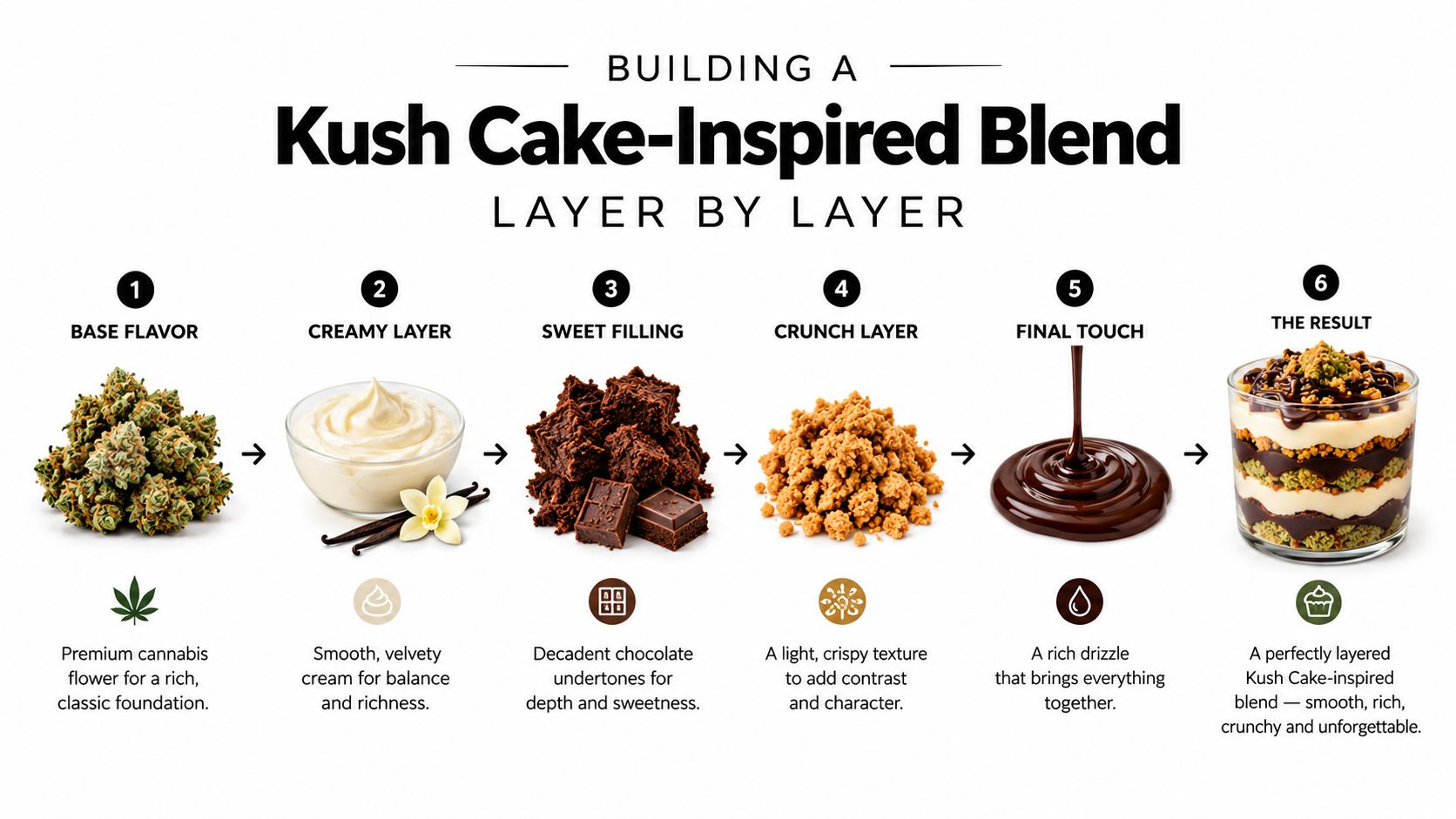
Build the blend in three layers, then adjust the balance rather than chasing a single “magic” terpene. A workable starting architecture is 35% caryophyllene, 18% limonene, 10% linalool, 8% myrcene, with the remaining 29% distributed among humulene, pinene, bisabolol, ocimene, and any approved supporting materials after sensory testing.
Start with the backbone
The middle and base should be assembled first because caryophyllene, myrcene, humulene, and bisabolol determine whether the profile feels like kush or just like dessert.
- Mid layer: Use caryophyllene as the anchor, with humulene providing dry herbal tension.
- Base layer: Add myrcene for earthy persistence and bisabolol for a softer floral landing.
- Trace depth: Use ocimene sparingly. It can brighten the blend, but excess volatility can make the profile feel thin.
Then add limonene and linalool. Limonene should lift the opening, while linalool should connect the citrus top to the creamy and floral middle. If the result smells like lemon cleaner, reduce the top note before adding more sweetness.
Gold Coast Terpenes lists 37 Strains and an Elevated Strains line as starting points for teams that need a profile family rather than isolated compounds. A formulator comparing dessert directions may also review Elevated Strains as a catalog reference, without treating it as a direct Kush Cake match.
Mix in a controlled sequence
- Combine the heavier backbone materials first.
- Add the floral and citrus components after the base is uniform.
- Dilute the concentrate into the carrier or distillate gradually.
- Shake gently until the oil is visually consistent.
- Allow the blend to rest before making a final sensory decision.
Use the carrier system approved for the intended product and confirm compatibility with the extract and hardware. Don't add PG, VG, PEG, or MCT solely to correct viscosity unless the product specification and regulatory pathway explicitly permit it. Gold Coast Terpenes positions its terpene materials as THC-free and free of those carriers, but every production team still needs current documentation for the exact material purchased.
A short rest can help the aroma settle, but long uncontrolled steeping can mute volatile top notes. Compare fresh, rested, and vaped samples using the same hardware, voltage, airflow, and fill conditions. The terpene blend guide can support that documentation process.
Loading Terpenes Into Distillate and Vape Cartridges
Terpene loading should be calculated by final batch weight, not by the starting distillate weight. For a target load of L%, the terpene mass is calculated as final batch mass × L, and the distillate mass is final batch mass minus terpene mass.
For a 100 g final batch:
- 2% load: 2 g terpenes plus 98 g distillate.
- 4% load: 4 g terpenes plus 96 g distillate.
- 6% load: 6 g terpenes plus 94 g distillate.
- 8% load: 8 g terpenes plus 92 g distillate.
- 10% load: 10 g terpenes plus 90 g distillate.
For a 1 kg final batch, the same math becomes 20 g, 40 g, 60 g, 80 g, or 100 g of terpene blend, with the balance made up by distillate. A common production error is adding a percentage of the starting distillate and then calling the resulting total a finished-batch percentage. That creates a different load and can distort both flavor and viscosity.
Load level comparison
| Load Level | Flavor Intensity | Vapor Production | Hardware Risk | Recommended Use |
|---|---|---|---|---|
| 2% | Light | Low change | Lower | Early sensory screening |
| 4% | Noticeable | Moderate change | Moderate | Balanced R&D starting point |
| 6% | Strong | More fluid vapor behavior | Increased | Confirmed profile trials |
| 8% | Very strong | Higher vapor output | Higher | Hardware-specific validation |
| 10% | Aggressive | Maximum listed test range | Highest | Only with documented compatibility |
The table is a development framework, not a universal release specification. Higher terpene loading can reduce viscosity and alter wicking, leakage behavior, coil temperature, and perceived harshness. Test the blend in the exact cartridge, fill temperature, storage conditions, and operating profile intended for sale.
Keep the math and documentation separate
Record the terpene blend as its own material with a lot number, COA, allergen information where applicable, and intended-use documentation. Gold Coast Terpenes describes its materials as lab-tested and THC-free, but a buyer should verify the current COA for each batch rather than relying on a general catalog statement.
The distillate mixing guide can help teams document batch calculations. For a first Kush Cake rebuild, begin with a restrained load, compare the output to the flower reference, then increase only when the hardware and sensory panel support the change.
Botanical Versus Cannabis-Derived Labeling Choices
Botanical terpenes offer supply consistency and a simpler non-cannabis ingredient story, while cannabis-derived terpenes can provide closer alignment to a specific extract lot. Nature-identical isolates can help reduce cost and improve repeatability, but the label and claim language must match the actual sourcing and jurisdiction.
The three sourcing routes
| Route | Strength | Trade-off |
|---|---|---|
| Botanical-derived | Stable sourcing and a clear botanical ingredient pathway | May require more blending to reproduce a particular flower lot |
| Cannabis-derived | Can preserve aroma nuances from cannabis biomass | More variable supply, documentation, and lot-specific character |
| Nature-identical | Precise control over selected molecules | May feel less rounded if the formula relies on too few components |
Gold Coast Terpenes' positioning centers on 100% botanically derived terpene blends, rather than cannabis-derived material. That can work well for a brand that wants to describe botanical terpenes or natural flavors, subject to the requirements of the applicable state, federal, or Canadian framework. Don't use “cannabis-derived” language for a botanical formula, and don't assume that “natural” is acceptable everywhere without a compliance review.
Flavor fidelity depends on the formula, not only on source category. A botanical blend can reproduce the main caryophyllene, limonene, linalool, and myrcene structure effectively, while a cannabis-derived input may contribute minor compounds that make a particular lot feel more authentic. Nature-identical materials can close specific gaps economically, but a high-volume SKU still needs finished-product sensory checks because a mathematically accurate ingredient list can taste unbalanced after heating.
Label and procurement checks
Before approving a supplier, confirm:
- Source statement: Botanical, cannabis-derived, or nature-identical inputs must be identified accurately.
- COA coverage: Documentation should match the exact lot and material.
- Carrier status: Verify that no unapproved diluents have entered the formula.
- Allergen review: Check the finished blend and all component documentation.
- Batch consistency: Compare aroma and analytical specifications across lots.
- Claim review: Keep effect language out of medical territory and align flavor claims with the actual sensory result.
Positioning Kush Cake Effects in a Product Lineup
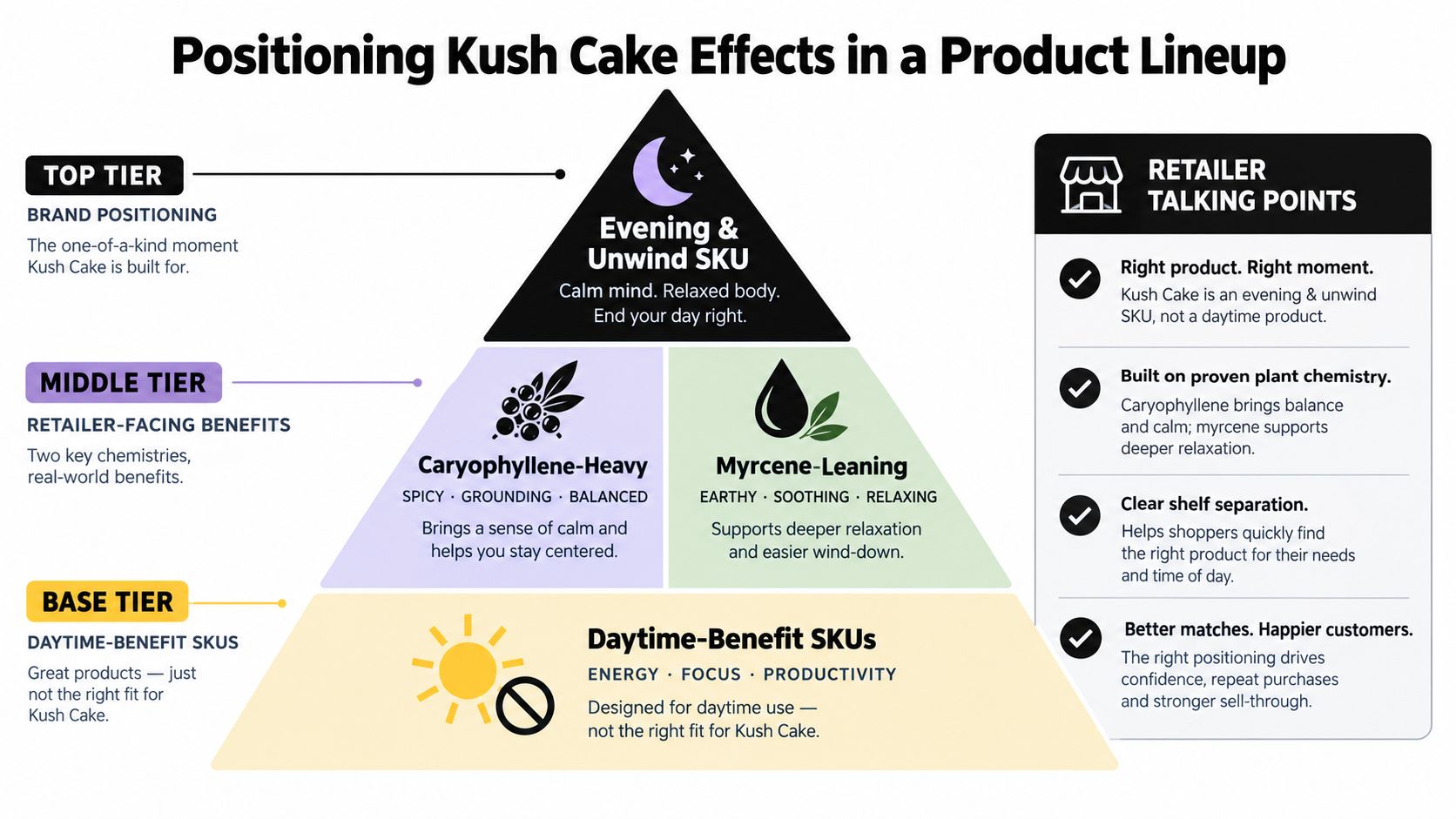
Kush Cake is strongest as an evening and unwind SKU, not as a focus or daytime product. Its caryophyllene-led, myrcene-supported structure translates more naturally into language about grounded relaxation, dessert richness, and late-day use than into claims about productivity or creativity.
The positioning should reflect tolerance and dose without making medical promises. Existing consumer descriptions vary between relaxed, euphoric, sleepy, and uplifting, and one consumer reference specifically notes that lighter-tolerance users may experience heavier effects while moderate-to-high-tolerance users may remain more functional for longer (Kush Cake effect reference).
Place it between two clear SKU roles
A simple three-part lineup can make Kush Cake easier for retailers and customers to understand:
- Morning or daytime: Bright, sharper profiles with lighter earthy weight.
- Late afternoon and evening: Kush Cake, with pepper, citrus, mint, and dessert depth.
- Nighttime: Heavier profiles designed around a more pronounced sedative-style sensory narrative.
The middle position is important. Kush Cake doesn't need to be marketed as a bedtime-only cart, but calling it a focus strain creates a mismatch between the caryophyllene-heavy profile and the buyer's expectation. “Dessert kush for the evening wind-down” is more defensible than “creative energy” or “all-day clarity.”
Translate effects without medical claims
Use sensory and situational language:
- Retailer-facing: “A peppery dessert profile with citrus lift and a grounded finish.”
- Brand-facing: “Designed for late-day sessions and relaxed settings.”
- Packaging-facing: “Vanilla, mint, citrus, and warm spice.”
- Avoid: Claims that the product treats pain, anxiety, insomnia, or other conditions.
The same oil can feel heavier for a new or low-tolerance consumer and more functional for an experienced consumer, so dose guidance and responsible-use language should remain separate from the flavor story. Keep the SKU's identity anchored in aroma, timing, and setting.
Formulation Checklist and Frequently Asked Questions
Before production, a Kush Cake-inspired cart should pass six checks: lineage brief, ratio lock, layered blend review, batch math, label verification, and SKU positioning. Gold Coast Terpenes can be evaluated as one botanical-sourced option, while its mixing calculator and bulk programs can support scaling after the formula and documentation are approved.
Production handoff checklist
- Lineage: Record whether the target is Wedding Cake and Kush Mints, LA Kush Cake, Detroit Kush Cake, or a specific flower lot.
- Ratio: Lock the caryophyllene-led architecture before adjusting minor compounds.
- Layering: Confirm that citrus is an opening note, pepper is present through the middle, and myrcene supports the finish.
- Math: Calculate terpene mass against final batch weight, then reconcile the actual filled mass.
- Hardware: Test viscosity, wicking, leakage, vapor, and flavor in the production cartridge.
- Documentation: Match the COA, source statement, allergen review, and label language to the exact material.
- Positioning: Keep the product in an evening and unwind lane, without medical or guaranteed-effect claims.
B2B FAQ
What should a first Kush Cake rebuild prioritize?
Start with beta-caryophyllene, limonene, linalool, and myrcene because those compounds carry the recognizable pepper, citrus, floral, and earthy structure. Gold Coast Terpenes offers both strain-style blends and isolated compounds, which lets a development team compare a prepared profile against a custom rebuild.
Are botanical terpenes less accurate than cannabis-derived terpenes?
Not automatically. Cannabis-derived inputs may preserve lot-specific nuance, while botanical materials can provide more predictable sourcing and repeatability. The finished cart, not the source label alone, determines whether the sensory match works.
How should nature-identical blends be positioned?
Use accurate ingredient and sourcing language, and have regulatory counsel review the label for the destination market. Don't describe a nature-identical or botanical formula as cannabis-derived, and don't make therapeutic claims based on terpene composition.
What load should a new formulator test first?
Use a restrained development load and compare several levels rather than assuming the highest load will taste best. For example, the 2% and 4% levels in the comparison table provide low and moderate screening points, but cartridge compatibility and final sensory output must determine the release specification.
What documentation should a terpene supplier provide?
Request a current COA, source information, safety documentation, allergen information where applicable, and clear details on carriers and intended use. Gold Coast Terpenes describes its terpene products as THC-free and free of VG, PG, PEG, and MCT, but the exact purchased lot should still be verified before production.
Gold Coast Terpenes offers botanical strain profiles, isolated compounds, formulation education, and tools for scaling terpene loads into distillate and cartridges. Use the Gold Coast Terpenes catalog to compare a prepared dessert profile with a caryophyllene-led Kush Cake rebuild, then request the documentation and bulk support your production process requires.