
Most SFV OG Kush replication attempts fail for a simple reason: they chase myrcene and call the result “OG.” The more useful target is the limonene, caryophyllene, and pinene balance that gives this cultivar its citrus-fuel-pine identity. Gold Coast Terpenes supplies 100% botanically derived terpene blends, and that distinction matters when a formulator is building a repeatable, strain-inspired profile for distillate or vape cartridges rather than making a generic earthy flavor.
SFV OG Kush is an indica-dominant hybrid associated with the OG Kush family and a cross of OG Kush and Afghani. The Cali Connection pushed the phenotype into the market, and independent strain records associate it with a first-place High Times Medical Cup win in Denver and a third-place High Times Amsterdam Awards result in the Indica category in 2012 (SeedFinder's SFV OG Kush record). Those awards help explain why the name still carries commercial recognition, but formulation accuracy depends on chemistry, matrix, hardware, and dosing discipline.
Why SFV OG Kush Belongs in a Formulator's Library
SFV OG Kush belongs in a formulator's library because its recognizable profile has more structure than the broad “OG” label suggests. A reliable strain-inspired terpene blend for SFV OG Kush should open with lemon and pine, develop into peppered fuel, and finish with restrained earth rather than turning into a dense myrcene cloud.
The commercial reference point is also strong. Modern guides commonly place SFV OG Kush around 18% to 26% THC, with some phenotypes or tightly controlled grows reaching 27% to 28% or higher (strain data for SFV OG). That range isn't a formulation specification, but it helps explain why brands use the cultivar name for strong-effect products and why a thin, generic aroma can make a high-potency oil feel disconnected from its intended identity.
Start with the sensory anchor
Treat the profile as a three-part signal:
- Front pull: Lemon peel, bright citrus, and fresh pine.
- Core: Pepper, resin, and fuel.
- Finish: Kush earth, soft floral depth, and a controlled musk.
The first mistake is building from a generic OG base and adding a little lemon. That usually leaves the product smelling sweet, muddy, and interchangeable. The better method is to establish the citrus-pine entry first, then add enough caryophyllene-led spice to make the fuel note credible.
Gold Coast Terpenes offers strain-specific profiles, isolated compounds, and formulation resources that can support this type of adjustment. Its catalog includes botanical, THC-free blends and isolates such as limonene, myrcene, and beta-caryophyllene, allowing a development team to correct a batch without changing the entire flavor system.
Practical rule: If the first pull smells earthy but not bright, don't add more myrcene. Rebuild the top note and check the caryophyllene balance before increasing total load.
SFV OG Kush has a useful place beside heavier OG, Afghan, and dessert profiles because it can occupy the space between dense relaxation and bright aromatic impact. That makes it commercially practical for cartridge brands that need a familiar Kush name but don't want every SKU to taste like the same dark, sweet base.
The Terpene Profile That Defines SFV OG Kush
The defining SFV OG Kush profile is not myrcene alone. Available references consistently identify myrcene, limonene, and caryophyllene as major contributors, with one analysis placing limonene around 0.6% to 0.9%, myrcene around 0.3% to 0.7%, and caryophyllene around 0.4% to 0.6% (Prime Cuts Nursery's SFV OG profile). Those values describe independent strain data, not a universal specification for every batch.
Build the aroma in layers
For formulating SFV OG Kush for vape cartridges, use the note order below as a sensory framework. The ranges in the table are the commonly reported reference ranges supplied for SFV OG analysis, not guaranteed finished-oil targets.
| Note Layer | Primary Compounds | Indicative Range | Sensory Role |
|---|---|---|---|
| Top | Limonene, pinene | Limonene 0.6% to 0.9%, pinene reported among the supporting terpenes | Lemon peel, pine lift, sharper opening |
| Mid | Caryophyllene, humulene | Caryophyllene 0.4% to 0.6%, humulene as a supporting constituent | Pepper, resin, fuel, dry spice |
| Base | Myrcene, linalool, camphene, minor constituents | Myrcene 0.3% to 0.7%, with linalool and other minor terpenes reported | Earth, kush depth, soft floral finish |
The top note controls recognition during the first inhale. Limonene provides the citrus brightness, while pinene contributes a green, resinous lift. The exact pinene fraction varies across phenotypes, so a botanical reconstruction should be judged by aroma and vapor behavior rather than by forcing every batch into one fixed ratio.
The mid note gives the profile its authority. Caryophyllene brings pepper and dry spice, but it also supports the fuel impression that consumers and product teams associate with a convincing OG profile. Humulene can add herbal depth, though too much can make the cart taste woody or hoppy.
Myrcene belongs in the base, not at the steering wheel. A myrcene-heavy blend may smell earthy in the bottle, yet it often produces a flat first pull and a thick, indistinct finish after dilution. The better target is a visible citrus entry followed by caryophyllene-led fuel and enough myrcene to keep the profile grounded.
Why pull order changes the judgment
Cartridge flavor isn't static. Volatile top notes tend to announce themselves early, while heavier spice and earth persist longer in the vapor path and on the finish. A blend can therefore pass a bottle evaluation but fail after repeated pulls if limonene dominates the opening and the base collapses into musk.
For a useful bench evaluation, assess the first pull for lemon and pine, the middle pull for fuel and pepper, and the third pull for lingering earth, sweetness, and harshness. This approach catches the common failure mode where a profile smells accurate before filling but loses its structure once hardware, heat, and dilution enter the system. Gold Coast Terpenes also publishes terpene profile guidance for formulators that can help teams document these sensory layers consistently.
Flower Ranges vs Concentrate Ranges for SFV OG Kush
Flower data shouldn't be used as a direct cart flavor target. Published summaries place well-cultivated SFV OG Kush flower in a broad 1.5% to 3.0% total-terpene window, while individual reference ranges include myrcene around 0.2% to 1.0%, limonene around 0.15% to 0.8%, and beta-caryophyllene around 0.1% to 0.6% (SFV OG terpene guide).
The important issue isn't just total terpene content. Curing, extraction, winterization, evaporation, carrier dilution, and hardware all change which notes remain perceptually dominant. Pinene and other lighter aromatic constituents can be less persistent, while caryophyllene and related heavier compounds may carry more influence in a concentrated matrix.
Use the matrix, not the myth
The following table is a practical comparison framework. Where the verified data doesn't provide a separate live resin or redosed distillate number, the appropriate target is qualitative rather than invented.
| Compound | Flower Range | Live Resin Range | Distillate, Re-dosed Target |
|---|---|---|---|
| Limonene | 0.15% to 0.8% | Matrix-dependent, often brighter when preserved well | Restore a clear citrus opening without masking fuel |
| Myrcene | 0.2% to 1.0% | Can become prominent in earthy fractions | Keep restrained enough to avoid a flat musk profile |
| Beta-caryophyllene | 0.1% to 0.6% | Can read strongly in resin and concentrate systems | Use for pepper and fuel structure |
| Pinene | Reported as a supporting constituent | Volatile and process-sensitive | Add only to the point where pine lifts the entry |
| Humulene | Supporting constituent | Matrix-dependent | Use for depth, not as the main identity |
A live resin reference may preserve more of the cultivar's native complexity, but it also brings its own aromatic background. A redosed distillate gives you more control, yet it can sound artificial if the top, middle, and base notes aren't balanced.
A flower GC panel tells you what was present in that sample. It doesn't tell you exactly what a cartridge will communicate after processing and dilution.
For product teams, this distinction determines how to set a strain-inspired terpene blend for distillate. Use flower data to understand the source identity, then use concentrate behavior and filled-cartridge evaluations to set the commercial target. A broader resource on high-terpene strains and formulation context can support that comparison without replacing your own batch testing.
Formulating SFV OG Kush for Distillate and Live Resin Carts
For distillate, start with a 1% to 3% total terpene addition rate, and treat 4% as the maximum stated by the product-facing formulation reference (SFV OG terpene blend guidance). The correct point inside that window depends on viscosity, native aroma, desired intensity, and hardware.
Thin distillate can often tolerate the upper part of the working range, while a thick fraction may perform better around 1.5% to 2.2% to protect wick uptake and avoid an overbuilt vapor profile. More terpene isn't automatically more accurate. Above the sensory requirement, limonene can become sharp and solvent-like, while caryophyllene can make the finish dry and peppery.
Match the load to the matrix
| Matrix | Target Load % | Range % | Hardware Note | Flavor Outcome |
|---|---|---|---|---|
| Distillate | Start near the middle of the working window | 1% to 3% | Viscosity affects uptake and heating | Controlled citrus-fuel profile |
| Live resin | Preserve native aroma first | 0.5% to 1.5% added blend | Sauce and resin vary by batch | Steered SFV OG character without erasing source notes |
| Rosin | Use a gentler addition | 0.75% to 1.5% | Heat-sensitive matrix needs restraint | Softer correction with less risk of aroma overload |
For live resin, first lock the native terpene background. Add the SFV OG blend only after you know whether the resin already supplies citrus, pine, pepper, or earth. The purpose is steering, not replacing.
Rosin requires similar restraint. Heat-driven degradation products and native aromatic compounds already occupy part of the flavor budget, so a heavy addition can make the cartridge taste hot, sharp, or overly engineered.
Use a controlled addition sequence
- Warm the terpene blend to 40°C so it moves consistently.
- Warm the distillate separately and add the blend under steady stirring.
- Mix until the batch looks uniform, then let it sit for 24 hours before filling.
- Fill a small hardware set and evaluate the first, middle, and later pulls.
- Record viscosity, leakage, vapor smoothness, aroma intensity, and finish.
Hardware can change the result more than expected. A 2.0Ω ceramic device won't present limonene-heavy top notes the same way as a 1.0Ω mesh device. Mesh may push the opening harder and expose sharpness sooner, while ceramic can produce a slower, rounder delivery that emphasizes the mid and base notes.
The distillate terpene formulation guide is useful for building a repeatable bench process, but every brand should validate the blend in its own oil and hardware. Track the actual product, not just the liquid in the mixing vessel.
How the SFV OG Kush Profile Translates Into Effects
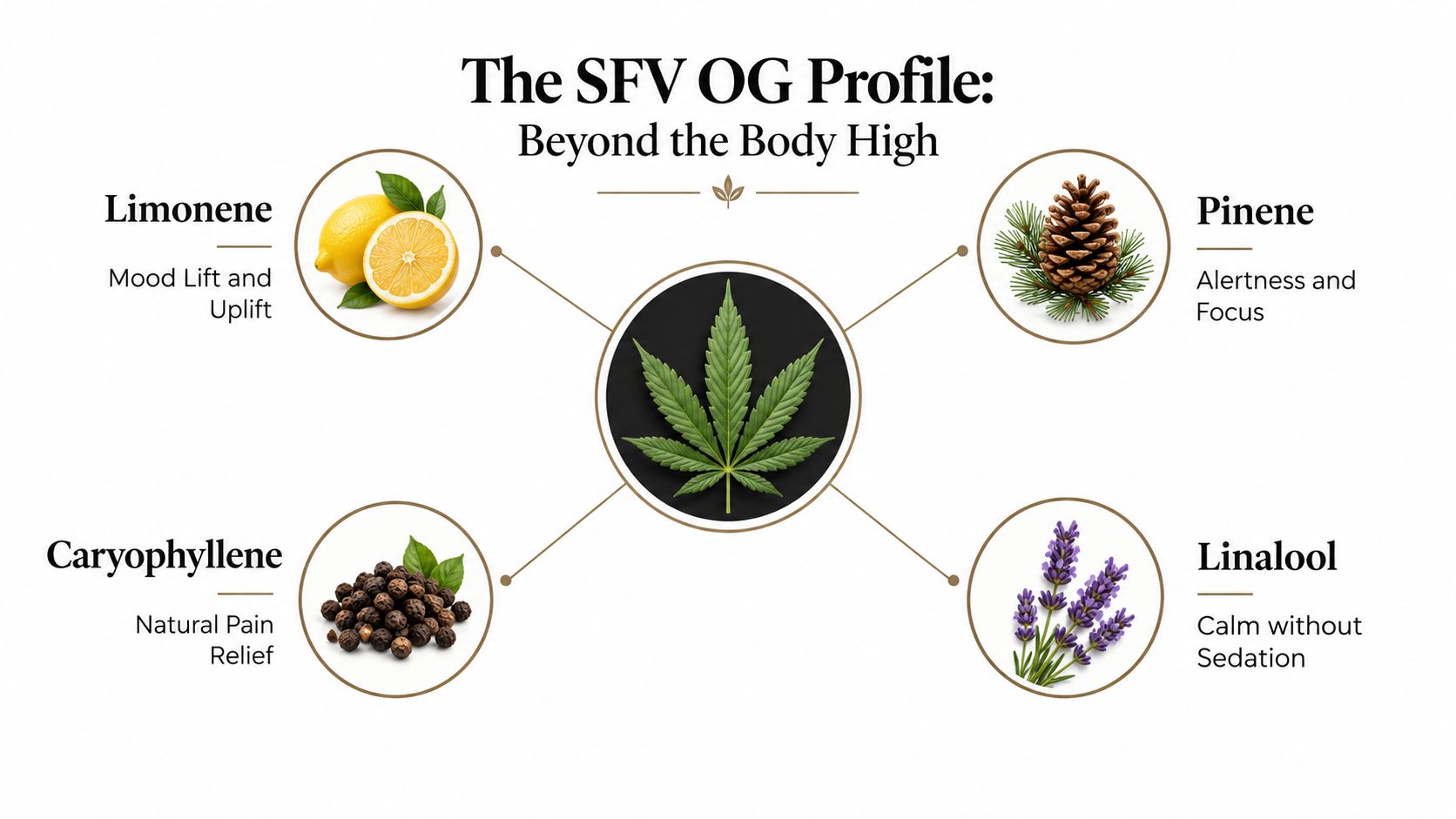
SFV OG Kush shouldn't be positioned as automatically body-heavy. Its reported chemistry includes limonene, myrcene, caryophyllene, pinene, linalool, camphene, and related minor terpenes (Leafly's SFV OG reference), so the perceived direction can shift with phenotype, processing, product type, and the balance between bright and grounding compounds.
Limonene and pinene can make a cartridge feel brighter at the beginning of the experience, while caryophyllene, myrcene, and linalool contribute a slower, more settled impression. That isn't a medical claim, and it doesn't mean an individual terpene produces THC-like psychoactivity. It means the aromatic profile can influence how users describe the product's character.
Formulation changes the narrative
A blend weighted toward limonene and pinene generally creates a faster, more lifted flavor impression. A blend weighted toward caryophyllene and humulene reads darker, drier, and heavier. Neither is automatically correct. The right balance depends on whether the product is meant to represent a bright flower reference, a dense resin, or a bold legacy OG profile.
Phenotype and cure can shift the alpha-pinene-to-mycene relationship enough to change panel feedback. Concentrate format adds another variable because extraction can amplify some constituents and reduce others. That's why a brand shouldn't copy a recreational description and assume the same effect language will transfer to every cart.
A balanced SFV OG formulation aims for the middle ground. The opening should feel distinct and energetic in aroma, while the finish retains the resinous, peppered Kush identity. Gold Coast Terpenes' OG Kush strain-effects resource provides additional context for teams comparing adjacent OG profiles.
A short sensory education video can help align product, sales, and quality teams before they score samples.
A Practical Flavor-Matching Workflow for SFV OG Kush
A representative rework began with a generic Kush blend that leaned heavily on myrcene and beta-caryophyllene. The first cart smelled earthy, slightly sweet, and flat, so the panel described it as generic rather than recognizably SFV OG.
The failed-cart GC-MS result showed 6.8% myrcene, under 1% limonene, and traces of valencene. The target reference showed 2.4% limonene and alpha-pinene near 0.9%. Those figures belong to this representative development scenario, not to a universal SFV OG specification.
Rebuild the missing front pull
The rework used a 60/40 split between the existing generic blend and a botanical SFV OG blend focused on top-note reconstruction, with the batch initially dialed to a 2.2% total load. The goal wasn't to remove the Kush foundation. It was to make the lemon and pine arrive before the earthy base took over.
The panel scored four attributes:
- Aroma intensity: How clearly the profile presents before and during vaporization.
- Citrus-fuel authenticity: Whether lemon, resin, and fuel read as one coherent identity.
- Sweetness: Whether the blend feels clean or artificially sweet.
- Finish: Whether the final note is peppered, earthy, harsh, or muddy.
The first round reduced the myrcene impression but still left the finish too dense. The second round lowered the total load to 1.8%, producing a sharper lemon-peel entry and a cleaner gas finish.
Keep the loop measurable
This kind of adjustment works because each change has a sensory reason. The team did not just add more “SFV” flavor. It identified the missing top notes, changed the blend composition, then reduced total load after the profile became sufficiently expressive.
Batching discipline: Change one variable at a time when possible. If you alter the blend ratio, total load, and hardware together, you won't know which decision improved the result.
For a production program, retain the failed sample, the revised sample, the GC-MS output, the scoring sheet, and the fill conditions. This record becomes more valuable than a strain name because it lets the next batch begin from a known sensory baseline.
Sourcing Botanically Derived SFV OG Terpene Blends
A supplier should earn a place in your formulation workflow through documentation, consistency, and technical support, not through a colorful strain description. Gold Coast Terpenes is one supplier option with botanically derived, THC-free terpene blends, isolated compounds, strain-specific profiles, and educational tools such as a mixing calculator and safety documents.
Check the five procurement points
| Evaluation Criterion | What to Verify | Acceptance Threshold | Red Flag |
|---|---|---|---|
| Documentation | Current COA and contaminant screening | Batch-specific records are available | Vague or missing documentation |
| Source identity | Botanical versus cannabis-derived labeling | Source is stated clearly on product and technical documents | “Natural” used without clarification |
| Consistency | GC-MS chromatograms across lots | Profile remains aligned with the approved reference | No lot comparison |
| Carrier system | PG, MCT, or strain-specific diluent details | Carrier won't mask citrus and fuel notes | Unclear carrier or unexplained additives |
| Technical support | Load-rate and hardware troubleshooting | Supplier can discuss formulation variables | Sales-only communication |
The verified formulation reference describes liquid SFV OG terpene blends as 100% aroma and gives a commonly recommended addition rate of 1% to 3%, with a 4% maximum. Confirm that any supplier's own documentation, labeling, and intended use align with your jurisdiction and product category before production.
Sample before you scale
Start with a small sample, such as 15 mL, then validate the material in a 100 g distillate bench batch before committing to scale-up. Test aroma intensity, vapor smoothness, oil stability, and hardware compatibility across three cart models. Those quantities are practical development checkpoints, not guarantees of commercial performance.
Botanical and cannabis-derived terpenes also need separate labeling and compliance review. A strain-inspired botanical profile must not be presented in a way that misleads buyers about cannabis origin, and the finished product must meet the rules of its target market. For shipping decisions that involve hemp and marijuana distinctions, review how Ship Restrict handles cannabis products alongside your legal and logistics advice.
Gold Coast Terpenes lists classic and contemporary profiles, including OG-related options, plus isolates and formulation tools. Product teams should still request the current COA, verify the exact lot, confirm carrier details, and test the material in the intended cartridge before approving a purchase order.
FAQ
What makes an SFV OG Kush terpene profile different from a generic OG blend?
A credible SFV OG target gives limonene and pine enough presence to create a bright opening, then uses caryophyllene and restrained myrcene for fuel and Kush depth. Gold Coast Terpenes offers strain-specific botanical profiles and isolates that can support this type of adjustment.
Should formulators use flower terpene data to set cart targets?
Flower data is useful for understanding the source identity, but cartridge targets should be validated in the concentrate matrix and hardware being sold. Processing, dilution, and heat can change the perceived balance substantially.
What load rate works for SFV OG in distillate?
The verified formulation reference gives a working addition range of 1% to 3%, with 4% as the maximum. Gold Coast Terpenes customers should still validate the exact blend in their oil, viscosity, filling process, and cartridge hardware.
Are botanical terpenes the same as cannabis-derived terpenes?
No. Botanical terpenes are sourced from plants other than cannabis, while cannabis-derived terpenes come from cannabis material. Product labels and technical documents should state the source clearly, and Gold Coast Terpenes identifies its relevant blends as botanically derived.
How should a brand choose a terpene supplier for vape cartridges?
Start with current batch documentation, source transparency, GC-MS consistency, carrier information, and technical support. A supplier such as Gold Coast Terpenes can be evaluated on those same criteria, but the brand should approve each lot through its own bench and hardware testing.
Gold Coast Terpenes offers botanical SFV OG and OG-inspired terpene options, isolated compounds, formulation tools, and documentation for cartridge and concentrate development. Visit Gold Coast Terpenes to review the available profiles, request a suitable sample, and build your next SFV OG batch around a measured citrus-fuel target rather than a myrcene-heavy shortcut.