
You're at the bench with a daytime cartridge brief, a familiar strain profile on one side, and a client asking for “creative energy” without the jittery edge of a straight sativa copy. A strain replication may reproduce the expected citrus, pine, or floral character, but it doesn't automatically solve the cognitive job the SKU is supposed to serve.
For product developers, terpenes for creativity work better as a formulation problem than as a strain recommendation. The useful questions are operational: does the blend support open ideation, sustained attention, or calmer creative work? Can you reproduce the aroma across batches? Does the terpene load remain compatible with the distillate, hardware, and inhalation target?
The evidence demands restraint. A 2024 randomized human trial tested vaporized d-limonene at 1 mg and 5 mg and found it indistinguishable from placebo on every measured pharmacodynamic outcome, including mood, cognition, and intoxication, as summarized in this evidence review of cannabis strains and creativity. That result doesn't make limonene irrelevant. It means a prominent marketing terpene isn't the same thing as a validated creativity effect.
Why Formulators Build Creativity Profiles Instead of Just Strain Copies
A strain-inspired terpene blend starts with a sensory reference. A functional SKU starts with a user task. Those are related, but they aren't interchangeable.
A Jack Herer or Durban-style profile may communicate brightness, pine, spice, or floral lift. It can be a useful reference for aroma replication, yet the same profile may be too sharp for a user who needs relaxed ideation, too distracting for a long editing session, or too sedating when the formulation carries heavy base notes. Calling every uplifting profile “creative” compresses three different product requirements into one vague promise.
Separate the cognitive job before choosing the terpene
Treat the brief as one of three jobs:
- Divergent brainstorming: The user needs to generate possibilities, follow tangential associations, and tolerate unfinished ideas. The profile should feel open and aromatic without becoming harsh or overly stimulating.
- Sustained focus: The user needs to stay with one thread, such as editing, design production, coding, or detailed formulation work. Here, distractibility is the failure mode, so the blend should have a clear anchor and controlled top-note activity.
- Low-anxiety ideation: The user already has ideas but overthinks, second-guesses, or struggles to begin. The formula needs enough lift to initiate work, with a rounded structure that doesn't push the experience toward nervousness.
That framework changes how you evaluate a catalog profile. Instead of asking whether it feels “uplifting,” ask whether its dominant terpene, supporting notes, and cannabinoid base fit the task.
Practical rule: Replicate a strain for sensory accuracy. Build a creative-use profile for a defined workflow.
A single strain copy rarely serves all three jobs. Terpinolene-forward blends may suit open ideation but feel too diffuse for single-thread work. A pinene-heavy focus profile may sharpen the aromatic signal while offering too little softness for users whose block comes from rumination. A limonene and beta-caryophyllene balance can address that emotional edge, but it may not deliver the novelty-oriented aroma brief a brainstorming SKU requires.
The workflow is straightforward: define the task, choose a mechanism-supported anchor, assign top, mid, and base roles, set a conservative loading target, then validate the finished oil through analytical and sensory testing. That's product design, not terpene folklore.
The Five Terpenes Behind Most Creativity Claims
Five names dominate commercial conversations around a terpene profile for creativity: limonene, alpha-pinene, beta-caryophyllene, terpinolene, and ocimene. Linalool belongs in the same discussion as a balancing note, particularly when the product brief includes users who are sensitive to an anxious or overly sharp sensory profile.
The evidence is uneven. The 2020 review of forest volatile organic compounds describes possible effects involving mental fatigue, relaxation, mood, and cognitive performance, while emphasizing that the exposure environment and formulation matter, not terpene identity alone. That distinction is central for formulators, because an isolated compound in a cartridge isn't equivalent to a forest environment or an essential-oil protocol.
Candidate roles and evidence limits
Limonene brings a bright citrus top note and is commonly assigned a mood-lift role. Mechanistic discussions often connect it with dopamine and mood modulation, but the controlled human evidence doesn't establish a direct creativity effect. The 2024 vaporized d-limonene trial, using 1 mg and 5 mg, found no difference from placebo across measured pharmacodynamic outcomes, so limonene should be positioned as an aromatic and formulation component, not a proven acute creativity agent. See this terpene effects guide when separating sensory descriptors from effect language.
Alpha-pinene supplies a sharp pine character and is often assigned to alertness and focus. The mechanism most often discussed is acetylcholinesterase inhibition, but much of the relevant evidence is mechanistic, animal-based, or indirect. Its practical job is clearer than its claim language: use it as a focus anchor when the target is a clean, single-thread aroma.
Beta-caryophyllene contributes pepper, spice, and body to a blend. Its interaction with CB2 and stress signalling makes it a plausible grounding component, yet that plausibility shouldn't become a medical or guaranteed anti-anxiety claim. In a low-anxiety ideation profile, it works as a mid or base-supporting note that can keep bright materials from reading thin.
Terpinolene has a complex floral, woody, and citrus profile. Formulators commonly place it in brainstorming-oriented blends because it can create novelty and aromatic movement, but the evidence doesn't validate it as a reliable creativity enhancer. It's best treated as a characterful top or top-mid material whose intensity must be controlled.
Ocimene gives an airy, sweet, herbal lift. Its role is usually an accent rather than an anchor. Human inhalation evidence is sparse, and interactions with THC remain insufficiently characterized for strong functional claims.
Linalool is the counter-balance. Its floral softness can round an aggressive top-note architecture, although too much can move the profile toward a heavier, less suitable direction for daytime creative work.
| Terpene | Plausible Mechanism | Evidence Strength | Aroma Role | Best Formulation Job |
|---|---|---|---|---|
| Limonene | Mood and dopamine-related modulation | Human creativity evidence is not established | Bright top note | Mood-oriented lift and citrus framing |
| Alpha-pinene | Acetylcholinesterase-related alertness pathway | Mostly mechanistic and indirect | Sharp top note | Focus anchor |
| Beta-caryophyllene | CB2 interaction and stress signalling | Mechanistic, with limited direct creativity evidence | Peppery mid or base support | Low-anxiety balance |
| Terpinolene | Arousal and sensory novelty hypothesis | Sparse direct human evidence | Floral, woody top or top-mid | Divergent brainstorming character |
| Ocimene | Uplifting aromatic lift hypothesis | Sparse human evidence | Airy top-note accent | Lightness and aromatic expansion |
A practical blend still needs structure. Formulation charts commonly assign limonene, pinene, and terpinolene to top notes, beta-caryophyllene to a mid role, and linalool to a base or base-mid role. The top, mid, and base model describes volatility and how the aroma unfolds, not a guaranteed pharmacological sequence.
Matching Three Creative Tasks to the Right Blend
The same terpene can serve different jobs at different concentrations and in different aromatic structures. A product developer should therefore match the blend to the task first, then adjust for flavor accuracy, cannabinoid base, viscosity, and hardware behavior.
The table below gives starting ratios for screening work. These are development ratios, not validated effect doses. Keep the pilot sensory-led and analytical, and treat any functional language as a product hypothesis until controlled testing supports it.
| Profile | Cognitive Job | Dominant Terpene | Supporting Terpenes | Starting Ratio (Dominant/Support/Modulator) |
|---|---|---|---|---|
| Divergent brainstorming | Open ideation and associative exploration | Terpinolene | Ocimene and limonene | 50% / 35% / 15% |
| Sustained focus | Single-thread attention and reduced distractibility | Alpha-pinene | Limonene and beta-caryophyllene | 50% / 35% / 15% |
| Low-anxiety ideation | Creative initiation without an overly sharp profile | Limonene | Beta-caryophyllene and trace linalool | 45% / 40% / 15% |
Profile A, divergent brainstorming
Make terpinolene the anchor when the brief calls for an open, exploratory character. Ocimene provides lift around the edges, while limonene keeps the top from becoming too herbal or flat. A softer top-note presentation matters here. If the first inhale is too piercing, it can make the product feel stimulating rather than spacious.
The ratio should be adjusted against the distillate's native flavor. A clean neutral base can carry more aromatic movement, while a strongly flavored extract may need less ocimene to avoid a crowded finish.
Profile B, sustained focus
Pinene leads this build because the sensory signal is direct and recognizable. Limonene supports brightness, while beta-caryophyllene remains restrained so the blend doesn't acquire unnecessary weight. Pinene is the anchor, limonene the accent, and caryophyllene the stabilizer.
This profile is not a promise of improved cognition. It's a formulation choice for a clear, pine-led sensory experience aligned with a focus-oriented brief.
Profile C, low-anxiety ideation
Limonene and beta-caryophyllene share the center of gravity. Pull terpinolene back, then use linalool as a rounding modulator rather than a defining note. The aim is a less brittle profile for users whose creative block comes from rumination instead of low energy.
The worked example that follows belongs to the divergent brainstorming profile, with terpinolene as the top-note driver and a limonene and beta-pinene mid-note carrier. Its structure uses the 30/50/20 framework as a blending architecture, not as evidence of a cognitive outcome.
Building a 30/50/20 Distillate Blend Step by Step
The 30/50/20 model gives the blend a practical aromatic skeleton. Top notes arrive first and fade quickly, mid notes form the heart, and base notes provide persistence. A formulation chart lists limonene at 0.5% to 2.5% and linalool at 0.2% to 1.5% as example starting ranges, but those ranges should be treated as development references, not universal targets. See this guide to mixing distillate with terpenes before translating a bench test into production.
For a 1 kg distillate batch targeting a 7% terpene load, the arithmetic is:
- Total terpene blend: 700 g
- Distillate: 1,000 g
- Finished batch target: 1,700 g before process loss
- Top-note portion at 35%: 245 g terpinolene
- Mid-note portion at 50%: 350 g total, split between limonene and beta-pinene
- Base-note portion at 15%: 105 g linalool
The exact 30/50/20 structure is a common blending framework, while the 35/50/15 split above is the worked profile for this divergent brainstorming example. It keeps the top note prominent, gives the mid-note carrier enough body, and limits the floral base so the finished cartridge doesn't become heavy.
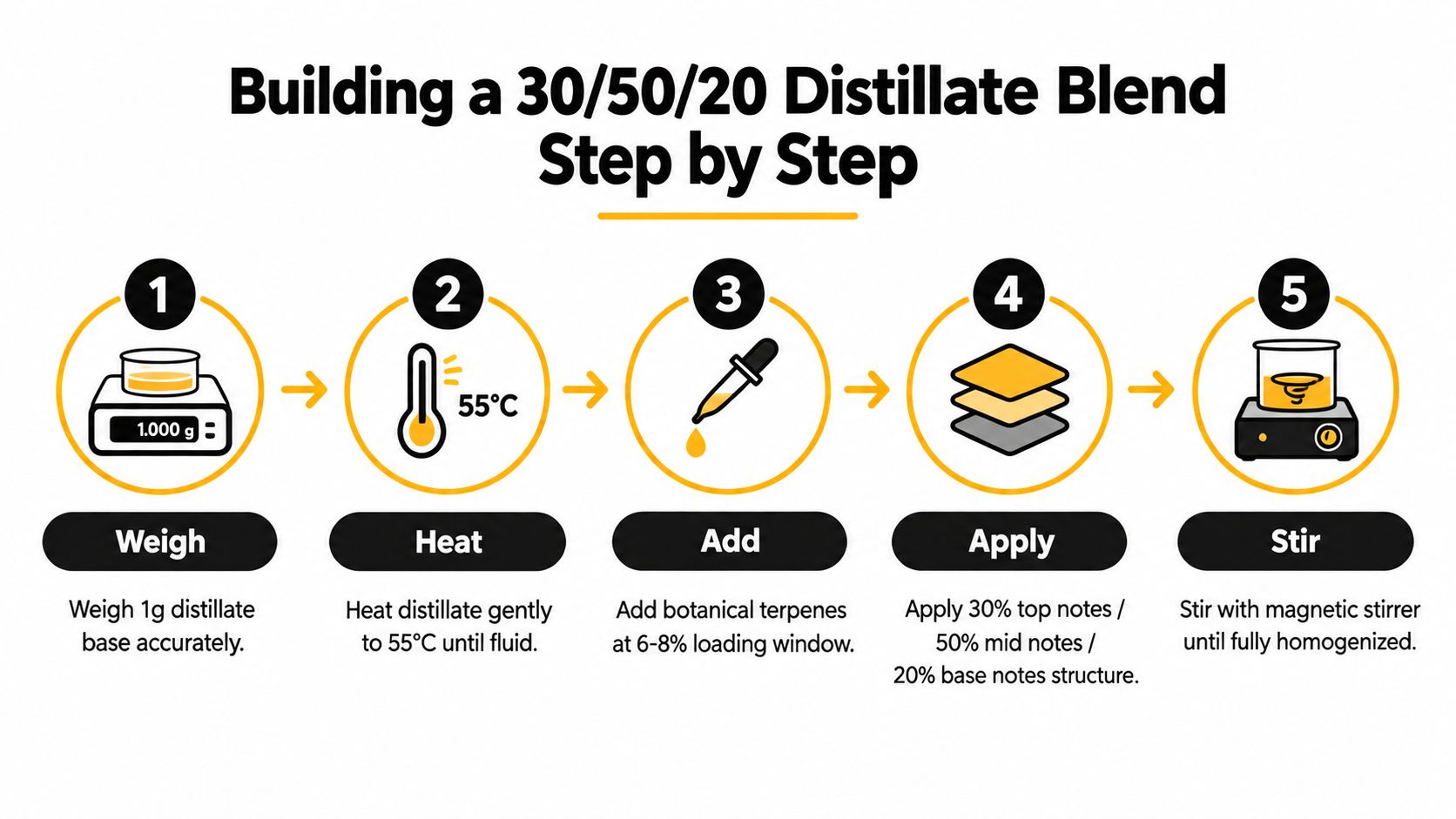
Bench workflow
- Weigh the distillate. Confirm the batch mass with a calibrated balance and record the lot identity. For a cartridge-scale screening run, use a separate test mass rather than scaling directly from volume.
- Heat gently to 55°C. Bring the distillate to 55°C until it becomes fluid. Avoid uncontrolled heat exposure, which can alter aroma and complicate repeatability.
- Add the terpene blend. The requested development window is 6% to 8% total terpenes. Add the pre-weighed blend slowly while mixing.
- Apply the note structure. Keep the top, mid, and base allocations documented separately. Don't rely on a single “total terpenes” number.
- Stir for 8 minutes. Use a magnetic bar, then pull viscosity samples and inspect the oil before filling.
For a 10 g test cart, a 7% load means 0.7 g total terpenes and 9.3 g distillate. To scale that same ratio to the 1 kg distillate example, multiply the terpene mass by the ratio of the production distillate mass to the test distillate mass. If the test uses 9.3 g distillate, the scale factor is 1,000 divided by 9.3. Record the formula in grams, not drops.
A cross-check using 0.87 g/mL specific gravity converts 700 g of terpenes to approximately 805 mL. Confirm the actual density on the certificate of analysis before using volume-based dispensing, because density variation changes the mass delivered.
Sample the finished blend in triplicate for GC analysis. Hold a filled or sealed oil sample in a mason jar at 4°C for 72 hours to identify separation, haze, or phase behavior before cartridge filling. A short hold catches obvious instability. It doesn't replace longer-term stability work.
Adapting a Gold Coast Terpenes Strain Profile for a Focus SKU
A creator may begin with an existing Jack Herer or Super Lemon Haze profile because the aroma already matches the brand's sensory direction. The mistake is treating the catalog label as the final formula. Use the profile as a baseline, run a GC report, and identify which monoterpenes drive the lift in that lot.
For a focus-oriented adaptation, the lab objective is to increase the perceived clarity of the top-note structure while reducing heavy dry-back. In the worked scenario, the formulator weights the top-note materials by 1.5x, shifts terpinolene and limonene upward, pulls back myrcene and humulene, and uses minor sesquiterpenes to round the finish. That is an aroma and performance hypothesis, not proof of a cognitive effect.
Worked ratio card
The percentages below are a development card for the scenario, not a claim about the composition of a catalog product.
| Terpene | Original Jack Herer % | Focus-Adapted % | Reason for Shift |
|---|---|---|---|
| Terpinolene | 20% | 30% | Increase bright, complex top-note identity |
| Limonene | 15% | 22.5% | Preserve citrus lift and support the top structure |
| Alpha-pinene | 20% | 25% | Strengthen the pine-led focus anchor |
| Myrcene | 15% | 8% | Reduce heavy body and sleepy dry-back |
| Humulene | 10% | 5% | Limit lingering earthy weight |
| Minor sesquiterpenes | 20% | 9.5% | Retain finish complexity after rebalancing |
The original and adapted cards are normalized to the same total for comparison. They aren't a substitute for a lot-specific GC report. A formula that looks correct on paper can still drift in aroma because the actual raw material composition changes.
A practical catalog review separates profiles that already run pinene-heavy from those that skew fruit-forward. Pinene-heavy material may need less added pinene and more attention to harshness. Fruit-forward material may need a controlled pine or terpinolene addition rather than a full strain-copy approach.
For a separate flavor reference, Elevated Strains can serve as a catalog point of comparison, but the product page shouldn't be treated as a substitute for analytical composition data.
Run every incoming lot through the same identity and composition checks. Compare actual percentages, retention times, and sensory notes against the approved reference. Catalog naming supports workflow organization. It doesn't eliminate batch-to-batch variability testing.
Dose Limits, Reproducibility, and Legal Guardrails
A creative cartridge can fail at the bench before anyone evaluates its aroma. Excess terpene load may increase harshness, sharpen the first inhale, or reduce oil stability. Use 4 to 6 mg per 5-second draw as the delivery range for the development model, calculated from cartridge mass, terpene load, device behavior, and draw duration. Treat it as a screening estimate, not a target. Any inhalation safety boundary requires jurisdiction-specific toxicology and regulatory review.
The 2024 randomized limonene trial tested vaporized d-limonene at 1 mg and 5 mg and found no difference from placebo across its measured pharmacodynamic outcomes, as covered in the evidence review cited earlier. That result limits what a formulator can claim from limonene alone. Findings involving low ambient exposure do not translate directly to a concentrated, multi-terpene cannabis cartridge.
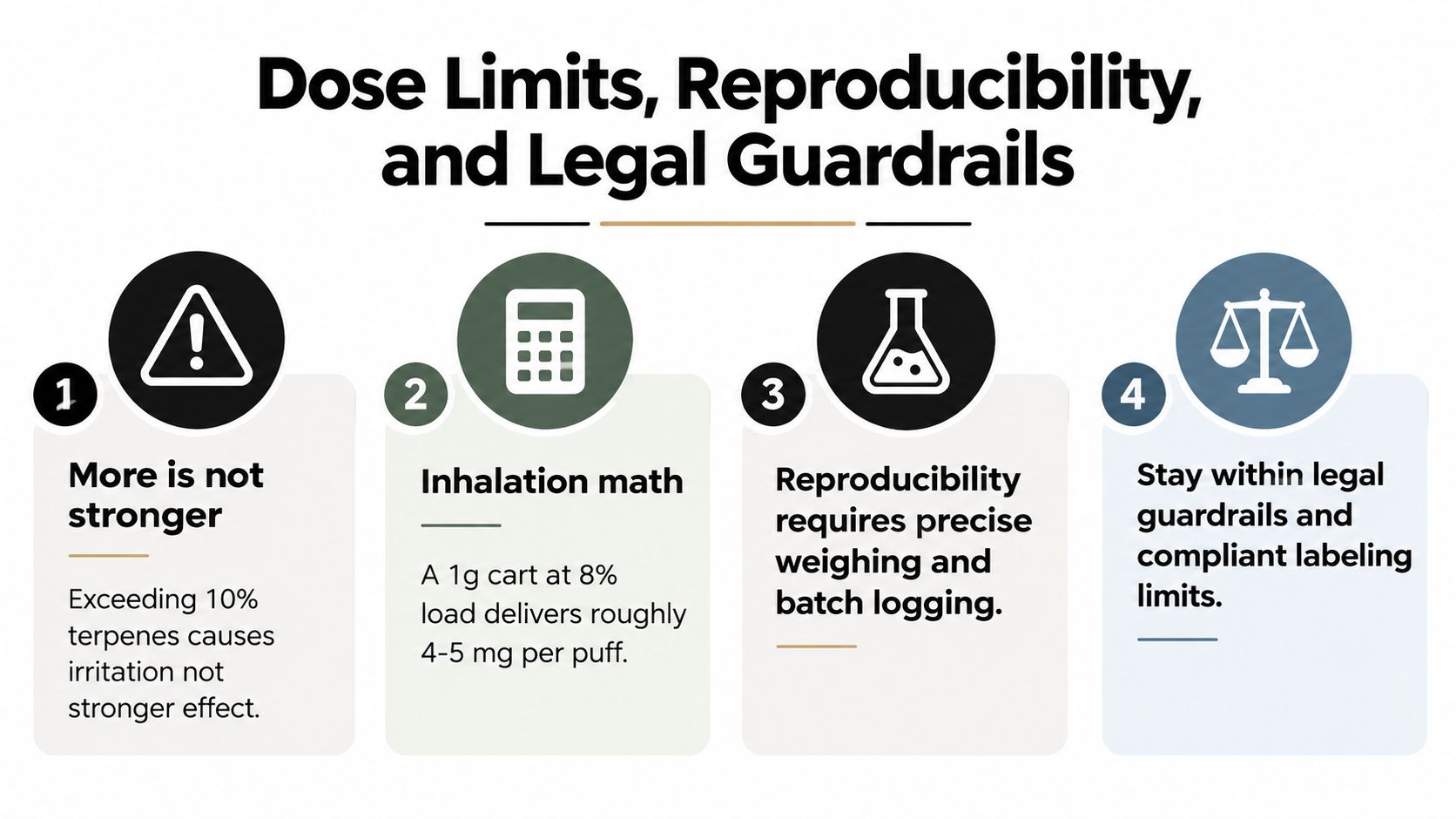
Build controls into the release process
- Use triplicate GC testing: Analyze each production batch in triplicate and retain chromatograms with the batch record.
- Keep a retention-time reference standard: Confirm compound identity against a documented reference instead of relying on peak names alone.
- Run blind sensory review: Have a panel compare the approved reference with the pilot without revealing sample identities.
- Log inhalation math: Calculate expected terpene delivery per draw from mass, load, device behavior, and draw duration. Keep the result within the approved 4 to 6 mg per 5-second draw screening range unless safety reviewers approve another model.
- Review the jurisdiction: U.S., U.K., and E.U. requirements differ, so check compliance language locally before release.
Prop 65 and FEMA GRAS boundaries require separate review. GRAS status does not authorize every inhalation use, and a flavor designation does not establish safety for a cannabis vape formulation. Review the legal status of terpenes alongside current state, federal, U.K., and E.U. requirements before approving a label or product claim.
Release gate: If aroma is strong but the GC profile, dose model, stability record, or legal review is incomplete, the SKU is not ready to scale.
Your Formulator Checklist for the Next Creative SKU
Start with the intended cognitive job, then build the profile around it. Divergent brainstorming calls for terpinolene, sustained focus points toward alpha-pinene, and low-anxiety ideation may suit a limonene and beta-caryophyllene balance. This three-profile approach gives the product a defined function instead of repeating a generic uplifting strain profile.
Use the worked distillate example as a process reference, not a universal formula. Confirm the note architecture, calculate actual terpene mass, and record each adjustment so the blend can be reproduced.
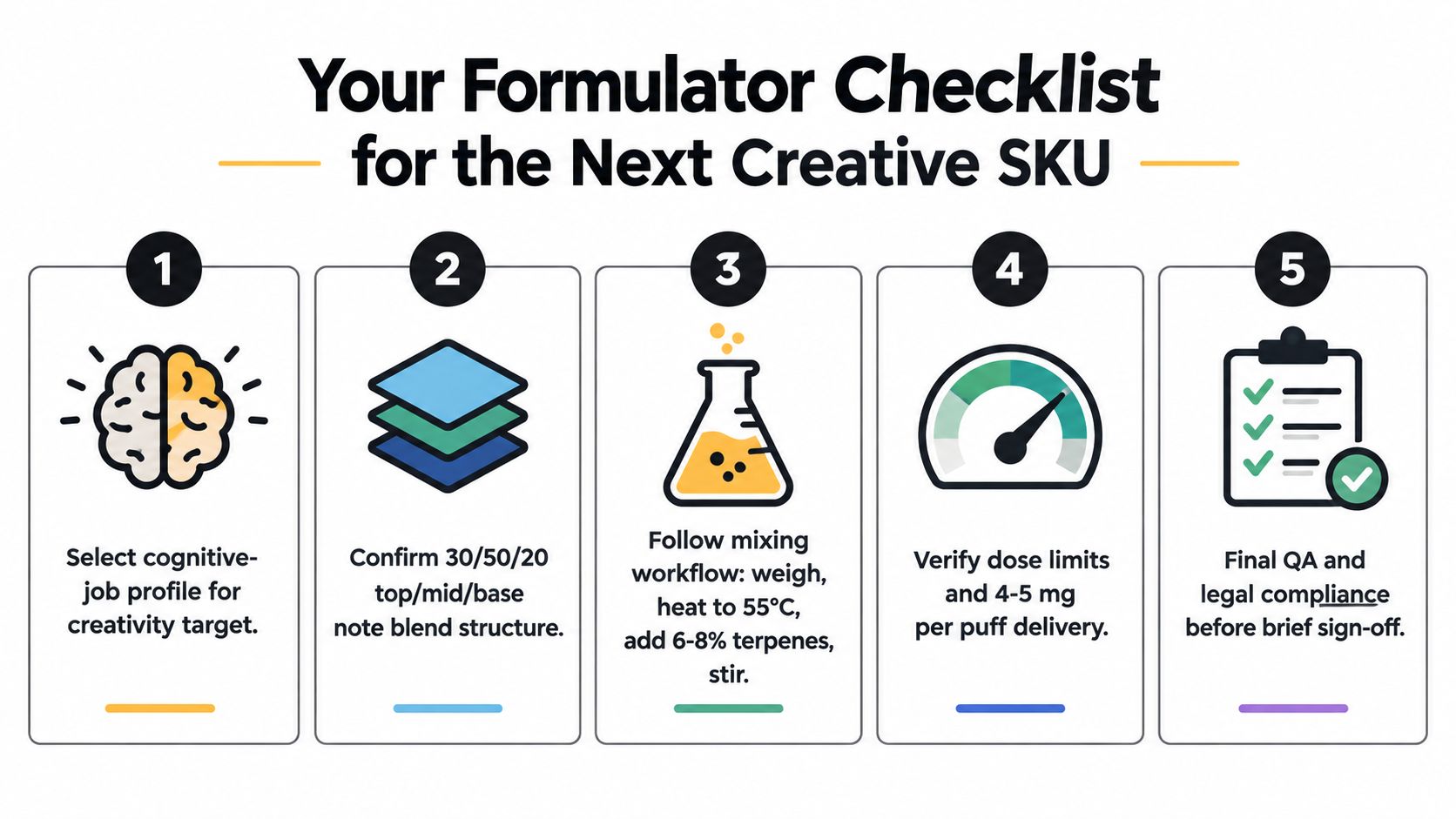
Bench decision checklist
- Identify the task: Define whether the SKU supports divergent brainstorming, sustained focus, or low-anxiety ideation.
- Select the anchor: Choose terpinolene, alpha-pinene, or a limonene and beta-caryophyllene balance, then add top-note accents deliberately.
- Set the blend structure: Apply the 30/50/20 top, mid, and base framework while keeping total terpenes within the approved 5% to 12% development range.
- Check the oil and hardware: Confirm viscosity, coil compatibility, fill behavior, and post-mix homogeneity before production.
- Verify the base: Run GC-MS on the strain reference, isolate stock, or distillate lot rather than relying on a catalog label.
- Calculate delivery: Model the inhaled amount against the 4 to 5 mg per 5-second draw screening boundary, and document the jurisdiction-specific safety review behind it.
- Confirm stability: Pull a 30-day stability sample and compare aroma, appearance, viscosity, and analytical composition.
Keep exposure decisions within the conditions examined by the 2024 limonene trial, without presenting that work as proof of a creativity benefit. Record every percentage for compliance, traceability, and future replication. The industry best-practices guide can support your internal batch record, sensory specification, and release checklist.
A strong strain-inspired terpene blend for vape cartridges has a defined job, reproducible aroma, verified composition, compatible viscosity, controlled delivery, and claims that match the evidence.
Gold Coast Terpenes supplies natural strain-specific blends and isolated compounds for cartridges, concentrates, and cannabis product formulation, including lab-verified, THC-free options formulated without VG, PG, PEG, or MCT. Visit Gold Coast Terpenes to review profiles and formulation resources for a creativity-focused SKU.