
The distillate is winterized, decarbed, and waiting on the bench. Your client wants an Apple Fritter cart before the shift ends, but the flower reference is in another room and its aroma can't be transferred directly into a syringe. The practical answer isn't another strain review. It's a target formulation spec that separates the cultivar's reported chemistry from the decisions required for replicating the flavor of Apple Fritter for vape cartridges.
Apple Fritter is widely described as a balanced 50/50 hybrid released in 2013 and bred by Lumpy's Flowers in Northern California from Sour Apple and Animal Cookies. Its profile became especially visible after a 2016 NorCal Cannabis Cup appearance and a reported second-place Best Hybrid finish, followed by inclusion on High Times' strongest-strains list in 2017 at 25.2% THC, as summarized by Herb's Apple Fritter strain profile. Those details matter commercially because the name carries both dessert recognition and a premium-potency association.
The formulator's job is narrower and more demanding. You need a blend that preserves the peppery caryophyllene backbone, keeps the apple and citrus lift audible, and remains stable in a cartridge after heating and storage. The build below treats “Apple Fritter strain exotic” as a sensory and analytical target, not as a promise that a re-engineered oil is identical to every flower phenotype.
Why Apple Fritter Belongs on the Formulation Bench
The strongest reason to keep Apple Fritter in rotation is that its sensory identity is legible. A new developer can smell the reference flower and usually identify three connected ideas: baked pastry, sweet apple, and peppery spice. That gives the bench a usable target, unlike profiles that depend on an indistinct mixture of fuel, earth, and fruit.
The reported chemistry supports that clarity. Apple Fritter is commonly described as caryophyllene-dominant, with limonene and myrcene frequently appearing among the leading terpenes. One recent sample measured 1.39% total terpenes, including 0.62% beta-caryophyllene, 0.30% limonene, and 0.17% alpha-humulene, while broader commercial summaries place total terpene content around 1.5% to 3.5% by weight in lab-labeled flower, according to Joint Commerce's Apple Fritter guide.
Bench principle: Start with the compounds that define the profile at first pull, then use the blend to restore the details that isolates can't reproduce alone.
The production appeal is straightforward. A strong jar aroma can translate into a recognizable first-pull flavor, and the cultivar's dessert association gives brand teams a familiar naming and positioning hook. That doesn't mean every cart will taste like flower. Distillate lacks the flower matrix, minor volatiles, and curing history that shape the original aroma, so the developer must decide which sensory features deserve priority.
A useful reference point is this Apple Fritter strain effects overview, but a product developer should use it as background rather than as a replacement for a chromatogram and sensory standard. The working target is a strain-inspired terpene blend with a defined backbone, a controlled load rate, and a documented comparison against the reference material.
Lineage That Shapes the Flavor Chemistry
Lineage is useful only when it changes a formulation decision. Apple Fritter comes from Sour Apple and Animal Cookies, and the cross explains why the profile doesn't settle into either a simple fruit note or a straight cookie note. Animal Cookies supplies the darker baked, dough-like direction and helps support a caryophyllene-led structure. Sour Apple supplies brightness, tart fruit lift, and the sharper edge that keeps the pastry impression from becoming heavy.
The parents shouldn't be treated as equal flavor halves. Terpenes don't average into a predictable midpoint, and a finished phenotype can express some inherited traits far more strongly than others. A formulator should therefore use lineage as a directional map, then let the actual flower chromatogram control the final weighting.
| Parent | Dominant Terpenes | Secondary Notes | Contribution to Apple Fritter |
|---|---|---|---|
| Animal Cookies | Caryophyllene-led spice | Myrcene, earthy and dough-like depth | Warm cookie structure, peppery base, rounded finish |
| Sour Apple | Limonene-led fruit lift | Brighter volatile fruit and tart accents | Apple-skin sharpness, citrus lift, aromatic contrast |
| Apple Fritter offspring | Caryophyllene with limonene and supporting terpenes | Pastry, sweet fruit, pepper, earth | Dessert-forward exotic profile with a defined backbone |
The practical mistake is to let the fruity side dominate because “apple” sounds like the primary brief. Too much limonene without enough caryophyllene makes the oil read as generic citrus candy. Too much caryophyllene and myrcene removes the apple lift and produces a dense, peppery, earthy concentrate.
The opposite error is to build a cookie profile and add a small amount of fruit at the end. That usually produces a heavy baked note with no crisp opening. The Sour Apple contribution needs its own budget from the start, even if the final blend remains caryophyllene-forward.
For a concise discussion of the cultivar's classification and lineage, see this Apple Fritter sativa-or-indica reference. At the bench, the conclusion is simple: weight caryophyllene high enough to honor Animal Cookies, while reserving enough bright terpene space to preserve Sour Apple's lift.
Mapping the Lab-Reported Terpene Profile
A useful formulation map divides the profile into top, mid, and base notes. The tiers aren't a substitute for a batch-specific certificate of analysis, but they help a developer decide which isolates belong in the first trial and which compounds should remain at trace levels.
Independent summaries commonly identify caryophyllene as the leading terpene, followed by limonene and pinene. Leafly's Apple Fritter profile describes that ordering and connects it with a peppery-sweet aroma that moves from pastry toward citrus. Other reported components include myrcene, linalool, fenchol, and camphene, showing why a short isolate build can still benefit from a pre-blended finishing component.
| Tier | Terpene | Flower % Range | Role in Profile |
|---|---|---|---|
| Top | Caryophyllene | 0.6%–1.0% | Pepper, warm spice, baked backbone |
| Top | Limonene | 0.4%–0.7% | Apple lift, citrus brightness |
| Top | Pinene | 0.2%–0.4% | Crisp resinous edge |
| Mid | Humulene | 0.1%–0.3% | Woody, hop-like dry-down |
| Mid | Myrcene | 0.1%–0.3% | Earthy body and rounded finish |
| Mid | Bisabolol | 0.1%–0.3% | Soft floral depth |
| Base | Linalool | Below 0.1% | Gentle floral sweetness |
| Base | Terpinolene | Below 0.1% | Herbal, piney complexity |
| Base | Ocimene | Below 0.1% | Light volatile lift |
The top tier carries recognition. Caryophyllene is the structural anchor, not merely another flavor ingredient. Limonene supplies the first bright impression, while pinene keeps the opening from feeling syrupy. In the mid tier, myrcene and humulene shape the body after the volatile top notes recede. The sub-0.1% compounds can still matter because small amounts of floral or herbal material can prevent a blend from collapsing into one blunt note.
This terpene profile guide is useful when building a reference sheet for the isolate shelf. Record each compound by flower percentage, then convert it to the selected cart load. For example, if a flower reference contains 0.6% caryophyllene and you select a 10% total terpene load, you can't copy 0.6% into the oil. You must treat the flower value as a compositional signal, normalize the desired terpene ratios, and account for isolate potency and any carrier-free blend concentration.
Formulation rule: Flower percentages describe the source matrix. They don't automatically prescribe the oil recipe.
A second complication is that source data varies. Independent guides report total terpene values around 1.5% to 3.5%, with caryophyllene often near 0.3% to 0.9%, limonene around 0.2% to 0.8%, and pinenes around 0.1% to 0.5%, as outlined by Joint Commerce's isolate-oriented Apple Fritter guide. Use those ranges to establish a test window, not to claim that every lot has the same fingerprint.
Translating Flower Percentages to Distillate Load Rates
Flower terpene totals and distillate load rates answer different questions. Lab-labeled Apple Fritter flower commonly falls around 1.5% to 3.5% total terpenes, while a distillate cartridge may need a formulation load between 5% and 12% by weight to deliver a comparable sensory impression, according to this guide to adding terpenes to distillate. The flower number describes the concentration inside a complex plant matrix. The cart load describes how much purified terpene material you add to a relatively neutral oil.
A one-gram batch makes the calculation clear. At a 7% load, use 0.07 g of terpene blend and 0.93 g of distillate, assuming the final batch is 1.00 g by weight. For a 100 g distillate batch, a 7% addition would require approximately 7 g of terpenes if you calculate the load against the finished batch, or a slightly different amount if your standard operating procedure defines the rate against the starting oil. Pick one convention and document it.
| Flower Total Terpene % | Distillate Load Rate | Flavor Intensity | Viscosity Note |
|---|---|---|---|
| 1.5%–2.0% | 5% | Milder, cleaner opening | Usually the thickest option |
| 2.0%–2.8% | 7% | Balanced profile strength | Often a practical starting point |
| 2.8%–3.5% | 10% | Richer aroma and sweeter top note | Thinner oil, stronger hardware sensitivity |
| 2.8%–3.5% | 12% | Very expressive, potentially aggressive | Check flow, leakage, and sensory harshness carefully |
For a milder pull, recalculate the same normalized blend at 5%. For a richer expression, test 10% before moving toward the upper end of the range. A higher load can improve aroma release, but it also lowers viscosity and can make the cart feel sharper or expose hardware limitations. A cutting agent shouldn't be the automatic fix. If the oil is too thick, first confirm temperature, terpene concentration, and hardware compatibility, then make any excipient decision only within the applicable product and jurisdiction requirements.
Building the Blend With Isolates and the Finishing Blend
A workable starting point for a 100 g distillate batch uses a defined isolate backbone and a pre-blended finishing component. The recipe below reaches 8.7% before adjustment, so weigh the batch by finished mass instead of assuming the remaining weight is plain distillate.
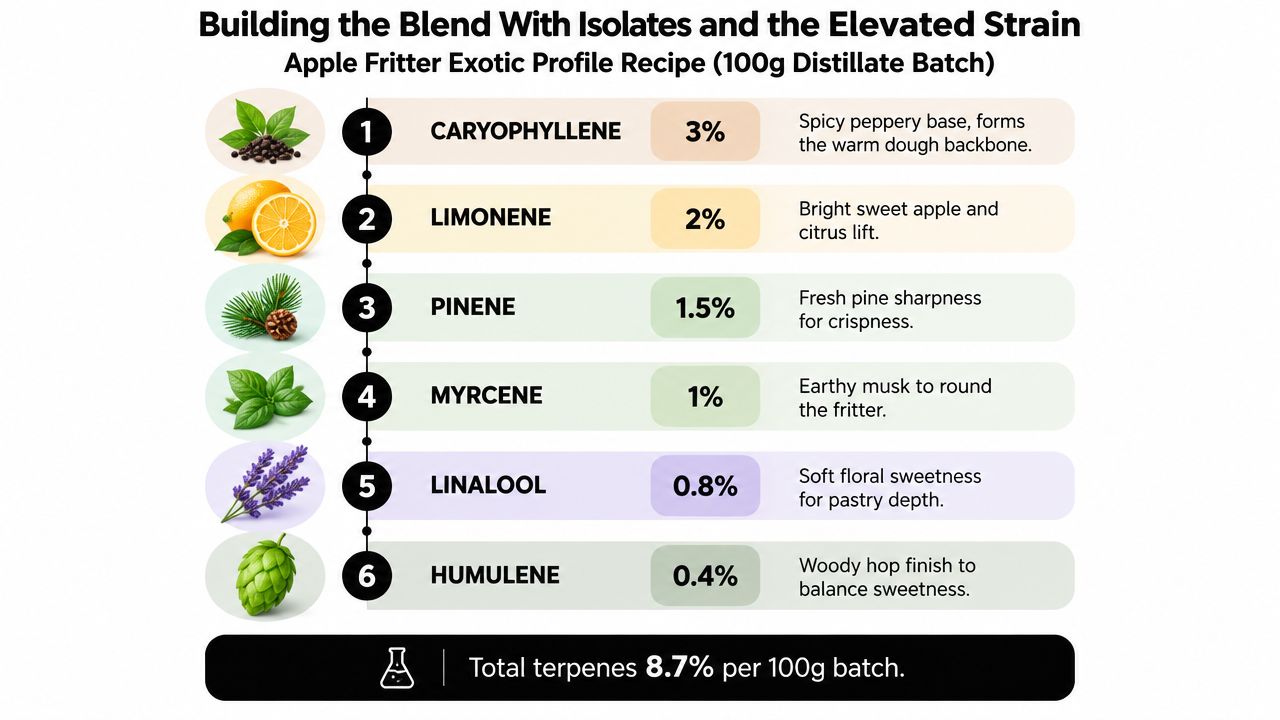
| Component | Percentage of batch | Mass for a 100 g batch |
|---|---|---|
| Caryophyllene isolate | 3.0% | 3.0 g |
| Limonene isolate | 2.0% | 2.0 g |
| Pinene isolate | 1.5% | 1.5 g |
| Myrcene isolate | 1.0% | 1.0 g |
| Linalool isolate | 0.8% | 0.8 g |
| Humulene isolate | 0.4% | 0.4 g |
| Apple Fritter finishing blend | Top up to 7%–8% total | Adjust by final batch weight |
The isolate names should match the certificates and internal catalog identifiers used by your facility. Do not swap in a botanical material because the name sounds close. Check identity, purity, origin, and analytical documentation before anything goes into a production batch.
Warm the distillate and terpene materials to 50–60°C before combining. Add the terpene portion in thirds under gentle magnetic stirring. That staged addition limits local overconcentration and gives the thick oil time to incorporate without aggressive shear or extra aeration.
- Weigh the warmed distillate into a clean, dry vessel.
- Add caryophyllene, limonene, and pinene first, then mix until the oil looks uniform.
- Add myrcene, linalool, and humulene in the next portion.
- Add the Apple Fritter finishing blend last, then adjust the total terpene percentage to the selected 7%–8% target.
- Pull a retained sample for sensory review and GC analysis after 24 hours of equilibration.
The finishing blend fills in soft pastry, fruit, and minor aromatic transitions that individual isolates often miss. A pre-blend can keep the profile from leaning too hard on a single floral or herbal note. One catalog example is the Apple Fritter strain-specific blend, Elevated Strains, which can serve as the finishing component in this kind of trial.
If the cart tastes harsh after steeping, check limonene and pinene first, then inspect the coil temperature and fill process. If it tastes muted, confirm that the blend was fully incorporated, that the sample rested for the planned equilibration period, and that the hardware is not suppressing volatile release.
Pre-Blended Profile vs Hand-Mixed Isolates
The choice between a pre-blended Apple Fritter profile and individual isolates is mainly a control decision. A pre-blend reduces weighing steps and limits the number of variables that can drift between operators. Hand mixing gives the technical team more room to push caryophyllene, lower pinene, or adjust the fruit-to-pastry balance for a specific hardware platform.
The available verified data doesn't establish catalog pricing, labor hours, or a validated ±0.3% tolerance window for either path, so those values shouldn't be presented as universal operating facts. Build the comparison around your own purchasing records, labor rates, analytical method, and release specifications.
| Factor | Pre-Blended Profile | Hand-Mixed Isolates |
|---|---|---|
| Setup | Fewer weigh-outs and a shorter initial setup | More individual weigh-outs and verification points |
| Consistency | Useful when the same profile must be reproduced quickly | Depends heavily on operator technique and lot control |
| Customization | Limited to the supplied profile and selected load | Direct control over caryophyllene, limonene, pinene, and minors |
| QC burden | Fewer component-level calculations | More certificates, lot numbers, and identity checks |
| Scale economics | Convenient for trials and smaller production runs | Can become more economical when purchasing and batching at scale |
| Sensory correction | Adjust the total load or add a controlled modifier | Change individual ratios with greater precision |
| Main risk | The blend may not match a particular flower phenotype | Small weighing errors can shift the sensory center |
For a new SKU, speed has value because the first objective is learning whether the profile survives the complete process, including warming, filling, steeping, and use. A pre-blended component can shorten that learning cycle. It also makes it easier to produce a controlled pilot without building a full internal reference library.
An established flagship line has a different need. Once the team has a validated chromatogram and a stable sensory panel, isolates can support seasonal corrections or hardware-specific adjustments. If one coil emphasizes pinene, the developer may reduce the pinene fraction while preserving the caryophyllene and limonene relationship.
Decision rule: Use a pre-blended profile for rapid trials and early SKU work. Move to hand-mixed isolates when the line has a proven target and the business can support tighter component-level QC.
Stability Hardware and Labeling Considerations
Caryophyllene-heavy formulas need disciplined handling. Oxygen, light, heat, and repeated headspace exposure can change the aroma balance, so the storage system should be designed before the first production run. Use nitrogen-purged distillate drums, amber glass for terpene isolates, airtight closures, and cool storage at 2–8°C with desiccant where the facility's procedures and material specifications allow it.
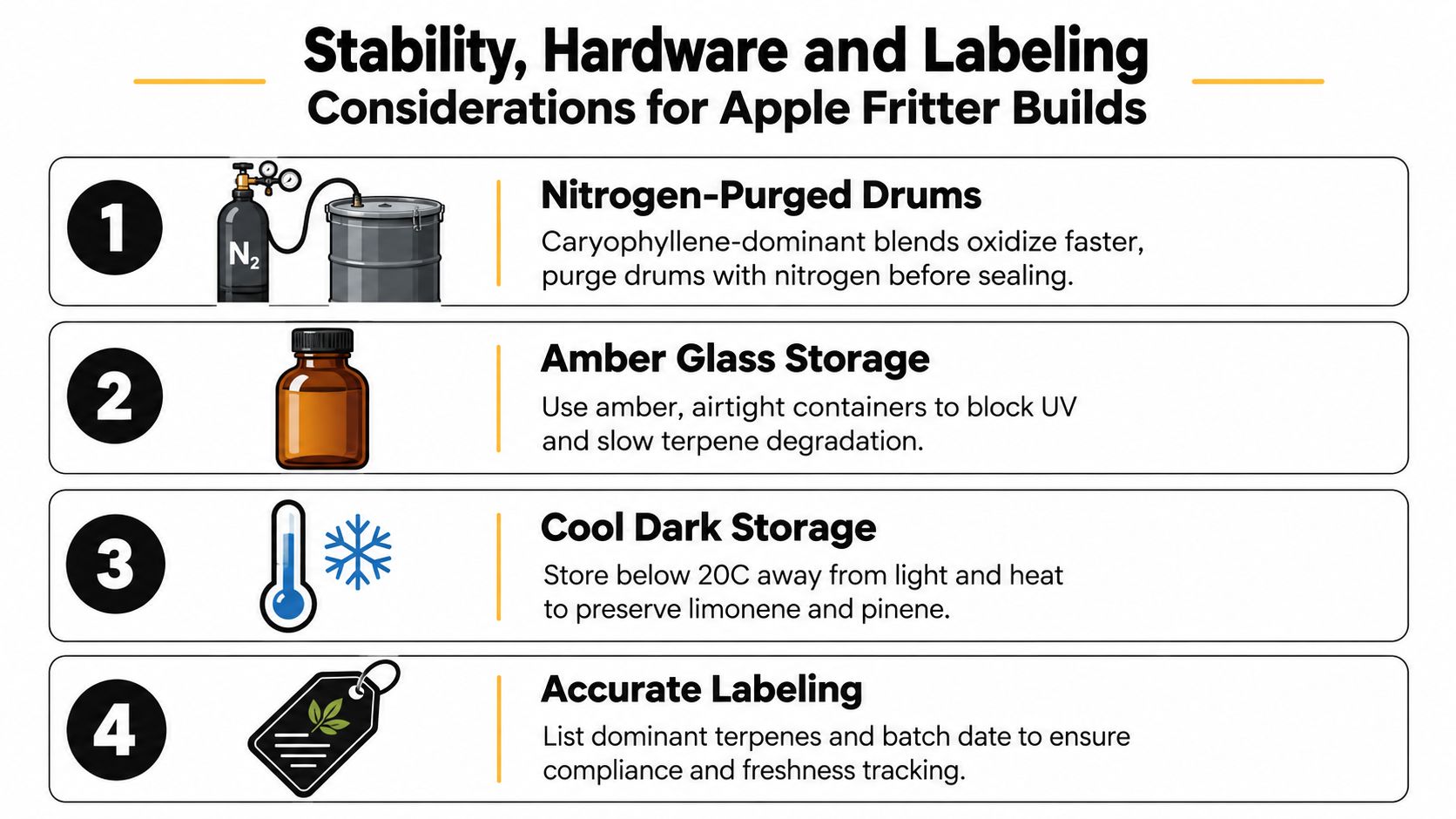
A 30-day post-blending retest window is a useful control point for checking caryophyllene oxide drift, but it should be treated as a proposed internal monitoring interval, not as a universal stability standard. Pair the retest with GC-MS data, retained samples, and sensory comparison. The point isn't to assume a failure. It's to identify whether the blend changes under your actual container, temperature, and headspace conditions.
Hardware can override a good formula. Avoid cotton-wick ceramic coils above 2.0 Ω in a high-terpene build, and evaluate sealed ceramic hardware such as CCELL or comparable systems at an operating band of 2.4–2.8 V. These settings are development targets, not release guarantees. Verify draw behavior, leakage, vapor output, and sensory carryover on the exact device used for sale.
Keep finished oil within a practical viscosity target of 80–110 cP for cart fills, with the measurement temperature recorded. A viscosity value without temperature is difficult to interpret, so pair the result with a controlled read, such as a reading at 25°C when that is your facility standard.
Label claims need analytical support
Use “true-to-flower” only when the product's lab-verified chromatogram supports the dominant-terpene thresholds defined in your quality system. Otherwise, describe the product as a flavor profile or strain-inspired isolate blend. A cultivar name can communicate intent, but it doesn't prove chemical identity across lots.
Regulatory treatment varies by jurisdiction. Confirm local terpene ceilings, including Oregon's 2.5% limit where applicable, California's testing treatment for dry weight where relevant, and any requirements for allergen disclosures when botanical-derived isolates are used. Link each batch code to isolate lot numbers, supplier documentation, and GC-MS retention data so a label review can be traced back to the actual materials.
Apple Fritter Formulation Checklist
Keep the final reference beside the scale, not buried in a development folder. The target should identify the dominant ratio, the total load, the device, the storage condition, and the release evidence. That combination protects the sensory profile from being reduced to a name on a label.
For a starting Apple Fritter strain-inspired terpene blend, use the following internal ratio target as a formulation hypothesis, then validate it against the selected flower reference and the final hardware:
- Caryophyllene: Target roughly 28%–34% of the terpene blend to hold the peppery dough structure.
- Myrcene: Target roughly 22%–28% for earthy body and a rounded finish.
- Limonene: Target roughly 12%–16% for apple and citrus lift.
- Pinene: Target roughly 6%–10% for crispness.
- Humulene: Target roughly 4%–6% for woody, hop-like balance.
- Linalool: Target roughly 2%–4% for soft floral sweetness.
- Bisabolol and selinene: Keep supporting levels under 2% unless your reference chromatogram calls for more.
Those ratio bands are bench targets, not verified universal composition ranges. The verified flower data supports caryophyllene dominance and the presence of limonene, pinene, myrcene, humulene, linalool, and other named components, but re-engineering requires normalization and testing.
| Parameter | Target | QC Check |
|---|---|---|
| Total terpene load | 5%–7% by weight in distillate | Confirm batch math and verify with a refractometer |
| Dominant ratio | Caryophyllene-led, with limonene and pinene supporting | Compare normalized GC-MS profile |
| Viscosity | 80–110 cP | Read at 25°C |
| Hardware | Sealed ceramic, 2.4–2.8 V development band | Test fill, leakage, draw, and sensory output |
| Storage | Amber glass, 2–8°C, nitrogen headspace | Record container, temperature, and headspace condition |
| Retest | 30-day post-blending check | Review caryophyllene oxide and sensory drift |
| Isolate identity | Every lot documented | Match COA, lot code, and GC-MS retention data |
| Stability screen | One-week accelerated screen at 40°C | Compare appearance, viscosity, GC-MS, and flavor |
| Release file | Traceable and complete | Attach chromatogram PDF and label-copy review |
| Sensory standard | Reference flower when available | Run a final panel against the retained standard |
Use the refractometer as one process check, not as proof of terpene identity. GC-MS verification remains necessary for isolate lots and finished-profile confirmation. Record the exact blend mass, operator, vessel, temperature, mixing time, equilibration time, cartridge hardware, and sensory result.
The finished product should be called true-to-flower only when the data supports that statement. If the formulation reproduces the recognizable pastry, apple, and pepper structure without matching the reference chromatogram, label it as a strain-inspired flavor profile.
Gold Coast Terpenes provides strain-specific blends and isolated compounds such as limonene, myrcene, and beta-caryophyllene for cartridge, concentrate, and broader cannabis product formulation work. Review the available formulation components and technical resources at Gold Coast Terpenes, then select materials that match your validated Apple Fritter target and QC process.