
A pine-forward cart can look perfect on paper and still taste like generic evergreen after filling. The usual failure is structural: pinene delivers a sharp opening, but the citrus lift disappears during blending, while an aggressive diesel note takes over the finish. For extractors, cartridge manufacturers, and brand owners, the problem isn't identifying “pine.” It's preserving the pine, citrus, and diesel progression that makes a Georgia Pine-inspired product recognizable.
Georgia Pine is a useful formulation target because its commercial identity rests more on aroma than on standardized effect language. Published references commonly associate it with Swamp Boys Seeds and the lineage Killer Queen G13 × Williams Wonder, while independent coverage describes a profile led by pinene with limonene, myrcene, and trace linalool support. Leafly's Georgia Pine reference and independent formulation-oriented strain coverage provide useful background, but neither replaces batch-level sensory testing.
This guide treats the Georgia Pine strain as a strain-inspired terpene blend for vape cartridges and distillate, not as a dispensary-style effect story. You'll learn how to identify the aromatic signature, assign top, mid, and base note roles, and make practical choices when a cart needs more forest lift, brighter citrus, or a grounded fuel finish. The aim is flavor accuracy and stability across manufactured inputs.
Introduction to Georgia Pine for Product Formulation
A brand owner hands over reference flower and a cartridge brief: preserve fresh pine, keep the citrus lift, and finish with diesel without harshness. The first bench blend smells convincing in the vial. Once diluted into neutral distillate and filled into a cartridge, the green snap fades. Pine remains, but it becomes flat, sweetened wood.
That failure points to a formulation problem. Pinene is assertive but volatile, so it can dominate the opening while leaving the middle thin. Adding more pinene often produces a sharp, cleaner-like impression instead of a more convincing forest note. Introducing too much fuel at the start creates a different problem. The blend skips the bright conifer stage and settles into generic diesel.
Georgia Pine works better as a controlled aroma target. It is widely described as a modern hybrid associated with Swamp Boys Seeds, with a reported Killer Queen G13 × Williams Wonder lineage and an aromatic identity that includes pine, gasoline, black licorice, and wild watermelon nuances. Leafly's strain profile helps define that sensory vocabulary, while product development requires tighter decisions about balance, volatility, and heat behavior.
The commercial target
For a manufactured product, set the Georgia Pine profile as an aroma arc:
- The opening is crisp, resinous, and recognizably coniferous.
- The middle brings lemon or bright citrus without turning candy-like.
- The finish adds fuel, pepper, or warm resinous depth while keeping the top note audible.
Consumer effect descriptions are a weak formulation brief. Retail language varies between calm, happy, relaxed, and energetic, and user reports are not standardized enough to guide a repeatable blend. Aroma provides a more practical target because the team can assess it in a vial, oil, cartridge, and finished package.
A practical terpene fundamentals guide supplies the chemistry vocabulary. The bench question is more specific: which compounds lead, which support them, and which stay low enough to preserve separation? In a pinene-dominant cart, heat and dilution can flatten citrus before the fuel note has settled. Set the blend around that trade-off, then judge the finished hardware rather than the vial alone.
Georgia Pine Lineage and Why It Matters for Replication
A cart can start with sharp pine and finish as generic evergreen. Georgia Pine's lineage helps explain why. It is widely described as a hybrid associated with Swamp Boys Seeds, with Killer Queen G13 × Williams Wonder reported as its common lineage across strain databases. That background points to a selected modern hybrid, not a narrowly defined landrace profile.
The distinction affects replication. A boutique hybrid may vary with the selected cut, breeding network, and release, so the name alone does not guarantee one terpene balance. Georgia Pine's early circulation is commonly placed in the 2010s, alongside clone swaps, forum trades, and limited breeder releases. The published Georgia Pine strain guide covers its potency positioning and breeding influence, while the lineage reference below gives a visual anchor for product teams.
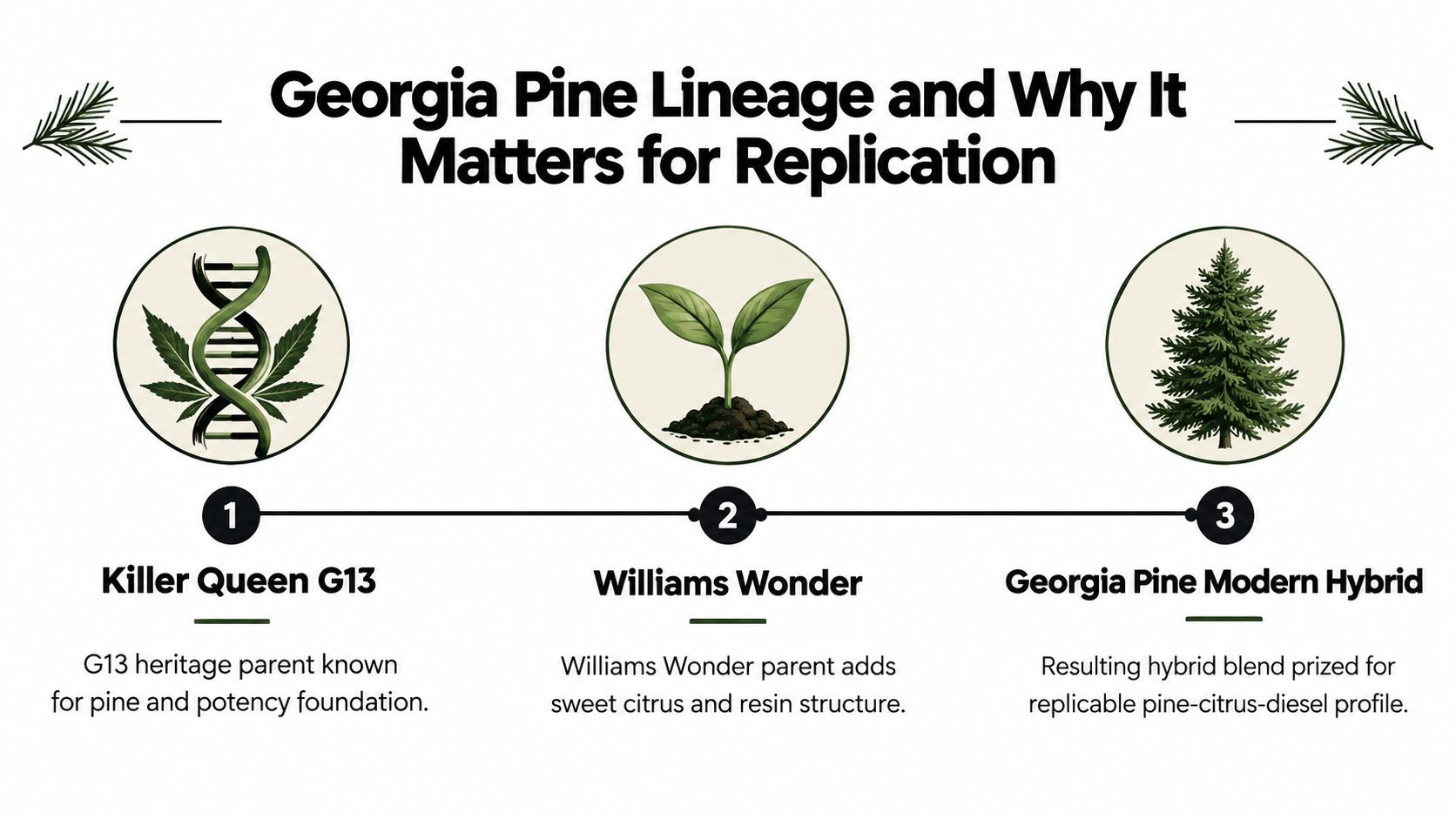
Use lineage as a direction, not a recipe
Three formulation decisions follow:
- Expect modern hybrid expression. Forest, citrus, fuel, and sweet secondary notes can coexist, so the target should have movement rather than a single-note pine character.
- Screen phenotypes before setting a benchmark. Samples sold under the Georgia Pine name may differ in aromatic balance across sources and harvests.
- Define the shared commercial identity. Build around pine first, then citrus lift and fuel depth. Do not chase every minor note from one flower sample.
The breeding record also supports a broader interpretation. Seedfinder's lineage record records at least 7 direct descendants for Georgia Pine, indicating that the cultivar contributed to later breeding rather than disappearing after one limited release. The figure does not establish a universal terpene certificate, but it supports treating Georgia Pine as a recognizable selection signal.
For replication, preserve that signal through processing. Set the target as an assertive pine opening, a lifted citrus center, and a resinous fuel finish. Then test the blend in the intended cartridge or distillate, because heat, dilution, and hardware can erase the separation that was clear in a vial. Lineage supplies the direction. Formulation determines whether the finished product still reads as Georgia Pine.
Core Terpene Profile for Georgia Pine and Note Structure
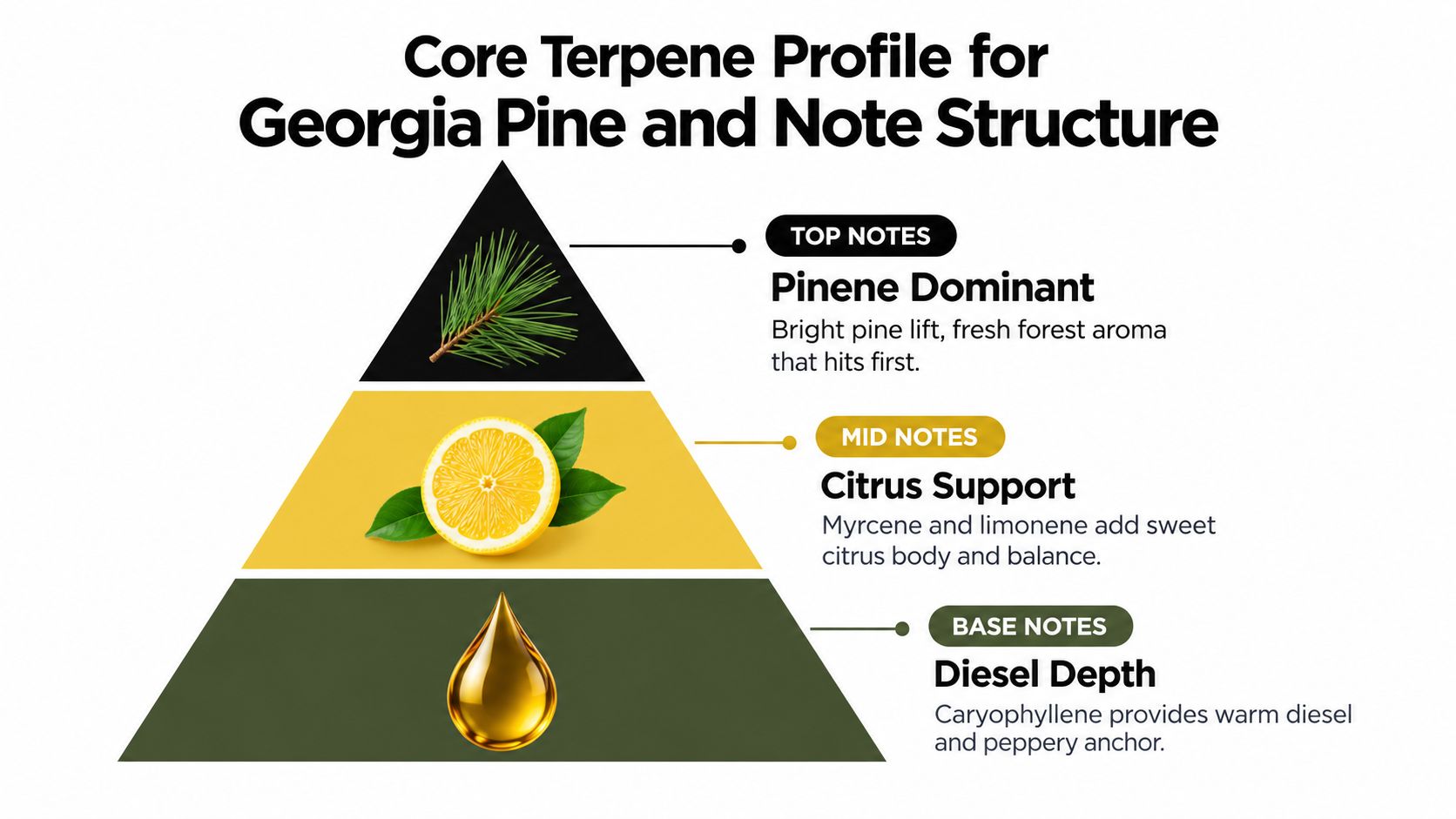
A pinene-dominant formula can lose its identity in a cartridge within a few heat cycles. The goal is to preserve separation between pine, citrus, and resinous fuel rather than let the profile collapse into generic evergreen. Independent coverage describes pinene as potentially accounting for over 40% of total terpenoid content, with limonene at about 20% and myrcene at about 15%, as shown in The reported terpene breakdown. Treat those figures as a reported hierarchy, not a certificate for every batch.
Formulation principle: Let the dominant terpene establish identity, then use supporting terpenes to create movement from the first impression through the finish.
Top notes and the pine opening
Pinene supplies the first recognition cue. In a Georgia Pine formulation, it should suggest fresh needles, pine resin, and green forest air, not household cleaner. A pinene-heavy blend can smell narrow when the opening arrives without enough mid-note structure.
Set the top note for lift, then allow it to recede. If sharpness persists from opening through finish, reduce the pinene emphasis before adding more. A measured increase in citrus body can preserve brightness while keeping the profile from turning abrasive.
Mid notes and citrus support
Limonene shapes the brighter middle. Its job is to suggest lemon peel, citrus oil, or fresh zest, giving the pine more space and definition. Excess limonene shifts the formula toward lemon candy, which weakens the strain-inspired target.
Myrcene supplies body underneath that brightness. At the reported level of about 15% of the terpene composition, it can keep the blend from feeling thin, while too much makes the profile soft and indistinct. Use it as a rounding component rather than the headline note.
Base notes and smoothing
Trace linalool can soften rough edges without becoming a floral feature. Keep it subordinate. Too much can push the blend toward soap or lavender and obscure its resinous character.
Use the following sensory checks during bench work:
- Sharp or cleaner-like: reduce pinene before adding sweetness.
- Flat or hollow: improve the relationship between limonene and myrcene.
- Too soft: pull back myrcene and restore a crisp top note.
- Harsh or one-dimensional: add a restrained base layer, with linalool used only for smoothing.
The terpene flavor chart can support role comparisons during formulation. Final evaluation still belongs in the finished oil and intended hardware, because heat and dilution can flatten distinctions that remain clear in a vial.
Sensory Signature From Pine to Citrus to Diesel
A commercial Georgia Pine target can be reduced to three linked descriptors: pine, citrus, and diesel. That shorthand becomes useful only when each descriptor has a defined sensory job. “Pine” should describe the attack, “citrus” should shape the center, and “diesel” should anchor the exit.
The pine opening needs clarity. Think crushed needles, fresh sap, and a brisk green lift. If it becomes solvent-like or medicinal, the top note is too exposed. A good cartridge should announce the forest character quickly, but it shouldn't punish the palate with a piercing edge.
Citrus should arrive as peel rather than confectionery. Limonene can brighten the blend, yet too much can make the product taste like a generic lemon flavor. The target is a narrow band between dull evergreen and sweetened citrus. When the citrus sits correctly, it makes the pine feel more dimensional instead of replacing it.
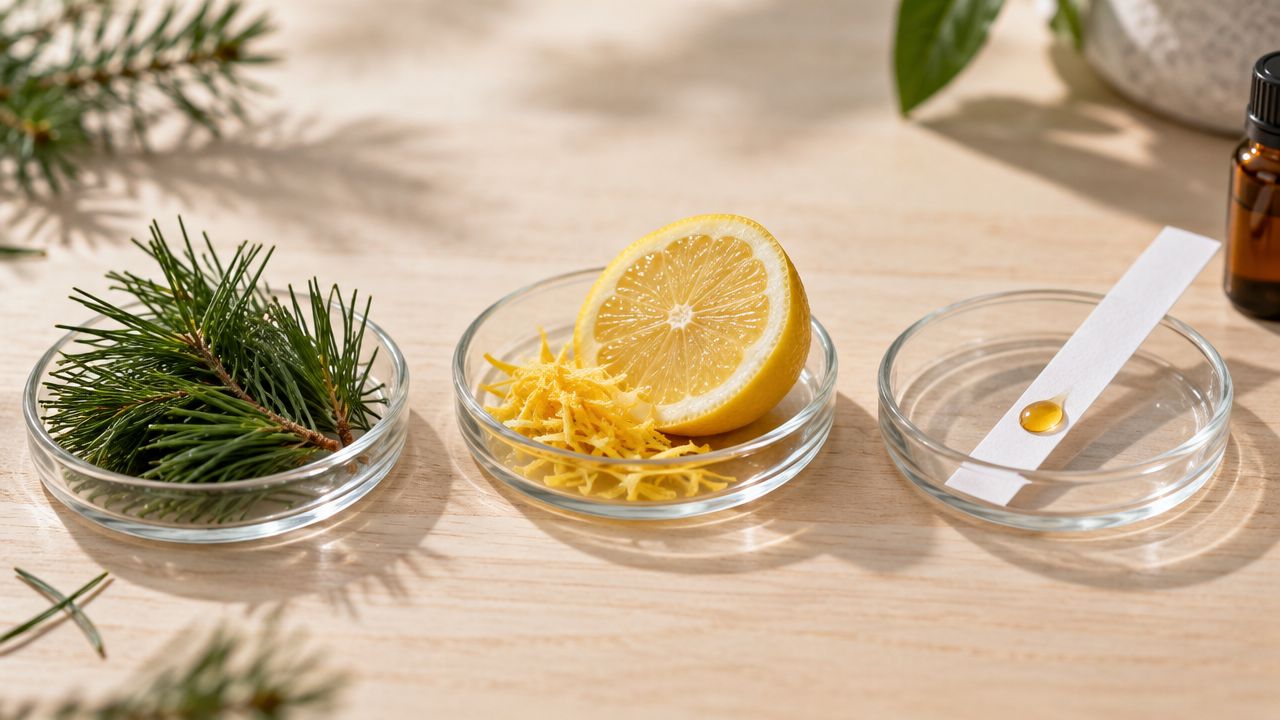
Give the finish somewhere to land
The diesel component should provide fuel, warm resin, and light peppered depth. A commercially oriented Georgia Pine seed listing describes the flavor as pine, citrus, and diesel, a practical three-part framework for replication. That product description supports a layered approach, with pinene leading, limonene lifting, and a heavier base structure shaping the finish.
Beta-caryophyllene is a useful anchor when the profile needs warmth and pepper. Humulene can contribute a drier, woody impression when the concentrate feels too sweet or rounded. Neither should erase the pine opening. The finish should be noticeable after the citrus fades, not present as a heavy note from the first inhale.
For QA, evaluate the blend at three points:
- First impression: Is the pine crisp and resinous, or sharp and artificial?
- Mid-palate: Does citrus appear as peel and lift, or as candy?
- Exhale: Does diesel provide depth, or does it flatten the entire profile?
A useful comparison is the King Louis OG terpene profile, which can help a team distinguish a pine-forward target from a heavier OG-style aromatic direction. The point isn't to make Georgia Pine taste like another strain. It's to sharpen the sensory vocabulary used during approval.
Formulating Georgia Pine for Vape Cartridges and Distillate
Start with the oil, not the flavor concentrate. A clean, winterized distillate gives you a neutral canvas, while a strongly flavored extract may already contain pinene, limonene, or fuel notes that distort the intended ratio. Record the base aroma before adding anything. If the distillate already smells woody or sharp, compensate in the blend rather than assuming the same concentrate recipe will work unchanged.
Pinene-heavy profiles need careful handling because the top note is both the identity marker and the first thing heat and air can compromise. High heat can flatten volatile brightness, while prolonged exposure to air can move the profile toward stale wood or generic resin. The finished cart also changes perception through hardware, viscosity, coil temperature, fill time, and storage.
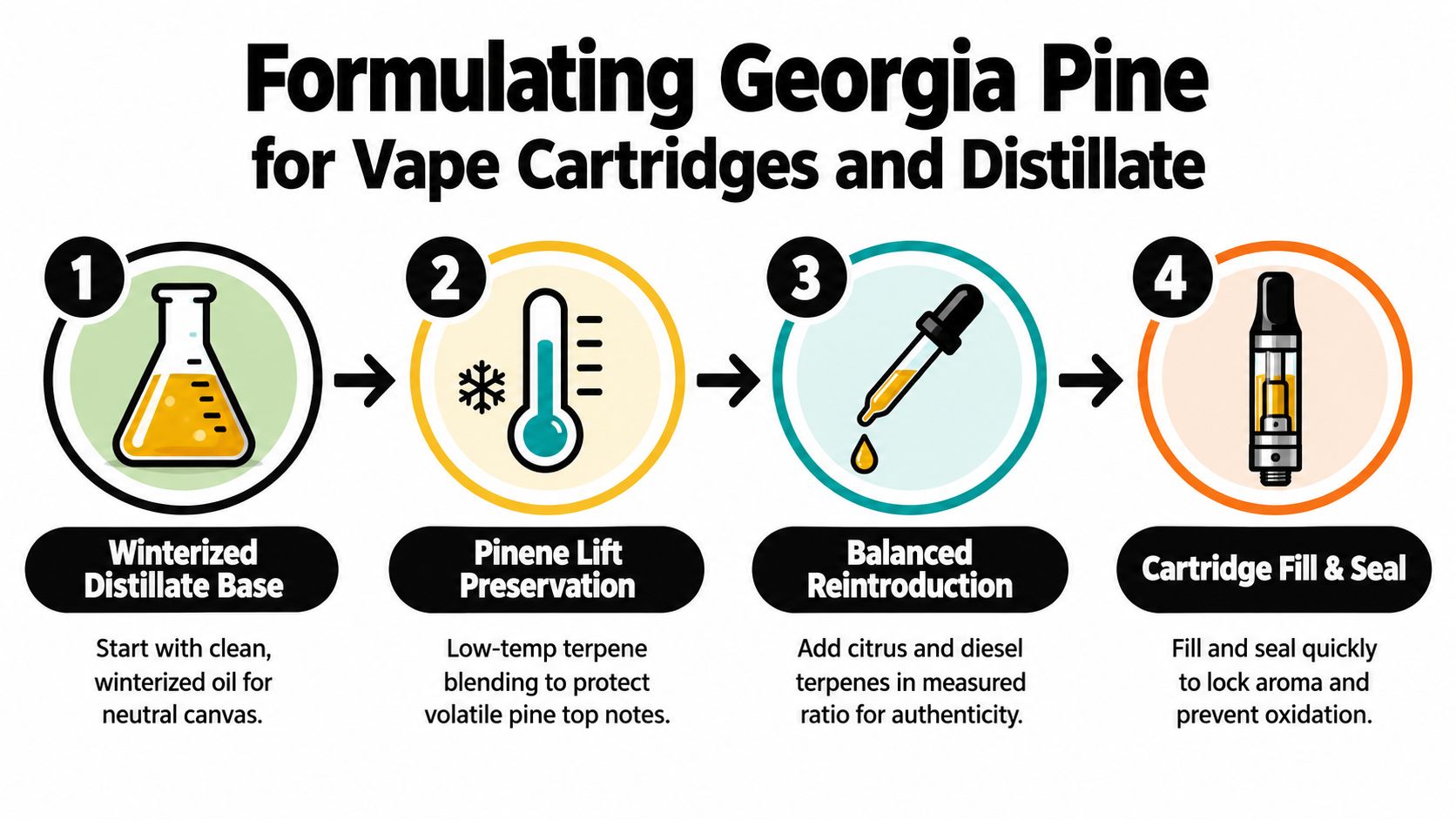
A controlled blending sequence
A practical sequence is:
- Characterize the base. Smell the winterized distillate at room temperature and after gentle homogenization. Document any native sweetness, fuel, bitterness, or plant-like notes.
- Build the support layer first. Combine the citrus and base components before adding the most volatile pine note. This lets you judge whether the blend has enough body without using pinene to solve every problem.
- Add pinene gradually. Introduce the pine component in small increments and evaluate the opening, mid-palate, and finish. Stop when the profile reads as forest resin rather than cleaner.
- Run finished-hardware checks. Test the blend in the intended cartridge, not only in glass. Compare the first draw with later draws and inspect the aroma after the oil has rested.
There isn't a universal total terpene load that works for every oil, cartridge, or regulatory environment. Set the lowest level that produces the target aroma, then validate vapor performance and user acceptability. A blend that smells powerful in a vial may become harsh when aerosolized.
Protect the top note
Use controlled temperature and minimize dwell time during mixing. Avoid leaving an open vessel exposed while the team debates a batch. Add the volatile fraction after the base and support notes are uniform, then fill and seal promptly.
For the diesel finish, beta-caryophyllene can provide peppery warmth, while a restrained humulene contribution can add dry woodiness. Don't use heavy base notes to compensate for weak citrus. That approach usually creates a dark product with no lift.
The distillate and terpene mixing guide is a useful reference for documenting addition order and calculating batch quantities. Keep a formulation record with base characteristics, blend additions, mixing conditions, hardware, fill timing, and sensory results. That record turns a subjective flavor target into a repeatable development process.
Terpene Pairings and Strain Inspired Blend Options Compared
Pairing decisions should follow the product goal. A bright daytime-positioned cart needs a different balance from a concentrate intended to emphasize fuel, resin, and pepper. Georgia Pine gives you a stable identity, but the supporting architecture can move the product toward citrus-forward, forest-forward, or diesel-forward territory.
Use isolates when you need precise adjustment, especially after a strain-inspired blend already captures the general direction. Limonene isolates can sharpen the citrus center, while Myrcene isolates add body when the blend feels too thin. Beta-Caryophyllene is more useful when the finish needs pepper, warmth, and fuel depth.
Choose the adjustment by sensory outcome
| Product Goal | Emphasis Adjustment | Sensory Result |
|---|---|---|
| Brighter cartridge | Increase citrus support while keeping pinene clearly dominant | Fresher lemon-peel lift with a cleaner forest opening |
| Forest-forward cart | Preserve the pinene lead and keep sweet notes restrained | Sharper resin and needle character |
| Heavier concentrate | Deepen beta-caryophyllene and consider humulene support | Warmer pepper, dry wood, and a longer diesel finish |
| Softer vapor profile | Use restrained myrcene and trace linalool support | Rounder mouthfeel with less aggressive top-note edges |
| More fuel without losing identity | Add base depth gradually rather than increasing diesel materials at once | A grounded exhale that still begins with pine |
The trade-off is straightforward. More limonene creates lift but can make the product generic if the citrus becomes the headline. More myrcene improves fullness but can blur the pine-citrus separation. More beta-caryophyllene strengthens the finish but can make the blend feel heavy if introduced before the top and middle are balanced.
For repeatable SKU work, compare a complete strain-inspired blend with an isolate-adjusted version. The full blend may provide better complexity, while isolates give the formulator tighter control over batch correction. Keep both approaches in the development record so the team knows whether a successful profile came from a fixed blend or from a tunable system.
Building a Consistent Georgia Pine Inspired Product Line
A Georgia Pine cart can open with clean needle-like pine and finish with diesel, yet lose both after heating. Build the line around aroma identity, then verify that identity in the oil, cartridge, and storage conditions rather than treating flower potency as a product specification. Legal-market references place flower potency around 18% to 24% THC, but that range does not predict taste, aerosolization, or profile stability. The independent potency summary provides context, not a recipe.
Set sensory checkpoints for the pine opening, citrus middle, and diesel finish. Approve each stage separately, then assess the complete arc in the finished cartridge or concentrate. Small-batch trials expose changes caused by native distillate aroma, cartridge construction, heating behavior, and storage.
Document what survives production
Track each approved batch with a sealed reference and clear target descriptors. Record:
- Reference standard: Preserve the aroma target and define acceptable pine, citrus, and diesel limits.
- Blend composition: List every component, its role, and any isolate correction.
- Process conditions: Log temperature, mixing time, vessel exposure, fill timing, and seal timing.
- Hardware performance: Compare the first draw, later draws, and stored units.
- Release decision: Document whether pine clarity, citrus lift, and diesel depth remain intact.
Keep adjacent profiles separate from the core Georgia Pine brief. Elevated Strains represents another catalog direction, useful for portfolio range but not a substitute for the pine-citrus-diesel target.
Source lab-verified, THC-free terpene components, prepare a controlled bench blend, and test it in the production oil and hardware. Gold Coast Terpenes supplies natural strain-specific blends, isolated compounds, mixing tools, and formulation resources for cartridge and concentrate development.
Gold Coast Terpenes offers strain-specific blends and isolated compounds for building a stable Georgia Pine-inspired profile in distillate and vape cartridges. Start with pine, citrus, and diesel architecture, then refine the finished aroma through visiting Gold Coast Terpenes.