
A sales lead emails on Monday morning asking for a Sour Apple Runtz live-resin cartridge on the docket by mid-quarter. The only references are a dispensary jar and a screenshot of a menu page. That's enough to name a product, but not enough to ship a repeatable flavor.
For a formulator, the Sour Apple Runtz strain is less useful as a fixed genetic promise than as a candy-gas flavor archetype. The working target is a bright green-apple lift, layered fruit sweetness, peppered gas, and a finish that remains legible after distillate loading, cartridge heating, and shelf aging. The profile has to survive outside the flower jar.
Setting the Brief for a Sour Apple Runtz Cartridge
Start by turning the sales request into a manufacturing brief. “Sour Apple Runtz cart” leaves too many variables open, especially when the market uses the name for related but non-identical lines. A documented reference describes the cultivar as an evenly balanced hybrid from Sour Apple and Runtz, while independent listings show multiple breeder lines under the same name. That provenance issue is covered in the Sour Apple Runtz strain terpene profile archive, and it should be resolved before anyone treats a jar as a universal standard.
Lock the product context first
Write the SKU hierarchy into the brief:
- Extract base: Distillate, live resin, or rosin. Each base carries a different native aroma, viscosity, and tolerance for added volatile material.
- Cannabinoid target: Sales should provide the intended THC band, but the formulator should keep that target separate from flavor loading. Potency language doesn't define the sensory profile.
- Hardware: Record whether the product uses a 1.0 mL ceramic cartridge or a 0.5 mL glass cartridge, then document coil resistance, airflow, and reservoir construction.
- Viscosity: Set a measurable operating target rather than asking for “smooth flow.” The blend must wick, fill, and recover consistently.
- Shelf window: Define the stability period the brand will claim. The flavor needs to remain recognizable through the planned storage and distribution cycle.
The flower reference usually presents a wider aromatic field than a cartridge can reproduce. Flower contributes cured resin, esters, aldehydes, and matrix effects that a terpene blend cannot replicate. A cart also exposes the formulation to repeated thermal events, oxygen in the headspace, and hardware surfaces that can mute or distort the first pull.
Return four deliverables before opening a bottle
The formulator owes sales and procurement a usable target, not a strain adjective:
- A draw-by-draw flavor arc: Bright apple and citrus at the start, rounded candy through the body, and peppery gas on the exhale.
- A sensory reference standard: Use a retained flower sample, a defined aroma strip, or a controlled pilot cart. A screenshot isn't a standard.
- A loading range: Give a low, target, and upper trial point tied to the base and hardware.
- A COA specification: Require terpene quantification, residual solvent results, density or specific gravity information, batch identity, and storage conditions.
For standard 510 development, the practical challenge is preserving the green-apple snap without reducing the profile to sweet candy. Hardware that reaches roughly 380 °F can strip or rearrange the perception of volatile top notes, while a six-week aging window can soften the sharpest fruit edge. The rest of the development record should connect the brief to a tank-ready blend that still reads as Sour Apple Runtz after those stresses.
Lineage, Variability, and Why One Profile Is Not Enough
The first mistake is assuming the name identifies one canonical chemotype. Sour Apple Runtz is documented as a cross of Sour Apple and Runtz, and one major reference places it in the broader Runtz family. Independent listings also show related breeder projects and inconsistent naming, so two lots carrying the same label may not share the same sensory center of gravity. The Sour Apple reference guide is useful background, but it shouldn't replace lot-level testing.
A phenotype can push toward tart green apple and citrus, or toward creamy candy with only a light sour edge. Cultivation environment, harvest timing, drying, and cure handling can move the balance further. The result is a ratio envelope, not a fingerprint. Formulators should define the acceptable sensory boundaries, then use the COA and a trained panel to place each incoming lot inside those boundaries.
What the documented ranges tell you
Published guides place Sour Apple Runtz and related Apple Runtz phenotypes in a relatively high-terpene class. Reported totals commonly sit around 1.5% to 3.5% by dry weight, with other profiling writeups citing narrower volatile fractions such as 1.5% to 2.5% or 1.0% to 1.8%, depending on method. The recurring anchors are beta-caryophyllene, limonene, and myrcene, while linalool, humulene, terpinolene, and ocimene appear as supporting or minor contributors. These ranges come from the documented Sour Apple Runtz and Apple Runtz profiles at JointCommerce and its related terpene analysis.
| Terpene | Low (%) | High (%) | Sensory Role |
|---|---|---|---|
| Beta-caryophyllene | 0.4 | 0.9 | Pepper, warmth, gas-supporting base |
| Limonene | 0.3 | 0.8 | Citrus brightness and apple-peel lift |
| Myrcene | 0.2 | 0.8 | Soft fruit, ripe sweetness, rounded body |
The figures describe reported family behavior, not a guarantee for every Sour Apple Runtz lot. Even a legitimate sample can smell more floral, more fuel-forward, or more confectionary than the numbers suggest because minor volatiles and non-terpene compounds influence the final impression.
A product such as Bananna runtz can sit in the same broad fruit-candy conversation, but a procurement team shouldn't treat adjacent names as interchangeable references. The blend card needs a defined target for sourness, apple realism, candy density, and gas persistence.
Dominant Terpenes and Their Sensory Roles
A credible strain-inspired terpene blend needs hierarchy. The profile shouldn't give every terpene equal weight, because the Sour Apple Runtz impression depends on contrast between a bright top, a soft fruit body, and a warm base. Published descriptions repeatedly identify beta-caryophyllene, limonene, and myrcene as important anchors, while minor terpenes add the detail that prevents a generic candy result.
Build the stack by sensory job
Beta-caryophyllene belongs in the base. Its peppery warmth gives the blend structure and helps the sweet notes finish with gas rather than syrup. Limonene supplies citrus-acid brightness. In this archetype, it helps the nose read as green apple peel rather than broad orange candy. Myrcene rounds the middle with ripe fruit and soft musk, preventing the limonene and sharper top notes from feeling thin.
Linalool can provide a restrained floral creaminess, but too much pushes the blend toward perfume. Ocimene adds a green, airy fruit tone that can sharpen the orchard impression. Terpinolene creates a sparkling, high-tone effect, useful for the first second of a draw, while valencene can reinforce citrus-fruit depth. Bisabolol works as a quiet softener, helping the transition from bright fruit into the warmer finish.
For a first development pass, use these as shares of the total terpene blend, not as universal finished-oil percentages:
- Top note: Terpinolene, limonene, and ocimene together at roughly 30% to 40% of the terpene blend.
- Body: Myrcene, linalool, and selected fruit-supporting compounds at roughly 35% to 45%.
- Base: Beta-caryophyllene and humulene at roughly 12% to 18%.
- Minor accents: Valencene, bisabolol, and other approved supporting materials filling the balance.
Those ranges are formulation starting points, not strain-lab measurements. A useful reference for myrcene handling is this myrcene terpene guide. Keep the blend card explicit about whether each percentage refers to the terpene phase or the finished cartridge.
Protect the top without losing the exhale
Monoterpene-heavy top notes usually present first and can fade fastest during heat exposure, oxygen contact, and storage. That doesn't mean loading the blend with limonene or terpinolene. Excess top note can turn sour apple into solvent-like sharpness, especially on a hot or restricted cartridge.
Sesquiterpene-rich base material generally contributes more slowly. Caryophyllene and humulene may not dominate the first fraction of the draw, but they can reappear on the exhale and in the retained after-aroma. The practical move is to let the first pull be bright, then allow the base to establish the identity before the user reaches the second or third pull.
| Tier | Terpene | Share of Total Terpene Load (%) | Sensory Contribution |
|---|---|---|---|
| Top | Terpinolene | 15 to 22 | Sparkling fruit and sharp lift |
| Top | Limonene | 10 to 16 | Citrus acid and green-apple peel |
| Top | Ocimene | 5 to 10 | Airy, green, floral-fruit accent |
| Body | Myrcene | 18 to 26 | Rounded fruit and candy softness |
| Body | Linalool | 4 to 8 | Floral cream and transition |
| Base | Beta-caryophyllene | 10 to 15 | Pepper, warmth, and gas |
| Base | Humulene | 2 to 5 | Dry wood and bitterness |
| Minor | Valencene and bisabolol | 3 to 7 combined | Fruit depth and soft finish |
The table is a practical ratio envelope for bench work. It isn't a promise that every flower COA will match it. Panel the blend after equilibration, then repeat the assessment through the cartridge rather than approving the aroma concentrate alone.
Translating the Profile into a Distillate Blend
Formulating for distillate requires a lower-friction starting point than copying the flower's total terpene percentage. Flower can carry a rich volatile fraction inside resin and plant matrix. Distillate offers a cleaner, more exposed base, so the blend must be tuned for taste, viscosity, and hardware behavior at the same time.
A practical finished-oil development window is 5% to 12% total terpene loading by weight, with a candy-gas target around 7% to 8% for standard 510 cartridges. These are development targets specified in the formulation brief, not claims about the documented flower COAs. Higher loading can increase leaching and harshness risk, while lower loading can flatten the green-apple snap on the first pull.
Use a staged addition process
Warm the distillate only enough to achieve uniform mixing. Add the terpene phase in a controlled sequence, beginning with the body and base, then introducing the bright top notes after the heavier materials have dispersed. This reduces the chance that the first volatile additions dominate the tank before the full blend has equilibrated.
A workable ratio model for a 7% to 8% finished loading is:
- Terpinolene-dominant top note: Roughly 35% of the terpene blend.
- Myrcene and ocimene body: Around 40% combined.
- Caryophyllene and humulene base: Near 15% combined.
- Minor accents: The remaining 10%, using materials such as valencene, bisabolol, or a carefully restrained floral modifier.
The ratio is deliberately layered. A terpinolene-heavy top creates the opening impression, but myrcene and ocimene keep it from reading as a thin green note. Caryophyllene and humulene supply the finish that makes the profile feel closer to candy gas than apple confectionery alone.
| Terpene Tier | Blend Share | Loading Target (% w/w) | Hardware Behavior |
|---|---|---|---|
| Top | 35% | 1.75% to 4.20% | Fast release, strong first-second impact |
| Body | 40% | 2.00% to 4.80% | Controls fullness and draw continuity |
| Base | 15% | 0.75% to 1.80% | Slower release, persistent exhale |
| Minor accents | 10% | 0.50% to 1.20% | Adds definition and prevents generic candy |
Test the first three seconds
At a 1.8 ohm ceramic setup, cold-start behavior can delay the body while the first heated zone releases a concentrated top note. The cart may taste sharply sour at the start, then settle into candy and gas as the wick saturates. A ceramic reservoir can preserve a clean profile, but it can also expose any imbalance because there's less background character to hide a harsh top.
Mesh hardware can render the sour note more broadly and rapidly. That may improve the opening, but it can also make limonene and terpinolene feel aggressive if the blend is not diluted into a rounded body. Compare the first three seconds, the middle of the draw, and the exhale on both platforms. The correct profile isn't the one that smells strongest in the vial. It's the one that keeps its sequence under the actual heating conditions described in the guide to mixing distillate with terpenes.
Build Paths, Isolates, Botanicals, and Strain-Inspired Blends
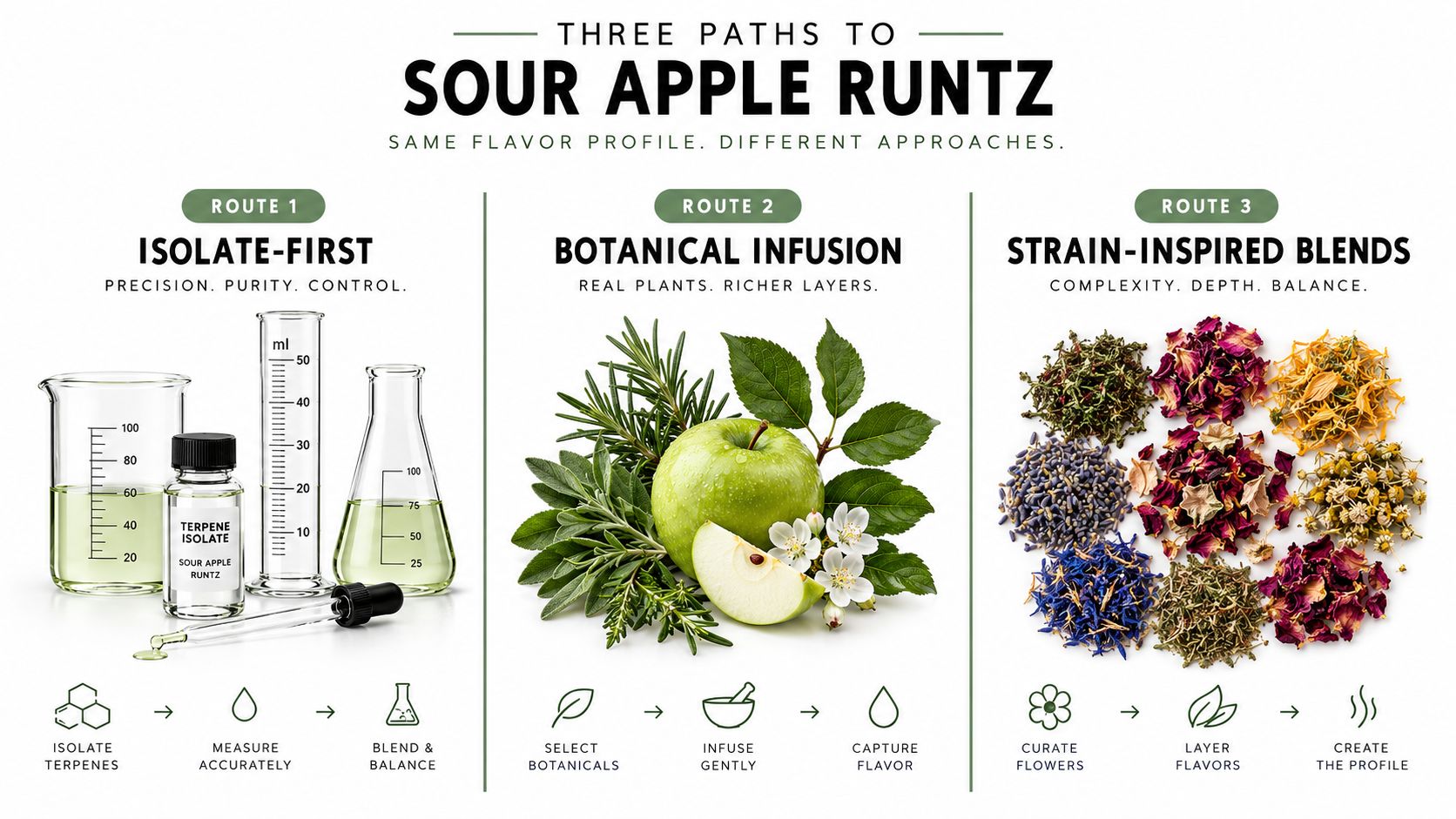
There are three defensible ways to build a Sour Apple Runtz-style profile. The right choice depends on the SKU's regulatory position, required repeatability, and how closely the product must resemble a retained flower reference. Supplier language shouldn't decide that for you.
Route one uses isolates as the control layer
An isolate-first build gives procurement a clean, documented composition. You can specify limonene, myrcene, beta-caryophyllene, and supporting materials independently, then correct a lot without changing the entire profile. That makes the route attractive for multi-batch production and tighter analytical control.
The trade-off is sensory. Isolates reconstruct the terpene skeleton well, but they may miss the sharp green-apple realism created by esters, aldehydes, and minor volatiles in a flower reference. The result can be precise but slightly schematic. This route suits a distillate SKU where consistency matters more than a close live-resin illusion.
Route two uses botanical inputs
Botanical blends can provide efficient access to fruit, citrus, spice, and floral notes, with paperwork that may fit a non-cannabis-derived flavor program more easily. Their weakness is specificity. Apple and candy notes can drift toward a broad fruit-confection profile, while the diesel or peppered edge may feel added rather than integrated.
A procurement lead should ask whether each botanical input has appropriate identity, allergen, and intended-use documentation. A botanical route can work for a flavor-forward product, but it needs more sensory correction than the supplier's name suggests.
Route three uses strain-inspired cannabis terpenes
Cannabis-derived, strain-inspired blends can land closest to the retained cultivar reference because the source material carries a broader volatile signature. They also bring the most variability in COA composition and the greatest regulatory friction across markets. The buyer must verify source, chain of custody, residual solvents, and state-specific acceptance before treating the route as production-ready.
For adjacent flavor benchmarking, Elevated Strains is a catalog reference, not proof that similarly named profiles share lineage or chemistry.
| Route | Consistency | Regulatory Risk | Sensory Fidelity | Cost Position |
|---|---|---|---|---|
| Isolate-first | Highest control | Usually easier to document | Moderate, requires reconstruction | Often easier to model |
| Botanical infusion | Moderate | Depends on inputs and market | Fruit-forward, gas may be weaker | Often cost-conscious |
| Strain-inspired | Lot-dependent | Highest review burden | Closest to a flower reference | Must be evaluated by source |
Reading the COA Before the Blend Hits the Tank
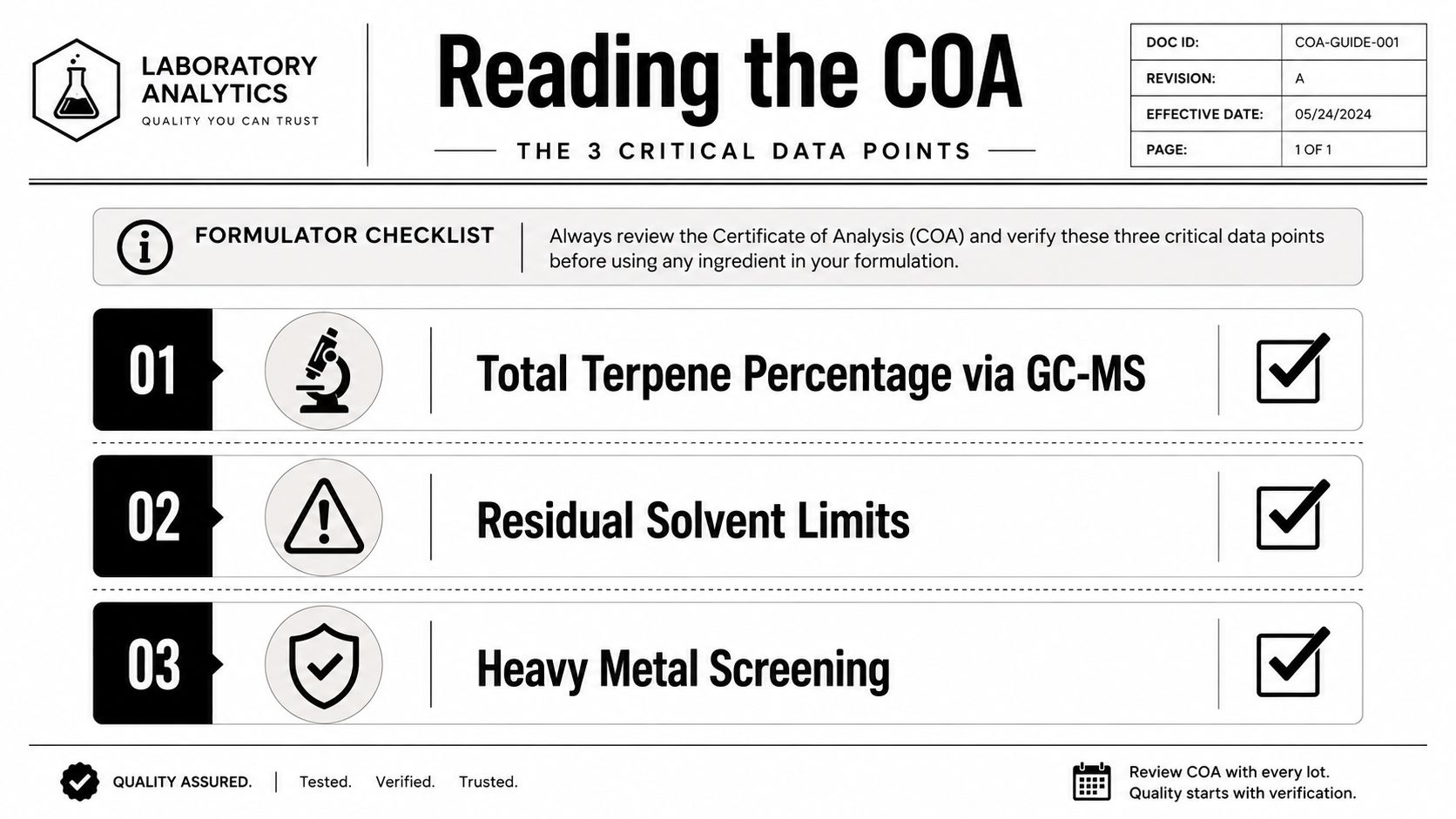
A COA is a purchasing control, not a decorative attachment. Before approving a lot, pull the total terpene percentage by GC-MS, the residual solvent panel, and the density or specific gravity reading. Those three items tell you whether the material is chemically characterized, clean enough for the intended process, and behaving like a neat terpene blend rather than an undisclosed carrier system.
Ask for the method behind the number
An HPLC-only panel isn't sufficient for terpene work. HPLC may support cannabinoid analysis, but terpene identity and quantification require a suitable GC-FID or GC-MS method with analyte names, units, and the laboratory's dilution factor. Without that context, a reported total can't tell you whether the blend contains the expected balance or whether a volatile fraction was measured consistently.
Density or specific gravity can flag a sample that has been cut with MCT, PG, or another carrier. A mismatch doesn't prove misconduct, but it does require a written explanation and a formulation review before the material reaches the tank.
Red flags that stop intake
- Terpinolene above 45% with no supporting myrcene: The profile may be too narrow to support a layered Sour Apple Runtz target.
- Ocimene listed but absent from the chromatogram trace: Ask the lab to reconcile the table and trace before approval.
- More than 10% total terpenes without a diluent disclaimer: Require clarification of the composition and intended use.
A junior buyer can run this intake check quickly:
- Method: Confirm GC-FID or GC-MS and record the method identifier.
- Dilution: Record the dilution factor and units used for every reported terpene.
- Batch: Match the COA batch ID to the container and purchase order.
- Storage: Record the stated storage condition and compare it with the received lot.
Sourcing, Legality, and a Procurement Checklist
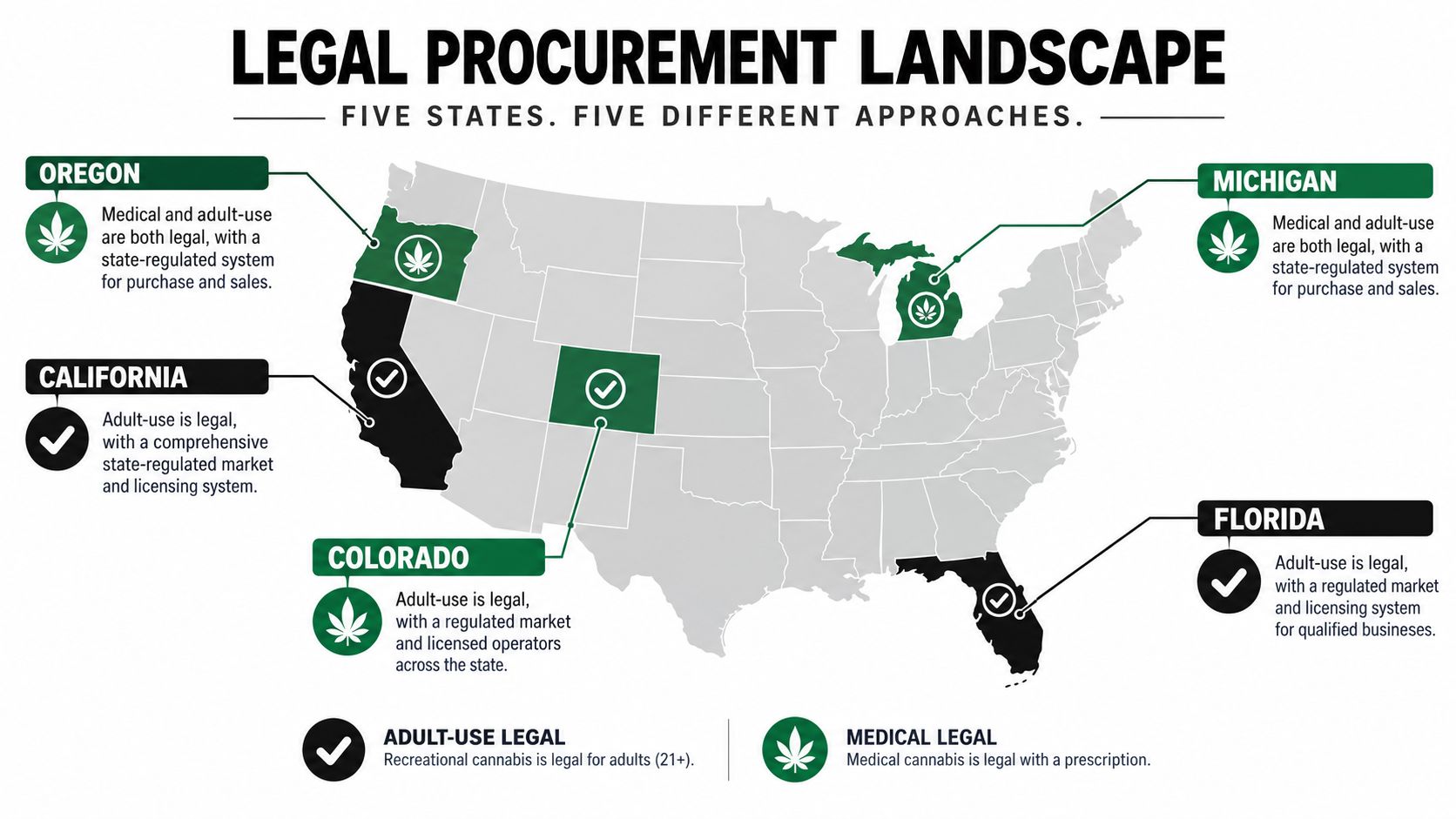
A Sour Apple Runtz profile can move through very different rules in California, Oregon, Colorado, Michigan, and Florida. Adult-use and medical frameworks aren't interchangeable, and hemp-derived products, including D8 products, can sit in a gray zone where vendors market similar profiles outside licensed channels. Don't assume a familiar strain name resolves the legal status of the ingredient or finished cartridge.
Interstate shipping creates additional exposure. Review child-resistant packaging, labeling thresholds for terpenes and carrier solvents, and the rules governing cannabis-derived ingredients before issuing a purchase order. For naming, packaging, and brand usage, procurement should also review copyright and trademark guidelines rather than treating a cultivar name as automatically clear for commercial use.
Hand procurement this checklist:
- License: Confirm state-licensed extraction or ingredient production where required.
- Testing: Request a third-party COA for every lot, not a generic profile sheet.
- Composition: Obtain allergen statements and full ingredient disclosure.
- Botanicals: Request IFRA or GRAS documentation where those materials apply.
- Safety files: Collect the current MSDS and handling instructions.
- Traceability: Require a documented chain of custody from isolate or source material through the finished cartridge.
Certifications only matter when they match the jurisdiction, product use, and actual audit scope. Logos without scope, lot identity, or supporting records are decorative. Revalidate the blend when scaling from lab to production, then test it again after six weeks of shelf aging.
Gold Coast Terpenes offers strain-specific profiles, isolated compounds such as limonene, myrcene, and beta-caryophyllene, and formulation resources for cartridges and concentrates. Use the available Gold Coast Terpenes catalog to source a controlled starting point, then validate the selected blend against your own base, hardware, COA requirements, and aging protocol.