
The answer to “super boof strain indica or sativa” is commercially less useful than the question suggests. Super Boof is generally classified as a balanced hybrid, with listings ranging from 50% indica and 50% sativa to roughly 60% sativa and 40% indica, while its formulation value comes from a more practical combination: Black Cherry Punch crossed with Tropicana Cookies, a myrcene-led terpene profile, and high reported THC. That distinction matters when you're rebuilding the cultivar for a cartridge or distillate SKU.
For a formulator, the target isn't a leaf-shape category. It's the relationship between myrcene, limonene, beta-caryophyllene, supporting terpenes, viscosity, hardware, and the intended sensory experience. Super Boof's appeal sits in that relationship, particularly its ability to carry fruit and citrus without losing a spicy, grounded finish.
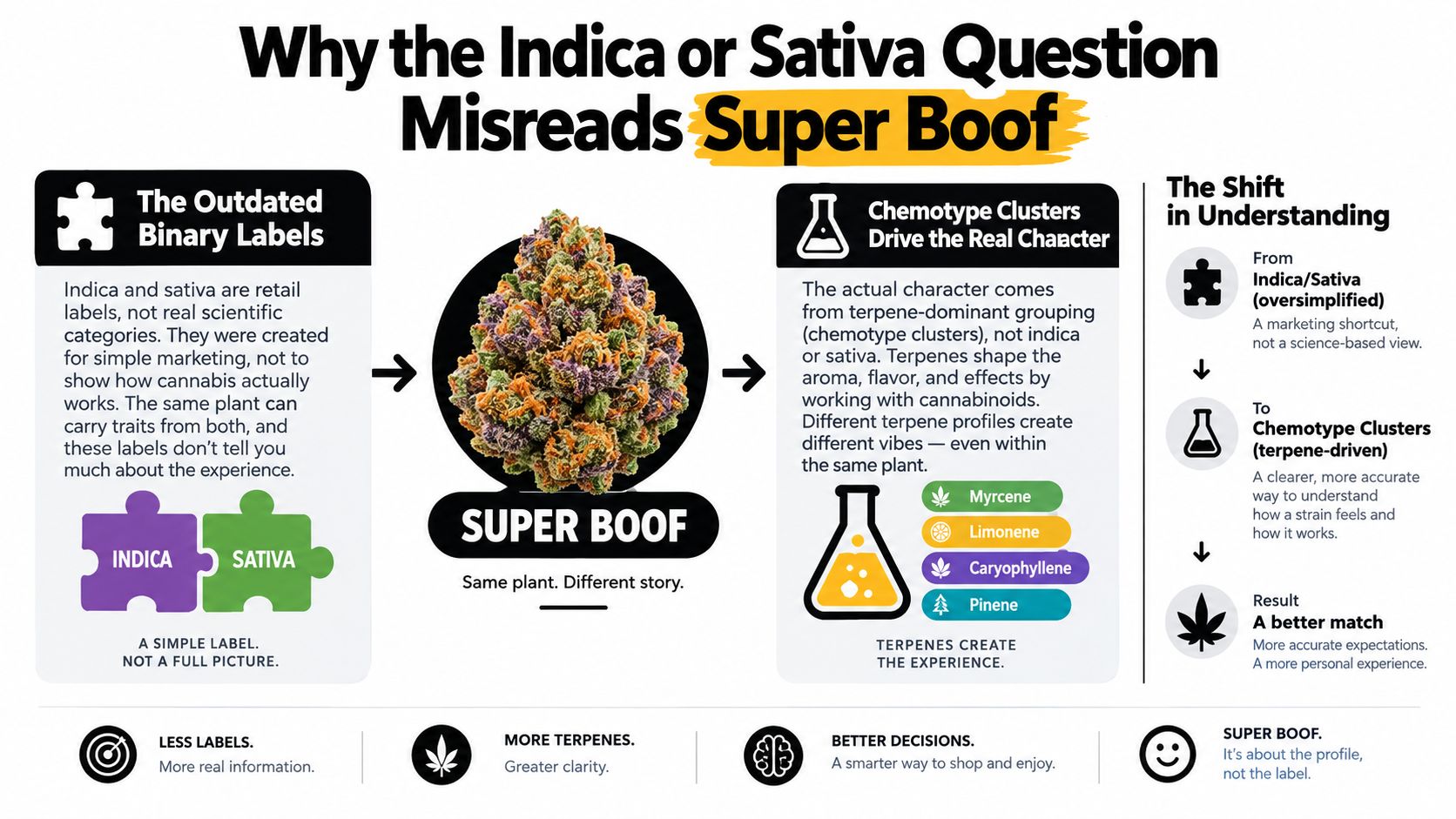
Why the Indica or Sativa Question Misreads Super Boof
Indica and sativa are useful catalog labels, but they're weak formulation specifications. They don't tell you whether a Super Boof lot will open with sharp citrus, lean toward cherry sweetness, or finish with pepper and earthy depth. Those decisions come from the chemotype, the phenotype, the cure, and the way the extract preserves or loses volatile compounds.
Super Boof belongs in the balanced-hybrid category, not at either extreme. Major retail and genetics listings commonly describe it as 50% indica and 50% sativa, while other listings use an approximate 60% sativa and 40% indica split. The variation reflects catalog conventions and phenotype differences, so treating either ratio as a precise production specification creates false confidence. The consistent facts are more useful: its lineage is Black Cherry Punch crossed with Tropicana Cookies, and its dominant aromatic structure is repeatedly associated with myrcene, limonene, and beta-caryophyllene (Super Boof's classification and lineage overview).
Use the chemotype as the production brief
For strain replication, I'd document three inputs before approving a blend:
- Dominant terpene cluster: Super Boof is commonly described as myrcene-led, supported by limonene and beta-caryophyllene.
- Cannabinoid band: Commercial descriptions regularly place THC around 28%, while other listings report roughly 25% to 32% (market potency and flowering data).
- Phenotype drift: Two cuts carrying the same name can still differ in citrus intensity, cherry weight, resin expression, and the balance between sweet and fuel-like notes.
That framework is more actionable than asking whether the plant is indica or sativa. A terpene guide to indica and sativa labeling can help explain the naming problem, but the blend itself should be built from a chromatogram and a sensory target.
The practical payoff is straightforward. If your cart needs a citrus-forward opening with a rounded, sweet body and a persistent peppery finish, Super Boof gives you a workable direction. If you need a sharply energizing citrus profile or a heavy earthy-sedative profile, the hybrid label won't tell you whether this cultivar is the right starting point.
Super Boof Lineage and Market Standing
Super Boof's lineage is more useful as a formulation brief than as an indica or sativa label. Black Cherry Punch supplies dark cherry, dense fruit, and a fuller base. Tropicana Cookies contributes bright citrus, sweet orange, and a more lifted aromatic expression. Together, they create the cultivar's familiar tension between candy fruit, citrus peel, spice, and a grounded finish.
The combination is consistent in direction, not identical in every lot. Cut selection, cultivation conditions, curing, and extraction can shift cherry intensity, citrus lift, resin character, and the balance between sweetness and earth.
Parent traits and the resulting profile
| Attribute | Black Cherry Punch | Tropicana Cookies | Super Boof (Result) |
|---|---|---|---|
| Primary aromatic direction | Dark cherry and dense fruit | Bright citrus and sweet orange | Cherry-citrus fruit with a balanced finish |
| Structural contribution | Fuller, heavier body | More lifted, citrus-forward expression | Hybrid sensory profile with both lift and weight |
| Formulation relevance | Supports sweetness and depth | Supplies top-note brightness | Requires balance between fruit, citrus, spice, and earth |
| Main production caveat | Fruit intensity can vary by cut | Citrus expression can vary by cut | CoA and sensory checks are required before scale-up |
That parent mix explains why a strain-specific reconstruction needs more than one dominant note. Push limonene too hard and the blend can become generic citrus. Build myrcene too heavily and the crisp Tropicana Cookies character may disappear. A workable target places citrus at the opening, fruit through the center, and spice or earth in the finish. That structure preserves contrast instead of turning the profile into candy.
Competition recognition and broad catalog adoption helped establish Super Boof's market position. Its documented commercial history includes reported placements in the Hybrid Flower category at the 2022 High Times Medical Cup and the Ice Water Hash category at the 2023 Emerald Cannabis Cup (documented award timeline and commercial profile). Leafly later named Super Boof its Strain of the Year for 2024, increasing the cultivar's visibility among U.S. retailers and consumers (Leafly's Super Boof profile).
Commercial listings commonly place THC near 28%, with broader claims of approximately 25% to 32%. Those figures describe market positioning, not a production specification. Before approving a run, request the lot-specific CoA and confirm whether limonene leads, myrcene supplies the body, and minor terpenes support the intended reconstruction.
For a neighboring flavor reference, 24k gold punch belongs in a separate comparison set, not as a direct Super Boof substitute.
Terpene Profile Decoded for Formulators
Super Boof is a myrcene-led profile whose citrus and spice ratios matter more than its indica or sativa label. One independent profile reports average THC of 21.3%, with values around 19.5% to 23.8%, while CBD averages near 1.1% and CBG around 0.6% (independent cannabinoid and terpene profile). Commercial listings place some material as high as 28%, so the practical formulation takeaway is simple: use the reported range to understand possible variation, then set the blend from the current lot's specification.
The same profile identifies myrcene, caryophyllene, limonene, and humulene as important components. Another guide reports dry-flower ranges of 0.6% to 1.5% myrcene, 0.3% to 0.8% limonene, 0.2% to 0.7% beta-caryophyllene, 0.05% to 0.3% linalool, 0.05% to 0.25% ocimene, and 0.05% to 0.2% humulene (Super Boof terpene range reference). For the full compound-by-compound breakdown, see this Super Boof terpene profile and map each range against your lot CoA.
Read the profile as a note architecture
| Terpene | Typical Range (%) | Note Position | Flavor Descriptor | Formulation Role |
|---|---|---|---|---|
| Myrcene | 0.6–1.5 | Mid to base | Earthy, soft fruit, herbal | Builds body and carries the sweeter center |
| Limonene | 0.3–0.8 | Top | Citrus peel, bright orange | Creates the opening lift and citrus identity |
| Beta-caryophyllene | 0.2–0.7 | Mid | Pepper, spice, dry warmth | Connects citrus to the deeper finish |
| Linalool | 0.05–0.3 | Base-mid | Soft floral, rounded | Smooths sharp edges at low contribution |
| Ocimene | 0.05–0.25 | Top | Fresh, green, lightly sweet | Adds air and freshness when used carefully |
| Humulene | 0.05–0.2 | Base | Woody, earthy, dry | Extends persistence and reduces excess sweetness |
A cart's first puff and final aftertaste require different decisions. Limonene delivers the opening lift, beta-caryophyllene links citrus to peppery depth, and myrcene supplies the central weight. Linalool can round sharp edges, while humulene keeps the finish dry. A formulator-focused guide places limonene among top-note candidates, myrcene and beta-caryophyllene among mid-note builders, and humulene and linalool among base or base-mid anchors (terpene note structure guide).
A commercial reference also lists beta-caryophyllene, d-limonene, and beta-myrcene as dominant Super Boof terpenes, corresponding to spice, citrus lift, and earthy body (Super Boof terpene reference). That ratio controls whether the cart tastes layered or thin after heating.
Formulation rule: Build the mid-note body before increasing the citrus top note. Super Boof should read as layered fruit and citrus, not lemon flavor sitting on neutral oil.
Comparing Super Boof With Similar Balanced Hybrids
Indica or sativa is a weak comparison for Super Boof. Product development depends on the terpene lead, the supporting ratio, terpene retention after curing, and the tested THC level. Those variables affect cart flavor, dilution behavior, and the perceived effect profile more directly than a retail label.
The available verified data is detailed for Super Boof, but it does not establish a consistent, citable dataset for Tropicana Cookies F2, Black Cherry Punch, Apples and Bananas, or GMO Cookies. Use those cultivars as profile targets, then confirm each lot with its current CoA rather than treating cultivar names as fixed chemical specifications.
| Cultivar or profile target | Useful formulation distinction | Data required before comparison |
|---|---|---|
| Super Boof | Myrcene-led, supported by limonene and beta-caryophyllene. The result is sweet citrus with peppery depth. | Confirm the lot's terpene ratio, total terpene content, THC, and sensory behavior. |
| Tropicana Cookies F2 | A bright citrus profile is the working expectation from its name and market positioning, but the dominant terpene can shift by phenotype. | Confirm whether limonene leads and record the top-three ratio. |
| Black Cherry Punch | A darker fruit profile may suit a rounder, less sharp cart direction. Cherry sweetness alone does not establish the terpene lead. | Confirm the dominant terpene, total terpene content, and whether the finish stays sweet or turns earthy. |
| Apples and Bananas | Fruit-forward material can overlap with Super Boof on sweetness while differing in citrus lift and body. | Compare the top-three terpene ratio after dilution, not flower aroma alone. |
| GMO Cookies | A savory, earthy, gas-heavy direction can provide a stronger counterpoint to Super Boof's fruit and citrus balance. | Confirm caryophyllene, myrcene, and other major contributors in the current lot. |
Super Boof's practical distinction is a myrcene-dominant but limonene-forward presentation. It can deliver candy sweetness and citrus brightness while retaining caryophyllene-driven spice. That combination gives a cart more movement than a profile dominated by one bright top note or a dense earthy lead.
For a fair head-to-head, pull the same fields from every candidate lot: dominant terpene, top-three ratio, total terpene content, THC, and sensory notes after dilution into the intended oil. Do not compare a fresh-flower CoA from one cultivar with a finished-distillate result from another.
Choose Super Boof when the SKU needs candy sweetness, citrus lift, gas, and enough terpene body to remain layered after processing.
Building Carts and Distillate With a Super Boof Blend
For a half-gram 510 cart using mid-viscosity distillate, a practical starting window is 8% to 12% botanical terpene loading. That loading range is specified in the formulation brief for this build, but Super Boof's myrcene-heavy character often reads sweeter and fuller than the raw GC trace suggests. Start at the low end, then adjust only after evaluating the diluted oil in the target hardware.
Match loading to the hardware
A 2.0 mm postless ceramic configuration is the standard starting point for the mid-viscosity build. If the formulation moves toward the higher end of the 12% terpene load, a 1.5 mm restricted configuration can provide a more controlled delivery profile, but it also demands tighter viscosity and wicking validation.
The hardware decision should follow the oil, not the strain name. Run a short stability and performance screen that checks fill behavior, resting viscosity, draw consistency, leakage, and flavor after repeated heating. The same Super Boof blend can behave differently when the distillate has a different residual cannabinoid composition or when the cartridge uses a different ceramic geometry.
Practical rule: Treat the 8% to 12% range as a development window, not a promise that every Super Boof cart should use the same loading.
For live resin and sauce carts, separate native terpene content from added botanical material. If the extract already carries 2.5% to 4% native terpenes, a botanical top-up may be justified when the native profile lacks the citrus or spice needed for the SKU. Below that threshold, assess whether the missing aroma comes from extraction loss, storage, or the source cultivar before adding a full strain-inspired blend.
Protect the profile during mixing
Cold-loading is the safer approach for live resin and sauce because it limits unnecessary thermal exposure while preserving volatile top notes. Keep the extract workable, add the measured terpene portion gradually, and homogenize only as much as needed to achieve a uniform phase. A practical guide to mixing distillate with terpenes covers the process considerations that should be validated against your own equipment and SOPs.
Two failure modes appear repeatedly:
- Terpene burn-off: Excessive heat during homogenization can flatten the bright citrus opening and leave the blend dominated by heavier notes. Use the lowest process temperature that still produces uniformity, and avoid extended high-heat holding.
- Wicking collapse: Over-loading beta-caryophyllene can make the oil behave poorly in restricted hardware. Keep the spice bridge subordinate to the myrcene and limonene structure, then validate wicking rather than assuming the ratio will transfer cleanly.
The temperature ceiling should come from your equipment qualification and ingredient specifications, not a universal number. If your process needs aggressive heat to mix, the issue may be viscosity management rather than insufficient temperature.
Why Terpene Complexity Outranks Hybrid Labels for Buyers
Super Boof's 2024 visibility came from a distinct aromatic identity, not from its hybrid ratio. That is the practical lesson for product teams: buyers can recognize citrus, sweet fruit, and a grounded finish, while indica and sativa provide little detail about the oil they will use. The cultivar's commercial appeal rests on a sensory profile that can be specified, tested, and reproduced.
Terpene complexity should lead the brief for three reasons. Phenotype variation can shift the balance between bright top notes and heavier body, even under one cultivar name. Hardware response follows viscosity, terpene ratio, and wicking behavior, not plant morphology. Retail buyers can also judge flavor accuracy from the first draw through the finish, whereas a hybrid label offers limited guidance about that experience.
Formulators should treat the name as a starting reference, not a finished specification. Request the current chromatogram, record the top-three terpene ratio, and retain a sensory reference sample beside the production standard. If the next lot moves toward sharper citrus or a heavier earthy profile, that change belongs in the product record rather than being hidden behind the same label.
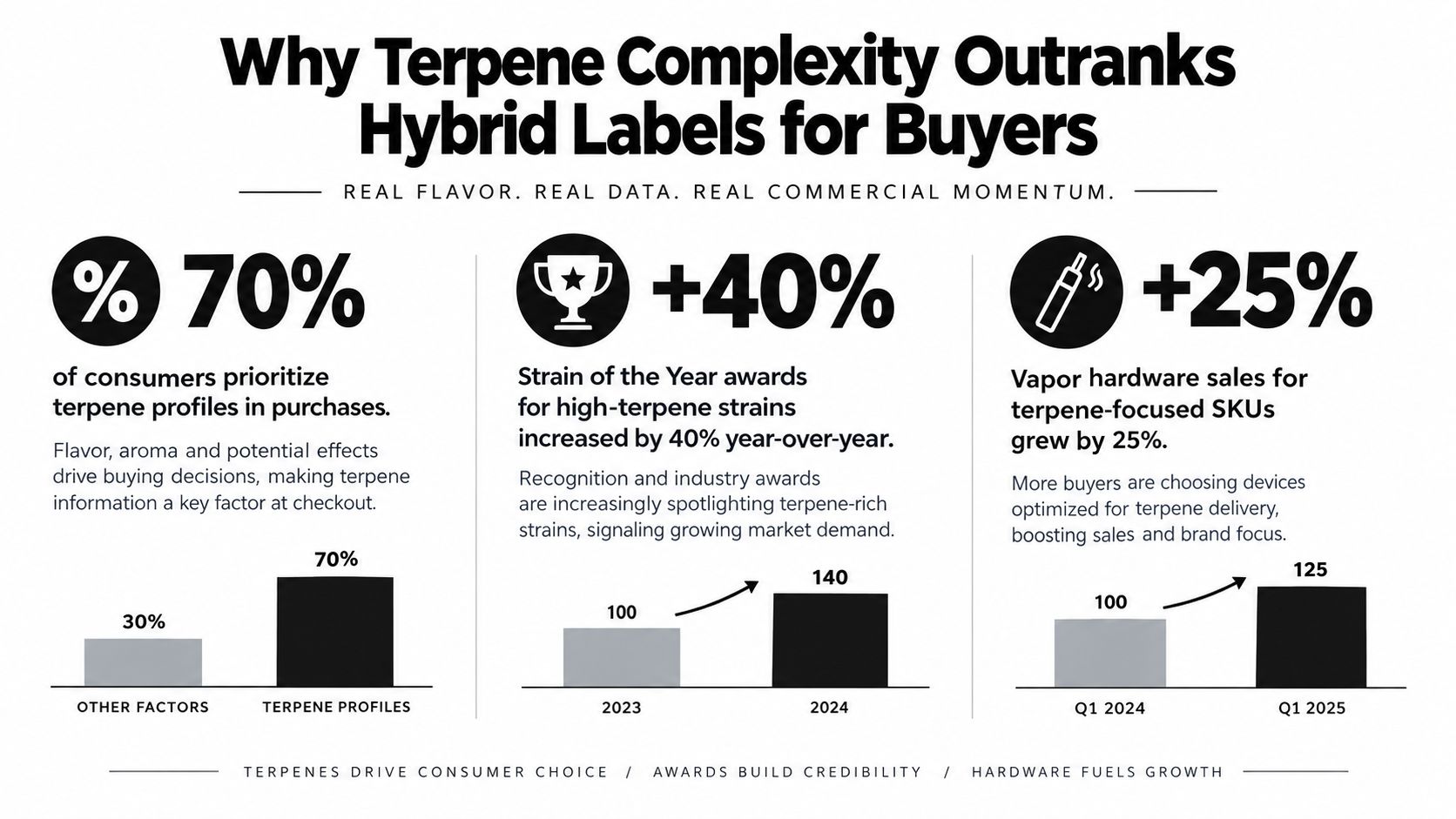
The menu label names the cultivar. The chromatogram shows what you can manufacture.
A strain-inspired brief should define flavor direction, note hierarchy, cannabinoid target, hardware, and intended occasion. Keep the hybrid label on the package if it supports merchandising, but let the terpene ratio and expected effect profile guide cart and distillate decisions.
Choosing the Right Profile for Your Next SKU
Super Boof fits a SKU that needs citrus punch, sweet fruit, and a grounded mid-to-base structure. It can anchor a daytime-oriented balanced hybrid, a flavor-forward live resin line, or a distillate product positioned around a rounded rather than aggressively sharp profile. Those are formulation decisions, not medical promises, and the final consumer experience will still depend on dose, hardware, and individual response.
Use this checklist before approving a blend:
- Define the intended occasion: Decide whether the product should communicate uplift, calm, balance, or a neutral all-purpose profile.
- Match the terpene leadership: Choose Super Boof when a myrcene-led profile with limonene brightness and beta-caryophyllene spice fits the brief.
- Confirm the cannabinoid target: Compare the input lot's tested THC against the product specification. Super Boof listings vary, so don't use a catalog number as a substitute for the current CoA.
- Validate the hardware: Check viscosity, ceramic geometry, draw, leakage, and wicking at the planned loading before scaling.
- Use a formulation calculator: A terpene mixing calculator can help organize ratios, but the result still needs bench validation and sensory review.
| Product goal | Lead with Super Boof when | Consider another profile when |
|---|---|---|
| Balanced hybrid cart | You need fruit, citrus, and spice in one layered profile | The SKU requires a single-note citrus or dessert identity |
| Live resin line | Native extract notes already support myrcene and caryophyllene | The extract is strongly gas-led and conflicts with the fruit target |
| Distillate SKU | You want a recognizable citrus-cherry reconstruction | The brief calls for a clearly limonene-dominant energy-positioned profile |
| Night-oriented SKU | The product can carry a rounded, heavier aromatic body | A denser, earthier profile better matches the intended positioning |
Gold Coast Terpenes offers natural strain-specific blends and isolated compounds, including myrcene, limonene, and beta-caryophyllene, for cartridge, concentrate, and distillate formulation. Visit Gold Coast Terpenes to review profile options and use the formulation resources when developing a Super Boof-inspired SKU.