
A Fruity Pebbles-style beer is a modern niche that emerged in the 2010s, and documented recipes have used cereal at 25% of the grist to create a distinct sweet finish. For cannabis formulators, the useful lesson isn't the cereal itself. It's the way cereal sweetness, fruit-forward aroma, acidity, and lingering base notes are assembled into a recognizable sensory target.
The popular advice is to copy the color or add a generic “candy” terpene. That approach usually misses the profile. Fruity Pebbles perception comes from a layered interaction between sweet cereal association, ester-like fruit character, citrus and tropical aromatics, and a finish that can move from soft and creamy to sharp, tart, or medicinal. A successful strain-inspired terpene blend for vape cartridges therefore needs a formulation map, not a single flavor label.
For manufacturers, the practical question is more precise: how do you reproduce the Fruity Pebbles flavor spectrum for distillate without allowing citrus top notes to erase the cereal impression? The answer depends on note placement, ratios, blending controls, and cartridge testing.
The Origins of Fruity Pebbles Beer: 2014 to Today
The category has a documented starting point. In 2014, McFate Brewing Company in Scottsdale, Arizona, cask-conditioned 10 gallons of session beer on Fruity Pebbles cereal. Coverage described the cereal character as unmistakable, although some drinkers initially treated the release as a joke. That response is useful historical context because the beer was being evaluated as both a brewed product and a concentrated breakfast-cereal memory. The documented history of cereal-based beers places the release among the clearer milestones in cereal-flavored craft beer.
McFate's experiment also established a practical formulation problem. Cereal supplied a recognizable sweet association, while the beer had to carry enough aroma and body to keep that association present in the glass. The result depended on the interaction of adjunct, fermentation character, and aroma rather than on cereal alone. That same trade-off applies to vape and distillate work: bright fruit notes can create recognition quickly, but excessive acidity or citrus intensity can push the profile away from cereal and toward sour candy.
From novelty release to repeatable concept
The idea became more durable when breweries adapted it to formats built around fruit and acidity. In 2021, Crooked Hammock Brewery released Yabba Dabba Brew, a fruited cereal sour made explicitly with Fruity Pebbles cereal. The release extended the concept beyond a single taproom stunt and into a recurring flavor direction within the U.S. craft beer market.
The format matters. Fruity Pebbles-inspired beers commonly appear as specialty ales, fruited sours, or novelty releases, rather than as permanent examples of a codified beer style. One Untappd-listed beer, Dented Keg Brewing Company's DK Fruity Pebble, records 4.2% ABV, while Stevens Point Brewery's Fruity Pebbles listing indicates that the beer is no longer being produced. These records support a practical conclusion: many examples are limited or short-lived, and the category remains experimental rather than standardized. The DK Fruity Pebble listing provides those product-level details.
Formulation lesson: A recognizable flavor concept can be commercially useful without becoming a formal style. Define the sensory target more precisely than the category name.
For cannabis product teams, the history points to a more useful replication method. Select the intended version first: sweet cereal and marshmallow, bright fruit punch, tart sour candy, or citrus-heavy cereal aroma. Then assign the formulation roles. Top notes can provide quick fruit recognition, mid notes can connect those fruits to the cereal impression, and base notes can preserve sweetness and body in the finish. That structure matters more than treating “Fruity Pebbles” as one interchangeable flavor label.
Deconstructing the Fruity Pebbles Flavor Profile
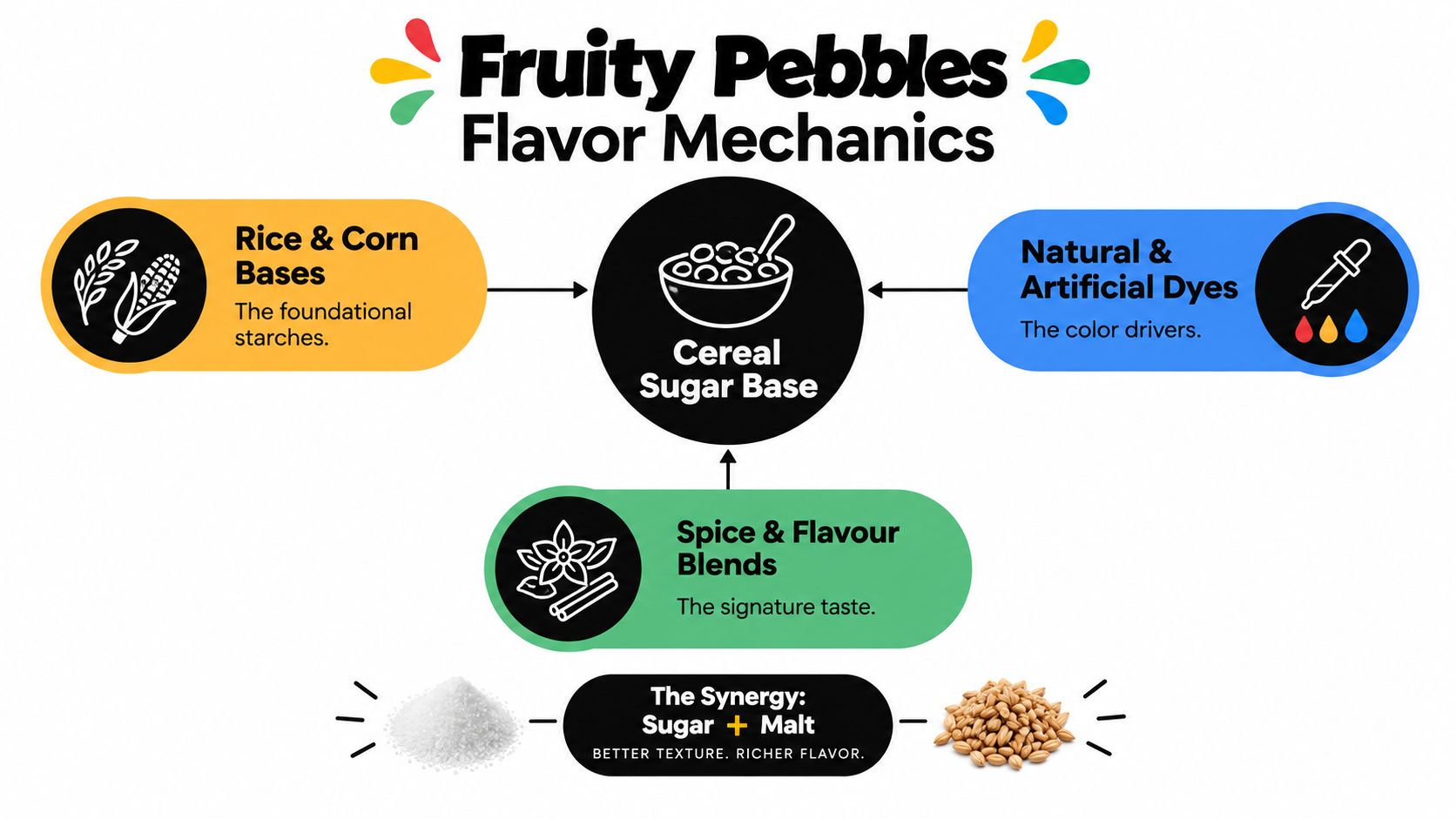
The cereal's visual identity can distract formulators from the actual sensory drivers. Color helps recognition, but the Fruity Pebbles impression in beer is shaped more strongly by aroma compounds, fermentation character, hop selection, sweetness, and finish. In a vape or distillate formulation, the same principle applies. A bright color or a broad “fruit” descriptor won't recreate the profile if the volatile structure is wrong.
Top-fermenting yeast produces ester-derived fruity notes, while hop volatiles can contribute fruit-like impressions at very low sensory thresholds. When citrus or tropical hop selections overlap with cereal sweetness, the brain can interpret the combined aroma as berry-citrus candy, fruit punch, or breakfast cereal. The cereal itself may contribute relatively little pigment, but it can supply sweetness and a recognizable “milk-bowl” association that changes how the fruit notes are interpreted. Beer flavor references outline the role of ester-derived fruity notes and aroma descriptors.
The four sensory levers
Think of the profile as a balance between four levers rather than one flavor additive:
- Cereal sweetness: Creates the grain, sugar, and bowl association. In a cannabis blend, this is usually represented indirectly through soft fruit, creamy, or rounded supporting notes.
- Fruit esters: Supply berry-like and tropical lift. They make the profile feel colorful and expressive rather than merely sweet.
- Citrus brightness: Adds definition and opening impact, but too much can turn the target into lemon candy or fruit punch.
- Finish and persistence: Determines whether the blend reads as cereal, marshmallow, sour fruit, or medicinal after the first inhale.
This explains why two products can share a Fruity Pebbles reference and still taste unrelated. One may prioritize citrus and volatile fruit, creating a sharp, punchy opening. Another may use a softer mid-note structure and a heavier base, producing a sweeter cereal impression that lasts longer but feels less vivid.
For beer context, the difference resembles the contrast between a fruit-forward sour and a hop-led pale ale. Readers looking for a useful comparison can use these passion fruit beer pairing ideas to see how acidity, fruit intensity, and beer structure alter the perception of the same broad flavor family.
Why color isn't enough
Color can support the product story, but it can't repair an unstable aroma stack. If a formulation has a loud citrus top note and no supporting middle, users may perceive lemon or solvent-like sharpness. If the base is too heavy, the blend can lose the lively cereal impression and become earthy or musky.
A useful reference point for strain-inspired flavor work is Sour Pebbles, not as a promise of exact equivalence, but as a reminder that “sour,” “fruit,” and “cereal” are separate sensory directions. Define the intended balance before adjusting the blend.
Terpene Formulation for Fruity Cereal Profiles
A terpene profile for cannabis product formulation should function as a formulation map. It includes the total terpene percentage, dominant compounds, supporting compounds, and the ratio between them. That structure gives a product team something reproducible to measure and revise. A strain name or flavor label alone doesn't tell a formulator which material should open first, which should create the heart, or which should remain on the finish.
For Fruity Pebbles-style work, use the classic top, mid, and base framework. The tiers aren't marketing categories. They describe how volatility and aroma persistence shape the experience.
Assigning the note roles
Top notes arrive first and fade quickly. A formulation guide identifies limonene as a top note with sharp citrus sweetness, making it useful for the bright opening associated with citrus candy. The trade-off is obvious. Too much limonene can pull the blend toward lemon peel, cleaner-like sharpness, or fruit punch, especially when the middle lacks enough soft fruit support. The Fruit Loops strain guide offers a relevant reference for citrus-forward cereal-style thinking, but the target still needs to be calibrated independently.
Mid notes create the aroma heart. Here, berry, tropical, and rounded fruit impressions should connect the sparkling top to the sweeter finish. A mid-note layer prevents limonene from standing alone and gives the formulation the colored-fruit character that users often associate with cereal pieces. The middle should be noticeable without becoming a generic fruit flavor.
Base notes linger and anchor the blend. Myrcene is described as an earthy-musky-fruity base note, while caryophyllene brings spicy, peppery, woody character and can also function as a heavier base component. Myrcene can help keep a fruit profile from feeling hollow, but excessive earthy musk can obscure the cereal association. Caryophyllene requires similar restraint because its spice and wood can shift the result away from a soft dessert profile.
Practical rule: Build the profile around the desired finish, then adjust the opening. A bright first inhale won't compensate for a muddy or medicinal aftertaste.
A workable sensory sequence
Start by writing the target as a sequence: bright citrus opening, colorful fruit middle, soft cereal-like sweetness, restrained earthy persistence. Then assign compounds to each role and record the ratio, rather than adding ingredients until the blend “smells close.” If the blend smells like fruit punch, reduce the sharp opening or strengthen the rounded middle. If it reads as earthy candy, lower the base influence before adding more citrus.
A product such as Elevated Strains Apple Fritter can be considered as a catalog reference when comparing fruit and dessert-oriented directions, but it shouldn't be treated as an automatic Fruity Pebbles replica. The useful practice is to compare sensory architecture, not names.
This approach also clarifies why cereal-inspired formulations differ from literal food flavorings. Aroma dominates retronasal flavor, so the product doesn't need to reproduce every cereal ingredient chemically. It needs to produce the right order of perception and a finish that confirms the intended memory.
Production Mechanics for Accurate Flavor Replication
A sound aroma map can still fail during production. Distillate viscosity, blending temperature, measurement method, and cartridge hardware all influence whether the final product delivers the intended profile. A formulation that smells accurate in a beaker may draw differently, separate during filling, or express a harsher top note after sitting in hardware.
Begin by warming the distillate to 40–60°C (104–140°F) so it becomes workable without unnecessary degradation. Once the material is fluid, stir for two to three minutes to promote homogenization. These operating ranges and mixing times are described in practical guidance for blending terpene formulations.
Control the blend before testing taste
Record the total terpene load and weigh every component. Measuring by drops introduces avoidable variability because drop size changes with viscosity, temperature, container geometry, and dispensing technique. Weight-based records give the team a batch history that can be repeated, audited, and adjusted.
The blend should be evaluated as a system:
- Opening aroma: Does the citrus arrive cleanly, or does it dominate?
- Middle expression: Does the fruit character connect to the cereal target?
- Finish: Does the base support sweetness, or does it introduce unwanted musk, spice, or medicinal character?
- Stability: Does the profile remain coherent after the oil rests and moves through hardware?
The final oil needs testing across the intended cartridge hardware. Check fill behavior, wick saturation, leakage, cold starts, draw resistance, and sensory performance. Hardware can change delivery enough to make a balanced blend seem weak or overly sharp.
For broader context on how brewing culture handles experimental flavor development, exploring the beer scene can provide useful background, but cannabis production still requires its own controls. The distillate mixing guide is the more directly relevant resource for documenting the blend and handling the oil.
Batch-control principle: A sensory target isn't reproducible until the temperature, weight, mixing time, and hardware are part of the specification.
Understanding Consumer Perception and Market Trends
Fruity Pebbles beer produces polarized reactions because the name points to a memory, while the liquid delivers a particular balance of sweetness, acidity, fruit, and finish. Some drinkers describe a beer as tasting like “fruity pebbles in a can.” Others experience a similar sour-fruit direction as too tart, lemony, medicinal, or cough-syrup-like. Those responses aren't contradictory. They reveal that the category contains several different sensory targets under one familiar label.
User-generated reviews of Fruity Pebbles sour beers show that split clearly, with praise for cereal authenticity alongside criticism that the beer tastes more like medicine or lemon than breakfast cereal. The SNAFU Brewing Company Fruity Pebbles Sour listing is a useful example of how far apart individual perceptions can be.
Fruit punch versus cereal sweetness
For a cannabis brand, the distinction matters because a fruit-punch formulation and a cereal-sweet formulation make different promises.
| Target | Sensory emphasis | Common failure |
|---|---|---|
| Fruit punch nostalgia | Bright citrus, broad fruit, quick impact | Loses the cereal identity |
| Cereal sweetness | Rounded fruit, soft finish, restrained acidity | Becomes dull or heavy |
| Tart cereal sourness | Acidity, citrus, sharp fruit | Reads as lemon or medicine |
| Dessert cereal | Sweet fruit, creamy association, lingering base | Can feel dense or earthy |
The target shouldn't be described only as “fruity.” That word leaves too much room for interpretation. Specify whether the product should remind users of fruit punch, marshmallow, milk and cereal, or sour candy. Then set the top, mid, and base notes around that choice.
Why the niche still matters
A 2026 projection from beverage trend coverage says fruity and sweet flavors remain strong globally, with expected demand for familiar profiles such as strawberry, lemon-lime, and vanilla alongside richer directions such as churro and cobbler. The same coverage supports a broader movement toward fruit-forward and dessert-inspired beverages, while beer commentary has continued to emphasize fruit-like hop aroma. See the 2026 beverage trend outlook for that forward-looking context.
The commercial opportunity isn't to promise a literal cereal replica. Position the profile as a sensory nostalgia experience and make the balance explicit. Buyers who want authentic cereal sweetness need different guidance from buyers who want a tart, bright fruit hit. Clear sensory language reduces the gap between expectation and first use, which is where repeatability begins.
Strategic Tools for Formulation Success
Fruity Pebbles-style products are niche, but niche profiles still require disciplined operations. The difference between a one-off blend and a viable SKU is documentation. Teams need a defined target, weighed inputs, batch records, safety information, and a way to calculate additions without relying on memory or informal adjustments.
A practical formulation workflow should include:
- Define the sensory target. Choose cereal-sweet, fruit-punch, tart sour, or dessert-forward before selecting compounds.
- Map the note stack. Assign top, mid, and base roles, then record the selected compounds and their ratios.
- Calculate the batch. Use a terpene mixing calculator to convert the target load into measurable component weights.
- Blend under controlled conditions. Warm the distillate within the workable range, mix consistently, and document the batch.
- Test the complete system. Evaluate the oil in the actual cartridge hardware, not only in a glass vial.
- Retain the result. Keep the sensory notes, hardware observations, and final formula together so a future batch can reproduce the same profile.
Gold Coast Terpenes supplies natural terpene blends, strain-specific profiles, and isolated compounds for cartridge, concentrate, and formulation work. Its education and operational resources include Terpenes 101 material, safety documents, and blending tools, which can help teams move from a flavor idea to a controlled production record.
Commercial standard: Treat the flavor as a defined sensory specification, not as a loose strain name. That makes troubleshooting faster and gives production, quality, and brand teams the same reference point.
For teams comparing adjacent beverage-inspired concepts, find Buffalo Trace homebrew deals offers a separate example of how homebrew interests can intersect with product discovery. It isn't a substitute for cannabis formulation controls, but it reinforces the value of documenting the flavor target before building a product around it.
Gold Coast Terpenes provides natural terpene blends, strain-specific profiles, and isolated compounds for cartridges, concentrates, and product formulation, including the citrus, fruit, and base-note materials needed for a Fruity Pebbles-inspired stack. Review the available Gold Coast Terpenes resources, define your target profile, and use the formulation tools to develop a repeatable blend for your distillate and hardware.